

You can keep the title on the calendar, the board keeps asking for updates, and still the depression keeps winning the day. Sleep is broken, focus is brittle, and outpatient therapy has started to feel like a polite conversation around a real clinical problem. That is the moment to stop treating this as burnout alone and start thinking in terms of depression residential treatment, especially when the person involved is carrying a leadership role, a company, or a family system that cannot afford more drift. For a useful distinction between the two, a clear guide on comparing burnout and depression helps frame the question clearly.
Redefining Depression Residential Treatment for Leaders
The executive who says, “This is getting worse, and the usual weekly session isn't touching it,” is not failing. That person is identifying a point where outpatient care has stopped matching the clinical load. Residential treatment is the right move when a leader still needs to function as a decision-maker, but can no longer rely on fragmented support to stabilize mood, sleep, and judgment.
A strategic intervention, not a retreat
The best frame is not defeat, it's containment. Residential care creates a live-in structure around depression so the person can focus on stabilization without the constant erosion of work pressure, family demands, and private shame. A systematic review of acute residential mental health services found that most studies reported clinical improvements comparable to inpatient units, and one randomized study with N=393 reported greater symptom improvement for residential clients at admission and follow-ups, along with higher service satisfaction and no difference in symptoms at 12 months, which supports the clinical credibility of this setting systematic review of residential mental health services.
That matters for leaders because the decision isn't “hospital or nothing.” It's whether the person needs a structured, supervised environment that can hold severe symptoms without turning life into an emergency ward. The strongest programs treat residential care as a sub-acute intervention, not a soft option, and they build it around safety, therapeutic intensity, and continuity of function.
Practical rule: if a leader can no longer protect sleep, make clean decisions, or stay emotionally steady between sessions, outpatient care has already lost the argument.
In a high-end setting, that intervention has to preserve discretion. Private rooms, quiet routines, and managed access are not cosmetic details; they are what make a serious admission workable for someone whose public role cannot just vanish. The right question is not whether residential care feels dramatic. The essential question is whether the current setup is still enough to prevent further decline.
Determining When Residential Care Is the Right Step
Many professionals wait too long because they're comparing the wrong things. They compare residential care to being locked in a hospital, when the accurate comparison is between a live-in therapeutic setting and the slow unraveling that happens when outpatient support has already maxed out. The U.S. VA guidance is direct, residential care can last up to 6 to 12 months, is appropriate for patients with unstable social networks or inadequate community support, and should be linked to ongoing outpatient or step-down care to support relapse prevention and independence VA guidance on residential care.
Safety, severity, and structure
The decision rule is simple. If the person needs 24/7 medical monitoring because of acute crisis, inpatient hospitalization is the correct level. If the person is not in an immediate emergency but can't maintain safety, function, or emotional regulation at home, residential treatment is the right sub-acute setting. Independent coverage on the distinction between inpatient and residential care makes the same point, residential care is often a step after hospitalization or when outpatient treatment has failed, while inpatient care is for acute crisis stabilization residential vs inpatient care distinction.
That difference matters for executives and families who want clarity, not euphemism. A residential program is appropriate when the person is unsafe to manage at home, but does not need a locked hospital ward. It is also the better fit when work, family, or social instability keeps undermining treatment adherence, because the structure itself becomes part of the therapy.
What should push the decision over the line
A few signals should move the conversation fast, even for a high-functioning adult. Persistent unsafe coping, repeated failure of outpatient treatment, and a support system that is too depleted to carry the person are not minor issues. They mean the environment itself has become part of the problem.
The cleanest test is whether the home setting is still helping recovery or merely witnessing deterioration.
The internal question for the family or board member is not “Can this person tough it out?” It's “Does this person need a structured live-in environment to stabilize before returning to full responsibility?” For a practical screening process, use the framework in how to choose a rehabilitation center for depression, then decide based on safety and clinical fit, not branding.
Core Clinical Components of Executive Programs
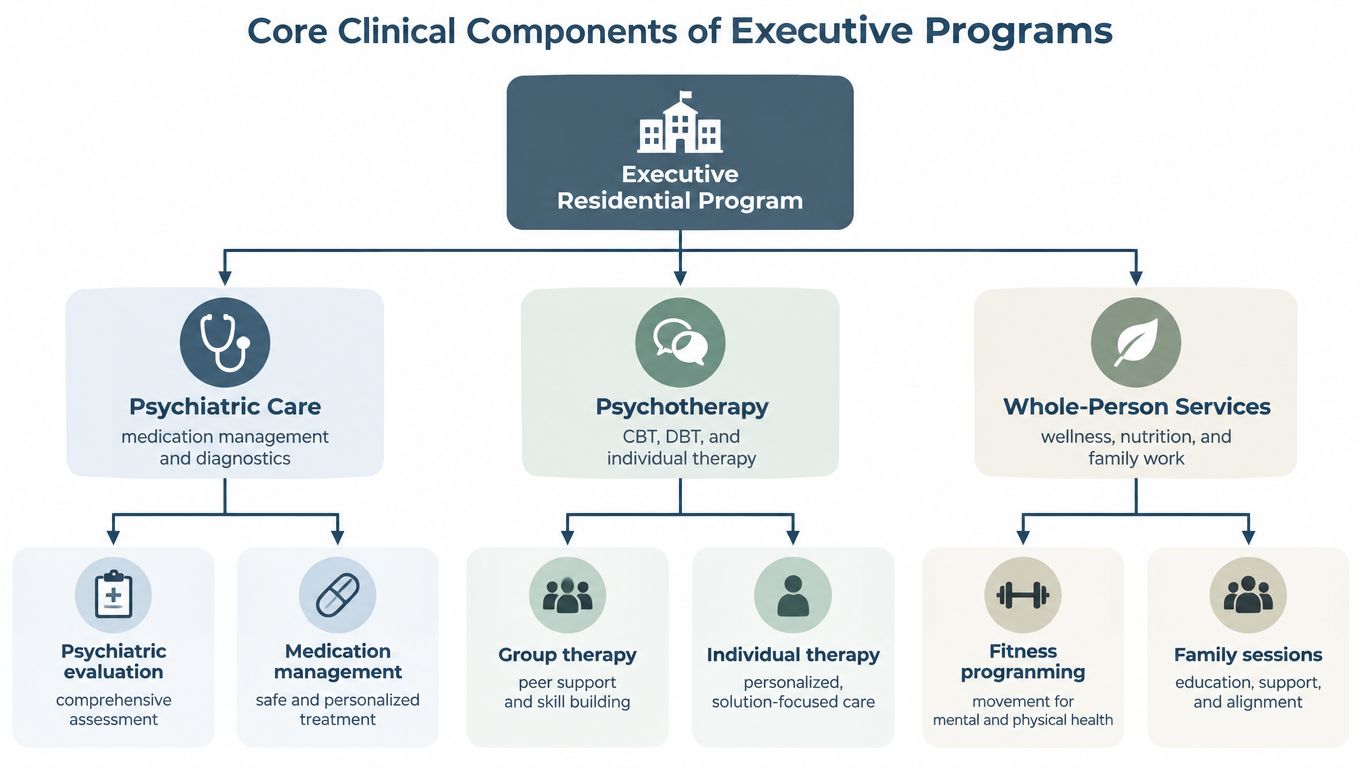
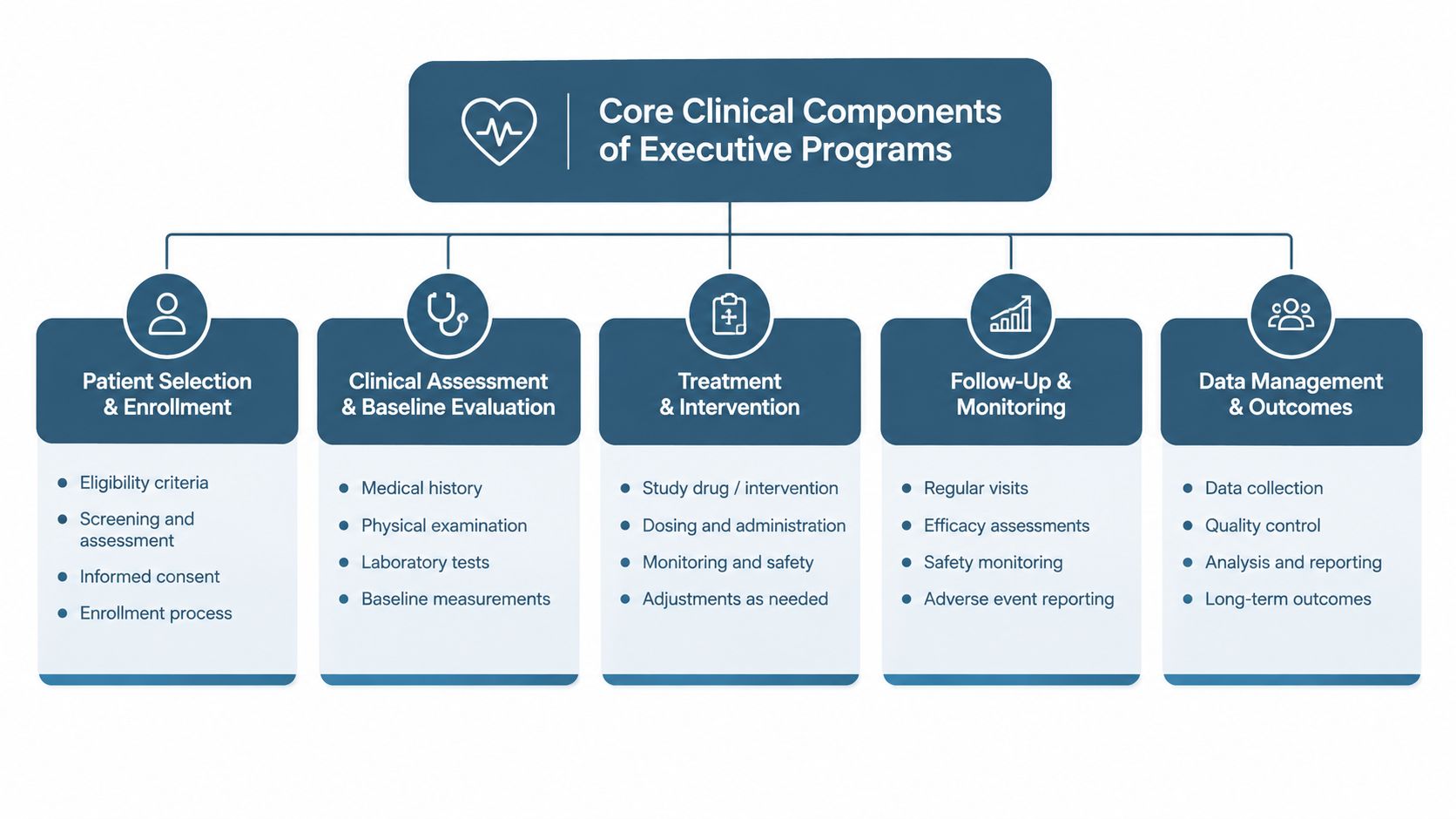
Luxury without clinical rigor is just expensive discomfort. A serious executive program earns its keep through psychiatric depth, disciplined psychotherapy, and whole-person support that respects the complexity of high-achieving adults. Comparative residential research has repeatedly shown meaningful improvement over time in depression-related symptoms, and another review found that across 17 studies reporting mental health outcomes, the vast majority of participants improved over time, which reinforces residential care as a clinically effective setting for depression and related psychiatric symptoms residential mental health outcomes review.
Evidence-based treatment has to lead
The backbone of the work should be familiar and measurable. CBT, DBT, and ACT belong in a serious program because they give clinicians practical ways to work on distorted thinking, emotional dysregulation, avoidance, and values-based action. For high-performing adults, that matters because depression often hides behind competence. The person may still perform at work while privately collapsing in energy, sleep, and self-trust.
The strongest programs also keep the treatment plan individualized. A PhD-level psychologist may focus on cognitive distortions and perfectionism, while a psychiatrist handles medication optimization and symptom tracking. That division is not bureaucracy, it is what allows the team to treat depression as both a brain-state problem and a behavioral pattern.
Holistic care has to serve the clinical plan
Holistic services are useful when they are attached to a treatment objective, not when they exist as decoration. Mindfulness, somatic work, fitness, nutrition, family sessions, and experiential therapies can all help restore regulation and stamina, but they should support the psychotherapeutic plan rather than distract from it. In the Scottish review of residential rehabilitation literature, studies found statistically significant improvements in mental health composite scores, and one strong Australian therapeutic community study observed reductions in depression, anxiety, and stress at discharge after a median stay of 16 weeks Scottish residential rehabilitation review.
In practice, that means a leader should ask what each service is for. If a program cannot explain why a particular therapy is there, it's probably just filling a brochure.
Clinical standard: every intervention should answer a treatment problem, not just a marketing problem.
Reflections is one option built around that model, with a California-licensed, Joint Commission-accredited residential setting and a multidisciplinary team that includes psychiatrists, psychologists, LMFTs, and addiction counselors. Its clinical mix includes CBT, DBT, ACT, mindfulness, somatic and equine work, fitness, nutrition, and family involvement, which fits the profile of executive-level care when the underlying issue is not just mood but broader functional collapse.
Maintaining Career Continuity During Treatment
For executives, the fear is rarely “Can treatment help?” It's “Can treatment happen without breaking my professional life?” That is a fair question, and the answer depends on facility design. Executive residential rehab is a defined niche for senior professionals and C-suite clients, and industry guidance says these programs commonly include private or semi-private suites, business-capable spaces, reliable high-speed internet, and scheduled work blocks so clients can manage urgent obligations during treatment executive rehab guidance.
Electronics should be policy, not improvisation
The cleanest facilities treat phone and laptop access as a managed clinical policy. That means access windows, supervision when needed, and limits that protect therapy time. A neutral industry guide notes that policies are facility-specific and may allow computers, Wi-Fi, and private conference rooms, while some programs begin with an initial blackout period before introducing electronics during non-treatment hours executive rehab electronics policy.
Work continuity without structure becomes a loophole. If a resident can answer every message, take every call, and carry every conflict straight into treatment, recovery gets diluted. If access is too restrictive, the person may resist admission entirely. The right balance is managed availability.
What a workable policy looks like
A serious program should be able to explain, in plain language, how work access is handled. It should define when messages are checked, when calls are permitted, and how the team handles urgent professional obligations without sacrificing clinical containment. The executive-rehab guidance cited above notes that phone and laptop access is often organized into designated periods, often 2 to 3 hours in the afternoon, which is a concrete example of how electronics can be formalized rather than improvised executive rehab guidance.
The point is not to let work run the day. The point is to prevent legitimate obligations from becoming a reason to avoid care. Families and boards should ask whether the facility protects privacy, whether the resident has a controlled workspace, and whether the care team understands that some clients cannot disappear from every professional responsibility at once.
For a practical example of how that can be handled, Reflections' guidance on working from rehab shows the operational logic of maintaining job continuity while staying inside treatment boundaries.
Work access should be structured enough to preserve treatment, and flexible enough to keep the professional life from collapsing.
Navigating Dual Diagnosis and Co-Occurring Conditions
Depression in high-stakes adults rarely arrives alone. It often sits beside anxiety, trauma, alcohol misuse, prescription misuse, or the exhaustion that comes from managing all four at once. When those patterns overlap, treating mood symptoms in isolation is usually a mistake. The Scottish review of residential rehabilitation literature reported meaningful mental health improvements in settings that integrated care, and the broader literature on residential outcomes consistently points toward better results when the program addresses the whole clinical picture rather than a single diagnosis Scottish residential rehabilitation review.
A dual-diagnosis path should be the default, not the exception
A resident who drinks to sleep, uses stimulants to perform, or numbs trauma through compulsive behavior is not presenting with “just depression.” The treatment team has to work the entire chain. That can mean clinically managed withdrawal when appropriate, psychiatric stabilization, trauma processing, and relapse prevention that starts early rather than waiting until discharge.
Independent guidance on residential care also notes that depression often travels with substance use and trauma, and that integrated treatment produces more durable outcomes than treating each issue in a separate silo residential care overview. That is the standard a board member or family should expect. A program that cannot address both the psychiatric and substance-use sides of the picture is not equipped for complex executive care.
The operational question is simple
Can the facility manage medication adjustment, therapy, withdrawal support, and privacy without fragmentation? If the answer is vague, the program is too shallow. If the answer is clear, the treatment is more likely to hold once the person returns to a high-pressure environment.
Bottom line: depression plus substance use is not a side issue. It is often the reason outpatient care keeps stalling.
Reflections' residential dual-diagnosis model is relevant here because it combines clinically managed medication-assisted withdrawal when appropriate with intensive therapy and continuing care planning, which is the kind of structure complex adults need when symptoms and coping behaviors are tangled together. For families making a hard decision, that is the distinction worth paying attention to.
Optimizing Length of Stay and Aftercare Planning
A rushed discharge is expensive in every sense. Leaders often want the shortest possible stay because the calendar feels unforgiving, but depression does not respond to a meeting schedule. The clinical literature points the other way. In a large residential lifestyle-treatment cohort, n=430, depressive severity fell by a mean of 13.98 BDI-II points over a median 19-day stay, from 20.14 at admission to 6.17 at post-assessment, with the largest gains among participants who started with moderate-to-severe depression residential lifestyle-treatment cohort.
Recovery needs time to settle
That finding does not mean every executive needs the same length of stay. It does mean symptom change can be real even over a relatively short period when the environment is structured and the treatment is active. Broader residential guidance in the VA notes that care can extend much longer when the clinical picture requires it, up to 6 to 12 months in some cases, with step-down care used to protect progress VA guidance on residential care.
The practical recommendation is simple. Do not buy a program based on the fastest discharge. Buy it based on whether it has the capacity to keep working until the person is stable enough to re-enter leadership without immediately sliding back.
Aftercare should be designed before admission
Discharge is not a finish line. It is a transfer point. Good programs plan for outpatient therapy, psychiatry follow-up, family involvement, and return-to-work pacing before the resident walks out the door. The Scottish review also noted one U.S. residential pilot with 124 discharges and 32 successful graduations, which shows why structured discharge benchmarks and continuing care matter after residential treatment Scottish residential rehabilitation review.
That is the piece many private-pay programs undersell. A person does not stay well because the stay was elegant. They stay well because the step-down path is clear, monitored, and realistic.
Evaluating Facility Credentials and Clinical Rigor
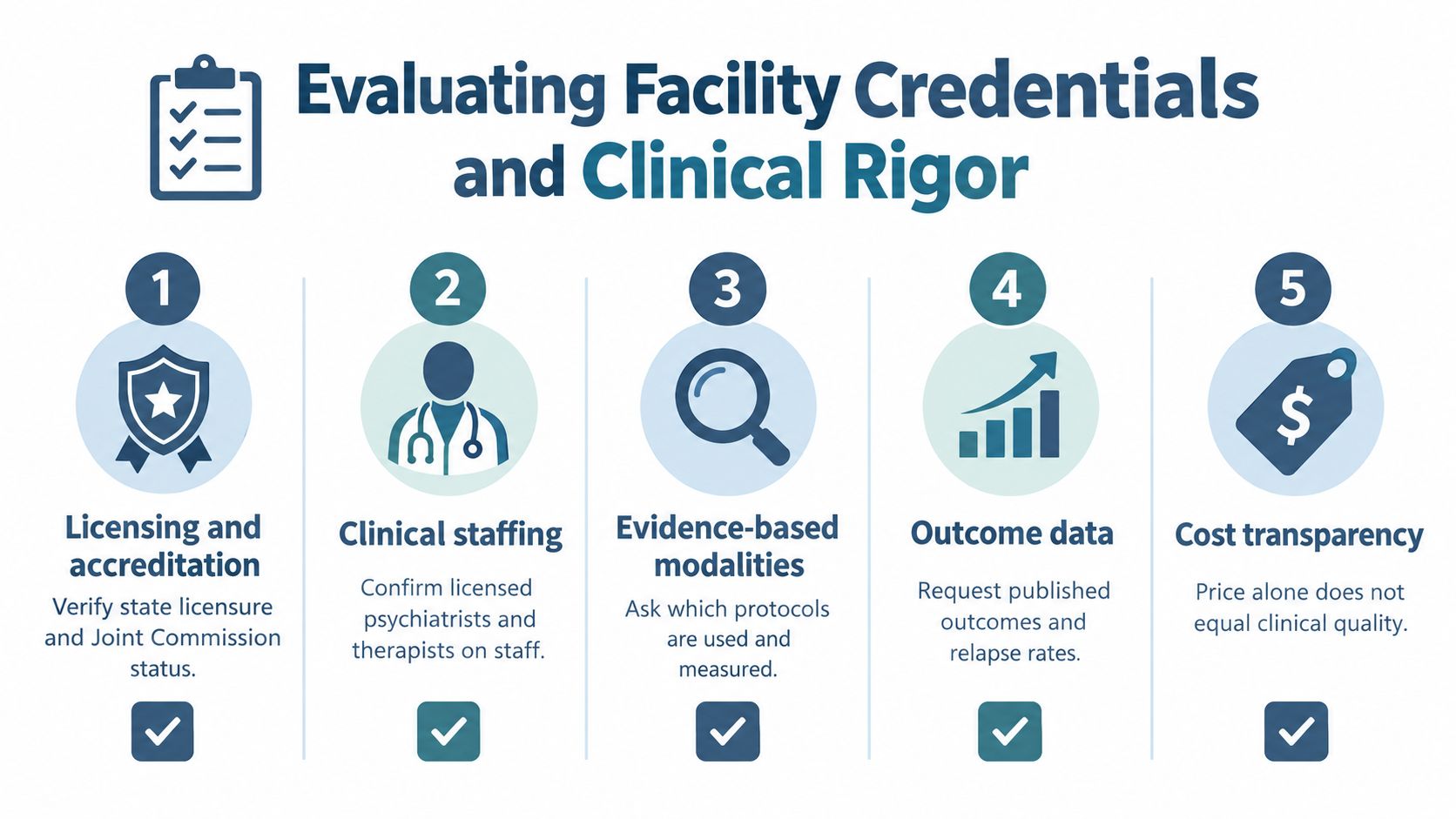
A high price tag does not prove clinical excellence. It proves private-pay positioning. The real test is whether the program can show licensing, accreditation, disciplined staffing, and a measurable treatment structure. The California listing for Reflections specifically notes Joint Commission Gold Seal accreditation and confirms that clients can keep cell phones and laptops so they can continue meeting professional responsibilities between rehab programming Reflections executive-rehab listing.
Ask about the parts that matter
The first question is whether the facility is clinically credible. Joint Commission recognition matters because it signals outside review, and private rooms matter because confidentiality and rest are not luxuries in depressed executives, they're treatment supports. A separate executive-rehab guide from Reflections says private rooms in both detox and residential care are used to protect rest and confidentiality, while digital access is guided by the clinical team and adjusted throughout treatment Reflections executive-rehab guide.
The next question is staffing. A real program should be able to name who does what, psychiatrists, psychologists, therapists, addiction counselors, and adjunctive clinicians. If the answer is a sales script rather than a clinical roster, keep moving.
Use a checklist, not a vibe
Families and boards should verify the following before committing:
- Licensing and accreditation: confirm state licensure and Joint Commission status.
- Clinical staffing: verify that licensed psychiatrists and therapists are on site.
- Evidence-based modalities: ask which protocols are used and how progress is measured.
- Outcome tracking: request published outcomes, discharge benchmarks, and follow-up planning.
- Cost transparency: price alone does not equal clinical quality.
A high-end program should also be able to explain family involvement, privacy protocols, work-access rules, and aftercare coordination without hesitation. If those answers are vague, the environment may be polished but not operationally serious.
Decision standard: choose the facility that can defend its clinical design, not the one that photographs best.
Reflections fits the profile of a confidential, clinically rigorous residential option for adults with depression and co-occurring disorders, especially where privacy, work continuity, and structured care all have to coexist. For a discreet consultation and a clear look at the program structure, visit Reflections.