

A spouse notices the pattern before the board does. The executive still joins conference calls, signs documents, travels for work, and answers messages, yet the evenings now include concealed drinking, unexplained prescription refills, irritability, and apologies that never lead to change. Family dinners disappear behind “urgent” work, while the person insists everything remains under control.
Staging an intervention becomes appropriate when private concern has stopped changing public behavior. For high-functioning adults, the central challenge isn't proving that the person is successful. It's recognizing that professional performance can coexist with a dangerous substance-use pattern and an untreated mental health condition. A carefully planned intervention should protect dignity, privacy, and career obligations while creating a direct route into integrated treatment.
When an Intervention Is the Right Next Move
Burnout usually improves when the pressure eases, support increases, or the person gets meaningful rest. A substance-use disorder keeps demanding accommodation. The calendar may remain full, but the person's behavior becomes increasingly organized around drinking, pills, stimulants, withdrawal, concealment, or recovery from the previous night.
A single caring conversation may be enough when the person remains open, accepts specific feedback, and follows through with help. Escalation makes sense when the same conversation has happened repeatedly and nothing changes.
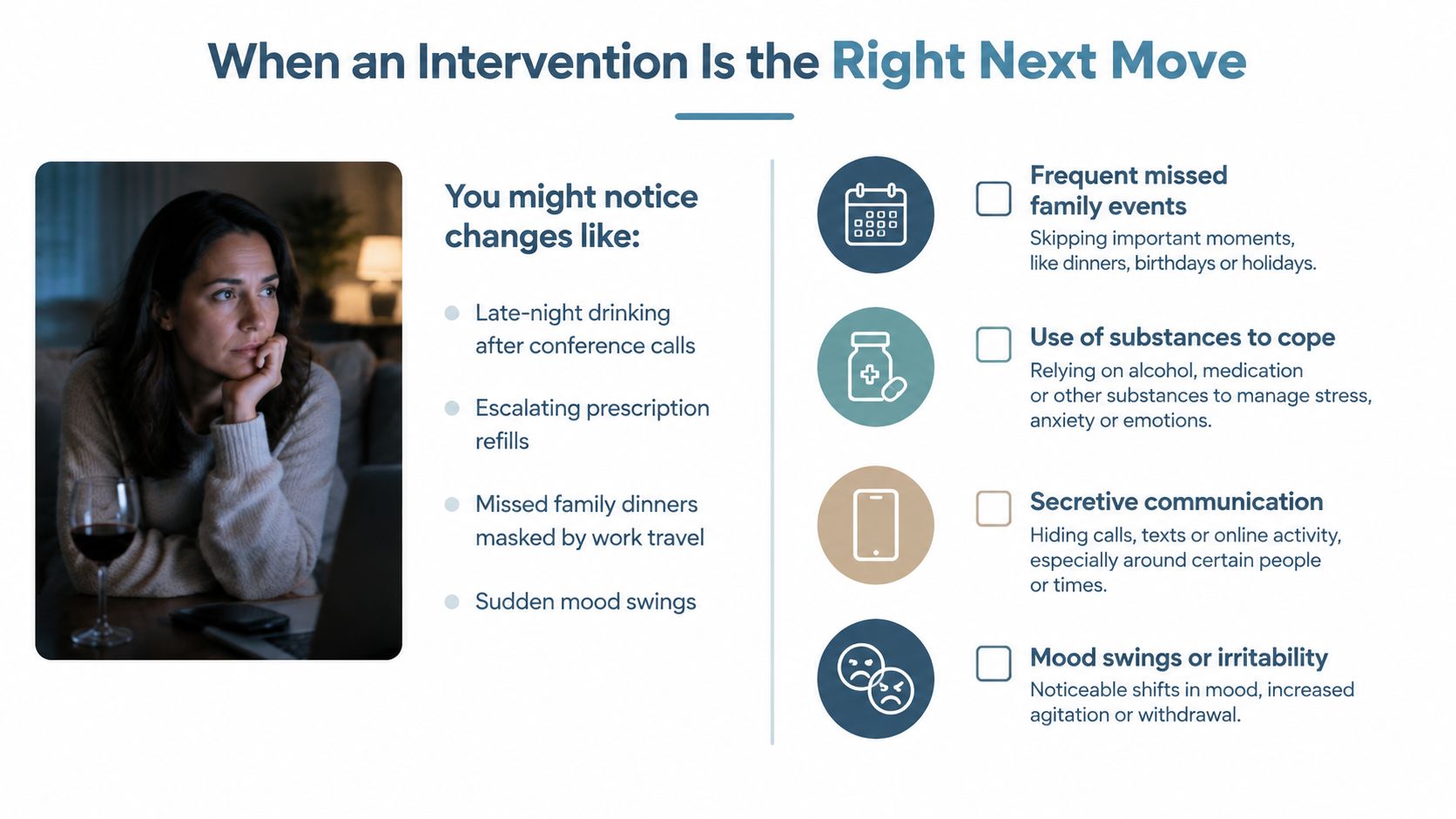
Signals that informal help has stalled
Families should look for a pattern, not one embarrassing incident:
- Failed moderation attempts: The person promises to reduce use, sets rules, or takes breaks, then returns to the same behavior.
- Concealment: Hidden bottles, unexplained medication requests, secretive calls, or inconsistent accounts indicate that the person knows others would object.
- Functional danger: Blackouts, impaired driving, missed obligations, reckless decisions, or serious errors threaten family stability and professional standing.
- Co-occurring symptoms: Depression, anxiety, mood swings, trauma symptoms, or suicidal thinking change the risk profile and require a dual-diagnosis clinician.
- Relationship exhaustion: A spouse, assistant, or adult child is covering absences, managing crises, or protecting the person from consequences.
Employee assistance programs, outpatient therapy, and private medical appointments remain useful options, but they aren't substitutes for a higher level of care when those routes have already stalled. The family should ask whether the person is still choosing treatment or merely negotiating for more time.
Practical rule: If the family must keep the problem invisible for the person to keep functioning, the family is already part of the illness pattern.
Waiting doesn't make the conversation safer. It often gives substance use more room to affect health, judgment, relationships, and professional responsibilities. A formal intervention isn't punishment. It's a coordinated decision to stop watching and start setting boundaries with a treatment option ready.
What an Intervention Actually Does for the Person
A well-run intervention replaces scattered arguments with a single, structured message. Instead of a spouse listing every grievance or a colleague making a vague accusation, each participant describes a specific observation, its impact, and the help being offered. The person hears facts that are harder to dismiss as a family overreaction.
That structure matters for executives because professional competence often becomes part of the defense. A person may say that revenue is strong, clients are satisfied, or no one at work has complained. Those statements don't answer what happens after the conference call, how medication is being obtained, or why family members have begun managing the consequences.
Why the format changes the conversation
The interventionist or neutral clinician keeps the discussion from becoming a trial. The clinician can interrupt blame, redirect arguments toward treatment, and help the family hold a boundary without humiliating the person. The room becomes less about winning an admission and more about presenting a supported next step.
Hearing the same concern from several trusted people also challenges the isolation that substance use creates. A spouse may be dismissed as emotional. A long-term colleague may be dismissed as uninformed. Together, carefully selected voices show that the pattern affects multiple parts of life.
The process is not universally effective in every population or for every outcome. A 2026 systematic review of randomized controlled trials found that 11 studies showed significant positive effects from family-based interventions and concluded that family involvement can reduce substance use and improve family functioning across adolescent and adult populations. Yet an adult-focused review found no significant effects on family-related secondary outcomes for psychotropic-drug users, which is why treatment entry, substance reduction, psychiatric stabilization, and relationship repair should be treated as separate goals.
What the intervention cannot do
Yelling, surprise accusations without a plan, and ultimatums that the family won't enforce usually push the person toward secrecy. An intervention also isn't a cure, a hostage negotiation, or a substitute for detoxification, psychiatric assessment, or residential treatment.
Its proper role is narrower and more useful. It creates a carefully managed doorway into care, ideally with a private admission plan, a clinically appropriate program, and a family prepared to stop enabling regardless of the response.
Picking the Right Intervention Model for a Dual Diagnosis
The right model depends on awareness, personality, family history, and psychiatric risk. A person with depression, anxiety, bipolar symptoms, trauma, or unresolved grief isn't someone with a substance problem added on. The intervention must avoid making substances the sole explanation for behavior when untreated mental illness may be driving use, intensifying withdrawal, or complicating motivation.
Four models in practical terms
The Johnson Model uses a planned, family-led confrontation, usually facilitated by a clinician. It can create urgency, but an executive who feels ambushed may shut down, leave, or redirect the discussion toward privacy violations and professional exposure.
The Field Model is invitational. Family members name what they see and invite the person into a conversation rather than concealing the purpose. It suits someone who has partial awareness and can tolerate dialogue, but it may lack force when denial remains strong.
ARISE uses graduated family involvement and emphasizes a continuing process rather than one dramatic meeting. It can fit families that need coaching and repeated contact, especially when trust is damaged but not gone.
Systemic Family Intervention examines the relationships, communication patterns, roles, and reinforcement loops around substance use. For dual diagnosis, this is often the most clinically useful lens because it can address symptoms and family responses together, provided the clinician has genuine co-occurring-disorder expertise.
| Model | Best Suited For | Dual-Diagnosis Fit | Key Risk |
|---|---|---|---|
| Johnson Model | Strong denial and urgent family concern | Useful only with careful psychiatric risk planning | The person may experience the meeting as an ambush |
| Field Model | Partial awareness and willingness to talk | Good when emotional regulation is adequate | The conversation may remain too soft |
| ARISE | Families needing graduated support | Strong when relatives need coaching over time | Progress can feel slow during an acute crisis |
| Systemic Family Intervention | Complex family dynamics and co-occurring symptoms | Often the best default for adults with dual diagnosis | Requires a clinician trained in both addiction and family systems |
A clear decision guide
Use an invitational or systemic approach when the person acknowledges part of the problem. Consider a more structured family-led format when denial is severe, consequences are escalating, and the family has already prepared firm boundaries. If there is active suicidal thinking, psychosis, severe mania, violence, or unpredictable behavior, the family shouldn't improvise. A qualified dual-diagnosis professional should determine whether an intervention is safe and what level of psychiatric support is required.
For adults with coexisting disorders, the default recommendation is a clinician-led, systemic or graduated approach, with treatment arranged before the conversation begins. The most important decision isn't which model sounds familiar. It's whether the model can move the person into care without worsening psychiatric instability or turning legitimate privacy concerns into the central conflict.
Preparing the Family Team Before the Conversation
A strong team is small enough to stay focused and large enough to represent the person's real life. A practical range is 4 to 8 participants, with selection based on trust rather than enthusiasm. The most vocal relative isn't automatically the most persuasive one.
A spouse may know the daily pattern, while a sibling understands the family history. A former colleague or long-term friend may reach an executive who dismisses a partner's concerns as personal conflict. Each person should bring one specific example, including when it occurred and what changed afterward.
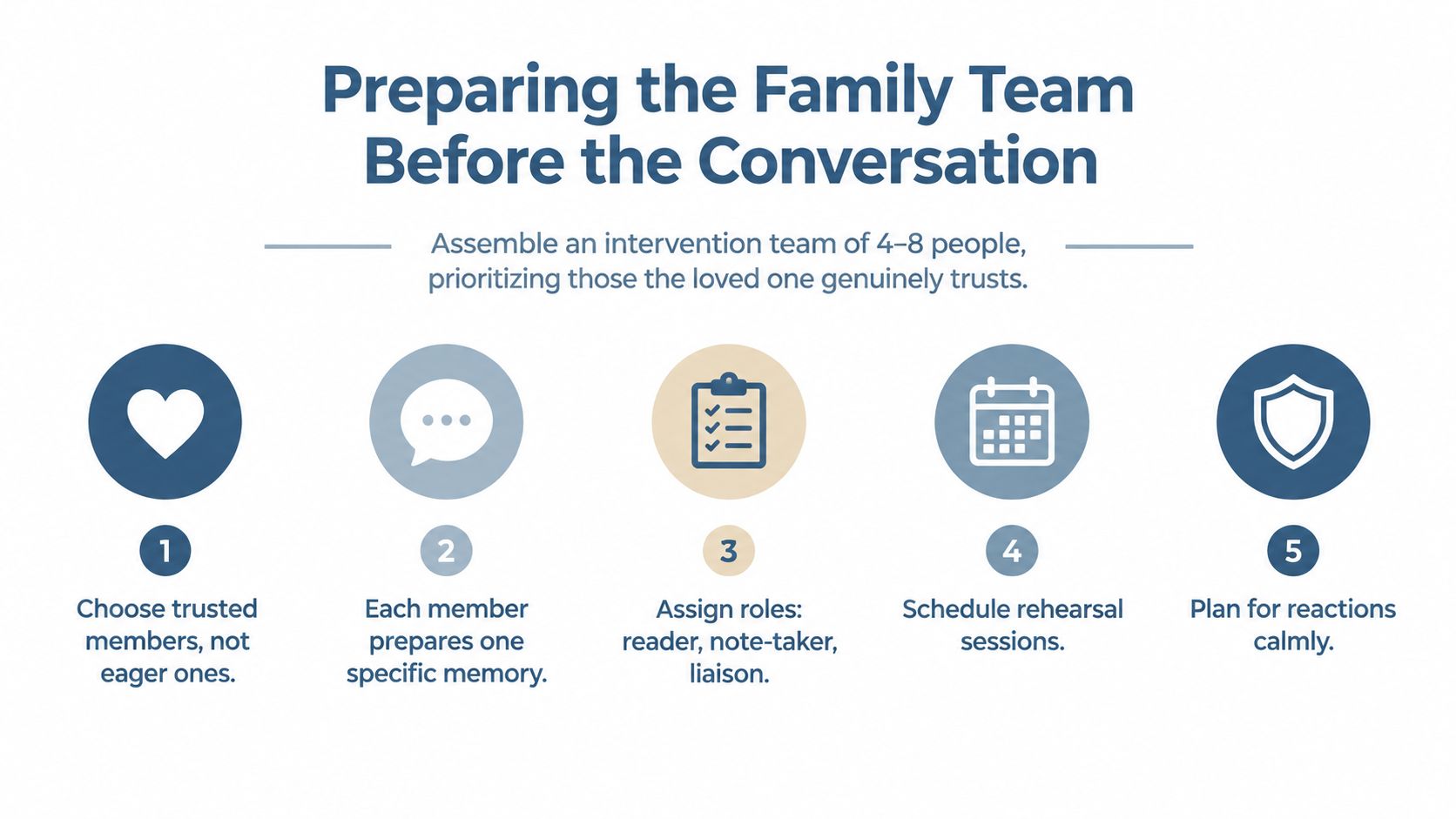
Build the team deliberately
Exclude anyone who still uses substances with the person, anyone likely to become aggressive, and anyone whose presence will create overwhelming shame. A family member who wants to expose every secret may satisfy an emotional need while damaging the intervention.
The family should also choose roles before the meeting:
- Lead reader: Delivers the opening and keeps the tone steady.
- Impact speakers: Read prepared statements without debating responses.
- Logistics lead: Manages transport, admissions communication, and practical arrangements.
- Family liaison: Communicates with the treatment team and interventionist.
- Safety support: Watches for escalation and follows the clinician's direction.
Families preparing with a specialist can review alcohol intervention specialists when alcohol is central to the concern, but the same planning principles apply to prescription drugs and other substances.
Rehearse boundaries, not speeches alone
The interventionist should hold a separate preparation session. The family needs to agree on the message, the consequences of refusal, and the behavior each person will change afterward. Consequences must be realistic. A spouse shouldn't threaten separation unless housing, finances, and legal advice support that decision.
Choose a private location, reserve 2 to 3 hours, silence phones, and remove unnecessary observers. The family should commit to consistent messaging for the following 90 days, whether the person accepts treatment or refuses it. Consistency prevents the loved one from negotiating separately with the most frightened participant.
The group also needs a plan for children, pets, household staff, confidential documents, and transportation. A private, prepared setting protects the person's dignity while giving the family enough control to follow through.
Writing the Script and Running the Rehearsal
Each intervention letter should sound personal, not manufactured. The strongest structure is simple: begin with care, describe one specific incident and its impact, name the emotional cost using an “I” statement, present the treatment already arranged, and state what will change if help is refused.
A spouse might describe finding the person asleep after a late-night call, then explain the fear and household disruption that followed. A colleague might describe a missed commitment without speculating about motives. The interventionist should remove sarcasm, labels, character attacks, and long histories that invite courtroom-style rebuttals.

Keep every statement contained
Each speaker should stay under five minutes. The limit isn't arbitrary. Short statements preserve attention and reduce the chance that grief becomes accusation. The interventionist should have authority to cut any sentence that sounds like a lecture, even if the speaker believes it is true.
A useful letter answers four questions:
- What happened? Use observable facts rather than diagnosis.
- How did it affect the writer? Use direct emotional language without blame.
- What help is available now? Name the level of care and admission plan.
- What happens if help is refused? State one boundary that will be enforced.
Families can strengthen their preparation by reviewing communication skills in recovery before rehearsal, especially when the person routinely redirects difficult conversations.
Rehearse the pressure points
Run the full read-through twice. Time every speaker, practice interruptions, and rehearse the moment the person says the group is violating confidentiality. Executives may threaten to call human resources, a board member, investors, regulators, or the press. The response shouldn't be a counterattack.
A calm answer might be, “This conversation is private, and the treatment option is ready. The family isn't debating your professional worth. The family is responding to what has been happening at home and to the safety concerns already described.”
The final rehearsal should include the physical transition. A pre-packed bag, transportation, admissions contact, medication information, and a person responsible for work notifications should be ready. The goal isn't to force movement. It's to remove every avoidable delay after a clear yes.
Choosing a Luxury Dual-Diagnosis Treatment Setting
A family shouldn't stage an intervention without knowing exactly where the person can go. For an executive with co-occurring mental health and substance-use disorders, separate providers that hand the person from detox to psychiatry to therapy create unnecessary gaps. The program should integrate addiction medicine, psychiatric care, psychotherapy, medication management, and family work under one coordinated clinical structure.
A high-end setting also has to respect the practical reality of professional responsibility. Some executive programs permit regular phone and computer access, and technology policies in rehabilitation settings vary by program. Access should be structured around therapy, sleep, privacy, and clinical safety rather than treated as an unrestricted privilege.
What the program must verify
Ask direct questions before the intervention:
- Clinical leadership: Are addiction psychiatrists and psychiatric prescribers involved in assessment and medication decisions?
- Co-occurring expertise: Do therapists routinely treat depression, trauma, anxiety, bipolar symptoms, and substance use together?
- Withdrawal management: Can the team monitor clinically managed withdrawal and adjust psychiatric medication during stabilization?
- Therapeutic depth: Does care include evidence-based approaches such as CBT, DBT, ACT, motivational interviewing, individual psychotherapy, and intensive groups?
- Trauma responsiveness: Are trauma-informed options, including somatic work or EMDR when appropriate, available?
- Family participation: Can relatives join private sessions and educational work without compromising the client's confidentiality?
- Executive privacy: Are admissions discreet, rooms private, communications protected, and work access supervised?
- Continuity: Will the program coordinate with the interventionist, psychiatrist, therapist, and outpatient team after discharge?
Quality control matters. The Joint Commission reports that accredited behavioral-health organizations undergo onsite surveys and are reviewed at least every three years against hundreds of national safety and quality standards through its behavioral-health accreditation and provider locator. Accreditation doesn't replace personal due diligence, but it gives families a meaningful standard to verify.
Private rooms should be available through both detox and residential rehabilitation when privacy, sleep, and confidential work access affect treatment engagement. Electronics may be allowed under scheduled windows or supervision, with restrictions during therapy. A premium program should explain those rules before admission, not improvise them after arrival.
Compare treatment structure, not decoration
Luxury treatment should mean clinical precision, privacy, and individualized support, not merely attractive surroundings. A major benchmark for luxury residential rehabilitation is roughly $30,000 to $100,000 or more for a month, with some programs exceeding $100,000 per month, according to this luxury rehabilitation cost overview. Families paying privately should demand clarity about staffing, psychiatric coverage, room arrangements, work access, family services, and discharge planning.
Treatment length should follow stabilization and progress, not a calendar chosen for convenience. Programs may offer 28, 45, 60, or 90 days, while co-occurring cases often need enough time for withdrawal, mood symptoms, trauma work, behavioral practice, and a safe transition. Short stays can be appropriate for some people, but they rarely provide the same opportunity to stabilize both diagnoses as a longer, coordinated episode.
| Feature Category | What to Verify | Red Flag |
|---|---|---|
| Accreditation | Current accreditation, licensing, and documented quality oversight | Vague claims without verification |
| Psychiatric care | Ongoing psychiatric assessment and medication management | Psychiatry handled only through outside referrals |
| Privacy | Private rooms, discreet admissions, protected communication, structured workspace access | Shared arrangements presented as the only option |
| Clinical staffing | Qualified addiction, psychiatric, therapy, and nursing coverage | One clinician carrying unrelated roles |
| Family protocol | Private sessions, education, boundaries, and consent procedures | Family involvement limited to a discharge call |
| Continuity | Written coordination with interventionist and outpatient providers | No defined aftercare handoff |
Plan for refusal before the meeting starts
A hard no requires calm follow-through. The family should say, “The treatment option remains available, but the boundaries described today will now take effect.” They shouldn't argue, chase, threaten exposure, or promise to forget the conversation.
A stalled yes needs a deadline and a concrete next action. “The family will arrange transportation and admission now. If the person needs a short private call with the clinician, that call can happen while the logistics continue.” A conditional acceptance that keeps producing new requirements may be avoidance. The interventionist should identify the difference between a legitimate privacy concern and another delay.
The person responsible for the pre-packed bag should keep it secure. The spouse or lead speaker should leave the room if emotions become destabilizing, while the clinician directs the remaining conversation. If a partner, business partner, or staff member arrives unexpectedly, that person shouldn't enter the intervention without the clinician's approval.
Legal counsel may be appropriate when company duties, professional licenses, fiduciary obligations, employment exposure, or confidential transactions are involved. Counsel should address lawful privacy and continuity planning, not be used to intimidate the loved one.
A 24-hour cooling protocol can help after a refusal or an emotionally incomplete acceptance. The family should make a follow-up call within that period, confirm the treatment option remains open, and avoid repeated messages. A second attempt makes sense when new safety information, a meaningful change in readiness, or a stronger clinical plan appears. If nothing has changed, the family may need to accept that another attempt is months away and focus on boundaries, safety, and professional guidance.
A refusal isn't proof that the intervention failed. It is information. The family's response determines whether the next opening remains possible.
Family Aftercare and the First Ninety Days
Residential treatment changes the household before the loved one returns. The family may feel relief first, then grief, anger, guilt, or exhaustion. Those reactions don't mean the intervention was wrong. They mean the family has stopped organizing every day around concealment and crisis.
The first 90 days need assigned responsibilities. A spouse can manage clinical communication with consent. Adult children should not become medication monitors or emergency negotiators. An executive assistant may handle calendar protection and neutral work explanations, while in-home staff maintain routines without discussing private health information.
Build a written family plan
A family therapist should establish regular check-ins and help relatives separate support from surveillance. An alumni liaison can explain program expectations and identify early warning signs. Spouses of high-profile adults may also benefit from a confidential peer setting where privacy, reputation, and financial complexity are understood.
The family should document:
- Weekly contact: Who speaks with the person, when, and through which approved channel.
- Household roles: Who manages children, pets, finances, travel, and staff communication.
- Work protection: What neutral explanation covers the absence and who handles urgent matters.
- Home preparation: Which substances, prescriptions, weapons, or triggering arrangements require professional review.
- Return planning: What the person will do during the first days home, including therapy, medical appointments, sleep, and transportation.
The family can use aftercare planning to organize continuing support beyond residential care. The plan should protect the recovering person without turning the household into a surveillance operation.
A one-page summary belongs on the refrigerator or in a secure household file. It should list the treatment team, emergency contacts, approved communication rules, each person's boundary, and the next family appointment. Reflections provides private residential dual-diagnosis treatment, individualized psychiatric and addiction care, family therapy, structured access to electronics, private rooms, and continuing-care coordination for adults who need discreet support without abandoning legitimate professional obligations.
Families facing this decision can contact Reflections for a confidential assessment of the intervention, psychiatric, detox, residential, and aftercare needs involved. Visit Reflections to discuss a private dual-diagnosis treatment plan designed for executives, working professionals, and the people responsible for helping them reach care.