

A family often notices the pattern before the board does. The executive still closes deals, still answers late-night messages, still shows up polished. But the mood is shorter, the memory is less reliable, the drinking has shifted from social to necessary, and home no longer feels steady.
That's the dangerous zone for high-performing professionals. Success hides decline. Money softens consequences. Staff members compensate. Spouses cover. Colleagues rationalize. By the time a family starts searching for alcohol intervention specialists, they usually aren't dealing with a minor habit. They're trying to protect a marriage, children, a company, and a public reputation at the same time.
When a Leader Needs Help A Guide to Executive Intervention
A typical executive alcohol case doesn't begin with a dramatic collapse. It begins with quiet changes. A founder starts drinking before dinners that used to be easy. A physician begins missing emotional cues at home. A senior partner becomes irritable, controlling, and impossible to confront unless everyone pretends the problem is stress.
The family often hesitates because the person still looks functional. That hesitation costs time. According to the 2024 alcohol treatment data from NIAAA, only 2.5% of the 28.0 million people ages 12 and older who need help receive any form of treatment. That gap explains why families can spend months waiting for insight that never arrives.
For high-profile households, the stakes are sharper. The wrong confrontation can trigger denial, rage, flight, or a reputation crisis. The right intervention protects privacy, preserves dignity, and creates a path to immediate care. Families managing logistics around business travel and confidentiality sometimes also review practical planning resources such as blog posts on Seattle executive travel when they need discreet transport coordination around a treatment transition.
What makes executive cases different
The central problem usually isn't whether alcohol has become destructive. It's whether anyone can interrupt the pattern without blowing up the person's identity.
- Status complicates accountability: Senior professionals are used to directing outcomes, not surrendering control.
- Family systems adapt: Loved ones often become managers of fallout instead of challengers of the addiction.
- Career pressure creates excuses: Travel, client dinners, investor stress, and public visibility become cover.
A high-functioning executive can be deeply impaired and still look impressive from the outside.
Families who recognize this pattern early often find it useful to review hidden signs of addiction in executives before making contact with a specialist. The point isn't to diagnose at home. The point is to stop minimizing what everyone already sees.
Why families shouldn't do this alone
A family-led confrontation usually becomes emotional, circular, and unfocused. Someone cries. Someone attacks. Someone backs down. The executive leaves the room, promises to cut back, and the house returns to silence.
That isn't strategy. It's exhaustion.
An intervention done properly is a controlled clinical and logistical event. It's designed to move a resistant, intelligent, accomplished person from denial into treatment without humiliation. For executives, that level of planning isn't optional. It's the standard that protects both life and legacy.
The Role of an Elite Alcohol Intervention Specialist
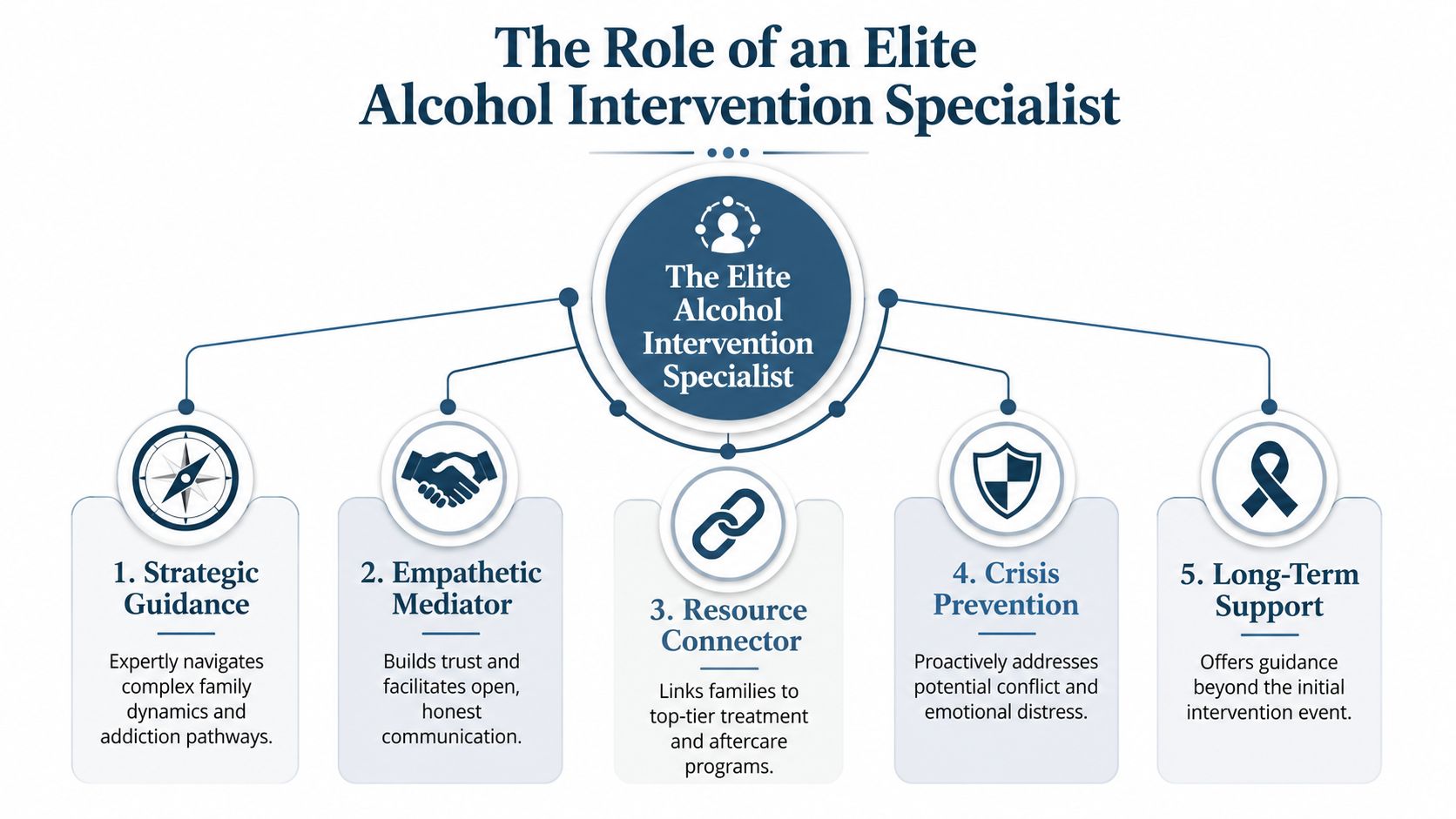
Most families picture an interventionist as a confrontational outsider. That image is wrong. Elite alcohol intervention specialists act more like strategic clinical directors. They assess risk, coach the support system, manage logistics, and keep everyone anchored to one objective. Immediate acceptance of treatment.
According to the Association of Intervention Specialists on intervention success rates, professionally guided interventions have a success rate of 80% to 90% in motivating an individual to accept treatment on the same day. Unassisted family attempts often fail. For executive cases, that difference matters because there may be only one realistic opportunity to get a clean yes before the person retreats behind advisors, assistants, travel plans, or anger.
What the specialist actually does
An elite specialist doesn't just show up for a meeting. The heavy lifting happens before the person ever walks into the room.
Assesses the case
The specialist gathers history on alcohol use, mental health concerns, work demands, enabling patterns, medical concerns, and likely escape routes.Builds the intervention team
Not everyone should attend. In executive cases, one poorly regulated sibling or one resentful business partner can derail the process.Prepares every statement
Family members need disciplined language. No speeches about morality. No character attacks. No vague pleading.Secures the treatment pathway
The specialist should arrange admission, transport, and contingency planning before the meeting begins.Runs the room
During the intervention, the specialist controls pace, tone, and boundaries so the executive can't hijack the conversation.
What high-end families should expect
The best alcohol intervention specialists combine emotional intelligence with operational precision. They understand that a CEO, trial attorney, surgeon, or founder may agree to treatment only if the plan feels credible, discreet, and immediate.
That means the specialist should be able to address concerns such as:
- Confidentiality: Who knows, who doesn't, and how communication is handled.
- Business continuity: What happens with devices, urgent approvals, and limited work obligations.
- Travel and admission timing: How the person gets from intervention to treatment without delay.
- Family alignment: Whether the household can hold boundaries after the meeting.
Practical rule: If a specialist talks more about the intervention event than the treatment handoff, that family is talking to the wrong person.
The executive standard
For a high-profile client, respect matters. Not indulgence. Respect. The specialist must present treatment as a decisive solution, not a punishment. A smart professional won't respond well to theatrics. They respond to clarity, reality, and consequences delivered without panic.
That is why elite intervention work is less about confrontation and more about structure. The family brings the truth. The specialist brings order. Together, they remove the chaos that addiction depends on.
Key Intervention Models for Professionals and Executives
Not every executive needs the same intervention style. Some respond to a firm, time-sensitive meeting. Others shut down if they feel cornered. The model should match the personality, family culture, and degree of denial.
A skilled specialist should be able to explain the framework being used and why it fits. If the answer sounds generic, the planning probably is.
Comparing the primary approaches
| Model | Approach Style | Best For |
|---|---|---|
| Johnson | Structured, direct, decisive | Professionals in clear denial who need a firm boundary and immediate treatment option |
| ARISE | Collaborative, invitational, escalating only if needed | Families that want to begin with engagement rather than surprise |
| CRAFT | Behavior-focused family change | Loved ones who need to stop enabling and increase motivation over time |
| Family Systems | Relational and pattern-based | Households where the addiction is tightly woven into long-standing family roles |
Johnson model
This is the classic intervention structure that is widely recognized. It's planned carefully, presented directly, and usually ends with a clear request to enter treatment immediately.
For certain executives, Johnson works well because it removes wiggle room. A leader who has talked circles around concern for years may need one disciplined moment where the family stops negotiating and starts acting. It's especially useful when the person has become intimidating, dismissive, or expert at promising future change.
ARISE model
ARISE is often a better fit when a family wants a more relational process. It starts with engagement and transparency rather than a surprise ambush. The process can intensify if needed, but it begins by drawing the person into a conversation rather than cornering them.
This approach can work well for image-conscious professionals who fear betrayal more than treatment itself. It lowers defensiveness without eliminating accountability.
The best intervention model is the one the family can carry out consistently after the specialist leaves.
CRAFT approach
CRAFT isn't a classic intervention event. It teaches loved ones how to change their own responses so the person with the drinking problem feels the impact of the disorder more clearly. Families stop cushioning consequences and start reinforcing movement toward help.
For executive households, CRAFT can be powerful when there's a long history of accommodation. A spouse stops covering missed obligations. Adult children stop pretending everything is normal. The family becomes calm, consistent, and less manipulable.
Family systems work
Some alcohol cases aren't just about one person's drinking. They're about an entire ecosystem built around control, secrecy, fear, status, and conflict avoidance. Family systems work addresses those patterns directly.
This is often the right lens when the executive's authority dominates the home, or when family members have taken on rigid roles such as rescuer, appeaser, rebel, or scapegoat. The intervention becomes more than a request for treatment. It becomes a reset of the family's operating rules.
What often works best for high performers
Many professionals respond best to a blend. A specialist may use family systems preparation, CRAFT-based coaching for loved ones, and then a direct intervention meeting informed by Johnson or ARISE principles.
A family exploring communication-based approaches may also want to understand motivational interviewing in treatment settings, because resistant executives often respond better to language that reduces power struggles and increases ownership.
The wrong question is, “Which model is best overall?” The right question is, “Which model fits this person, this family, and this level of risk?” That's where expertise shows.
Vetting Your Specialist Credentials and Red Flags
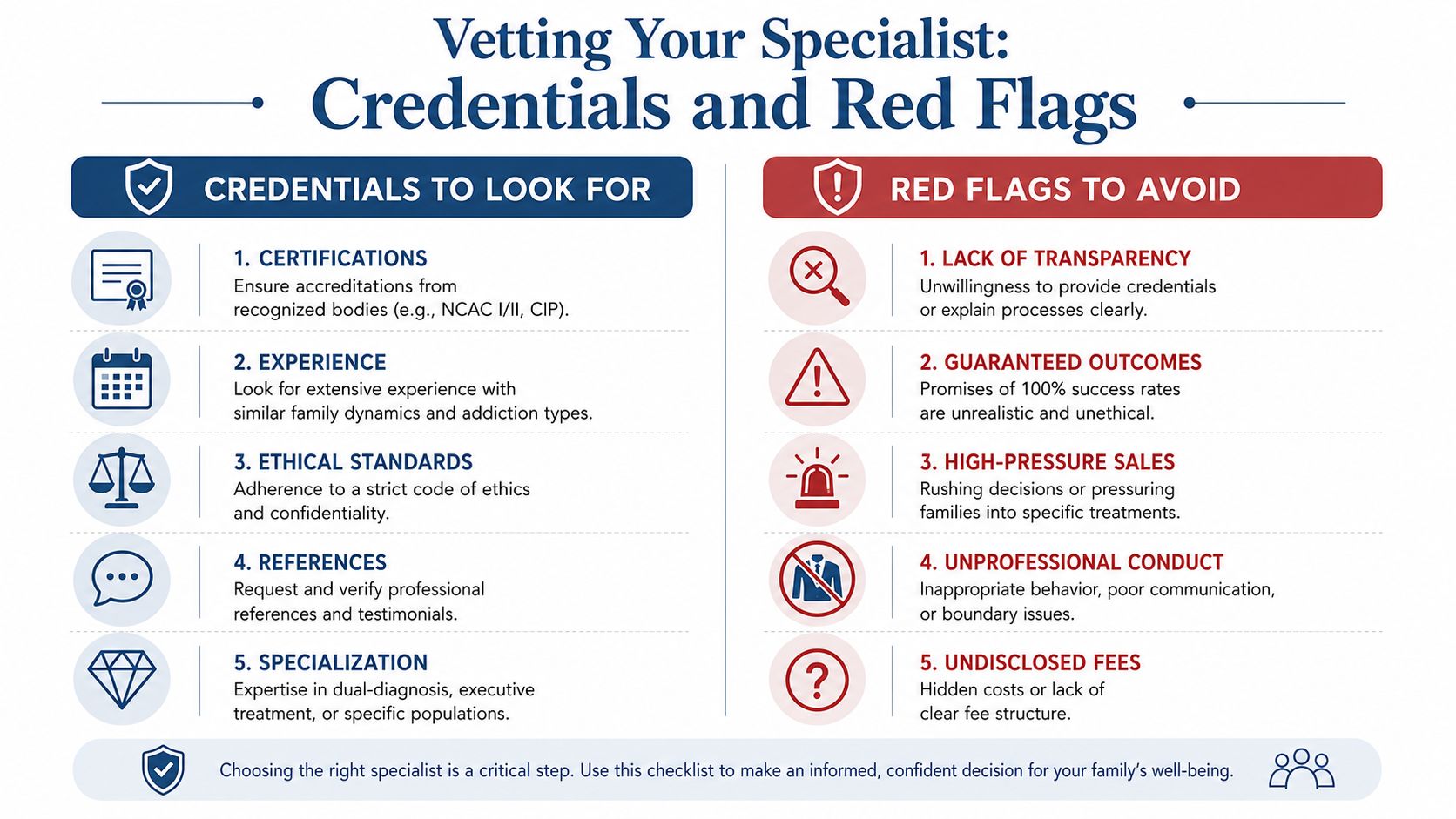
This field attracts excellent professionals and reckless opportunists. Families dealing with wealth, urgency, and fear are especially vulnerable to polished but underqualified interventionists. Credentials matter because the work is high-stakes. A bad intervention can deepen denial, rupture the family, and delay treatment.
One useful benchmark is advanced credentialing. According to Board Registered Interventionist Level II requirements, a BRI-II specialist needs at least five years of experience and 28+ hours of advanced training in recognized models and co-occurring addictions. That doesn't guarantee excellence, but it signals serious investment in competence.
Credentials that actually matter
Families should look past charisma and ask for specifics.
- Advanced intervention training: Recognized model training matters because elite cases require more than intuition.
- Real case experience: The specialist should have substantial experience with alcohol cases involving family complexity, resistance, and urgent placement.
- Ethical standards: A credible professional should work under a clear code of ethics and respect confidentiality.
- Dual-diagnosis fluency: Executive alcohol cases frequently involve anxiety, trauma, depression, bipolar symptoms, or self-harm concerns.
A specialist may also hold additional counseling or addiction credentials. That can be helpful. But the key issue is whether the person can safely manage a high-functioning, image-conscious client whose case may become volatile quickly.
Red flags that should end the call
Some warning signs are obvious. Others sound reassuring until they create a disaster.
- Guaranteed outcomes: No ethical clinician promises a sure result.
- Pressure to commit immediately: Families need urgency, not coercion.
- Vague process descriptions: If the specialist can't explain preparation, logistics, and follow-up clearly, that's a problem.
- One-size-fits-all language: Executive families need personalized planning, not a recycled script.
- Hidden fees or fuzzy boundaries: Poor transparency usually predicts poor coordination.
A credible interventionist welcomes hard questions. An unqualified one redirects, sells, and rushes.
Questions worth asking directly
A family should ask how the specialist handles refusal, psychiatric risk, transport, family preparation, and treatment matching. They should also ask who will be present, how long the planning takes, and what support continues after the initial event.
The answer should sound calm, detailed, and clinically grounded. It shouldn't sound theatrical. Families aren't hiring a personality. They're hiring judgment.
The Intervention Process A Checklist for Families
Once a family decides to act, hesitation should stop. The process works best when every practical detail is handled before the loved one is approached. That includes attendance, language, transport, admission, and contingency planning.
The image below captures the tone families should look for. Calm, organized, and clinically guided.

Step one through consultation and case review
The first consultation should establish whether the situation involves alcohol only or whether there are signs of psychiatric instability, medical risk, or active self-harm concern. The specialist should ask detailed questions about drinking patterns, medications, family roles, and the executive's current obligations.
This is also where cost clarity matters. The Association of Intervention Specialists guidance on family questions and costs makes an essential point. Interventionist services are often a private-pay expense not covered by insurance, so families should request a detailed breakdown of included costs, travel fees, and post-intervention follow-up before committing.
Step two through planning the team and the message
Not everyone who loves the person belongs in the room. Selection should be deliberate.
- Choose regulated participants: Include people who can stay focused and won't drift into blame.
- Write concise impact statements: Each person should describe what they've seen, how it has affected them, and what boundary will follow if treatment is refused.
- Rehearse: Families should practice out loud. Strong writing isn't enough. Delivery matters.
Step three through securing the treatment path
An intervention without immediate placement is sloppy. The executive should not be asked to agree to treatment in the abstract.
The specialist should confirm:
- Admission availability: Detox or residential placement should be ready.
- Travel plan: Transport should be discreet and immediate.
- Packing and personal logistics: Clothing, medications, identification, and devices should already be addressed.
- Professional continuity: Limited communication with legal, financial, or corporate contacts should be mapped appropriately.
Step four through intervention day
The intervention itself should be brief, direct, and controlled. Family members read prepared statements. The specialist manages interruptions, manipulation, blame shifting, and exit attempts. The ask is simple. Accept treatment now.
If the answer is yes, movement should happen immediately. If the answer is no, the family must hold the boundaries they stated. Without follow-through, the intervention becomes another empty crisis.
Families don't need more emotional intensity. They need disciplined execution.
Questions every family should ask before hiring
- How is psychiatric risk assessed before the meeting?
- What does the fee include, and what is billed separately?
- How is confidentiality protected for executives and public figures?
- What happens if the client refuses treatment?
- How is the treatment program selected and coordinated?
The quality of those answers usually tells the family everything they need to know.
Coordinating with Dual-Diagnosis and Executive Treatment
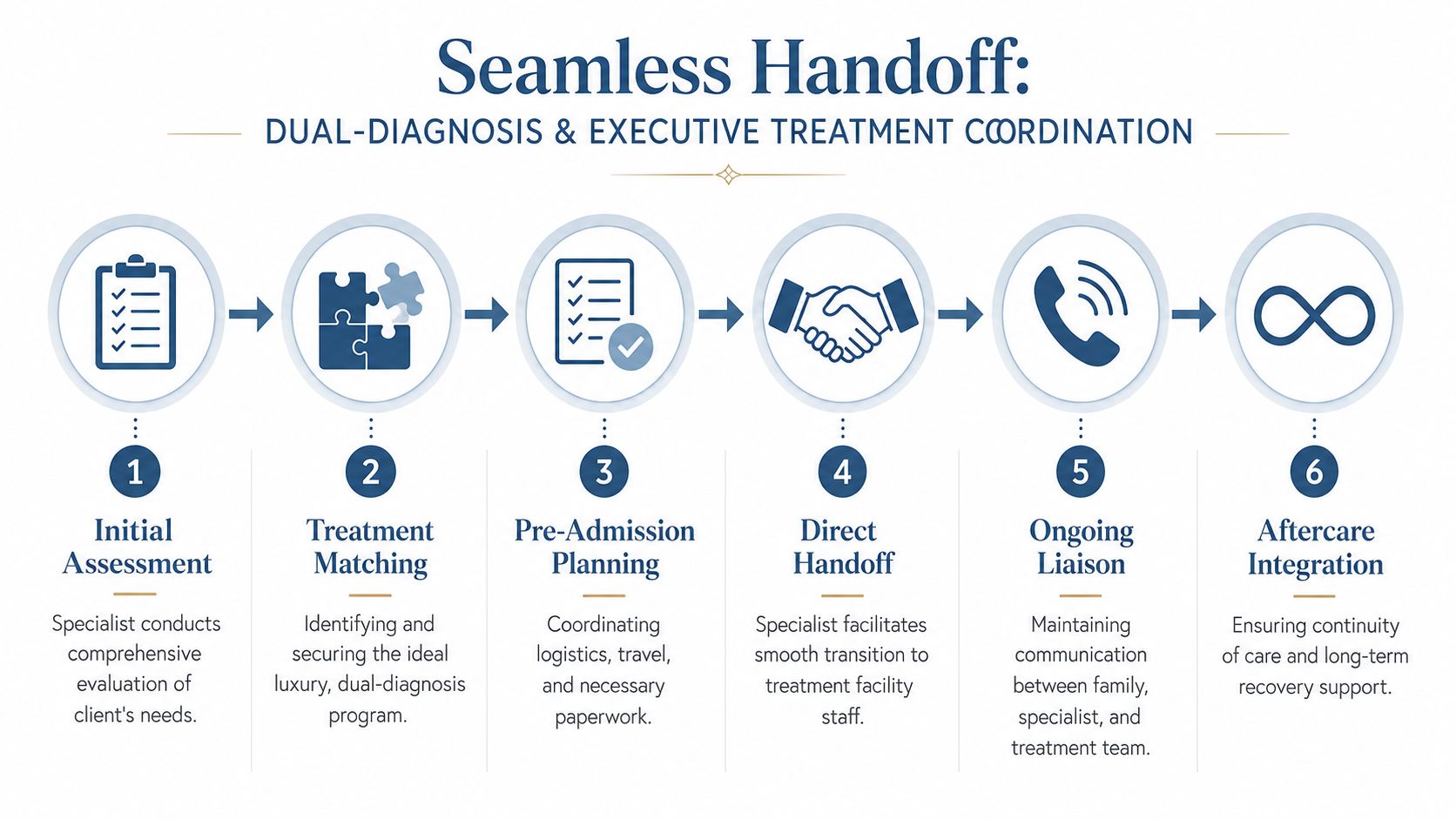
The intervention is only the front door. The crucial clinical question is what happens in the first hours after the person says yes. Many generic guides fail at this point. They treat the intervention as the main event. It isn't. The handoff into treatment is.
For executives with anxiety, depression, trauma, bipolar symptoms, self-harming behavior, or other psychiatric concerns, alcohol intervention specialists must think like triage coordinators. According to the American Addiction Centers intervention guide, professional guidance is highly recommended when the person has a history of serious mental illness or suicidal attempts. That point should shape the entire plan.
Why mental health stability comes first
A poorly handled intervention can destabilize someone who already feels cornered, ashamed, paranoid, or emotionally dysregulated. In a dual-diagnosis case, the specialist must account for medication issues, sleep disruption, trauma triggers, and the possibility that alcohol has been masking a psychiatric disorder.
That requires more than getting consent for treatment. It requires selecting a program prepared to manage both the addiction and the mental health condition from day one.
- Pre-admission coordination matters: The receiving clinical team should know the psychiatric concerns before arrival.
- The environment matters: High-profile clients often need private rooms, confidentiality, and a setting that reduces agitation rather than increasing it.
- Professional continuity matters: Executives may need structured access to phones and laptops so urgent career obligations don't become a reason to refuse care.
Luxury executive rehab settings commonly maintain a smaller census and higher staff-to-client ratios than standard centers, and some premium programs provide two individual therapy sessions per week instead of the standard one, as noted in executive rehab guidance from Rushton Recovery. Executive rehab facilities also commonly provide private rooms as a core amenity to support confidentiality and comfort, as described in executive treatment guidance on Rehabs.com.
Financial realism also matters
Families should understand the difference between the private-pay intervention process and the later treatment financing questions. If insurance complications arise around the treatment phase, practical resources such as this step-by-step health insurance appeal can help families organize the next move without losing momentum.
For households dealing with both alcohol misuse and psychiatric strain, dual-diagnosis support for high-achieving clients is often the more relevant treatment lens. The issue isn't just stopping alcohol. It's stabilizing the whole person without dismantling the structure of their life.
The best intervention is the one that lands softly inside the right clinical setting.
How to Begin the Conversation for Lasting Recovery
Families often wait for certainty. They want one more sign, one more bad event, one more confession. That delay protects the addiction, not the person.
The better standard is simple. If alcohol is changing judgment, relationships, reliability, or emotional stability, the conversation should begin now. For executives, that conversation should be disciplined, private, and built around immediate next steps. Not threats. Not moral lectures. A plan.
Leadership is not just what a person does in the boardroom. It's also the willingness of a family to act when facing uncomfortable realities. A professionally managed intervention is not an act of panic. It is a serious, compassionate decision to protect a life that still has enormous value.
Silence won't preserve a career. Structure might. Delay won't protect a family. Treatment might. When the person involved is highly accomplished and strongly resistant, alcohol intervention specialists often become the bridge between denial and care.
Reflections offers confidential guidance for families, executives, and referring professionals who need a discreet path into high-end dual-diagnosis treatment. As a California-licensed, Joint Commission-accredited luxury provider, Reflections delivers private-pay care for adults who need clinically advanced treatment, private rooms in both detox and rehab, a highly accredited multidisciplinary team, and appropriate access to electronics so work obligations can remain contained while recovery begins. Families seeking a private consultation can learn more through Reflections.