
A senior executive leaves a private residential program after 30 or 45 days and returns to a full inbox, a Tuesday board meeting, constant travel, and a dinner where wine is part of the ritual. The clinical environment that protected recovery has disappeared, but the pressure that contributed to substance use or psychiatric instability hasn't. That transition requires more than a discharge packet and a list of phone numbers.
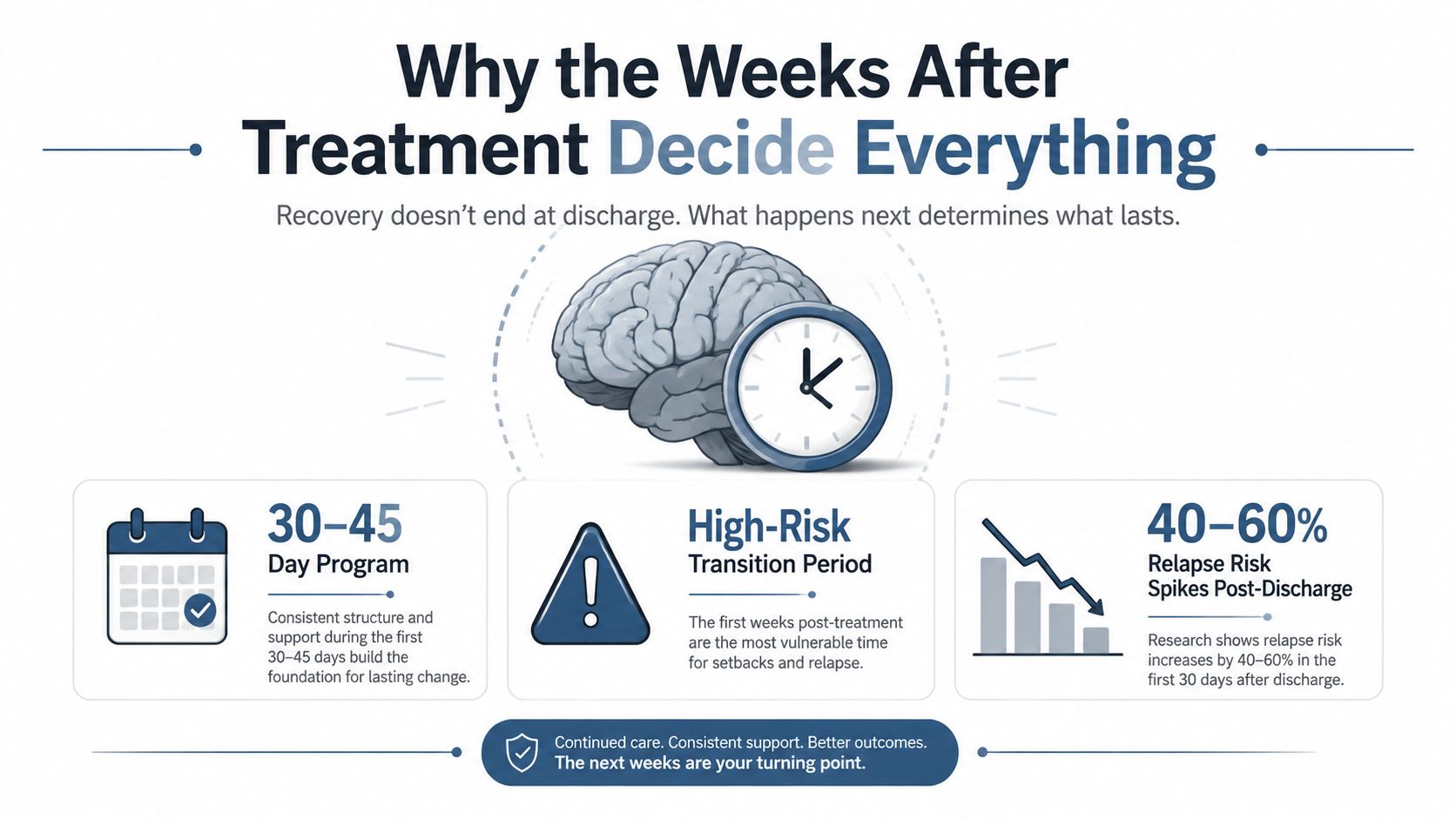
Why the Weeks After Treatment Decide Everything
Residential treatment works partly because it changes the client's environment. Access to substances is removed, sleep is structured, clinicians are nearby, and the daily schedule makes avoidance difficult. The client can focus on withdrawal management, psychiatric stabilization, therapy, nutrition, and the underlying causes of compulsive behavior without managing every professional demand at the same time.
Discharge removes that protective structure immediately. Continuing care replaces it with a portable system of appointments, monitoring, clinical communication, peer contact, medication follow-up, and rapid intervention when warning signs return. For executives, the system must fit around work without allowing work to become an excuse for therapeutic disengagement.
Research on continuing care supports an active approach. A major review found that recovery management checkups produced better substance-use outcomes and faster reentry to treatment after relapse, while broader evidence found a small but significant benefit for continuing care at treatment end and follow-up, measured as g = 0.187 and g = 0.271, respectively (review of continuing-care research).
The bridge must be designed before discharge
A working client shouldn't leave residential treatment with only a future appointment and general advice to attend meetings. The discharge plan should identify:
- Clinical ownership: One designated person should coordinate the therapist, prescriber, case manager, and support network.
- Early warning signs: The plan should name changes in sleep, mood, cravings, medication adherence, isolation, and work behavior that require action.
- Response steps: The client and family should know who to contact, what happens after a missed appointment, and when care intensity increases.
- Professional logistics: Sessions, secure telehealth, travel, electronics access, and privacy arrangements should be planned around the client's actual calendar.
A client may have significant financial resources, but money can't substitute for continuity. The first phase after residential treatment should be treated as a clinical inflection point, not a ceremonial end to treatment. Executives who protect time for recovery preserve the investment made in residential care. Those who return to unrestricted pressure without support leave the most vulnerable phase to chance. Discreet peer support groups can provide another layer of accountability without exposing private treatment details in the workplace.
Defining Continuing Care Beyond the Buzzword
What is continuing care? In recovery, it's the planned continuation of clinical and recovery services after an acute treatment episode, with enough structure to sustain gains, detect deterioration, and adjust treatment. The concept resembles chronic disease management. Diabetes, hypertension, and asthma require ongoing monitoring and treatment adjustments because symptoms can change after the initial intervention. Addiction and co-occurring mental health conditions demand the same refusal to treat discharge as a cure.
National health information guidance describes long-term care as including hospital-based continuing care, also called extended, chronic, or complex continuing care, for people with complex needs who aren't ready for discharge from hospital (Canadian Institute for Health Information). The term is broader than addiction treatment, but the central principle carries across settings: professional support continues as needs evolve.
In behavioral health, SAMHSA places continuing care within a continuum that includes promotion, prevention, treatment, and recovery. Its recovery-oriented model emphasizes services that are person-centered, self-directed, and adjustable over time (SAMHSA continuum-of-care guidance).
What continuing care is not
Aftercare often means a discharge recommendation. It can be useful, but the label doesn't guarantee active monitoring or clinical accountability.
Step-down care, including PHP or IOP, describes a level of treatment intensity. Continuing care is the longer-term operating philosophy that can include those levels, outpatient services, medication management, peer support, and case coordination.
Sober living is a housing model. It may provide structure and peer accountability, but it isn't automatically clinical treatment.
Alumni programming can strengthen connection, yet social events without outcome measurement or relapse-response procedures shouldn't be marketed as continuing care.
Practical rule: If no clinician owns the plan, no one measures progress, and no one has authority to increase support, the arrangement is discharge planning, not a complete continuing-care system.
Residential treatment is the ignition phase. Continuing care is the guidance system. For an executive, that guidance system must protect privacy, accommodate professional obligations, and remain clinically active when the client travels, faces a crisis, or begins to disengage. An extended care program can provide a more deliberate bridge than a generic referral list.
Models That Make Up a Modern Continuing Care Plan
No single format fits every professional. A client with stable mood, reliable medication adherence, and a strong home environment may manage with outpatient therapy and scheduled psychiatric follow-up. A client with repeated relapse, unstable sleep, trauma symptoms, or high-risk travel may require more frequent contact and a monitored setting.
The practical models include:
- Outpatient psychotherapy: Weekly or biweekly individual sessions can address cravings, emotional regulation, trauma, relationships, and workplace stress.
- IOP or PHP: More intensive programs combine group and individual work and can be appropriate when outpatient contact doesn't provide enough containment.
- Monitored residence: Sober living or another structured residence can reduce environmental exposure while the client rebuilds routines.
- Peer engagement: Alumni communities, mutual-support meetings, and recovery coaching add accountability outside formal appointments.
- Telehealth and case management: Secure video sessions, check-ins, coordination, and travel planning keep care connected across locations.
- Medication maintenance: Naltrexone, buprenorphine, or SSRIs may be used when clinically appropriate and paired with psychotherapy. SAMHSA describes substance use disorder treatment as most effective when medication is combined with counseling and behavioral therapies in a whole-patient approach (SAMHSA treatment guidance).
Standard and executive-adapted formats
| Model | Standard Format | Executive Adaptation |
|---|---|---|
| Outpatient therapy | Fixed daytime appointment | Early-morning, evening, or protected private-suite sessions |
| IOP or PHP | Set group and individual schedule | Secure teleconferencing, planned work blocks, and discreet attendance |
| Monitored residence | Shared structure and house rules | Private accommodation, confidential coordination, and business continuity planning |
| Peer support | Local meetings or alumni contact | Carefully selected peer access, virtual participation, and travel-compatible support |
| Medication management | Routine prescriber visits | Coordinated prescribing, medication reconciliation, and secure communication |
| Case management | Basic referrals and reminders | Travel logistics, provider coordination, family communication, and escalation planning |
Electronics access can be clinically useful when it's bounded. A laptop or phone may allow a client to handle essential obligations, but unrestricted access can also enable secrecy, sleep disruption, work compulsion, or contact with people connected to substance use. The policy should specify permitted use, private work areas, monitoring expectations, and the circumstances that require clinical review.
For complex travel and transition needs, Approved Experiences Traveler care coordination offers a relevant reference point for organizing support across logistics and providers. The executive client still needs a clinical team capable of interpreting symptoms, not merely arranging appointments.
How Continuing Care Fits Dual Diagnosis Treatment
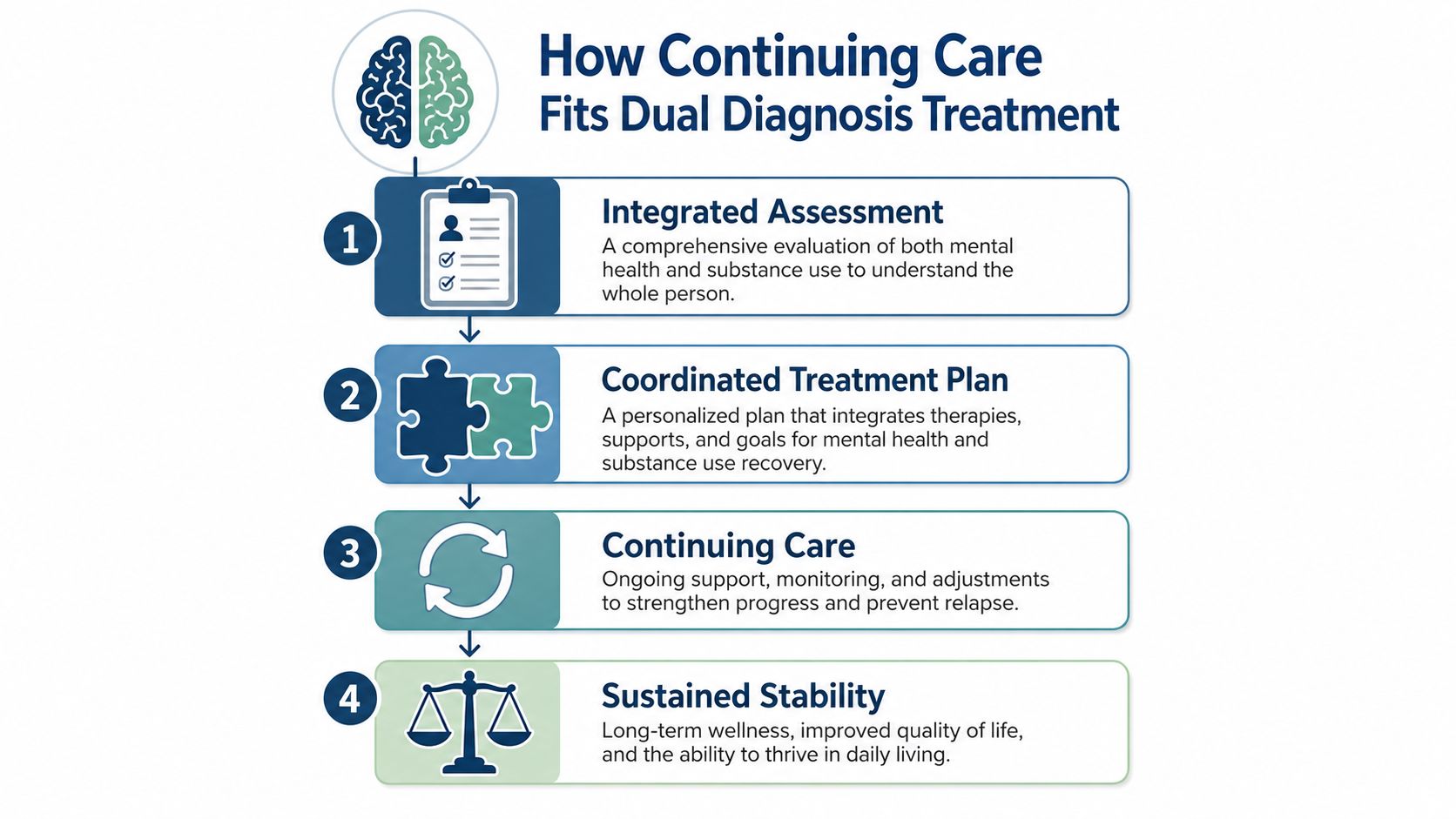
A senior partner leaves residential treatment on Friday and returns to a full calendar Monday. If the addiction clinician, psychiatrist, therapist, and employer-facing coordinator work from different plans, insomnia may be treated as a scheduling problem, cravings may be missed, and medication changes may go unreported. Dual diagnosis care fails when psychiatric and substance-use treatment separate after discharge.
The team should maintain one clinical formulation covering substance use, depression, anxiety, trauma, bipolar disorder, or executive dysfunction. That plan must connect medication management, addiction therapy, sleep stabilization, relapse prevention, and mutual-support participation. Before discharge, the record should specify diagnoses, medications, withdrawal risks, warning signs, response protocols, and upcoming appointments.
Measurement prevents polite drift
A program needs scheduled review before a crisis forces action. Track:
- Medication consistency: Review missed doses, side effects, and unsupervised changes promptly.
- Sleep and mood: New sleep disruption can signal mania, medication problems, depression, or renewed substance use.
- Substance-use targets: State abstinence or reduced-use goals clearly and match them to the clinical plan.
- Functioning: Assess work performance, relationships, self-care, and decision-making, not symptoms alone.
- Engagement: Missed sessions and reduced communication may indicate avoidance rather than recovery.
The team should record these measures consistently and define who responds when they worsen. Outcomes measurement gives an executive client and authorized clinicians a shared basis for adjusting care, rather than relying on confidence or polished updates.
Secure records, messaging, and telepsychiatry can support continuity without workplace disclosure. Executives may require early-morning sessions, limited after-hours demands, and a named crisis contact. Privacy protects a career only when it does not hide clinically significant deterioration from the authorized care team. Electronics access should follow the same principle: permit necessary work and communication, while setting boundaries around sleep, secrecy, and contacts linked to substance use.
Continuing care should remain active and responsive to relapse risk. A review describes a minimum duration of three to six months, with care extending to 12 months potentially needed for recovery (PubMed-indexed review). Another continuing-care review links longer planned care with better outcomes and reports that approximately 12 months may be needed when higher abstinence outcomes are the objective.
Trauma-related symptoms require coordinated treatment rather than a substance-use plan alone. Referral sources can review Vancouver Counselling Clinic trauma services when deciding how trauma-focused work fits the continuing-care plan.
Realistic Timelines for Working Professionals
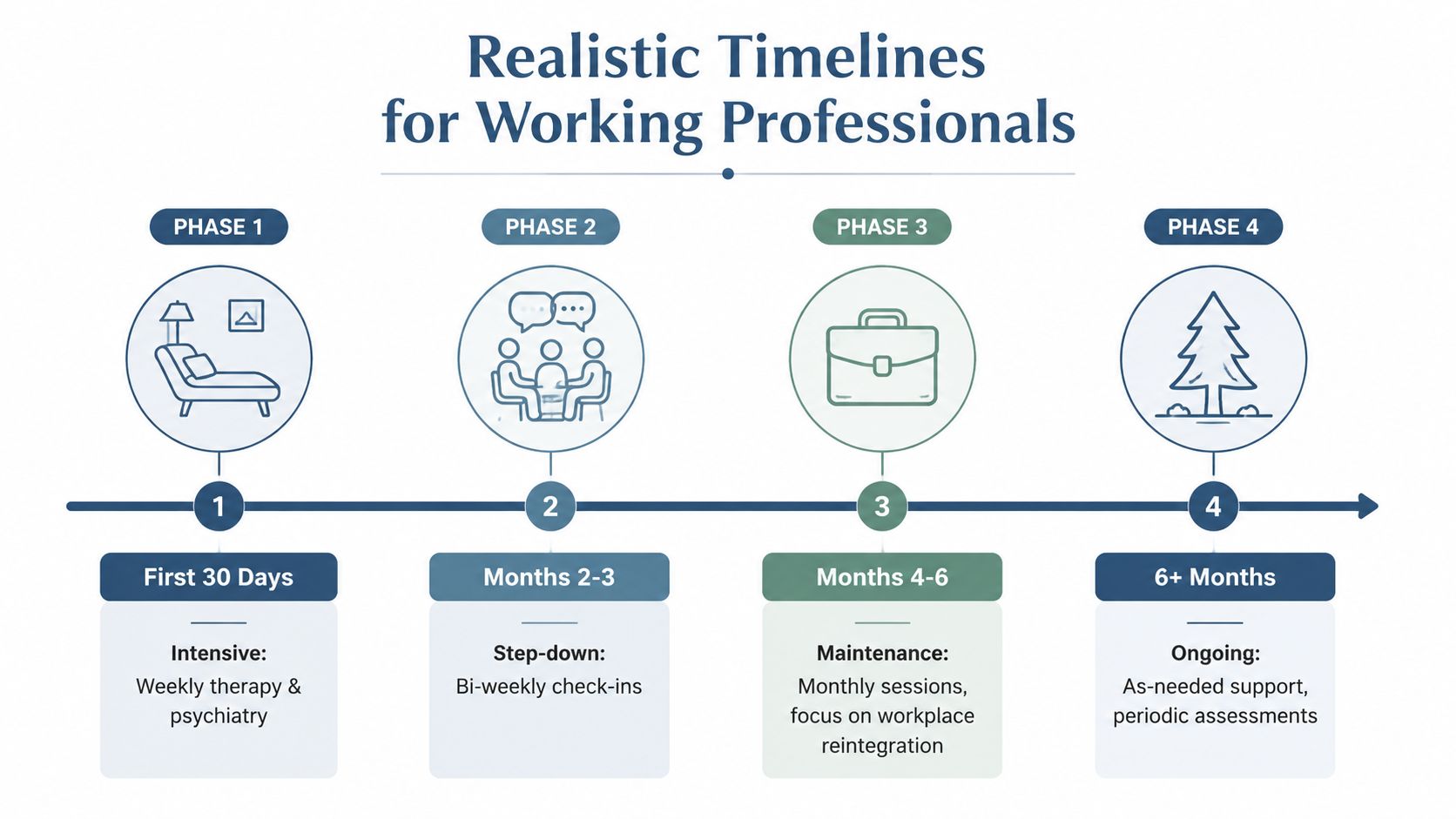
Continuing care should be phased, not sold as an automatic end date. The schedule must respond to risk, functioning, symptoms, and engagement. A professional client may reduce appointment frequency while responsibilities increase, but accountability should never disappear just because the calendar becomes crowded.
The first 30 days
A chief executive returns home on a Monday and keeps the work calendar intentionally limited. During the first week, the outpatient therapist reviews the residential formulation, the prescriber reconciles medications, and the case manager confirms privacy and travel procedures. The client uses a written relapse-response plan and maintains structured sleep, nutrition, and peer contact.
By the second and third weeks, therapy remains weekly, psychiatric follow-up occurs as clinically indicated, and the team reviews cravings, mood, medication consistency, sleep, and work tolerance. A missed appointment triggers contact rather than passive rescheduling. The question isn't whether the client feels confident. It's whether the recovery system is functioning under real-world pressure.
Days 31 through 60
Work responsibilities may expand during the second month. A workable schedule could include one evening therapy session, a secure telepsychiatry check-in, two recovery meetings, and a weekend wellness block. Travel should be planned with medication continuity, remote appointments, local emergency contacts, and a defined response if the client begins using again.
SAMHSA and Medicaid guidance states that continuing care should be offered to youth entering substance use treatment regardless of whether they complete the initial episode, and that starting care within two weeks of leaving treatment improves outcomes. Some models also use assertive outreach during the first 90 days after discharge (SAMHSA and Medicaid bulletin). The operational lesson applies broadly: contact should begin before motivation fades.
Day 90 and beyond
After 90 days, some clients continue weekly therapy while psychiatric appointments or peer participation become less frequent. Others require more support because cravings, mood instability, missed medication, return-to-use episodes, or workplace impairment have re-emerged.
Continuing care may last six to twelve months or longer when co-occurring disorders, chronic pain, trauma, or repeated relapse increase vulnerability. Clinicians should review appointment adherence, medication consistency, substance-use targets, sleep, mood, work functioning, and quality of life. The correct duration follows risk, not a marketing promise.
The Family Role in Sustained Recovery
Family members aren't spectators. They can provide information, reinforce boundaries, support medication routines, and recognize changes the client may minimize. Their involvement must still preserve the client's autonomy and confidentiality.
The first clinical step is written consent. The plan should define what relatives may know, how the team communicates, which topics remain private, and what circumstances justify urgent contact. An executive may authorize a spouse to receive updates while excluding colleagues, employees, board members, and insurers from treatment details.
Engagement should be practical
High-quality programs give families specific skills rather than vague encouragement. Useful formats include:
- Family therapy: Clinicians address conflict, enabling behavior, communication, and boundaries in a structured setting.
- Education sessions: Relatives learn how addiction, trauma, depression, anxiety, or bipolar symptoms can affect behavior and recovery.
- Coaching calls: Short, private calls help family members respond to warning signs without surveillance or coercion.
- Selected treatment meetings: Participation is limited to sessions that support the care plan and the client's consent.
- Crisis coordination: Designated relatives know whom to contact if sleep collapses, medication is stopped, or substance use resumes.
Family participation should produce observable changes. Relatives should become less enabling, communicate more directly, report concerns earlier, and coordinate more effectively during stress. It shouldn't become a monitoring arrangement that forces the client to perform recovery for the household.
Secure video sessions and discreet scheduling help protect professional reputation. When housing is unsafe, abuse is present, or family conflict worsens symptoms, clinicians may restrict involvement and prioritize safety. The family is a clinical lever, but the lever must be used with consent, boundaries, and sound judgment.
Choosing the Right Continuing Care Partner
Choosing a continuing-care partner is a clinical decision, not a branding exercise. A polished setting matters to executives who need privacy and comfort, but the decisive questions concern accreditation, clinical depth, staffing, communication, and measurable follow-through.
A prospective client or referral source should verify whether the provider holds Joint Commission or CARF accreditation, aligns services with appropriate ASAM levels of care, and employs board-certified psychiatrists with dual-diagnosis experience. The program should explain who will manage therapy, medication, case coordination, family communication, and crisis escalation after discharge.
What the written plan should prove
A credible provider can name the post-discharge therapist, prescriber, and case manager before residential treatment ends. The plan should document appointment dates, medication responsibilities, communication permissions, travel procedures, electronics expectations, and criteria for increasing care.
Standard aftercare often stops at referrals. Executive-grade coordination should address secure business-hours electronics access, encrypted telehealth, concierge travel logistics, and outcome reporting. Programs may track retention, psychiatric stability, employment continuity, medication adherence, and return-to-use episodes, but they shouldn't claim results without defining how those outcomes are measured.
| Criterion | Standard Aftercare | Executive Continuing Care |
|---|---|---|
| Discreet access | General appointment options | Protected scheduling, private telehealth, and controlled electronics access |
| Dual-diagnosis depth | Separate therapy and medication referrals | Integrated psychiatric, addiction, trauma, and sleep coordination |
| Family engagement | Optional family handout | Consent-based sessions, education, coaching, and crisis roles |
| Travel support | Client arranges logistics | Care team coordinates appointments, medication continuity, and escalation contacts |
| Follow-through | Discharge packet and reminders | Named clinicians, active outreach, measurement, and documented adjustments |
| Work continuity | Generic return-to-work advice | Calendar-sensitive planning that protects recovery and essential obligations |
A luxury setting should never be confused with clinical superiority. The relevant question is whether the environment helps a client engage openly while the team maintains rigorous care. Reflections, for example, describes a California-licensed, Joint Commission-accredited residential program with dual-diagnosis treatment, private rooms, appropriate electronics access, multidisciplinary clinicians, medication-supported withdrawal when indicated, family education, and continuing-care coordination. Its recovery coaching services represent one component to evaluate within a broader post-residential plan.
Next Steps and Common Questions
Executives and families should begin planning before residential discharge. Waiting for a crisis creates avoidable risk, disrupts work, and leaves privacy decisions to the last minute.
- Schedule a confidential intake call: Review substance-use history, psychiatric symptoms, work obligations, travel, family dynamics, and privacy requirements.
- Request the written plan before admission: It should show how residential treatment connects with therapy, psychiatry, medication management, peer support, and case coordination.
- Confirm electronics and travel logistics: Ask what phone and laptop access is permitted, where private calls occur, and how international travel will be handled.
- Align the outpatient team early: Identify the receiving therapist and prescriber before discharge. The first appointment should be scheduled, not left to chance.
- Define measurement: Agree on the symptoms, behaviors, appointments, medication routines, and work-function markers the team will review.
Common questions
How long should continuing care last?
Several months is a sound starting point, with longer care when relapse risk, psychiatric symptoms, or work instability remains high. Clinical reviews commonly describe three to six months as a minimum and support extending care toward 12 months for more complete recovery, as noted earlier. The plan should change when symptoms or functioning change.
Can continuing care be delivered remotely?
Yes. Secure telehealth, messaging, coaching, and case management can support many appointments. Remote care still requires clear clinical ownership, privacy safeguards, medication coordination, and a local emergency plan. Electronics access should support treatment rather than undermine boundaries.
How is medication management handled across providers?
Assign one prescriber or psychiatric lead to reconcile medication changes, monitor side effects, coordinate with primary care when needed, and prevent contradictory instructions. Document every change and identify who responds when symptoms worsen.
What happens during international travel?
Before departure, confirm appointments, medication continuity, local emergency contacts, time-zone logistics, and the response protocol. Travel is a clinical variable that can affect sleep, access to medication, communication, and relapse risk.
How is confidentiality protected with employers and boards?
Share information only with the client's written authorization, except where applicable law creates a safety obligation. Use secure communication and discreet scheduling while preserving the clinical oversight needed for safe care.
What should families expect at 30, 60, and 90 days?
At 30 days, review engagement, medication consistency, sleep, mood, and relapse-prevention behaviors. By 60 days, assess whether the plan holds under work pressure and travel demands. At 90 days, decide whether to maintain, step down, or intensify care based on symptoms, substance-use targets, functioning, and adherence.
Continuing care is a planned, measurable phase, not an open-ended subscription. It should protect recovery while a professional returns to demanding responsibilities.
Reflections provides private residential detox and rehabilitation, dual-diagnosis treatment, appropriate electronics access, private rooms, family involvement, and structured continuing-care coordination for executives and working professionals. Visit Reflections to arrange a confidential conversation about transition beyond residential treatment.