

You can keep the laptop open, answer the urgent email, and still know the nights are getting harder. The problem isn't productivity, it's that trauma starts leaking into judgment, sleep, and presence, and high-performing people usually notice it last because the calendar keeps moving. For executives and founders who need privacy, structure, and real clinical depth, equine therapy for PTSD deserves a serious look, but only when it's part of a tightly managed treatment plan that protects dignity, safety, and continuity of work.
Why Executives Are Asking About Equine Therapy for PTSD
A partner who can still run a meeting but can't shut off the startle response at 2 a.m. is not looking for spa language. They're looking for treatment that can reach the body, reduce hyperarousal, and do it without turning life upside down. That's why experiential care has moved from niche veteran programs into premium dual-diagnosis settings, where the question isn't whether the setting is comfortable, it's whether the intervention is clinically defensible and operationally realistic.
For that audience, horse work only matters if it sits inside a real treatment culture. Reflections' executive rehab program is built around that reality, private rooms, discreet care, and the ability to keep electronics so work obligations don't become a reason to delay treatment. That matters because many high-acuity professionals don't need a retreat. They need a place where treatment can happen without burning down their career.
Why this modality gets attention in high-end care
Horses are not being used here as a luxury accessory. They're being used because trauma often shows up as body tension, emotional shutdown, poor sleep, and a narrow stress tolerance that office talk therapy doesn't always loosen fast enough. In a luxury setting, that makes equine work useful as a somatic and relational entry point, especially when the client is bright, skeptical, and used to managing everything through intellect.
Practical rule: If a program sells horse sessions as a stand-alone wellness add-on, the clinical value is probably being oversold. If it uses horses to deepen regulated engagement inside a credentialed PTSD and addiction track, the concept is far more credible.
The executive audience should be asking a different question than the typical consumer. It's not “Is this relaxing?” It's “Does this help me stay in treatment, regulate faster, and keep making progress while my life remains active?”
What Equine-Assisted Therapy Actually Is
Equine-assisted therapy is a clinical umbrella, not a single activity. The main forms are equine-assisted psychotherapy, equine-assisted learning, and equine-facilitated experiential learning. In practice, that means the horse is part of a structured therapeutic process, not a recreational ride dressed up in clinical language.
The important distinction is simple. Ground-based work means approaching, haltering, leading, grooming, observing herd behavior, or doing liberty exercises. Mounted work, if it's used at all, is separate and not required for trauma treatment. A client does not need riding experience to participate meaningfully.
Who is in the arena
A proper session has a mental health professional, an equine specialist, and the horse. The clinician handles the psychological frame, risk containment, and processing. The equine specialist manages the horse, reads behavior, and protects physical safety. The horse is not a prop, it's a responsive partner whose behavior becomes part of the therapeutic material.
That triad matters because trauma work needs both emotional containment and real-world feedback. If a client is tense, avoidant, overcontrolled, or scattered, the horse often reflects that immediately through movement and proximity. That feedback is far more concrete than a therapist asking, again, whether the client “feels safe.”
What it is not
Equine therapy is not the same as therapeutic riding, hippotherapy, or casual barn exposure. Those may have value in other contexts, but they are not the same as trauma-focused experiential psychotherapy. For an executive deciding whether to invest time and privacy, the label has to mean something clinically specific.
Clients should ask whether the horse work is grounded in treatment goals, or whether it's being offered mainly as an amenity. The difference determines whether the session changes the nervous system or just fills an afternoon.
The Clinical Evidence for PTSD Outcomes
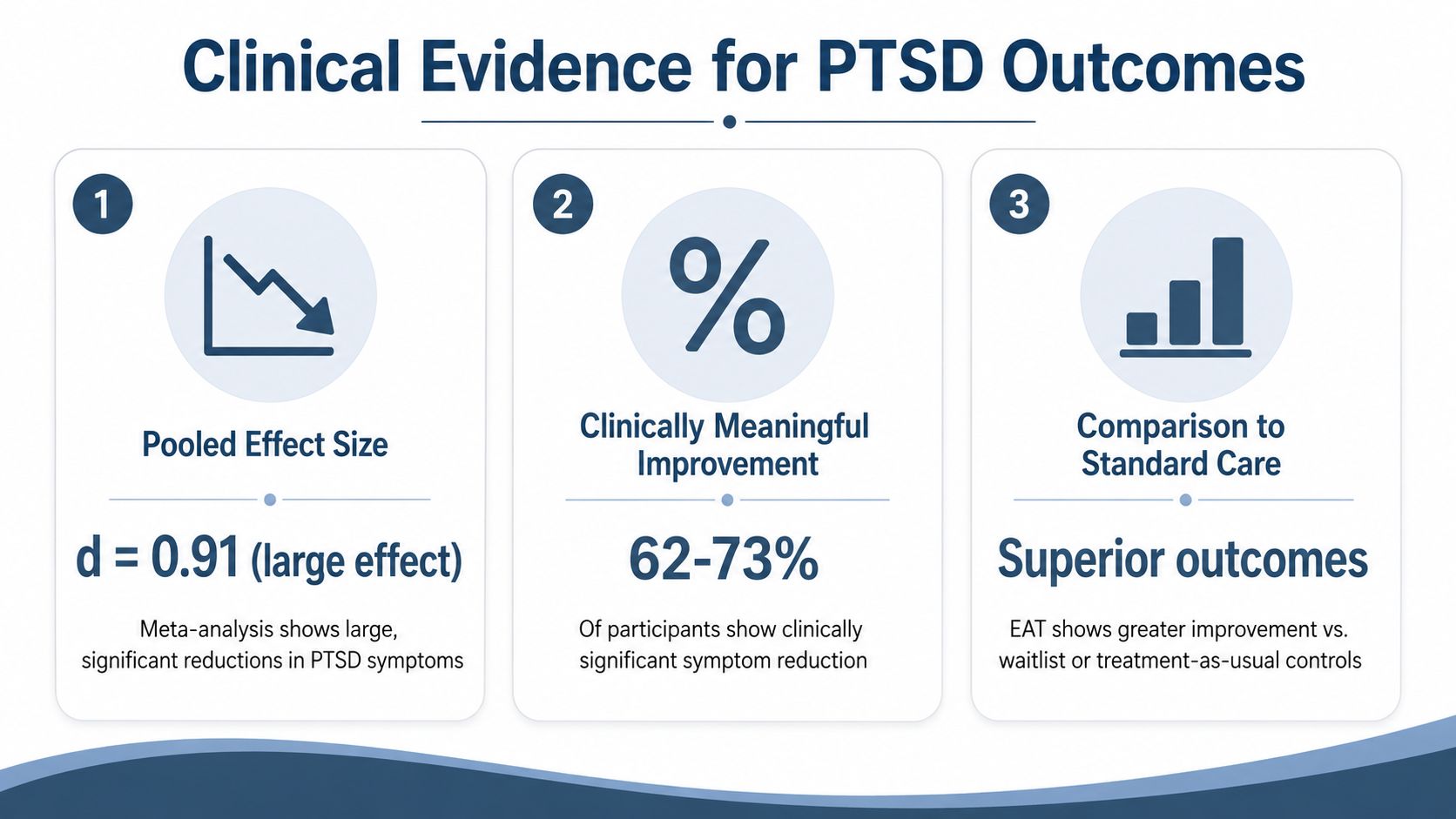
The evidence is solid enough to matter, and still incomplete enough to demand discipline. A 2024 systematic review and meta-analysis of equine-assisted services for military veterans found that 8 of 13 studies reported PTSD scores, with a pooled mean reduction of 12.46 points on PTSD scales, an average 22.59% improvement across studies, and individual study gains ranging from 4.02% to 50.68%. A separate 2024 PubMed meta-analysis reported the same pooled mean difference and a 22.6% reduction in PTSD scores after treatment. For an executive weighing care options, that is real symptom movement, not therapy theater.
The functional outcomes deserve equal attention. In an open case series, total SPRINT scores improved from 24.38 ± 6.4 at baseline to 21.54 ± 7.94 after 6 months, and disability improved as well. The same study reported inefficiency dropping from 4.15 ± 2.73 days per week to 1.88 ± 2.18 days per week at 6 months. That matters in high-demand care, because daily performance is what breaks first when PTSD is running the show.
What the strongest studies suggest
A randomized study using the Equine Partnering Naturally approach found large immediate post-treatment effects for posttraumatic stress symptoms d=1.21, generalized anxiety d=1.01, mindfulness strategies d=1.28, and smaller but still meaningful effects for depression d=0.54 and reduced alcohol use d=0.58. That pattern fits dual-diagnosis care. Horse-based work can support regulation, attention, and substance-use risk in the same treatment plan, which is exactly why it belongs inside a structured residential program rather than on the side of it.
The Columbia veteran findings get cited because they showed a strong clinical signal. The program reported a marked reduction in PTSD and depression in more than 50% of participants at both post-treatment and three-month follow-up Columbia Psychiatry report. That does not make equine therapy a cure. It does justify serious consideration when the rest of the program is built around evidence-based trauma treatment and the client still has work obligations to manage during care.
For a broader orientation to PTSD care options, the guide by Be Your Best Self Thrive is a useful starting point, and the treatment discussion should sit alongside a look at equine therapy for mental health when you are evaluating how experiential work fits into a higher-acuity plan.
The limits matter
The field still has problems that no serious program should hide. A 2023 review of equine-assisted therapy for PTSD included 10 studies and found significant symptom reduction, while also calling for more research and far better standardization. The 2024 veteran review made the same point more directly. Study quality remains uneven, and protocols vary too much across programs 2024 review.
That is the right lens for a C-suite buyer. Equine work is evidence-informed adjunctive care, not a standalone PTSD cure, and any program that sells it as a replacement for CBT, DBI, ACT, or other trauma-focused treatment is overselling the product.
Why Horses Help the Nervous System Reset
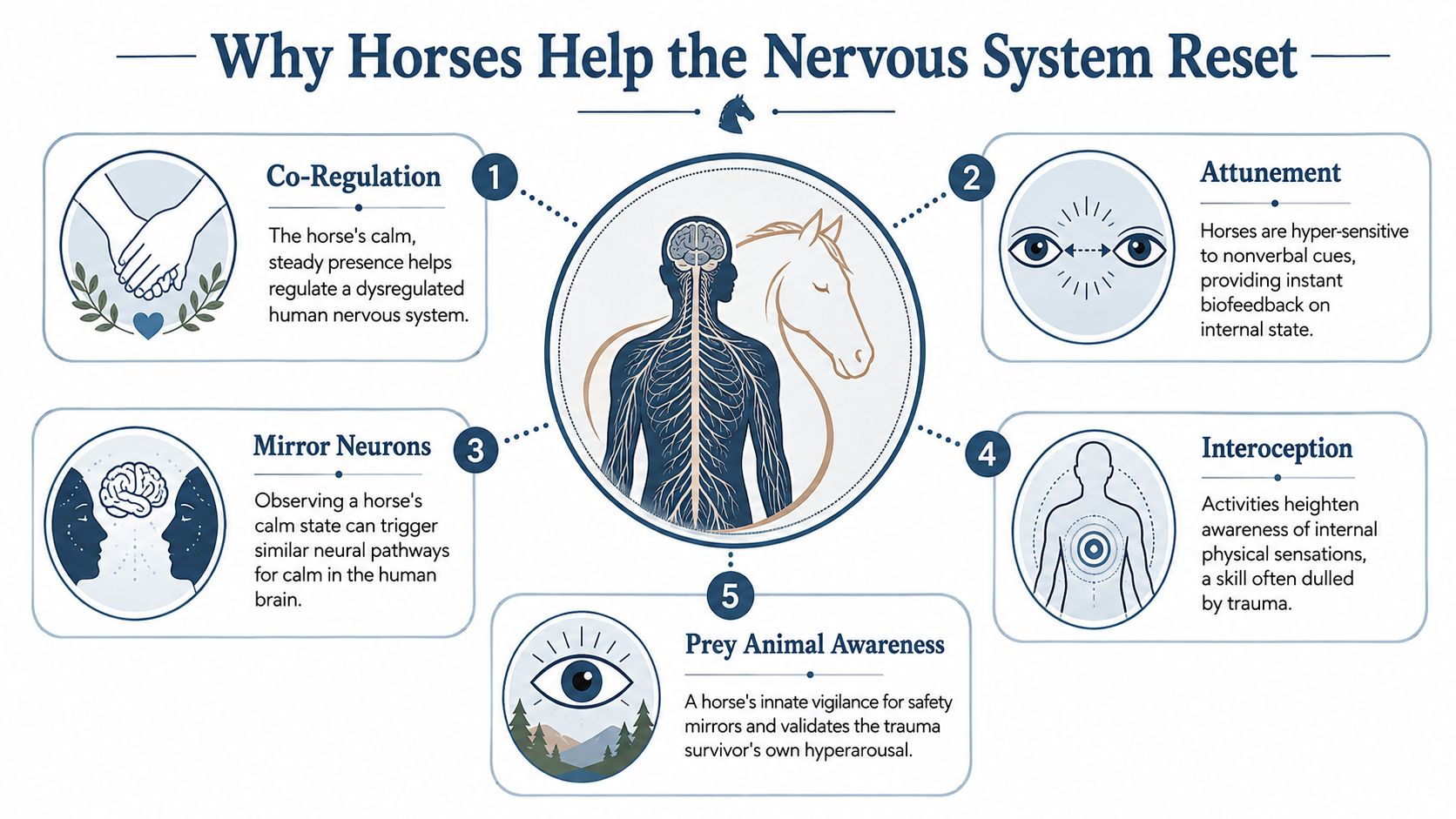
Trauma recovery is not just a conversation problem. It's an attunement problem, a body-state problem, and often an avoidance problem. Horses help because they make the client's internal state visible in real time. That gives the clinical team a live read on arousal, tension, posture, and control that can be used for regulation work.
A horse is a prey animal, so it's exquisitely sensitive to nonverbal cues. That sensitivity supports co-regulation, because the client's nervous system gets immediate feedback about whether their body is signaling threat or steadiness. It also supports interoception, the ability to notice internal sensations before they escalate into panic, shutdown, or impulsive behavior.
What the horse is actually teaching
The useful mechanism isn't mystical. It's experiential learning. A client who stays braced around the horse sees the horse respond. A client who slows their breath, softens posture, and gives the animal consistent cues often gets a different response. That loop can bypass the verbal defenses that keep trauma locked behind analysis.
This is also where attunement and relational repair come in. A horse doesn't care about title, income, or résumé. It responds to presence, timing, and clarity. For a professional who lives in performance mode, that can be humiliating at first, then liberating once the system realizes it doesn't have to manage everything through control.
Clinical insight: The horse does not replace therapy. The horse creates conditions where therapy lands faster because the body is already involved.
The randomized study's finding that horse-based work increased mindfulness strategies d=1.28 and reduced alcohol use d=0.58 is especially relevant for dual-diagnosis care randomized study. Those changes fit a sensible mechanism. Better affect regulation makes it easier to notice triggers early, and that lowers the odds of reaching for substances to blunt the edge.
What a Session Looks Like From the Client Side
The first thing a high-profile client should know is that no one is expected to “be a horse person.” The standard is not prior experience, it's willingness to engage. A good program starts with a clinical check-in, confirms the day's target, and then sets a safety frame that includes the option to stop at any point.
The practical details matter more than the brochure language. Closed-toe boots, long pants, and minimal jewelry are standard expectations. A small herd is often easier to manage than a large one because it keeps the environment contained and the feedback cleaner. If the client has never touched a horse, the team should scaffold the entry slowly and deliberately.
A representative flow
- Pre-session review. The clinician checks mood, arousal, triggers, and goals for the session.
- Safety briefing. The equine specialist explains how to approach, lead, and move around the animal.
- Groundwork. The client may groom, halter, lead, or observe the horse before any deeper task begins.
- Optional mounted work. If a program uses riding, it's an add-on, not a requirement.
- Processing. The session closes back in a therapeutic setting, where the clinician helps translate the experience into treatment language.
Privacy is part of the value proposition for executives. Sessions should be one-on-one or carefully limited, with confidentiality built in and clear permission to step out if the material feels too activating. That matters for clients who are accustomed to holding everything together in public and need a place where they can stop performing without losing control.
How Equine Work Fits Inside an Evidence-Based Program
Equine sessions are useful when they sit inside a real treatment architecture. Alone, they may help engagement. Integrated into a rigorous dual-diagnosis program, they can support the deeper work of PTSD recovery, emotion regulation, and substance-use stabilization.
That's why a luxury residential setting has an advantage when it does this correctly. Clients can move between horse work, CBT for trauma, DBT for emotion regulation, ACT for psychological flexibility, and medication support when appropriate, without losing continuity. Reflections also allows clients to keep phones and laptops, and that changes the calculus for working professionals who can't disappear from their roles.
The point is not to create a soft experience. The point is to make a hard experience sustainable enough that the client stays in treatment long enough to benefit.
The same logic applies to somatic work more broadly. Reflections' somatic experiencing at Reflections fits this model because trauma is often stored as body-level activation, not just a story to be retold. In a properly sequenced program, horse work can prime the body, then the rest of therapy can consolidate the insight.
Medication-assisted treatment can also fit, when clinically indicated and coordinated carefully. For executives with alcohol use disorder or opioid use disorder, the question is not whether experiential therapy replaces medical care. The question is whether the whole plan is coherent, measurable, and respectful of the person's actual life constraints.
Safety, Contraindications, and Honest Limitations
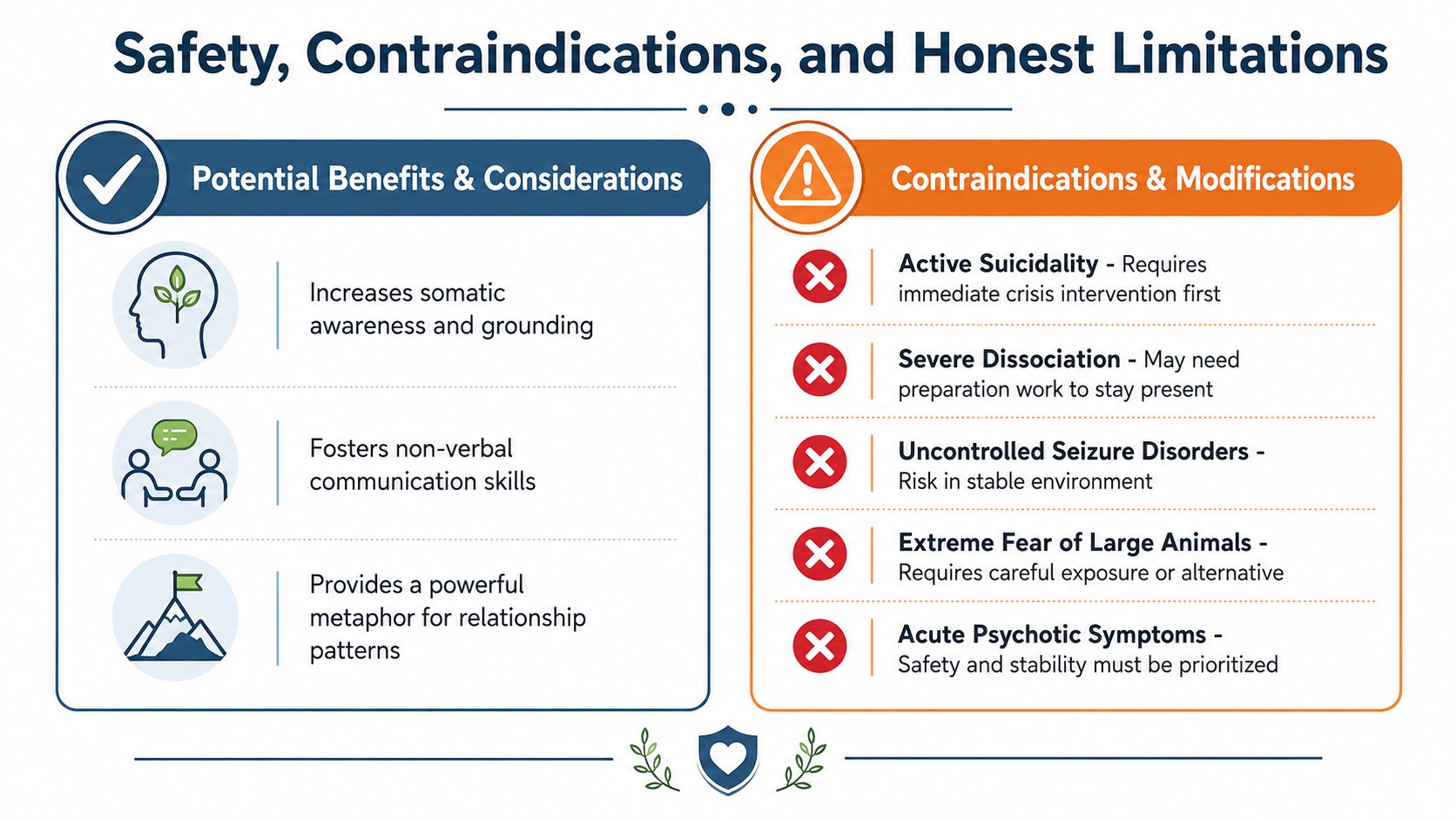
Horse work is not for everybody, and reputable programs should say that clearly. Active suicidality, severe dissociation, active withdrawal, uncontrolled seizure disorders, major orthopedic limitations, and genuine phobia of horses all require screening and, in some cases, deferral or modification. If a program acts like those issues don't matter, it's not being responsible.
That caution is especially important because horses are large animals, and the risk has to be managed by trained staff, not by optimism. A legitimate program screens during intake, staffs sessions with both a mental health clinician and an equine specialist, and keeps the treatment frame tight enough that the horse remains a therapeutic partner, not an uncontrolled variable.
What to expect from a serious program
- Increases somatic awareness and grounding, because the work is rooted in the body, not just the story.
- Fosters non-verbal communication skills, which matters for clients who over-rely on control and language.
- Provides a powerful metaphor for relationship patterns, especially around boundaries, trust, and responsiveness.
The limitations are just as important. Reviews repeatedly note the lack of enough rigorous trials, manuals, and safety data to make broad claims across all populations 2023 review 2024 review. That's why horse work should be framed as a way to improve participation, regulation, and insight, not as a magical fix for PTSD.
If the pitch sounds universal, it's probably weak. The best programs are specific about who benefits, who needs modification, and who should wait.
Choosing a Reputable Program and the Right Questions to Ask
High-end care should feel discreet, but it should also feel exacting. The first question is accreditation. A legitimate residential program should be able to speak clearly about Joint Commission or CARF standards, clinical staffing, and how trauma work is supervised. The second question is whether the horse program is clinically integrated or merely decorative.
Executives should ask who is in the room. A premium program should have PhD-level psychologists, psychiatrists, LMFTs, certified addiction counselors, and an Executive Clinical Director who can coordinate the plan across modalities. That matters because horse work without psychiatric depth can look polished while missing the diagnosis under the surface.
A practical vetting checklist
- Accreditation: Ask whether the program is accredited and how that shapes quality oversight.
- Clinical depth: Ask who leads trauma treatment, who manages medication, and how dual-diagnosis care is handled.
- Equine integration: Ask whether horse sessions are part of formal treatment planning or just an optional extra.
- Safety screening: Ask how dissociation, suicidality, seizures, physical limits, and animal fear are handled.
- Work continuity: Ask whether clients can keep their phones and laptops to meet essential obligations.
- Room standards: Ask whether private rooms are standard in both detox and residential rehab.
- Family involvement: Ask whether the program offers private family sessions and educational workshops.
- Medication coordination: Ask how horse work fits with medication-assisted treatment when that's clinically indicated.
Families usually want practical answers after the admissions call. Insurance generally won't cover equine therapy as a separate item, but it may be covered as part of residential treatment when it's clinically indicated and included in the program structure. If a client has never ridden or has physical limitations, ground-based work is the standard adaptation, not an afterthought.
Family participation also matters in premium care. Private family sessions and monthly educational workshops give relatives a way to understand the trauma cycle without turning the client into a case study at the dinner table. That's the right level of involvement for people trying to rebuild trust while preserving dignity.
When evaluating a program, the best final question is simple. Ask whether the treatment plan is designed around the client's actual life, or around an idealized version of recovery that assumes work, privacy, and family responsibilities can all be paused. For executive-grade care, that answer should be obvious.
Reflections offers private, accredited dual-diagnosis residential care with structured equine therapy, somatic work, and evidence-based psychotherapy in a setting designed for professionals who can't afford to disappear from their lives. If horse-based trauma treatment sounds relevant, visit Reflections to review the program, ask about executive accommodations, and start a confidential admissions conversation.