

A great many professionals arrive at treatment with a familiar private thought. They can manage a company, a team, a crisis, and a calendar that would flatten others. Yet they can't reliably access calm, closeness, or emotional clarity when they need it most.
That split creates a specific kind of suffering. Outwardly, life still looks intact. Internally, the system starts running on control, performance, and sheer cognitive force. Conversations become managed instead of felt. Rest stops restoring. Relationships begin to feel like one more domain to optimize. For executives, founders, physicians, attorneys, and other high-functioning adults, that pattern often hides trauma, anxiety, depression, substance use, or a mix of all of them.
Equine therapy for mental health matters in this context because it reaches places that high intellect alone often can't. It brings a person into direct contact with nonverbal patterns, emotional regulation, trust, boundaries, and authentic presence. When it's clinically grounded and carefully integrated into treatment, it isn't a novelty. It's a serious therapeutic modality for people who are used to staying several steps ahead of everyone else, including themselves.
Beyond the Boardroom The Need for Deeper Connection
The executive who feels emotionally flat isn't broken. More often, that person has become overdeveloped in one direction.
High performers learn early that composure gets rewarded. Precision gets promoted. The ability to override fatigue, grief, fear, and vulnerability can look like strength for a long time. Then the same capacity becomes a liability. A person can run a board meeting with total command and still feel detached from a spouse, a child, or even his or her own body.
Why insight alone sometimes stalls
Traditional insight-oriented work can help. But some professionals are so verbally skilled that they can explain their lives without entering them emotionally. They narrate pain elegantly while remaining defended against it.
That's where experiential treatment becomes clinically useful. A horse doesn't respond to title, income, polish, or narrative sophistication. It responds to congruence. If a client says, “I'm calm,” while the body is tense and the nervous system is activated, the interaction usually reveals the mismatch quickly.
High-functioning people often don't need more analysis first. They need a setting where the body and emotions become harder to out-argue.
This is one reason leadership retreats and innovation settings have moved toward more embodied, relational work. The broader conversation about team innovation in Costa Rica reflects that shift. Serious professionals increasingly recognize that better decisions and stronger leadership don't come only from strategy. They also come from regulation, presence, and honest feedback.
Why this modality appeals to discerning clients
Equine therapy for mental health often resonates with professionals who dislike anything that feels sentimental, performative, or vaguely “wellness” oriented. Properly done, it's structured, clinically interpreted, and sharply practical.
A discerning client usually wants to know three things:
- Will this respect my intelligence: It does when the work is framed clearly and tied to observable patterns.
- Will this waste time: It shouldn't. The arena often surfaces core issues quickly because defenses become visible in real time.
- Will this connect to real life: It should. The value lies in translating what happens with the horse into leadership, partnership, recovery, and everyday functioning.
For a more treatment-specific look at that process, this overview of why equine therapy is one of the most powerful and underrated forms of treatment offers useful context.
What Is Clinically Grounded Equine Therapy
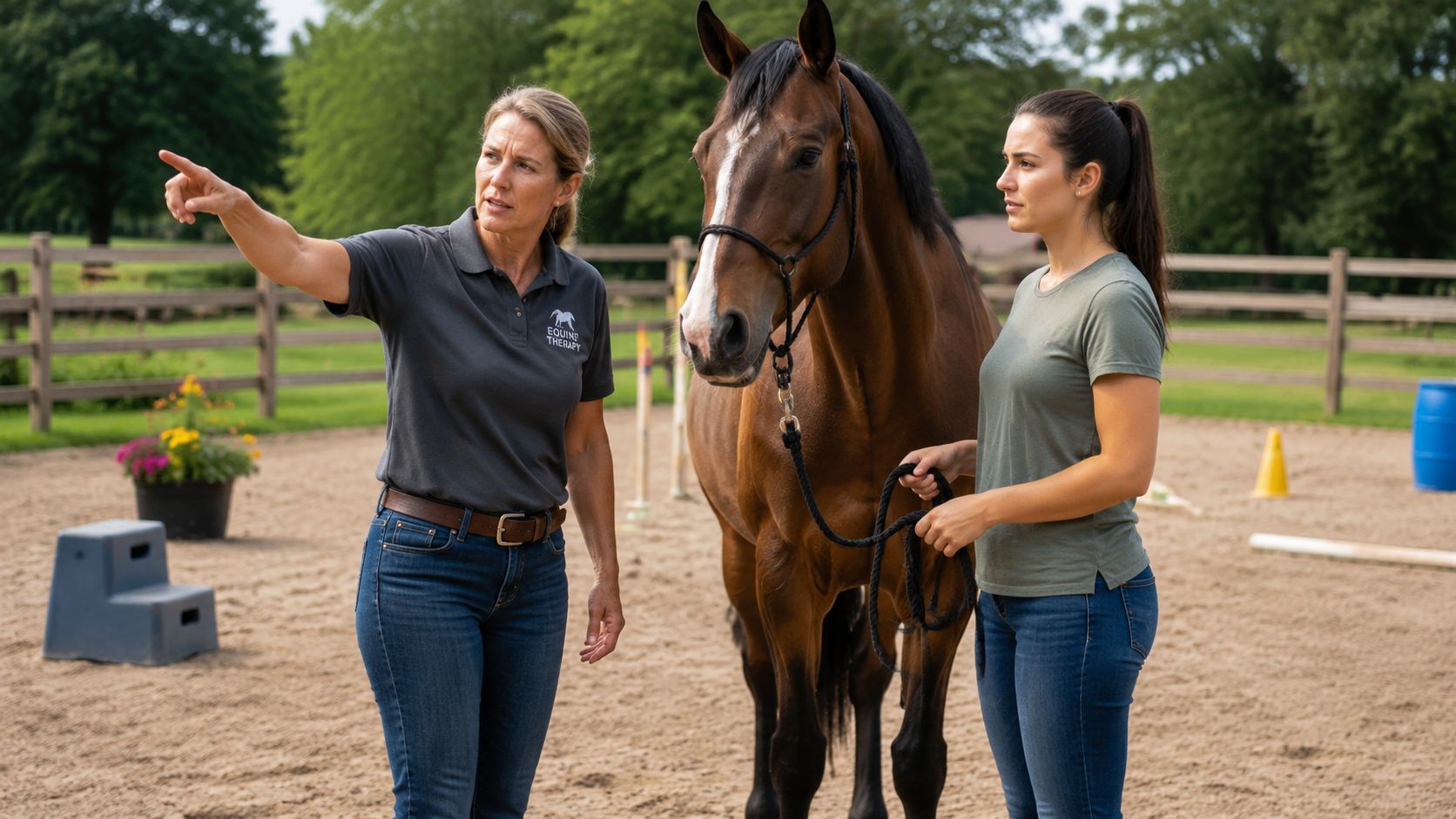
Clinical equine therapy isn't recreational riding with therapeutic language added afterward. It's a structured mental health intervention with clear goals, professional roles, and a defined clinical frame.
What it is, and what it isn't
In a clinically grounded model, the focus is psychological treatment. The horse becomes part of an experiential process designed to reveal patterns in emotional regulation, communication, control, trust, avoidance, and relational style.
That differs from programs centered on riding instruction, horsemanship, or general enrichment. Those experiences may still be meaningful, but they aren't the same as psychotherapy. For an executive or professional seeking real behavioral change, that distinction matters.
A useful way to think about it is this:
| Approach | Primary focus | Clinical relevance |
|---|---|---|
| Equine-assisted psychotherapy | Emotional and relational patterns | Part of mental health treatment when led by qualified clinicians |
| Therapeutic riding or recreational horse work | Riding skill, activity, or general benefit | May support well-being, but isn't automatically psychotherapy |
The team in the arena
Safe, credible equine therapy for mental health relies on role clarity. Sessions generally involve:
- A licensed mental health clinician: This professional holds the therapeutic frame, tracks themes, and helps translate the experience into treatment.
- An equine specialist: This person manages horse behavior, safety, and activity design from an equine perspective.
- The horse: Not as a prop, but as an active participant whose responses provide immediate relational feedback.
That multidisciplinary setup is one reason this modality can be so effective with analytical adults. The work has enough structure to feel serious, yet enough immediacy to break through over-intellectualization.
What a discerning client should look for
Not every equine program is clinically rigorous. Before starting, clients should understand whether the service is therapy, who is licensed, how safety is managed, and how the session connects to a broader care plan.
Practical rule: If a program can't explain the therapist's role, the equine specialist's role, and how insights are processed after the activity, it may not be offering clinical treatment.
Readers exploring a residential model can review how equine therapy at Reflections is positioned within a broader treatment setting. The critical issue isn't whether horses are present. It's whether the work is clinically intentional.
How a Horse Becomes a Mirror for the Mind
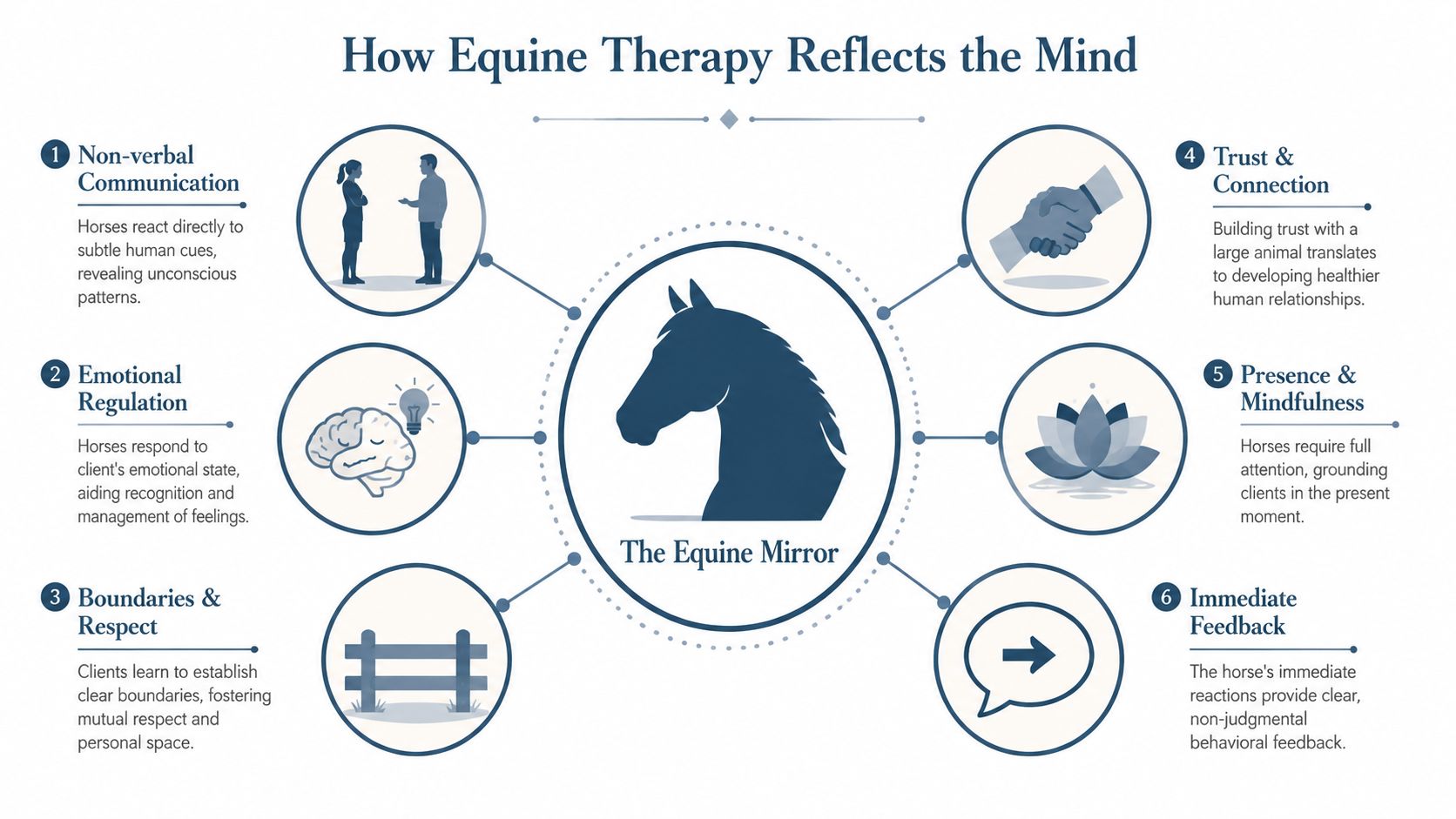
A horse functions as a kind of living biofeedback system. Not a machine. Not a diagnostic tool. But a highly responsive relational partner whose behavior often reflects what a client is signaling without realizing it.
For executives and high-achieving professionals, that matters because many have spent years refining outward presentation. They know how to sound composed while the body is braced. They know how to appear engaged while remaining emotionally unavailable. In the arena, those splits become harder to maintain.
The feedback is immediate
When a client approaches a horse with agitation masked as confidence, the horse may hesitate, drift away, or become watchful. When the client settles, breathes, and becomes more congruent, the interaction often changes. That shift gives the therapist something unusually concrete to work with.
The lesson isn't “the horse likes calm people.” The deeper lesson is that the client can observe, in real time, how internal state affects connection, leadership, and trust.
This often brings abstract clinical ideas into focus:
- Emotional regulation: The client sees whether tension is being managed or merely hidden.
- Boundaries: The client learns the difference between firmness and force.
- Presence: Divided attention usually weakens communication with the horse.
- Authenticity: Congruence tends to work better than performance.
Why this translates to leadership
A horse won't be persuaded by status. That's precisely why the work is useful for leaders. In senior roles, people often receive filtered feedback. Subordinates may accommodate them. Colleagues may avoid challenge. Family members may have adapted around them for years.
The horse doesn't participate in those social distortions.
A leader who is controlling without awareness often sees it. A professional who confuses intensity with clarity often sees that too. Someone who avoids direct expression may discover that vague signals create confusion and distance. Those are not minor insights. They map directly onto conflict management, delegation, intimacy, and recovery.
The arena often reveals the same pattern a client brings to the boardroom, the marriage, and the relapse cycle. It simply does so without argument.
Why the mechanism is credible
The most persuasive case for this work isn't magical language about animals healing people. It's that the process creates observable, embodied learning. That learning can then be interpreted clinically and practiced repeatedly.
A 2024 study of at-risk youth found that equine-assisted programs were associated with 18% to 23% improvement in global psychological, social, and emotional well-being scores, along with gains of 12% to 28% in areas such as resilience, self-efficacy, social and emotional skills, hope, and cognitive reappraisal. The same study reported that participants improved at levels similar to traditional psychotherapy, which supports equine work as a credible component of structured mental health care.
That finding doesn't mean every equine program is equally effective, and it doesn't settle every clinical question. It does support the broader idea that when this work is structured well, it can produce meaningful psychological change.
Who Benefits from This Unique Therapeutic Alliance
Not everyone needs equine therapy. Some clients do very well with traditional talk therapy alone. Others need a modality that reaches beneath polished language, chronic overcontrol, and emotional shutdown. That's where this work tends to stand out.
For high-functioning adults, the fit is often less about diagnosis alone and more about style of adaptation. A professional may be successful, articulate, and well defended at the same time. Equine therapy for mental health can help when insight exists, but change still hasn't landed in the body, the relationships, or the daily behavior.

Profiles that often respond well
Several groups often benefit from this kind of therapeutic alliance:
- Professionals with perfectionism and control issues: They may discover how rigidity interferes with trust, adaptability, and real connection.
- Clients who intellectualize everything: The horse shifts the work from explanation to experience.
- People with trauma or PTSD features: Especially when direct verbal processing feels too exposed, too abstract, or chronically stalled.
- Adults in dual-diagnosis care: The work can support self-regulation, frustration tolerance, honesty, and relational repair.
A nuanced clinical effectiveness review from the U.S. National Library of Medicine notes that research on canine and equine therapy is still being appraised, while some studies have reported reductions in anxiety, depression, alcohol consumption, and psychological distress in specific programs. That's encouraging, but it also argues for precision. Benefits shouldn't be generalized to every format or every population.
Where this modality tends to help most
For executives in recovery, one of the central problems isn't merely stress. It's disconnection under stress. That disconnection may show up as substance use, emotional withdrawal, compulsive work, irritability, secrecy, or a feeling that life has become purely functional.
Equine work can be powerful here because it asks for a kind of engagement many high performers have lost. The client has to become present enough to notice, regulated enough to influence, and honest enough to adjust. There is no shortcut through charisma or analysis.
Consider how closely the therapeutic tasks align with executive challenges:
| Executive struggle | Arena task |
|---|---|
| Managing by control | Leading without force |
| Speaking without vulnerability | Communicating through congruent presence |
| Difficulty trusting | Building rapport with a sensitive partner |
| Reactivity under pressure | Regulating before acting |
That doesn't make equine work a leadership seminar. It remains therapy. But for certain professionals, its relevance to leadership is obvious.
Integrating Equine Work into Executive Treatment
The arena should never function as a detached experience. If the session produces insight but nobody helps the client process, challenge, and apply that insight, much of the value gets lost.
In an advanced treatment setting, equine work becomes one data-rich part of the overall clinical picture. A client may discover in the arena that he becomes controlling when uncertain, shuts down when not immediately effective, or sends mixed relational signals under pressure. Those patterns then become material for individual therapy, group work, family sessions, and relapse prevention planning.
How integration strengthens results
Executive treatment necessitates a higher level of coordination. High-performing adults often don't need more disconnected services. They need therapies that speak to each other.
A well-integrated plan might connect arena experiences to:
- CBT work: Identifying distorted beliefs that appeared during the session, such as “If I'm not in control, things fall apart.”
- DBT skills: Practicing distress tolerance and emotional regulation after a frustrating interaction.
- Trauma treatment: Tracking body-based responses, safety cues, avoidance, and hypervigilance.
- Addiction recovery: Examining how impatience, shame, or control dynamics show up before compulsive behavior.
Why this matters for working professionals
Executives and other professionals usually measure treatment by one question. Does it transfer?
If a breakthrough stays poetic and never becomes behavioral, it won't hold under pressure. The clinical task is to move from arena insight to lived application. That might mean changing how the client handles conflict with a partner, delegates to a team, responds to shame, or tolerates uncertainty without reaching for alcohol, stimulants, or emotional withdrawal.
Reflections uses equine work as one component inside an individualized dual-diagnosis plan, alongside psychotherapy, psychiatry, skills-based care, and other experiential modalities. For clients who need discretion, continuity, and enough flexibility to remain engaged with selected professional obligations, that kind of integration matters more than any single therapeutic moment.
The horse may reveal the pattern. Treatment has to help the client interrupt it in real life.
A Look Inside a Private Equine Therapy Session
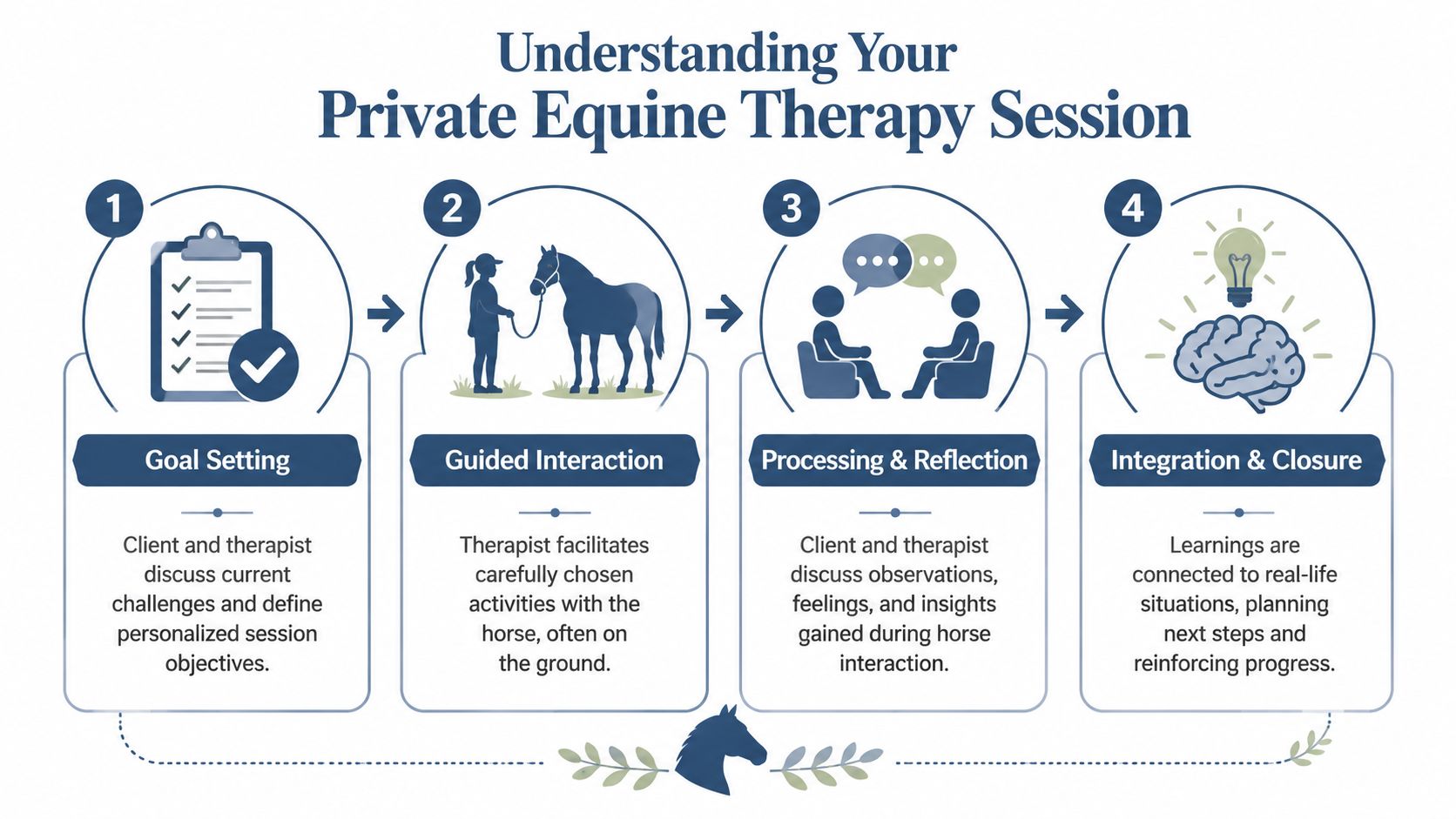
Most discerning clients want to know what happens. The answer is simpler and more clinical than many expect. In most cases, the session is ground-based. No riding skill is required, and no performance is expected.
What the hour may look like
A private session often starts with a brief check-in. The therapist clarifies the client's current emotional state, recent triggers, and a concrete focus for the session. For a working professional, that focus may be something like frustration tolerance, trust, leadership under pressure, or difficulty staying present.
The interaction with the horse is then selected intentionally. A client might be asked to lead the horse, pause with it, guide it through a simple obstacle, or notice what changes when effort increases. The task is rarely complicated. The meaning comes from how the client approaches it.
Afterward, the therapist processes what happened. The conversation may sound simple, but it's clinically pointed.
The processing is where the work deepens
Questions often include:
- What did the client feel in the body when the horse stopped, resisted, or moved away?
- What strategy appeared first when the task wasn't going smoothly?
- What changed when the client shifted tone, pace, or internal state?
- Where else does that pattern show up in work, marriage, parenting, or recovery?
This phase matters because insight needs language and context if it's going to travel beyond the arena.
“The value isn't getting the horse to comply. The value is recognizing what the client does when connection becomes uncertain.”
The evidence for adults is still developing, and a careful clinician should say that plainly. A 2016 Department of Defense review found that only 3 studies met inclusion criteria for adults at high risk for PTSD, suicide, and related conditions, and concluded there was an insufficient body of evidence to determine effectiveness and safety. At the same time, the review noted that one poor-quality pretest-posttest study showed statistically significant improvements in depression, anxiety, and trauma symptoms among adults with PTSD symptoms. That's a balanced picture. The modality shows promise, but structure and clinical judgment remain essential.
Practical Considerations for Discerning Clients
The practical questions around equine therapy for mental health are usually straightforward. Is it covered by insurance. Is it safe for someone with no horse background. Does it matter for a person with a demanding career.
How private-pay treatment changes the equation
Insurance coverage for equine services is uneven and often confusing. Reimbursement may depend on diagnosis, documentation, modality, state law, and whether the service is billed as mental health treatment rather than riding or recreation. A recent Illinois law indicates that medically necessary equine therapy performed by a licensed therapist and certain therapeutic riding programs are set to be covered starting in 2026, while coverage remains variable and Medicare generally doesn't cover equine therapy, as described in this report on Illinois equine therapy coverage changes and ongoing reimbursement limits.
For discerning clients, the clinical implication is simple. A private-pay model allows treatment teams to include equine work based on clinical fit rather than forcing decisions through inconsistent reimbursement rules.
No horse experience is required
Clients don't need to know how to ride, handle tack, or behave like an equestrian. The work is designed for people who are new to horses.
Safety comes from structure:
- Qualified facilitation: Sessions are led by clinicians and equine professionals.
- Ground-based activities: The therapeutic focus is relational and psychological, not athletic.
- Clear pacing: The team adjusts the task to the client's presentation, diagnosis, and nervous system capacity.
Why this matters to a busy professional
This work isn't separate from professional life. It often targets the capacities that determine whether success is sustainable.
Those capacities include:
- Emotional regulation under pressure
- Boundary-setting without aggression
- Authentic communication
- Presence during conflict
- The ability to lead without overcontrol
For clients who also want restorative structure beyond the therapy room, therapeutic outings at Reflections show how experiential work can support broader treatment goals without reducing care to passive comfort.
Equine therapy for mental health can be a precise, high-value part of treatment for professionals who've outperformed their coping strategies. For those considering confidential, clinically integrated residential care with private rooms, appropriate access to electronics, and dual-diagnosis treatment designed for working adults, Reflections offers a discreet starting point for evaluating whether this approach fits their needs.