
There is no single number of days that breaks an addiction. Acute withdrawal can last days to weeks, while lasting change typically requires 90 or more days of sustained care, and longer engagement can nearly double recovery success compared with the shortest stays.
Why, then, do people keep searching for a magic number such as 21, 30, or 90 days? The question usually combines two different goals: getting through the body's immediate reaction to stopping a substance, and changing the emotional, behavioral, and environmental patterns that keep substance use active.
A person may sleep better, think more clearly, and feel physically safer after detox. That improvement matters, but it doesn't automatically mean the addiction has been “broken.” A disrupted routine can return quickly when the person faces a board meeting, family conflict, travel, insomnia, or the private stress that often accompanies executive responsibility.
For professionals, the calendar question has practical consequences. A chief executive or high-earning specialist may worry that treatment will expose a problem, interrupt leadership responsibilities, or create uncertainty for colleagues and clients. Yet choosing a program only because it ends quickly can leave the most important clinical work unfinished. A confidential, structured setting can make a longer plan more realistic without requiring a complete withdrawal from professional identity.
A useful starting point is a careful assessment for substance use disorder, followed by a plan that matches medical risk, mental health needs, substance type, support system, and work demands. The timeline below separates withdrawal from rehabilitation, then shows how private residential care can protect momentum while recovery develops.
Why There Is No Single Number of Days That Breaks Addiction
A calendar date can mark progress, but it can't determine recovery. Addiction affects brain reward pathways, stress responses, decision-making, relationships, and daily routines. Those systems don't reset simultaneously, so physical relief and durable recovery often arrive at different times.
The popular short-program myth survives because detox can produce a visible change. Tremors may ease, sleep may begin to improve, or cravings may become less constant. Those signs can create confidence, but confidence without a relapse-prevention plan can become a vulnerability, particularly when a person returns to the same workload, contacts, access, and stressors that surrounded substance use.
Withdrawal is a medical phase, not a cure date
A large, multi-site treatment-outcomes study found a clear relationship between time retained in care and one-year recovery success. People who stayed 7 to 20 days had a 24.1% success rate, compared with approximately 36.6% among those with median stays between 28 and 63 days, and 46.8% among those retained for more than 90 days. The longest-stay group therefore approached twice the success rate of the shortest-stay group. The full study reports these retention and outcome findings.
The same dataset found that fewer than 15% of people treated for 20 days or less avoided alcohol and non-prescribed drugs for the full 12 months, compared with 33% of those treated for more than 90 days. These figures don't mean every person needs the same length of residential care. They do show why a short stay often functions as an entry point rather than a complete recovery plan.
Practical rule: Feeling better answers the question, “Is the body stabilizing?” It doesn't yet answer, “Can this person sustain recovery under pressure?”
For executives, sustained care can be designed around privacy, clinical intensity, and appropriate professional connectivity. The aim isn't to preserve every normal demand immediately. It's to protect the person's capacity to make sound decisions while treatment addresses the patterns that a brief detox cannot reach.
How Long Withdrawal Really Lasts by Substance
Withdrawal resembles a system reboot after prolonged overload. The body has adapted to the presence of a substance, sometimes by increasing or suppressing certain forms of nervous-system activity. When the substance stops, the system has to recalibrate. The speed and intensity of that recalibration depend on the substance's duration of action, the person's level of adaptation, and the severity of withdrawal.
That's why “day four” or “day seven” can't serve as a universal finish line. Two people can stop using different substances on the same day and face very different clinical risks.
Opioid withdrawal follows the drug's duration
Short-acting opioids typically produce withdrawal that starts 8 to 24 hours after the last use and lasts 4 to 10 days. Long-acting opioids may take 12 to 48 hours to produce symptoms and can persist for 10 to 20 days. The National Library of Medicine outlines these opioid withdrawal windows and their clinical variability.
This distinction matters because a person may feel well enough to make decisions before the nervous system has fully settled. Symptoms can include agitation, gastrointestinal distress, sleep disruption, muscle discomfort, and intense urges to resume use. Medical oversight helps clinicians monitor severity and consider appropriate withdrawal-management strategies.
Alcohol withdrawal requires particular caution
Alcohol withdrawal usually begins within 6 to 24 hours, reaches its peak around 36 to 72 hours, and lasts approximately 2 to 10 days. The range is broad because prior withdrawal history, overall health, pattern of use, and other medical factors can change the risk profile. The same clinical reference describes how withdrawal timing varies by substance and individual presentation.
A professional who tries to manage alcohol withdrawal privately while continuing work may misread early symptoms as ordinary stress or fatigue. That approach can delay appropriate care during a period when symptoms may intensify. A medically managed setting separates clinical monitoring from workplace pressure, allowing the team to respond as the course develops.
Detox answers one question: how can the body move safely through acute withdrawal? It doesn't answer how the person will handle conflict, exhaustion, loneliness, travel, or access to substances after discharge. Those challenges require the next phase, structured treatment and continuing care.
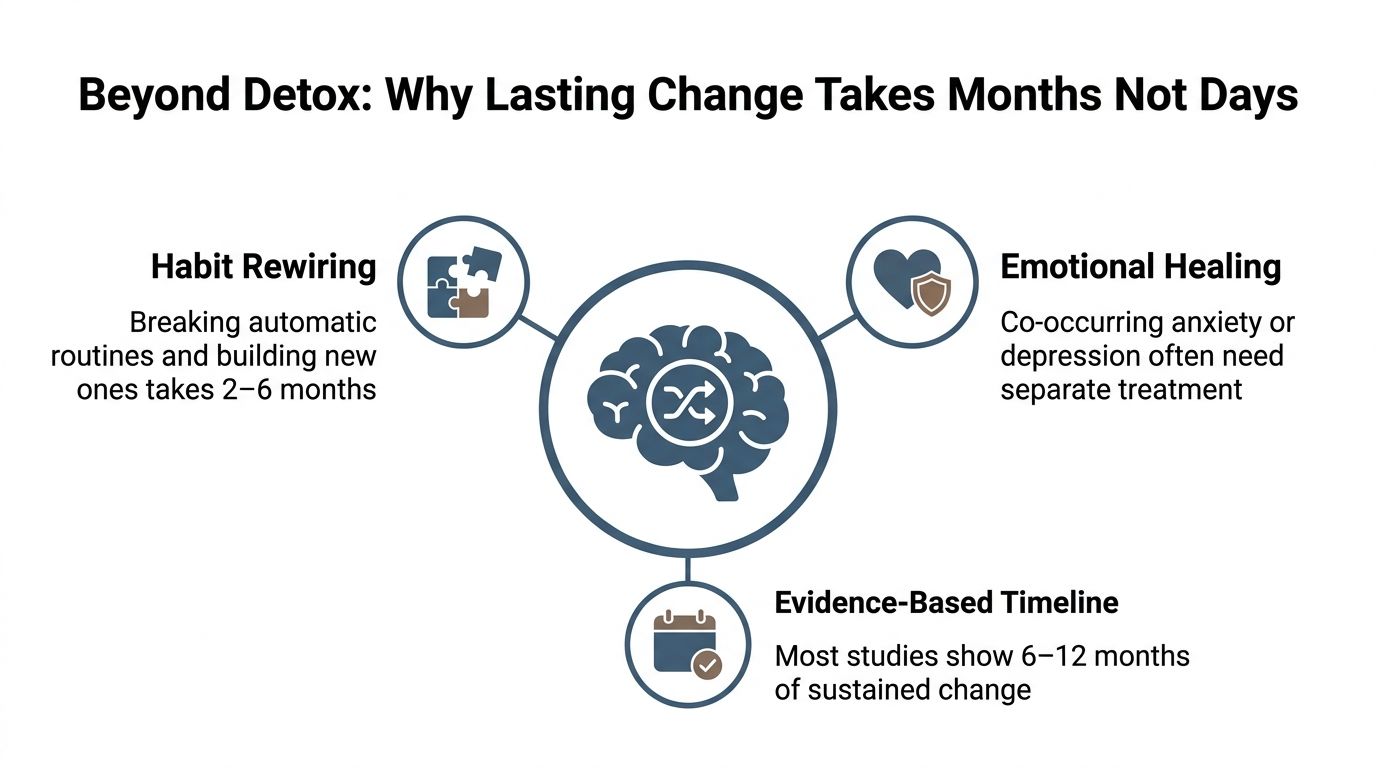
Beyond Detox Why Lasting Change Takes Months Not Days
Detox removes or reduces the immediate physical crisis. Rehabilitation builds the capacity to live differently after the crisis has passed. The difference is similar to stopping an injury from worsening versus completing the strength and movement work needed to return safely to demanding activity.
The National Institute on Drug Abuse states that individuals with addiction need at least three months in treatment to significantly reduce or stop drug use, and that programs shorter than 90 days have limited effectiveness. For opioid agonist maintenance, 12 months is considered a minimum, and some people benefit from treatment for years. NIDA's treatment principles explain why treatment duration must extend beyond detox.
Repetition changes behavior
A person doesn't learn relapse prevention by hearing it once. Skills become dependable when the person practices them during ordinary days, difficult conversations, cravings, poor sleep, and moments of professional pressure.
Residential treatment may provide space to work on:
- Trigger recognition: Identifying the thoughts, locations, relationships, and physical states that precede use.
- Coping rehearsal: Practicing alternatives such as distress tolerance, urge management, communication, and structured rest.
- Underlying conditions: Treating anxiety, depression, trauma, grief, or other symptoms that may intensify substance use.
- Decision-making: Rebuilding the ability to pause before acting, especially when a person is accustomed to rapid, high-stakes choices.
- Transition planning: Testing support arrangements before returning to travel, leadership demands, family obligations, or independent living.
Post-acute symptoms can also complicate this phase. Sleep disruption, mood changes, irritability, and cognitive strain may persist after acute withdrawal, which is why a clinical explanation of post-acute withdrawal syndrome can help families interpret changes without assuming that treatment has failed.
Feeling better differs from sustained remission
Early improvement can be genuine and still incomplete. NIDA reports that after initial remission, achieving sustained remission may take as much as 8 years and 4 to 5 treatment or mutual-support engagements, with risk remaining high for several more years. NIDA's recovery research discussion describes this longer, non-linear process.
That finding shouldn't discourage treatment. It provides a more accurate definition of success. Recovery is not invalidated by the need for additional support, a medication adjustment, or renewed therapy. A strong plan anticipates changing needs instead of treating readmission or a setback as a personal failure.
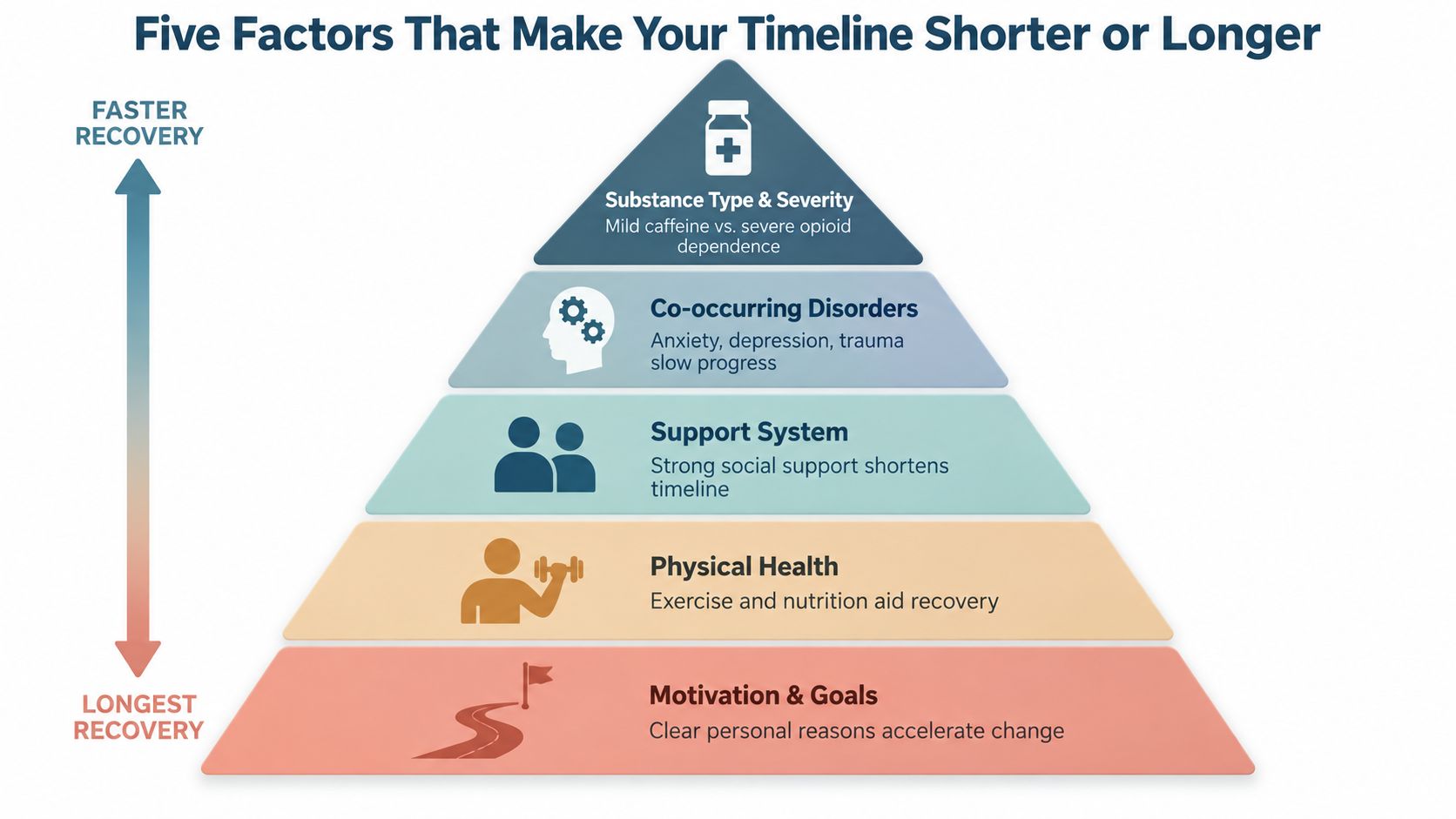
Five Factors That Make Your Timeline Shorter or Longer
No clinician can estimate a meaningful recovery timeline from the substance name alone. The assessment must consider the interaction between physical dependence, psychological symptoms, living conditions, professional stress, and willingness to remain engaged.
A high-functioning executive may look organized, financially secure, and successful while carrying severe sleep deprivation, concealed use, relationship strain, or untreated depression. External performance can hide clinical complexity. It shouldn't be used to assume that a short intervention will be sufficient.
The variables clinicians examine
Substance type and severity shape withdrawal and craving patterns. A person using one substance intermittently may face a different course from someone managing long-standing dependence, multiple substances, or repeated withdrawal episodes.
Co-occurring mental health conditions often extend the work. Anxiety, depression, trauma, post-traumatic stress symptoms, grief, bipolar symptoms, or borderline traits can make abstinence harder when treatment addresses substance use in isolation. Dual-diagnosis care treats the conditions together rather than asking the person to manage one untreated driver alone.
Length and intensity of use influence how substance use has entered daily life. A pattern tied to travel, late-night work, social access, or emotional avoidance requires more than removing the substance. It requires redesigning routines and testing those changes under realistic pressure.
Support and stress load can either stabilize recovery or undermine it. A private, supportive family environment may help. Constant travel, public visibility, conflict at home, or unrestricted access to substances may require stronger boundaries and more structured continuing care.
Engagement with treatment remains central. Evidence-based psychotherapy, medication when clinically appropriate, family participation, peer support, sleep restoration, nutrition, and exercise all contribute to a plan. The right combination depends on assessment rather than status or income.
A professional doesn't need to diagnose personal risk alone. Warning signs such as repeated unsuccessful attempts, withdrawal symptoms, escalating secrecy, impaired judgment, or mental health deterioration warrant a confidential evaluation.
What Detox and 30 60 and 90 Day Programs Actually Accomplish
Treatment length is best understood as a clinical function, not a badge of commitment. Detox manages acute medical needs. Residential rehabilitation creates a protected environment for assessment, therapy, stabilization, and planning. Longer care gives clinicians more opportunity to observe how a person responds after the initial relief fades.
A recovery-timeline source describes detox as commonly lasting 3 to 10 days, while residential or inpatient rehabilitation commonly lasts 30 to 90 days. It also identifies 60 to 90 days as a period associated with stronger residential outcomes, even though many people complete shorter 28- or 30-day programs. This overview distinguishes detox from residential treatment duration.
| Program Length | Primary Purpose | Best Fit When |
|---|---|---|
| Detox, 3 to 10 days | Medically managed withdrawal and initial stabilization | Withdrawal risk requires monitoring before rehabilitation begins |
| 30 days | Assessment, early therapeutic work, and a structured recovery plan | The person needs a focused entry into treatment and has a strong step-down plan |
| 60 days | Repeated skills practice, deeper mental health work, and transition preparation | Symptoms, relapse history, or work and family stress require more protected time |
| 90+ days | Sustained stabilization, relapse prevention, and coordinated continuing care | Substance use is chronic, complex, recurrent, or linked with significant co-occurring conditions |
These categories aren't rigid prescriptions. Some people need a medically managed withdrawal period followed by residential care. Others require medication management, step-down services, outpatient therapy, or mutual support for an extended period.
Making longer care workable for professionals
Luxury residential care can reduce the practical barriers that cause executives to choose prematurely short treatment. Private rooms support confidentiality and restorative sleep. Appropriate access to cell phones and laptops can allow residents to handle essential career obligations while clinicians establish boundaries that keep work from overwhelming treatment.
For someone addressing nicotine or smokeless tobacco alongside broader substance concerns, a practical step-by-step dip cessation guide may complement individualized clinical care. It shouldn't replace assessment, especially when several substances or mental health symptoms are involved.
The relevant question isn't, “How quickly can treatment end?” It's, “What level of care gives this person a credible chance to return to responsibility without returning to the old pattern?”
Realistic Recovery Milestones and When Relapse Risk Peaks
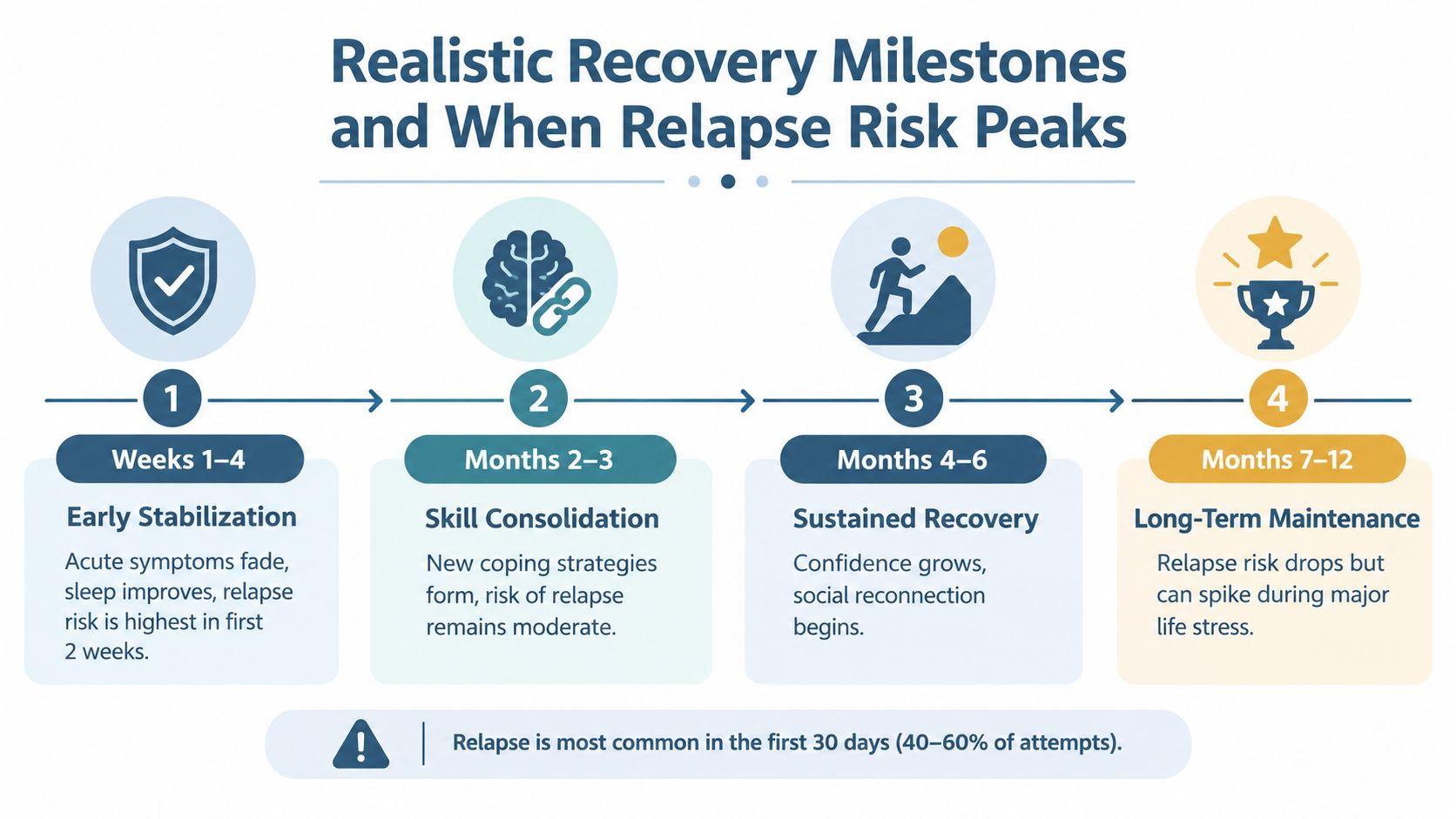
A milestone-based plan is more useful than a countdown. It gives the person and family observable signs of progress while leaving room for medical variation, emotional setbacks, and changes in treatment intensity.
Consider an executive who enters care after repeated attempts to stop during demanding work periods. During the first weeks 1 through 4, the clinical priority is stabilization. Acute symptoms may fade, sleep may begin to normalize, and the person may have more capacity for therapy. The early sense of control can be encouraging, but it can also lead to premature discharge or the belief that professional support is no longer necessary.
The first months test new skills
During months 2 and 3, therapy shifts from immediate stabilization toward skill consolidation. The executive may practice responding to difficult emails without using, delegating instead of over-controlling, and discussing recovery needs with family or trusted colleagues. Cravings can still appear when the person feels tired, criticized, isolated, or unusually successful.
During months 4 through 6, sustained recovery becomes less about constant crisis management and more about confidence with ordinary life. Social reconnection can begin, but so can overconfidence. A person may decide that one exception is safe, or that a demanding trip doesn't require the support plan developed in treatment.
By months 7 through 12, continuing care focuses on maintenance, flexibility, and long-term identity. Major life stress can still activate old responses, even after a long period of stability. Alumni contact, family sessions, therapy, medication follow-up when appropriate, and a clear response plan provide safeguards.
Progress has recognizable markers
Progress may include honest reporting of cravings, consistent sleep routines, improved emotional regulation, repaired communication, willingness to accept accountability, and a plan for high-risk situations. Warning signs include missed appointments, renewed secrecy, isolation, romanticizing past use, abrupt medication changes, and returning to work without adequate support.
A lapse should prompt immediate clinical contact, not shame or concealment. The earlier a person re-engages support, the more options remain available for adjusting the plan.
Choosing Private Residential Care That Fits a Demanding Career
How can a demanding professional enter treatment without letting work requirements delay recovery? The right private residential program protects clinical time while addressing privacy, responsibility, and the needs of family and colleagues.
A suitable program should provide medical and psychiatric assessment, individualized treatment, evidence-based psychotherapy, medication review when appropriate, and clear continuing-care coordination, as outlined in this guide to treatment centers for working professionals. Accreditation, qualified clinical leadership, and multidisciplinary staffing help families assess whether a program can address substance use alongside mental health needs.
Questions worth asking before admission
- Clinical scope: Can the team treat substance use and co-occurring anxiety, depression, trauma, or other mental health symptoms together?
- Medical support: Is withdrawal management supervised, with medication care available when needed?
- Privacy: Does each resident receive a private room during detox and residential treatment?
- Professional continuity: Can residents use phones and laptops appropriately without allowing work to displace treatment?
- Family participation: Are private family sessions and educational opportunities available?
- Continuing care: Does discharge planning include therapy, medication follow-up, alumni support, and flexible services after residential care?
Reflections is a California-licensed, Joint Commission-accredited provider offering dual-diagnosis residential care, private rooms in detox and rehabilitation, and appropriate electronics access for work, school, and family communication. Its multidisciplinary team provides individualized evidence-based and experiential treatment. Residential stays typically range from 30 to 90 days, followed by continuing support.
Families do not need to wait for a public crisis. Repeated withdrawal, difficulty sustaining abstinence, worsening work impairment, or declining mental health can justify a confidential assessment even when the professional still appears successful.
The clearest answer to “how many days to break an addiction” is a staged plan. Acute withdrawal may take days. Psychological and behavioral change usually develops over months, while sustained remission may require continuing engagement for much longer. Private residential care can preserve momentum by separating treatment from daily workplace demands, then coordinating a return that includes appropriate support.
Reflections provides confidential, private residential treatment for executives and professionals who need medically managed withdrawal, dual-diagnosis care, private rooms, and appropriate work connectivity. Families and professionals can visit Reflections to explore treatment options and begin a confidential conversation about the right level and duration of care.