

A senior executive arrives at a private residential program carrying more than a suitcase. A phone keeps vibrating with board updates, a laptop contains unfinished decisions, and the body feels depleted from poor sleep, chronic stress, substance use, or the medication changes that often accompany early treatment. The executive may want meaningful recovery without disappearing from professional responsibilities, and may also need privacy, clinical structure, and a setting that feels safe rather than institutional.
That's where fitness and recovery can become part of a carefully coordinated dual-diagnosis plan. Exercise isn't a substitute for psychotherapy, psychiatric care, medication management, or medical detox. Used appropriately, it can support mood regulation, physical confidence, stress tolerance, sleep routines, and a gradual return to demanding work.
A luxury residential setting can make that integration more practical. Private rooms support rest and confidential reflection, while appropriate access to cell phones and laptops can help residents manage essential career obligations within clinically defined boundaries. Reflections describes a California-licensed, Joint Commission-accredited residential program for adults with co-occurring mental health and substance use disorders, with individualized care that includes clinical and wellness services. Its holistic wellness programs provide useful context for how fitness can sit alongside broader recovery work.
The sections ahead examine the clinical mechanisms, evidence, exercise options, safety checks, individualized planning, and outcome tracking that matter for high-profile professionals. Readers seeking a wider view of movement-based and physical rehabilitation approaches can also consult this guide to regenerative rehabilitation therapies, especially when recovery includes physical limitations or a return from injury.
Introduction to Fitness and Recovery in Executive Rehab
For an executive, residential treatment can create an uncomfortable conflict. The person may understand that continued substance use, anxiety, depression, trauma symptoms, or burnout have become unsustainable, yet still feel responsible for a company, employees, investors, patients, clients, or family members. A program that demands total disconnection may feel impossible, while a program with no boundaries may fail to create the conditions needed for recovery.
Luxury executive rehab addresses that tension through structure rather than unlimited convenience. Private rooms give residents a controlled place to sleep, decompress, and process difficult clinical material. Appropriate electronics access can allow scheduled communication with professional contacts, provided the treatment team establishes boundaries around timing, content, and emotional load. Independent industry guidance notes that executive rehab policies differ by facility, with some programs using an initial blackout period and later allowing electronics during non-treatment hours under defined conditions, as described in this executive rehab guidance.
Fitness adds another layer of clinical structure. A resident might begin with guided walking, mobility work, or breath-led movement while the medical team manages withdrawal, sleep disruption, medication effects, and acute anxiety. As stability improves, the plan could include resistance training, low-impact conditioning, yoga therapy, or somatic work. The aim isn't to reproduce a demanding corporate performance schedule in a gym. It's to help the resident experience effort, recovery, discomfort, and self-regulation in a safe sequence.
Practical rule: The right exercise plan supports treatment participation. It never competes with stabilization, therapy, or medical oversight.
The executive context also changes how success is defined. A useful plan may improve the ability to attend therapy with focus, tolerate stress without reaching for substances, sleep more consistently, and communicate with a leadership team without abandoning clinical priorities. Fitness becomes one part of a discreet, individualized system that respects both health needs and professional identity.
Clinical Benefits and Mechanisms of Fitness
Structured exercise affects more than muscle tissue. It gives clinicians a practical way to influence arousal, energy, attention, body awareness, and confidence while a resident works through psychiatric and substance use concerns. The intervention must be calibrated, because excessive intensity can add stress when the nervous system already has limited capacity.
Exercise as a biological signal
During movement, the body responds to a controlled challenge. Heart rate rises, breathing changes, muscles receive greater blood flow, and the brain receives information that the person can tolerate effort without immediate danger. Afterward, a well-designed recovery period teaches the body to return toward baseline. That repeated transition, activation followed by downshifting, can support stress resilience.
Exercise is also associated with neurochemical processes involving endorphins and brain-derived neurotrophic factor, commonly called BDNF. Endorphins can contribute to a sense of relief or improved mood, while BDNF is involved in neural maintenance and plasticity. These mechanisms don't make exercise an antidepressant replacement, and they don't eliminate cravings on command. They help explain why movement can be a useful adjunct to psychotherapy, medication optimization, mindfulness, and addiction counseling.
For a resident with anxiety, the therapeutic value may come from learning that a racing heart can occur during safe exertion and then settle without catastrophe. For someone with depression, a short, supervised session can create behavioral momentum when motivation is low. For someone in addiction recovery, the session can occupy a vulnerable period, interrupt rumination, and offer a non-substance route to regulate internal discomfort.
Recovery is part of the prescription
Modern exercise science increasingly treats recovery as a training variable rather than as an afterthought. A 2024 systematic review found that interval training programs using active or passive recovery improved physical fitness and physiological outcomes in trained and untrained people aged 14 to 48, with effect sizes ranging from 0.13 to 1.29 in trained participants and 0.19 to 3.29 in untrained participants. The same review reflects the broader development of recovery science, including older principles that lower-body resistance work often requires 48 to 72 hours of recovery, compared with 24 hours or less for upper-body work, and historical medical practice that recognized prescribed rest in post-myocardial-infarction care by 1912 (systematic review of interval training and recovery).
In residential care, this principle prevents a common executive mistake, treating physical intensity as proof of commitment. A resident who has trained hard for years may still need a lower dose during detox, medication changes, sleep deprivation, or acute mood instability. Recovery days can include walking, gentle mobility, nutrition support, therapy, and low-stimulation time.
Why tailored exercise matters in dual diagnosis
Substance use and mental health conditions can disrupt sleep, appetite, coordination, impulse control, and the ability to read bodily signals. A personalized program gives clinicians another observation window. The exercise specialist can notice dizziness, agitation, avoidance, overexertion, dissociation, or unusually poor recovery and communicate those findings to the psychiatrist and therapy team.
The psychological mechanism is partly behavioral. A resident practices setting a manageable goal, completing it, noticing internal reactions, and choosing a recovery response. That sequence resembles the broader work of relapse prevention. Instead of demanding perfect control, the team builds repeated experiences of flexible control.
Nutrition can reinforce the overnight recovery period. Research summarized in a recent review indicates that 20 to 40 grams of casein taken roughly 30 minutes before sleep can increase overnight whole-body protein synthesis, and in young adults may improve the adaptive response to resistance training over 10 to 12 weeks (review of pre-sleep protein and muscle recovery). In a luxury residential setting, nutrition professionals can evaluate whether that strategy fits the resident's medical status, eating patterns, medications, and treatment goals rather than treating it as a universal instruction.
Residents who want a practical explanation of post-training tissue repair can also review this resource on speed healing after hard workouts. The clinical team should still decide which recommendations are appropriate for a person in detox, psychiatric stabilization, or medication-assisted care.
Evidence on Exercise Impact in Recovery
The strongest evidence in this area supports a measured conclusion. Recovery interventions can influence how people feel after exertion, but that finding doesn't prove that exercise alone prevents relapse or resolves a psychiatric disorder. In dual-diagnosis care, exercise works best as one coordinated component of a larger treatment plan.
A 2018 systematic review and meta-analysis of 99 studies found that recovery interventions reduced delayed-onset muscle soreness by a moderate amount, with an overall standardized mean difference of −0.78, with a 95% confidence interval from −0.61 to −0.94, and reduced perceived fatigue more strongly, with an overall standardized mean difference of −1.40, with a 95% confidence interval from −0.89 to −1.92 (systematic review and meta-analysis of post-exercise recovery strategies). The review identified massage as the most effective strategy overall for soreness and fatigue, while cold-water immersion and compression garments also showed meaningful benefits.
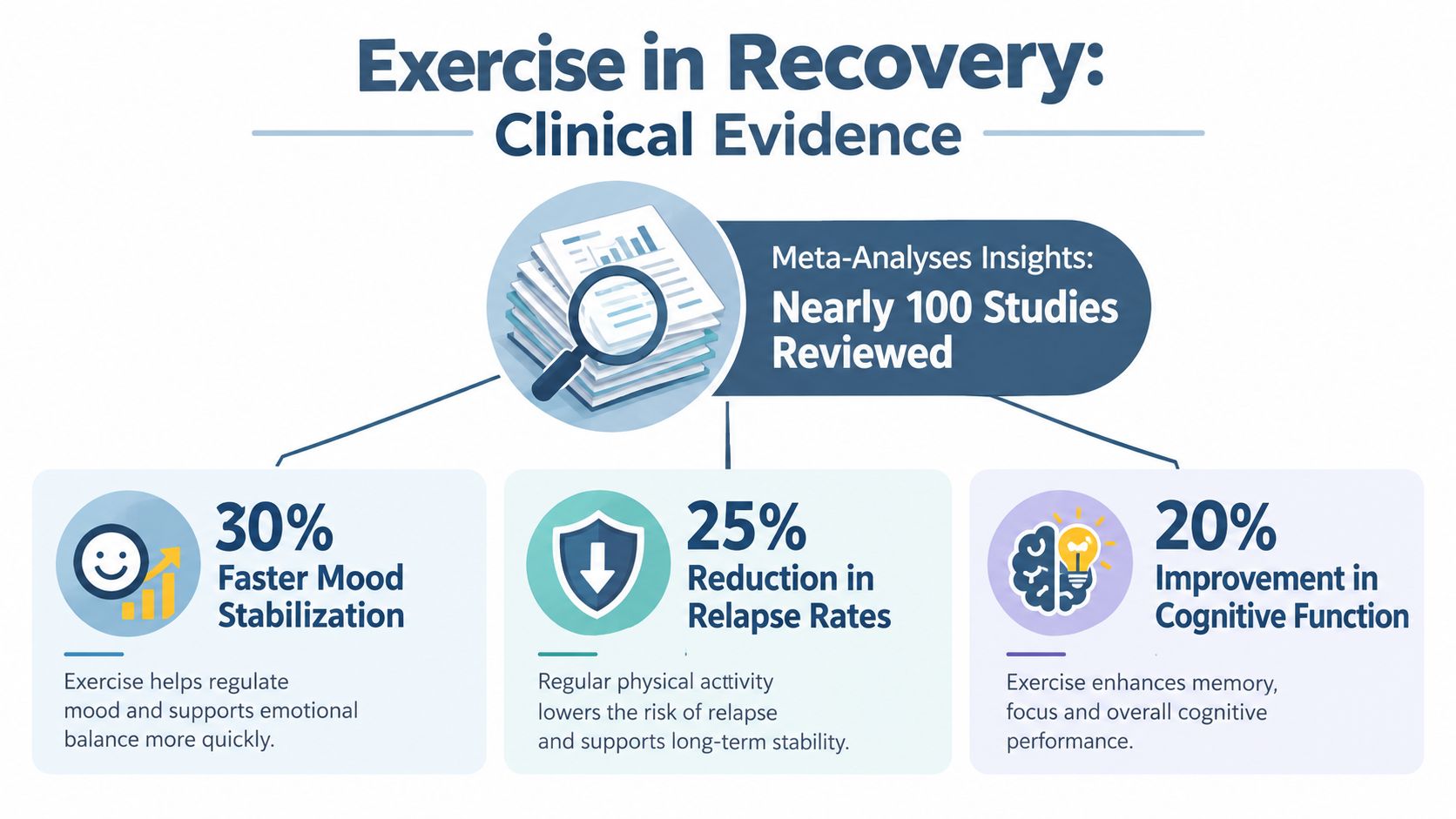
The practical meaning is straightforward. A resident who experiences less fatigue and soreness may be more able to participate in therapy, maintain a daily routine, and approach the next planned session without feeling physically overwhelmed. That's different from claiming a specific reduction in relapse or a guaranteed improvement in cognition. The verified evidence here quantifies recovery effects, while addiction outcomes require individualized clinical interpretation.
Translating evidence into residential care
A luxury program can use these findings to design a progression rather than assign exercise as a generic amenity. The clinical team might begin with low-intensity movement, monitor sleep and mood, then add resistance or intervals when the resident demonstrates adequate stability. The plan can also account for executive demands, such as a scheduled call after a morning session followed by therapy and protected rest.
The key distinction is between readiness support and performance pressure. Fitness should help a resident become more available for treatment, not create another arena in which perfectionism, compulsive behavior, or self-punishment takes control.
Effective Exercise Types in Dual Diagnosis Care
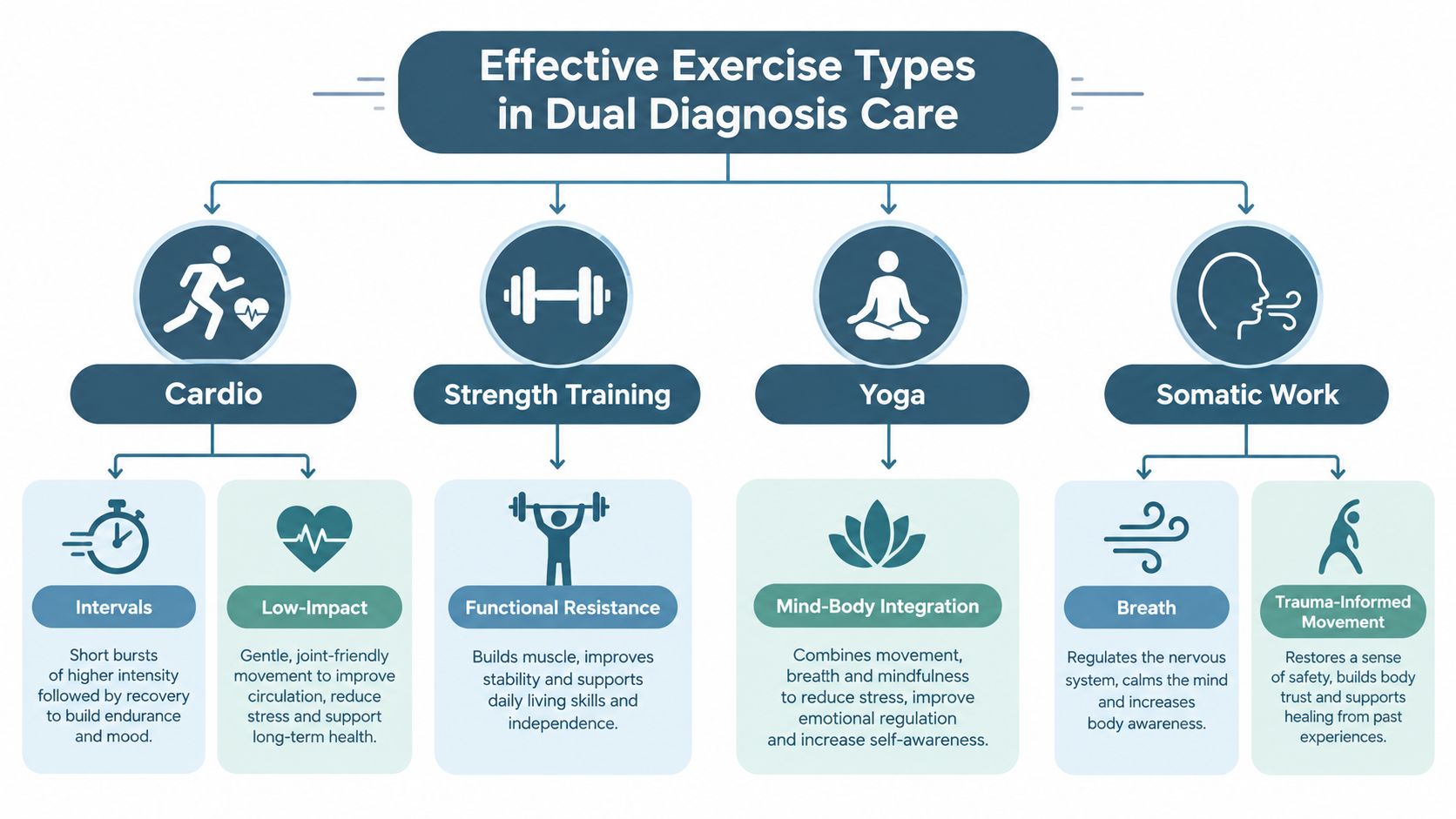
Different modalities create different clinical experiences. Cardio can help a resident reconnect with rhythm and endurance. Strength training can restore physical agency. Yoga can combine attention with movement, while somatic work can help trauma survivors notice bodily cues without forcing exposure.
Cardio
Low-impact cardio, such as walking, cycling, or controlled machine work, may suit a resident whose sleep, balance, or medication response remains unsettled. Intervals can be introduced later, with work and recovery periods adjusted to the person's cardiovascular status and emotional response. The objective isn't exhaustion. It's a predictable rise and fall in effort that supports confidence and self-regulation.
Strength training
Functional resistance work can address posture, mobility, and everyday physical demands. A professional who has spent years traveling or working at a desk may benefit from carefully coached pushing, pulling, hinging, carrying, and core stability patterns. Load selection should reflect medical clearance, injury history, coordination, and recovery capacity.
Yoga
Yoga can provide a slower setting for attention, breathing, balance, and flexibility. Some residents find that a guided practice creates a useful transition between intensive therapy and the rest of the day. Others may need modifications because certain positions or inward attention can activate trauma responses. A trauma-informed instructor can offer choice rather than treating discomfort as a test of commitment. More information on this modality is available through yoga for addiction recovery.
Somatic work
Somatic sessions may include breath awareness, grounding, gentle movement, and orienting to the environment. A resident with dissociation or a trauma history may need brief, externally focused exercises rather than prolonged body scanning. The therapist and movement professional should coordinate closely so that the work supports safety and agency.
A 2026 systematic review in endurance athletes found very low-certainty evidence for passive modalities such as compression and massage beyond placebo, while targeted strength and yoga showed more reliable psychological and physiological benefits (systematic review of recovery modalities). That doesn't make massage or compression irrelevant. It means they should remain supportive options, not magic-bullet substitutes for sleep, nutrition, appropriate training load, and clinical care.
Safety Guidelines and Contraindications
Fitness in dual-diagnosis treatment begins with screening, not with a demanding workout. Residents may be in withdrawal, taking psychiatric medication, receiving medication-assisted treatment, managing cardiovascular risk, or living with trauma that changes how bodily sensations are experienced.
A clinical safety sequence
Review medical status. The medical team should assess withdrawal risk, cardiovascular history, injuries, balance, hydration, sleep, and current physical symptoms before exercise begins.
Review medication effects. SSRIs, benzodiazepines, and medication-assisted treatment can affect alertness, coordination, blood pressure, appetite, or perceived exertion. The exercise professional shouldn't alter medication or interpret symptoms alone. Findings belong in the shared clinical record.
Screen trauma responses. Somatic work, breath practices, enclosed spaces, touch, and eyes-closed exercises can feel unsafe for some residents. Choice, consent, predictable instructions, and permission to stop are essential.
Set escalation rules. Dizziness, faintness, chest discomfort, unusual shortness of breath, confusion, severe agitation, or a sudden change in coordination requires stopping and clinical assessment. Orthostatic hypotension, particularly when standing from a low position, deserves prompt attention.
Adjust for psychological red flags. Flashbacks, dissociation, panic, compulsive exercise urges, or intense shame after a session should change the plan. A lower intensity, shorter duration, different modality, or pause may be clinically appropriate.
Clinical boundary: Exercise specialists, psychiatrists, nurses, and trauma therapists should share observations before increasing intensity.
A Joint Commission-accredited environment can support this communication through defined roles and documentation. The standard is not to eliminate every uncomfortable sensation. It's to distinguish productive challenge from medical instability, trauma activation, or compulsive overreach.
Designing Individualized Fitness Plans
An executive fitness plan needs to fit the person's clinical picture and professional reality. A schedule that ignores board responsibilities will fail operationally, while a schedule that lets work dominate treatment will fail clinically. The planning process should make both constraints visible from the beginning.
Step one involves assessment
The intake should cover prior exercise, injuries, current conditioning, sleep, nutrition, substance use patterns, mood symptoms, trauma history, medication changes, and the resident's relationship with achievement. Career obligations belong in the same conversation. A chief executive may need protected time for a limited call window, while a physician, attorney, or founder may need a different communication rhythm.
The team can then identify whether exercise has been a source of health, avoidance, compulsion, identity, or self-punishment. That distinction changes the intervention. A resident who has used intense training to escape emotion may need more emphasis on recovery and interoceptive safety. Another resident may need gradual activation because depression has narrowed daily activity.
Step two sets shared goals
Goals should be written in observable, clinically relevant language. Examples include attending planned sessions with adequate energy, practicing a downshift after exertion, improving confidence with ordinary movement, or establishing a sustainable routine for discharge. Aesthetic goals or performance targets may be discussed, but they shouldn't override stabilization, nutrition, sleep, or relapse-prevention priorities.
The exercise professional can coordinate with the psychiatrist, therapist, nutrition clinician, and nursing team. Reflections is described as a California-licensed, Joint Commission-accredited residential provider for adults with co-occurring mental health and substance use disorders, with luxury accommodations and multidisciplinary treatment (Reflections luxury residential program). That type of setting can support fitness planning within a broader clinical framework rather than isolating it as a separate concierge service.
Step three builds the schedule
Frequency and intensity should respond to recovery capacity. A sample routine for a high-profile professional might look like this:
| Time block | Clinical and professional focus |
|---|---|
| Morning | Breakfast, medication review, gentle mobility or a clinician-approved workout |
| Late morning | Individual therapy or psychiatric care |
| Midday | Protected work communication through scheduled electronics access |
| Afternoon | Group therapy, experiential work, or low-impact movement |
| Evening | Dinner, family contact, reflection, and reduced stimulation |
The schedule isn't a prescription. It illustrates how private rooms, planned electronics access, therapy, and exercise can coexist without allowing work to fill every recovery interval.
Step four monitors response
A resident may tolerate strength work but not crowded classes. Another may benefit from yoga but become activated by breath retention. Trainers should record exertion, mood before and after sessions, soreness, sleep, cravings, and any unusual symptoms. The treatment team can then adjust the plan instead of waiting for a crisis.
A private residential environment also allows quick feedback. A resident can discuss a difficult session in therapy, review medication effects with the medical team, and return to movement with modifications. Executives seeking a more specific discussion of individualized support can explore how personal trainers support recovery for executives and high-performing professionals.
Tracking Outcomes and Engaging Families
Recovery data becomes useful when it changes a decision. A wearable score that prompts anxiety or compulsive behavior may be less helpful than a simple conversation about sleep, mood, cravings, and energy. A 2025 review found that wearables can track sleep, training load, and recovery-related physiology, while a 2024 study of regular exercisers identified limited research on how people interpret and use readiness scores in daily life (review of wearable recovery sensing). Readiness scores should therefore be treated as trend information, not commands.
Creatine kinase, or CK, offers a more specific physiological example. CK typically peaks about 24 hours after muscle-damaging exercise and can remain high for up to 7 days. Serial trends can help clinicians assess recovery and identify excessive training stress, while a single result provides less context (review of creatine kinase and exercise recovery).
| Metric Type | Description | Frequency |
|---|---|---|
| Physiological | CK trends, when clinically indicated, alongside symptoms and training history | As determined by the medical team |
| Psychological | Mood, anxiety, sleep quality, and emotional regulation observations | Regular clinical check-ins |
| Behavioral | Craving patterns, exercise avoidance, compulsive urges, and treatment attendance | Ongoing review |
| Wearable trends | Sleep, training load, and recovery-related physiology interpreted cautiously | Reviewed as a pattern |
| Family continuity | Selected goals, warning signs, and agreed support actions | During planned family work and aftercare |
Families shouldn't receive every private clinical detail or every device metric. They can receive the information needed to reinforce the resident's plan, such as preferred routines, signs of overexertion, and agreed communication boundaries. Private sessions and educational workshops can help loved ones respond with accountability rather than surveillance.
Electronics access can support continuity when it's structured. A resident might share a selected progress dashboard or weekly routine with a spouse, family member, or designated professional, while keeping treatment notes and sensitive health data private. Even practical choices, such as selecting a comfortable band for a wearable, can support consistent use. A guide to Nothing But Bands' leather strap collection may be relevant for residents who want a more discreet, professional-looking accessory, but appearance should never outweigh comfort, safety, or clinical usefulness.
Conclusion and Next Steps in Fitness Recovery
Fitness and recovery in executive rehab work best when movement is treated as clinical support, not as a luxury add-on or performance contest. Personalized exercise can help residents practice stress regulation, reconnect with physical capability, and create routines that support psychotherapy, medication management, nutrition, sleep, and relapse prevention.
The strongest model combines several safeguards. It uses evidence without overstating it, selects exercise according to diagnosis and medical status, protects trauma-sensitive choice, schedules career obligations within boundaries, and reviews physiological, psychological, and behavioral trends together. Private rooms and a high-end residential environment can provide the privacy and comfort executives need, while accredited multidisciplinary care supplies the clinical structure that amenities alone can't provide.
Executives and families evaluating treatment should ask how fitness is screened, who supervises it, how exercise interacts with psychiatric care, and what happens when work demands intensify. A personalized plan should support a sustainable return to leadership, not recreate the pressure that contributed to crisis.
Reflections offers private residential dual-diagnosis care for adults who need clinically coordinated treatment alongside discreet living arrangements, individualized wellness services, and appropriate electronics access for essential career obligations. Visit Reflections to speak with the multidisciplinary team about building a fitness and recovery plan that supports mental health, professional continuity, and long-term stability.