
A founding CEO notices the tremor before an afternoon board call. An airline bottle disappears into a desk drawer, the company phone stays face down, and a private laptop carries a search for detox in California. The executive isn't only weighing withdrawal. There are confidential transactions, a device-dependent schedule, a board that can't know, and a spouse who has finally drawn a line.
That moment requires a clinical decision, not a reputational maneuver. California has a substantial treatment need, with approximately 5.6 million residents age 12 and older, about 17% of the population, meeting criteria for a substance use disorder in 2022 to 2023 according to the California Health Care Foundation's 2025 Substance Use in California Almanac. The right private program must manage medical risk, confidentiality, executive obligations, and the next phase of treatment at the same time.
For a high-profile professional, detox should function as a discreet clinical handoff. It should protect the calendar, the cap table, and the clinical record in parallel, while giving the person enough structure to become medically and psychiatrically stable.
When an Executive Starts Looking at Detox in California
The search usually begins before the executive admits the problem to anyone else. A chief executive may still be signing documents, leading negotiations, and approving payroll while privately calculating how long the body can go without alcohol, opioids, benzodiazepines, or stimulants. Afternoon shaking, sweating, irritability, insomnia, and memory gaps become operational risks disguised as stress.
A founder facing an NDA-protected transaction can't explain every absence. A senior partner may need secure access to a laptop, a private call with counsel, or a tightly controlled conversation with a chief of staff. A spouse may see the situation differently, especially after repeated promises fail. The executive often fears that treatment will expose weakness, disrupt leadership, or trigger speculation long before considering that unmanaged withdrawal can create a far more serious loss of control.
The decisive question is not whether treatment will interrupt work. It's whether untreated withdrawal will eventually interrupt work in public.
A luxury setting matters, but only when privacy supports clinical care rather than replacing it. Private rooms, discreet arrival procedures, appropriate electronics access, and a defined communication plan can help a working professional remain connected without turning treatment into an informal hotel stay. Executives arranging travel may also consider bespoke wellness itineraries as part of a broader privacy and logistics plan, provided the clinical admission remains the priority.
The admissions conversation should focus on the substance pattern, previous withdrawal, medical history, psychiatric symptoms, current medications, and immediate safety. A private executive pathway may include executive rehab planning that accounts for professional duties, but no calendar should override medical triage. Detox becomes the correct conversation when the person can no longer safely manage stopping, reducing, or delaying use without supervised support.
What Medical and Sub-Acute Detox Actually Mean
The word detox covers different clinical realities. Medical withdrawal management generally means continuous physician and nursing oversight, scheduled or symptom-triggered medication, repeated vital-sign assessment, and the capacity to respond if withdrawal escalates. For alcohol withdrawal, clinicians may use a monitored benzodiazepine taper. For opioid withdrawal, a physician may evaluate buprenorphine or methadone protocols. Staff may also use structured scales such as CIWA for alcohol withdrawal and COWS for opioid withdrawal.
Sub-acute withdrawal management is different from hospital-level care, but it isn't casual observation. It can fit mild-to-moderate withdrawal when the person is medically stable, has appropriate support, and remains under physician direction in a residential setting. The clinical team still needs a documented protocol, regular assessment, medication oversight, and a clear escalation plan.
A luxury room doesn't become a detox unit because it has high-end furnishings. If a facility lacks a medical director, trained overnight staff, emergency equipment, and a reliable response pathway, it may offer comfort, but it shouldn't represent itself as medical withdrawal management.
When medical oversight should lead
Executives with a cardiac history, seizure risk, a history of severe withdrawal, or combined alcohol and benzodiazepine use should default toward medical-level evaluation. Benzodiazepine withdrawal can become dangerous, and alcohol withdrawal can worsen after the last drink rather than resolve immediately. Opioid withdrawal also requires careful assessment, especially when fentanyl exposure, polysubstance use, or uncertain dosing complicates the history.
The admissions team should never promise a medication plan before a clinician evaluates the person. A responsible program asks about the last use, usual quantity, route, frequency, previous complications, current symptoms, other substances, psychiatric risk, and prescribed medications. If active suicidal thoughts, severe confusion, unstable vital signs, or an acute medical emergency is present, emergency services are more appropriate than a private residential admission.
For an executive, the standard is simple. Privacy is valuable, but medical capability is essential. The program should make the level-of-care decision from clinical facts, not from the client's title, budget, or preference for a particular room.
ASAM Levels and California Licensing Explained
An executive comparing California detox programs should start with two questions: which ASAM level does the facility provide, and which state license authorizes it? The answers reveal whether the program offers clinically managed withdrawal, hospital-level care, or a room with limited medical capacity.
The American Society of Addiction Medicine framework assigns placement according to withdrawal severity, medical needs, psychiatric stability, recovery environment, and the monitoring intensity required. A polished setting does not determine the level of care.
California guidance connects ASAM Level 3.2 withdrawal management with a DHCS-licensed residential facility. Levels 3.7 and 4.0 require hospital-based settings, including a chemical dependency recovery hospital or freestanding psychiatric hospital, according to withdrawal-management guidance from the California Department of Health Care Services. That guidance also separates supervised withdrawal management from basic observation. The program must have trained personnel, 24-hour onsite supervision, and the ability to support residents who are intoxicated or withdrawing.
| ASAM Level | Clinical Setting | California License | Typical Executive Fit |
|---|---|---|---|
| Level 3.2 | Clinically managed residential withdrawal management | DHCS-licensed residential facility | Medically stable clients who need structured supervision and ongoing treatment planning |
| Level 3.7 | Medically monitored intensive residential withdrawal management | Hospital-based setting | Higher medical or withdrawal risk requiring intensive monitoring |
| Level 4.0 | Medically managed intensive inpatient withdrawal management | Chemical dependency recovery hospital or freestanding psychiatric hospital | Severe medical or psychiatric instability requiring hospital resources |
California is also changing how withdrawal management fits into residential treatment. DHCS is phasing out detoxification as an independent licensable service and integrating non-medical withdrawal management into standard residential care. The transition is projected to take effect by June 30, 2027, according to the state's evidence-based standards fact sheet. A serious program should therefore show how its licensing, documentation, staffing, and clinical handoffs align with the ASAM Criteria.
For a working professional, this distinction defines the first handoff into a dual-diagnosis continuum. Ask for the facility's DHCS authorization and stated level. Joint Commission accreditation adds external quality oversight, but it does not replace state licensure. Verify both, then confirm that the setting and staff match the proposed placement.
Inpatient Versus Outpatient Detox for Working Professionals
Outpatient detox can preserve a professional's household routine, but it transfers much of the safety burden to the home. That can work only when the person has stable housing, low withdrawal severity, no recent complications, no psychiatric crisis, reliable transportation, and someone sober and capable of supporting the protocol.
Inpatient care removes the person from the environment where alcohol, pills, stimulants, work pressure, and concealment have become linked. It also gives clinicians direct access to symptoms, medication response, sleep disruption, mood changes, and unexpected complications. For a CEO, that structure doesn't need to mean complete professional disappearance. A private room, controlled electronics access, secure Wi-Fi, and a defined nurse communication line can preserve essential continuity without asking the executive to self-monitor a medically unstable process at home.
The executive decision matrix
| Decision Factor | Choose Inpatient If… | Choose Outpatient If… |
|---|---|---|
| Withdrawal history | There has been a seizure, delirium, severe complication, or failed unsupervised reduction | Previous withdrawal has been mild and clinically uncomplicated |
| Substance pattern | Alcohol, benzodiazepines, opioids, or multiple substances create uncertain risk | The substance pattern is clear, limited, and assessed as lower risk |
| Mental health | Suicidality, severe mood instability, psychosis, or acute trauma symptoms are present | Psychiatric symptoms are stable and the person has active outpatient support |
| Home environment | Household access, conflict, isolation, or work pressure undermines safety | The home is sober-supportive, calm, and able to follow the care plan |
| Professional obligations | The person needs clinical monitoring while retaining limited device access | The person can attend daily medical appointments and remain safely at home |
Polysubstance use, high-dose benzodiazepine dependence, significant alcohol dependence, recent seizure history, active suicidal ideation, or a dual-diagnosis presentation requiring medication stabilization makes inpatient care the responsible choice. Electronics access changes the operational experience, not the medical threshold. An encrypted device policy cannot make home detox safe when a red flag is present.
A practical rule helps under pressure. One serious red flag should move the recommendation to inpatient evaluation. Without those red flags, an executive outpatient protocol with daily physician contact may be defensible, but only after a clinician confirms the placement and the home team can follow instructions precisely. A careful comparison of inpatient versus outpatient rehab can help the executive and family organize that decision before the admissions call.
Inside a Private-Room Medically Managed Withdrawal
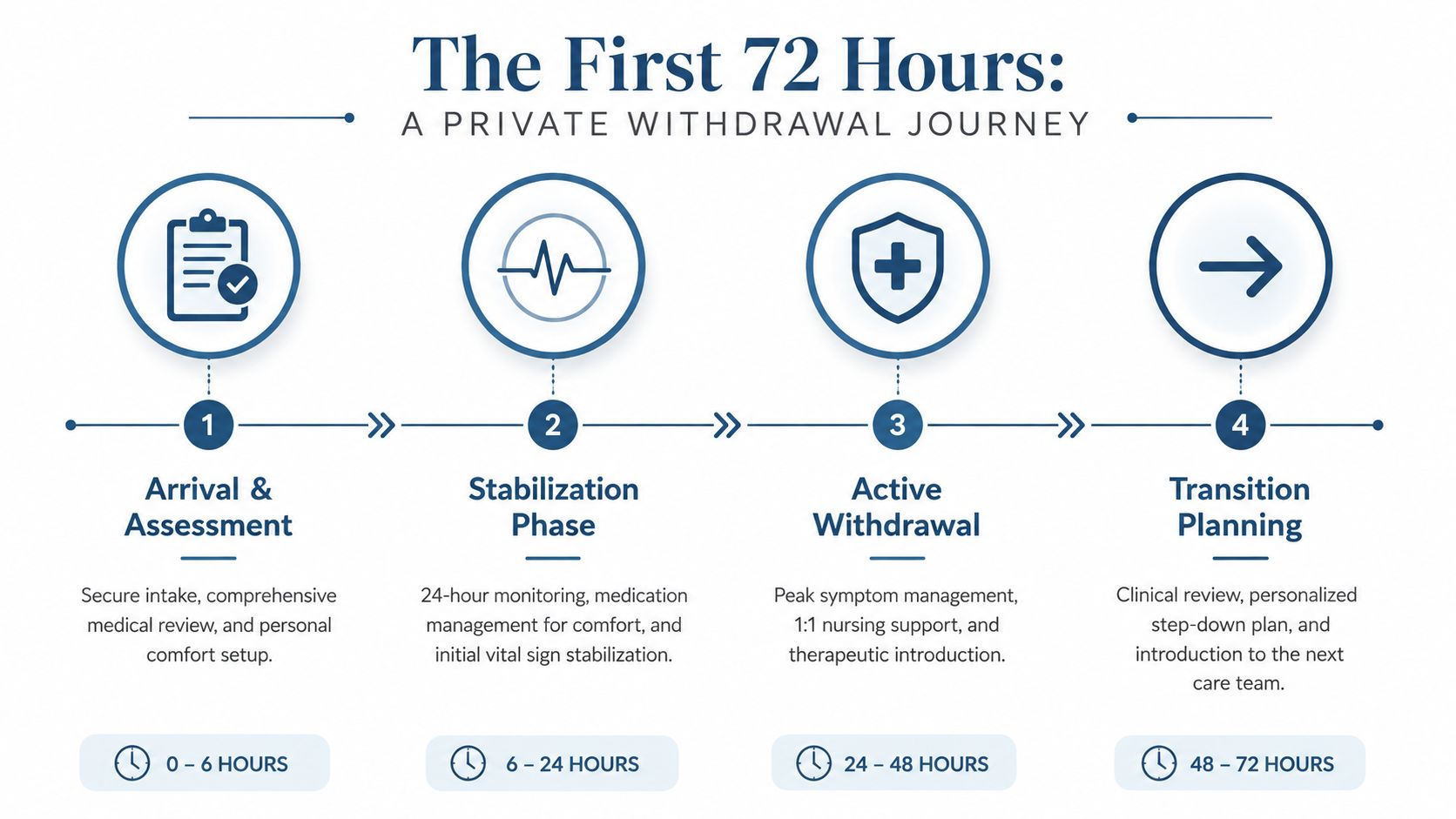
The first hours should feel orderly, discreet, and clinically deliberate. Arrival begins with secure intake, medication reconciliation, substance-use history, vital signs, withdrawal-risk screening, and a review of medical and psychiatric records. The team should also ask about anxiety, depression, trauma, sleep, suicidal thinking, prior diagnoses, and current psychiatric treatment rather than waiting until the residential phase.
The first clinical window
During the first day, addiction-medicine nurses monitor symptoms and vital signs around the clock. Clinicians may use CIWA or COWS scoring to guide symptom-triggered medication, while the physician determines whether a scheduled taper is safer. Alcohol withdrawal may require benzodiazepine management. Benzodiazepine withdrawal itself generally demands careful physician oversight because abrupt changes can create serious risk. Opioid withdrawal may involve physician-directed buprenorphine or methadone treatment after a clinical assessment.
Supportive care can include hydration, nutrition, sleep restoration, and management of nausea, pain, agitation, or anxiety. The goal isn't to sedate an executive into passivity. It is to reduce dangerous symptoms while preserving enough clarity for assessment, communication, and participation in the next clinical decision.
Stabilization without chemical flattening
The psychiatrist evaluates whether anxiety, depression, trauma symptoms, bipolar symptoms, or other psychiatric concerns are driving substance use or worsening during withdrawal. Psychiatric medications may need adjustment, continuation, or a more careful review once substances leave the system. That work prevents the common mistake of treating the withdrawal episode while missing the disorder that made repeated use feel necessary.
Private rooms support sleep, dignity, and controlled contact with family or work. They don't eliminate observation. Nursing coverage, physician availability, medication documentation, and escalation procedures remain the foundation.
By the end of the withdrawal phase, the team should be able to describe what has stabilized, what remains clinically active, which medications continue, and what level of care follows. The handoff is successful only when the person leaves withdrawal management with a treatment plan, not merely a cleared bed.
Accreditation and the Clinical Team Behind the Door
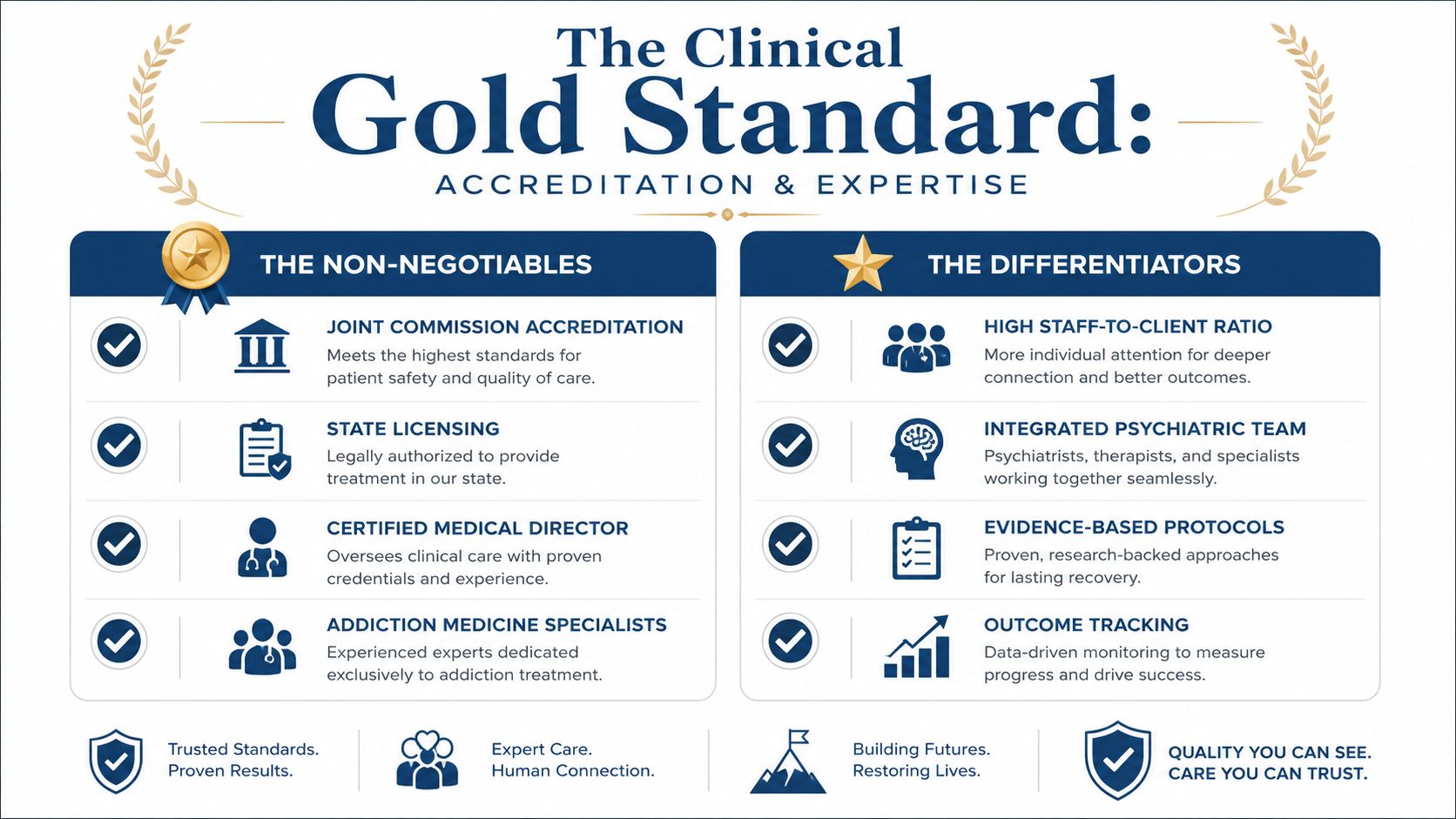
A luxury residence with attractive design and a counseling schedule isn't automatically a clinical program. State licensure establishes authorization. Accreditation adds an external standard for quality, safety, and accountability. Executives paying privately should expect a California DHCS license plus current accreditation from a recognized body such as The Joint Commission or CARF.
The clinical team matters more than the lobby. A serious program should identify the medical director, explain that physician's addiction-medicine qualifications, and describe who manages overnight changes. A psychiatrist should be available to address dual-diagnosis medication needs. Licensed addiction nurses should cover every shift, while a PhD-level psychologist should oversee the treatment model and its clinical consistency.
What qualified staffing looks like
The treatment model should include evidence-based work such as CBT, DBT, motivational interviewing, and trauma-informed therapy when clinically appropriate. Certified substance-use counselors can provide structured skills work, but they shouldn't be the only clinical resource for a person with withdrawal risk and psychiatric symptoms.
A multidisciplinary structure allows each professional to handle a defined responsibility:
- Medical director: Sets withdrawal protocols, reviews risk, and directs medical escalation.
- Psychiatrist: Evaluates mood, trauma, psychosis, suicidality, and medication response.
- Clinical psychologist: Oversees assessment, formulation, and the psychological treatment model.
- Licensed nurses: Monitor symptoms, administer medications, document changes, and respond to deterioration.
- Certified counselors and adjunctive therapists: Deliver structured recovery, behavioral, family, and experiential work within the treatment plan.
Reflections states that its California residential facilities are state licensed and Joint Commission accredited. Its multidisciplinary team includes PhD-level psychologists, psychiatrists, LMFTs, certified drug and alcohol counselors, and adjunctive therapists. The program's Joint Commission accreditation information provides context for executives evaluating what external oversight should look like.
Warning signs are easy to name. No named medical director, rotating telehealth prescribers, no 24-hour nursing, or vague credential answers should end the shortlist. Luxury without clinical depth is hospitality, not treatment.
Vetting a Luxury California Detox Program
The admissions call should operate like a working interview. The executive is assessing the program's clinical infrastructure, privacy practices, and operational fit, while the program assesses whether it can safely accept the person. A polished admissions representative isn't enough.
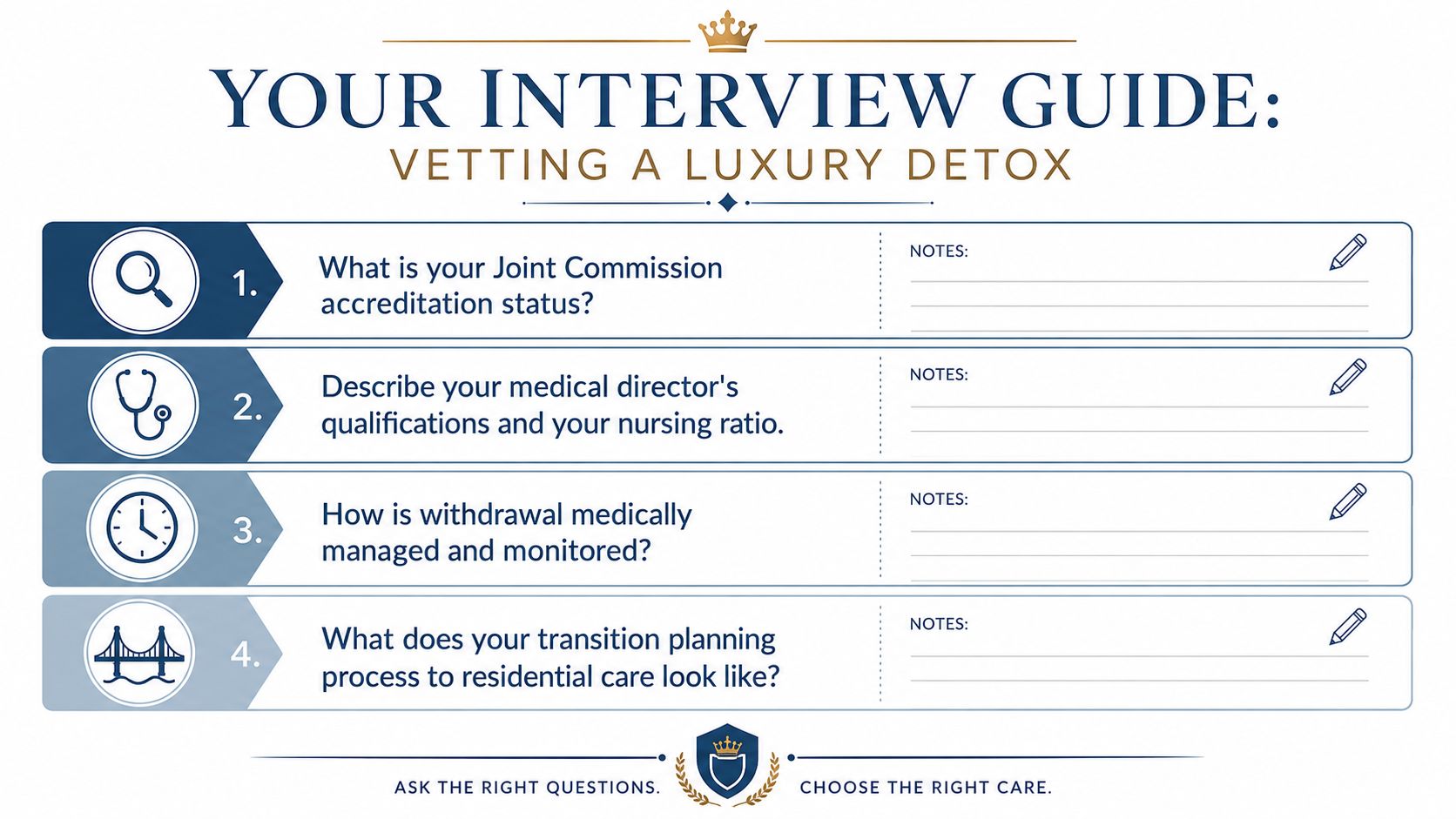
The first part of the call should establish clinical capability. Ask who is physically available overnight, how nurses are staffed, how alcohol and benzodiazepine withdrawal is managed, how opioid withdrawal is assessed, and what happens if symptoms exceed the facility's capacity. The answers should be specific, not a promise that “the team is always available.”
A focused discovery call
A practical call can follow this sequence:
- Verify credentials first. Ask for the current DHCS license, the authorized level of care, and accreditation status. The program should explain how those credentials apply specifically to withdrawal management.
- Test medical depth. Ask for the medical director's qualifications, nurse coverage, physician availability, emergency-transfer process, and approach to benzodiazepine, alcohol, opioid, and stimulant-related presentations.
- Assess dual-diagnosis capability. Ask who evaluates depression, trauma, anxiety, bipolar symptoms, suicidality, and medication interactions. The answer should identify a psychiatric pathway, not just “groups.”
- Define the handoff. Ask whether the same psychiatrist and lead therapist can follow the case into residential care, how medications are reviewed, and how the team decides between continued residential treatment and outpatient step-down.
The operational questions matter just as much for a working professional. Ask whether cell phones and laptops are permitted, how devices are secured, whether private communication with counsel or a chief of staff can occur, how family visits are arranged, and whether the room remains private during both withdrawal management and residential care.
A private aviation arrangement may reduce exposure during travel, and executives researching discreet arrival logistics can review Palm Springs flights with Haute Jets. Travel convenience should support a verified clinical plan, not substitute for one.
The call should end immediately if the program gives vague answers about accreditation, pressures the family to commit financially before clinical screening, or guarantees a discharge date. The separating question is direct: Who is on call at 2 a.m., and what is that person's training?
From Detox Into Residential Dual-Diagnosis Care
An executive may arrive for detox expecting a short interruption to work. The clinical team should treat that admission as the first handoff in a private dual-diagnosis continuum, with withdrawal management, psychiatric care, privacy, device access, and residential planning connected from the start.
Detox ends the acute phase. It does not resolve trauma, anxiety, depression, bipolar symptoms, stimulant use, or other co-occurring conditions. California's monitored data show why the next decision deserves scrutiny. During 2022 to 2023, only 29.6% of outpatient clients and 7.1% of intensive day-care clients stayed 31 days or more, according to the state's 2025 SNAP report. County and payer differences also appear in medication-assisted treatment and withdrawal-management measures.
A discharge from detox is not evidence of recovery. Require a documented clinical decision about residential treatment or outpatient step-down, supported by a warm handoff.
What a strong continuation includes
The psychiatrist and lead therapist should continue with the case whenever possible. Medication decisions made during withdrawal should become part of a longer stabilization plan, with clear review points rather than abrupt changes after acute symptoms improve. Residential treatment should address the psychiatric and behavioral drivers of substance use, not provide a comfortable place to remain abstinent.
Executive-level care must also protect controlled continuity. Appropriate phone and laptop access, private rooms, limited board-facing calls, and a written return-to-work plan can preserve necessary communication without keeping the client fully available. With consent, the plan may include HR, legal counsel, family-office staff, or a board representative. Assign one approved contact to manage scheduling, urgent messages, and other narrow business needs.
A practical 72-hour admissions plan
During the first day, provide the medication list, recent medical information, emergency contacts, insurance or private-pay details, and names of people approved to receive updates. A chief of staff or family-office representative can handle calendar triage, travel, bill payment, and limited workplace communication.
During the second day, the clinical team should complete medical and psychiatric assessments, review the withdrawal response, and determine whether the current campus can safely provide residential care. Ask whether staying in the same setting protects continuity or whether a separate residential property offers a stronger dual-diagnosis environment.
During the third day, require written documentation of the transition decision, medication plan, communication boundaries, therapy priorities, and return-to-work supports. Public California data also show incomplete treatment access, with only about two in five commercially insured HMO or PPO members diagnosed with alcohol or other drug dependence receiving an initial treatment visit within 14 days. Private-pay access may simplify logistics, but follow-up still requires active coordination.
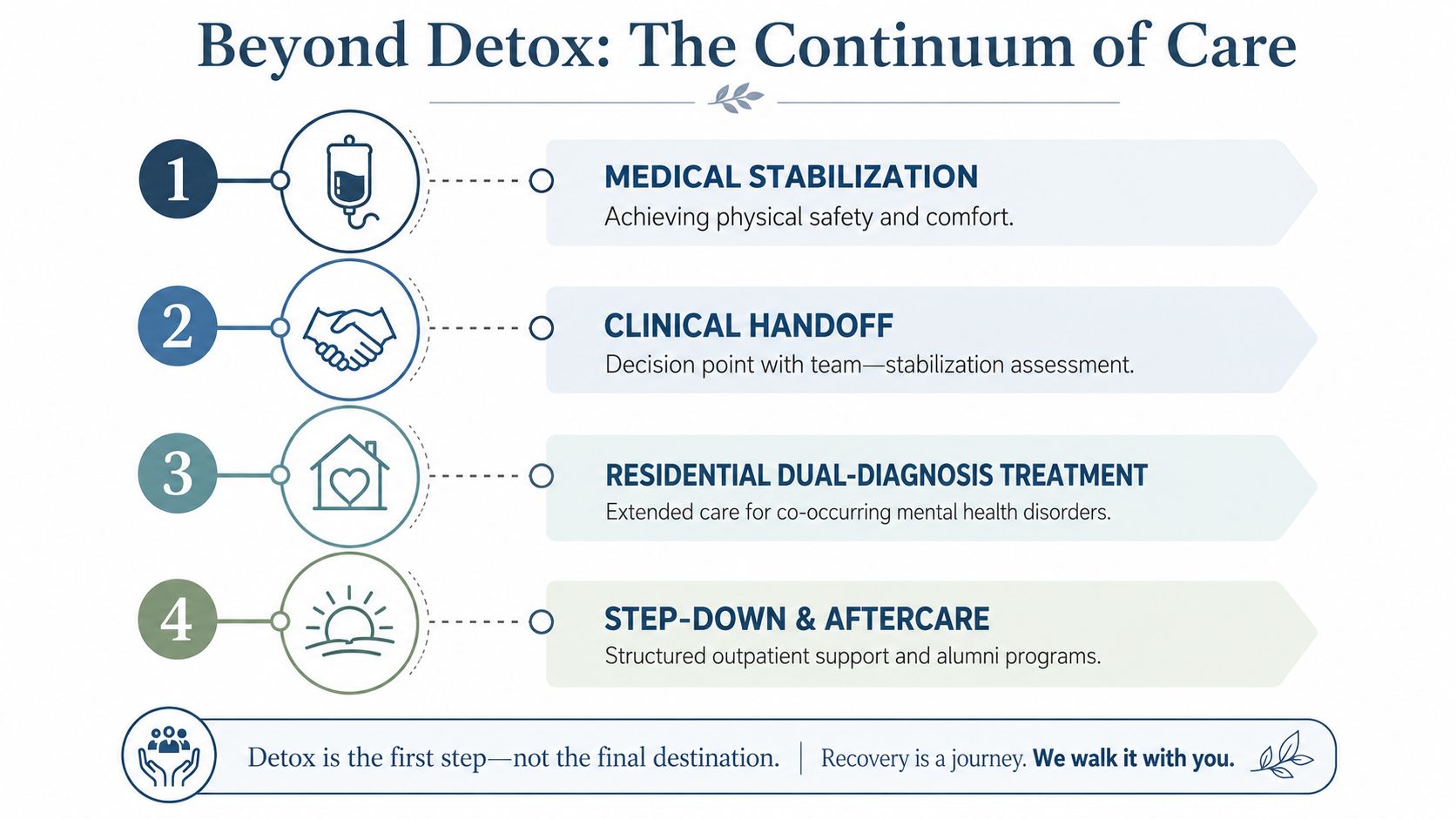
A credible program keeps privacy intact while making the treatment path visible to the people responsible for supporting it. Reflections offers California-licensed, Joint Commission-accredited residential dual-diagnosis care, clinically managed medication-assisted withdrawal when appropriate, private rooms, multidisciplinary treatment, and appropriate electronics access for clients who need structured contact with work and family.
Executives considering detox in California can contact Reflections for a confidential clinical assessment covering withdrawal risk, co-occurring mental health symptoms, privacy, device access, and residential transition planning. The admissions team can coordinate a discreet arrival plan and assess whether the private-room, multidisciplinary setting fits the person's medical and professional needs.