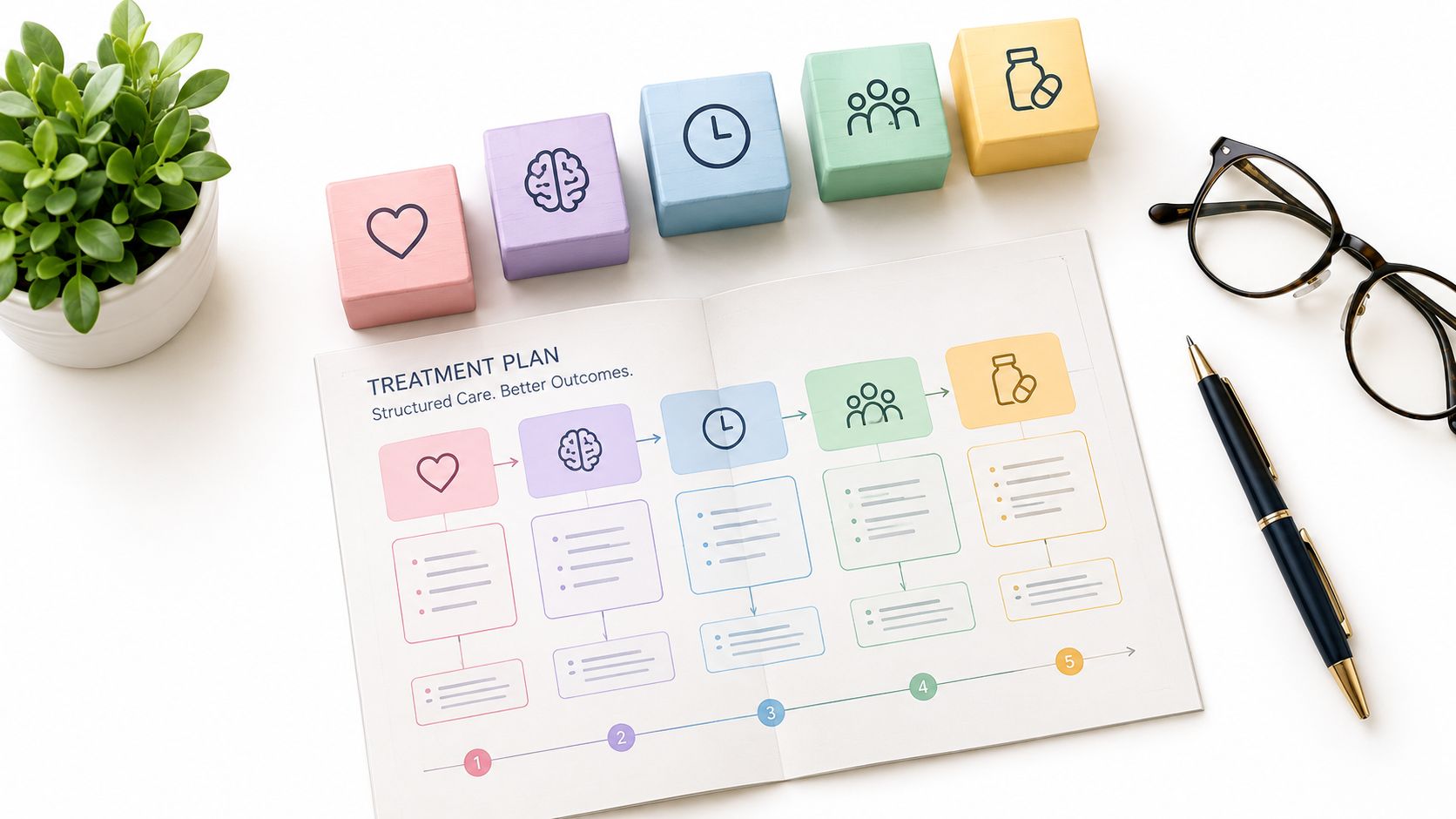

A senior executive can leave residential treatment with genuine commitment, a clear discharge plan, and a calendar that fills before the first week ends. The inbox is overflowing, family members need reassurance, travel is already booked, and every visible decision feels consequential. Under that pressure, motivation becomes an unreliable clinical tool. Sustainable lifestyle changes require a system that protects recovery while accommodating professional responsibility, family roles, privacy, and the realities of a public-facing career.
What Sustainable Lifestyle Change Really Means in Recovery
Returning to work often exposes the gap between intention and infrastructure. A chief executive may recognize relapse warning signs yet skip meals, sleep poorly, miss medication, or withdraw after a difficult board meeting. Recovery then competes with deadlines, travel, family responsibilities, and public scrutiny. The answer is a structure that carries part of the load when judgment and energy are limited.
Sustainable lifestyle change means integrating clinical stabilization, behavioral habits, and environmental design. Sleep timing, nutrition, movement, peer support, medication adherence, therapy, and family communication should reinforce one another. The plan earns its place by reducing high-stakes decisions made while tired, distressed, traveling, or under scrutiny.
A wellness reset can feel effective in a controlled setting. Daily recovery must also withstand late-night deal cycles, red-eye flights, client dinners, conflict at home, and periods of intense visibility. A routine that survives calm weeks still needs to hold up when work becomes chaotic.
Build around protection, not perfection
Start with a small set of operating requirements:
- Clinical continuity: Protect calendar space for therapy, psychiatric follow-up, medication management, and continuing care.
- Physiological stability: Regular sleep, meals, hydration, and movement reduce vulnerability to cravings and emotional volatility.
- Environmental support: Configure the home, travel schedule, devices, and social settings so that recovery requires fewer acts of willpower.
- Rapid response: A warning sign should trigger a rehearsed action, not a private debate.
These safeguards should fit the person's professional identity. A public-facing leader may need discreet check-ins, a travel plan that limits exposure to known triggers, and a clear process for telling family or staff when clinical needs take priority. Career continuity matters, but it cannot depend on concealing deterioration until a crisis forces disclosure.
Household decisions also extend recovery beyond the individual. The United Nations reports that lifestyles account for an estimated two-thirds of global emissions, while material, fuel, and food extraction and processing contribute half of total global greenhouse gas emissions, alongside more than 90% of biodiversity loss and water stress (United Nations climate facts). Repairing rather than replacing, reducing unnecessary consumption, choosing lower-impact meals, and using shared or public transportation can support both environmental responsibility and a more deliberate daily structure.
Social situations require specific boundaries. Anyone considering alternatives such as thc drinks should discuss intoxicating or psychoactive products with the treatment team, especially when substance use disorder, medication, or relapse risk is present. A product marketed as an alternative is not automatically safe.
The strongest plan is specific, discreet, repeatable, and resilient under stress. It protects treatment access without demanding that a high-performing professional abandon work, family, or identity to remain well.
Stabilizing Sleep Nutrition and Movement First
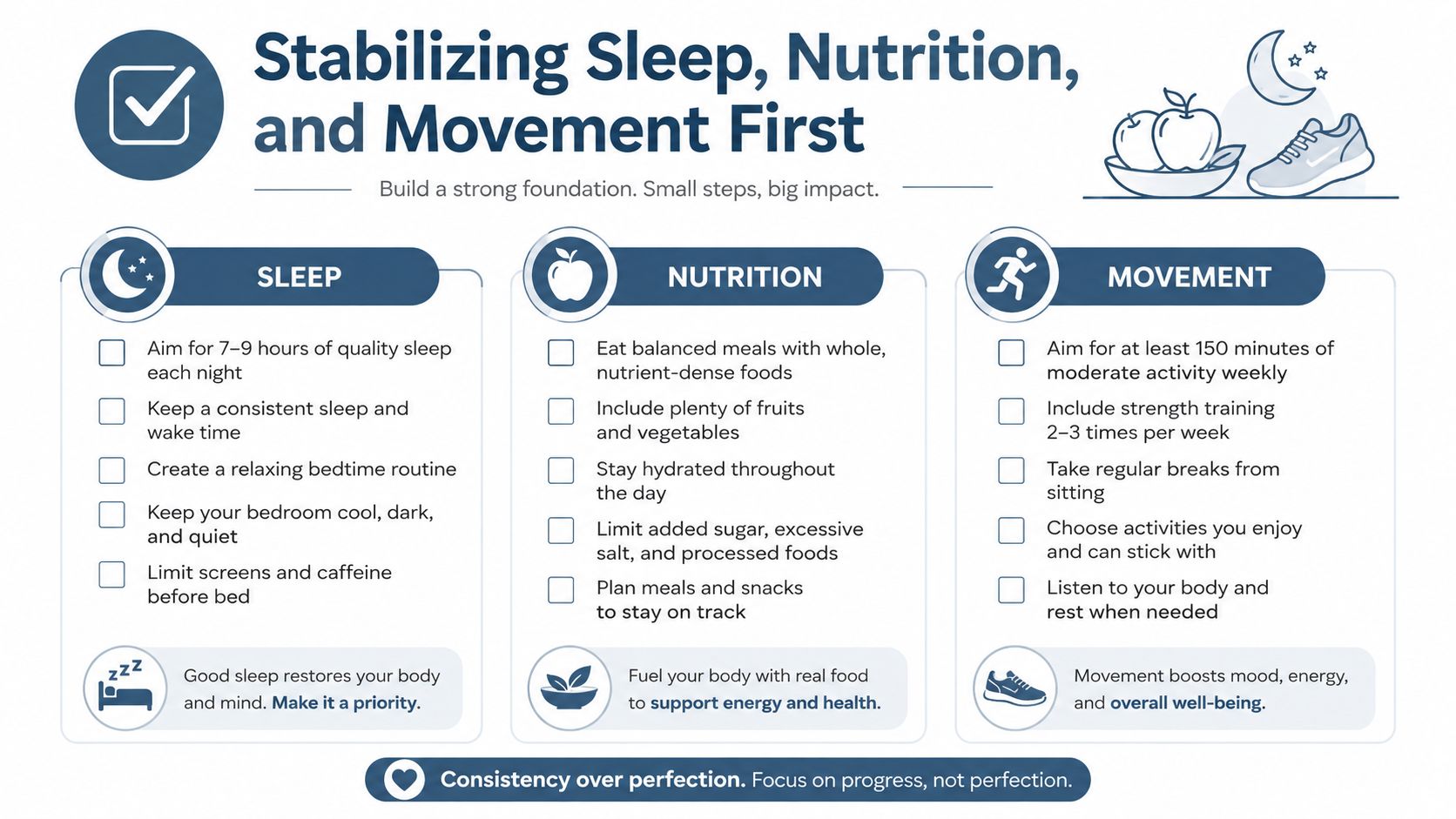
A senior leader may leave treatment with a full calendar, family responsibilities, and a public identity to protect. The first months of recovery still require a dependable physiological baseline. Sleep, food, and movement affect mood, concentration, cravings, and tolerance for stress, which in turn shape therapy, judgment, and performance.
Make sleep predictable
A fixed wake time usually anchors recovery more reliably than pursuing a perfect bedtime. Build around a consistent wind-down period, reduced stimulation, and a dark, quiet room. Set a planned caffeine cutoff.
Travel across time zones requires advance planning. Protect the wake time as closely as possible, use light exposure with clinical guidance, and avoid compensating with irregular daytime sleep. A routine that survives travel will hold up better than one that depends on ideal conditions.
Sleep also intersects with sustainable consumption. Food represents 28% of household carbon footprints globally, along with 48% of household land impacts and 70% of household water impacts (University of Groningen summary of international household research). A stable evening routine can support deliberate meal planning, less impulsive ordering, and fewer late-night decisions.
Keep nutrition functional
The executive version of nutrition skips elaborate meal plans in favor of preventing long gaps between meals:
- Morning foundation: A protein-forward breakfast supports a steadier start than relying on coffee alone.
- Meeting protection: A planned snack or balanced lunch helps prevent a full day of negotiations from becoming a blood-sugar crisis.
- Travel substitution: Hotel breakfast, a prepared meal, or a simple grocery stop can replace skipping food altogether.
- Social boundary: Declining alcohol at a client dinner may feel awkward, while protecting recovery preserves the capacity to work and lead.
The Sleep Consultant on diet and sleep provides additional context for treating food, activity, and rest as connected goals. Reflections' integrated wellness program for nutrition and rebalancing may be considered when nutritional routines need attention alongside broader clinical care.
Use movement as regulation
Set one daily movement anchor outside peak work hours. It may be a walk, mobility routine, or strength session. Hotel corridors, stairs, a private-room mobility sequence, or a short walk during a call can preserve continuity when a gym is unavailable.
Choose one weekly session for nervous-system regulation rather than performance. Movement supports treatment by interrupting rumination, releasing physical tension, and creating a repeatable transition between work and recovery. It should remain practical enough to continue during demanding weeks, not become another performance standard.
Emotion Regulation Tools That Hold Up Under Pressure
High-performing professionals often understand emotional concepts intellectually while remaining vulnerable to rapid physiological escalation. The useful question is not which modality sounds most appealing. It's which skill can be retrieved during a specific trigger, at a specific level of stress, without requiring privacy or extended downtime.
Dialectical behavior therapy, acceptance and commitment therapy, and mindfulness have different jobs. DBT is particularly practical during acute distress because it provides concrete actions. ACT supports values-based behavior when stress persists for weeks. Mindfulness develops the observation capacity that allows either approach to work before an impulse becomes a decision.
A pre-meeting anxiety response may call for paced breathing and a brief body scan. Post-conflict rumination may benefit from checking facts, identifying assumptions, and choosing an opposite action. A late-night craving may require changing location, contacting a support person, and using a distress-tolerance skill rather than debating the craving internally.
Match the tool to the moment
| Tool | Best Recovery Phase | Best Stress Level | Executive Use Case |
|---|---|---|---|
| DBT distress tolerance | Early recovery and high-risk transitions | Acute | Use TIPP, check the facts, or opposite action during panic, conflict, or craving |
| ACT defusion and committed action | Ongoing recovery | Chronic or moderate | Notice self-critical thoughts without obeying them, then act according to professional and personal values |
| Mindfulness | All phases | Mild to moderate, with repetition during calm periods | Use box breathing between meetings or a brief body scan before bed |
DBT's PLEASE skills also deserve attention because physical vulnerability can intensify emotional reactivity. Sleep, nutrition, movement, and medication adherence aren't separate from emotion regulation. They are conditions that make regulation more available.
Practical rule: Every common trigger should have one default response. A person shouldn't have to select from an entire skills manual during a late-night craving.
A short scheduled practice is more realistic than an idealized retreat from work. Two minutes of grounding after morning coffee, a deliberate exhale before entering a meeting, or a 90-second body scan at night can create repetition without requiring a major schedule change. Reflections' meditation support for recovery reflects this kind of structured practice within a broader treatment environment.
Integrating Clinical Care Work and Family
Recovery becomes fragile when clinical care, employment, and family life operate from separate calendars. The executive may protect therapy but neglect family communication, or attend family meetings while allowing work to consume medication management and sleep. A durable plan treats all three systems as part of one operating schedule.
Schedule the non-negotiables first
Therapy appointments, psychiatric reviews, medication management, family check-ins, and recovery meetings should be placed before discretionary work. They deserve the same protection as a board meeting, including travel buffers and a policy against routine rescheduling.
A neutral workplace explanation is often sufficient. A professional may describe appointments as recurring medical care or use protected health leave where eligible, without disclosing diagnostic details to colleagues who don't need them. Confidentiality should be planned rather than improvised.
Family members also need clarity. A written recovery agreement can identify who receives updates, how warning signs are communicated, what happens during a crisis, and which conversations belong in therapy. A partner or adult child shouldn't have to interpret every change in mood without guidance.
Use a worked accommodation plan
Consider an executive facing a heavy travel week:
- Early morning: A standing therapy appointment is protected before discretionary calls.
- Midday: A medication check is scheduled during a travel window, with the clinical team confirming logistics.
- Evening: A weekly family meeting remains on the calendar, even if the format changes from in-person to secure remote participation.
The work calendar can then be built around those commitments. If a conflict appears, the first question is whether a lower-value meeting can move, not whether clinical care can disappear.
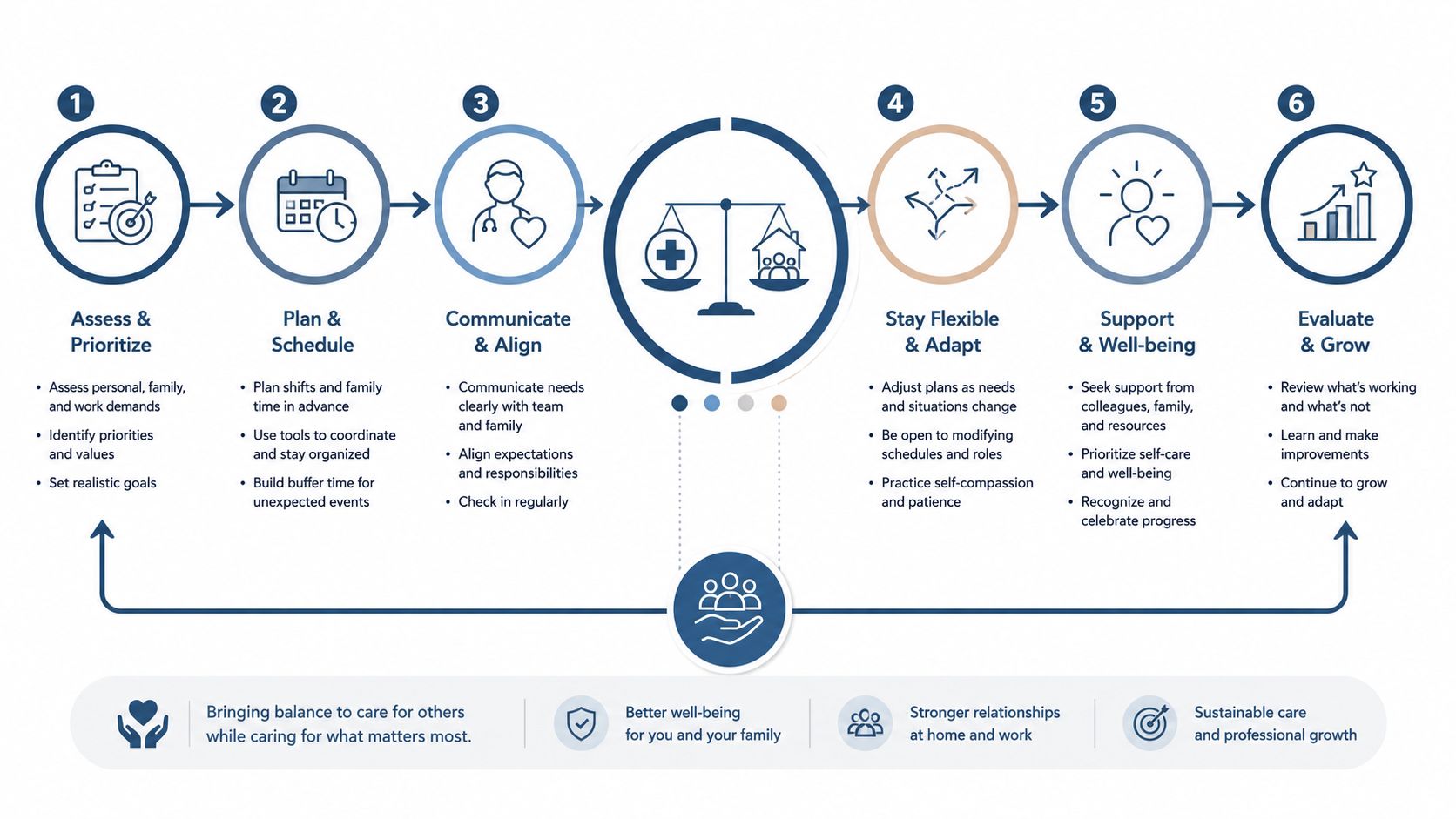
The most common failure mode is work creep. A meeting expands, a flight changes, and a protected appointment becomes optional. The guardrail is simple: clinical and family commitments remain locked unless the treatment team agrees to a change.
Resources on relationships during recovery can help families move from emotional improvisation toward clearer participation. The executive doesn't need to surrender professional identity. The executive needs a schedule that stops work from consuming every protective factor.
Designing Habits That Survive a Demanding Schedule
A habit that works only at home isn't a recovery habit for someone who travels, leads teams, or manages unpredictable negotiations. The design must begin with existing anchors, then add a backup cue for the days when the original routine fails.
Morning coffee can cue a two-minute grounding exercise. A calendar notification can cue relaxed posture and one deliberate breath before a meeting. A dim-light signal can cue the evening wind-down, while a phone setting can reinforce the boundary around stimulation. These pairings reduce reliance on memory.
Build redundancy into the routine
| Anchor Cue | Target Behavior | Backup Cue |
|---|---|---|
| Morning coffee | Brief grounding and hydration | First calendar opening |
| Meeting notification | Posture reset and paced breathing | Doorway before entering the room |
| Evening dim-light cue | Begin wind-down routine | Phone grayscale setting |
| Calendar exercise block | Walk, mobility, or strength session | Wearable reminder or hotel corridor route |
| Sunday calendar review | Check sleep, meals, movement, and appointments | Accountability message |
The pairing matters because executives routinely encounter disrupted time zones, client dinners, and consecutive travel days. A missed workout shouldn't eliminate movement for the day. A late dinner shouldn't become a reason to abandon the next morning's meal structure. The backup cue preserves the identity of the routine even when the original cue disappears.
Track drift before it becomes danger
A one-line nightly log can record sleep quality, mood, cravings, medication adherence, and the day's main stressor. A Sunday review should take only a few minutes and ask:
- Which protective behavior held?
- Which cue failed?
- What environmental change would make the behavior easier next week?
- Does the treatment team need to know about the pattern?
Information alone often produces modest behavior change. A meta-analysis of residential energy interventions found that information interventions reduced household energy use by an average of 6.24% after publication-bias correction, while randomized trials showed effects of about 5.2%, with substantial variation and possible rebound effects (meta-analysis of residential energy-efficiency interventions). The recovery parallel is direct. Tracking is useful, but tracking without structural support rarely carries the full burden.
Relapse Prevention Tracking and Continuing Care
A C-suite client may treat recovery like a strategic initiative, but a dashboard alone won't prevent recurrence. The plan must describe what happens when the first warning sign appears, who gets contacted, and which environmental changes take place before the situation escalates.
A representative client might identify several early indicators: shortened sleep, increasing secrecy around medication, irritability after travel, skipped meals, and a growing belief that professional pressure justifies isolation. Each indicator receives a response. Reduced sleep prompts a clinical check-in. Secrecy prompts contact with a chosen support person. Travel-related irritability triggers a pause on non-essential evening commitments.
Write the plan in operational language
A written relapse-prevention plan should include:
- Warning signs: Observable changes in sleep, mood, behavior, communication, or medication adherence.
- Internal triggers: Shame, fear of failure, anger, loneliness, or self-critical thinking.
- External triggers: Travel, conflict, celebrations, access to substances, or unstructured evenings.
- Coping responses: A named DBT, ACT, or mindfulness skill for each trigger.
- People to contact: Clinicians, family members, peers, sponsors, or trusted colleagues.
- Environmental changes: Leaving a risky setting, changing travel arrangements, or reducing discretionary commitments.
The tracking rhythm can be layered without becoming obsessive. A daily mood and craving check, weekly therapy review, monthly psychiatric medication review, and quarterly continuing-care reassessment create different levels of oversight. The treatment team should determine the appropriate clinical frequency for the individual.
A lapse, relapse, and recurrence aren't interchangeable terms. A lapse may be an isolated return to a behavior, relapse generally describes a broader return to problematic use or symptoms, and recurrence can describe the return of a condition or pattern after improvement. The correct response is prompt clinical assessment, not secrecy or catastrophic thinking.
Continuing care extends beyond appointments. Peer support, alumni participation, family education, workplace reintegration check-ins, and secure communication with clinicians can keep the plan active after residential treatment. Residential substance use treatment commonly lasts 30, 60, or 90 days, and independent treatment guidance identifies 90 days as the most effective duration for moderate-to-severe cases because it provides time for stabilization, therapy, and relapse-prevention skills to consolidate. Guidance citing the National Institute on Drug Abuse states that treatment lasting less than 90 days produces limited long-term results for most substance use disorders, with 90 days described as a minimum threshold for lasting outcomes.
The client keeps a one-page plan accessible, updates it quarterly, and shares it only with chosen people.
Your First 90 Days of Sustainable Recovery
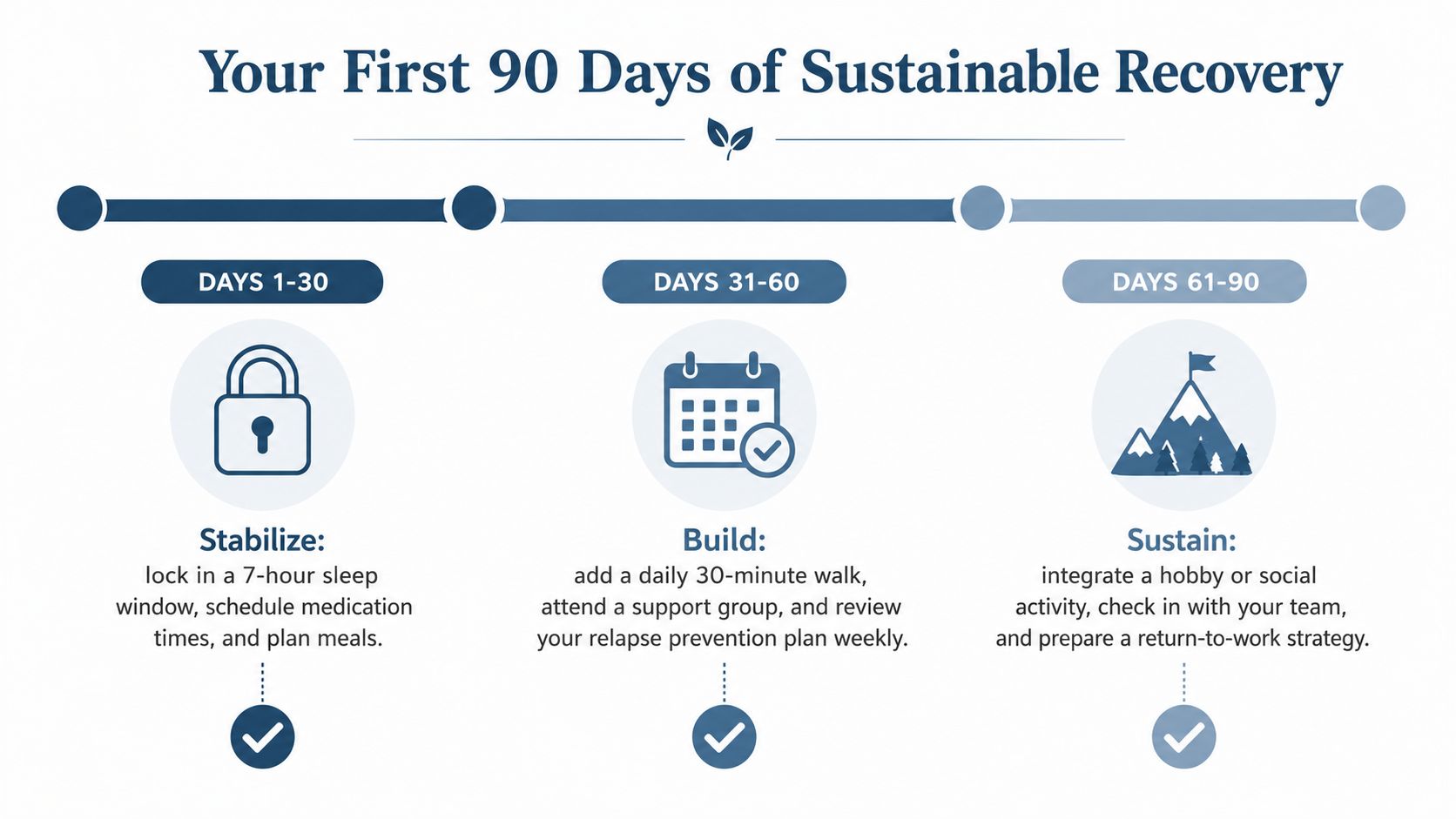
The first three months should be treated as a staged implementation period, not a test of personal discipline. Each action needs a visible cue, such as a calendar block, phone reminder, or accountability partner, so the routine remains available during travel and high-stakes deadlines.
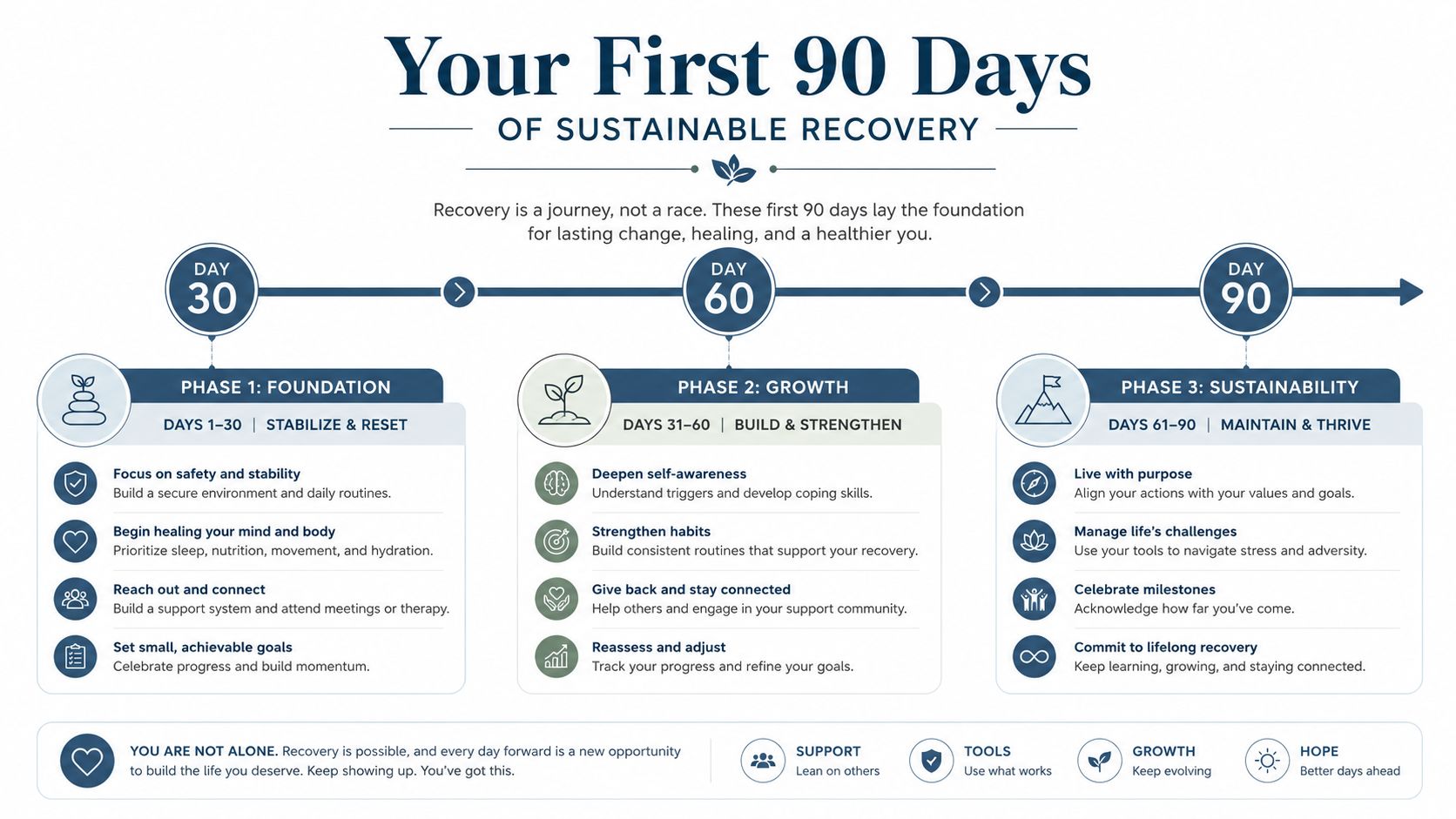
Days 1 through 30 focus on stabilization
The first phase protects the basics:
- Sleep: Lock in a consistent 7-hour sleep window, subject to individualized clinical guidance.
- Medication: Schedule medication reviews and keep administration times visible.
- Safety: Identify two crisis contacts and confirm how they should be used.
- Capacity: Pause non-essential commitments while the treatment team evaluates stability.
- Food and movement: Plan regular meals and use gentle daily activity as tolerated.
This period isn't the time to prove that work can continue at maximum intensity. Electronics access may allow appropriate engagement with career obligations, but access should be balanced against clinical needs, rest, and privacy.
Days 31 through 60 build structure
Once the foundation is holding, add one movement habit and a daily 10-minute mindfulness block. Map work triggers against the coping skills selected earlier, then review the pattern in therapy rather than relying on self-assessment alone. A trackable 90-day workout plan can provide structure, but the exercise choice should remain compatible with medical status, energy, and recovery priorities.
Days 61 through 90 harden the system
The final phase formalizes the written relapse-prevention plan, aligns communication with family and chosen supports, completes a broader self-monitoring review, and schedules the first continuing-care appointment. The executive can also prepare a return-to-work strategy that identifies travel limits, meeting boundaries, clinical appointments, and escalation steps.
Sustainable living isn't a finish line. Small, repeated behaviors outperform motivation, particularly when the system is designed for the difficult weeks rather than the easy ones.
Reflections provides confidential, private residential detox and rehab for executives and working professionals, with private rooms, an accredited multidisciplinary clinical team, appropriate electronics access, dual-diagnosis treatment, family involvement, and continuing-care planning. Professionals seeking a structured environment for sustainable lifestyle changes can visit Reflections to discuss confidential treatment options with the admissions team.