
The message usually arrives late, after a board meeting, a missed family dinner, and a few too many nights trying to force sleep. A senior leader starts using alcohol to come down after a wired stretch, then leans on stimulants to stay sharp the next morning, and tells themselves it's still under control because work keeps getting done.
That story is familiar in executive treatment, and it's also dangerous. Bipolar symptoms and substance use feed each other, and by the time the pattern is obvious, career performance, relationships, and health have usually started to slip.
For high-achieving professionals, the problem is rarely a lack of discipline. It's a clinical mismatch, a bipolar disorder and substance abuse treatment plan has to be discreet, integrated, and strong enough to hold both the mood disorder and the addiction at the same time.
When High Performance Meets Hidden Struggles
A managing director can look polished from the outside and still be in free fall. One week, there's relentless productivity, little sleep, and a rush of ideas. The next, there's exhaustion, irritability, and a quiet habit of drinking or using stimulants just to get through the day.
That pattern is not a character flaw. It's what untreated bipolar disorder often looks like when someone has enough status, money, or stamina to hide it for a while.
The executive version of self-medication
Alcohol is often used to blunt depressive lows. Stimulants are often used to extend hypomanic energy or fight through fatigue. Both choices seem functional in the moment, and both make the underlying illness harder to see.
The damage is usually incremental. Sleep gets erratic, judgment gets looser, and the professional starts compensating with more effort, more secrecy, and less honesty. By the time the performance problem becomes visible, the issue is usually much bigger than “stress.”
Practical rule: If the substance use is framed as part of the work routine, the clinical risk is already high.
That is why luxury residential care matters for this population. A program built for executives has to protect privacy, preserve dignity, and still do the hard clinical work. Anything less turns treatment into a temporary pause instead of a real intervention.
The Clinical Overlap Between Bipolar Disorder and Substance Use
The overlap here is not subtle. A 2025 review of large epidemiologic studies reported lifetime substance use disorder prevalence of 56.1% in people with bipolar disorder overall, including 60.7% in bipolar I and 48.1% in bipolar II, compared with 13.8% in the general population. The same review also noted earlier evidence showing at least 40% lifetime prevalence in bipolar I and at least 20% in bipolar II, which means this problem has been clear for a long time. The review also summarized alcohol use disorder as especially common, with average prevalence of 30% across 78 clinical studies, cannabis use disorder at 24% across 53 studies, and other substance use disorders at about 17%.
Why the two conditions distort each other
Bipolar disorder affects reward, sleep, impulse control, and judgment. Substance use then amplifies instability, which makes each episode harder to recover from cleanly. That creates the familiar executive cycle, periods of overextension, followed by crashes that look like burnout but are often a combined mood and addiction problem.
Diagnosis gets messy fast. A person may look manic because of stimulant use, or depressed because of withdrawal, while the underlying bipolar disorder keeps operating underneath both. That is why sequential care fails so often, the team cannot safely “wait and see” which problem settles first.
| Clinical Dimension | Impact of Co-Occurrence |
|---|---|
| Mood regulation | More unstable, with harder-to-predict swings |
| Sleep | Often disrupted, which weakens recovery |
| Judgment | More impulsive decisions and weaker self-monitoring |
| Medication response | Harder to assess and manage cleanly |
| Recovery planning | Needs one coordinated plan, not two separate tracks |
Clinical point: Treating the substance use without stabilizing mood invites relapse. Treating mood without addressing substance use leaves the same triggers in place.
This overlap changes medication planning from day one. The right stabilizer, the right monitoring cadence, and the right sobriety support need to be coordinated, not improvised. That's the difference between a program that sounds solid and one that is.
Integrated Treatment That Targets Both Conditions
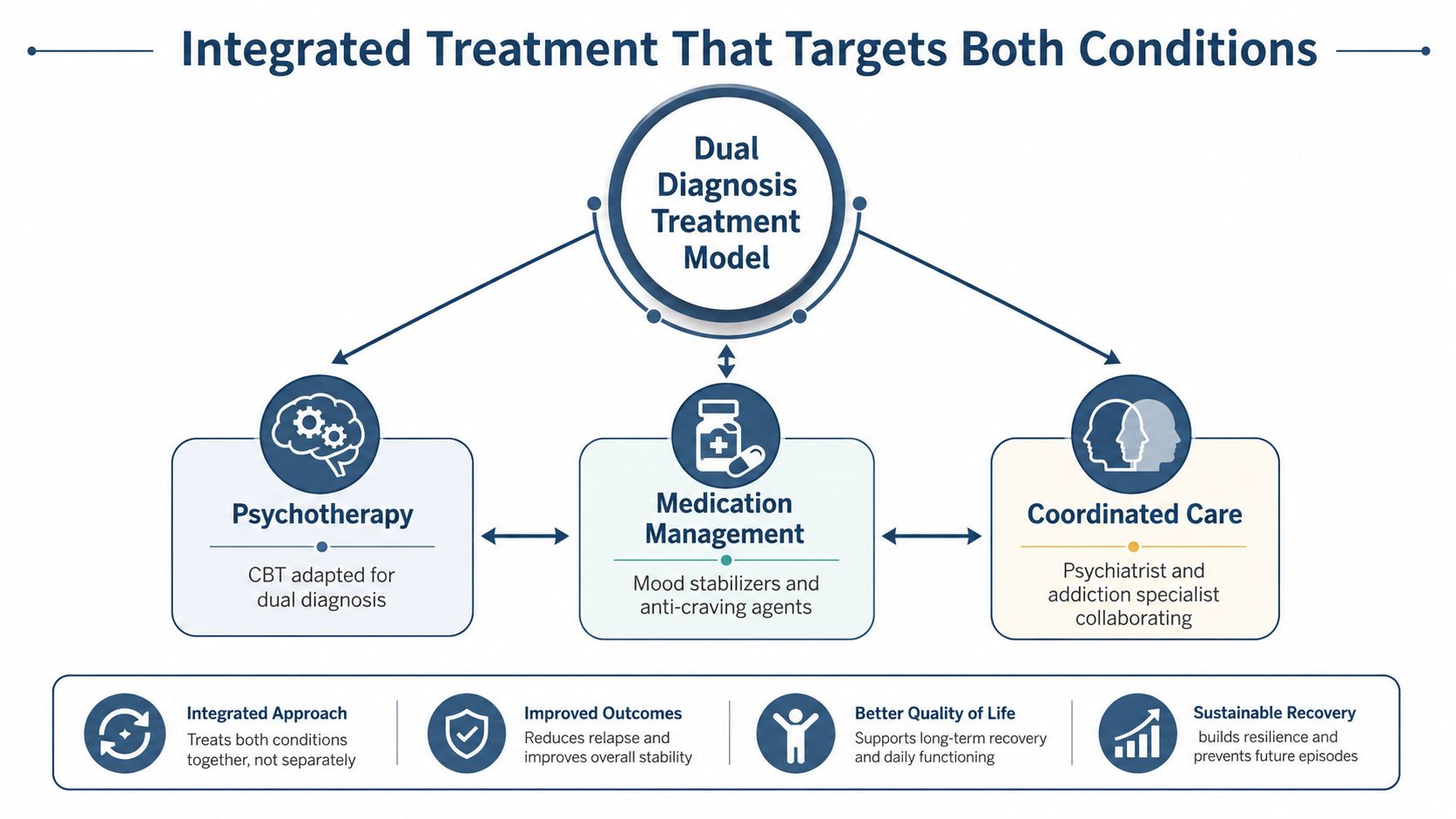
An executive may need to lead a meeting while experiencing escalating energy, sleeping poorly, and using substances to maintain control. Treatment must address that clinical reality without forcing a choice between mood stabilization, recovery, and every professional responsibility. The strongest model is integrated care, with one team coordinating both conditions rather than placing them on separate tracks.
A 2022 clinical practice guideline identified integrated group therapy as the most well-validated psychosocial intervention for substance-use outcomes when substance use is addressed early. A 2024 review also emphasized personalized and multimodal treatment because no single intervention consistently addresses both mood and substance-use problems. That guidance supports a practical executive-care standard: stabilize the person, protect appropriate work continuity, and reduce relapse risk through one coordinated plan.
Psychotherapy that matches the case
Cognitive behavioral therapy adapted for dual diagnosis helps clients identify thoughts that contribute to medication nonadherence and substance use. Dialectical behavior therapy fits cases where emotional swings lead to impulsive drinking, reckless work decisions, or late-night spirals. Motivational enhancement therapy addresses ambivalence directly. Many high-performing professionals want relief while protecting a hard-earned identity and career.
Therapy should produce usable decisions, not abstract discussion. Sessions need to connect triggers with travel, deadlines, conferences, isolation after work, and the consequences of impaired judgment.
Medication optimization with a narrow goal
The literature favors mood stabilization first, followed by targeted substance-use treatment. Reviews of comorbid bipolar disorder and alcohol or illicit drug use report that lithium and valproate can improve mood and may indirectly reduce substance use. Placebo-controlled data also found that valproate added to lithium improved mood and alcohol-use symptoms. Earlier clinical guidance recommends integrated care after detoxification, with pharmacologic treatment centered on stabilization rather than relying on abstinence alone.
Medication decisions require consistent psychiatric oversight, symptom tracking, and attention to adherence. Psychiatric medication management should therefore remain connected to therapy, substance-use monitoring, sleep planning, and the client's work demands.
Recovery support executives will use
Relapse prevention must be specific. Identify high-risk travel, conference nights, loneliness after work, and false confidence after a productive stretch. Peer support remains useful when it is discreet, structured, and compatible with a demanding schedule.
Reflections provides integrated psychiatric and substance-use care in a residential setting, with medication optimization and continuing support included in treatment planning.
Bottom line: The strongest plan keeps mood care and addiction care active together, with treatment intensity and scheduling built around the client's clinical needs and professional obligations.
Luxury Residential Care Designed for Executives
Conventional rehab often misses the mark for executives because the environment itself is part of the treatment problem. Shared rooms, rigid schedules, and a generic group culture can make a high-functioning professional shut down before the work begins. Luxury residential care is different because it respects privacy without softening the clinical standard.
What the environment changes
Independent rehab listings show that executive or luxury tracks commonly use private rooms and allow personal electronics such as cell phones and laptops, so clients can keep up with work during treatment. One verified listing states that clients on an executive track have full access to personal devices and stay in private rooms. Luxury directories also document that upscale residential programs may advertise private rooms, chef-prepared meals, fitness or recreational amenities, and secluded settings.
That matters because discretion is not cosmetic. If a client is worried about exposure, they will minimize symptoms, delay honest disclosure, and resist length of stay.
| Feature | Standard Rehab | Luxury Executive Dual-Diagnosis Program |
|---|---|---|
| Accommodations | Often shared or basic | Private rooms are expected |
| Electronics | Often restricted | Cell phones and laptops may be allowed |
| Privacy | Limited | Designed around discretion |
| Schedule | Fixed and broad | More flexible around professional obligations |
| Clinical focus | Can be generic | Built for mood disorder and addiction overlap |
| Setting | Institutional | Secluded, upscale, lower visibility |
Why clinical depth still has to lead
Privacy alone is not enough. The most important asset in residential dual-diagnosis care is real-time psychiatric oversight, because withdrawal, sleep disruption, and stress can all destabilize mood fast. Programs for executives need on-site clinicians who can adjust medications, monitor depressive or manic shifts, and keep the treatment plan coherent.
The useful question is not whether a program feels comfortable. It's whether the comfort is supporting engagement. Reflections is one option in this category, since it is a California-licensed, Joint Commission-accredited residential provider that uses private, upscale housing, allows appropriate electronics access, and builds treatment around co-occurring mental health and substance use disorders, including bipolar-related presentations. For a closer look at residential structure, see its bipolar disorder residential treatment page.
Family Involvement and Continuing Care Pathways
Recovery gets stronger when the family stops guessing and starts working from the same plan. Spouses, parents, and adult children often react to bipolar episodes and substance use as separate crises, when in reality they are usually seeing one interconnected pattern. Family therapy creates a shared language so the household stops reinforcing denial, rescuing, or escalation.
What family work should cover
Families need direct education about mood episodes, relapse warning signs, boundary setting, and what support looks like without enabling. That includes learning how to respond to agitation, secrecy, withdrawal, or a sudden return to overconfidence. It also means understanding that “helping” can become harmful when it removes consequences every time the client feels overwhelmed.
A calm family system doesn't happen by accident. It comes from structure, repetition, and honest expectations.
Aftercare has to be equally structured. Working professionals usually do best when discharge planning includes step-down support, medication follow-up, peer accountability, and a clear plan for travel, work demands, and sleep protection. The point is continuity, not discharge theater.
The practical aftercare sequence
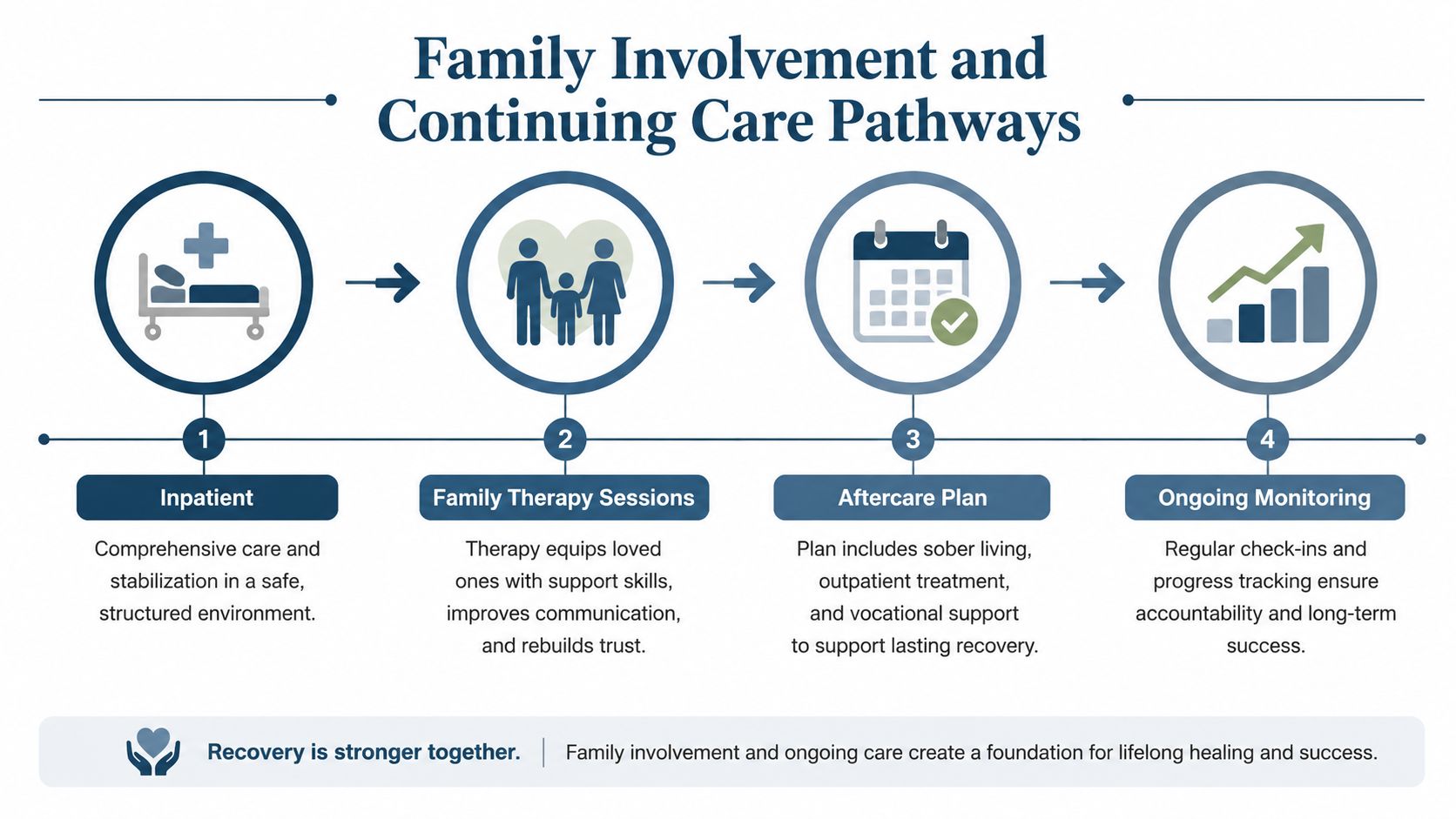
A useful pathway usually includes:
- Family therapy sessions, so loved ones learn support skills instead of improvising.
- Aftercare planning, with sober living, outpatient care, or vocational support where needed.
- Ongoing monitoring, especially around sleep, medication adherence, and return-to-work stress.
- Telehealth follow-up, when travel or leadership demands make in-person care harder.
The family piece is not optional because co-occurring bipolar disorder and substance use disorder tend to destabilize the whole household, not just the client. Family therapy for addiction recovery is most useful when it is tied to the same clinical language the residential team uses, rather than treated as a separate, softer service.
Choosing an Accredited Dual Diagnosis Program
For a professional with bipolar disorder and substance use, program choice is a strategic decision, not a comfort preference. The wrong facility can cost time, credibility, and momentum. The right one protects all three.
What to verify before admission
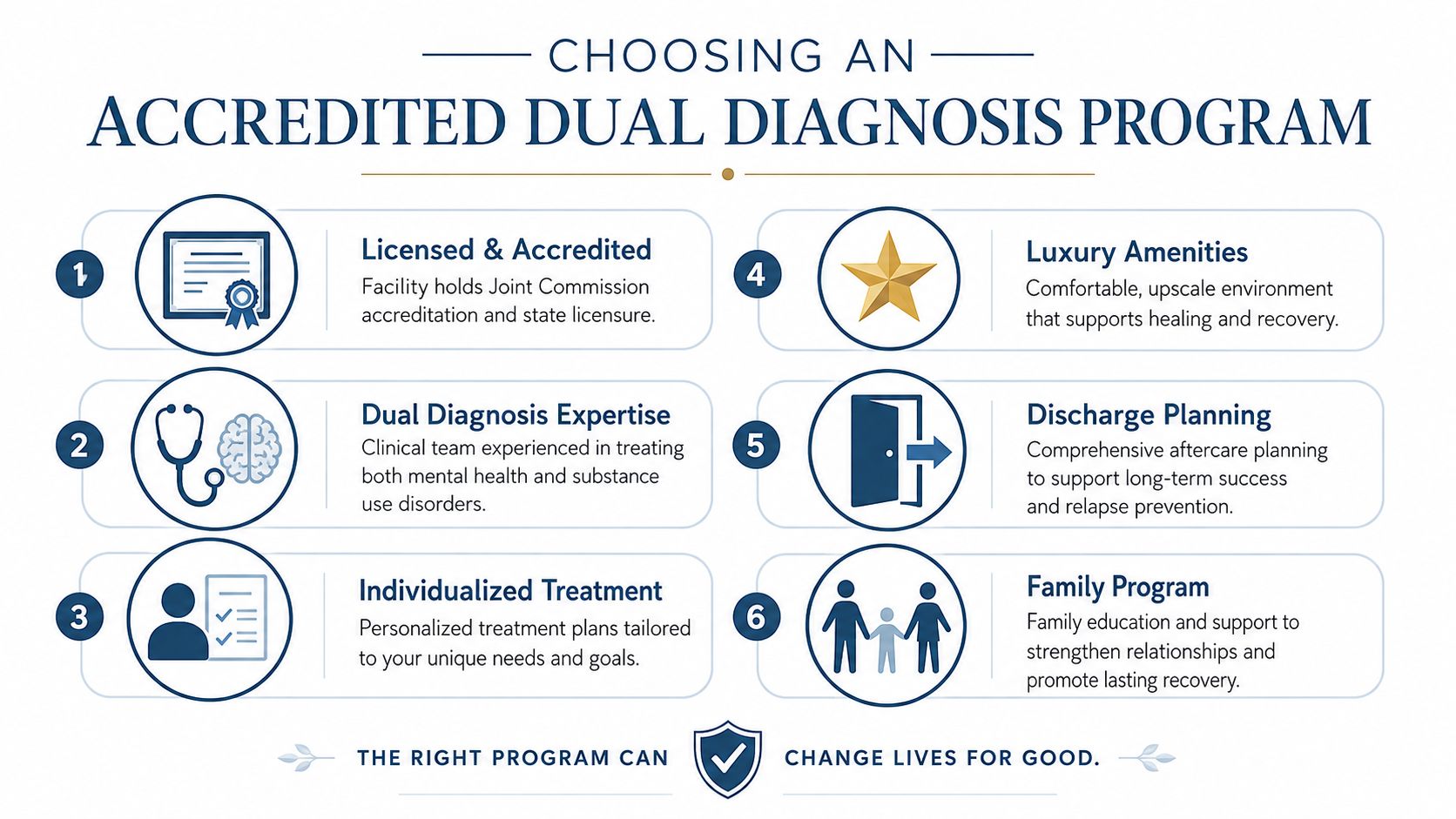
Accreditation is the first filter. The Joint Commission's Behavioral Health Care accreditation is awarded only after an onsite survey by a Joint Commission surveyor or surveyors, and it explicitly covers behavioral health organizations including substance use disorder treatment providers. The organization also provides a public provider locator so a program's status can be checked independently rather than accepted on marketing alone. Those verification tools matter because dual-diagnosis care should be measurable, not vague.
Beyond accreditation, the team should have real psychiatric and addiction medicine depth, not just general counseling. Look for on-site psychiatric care, evidence-based psychotherapy, family programming, and clear discharge planning for executives who need continuity.
The decision points that matter most
- Licensed and accredited: Verify the facility's behavioral health accreditation.
- Dual-diagnosis expertise: Ask whether bipolar and substance use are treated in one plan.
- Individualized treatment: A senior executive needs a plan built around work reality, not a template.
- Luxury amenities: Private rooms and discreet accommodations reduce friction and exposure.
- Discharge planning: The plan should cover step-down care, medication continuity, and follow-up.
- Family program: Loved ones should be included in a structured way.
A high-end program is not valuable because it is expensive. It is valuable when it lowers noise, protects privacy, and makes sustained treatment possible for someone who cannot disappear from life for months without planning. The admissions process should also account for coordination with existing medical, legal, or family advisors when appropriate.
Common Misconceptions About Dual Diagnosis Recovery
An executive may keep leading meetings while cycling between depression, agitation, and substance use. Waiting for one problem to disappear before treating the other extends that cycle. Integrated care addresses bipolar disorder and substance use at the same time, with one coordinated clinical plan.
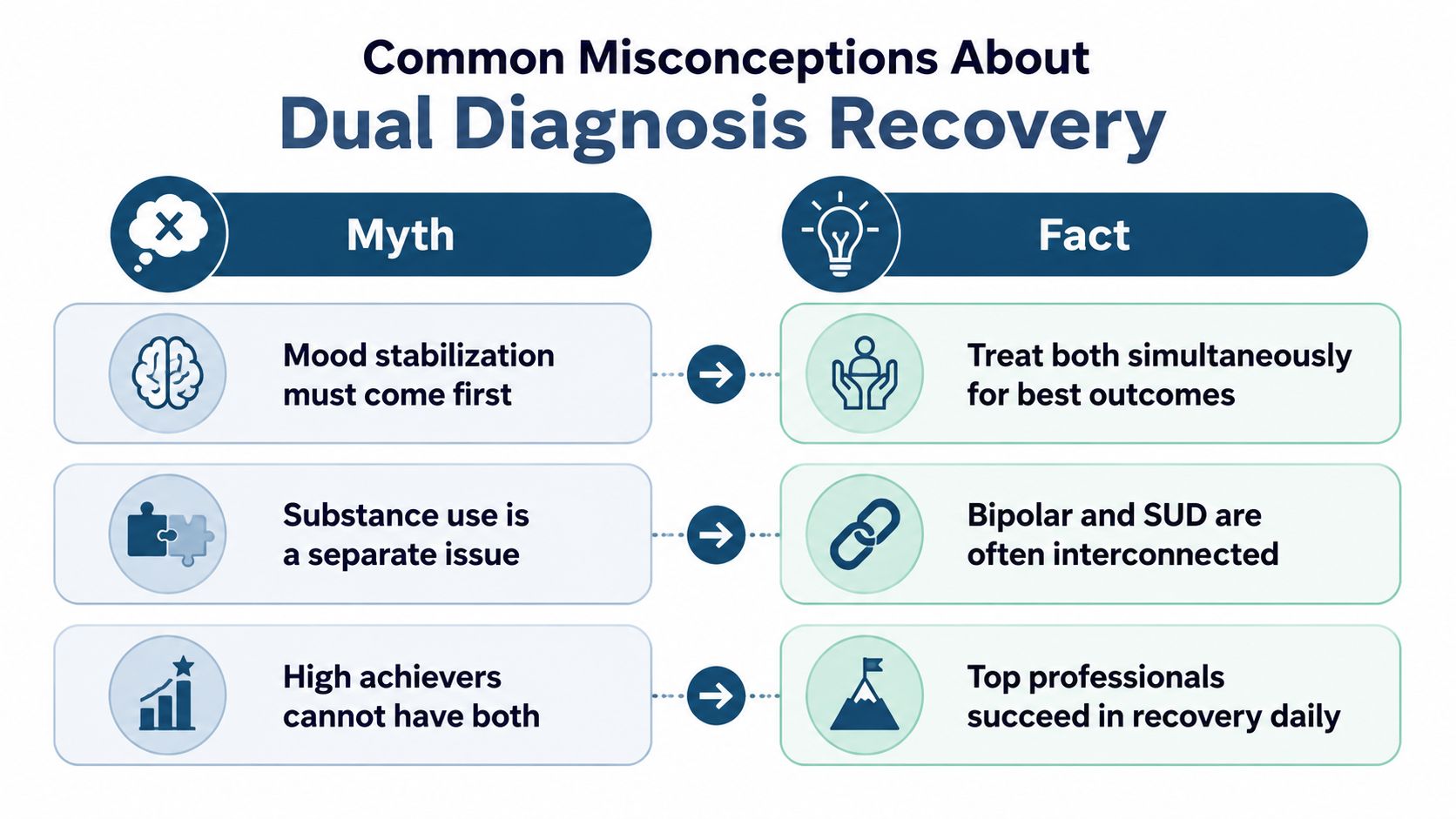
The myths that keep people stuck
- Myth, mood stabilization has to happen first. Fact, both conditions need attention together when they're interacting.
- Myth, substance use is a separate issue. Fact, bipolar and substance use are often clinically intertwined.
- Myth, high achievers can't go to treatment and still manage responsibilities. Fact, executive programs are built to preserve discretion and continuity.
Sobriety alone does not resolve bipolar symptoms. The client still needs a separate psychiatric evaluation, an appropriate medication strategy, and regular monitoring after alcohol or drug use stops. Treatment should also track sleep, mood changes, medication response, and relapse warning signs.
Stigma creates another barrier. Professionals may assume dual-diagnosis care will disrupt a company, family, or public role beyond repair. That assumption often keeps them in partial treatment while symptoms continue affecting judgment, relationships, and performance.
Recovery doesn't fail because the situation is complex. It fails when the treatment plan is too simple for the case.
The practical standard is clear: treat both conditions together, protect privacy, and build continuing care around the client's actual work and family obligations. Reflections provides residential dual-diagnosis care for adults in a private, upscale setting, with psychiatric support, medication management, family involvement, and continuing care for people with demanding lives. Visit Reflections to begin a confidential conversation about treatment.