

The board meeting is tomorrow, but the executive entering a private residential program can't concentrate on the transition plan. Alcohol has become the fastest way to quiet anxiety after work, and the relief no longer lasts through the night. A discreet intervention, a worsening sleep pattern, and concern about what happens when the first serious craving arrives have made one fact impossible to avoid: professional success hasn't protected this person from addiction.
For executives, chief executives, and high-earning professionals, treatment has to address more than substance use. It must account for confidentiality, co-occurring anxiety or mood symptoms, family strain, leadership responsibilities, and the identity that often keeps a high-functioning person defended against help. Acceptance and commitment therapy for addiction offers a practical way to work with those realities. It doesn't ask a client to win an argument with every craving or eliminate every uncomfortable thought. It teaches the client to respond differently, then take action toward a life that sobriety can support.
Why ACT Belongs in High-End Addiction Treatment
A 44-year-old executive with alcohol use disorder and generalized anxiety arrives at a luxury residential program after a discreet intervention. The client has built a career on anticipating objections, controlling outcomes, and finding a rational explanation for almost everything. Those strengths helped in the boardroom, but they also create defenses in therapy. The client can explain the drinking, describe the risks, and still avoid the emotional experience that keeps the cycle active.
A confrontational approach may intensify that defensiveness. A purely skills-based approach may give the client useful tools without changing the relationship with shame, fear, craving, or perceived failure. ACT takes a different position. The therapist doesn't argue that the anxiety is irrational or demand that the craving disappear. The therapist helps the client notice what is happening internally, make room for it, and choose a behavior aligned with a personally meaningful direction.
Treating the mechanism beneath the substance
For this executive, alcohol may function as an avoidance strategy for anxiety, exhaustion, loneliness, or the pressure to remain indispensable. ACT targets that avoidance pattern rather than focusing only on the substance-specific trigger. The question becomes less “How can the client suppress the urge?” and more “What happens when the urge is present, and what action would protect the life the client values?”
That shift matters in dual-diagnosis care. A client may be abstinent while remaining trapped in perfectionism, emotional suppression, catastrophic thinking, or relentless overwork. If those patterns continue, the person may remain vulnerable even when the immediate access to alcohol has changed.
Clinical principle: Recovery becomes more durable when the client learns to carry difficult internal experiences without letting them dictate behavior.
Aligning recovery with executive life
Values work also gives treatment a language beyond an abstinence script. The executive may value presence with family, ethical leadership, physical vitality, mentorship, or the ability to make decisions without concealment. Those values don't excuse substance use, but they can provide a durable reason to tolerate the discomfort of recovery.
A high-end program can support that work with a highly accredited clinical team, discreet care, private accommodations, and a treatment schedule that recognizes legitimate professional obligations. Structured electronics access can allow appropriate contact with work while treatment remains clinically protected. The purpose isn't to preserve business as usual. It's to help the client practice responsible engagement without using work as another form of escape.
ACT therefore belongs inside luxury addiction treatment because it treats the person who uses the substance, not just the substance itself. It can connect clinical work to the client's actual relationships, responsibilities, and identity, while remaining one component of a broader plan for psychiatric care, medical safety, and continuing recovery.
The Core Processes of Acceptance and Commitment Therapy
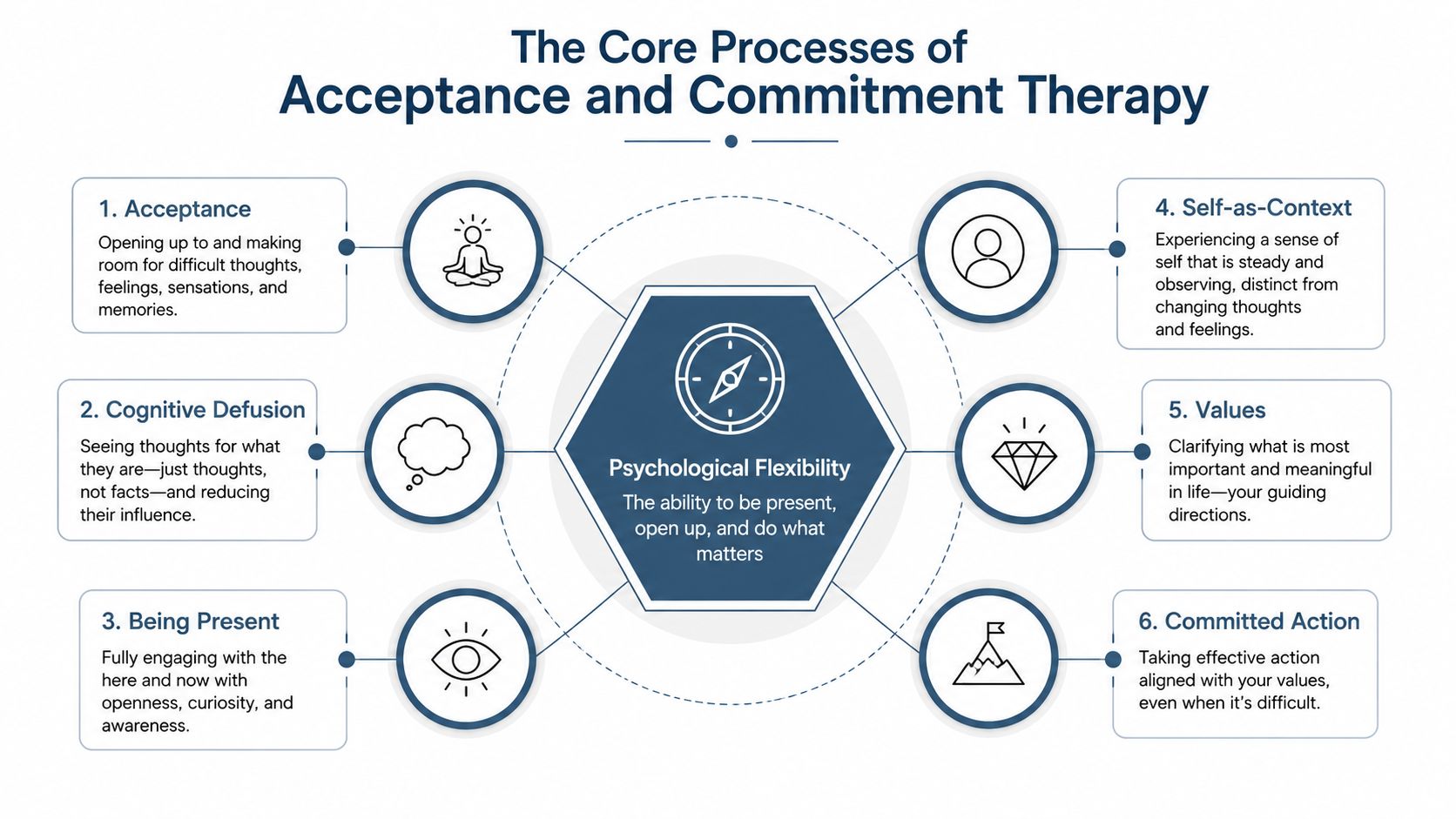
ACT's six core processes work as one model of psychological flexibility, not as six unrelated exercises. A useful metaphor is crossing a river. The client must stop exhausting energy by fighting the current, stay oriented in the present, recognize that the current isn't the whole self, and move toward the far bank with deliberate strokes.
The upstream processes
Acceptance means willingness to experience cravings, urges, anxiety, shame, and physical discomfort without automatically suppressing or escaping them. It doesn't mean approving of addiction or tolerating unsafe circumstances. It means dropping the unworkable struggle to control every private experience before taking a healthy action.
Cognitive defusion changes how a client relates to thoughts. “A real professional doesn't need help” becomes “the mind is producing a thought about professionalism and help.” The thought can remain present without functioning as an order. A therapist may use the phrase “I am having the thought that…” or ask the client to sing a distressing sentence to the tune of “Happy Birthday.” The exercise creates distance from literal belief without requiring a forced positive replacement.
Staying oriented while crossing
Present-moment awareness brings attention back to current sensations, surroundings, and choices. A craving often pulls attention into a predicted future, such as imagining relief after drinking, or into a remembered failure. Noticing the breath, feet on the floor, sounds in the room, and the immediate urge helps the client see that a choice is still available.
Self-as-context gives the client a stable observing perspective. The person isn't identical to an anxious thought, an addiction diagnosis, a leadership role, or a mood state. This process helps an executive notice that many experiences have changed across life while awareness of those experiences has remained available.
For readers exploring related skills, DBT therapy for addiction may provide a useful point of comparison, particularly when emotion regulation and crisis-management skills need to sit alongside ACT's willingness work.
Reaching the far bank
Values are chosen directions, not finish lines. “Be a dependable parent” or “lead with integrity” describes an ongoing direction. “Complete a treatment program” is a goal with an endpoint. Values clarify why sobriety matters when immediate comfort competes with long-term priorities.
Committed action turns those values into observable behavior. The client might tell a spouse the truth about a difficult evening, attend a scheduled therapy group, leave a high-risk event early, or contact support before the urge escalates. The action doesn't need to feel comfortable or impressive. It needs to move the person toward the life being built.
What an ACT Session Actually Looks Like
A 50-minute individual session in luxury residential care may begin with a focused check-in. The therapist reviews urges, sleep, medication adherence, mood, and immediate safety. That information informs the session, but ACT doesn't stop at reporting symptoms. The work moves quickly into the client's relationship with thoughts, sensations, and choices.
The client says, “A real professional doesn't need help.” Instead of debating the statement, the therapist invites the client to repeat it slowly, then add, “I am having the thought that a real professional doesn't need help.” The therapist may ask what changes when the sentence is observed rather than obeyed. The client doesn't need to decide whether the thought is completely false. The task is to notice its influence and create room for another response.
Working with a live craving
The client then describes walking past a hotel bar before admission and feeling a strong pull to drink. Acceptance work doesn't involve romanticizing the bar or testing safety recklessly. In a controlled setting, the therapist helps the client identify the craving's location in the body, its movement, the accompanying images, and the urge to escape it. The client practices allowing the sensations to rise and change while remaining connected to the room and the present choice.
The therapist might ask, “What does the craving want the client to do, and what does the client want life to stand for?” That question separates an internal event from a behavioral commitment.
Finding a reason beyond “not drinking”
Values clarification may use a card-sort exercise, a life timeline, or a conversation about moments when the client felt most useful and connected. The client discovers that sobriety isn't only about avoiding alcohol. It supports being emotionally available to family, making careful decisions, and leading without secrecy.
The session closes with one committed action for that evening. For example, the client may join a family call and remain present for the full conversation, tied to the value of connection. The cue is simple: when the thought “I can handle this alone” appears, the client adds, “I am having the thought that I can handle this alone,” then chooses the next support-seeking action.
The tone is collaborative, curious, and metaphor-rich. Homework is usually brief and behavioral, not a large packet of cognitive worksheets.
What the Evidence Says About ACT for Addiction
For a client in residential care, the evidence supports ACT as a promising adjunct, not a universal replacement for established treatment. A 2015 meta-analysis identified 10 randomized controlled trials and found a significant small-to-medium effect favoring ACT over active treatment comparisons after treatment. The effects were comparable across smoking cessation and other drug-use disorders, as reported in the published meta-analysis record.
A broader 2022 systematic review examined 17 randomized clinical trials. It concluded that ACT was similarly effective to empirically validated therapies and more effective than inactive treatment. The review also associated ACT with improvements in quality of life and psychological flexibility during follow-up, according to the 2024 systematic review and meta-analysis. For clinical planning, that points to a specific use case: clients whose relapse pattern includes avoidance, rigid coping, and difficulty tolerating internal distress.
The most recent evidence synthesis reviewed 28 studies and included 22 studies in its meta-analysis. It found no difference in treatment completion compared with other active interventions. ACT did increase the odds of abstinence at the end of treatment and at short-term follow-up. Abstinence was higher than with CBT at the end of treatment, while the long-term advantage was not clearly sustained.
Evidence snapshot
| Review period | Overall finding | Key limitation |
|---|---|---|
| 2015 | Small-to-medium advantage over active comparisons after treatment, with comparable effects across smoking cessation and other drug-use disorders | The evidence base included 10 randomized controlled trials |
| 2022 | Similar effectiveness to empirically validated therapies, greater effectiveness than inactive treatment, and gains in quality of life and psychological flexibility | More work was needed to clarify how process changes translate into addictive-behavior outcomes |
| 2024 | Better short-term abstinence outcomes, higher end-of-treatment abstinence than CBT, and no completion advantage over active interventions | The long-term advantage was not clearly sustained |
The practical verdict is measured. ACT can help a client respond to cravings without automatic avoidance and continue with values-guided action, particularly in the short term. Its fit is strongest when standard abstinence skills have not addressed emotional suppression, rigid thinking, or repeated escape behavior.
Format and dose still matter. ACT may be delivered as a focused adjunct within residential treatment rather than as the entire care plan. It should not be presented as a standalone cure when medical withdrawal management, medication, psychiatric treatment, or relapse-prevention planning is indicated.
How ACT Integrates With CBT, DBT, MAT, and 12-Step Care
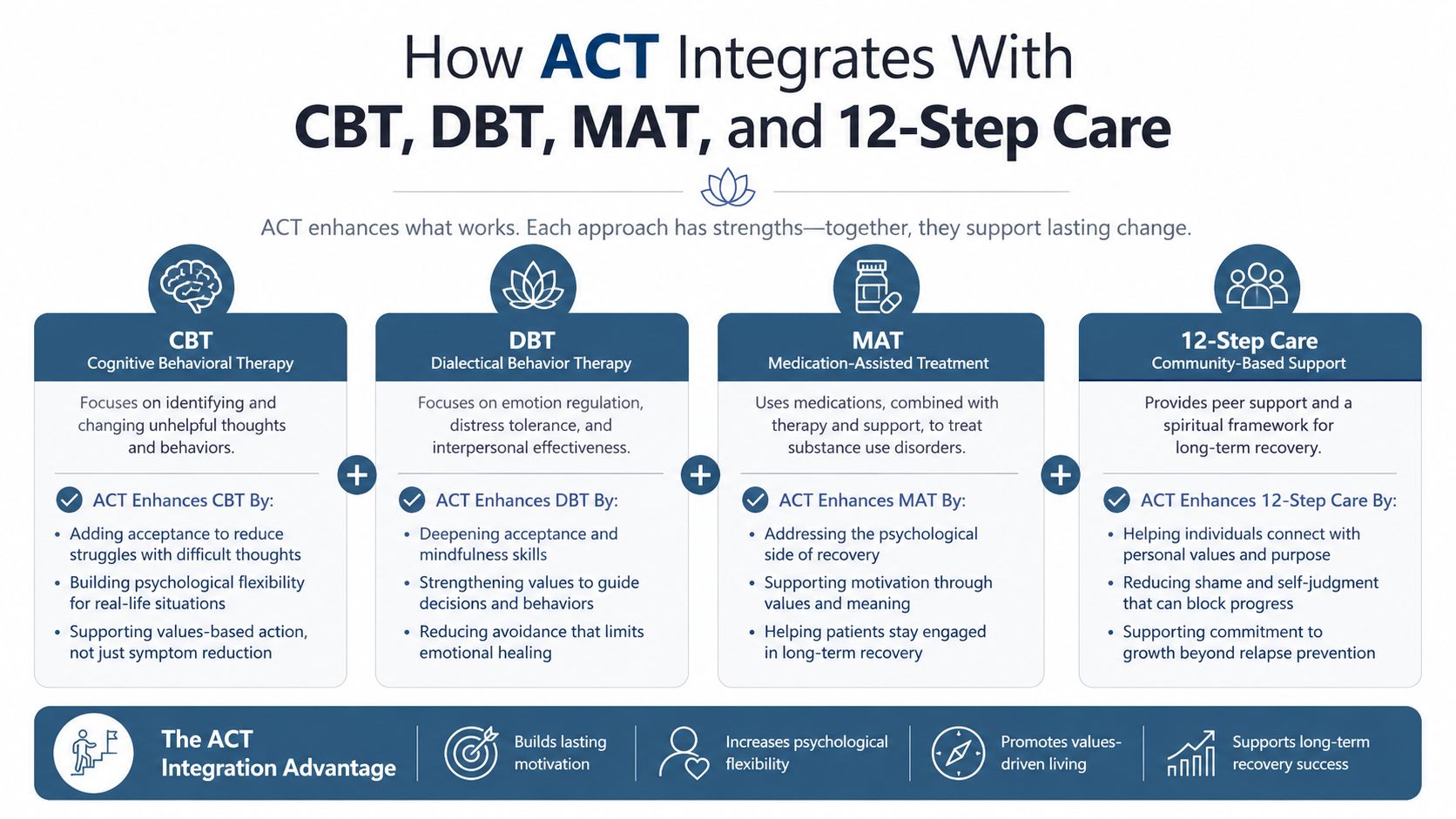
ACT works best as a process-based complement. It adds a different therapeutic function to existing care rather than competing for the role of every other modality.
| Approach | Primary contribution | ACT's complementary role |
|---|---|---|
| CBT | Identifies triggers, tests beliefs, and builds relapse-prevention behaviors | Helps the client accept internal discomfort and defuse from thoughts without needing to win a cognitive debate |
| DBT | Teaches distress tolerance, emotion regulation, and interpersonal effectiveness | Strengthens willingness to experience emotion while applying concrete skills |
| Motivational interviewing | Resolves ambivalence and draws out personally meaningful reasons for change | Converts those reasons into repeated, values-guided behavior |
| Medication-assisted treatment | Addresses withdrawal risk, physiological dependence, and cravings when medication is clinically appropriate | Works with the thoughts, emotions, and avoidance patterns that medication alone doesn't resolve |
| 12-step or mutual-support care | Provides community, accountability, and a recovery structure | Helps the client respond to urges and self-criticism without treating either as a command |
A client receiving CBT may learn to identify the thought that precedes drinking and create a safer alternative response. ACT adds willingness and defusion, so the client doesn't have to feel calm or become fully convinced by a replacement thought before acting. A client receiving DBT may use distress-tolerance skills during a surge of shame, while ACT helps connect that willingness to a chosen value such as honesty or family presence.
Medication remains essential for many opioid, alcohol, and tobacco use disorders when clinically indicated. ACT can address the internal experiences that continue after withdrawal risk has been medically reduced. In mutual-support settings, it can help a client attend, disclose, and accept accountability without turning a lapse-related thought into an identity verdict.
The clinical team should match each intervention to diagnosis, stage of change, safety needs, medication plan, and recovery goals. Integrated care may include psychotherapy, psychiatric treatment, nursing observation, medical monitoring, family work, and peer support. ACT supplies a mechanism for changing the client's relationship with private experience, while the rest of the plan addresses risks and needs that require other forms of care. A practical overview of CBT for addiction can help families understand that integration doesn't mean choosing one branded method.
ACT Inside a Luxury Residential Treatment Program
ACT should function as a structured clinical discipline embedded in the treatment day, not as an optional meditation class. A well-designed residential plan may combine individual ACT sessions, process groups, craving-and-urge experiments, values clarification, relapse rehearsal, psychiatric care, and guided practice in carefully selected real-world situations.
Designing the treatment environment
Private rooms can give residents protected space to decompress, reflect, and sleep without turning the accommodation into isolation. Executive-focused programs may use controlled electronics access rather than an unrestricted or automatic ban. Some programs describe device use in defined windows and under clinical review, while other executive tracks allow cell phones and laptops during non-therapy hours or when clinically appropriate, as reflected in executive rehabilitation guidance.
The clinical question is whether electronics support responsible contact without becoming an avoidance route. A resident may complete a limited work obligation, notice rising anxiety, and then practice acceptance rather than using the laptop to evade therapy or emotional processing.
Coordinating dual-diagnosis care
A multidisciplinary team can align ACT exercises with medication management, sleep stabilization, trauma treatment, and mood monitoring. The team may include an addiction physician, psychiatrist, licensed therapist, and nursing staff, with family clinicians and adjunctive therapists contributing when appropriate.
Dosing has to fit the person. A resident with severe anxiety, depression, trauma symptoms, or mood instability may need stabilization before intensive experiential work. A more stable executive may use focused individual sessions plus short, structured practice between sessions. Neither approach is automatically superior. The treatment plan should respond to the client's presentation and capacity.
Family sessions can clarify relationship values and rehearse difficult conversations. Discharge planning should connect those values to observable behaviors, support contacts, medication follow-up, and continuing care. Medication-related planning can be reviewed alongside medication-assisted treatment information.
Measuring more than abstinence
A serious program tracks more than whether a client reports no substance use. Clinicians can monitor craving response, psychological flexibility, attendance, functional recovery, and sustained values-based activity alongside safety and psychiatric symptoms. The setting enhances ACT only when privacy, clinical rigor, appropriate access to work, and continuity after residential care accompany the amenities.
Common Misconceptions About ACT for Addiction
ACT isn't just mindfulness with a new name. Present-moment awareness is one process within a broader model that also includes acceptance, defusion, self-as-context, values, and committed action. A breathing exercise may help a client settle, but it doesn't by itself clarify the life direction the client is choosing or produce a behavioral plan.
ACT isn't a soft alternative to CBT. It can feel less argumentative because the therapist doesn't spend the session disputing every painful thought. That doesn't make the work passive. The client practices approaching cravings, shame, fear, and difficult conversations while choosing behaviors that carry personal meaning.
What ACT doesn't promise
ACT doesn't aim to eliminate cravings or negative thoughts. Trying to guarantee their absence can turn normal recovery discomfort into evidence of failure. The clinical target is a more flexible response, where a craving can be noticed without becoming the next action.
ACT also isn't a standalone, time-limited cure for substance use disorders. Medical withdrawal management, medication, psychiatric care, family involvement, peer support, and relapse-prevention planning may all be necessary. A 2025 systematic review across third-wave therapies found only small-to-moderate benefits on abstinence, craving, and substance use, with most studies carrying some concerns or serious risk of bias and overall low-to-moderate certainty, as reported in the review of third-wave therapies.
Professional ACT delivery also differs from an app-based acceptance exercise or a generic workbook. High-functioning clients with trauma, anxiety, depression, or bipolar symptoms may appear capable while remaining highly avoidant. If a residential program reduces ACT to a single lecture or occasional mindfulness period, it may underdose the mechanism that makes the therapy relevant.
Choosing a Program That Uses ACT at the Right Depth
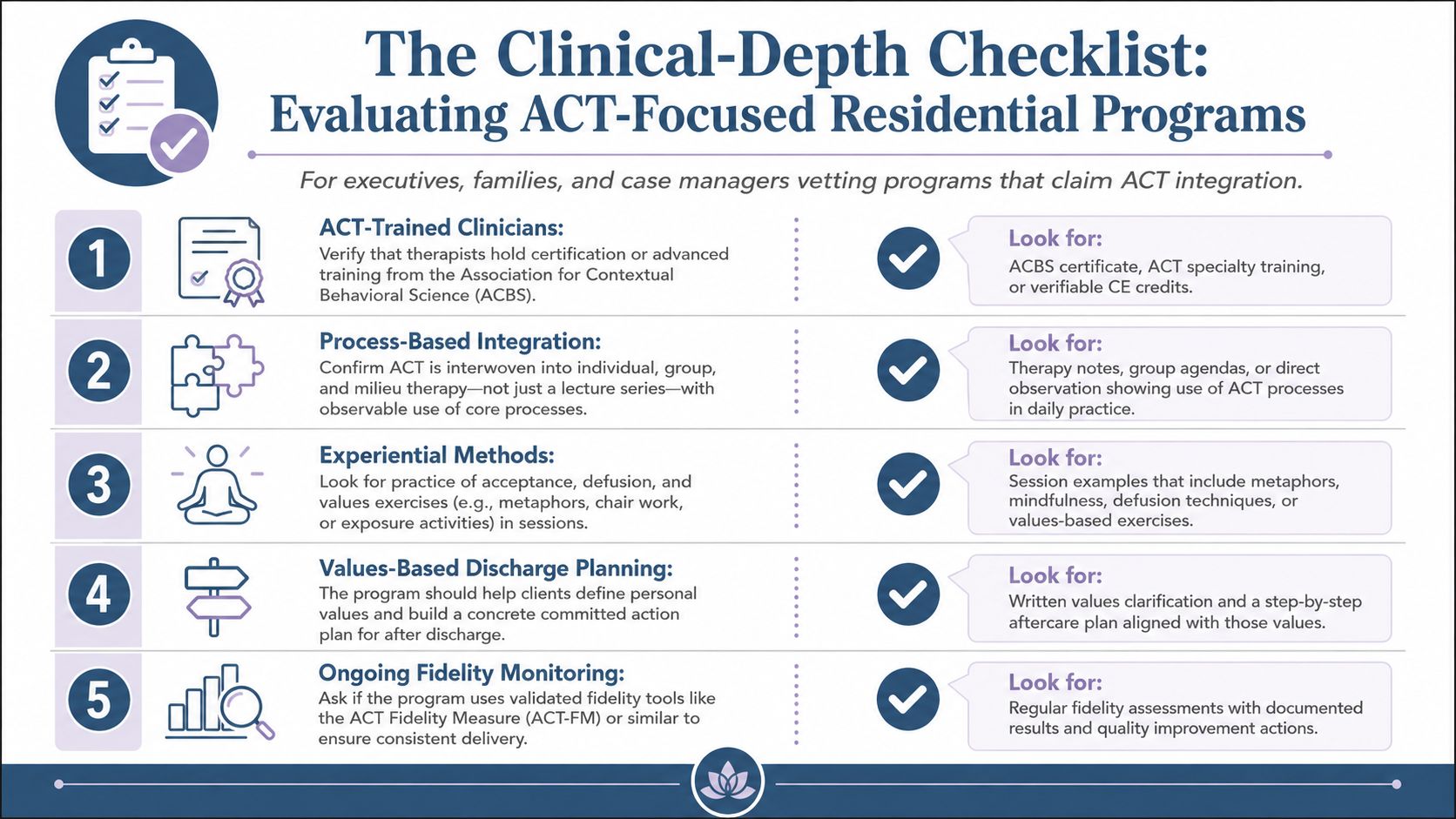
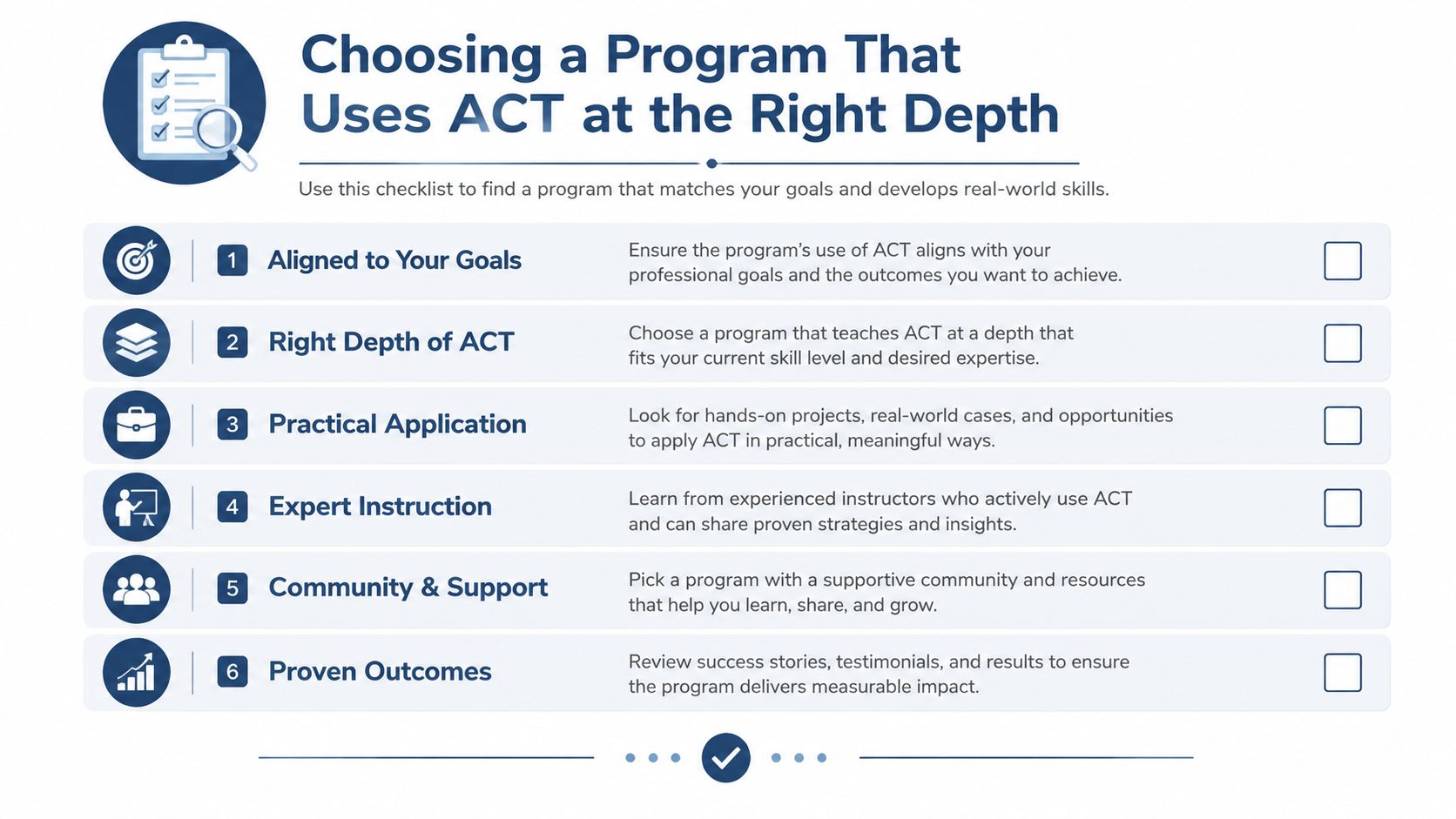
A program claiming ACT integration should be able to explain how the model appears in actual sessions, groups, family work, and discharge planning. The word “ACT” on a website isn't enough. Executives and families need to know whether clinicians use the model to change behavior or borrow its vocabulary.
Questions that reveal clinical depth
- Clinician preparation: Ask whether therapists have ACT-specific training and supervised consultation experience. A credible answer should identify how clinicians maintain competence, not just mention general psychotherapy credentials.
- Process integration: Ask how acceptance, defusion, present-moment awareness, self-as-context, values, and committed action appear in treatment. The answer should describe observable clinical work across individual and group settings.
- Experiential practice: Ask for examples of metaphors, urge exercises, chair work, or exposure activities used when clinically appropriate. ACT is learned through practice, not only explanation.
- Values-based discharge planning: Ask how the resident's values become concrete commitments for work, family, health, support, and aftercare. “Stay sober” is important, but it isn't a complete behavioral plan.
- Dual-diagnosis coordination: Ask how ACT is adapted when anxiety, trauma, depression, or mood instability affects readiness for experiential work. Psychiatric and medical care should be coordinated rather than treated as separate tracks.
- Measurement and continuity: Ask what the program tracks beyond abstinence and how those observations inform continuing care. Follow-up should address craving response, flexibility, functioning, support use, and values-based activity.
Red flags include a single-session mindfulness offering, no written values work, generic workbook distribution, and no explanation of how therapists tailor intensity. A program may have excellent amenities and still provide shallow ACT if the clinical team doesn't connect exercises to relapse mechanisms and discharge behavior.
Reflections offers ACT within a private, Joint Commission-accredited residential program for adults with co-occurring mental health and substance use disorders. Its multidisciplinary care can combine ACT with CBT, DBT, motivational interviewing, medication optimization, family work, and continuing support, while private rooms and appropriate electronics access address the practical needs of working professionals.
Executives and families evaluating treatment can contact the clinical admissions team, describe the substance-use pattern and co-occurring symptoms, and ask how ACT would be dosed within a broader plan. Visit Reflections to explore a discreet residential approach that connects psychological flexibility with medical, psychiatric, family, and aftercare support.