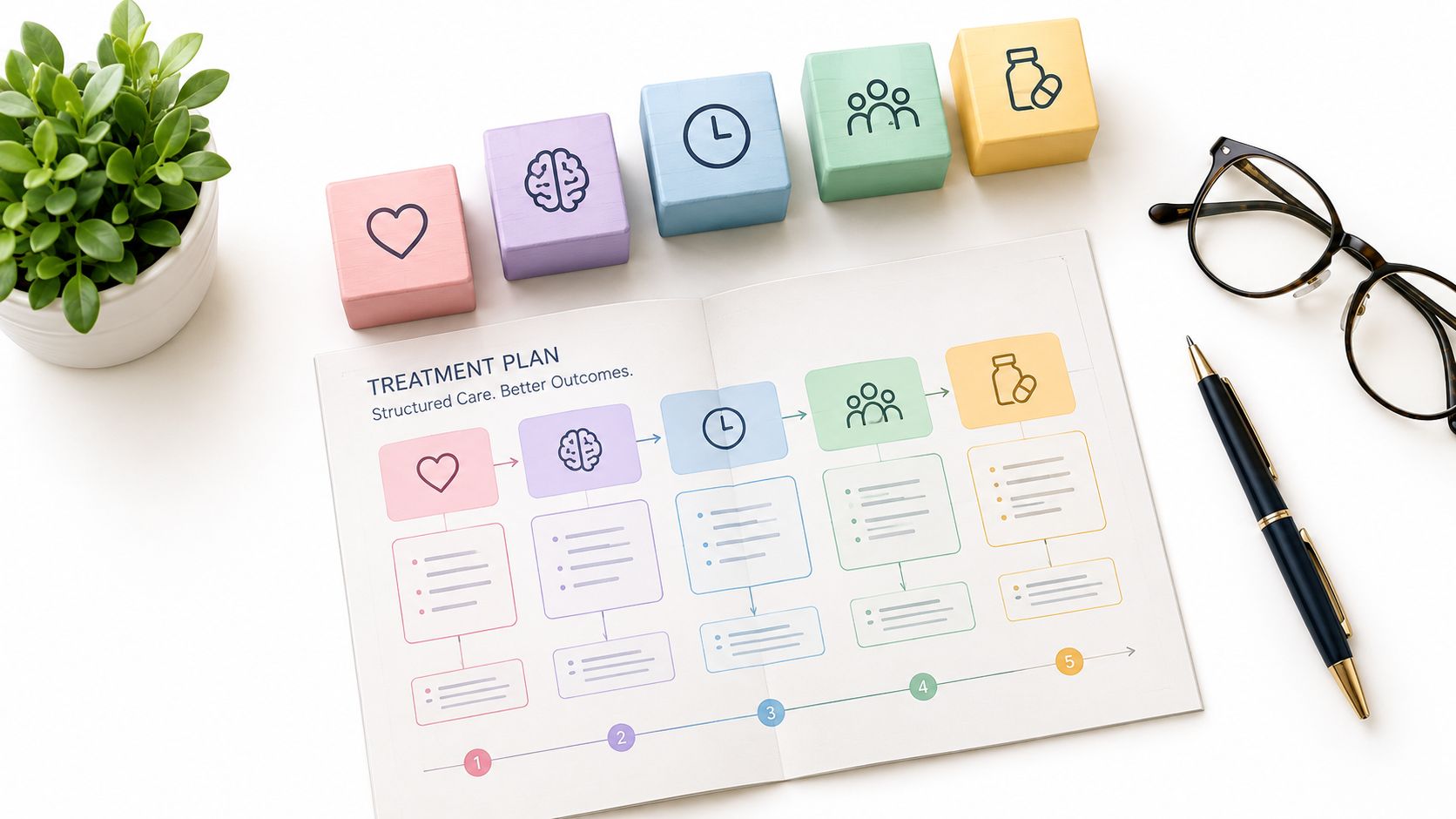

The email drafts are still going out. The board materials still need review. Investors, clients, employees, and family all expect steadiness. At the same time, sleep is thinning out, irritability is becoming normal, alcohol or medication use is carrying more of the day than anyone else knows, and the private promise to get control of it by Monday keeps failing.
For high-functioning professionals, that's often the crisis. Not a public collapse. A sustained, hidden deterioration while performance still looks acceptable from the outside.
Standard recovery models often miss this population. They may ask successful adults to step entirely away from professional responsibilities, tolerate shared living arrangements, or accept a generic schedule that treats executive stress, trauma, depression, and substance use as separate issues rather than as a connected clinical picture. For professionals with co-occurring disorders, that approach often feels unrealistic from the first phone call.
Beyond the Boardroom The Need for a New Approach to Recovery
A senior executive can be in serious trouble and still appear composed. Meetings happen. Decisions get made. Travel continues. The person may even be outperforming peers in visible ways while privately relying on alcohol, stimulants, sedatives, or compulsive routines to regulate stress, panic, insomnia, or emotional volatility.
That mismatch creates delay. Many executives don't resist treatment because they deny the problem. They resist because they assume treatment will require an abrupt disappearance from their lives, a loss of privacy, and an environment that doesn't understand the realities of leadership pressure.

A more appropriate model respects two truths at once. The first is that the clinical need is real and urgent. The second is that a professional life doesn't always stop cleanly on command. In a carefully structured residential setting, some clients can remain connected to key obligations through appropriate access to electronics, private space, and clinical boundaries that protect treatment rather than undermine it. A program built for this level of care looks very different from a generic retreat or a standard rehab track. Executive wellness and recovery support in a private residential setting is one example of how that model is structured.
Why conventional models often lose this audience
Executives usually need several essentials:
- Discretion: They can't risk avoidable exposure.
- Privacy: Shared rooms and chaotic milieus often increase resistance.
- Clinical depth: Burnout alone isn't the diagnosis. Trauma, anxiety, bipolar traits, depression, and substance use often overlap.
- Functional continuity: Some professional communication must be managed responsibly, not ignored.
Recovery for executives works better when treatment respects reality without surrendering clinical standards.
Holistic wellness programs matter in this setting because they address the whole organism under pressure. Not just the substance use. Not just the mood symptoms. The full pattern of nervous system overload, sleep disruption, isolation, distorted coping, and identity strain that develops when a person is rewarded for remaining externally competent long after internal stability has started to fail.
What Holistic Wellness Means in a Clinical Context
In luxury treatment, integrated wellness programs shouldn't mean scented candles, optional yoga, and a more attractive brochure. In a clinical setting, an integrated approach means the treatment team addresses the person as an integrated system. Mood, cognition, behavior, sleep, nutrition, physiology, trauma response, relationships, and meaning all affect recovery.
For executives with dual diagnosis concerns, that distinction matters. A person may enter treatment because of alcohol dependence, but the maintaining factors may include untreated anxiety, chronic hyperarousal, isolation, erratic nutrition, poor sleep, shame, and a work identity that leaves no room for vulnerability. If treatment focuses only on stopping substance use, the core drivers remain active.
From broad wellness to targeted clinical care
The move toward clinically integrated wellness came in part from the limits of older workplace models. A U.S. Department of Labor analysis of workplace wellness programs found that such programs covered more than 50 million U.S. workers, yet stronger participation did not reliably lower total medical costs, and higher-intensity participants had healthcare costs of about $20 higher per month. For treatment providers, the lesson is clear. Broad participation in wellness activities isn't the same thing as clinically meaningful recovery. Precision matters.
That's why a strong program doesn't offer a buffet of attractive experiences and hope that something lands. It uses assessment to determine which interventions fit the person in front of the team. An executive with panic and alcohol dependence may need meditation introduced gradually because silence initially intensifies distress. Another client with severe disconnection from bodily cues may benefit more from movement, meal stabilization, and somatic work before extended insight-oriented therapy becomes productive.
What clinical integration looks like
A serious holistic plan usually includes:
- Psychiatric evaluation and medication review: Symptoms are assessed in context, not in isolation.
- Psychotherapy with specific goals: Trauma, shame, compulsive thinking, and relationship patterns are treated directly.
- Behavioral stabilization: Sleep, meals, exercise, and daily rhythm are structured because dysregulation feeds relapse risk.
- Adjunctive supports with a clear rationale: Meditation, creative therapies, and body-based modalities are prescribed to support measurable treatment goals.
Nutrition is a good example. For some professionals, years of irregular eating, high caffeine intake, GI distress, and stress-driven appetite changes have direct effects on mood and concentration. A structured nutritional framework can support clinical recovery, and practical models such as AI Meal Planner's gut health program can help illustrate how diet planning becomes more useful when it's individualized for a real physiological concern rather than treated as generic wellness content.
Clinical standard: If a “holistic” intervention can't be connected to symptom reduction, emotional regulation, treatment engagement, or relapse prevention, it belongs in recreation, not in the treatment plan.
The Pillars of an Integrated Holistic Program
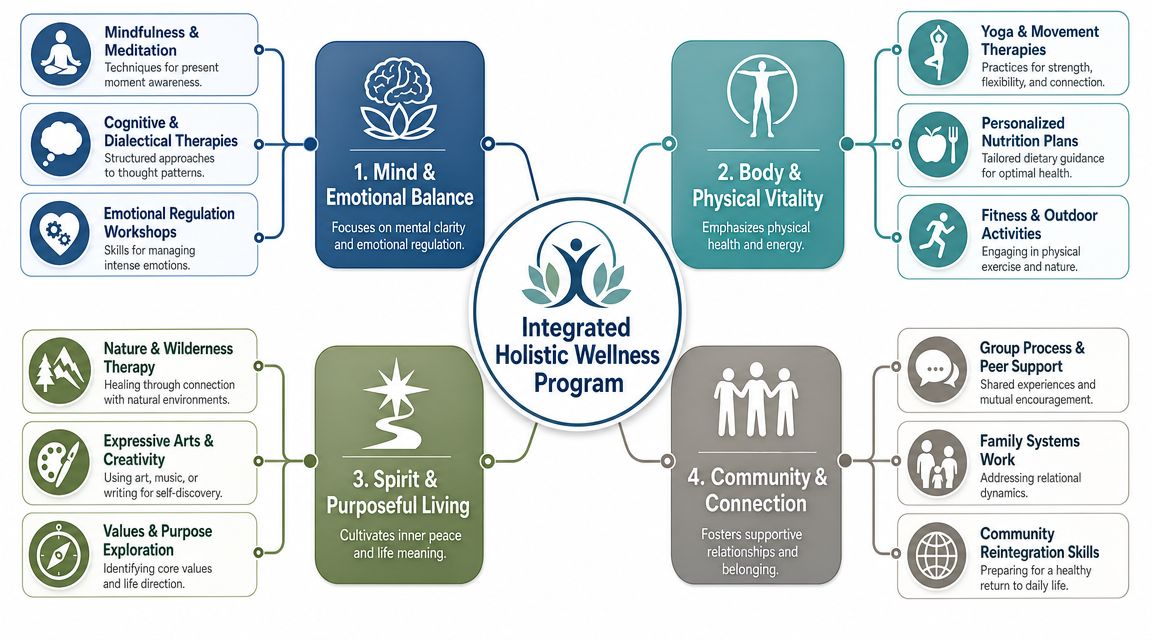
An integrated program works when each modality has a job to do. Not every client needs every intervention in the same way. For executives, the strongest whole-person wellness programs are curated, sequenced, and tied to clinical goals that matter in daily life: emotional control, sleep restoration, self-awareness, trust, stamina, and better decision-making under stress.
Core modalities and why they matter
Mindfulness and meditation help clients notice internal states earlier. That sounds simple, but many high performers have spent years overriding fatigue, grief, fear, and craving signals until those signals become blunt or extreme. Mindfulness rebuilds the ability to detect activation before it becomes a blowup, relapse, or shutdown.
Somatic work addresses the body's side of trauma and chronic stress. Some clients can explain their history elegantly and still remain physiologically stuck in hypervigilance. Body-based interventions can help a person identify tension patterns, defensive responses, and stored activation that talk therapy alone doesn't fully reach.
Nutritional therapy is often underestimated by professionals who are used to pushing through hunger, travel fatigue, and caffeine dependence. In treatment, food is not cosmetic. It's regulatory. Stable meals can support concentration, emotional steadiness, medication tolerability, and a more predictable daily rhythm.
Experiential approaches that build capacity
Personalized fitness gives the nervous system another route toward regulation. The point isn't athletic performance. The point is helping a client experience effort, release, discipline, and embodiment in a way that reduces agitation and improves resilience.
Art and music therapy can be especially effective for clients who communicate well in corporate settings but struggle with grief, shame, or internal conflict that doesn't surface through linear conversation. These modalities often access material that a polished verbal style keeps protected.
Equine therapy can be clinically useful for executives whose identity is built around control, speed, and intellectual command. Horses respond to presence, consistency, and nonverbal communication. That can expose relational patterns quickly and without humiliation. Holistic therapy in a dual-diagnosis setting often includes this kind of experiential work because it reveals how clients manage trust, pressure, and emotional signaling in real time.
A modality earns its place when it changes what the client can do under stress, not when it merely fills the schedule.
Holistic modalities and their clinical goals
| Modality | Clinical Goal | Example Application in Recovery |
|---|---|---|
| Mindfulness and meditation | Increase self-observation and distress tolerance | A client learns to notice craving and escalation before acting impulsively |
| Somatic work | Reduce physiological hyperarousal and improve body awareness | A trauma survivor identifies physical stress cues and practices down-regulation |
| Nutritional therapy | Stabilize energy, mood, and daily rhythm | A professional with erratic eating patterns follows a structured meal plan during treatment |
| Personalized fitness | Support emotional regulation and healthy routine | Daily movement becomes a replacement for stress-driven substance use after work |
| Art or music therapy | Access emotions that are difficult to verbalize | A client explores shame or grief through guided creative work |
| Equine therapy | Improve trust, boundaries, and nonverbal awareness | A leader notices how control habits affect connection and responsiveness |
How Holistic Therapies Enhance Clinical Treatment
The right question isn't whether integrative approaches are pleasant. The right question is whether they make core treatment more effective. In comprehensive dual-diagnosis care, they often do, because they help clients become more reachable, more regulated, and more capable of using psychotherapy well.
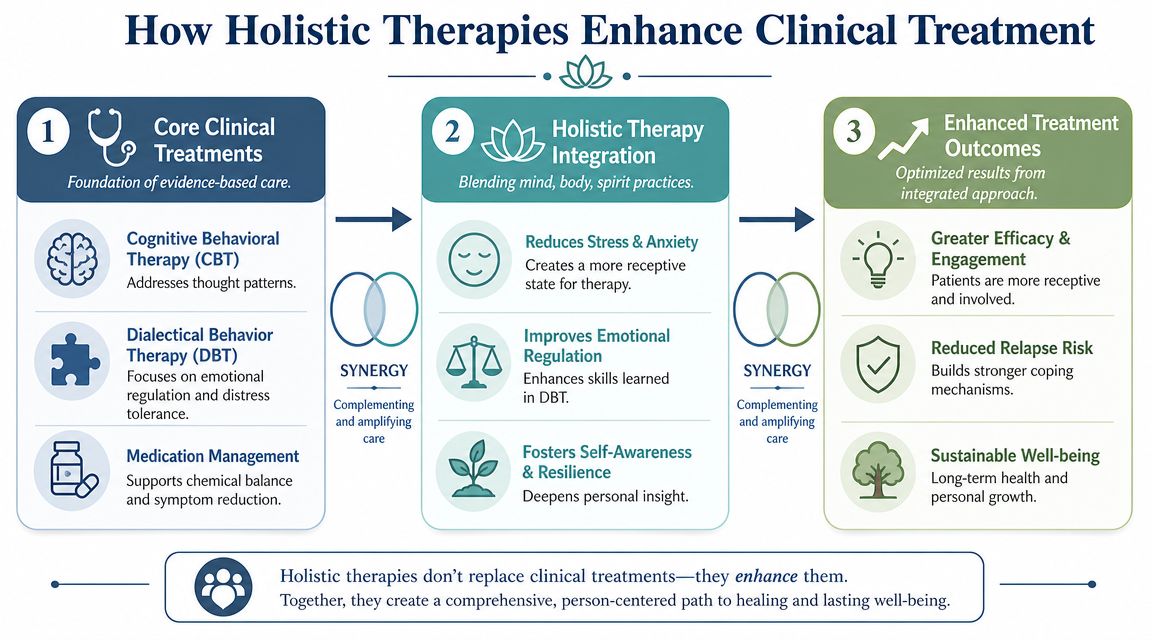
A client who enters a CBT session in a state of high physiological arousal may understand the therapist's questions intellectually while remaining too activated to examine beliefs openly. A client who has practiced grounding, breathing, and body awareness beforehand is often better able to tolerate difficult insight without fleeing into minimization or defensiveness.
Integration is where the value appears
Public discussion often treats wellness activities as lifestyle perks. That misses the main clinical point. Community health discussions have noted that the often-overlooked issue is how integrated wellness is adapted for people with co-occurring disorders, where the core question becomes which components improve adherence, emotional stability, and relapse prevention in dual-diagnosis populations, not whether they seem appealing on the surface, as reflected in this discussion of holistic wellness among community residents.
In practice, integration can look like this:
- DBT plus mindfulness: The client uses meditation and breath regulation to strengthen distress tolerance during emotionally charged moments.
- Psychiatry plus nutrition: Food structure and hydration can support medication tolerability and reduce some of the volatility caused by depleted routines.
- Trauma therapy plus somatic work: Physical cues help identify when memory processing is moving toward productive engagement versus overwhelm.
- Group therapy plus experiential work: A client who struggles with vulnerability may access more honesty after nonverbal therapies reduce guardedness.
A more cohesive treatment day
When treatment is coherent, one part of the day prepares the client for the next. Morning regulation work can make an afternoon process group more honest. Nutritional support can reduce the irritability that derails therapy. Movement can lower agitation so a family session becomes possible instead of explosive.
That's especially important for executives, who are often practiced at remaining articulate while emotionally defended. Integrated interventions can reduce that split. Nutrition and holistic rebalancing in executive treatment is one example of how a program may use daily structure to improve therapeutic access rather than offering wellness as a separate track.
The most effective integrated programs don't ask whether a modality is traditional or alternative. They ask whether it helps the client stay in treatment, absorb treatment, and use treatment outside the facility.
The Evidence Behind Whole-Person Recovery
Analytical clients usually want a clear standard. Which parts of a holistic model are clinically grounded, and which parts are just expensive packaging? That's the right question.
The wellness space often mixes strong interventions with weak ones, and that creates confusion. A thoughtful clinical program separates appealing activities from therapies that can be tied to symptom reduction, engagement, emotional regulation, and functioning. Discussions in medical practice settings have emphasized this problem directly, noting that a major challenge is distinguishing evidence-based interventions from popular ones, and that serious programs match integrated elements to specific needs and measurable outcomes, as discussed in this MGMA overview of holistic care for vulnerable populations.
What a discerning standard looks like
For a high-functioning adult with co-occurring disorders, evidence-informed whole-person care usually has several characteristics:
- It starts with diagnosis, not aesthetics. The treatment team identifies the role of trauma, mood instability, anxiety, sleep disturbance, and substance use before assigning modalities.
- It uses interventions for a reason. Movement may be prescribed because the client is agitated and disconnected from the body, not because exercise looks healthy on paper.
- It tracks actual change. The team watches whether the client is attending, engaging, regulating emotion better, and functioning with more stability.
- It adjusts quickly. If a modality isn't helping, it should be modified or replaced.
What doesn't work well
Programs become less credible when whole-person care is used as a branding layer over shallow clinical work. Common problems include offering the same wellness menu to everyone, confusing comfort with treatment, or treating adjunctive therapies as substitutes for psychotherapy, psychiatry, and addiction medicine.
That's where executive clients need to be especially careful. A polished environment can support healing, but it can also hide a lack of rigor. The standard should be simple. Every element of care should connect back to a treatment hypothesis about what is maintaining the disorder and what will improve stability.
Luxury is useful when it protects privacy, improves rest, and lowers resistance to treatment. It is not a clinical method by itself.
When whole-person recovery is done well, the benefit isn't that treatment feels softer. The benefit is that treatment reaches more of the person who needs help.
What Executives Must Look for in a Holistic Program
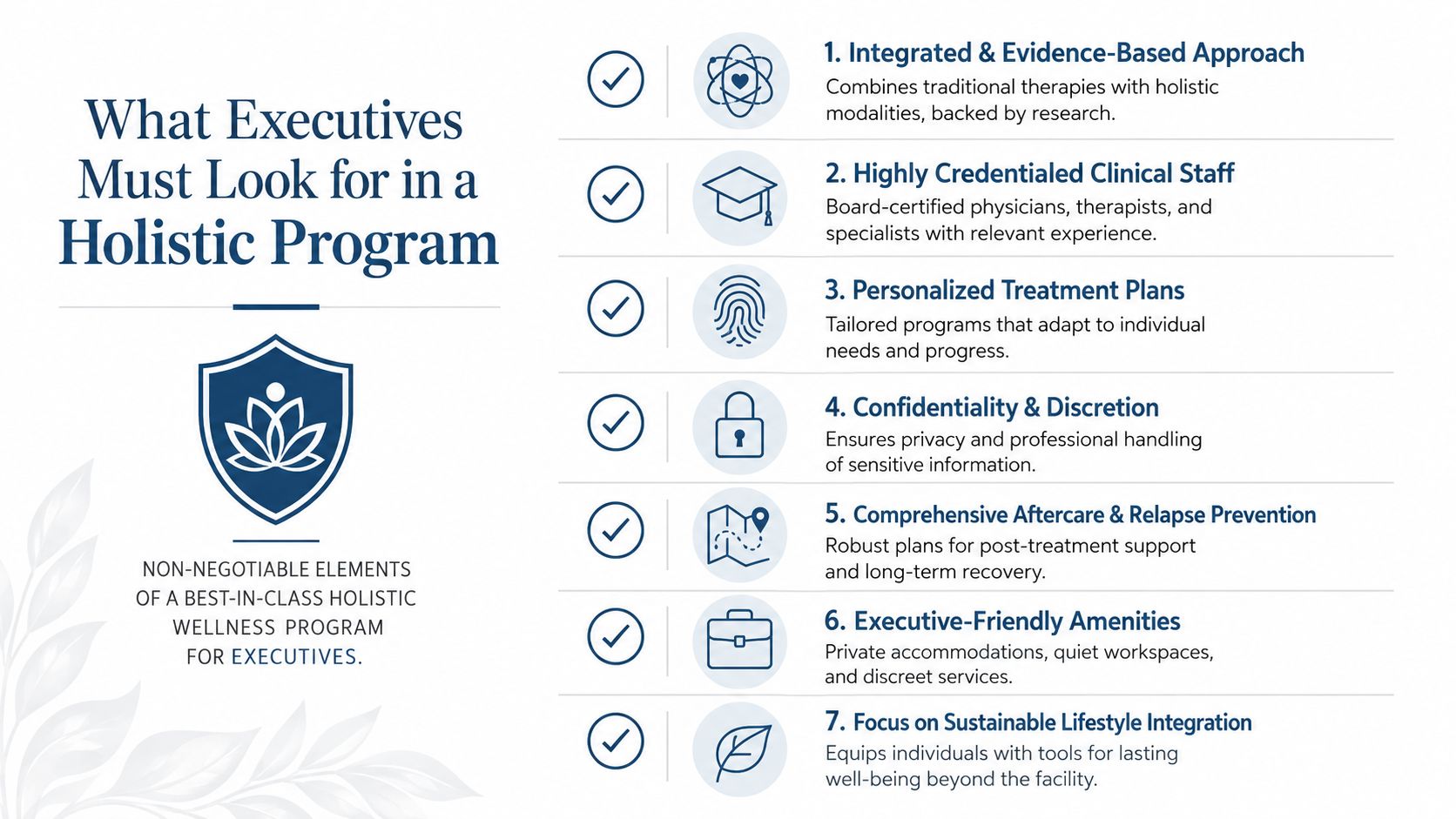
Executives often evaluate treatment the way they evaluate any major decision. They look for competence, discretion, fit, and risk management. That approach is appropriate. A premium environment matters, but the essential question is whether the program can treat complex co-occurring disorders without forcing the client into an unrealistic model of care.
Non-negotiables in a high-end program
A comprehensive well-being program should include:
- Credentialed clinical leadership: The treatment plan should be directed by experienced professionals who understand dual diagnosis, not only addiction in isolation.
- Private accommodations: Private rooms in detox and residential care reduce exposure, support sleep, and make it easier for professionals to settle into treatment.
- Electronics access with structure: Some high-level clients need responsible access to phones or laptops to manage urgent obligations without losing the focus of care.
- Real psychiatric capability: Anxiety, depression, trauma-related symptoms, bipolar traits, and substance use often interact. The program must be able to assess and treat that full picture.
- Family involvement: Professional success doesn't insulate a family system from strain. Recovery becomes more durable when loved ones are brought into the process thoughtfully.
- Continuing care planning: Discharge isn't the end of treatment. It's the point where the client tests new stability in real life.
How to evaluate value, not just amenities
Employers already understand that support and functioning are connected. In workplace wellness summaries, employees who feel their organization cares about their well-being are reportedly 56% more engaged and 34% more likely to stay, according to this review of corporate wellness statistics. In executive treatment, the comparable question is whether care restores the person's ability to function with steadiness, judgment, and sustainable engagement.
That's why decision-makers should ask direct questions such as:
- How are holistic therapies integrated with evidence-based psychotherapy and psychiatry?
- Can the program accommodate confidential work obligations without letting work take over treatment?
- Are private rooms standard or only occasionally available?
- How are family sessions and aftercare structured?
- What does the clinical team do when a client presents as high-functioning but emotionally defended?
For readers thinking at the organizational level, broader holistic employee well-being strategies can be useful for prevention and culture-building. Residential treatment serves a different purpose. It's for the point at which wellness support is no longer enough and integrated clinical care is required.
One example in this category is Reflections, a California-licensed, Joint Commission-accredited residential provider that offers private rooms, executive-compatible electronics access, and dual-diagnosis treatment with integrated and evidence-based modalities in the same care plan.
Frequently Asked Questions for Professionals
Can someone realistically continue to manage a career while in residential treatment
In some cases, yes. The key is structure. High-functioning professionals often need limited, clinically appropriate access to phones and laptops so they can handle urgent responsibilities, protect business continuity, and reduce the fear that everything will unravel while they get help.
That doesn't mean treatment becomes remote work in a nicer setting. It means the program sets boundaries around timing, privacy, and therapeutic priority. When done well, access to electronics reduces resistance to admission while preserving the seriousness of residential care.
How is this different from a traditional 12-step model
A traditional 12-step approach centers peer support, shared accountability, and a recovery fellowship. That can offer substantial value. But executives with co-occurring disorders often need more than a peer framework.
They may require psychiatric evaluation, trauma treatment, medication review, structured psychotherapy, family work, and clinically integrated holistic modalities that address both the substance use and the underlying mental health drivers. The difference isn't that one model is sincere and the other isn't. The difference is the level of clinical complexity being treated.
With private rooms and amenities, does it still feel like serious treatment
It should. Private accommodations, high-quality food, calm surroundings, and discretion support treatment. They don't replace it.
Serious treatment still includes intensive therapy, clinical assessment, medication management when appropriate, skills training, and accountability. A luxury setting is useful when it lowers defensiveness, improves rest, and makes it easier for a professional to remain in care long enough for the work to take hold.
Privacy should make deeper treatment possible, not allow avoidance.
What level of privacy and discretion should a high-profile client expect
A properly designed executive program should protect confidentiality carefully. That usually includes private rooms, a controlled residential environment, thoughtful communication protocols, and staff who understand the reputational concerns of public-facing professionals.
Discretion also includes emotional privacy. Many executives need space to stop performing competence long enough to be honest. That usually happens faster when the environment is stable, quiet, and clinically well-managed.
How can a family tell whether the person needs this level of care
The answer often lies in pattern, not in a single dramatic event. Warning signs include escalating substance use, worsening mood symptoms, hidden medication misuse, repeated failed attempts to cut back, increasing isolation, work functioning that is becoming harder to sustain, or a personality shift that loved ones can feel even if outsiders can't.
When a successful person is expending enormous energy to appear fine, the severity can be easy to miss. Families should pay attention to secrecy, defensiveness, sleep disruption, and the growing gap between public performance and private stability.
When treatment needs to match the realities of leadership, privacy, and co-occurring mental health and substance use disorders, Reflections offers a residential model built around private accommodations, executive-compatible structure, and clinically integrated care. A confidential conversation can help determine whether that level of support fits the situation now, before the cost of waiting grows larger.