

The most popular advice about post acute withdrawal syndrome is also the least useful for executives: “Detox is over, so normal performance should return.” That assumption turns a complicated recovery phase into a test of willpower. A chief executive may complete medically supervised withdrawal, return to a board calendar, and then discover that sleep, concentration, emotional control, and motivation remain unreliable. The problem isn't a lack of discipline. It may be a prolonged and clinically significant recovery process that requires a different level of planning.
Post acute withdrawal syndrome can follow alcohol or other substance withdrawal, and it can also occur after stopping antidepressants. The evidence isn't equally strong across every substance or every symptom, so responsible care avoids both dismissal and overdiagnosis. For high-performing professionals, the practical question is how to protect health, judgment, confidentiality, and career responsibilities while clinicians determine what is happening.
Rethinking What Post Acute Withdrawal Syndrome Actually Is
A managing partner leaves treatment expecting a clean restart. The acute withdrawal has passed, the calendar is full, and colleagues assume the hardest part is finished. Within days, sleep becomes fragmented, ordinary decisions feel exhausting, and a routine disagreement produces an emotional reaction that seems out of proportion. The professional can still perform in short bursts, which makes the problem harder to recognize. A strong presentation in the morning doesn't disprove serious impairment by late afternoon.
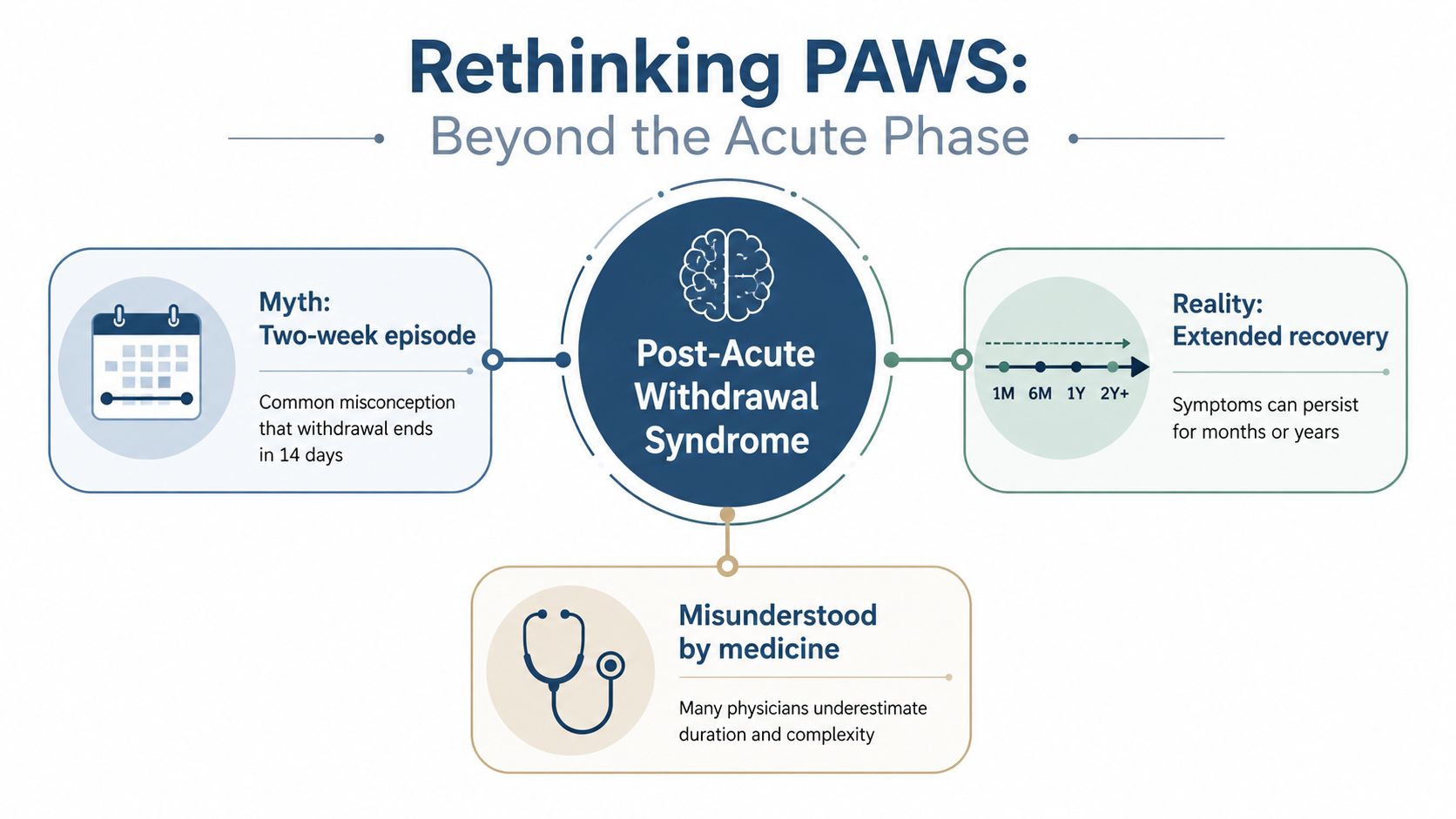
Post acute withdrawal syndrome isn't a brief detox afterthought. Alcohol-focused reviews describe it as a subacute syndrome involving persistent irritability, anxiety, and sleep disturbance after acute withdrawal, with symptoms that can fluctuate as recovery continues. The neurobiology appears to involve dysregulation across stress, reward, and endocrine systems rather than one isolated mechanism, according to a 2022 review of post-acute withdrawal syndrome.
The executive version of the problem
High-functioning professionals often expect recovery to behave like a business project. They want a defined endpoint, predictable milestones, and a rapid return on capacity. PAWS doesn't reliably follow that model. A person may feel clearer for a period, then experience renewed insomnia, irritability, cravings, or cognitive fatigue after stress, travel, conflict, or an intense work cycle.
The duration can be much longer than many patients or clinicians expect. A 2025 systematic review found reported antidepressant withdrawal durations ranging from about 1.5 months to many years. One online self-report analysis cited in that review reported a mean duration of 37 months, a median of 26 months, and a range of 5 to 166 months. Those findings don't establish a universal timeline, but they do show why rigid expectations can damage confidence and encourage premature self-management.
The distinction matters because shame changes behavior. A professional who interprets brain fog as weakness may conceal symptoms, increase work pressure, or return to alcohol, sedatives, stimulants, or other substances to force productivity. A clinically informed plan treats symptoms as information, not as a character verdict. Guidance about detox side effects can help families and professionals understand why the transition after acute withdrawal deserves continued monitoring.
Practical rule: A return to abstinence is a major milestone, not proof that the nervous system has completed recovery.
The Core Components of PAWS and How It Manifests
PAWS becomes easier to manage when symptoms are organized into affective, cognitive, and somatic clusters. The categories overlap, but separating them helps a treatment team identify patterns, assess safety, and design a practical work plan.
Affective symptoms
Affective symptoms change how a person feels and reacts. Anxiety may appear as persistent internal tension before a routine meeting. Irritability can shorten the distance between a disagreement and an angry email. Depression, anhedonia, low motivation, and emotional numbness can make profitable opportunities feel meaningless.
These symptoms often create a misleading professional narrative. A leader may describe a negotiation as intolerable when the issue is heightened stress sensitivity. A partner may withdraw from trusted colleagues because ordinary social contact feels demanding. Clinicians should assess mood, cravings, sleep, trauma history, and safety rather than treating each difficult interaction as a separate personality problem.
Cognitive symptoms
Cognitive PAWS affects the functions executives depend on most. Concentration may fail during a long presentation. Working memory may drop details from a complex conversation. Decision-making can become slower, more impulsive, or excessively rigid. A professional might reread a contract repeatedly without retaining its key terms, then compensate by working late, which further disrupts sleep.
A useful response isn't to demand constant peak output. It's to reduce avoidable cognitive load while preserving meaningful responsibility. Written agendas, shorter meetings, delegated administrative decisions, and protected recovery periods can expose the actual pattern without forcing the person to prove capacity through exhaustion.
Somatic symptoms and fluctuating recovery
Somatic symptoms include sleep disturbance, fatigue, physical tension, and other bodily discomfort. The symptoms may improve unevenly. The 2022 alcohol-focused review synthesized 27 studies and emphasized that PAWS symptoms can emerge after the acute phase and fluctuate, a pattern that can be mistaken for relapse or personal failure. The review's clinical discussion supports monitoring symptom recurrence instead of assuming that every difficult day represents deterioration.
A practical tracking system records sleep quality, stress exposure, cravings, mood, concentration, medication changes, and work demands. The purpose isn't to turn recovery into another performance dashboard. It's to give clinicians enough context to distinguish a recurring pattern from a new medical or psychiatric problem and to identify which demands reliably intensify symptoms.
Why Executives and High-Performing Professionals Face Unique PAWS Risks
PAWS rarely appears during a quiet period. Executives may be managing it while making decisions that affect employees, investors, patients, clients, or family finances. A small decline in concentration can become consequential when a professional must assess risk, resolve conflict, or respond to a crisis without preparation.
Pressure magnifies ordinary symptoms
Sustained stress can prolong sleep disruption and make emotional reactivity harder to hide. A chief financial officer with fragmented sleep may complete a forecast yet lose judgment during a late-night dispute. A founder experiencing cognitive fog may respond by scheduling more meetings, making faster decisions, or returning to familiar substances or medications to recreate a previous level of output.
High performers often conceal impairment effectively. They can delegate selectively, use assistants to protect their calendars, and deliver brief periods of excellent work. These adaptations preserve appearances while postponing assessment. By the time the professional seeks help, substance use, anxiety, depression, trauma, and withdrawal may be interacting rather than presenting as one clear diagnosis.
Work performance can therefore become both a resource and a liability. Limited, structured responsibility may support identity and stability. Unchecked responsibility can also provide a socially acceptable way to avoid rest, treatment, or honest disclosure.
Why duration changes the planning conversation
Short-term career planning may be inadequate in some cases. A 2020 analysis of 69 individual reports of protracted antidepressant withdrawal found that symptoms persisted for a mean of 37 months and a median of 26 months. The same analysis reported that time on the causative antidepressant averaged 96 months and reached 278 months. These figures came from individual reports, so they should not be treated as prevalence estimates or predictions for every patient. They do show why clinicians should ask about long-term medication exposure and avoid promising rapid resolution. The full analysis of protracted withdrawal also described withdrawal as multi-systemic rather than purely emotional.

For an executive, planning should account for safety, symptom severity, role demands, delegation, and the possibility that work is serving as avoidance. The appropriate arrangement may involve reduced decision load, protected recovery time, and clearly defined limits rather than automatic leave or immediate full-speed work. A discreet treatment environment can help the professional remain connected to selected responsibilities without treating continued performance as proof of clinical readiness.
Distinguishing PAWS from Depression, Anxiety, and Relapse Signals
PAWS, depression, anxiety, and relapse can look similar from the outside. All may involve poor sleep, low mood, reduced concentration, agitation, or withdrawal from relationships. The difference isn't established by one symptom. Clinicians need a timeline, collateral information, substance-use history, medication history, and repeated assessment.
A structured comparison
| Pattern | Questions clinicians ask | Why it matters |
|---|---|---|
| Timing | Did symptoms begin during or after cessation? Did they predate substance use? | A temporal relationship can support withdrawal, but it doesn't prove causation. |
| Course | Do symptoms fluctuate in waves, remain consistently low, or steadily worsen? | Fluctuation can occur in PAWS, while persistent or progressive symptoms may require assessment for another disorder. |
| Function | Can the person work briefly but not sustain attention, sleep, or emotional control? | Partial performance can conceal clinically meaningful impairment. |
| Relapse signals | Are cravings intensifying, secrecy returning, access to substances increasing, or recovery contacts decreasing? | Behavioral changes may require immediate intervention even when symptoms are attributed to PAWS. |
| Safety | Is there suicidal thinking, severe agitation, psychosis, medical instability, or dangerous impulsivity? | Safety concerns take priority over diagnostic labels. |
A primary depressive or anxiety disorder may have existed before substance use, may continue independently of withdrawal, or may be worsened by it. Relapse can also produce symptoms that resemble PAWS, but it often brings changes in behavior, access, concealment, cravings, or routine. The assessment should remain open to more than one explanation.
What the evidence can and cannot establish
A 2025 systematic review screened 1,286 records and identified only seven eligible studies on PAWS after stopping antidepressants. The review described the evidence as sparse, low certainty, and heavily influenced by case reports and self-reported internet narratives. It also noted that reported duration ranged widely from 1.5 to 166 months and questioned whether symptoms that emerge long after cessation necessarily reflect pharmacodynamic withdrawal. The systematic review and metanarrative synthesis therefore supports caution, not dismissal.
Clinicians can improve decisions by documenting symptom onset, medication taper speed, substance exposure, sleep, mood, cravings, and functional changes over time. Digital clinical documentation can also help therapists coordinate observations and maintain continuity. Practices evaluating workflow support may find a Recepta.ai platform for therapists useful as a general resource, while diagnosis and treatment decisions remain the responsibility of qualified clinicians.
Evidence-Based PAWS Management Strategies in a Luxury Setting
Luxury care should mean clinical precision plus practical privacy, not comfort without accountability. PAWS management works best as a layered plan that addresses withdrawal symptoms, co-occurring disorders, sleep, cravings, professional obligations, and the conditions that made substance use functional in the first place.
Build the clinical plan in layers
Start with assessment and stabilization. The team reviews substance exposure, medication history, psychiatric symptoms, medical risk, sleep, nutrition, and immediate safety. Clinically managed withdrawal and medication-assisted stabilization may be appropriate, but medication changes require careful sequencing.
Match therapy to the symptom pattern. Cognitive behavioral therapy can identify catastrophic interpretations and behavioral loops. Dialectical behavior therapy develops emotion regulation, distress tolerance, and interpersonal control. Acceptance and commitment therapy helps professionals act according to values when discomfort remains present. Motivational interviewing addresses ambivalence without turning treatment into a confrontation.
Use minimal, effective pharmacology. A new medication may relieve a symptom, create another burden, or obscure the underlying pattern. A careful prescriber considers prior response, interactions, taper history, sleep, anxiety, cravings, and the patient's preference before adding or changing medication. Psychiatric medication management should include monitoring and adjustment rather than a one-time prescription decision.
Translate recovery into workplace protections. The plan can identify travel triggers, high-conflict meetings, late-night decision windows, access to substances, and situations where fatigue impairs judgment. A professional may remain engaged with selected responsibilities while delegating high-risk decisions and using scheduled clinical check-ins.

Why the setting changes execution
Privacy and physical space can determine whether a professional can remain in treatment long enough to benefit. Reflections provides private rooms for residents in both detox and rehabilitation, along with access to electronics under appropriate clinical structure. This approach reflects a broader executive rehabilitation model in which residents may use phones, laptops, internet, conference rooms, and private work areas to maintain necessary career engagement during care, as described in guidance on electronics in treatment.
That access isn't automatically therapeutic. Unrestricted work can become avoidance, interfere with groups, or preserve the stress cycle that contributed to substance use. The useful compromise is scheduled access, clear boundaries, and a clinical team authorized to reduce work demands when symptoms or safety concerns require it. Adjunctive practices such as mindfulness, movement, nutrition, and somatic work can support regulation, but they shouldn't replace evidence-based psychotherapy, medical assessment, or relapse planning. For trauma-related symptoms, a clinician may also evaluate specialized approaches such as Providers for Healthy Living trauma therapy when clinically appropriate.
When to Seek Residential or Higher-Level Care for PAWS
Not every person with PAWS needs residential treatment. Some professionals can remain safe and stable with outpatient therapy, prescriber follow-up, family support, a predictable schedule, and a reliable relapse prevention plan. The decision changes when symptoms repeatedly overwhelm those supports or when the professional's environment makes honest recovery impossible.
Four indicators deserve serious attention
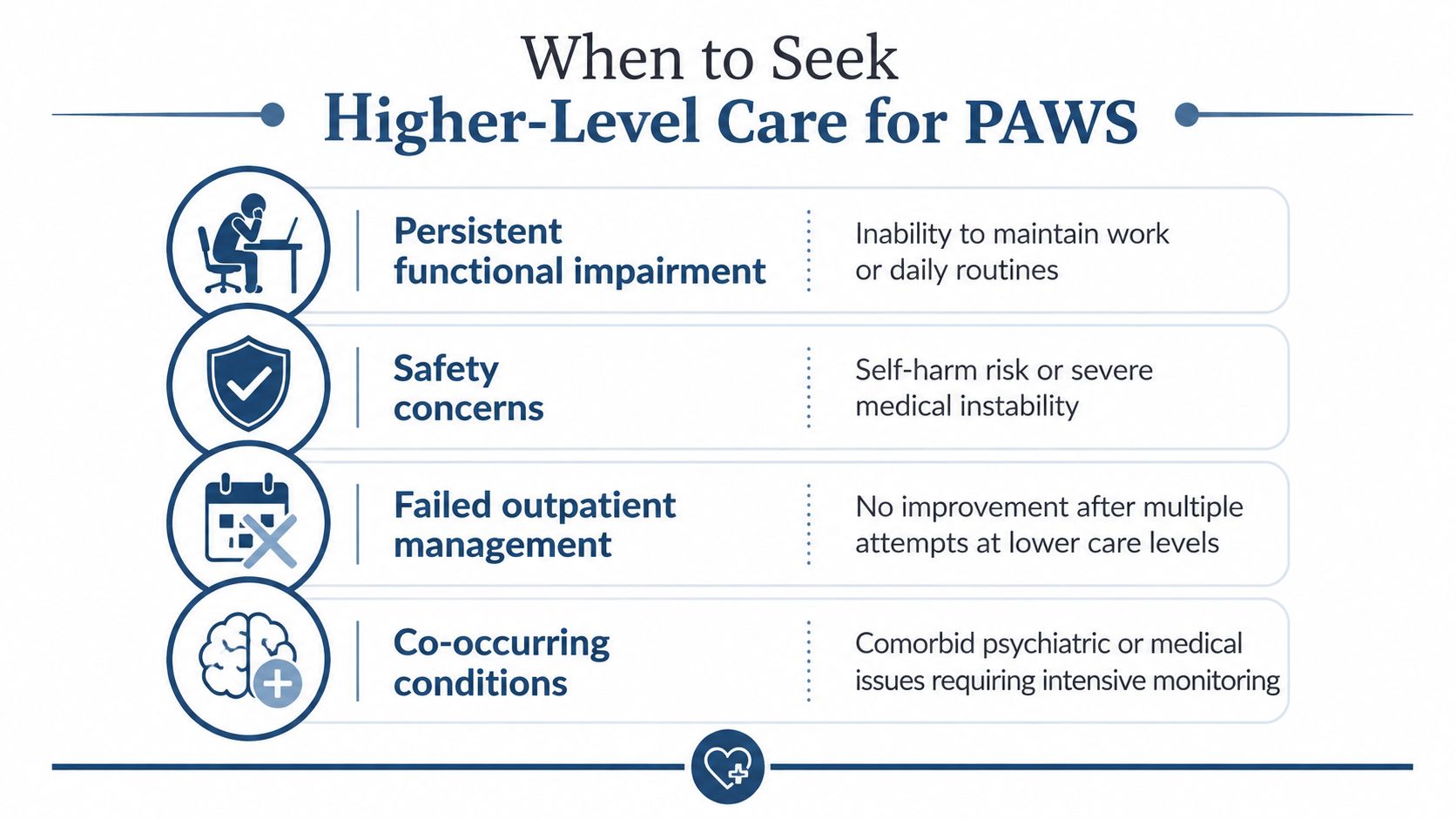
- Persistent functional impairment: The professional can't sustain work, sleep, self-care, or ordinary daily routines, even after practical accommodations.
- Safety concerns: Self-harm risk, severe medical instability, dangerous impulsivity, or escalating substance access requires urgent clinical evaluation.
- Failed outpatient management: Symptoms continue to destabilize the person despite repeated attempts at lower levels of care, incomplete follow-through, or an environment that repeatedly defeats the plan.
- Co-occurring conditions: Depression, anxiety, trauma symptoms, bipolar features, personality-related instability, or medical conditions require integrated monitoring rather than isolated withdrawal advice.
Accreditation and executive standards
For high-net-worth clients, luxury should never substitute for external accountability. The Joint Commission awards accreditation only after a successful on-site survey. In Behavioral Health Care & Human Services, one or more Joint Commission surveyors assess compliance with applicable standards, as explained in the Joint Commission accreditation process. That makes accreditation materially different from a program describing its own quality.
Residential care is particularly useful when the professional needs round-the-clock observation, medication oversight, structured therapy, protected sleep, or separation from immediate access to substances. Private rooms can support dignity and confidentiality, while a clinically managed environment reduces the need to perform wellness for colleagues or family members. Some facilities advertise private rooms or suites throughout detox and residential care, but families should verify exactly what privacy means at each level, rather than assuming every luxury program offers the same arrangement.
A sound placement decision weighs clinical acuity against the risks of remaining in the current environment. The question isn't whether the person can attend one meeting. It's whether the person can recover safely while maintaining enough judgment to protect health, relationships, and professional responsibilities.
Continuing Care Planning and Family Guidance for Long-Term Success
Discharge isn't the end of PAWS management. It's the point at which structured clinical support must become a durable life system. An executive returning to travel, negotiations, public visibility, and constant availability needs a plan that anticipates difficult weeks instead of treating symptom recurrence as an unexpected failure.
Design the next phase before discharge
A continuing care plan should identify the next clinicians, appointment cadence, medication responsibilities, recovery contacts, work boundaries, travel procedures, sleep protections, and emergency responses. Alumni programming and flexible follow-up services can preserve therapeutic connection while the professional gradually resumes demanding responsibilities. Treatment lengths commonly range from 30 to 90 days in structured residential programs, followed by continuing care, but duration should reflect clinical need rather than a fixed prestige-oriented schedule.
A useful plan names observable warning signs. These may include missed appointments, unexplained absences, increasingly defensive communication, sleep collapse, renewed secrecy, escalating cravings, or a sudden attempt to eliminate all support. The plan also assigns action. A spouse, assistant, physician, or therapist shouldn't have to debate who calls whom during a crisis.
Families need education, not surveillance
Family members often notice a change before the professional acknowledges it, yet anxious monitoring can create conflict and concealment. Private family sessions help relatives distinguish a withdrawal-related fluctuation from a safety emergency, a depressive episode, or a return to substance use. Educational workshops can also clarify communication boundaries, medication concerns, confidentiality, and the difference between supporting accountability and policing every behavior. Reflections describes family therapy as part of its recovery approach through family therapy for addiction recovery.
The family's role is to create conditions for honesty. That may mean protecting sleep, refusing to cover up dangerous behavior, limiting access to substances, supporting clinical appointments, and responding to warning signs without humiliating the person. Executives benefit when loved ones focus on patterns and safety rather than demanding a perfect explanation for every difficult day.
A sustainable plan protects both recovery and identity. Professional responsibility can continue, but it can't be allowed to dictate every clinical decision.
Reflections is a California-licensed, Joint Commission-accredited luxury rehabilitation provider offering dual-diagnosis care, medically supervised withdrawal support, individualized therapy, medication optimization, private residential treatment, family involvement, and continuing care for adults with co-occurring mental health and substance use disorders. Executives and working professionals who need discreet, clinically structured help with post acute withdrawal syndrome can visit Reflections to discuss an appropriate level of care and a recovery plan that accounts for both health and career obligations.