
A founder cancels a board call after drinking through the afternoon. A senior partner conceals benzodiazepine use from colleagues. A surgeon relies on stimulants to cover demanding shifts, then cannot sleep without them. By the time a high-functioning professional admits that outpatient care has failed, the problem usually affects judgment, health, family relationships, and operational reliability.
Residential dual diagnosis treatment is designed for this level of complexity. It combines continuous clinical oversight with psychiatric care, addiction treatment, privacy, and a structured environment that can accommodate legitimate professional responsibilities. The luxury setting matters only when it protects clinical focus, confidentiality, and continuity. Private rooms and controlled access to electronics are useful, but they aren't substitutes for an integrated treatment plan.
This guide focuses exclusively on high-end residential care for executives, C-suite leaders, working professionals, and high-profile adults. The question isn't whether a facility has attractive furnishings. The question is whether its clinical architecture justifies private-pay pricing and can help a resident stabilize without treating work obligations as either an excuse or a moral failure.
When Work and Recovery Collide
A professional considering admission often faces an impossible Thursday. The founder has missed a board call after drinking by midafternoon. The partner has hidden prescriptions from human resources. The surgeon has stockpiled stimulants to survive night shifts and now feels unable to function without them. The person still appears capable from the outside, but outpatient appointments, private therapists, and promises to cut back haven't produced durable control.
That is where residential care becomes a rational business and health decision. Residential dual diagnosis treatment provides a protected setting for people who need 24-hour structure, medical oversight, psychiatric evaluation, and addiction treatment at the same time. It also gives an executive the privacy and operational planning needed to protect a practice, company, professional license, or family system while treatment begins.
A standard facility may ask a resident to disconnect entirely. An executive program should ask a more precise question: Which work contact supports stability, and which contact undermines it? A written electronics policy, scheduled access, confidentiality safeguards, and clear clinical boundaries can make that distinction practical. Guidance on working during treatment, including the need to balance professional duties with recovery, is also addressed in this resource on working from rehab.
The actual decision
The choice isn't between luxury and seriousness. It's between integrated clinical care and a polished environment that happens to offer psychiatric availability. A program earns its price through diagnostic precision, medication management, therapy depth, family work, nursing coverage, case review, and transition planning.
Executive-care rule: Privacy and professional flexibility should make treatment possible. They should never make treatment optional.
The rest of the evaluation should therefore focus on what happens behind the private door. A high-end program must treat substance use and psychiatric symptoms under one formulation, measure progress, involve the family appropriately, and maintain continuity after discharge. What does an executive-level integrated program deliver, and how is it different from a well-marketed spa with a psychiatrist on call?
What Dual Diagnosis Actually Means
Dual diagnosis, also called co-occurring disorders, means that a person has both a substance use disorder and a mental health condition. Common examples include depression, anxiety, bipolar disorder, PTSD, and ADHD. The conditions interact, so alcohol may temporarily blunt anxiety while worsening sleep and mood, or stimulant misuse may intensify agitation in someone already vulnerable to mood instability.
Treating only one condition leaves the other active. It's like patching a leaking roof during a storm. An antidepressant plan may produce unreliable results while heavy drinking continues, and trauma therapy can become destabilizing when a resident remains chemically activated, sleep-deprived, or intoxicated.
The important distinction is integration. In a fragmented model, an addiction counselor, psychiatrist, therapist, and medical provider may each work from separate notes and competing priorities. In a serious residential program, one multidisciplinary team builds one treatment plan, coordinates medication decisions, tracks substance use and psychiatric symptoms together, and revises the case formulation as new information appears.

Why executives often miss the diagnosis
High achievement can conceal impairment. A resident may still lead meetings, maintain income, or perform technical work while using substances to manage fear, insomnia, trauma, depression, or relentless pressure. The apparent success delays an accurate assessment and encourages professionals to frame treatment as a scheduling problem instead of a clinical one.
A strong intake separates primary symptoms from substance-induced effects without assuming that either explanation is sufficient. The team should review the timeline of mood changes, sleep disruption, trauma symptoms, medication use, withdrawal, and relapse. Educational material such as the Premiere Education addiction course can also help families and professionals understand addiction without reducing it to poor discipline.
Integrated care matters because the resident needs one accountable team. That team should know why a medication was prescribed, what symptoms it targets, how substances affect those symptoms, and what the family sees outside clinical appointments. Dual diagnosis isn't a niche issue in a residential setting that treats mental health seriously. It is often the central clinical reality.
The Clinical Architecture of a Luxury Program
Luxury residential care should begin with medical safety, not a welcome basket. Withdrawal from alcohol, benzodiazepines, or stimulants can complicate sleep, mood, cognition, and physical stability. A medically managed detox and psychiatric stabilization phase gives clinicians the opportunity to monitor withdrawal, reduce acute risk, and avoid mistaking withdrawal symptoms for a fixed psychiatric diagnosis.
Once the resident is medically stable, the team needs a thorough reassessment. That includes psychiatric history, substance-use chronology, trauma exposure, sleep, pain, medical conditions, prior treatment response, and a complete medication reconciliation. The reconciliation often reveals duplicated prescriptions, inconsistent dosing, untreated side effects, or a medication strategy that was built around symptoms created by substance use.
What the treatment stack should contain
A credible plan uses several modalities for distinct purposes:
- Individual CBT: Identifies thinking patterns that drive avoidance, compulsive use, shame, and impaired decision-making.
- DBT or schema-focused work: Builds emotional regulation, distress tolerance, interpersonal effectiveness, and insight into long-standing patterns.
- EMDR and trauma-informed therapy: Addresses trauma when the resident has enough stabilization to process it safely.
- Motivational interviewing: Resolves ambivalence without turning treatment into a confrontation.
- Confidential group therapy: Creates accountability and connection, but groups must be small and professionally moderated.
- Medication management: Evaluates psychiatric medications and, when clinically appropriate, options such as buprenorphine, naltrexone, or acamprosate for substance-use disorders.
Medication-assisted treatment should never be treated as a status issue. A private-pay resident deserves the same evidence-based options as anyone else, presented without stigma and monitored with clinical discipline. Detailed information about psychiatric medication management should be available before admission, not improvised after symptoms escalate.
The operational tests
The facility should have meaningful psychiatric presence, 24-hour nursing, senior medical oversight, and continuous case review. A psychiatrist who appears briefly while nonmedical staff manage the daily clinical reality isn't enough for complex co-occurring disorders.
Two features separate a clinical program from a marketing brochure:
- Measurement-based care, using repeatable symptom and functioning assessments to guide decisions.
- Continuous case review, where the clinical team tests its formulation against observed behavior, medication response, family reports, and relapse risk.
The research supports this integrated model. A controlled implementation study reported that residents completing a 3-month integrated program showed clinically significant improvements in symptoms, knowledge, and skills, with high satisfaction, measured at a mean of 4.51 out of 5. The authors concluded that more integrated substance-use and mental-health care was more effective than less integrated care. Read the controlled study on integrated residential treatment.
How a 30 to 90 Day Stay Is Structured
A 30 to 90 day pathway should be treated as a clinical sequence, not a package of nights. The exact duration depends on withdrawal risk, psychiatric stability, medication response, trauma history, relapse pattern, family needs, and the resident's ability to function safely outside the facility.
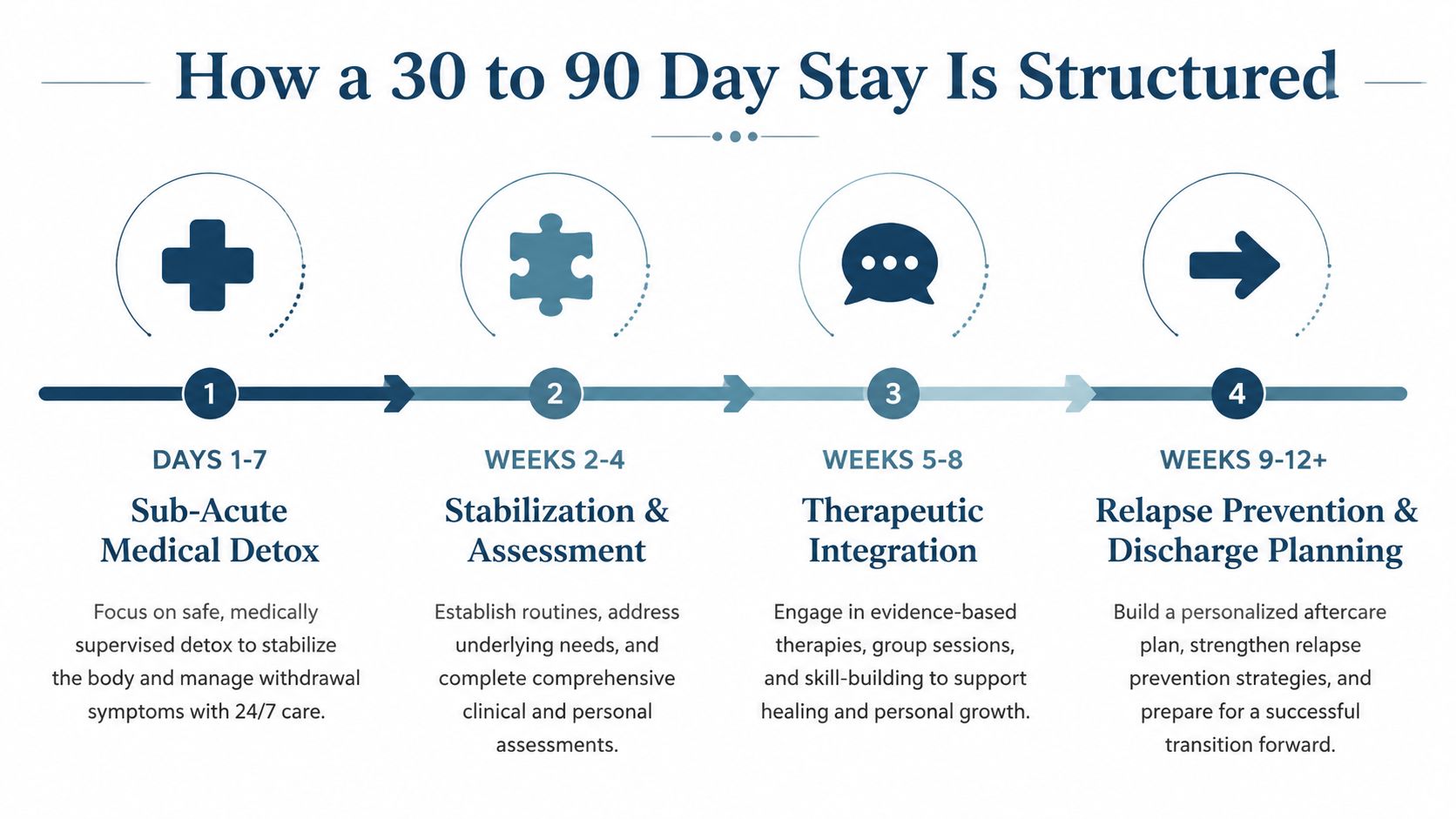
Phase one focuses on safety
The opening period is for sub-acute medical detox, withdrawal monitoring, sleep restoration, medication review, and immediate psychiatric stabilization. A resident who is still intoxicated, withdrawing, or severely sleep-deprived can't produce reliable insight or make sound long-term decisions.
Phase two establishes the formulation
The next stage involves diagnostic clarification, medication titration, individual therapy, skills training, and observation across different parts of the day. Clinicians learn whether depression persists after substance effects recede, whether anxiety responds to stabilization, and which triggers repeatedly precede cravings or impulsive behavior.
Phase three creates therapeutic integration
Deeper work can then address trauma, grief, family conflict, shame, perfectionism, professional identity, and avoidance. Therapy must connect insight to behavior. A resident rehearses refusal skills, emotional regulation, difficult conversations, sleep routines, and work boundaries instead of merely discussing them.
Phase four tests the transition
Relapse prevention and discharge planning should begin before the final days. The team coordinates outpatient psychiatry, therapy, medication access, family support, work re-entry, monitoring, recovery meetings, and crisis procedures. A residential program that waits until discharge week to build this plan has waited too long.
Evidence supports sustained engagement. In a 2011 study of people with co-occurring disorders, retaining residents in residential care for at least 90 days was associated with less inpatient mental-health use and more mental-health services at six months. Outpatient mental-health care after discharge was associated with reduced substance use at six months. Review the residential continuity findings.
A Day in the Life of an Executive Resident
Consider a representative composite resident, a 47-year-old business partner with alcohol use disorder and treatment-resistant depression. The day begins at 6:30 with nursing checks, vital signs, sleep review, and a brief assessment of mood, cravings, and withdrawal symptoms. That information informs the morning medication meeting with the psychiatrist.
The resident then attends individual CBT or DBT work focused on depressive avoidance, alcohol-related decision-making, and the pressure to remain indispensable at work. A small clinical group follows, where the resident practices emotional regulation and hears how other professionals manage shame, secrecy, and impaired judgment.
A structured afternoon
After lunch, the schedule may include EMDR when the clinical team considers trauma processing appropriate, or a neurofeedback session when it fits the treatment plan. An afternoon process group examines the resident's behavior in real time, including defensiveness, withdrawal from peers, or attempts to control the schedule.
Family therapy occurs once or twice weekly, depending on readiness and clinical need. The work may address financial secrecy, broken trust, communication patterns, role expectations, and the family's response to relapse. Weekly executive coaching can help translate recovery goals into delegation, travel planning, calendar boundaries, and a sustainable return to leadership.
The evening includes dinner, a recovery meeting based on a compatible framework, and protected downtime in a private suite. Electronics may be available under structured guidelines so the resident can manage essential professional obligations without turning the facility into an office.
Every block must serve one of three purposes:
- Clinical stabilization, including medication, sleep, nursing observation, and medical monitoring.
- Therapeutic depth, including individual, family, trauma, and skills-based work.
- Recovery community, including process groups, peer accountability, and mutual-support meetings.
Private rooms and refined surroundings can reduce distractions and protect confidentiality. They don't justify the price on their own. Structure, clinical attention, and disciplined continuity justify the cost.
How to Evaluate a Luxury Residential Program
Families should evaluate luxury treatment as a clinical procurement decision. Square footage, cuisine, and spa services can improve comfort, but accreditation, staffing, documentation, and aftercare determine whether the program can responsibly treat co-occurring disorders.
Joint Commission accreditation is an organization-level quality designation, and the Joint Commission maintains a dedicated Behavioral Health Care and Human Services accreditation program along with a provider locator for accredited substance-use treatment organizations. Accreditation doesn't guarantee a particular outcome, but it gives families a formal quality framework to verify.
| Evaluation Criterion | What to Verify | Red Flag |
|---|---|---|
| Accreditation | Confirm current Joint Commission or CARF status and request the latest survey information. | The facility offers only vague claims about being “accredited.” |
| Clinical leadership | Identify the psychiatrist, addiction-medicine clinician, therapists, nursing leaders, and case-review process. | A generalist handles complex medication decisions without senior psychiatric oversight. |
| Electronics policy | Request written rules for phones and laptops, including hours, monitoring, privacy, and clinical restrictions. | Staff make verbal promises but provide no policy. |
| Private rooms | Confirm whether every resident receives a private room during detox and residential care. | Private accommodation depends on availability or an added upgrade. |
| Family programming | Review private sessions, educational workshops, family intensives, and post-discharge involvement. | Family contact is limited to a short phone call or generic presentation. |
| Continuing care | Ask how the team manages psychiatric handoffs, prescriptions, therapy, monitoring, and work re-entry. | Discharge consists of a list of phone numbers. |
What the family should inspect
Staff credentials matter more than décor. Families should ask who owns each resident's medication decisions, how often the senior psychiatrist participates, who reviews risk changes, and whether licensed clinicians lead groups.
The electronics policy deserves special attention for executives. One luxury executive model describes private bedrooms with a desk, television, Wi-Fi, and permission to use cell phones and laptops for work obligations. Review an example of executive-oriented residential policies. That approach can be appropriate, but only when the program defines limits that preserve treatment.
Pricing also varies by setting. Independent industry material describes private-pay residential care as commonly reaching the tens of thousands of dollars for a 30-day episode, with luxury executive facilities reaching substantially higher daily or monthly rates. Review the private-pay residential pricing discussion. Families should demand an itemized estimate, extension policy, and explanation of bundled and separately billed services.
What Outcomes Really Depend On
Outcomes depend less on thread count than on engagement, integration, and continuity. A polished environment can help an executive tolerate admission, but it won't correct an inaccurate diagnosis, inconsistent medication management, weak family work, or a failed handoff.
The strongest available evidence points to duration and continuity rather than a short, self-contained episode. The 2011 residential study linked staying at least 90 days with lower inpatient mental-health use and greater outpatient mental-health service use at six months, while outpatient care after discharge was associated with reduced substance use at six months. See the study on residential retention and post-discharge care.
The variables that deserve scrutiny
- Length and completion: Complex co-occurring disorders often require enough time for stabilization, medication decisions, behavioral rehearsal, and transition planning.
- Continuity of psychiatry: The residential psychiatrist should communicate directly with the outpatient prescriber instead of transferring responsibility through a generic discharge summary.
- Family participation: Sessions should produce concrete changes in communication, boundaries, safety planning, and support.
- Medication fidelity: The team should document why medications continue, change, or stop, including medication-assisted treatment when appropriate.
- Transition monitoring: The first stage after discharge needs scheduled contact, accountable providers, and a clear response to warning signs.
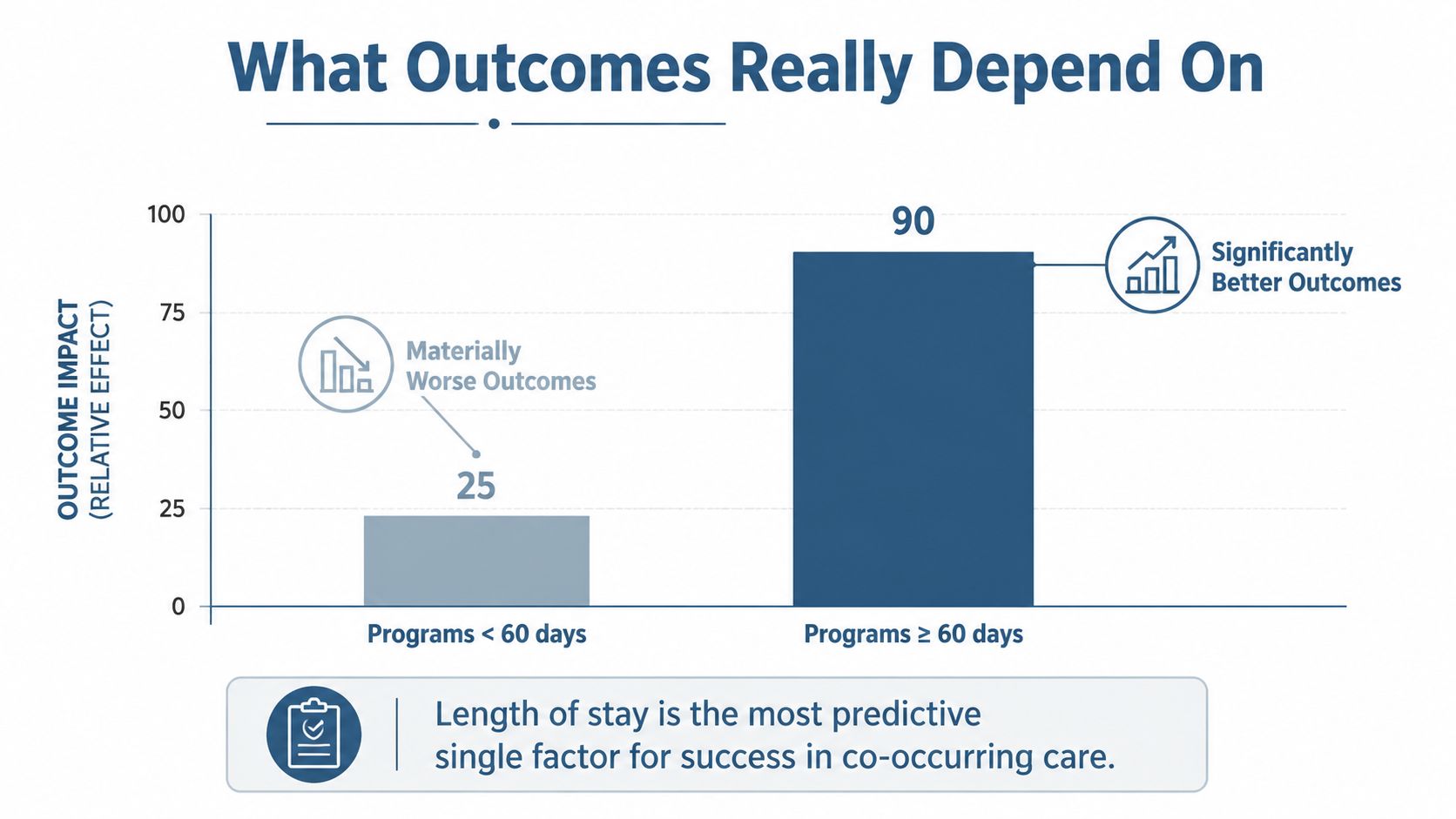
A separate co-occurring-disorders study found that people who completed residential care plus assertive community treatment had near-100% recovery and almost no subsequent hospitalizations, while earlier discharge was linked to worse outcomes. Review the published outcomes document. That finding supports a practical conclusion: a 30-day stay may be an entry point, not a cure.
Programs should publish how they define completion, what follow-up they conduct, and how they report outcomes. Any facility promising guaranteed abstinence or a fixed-duration cure without transparent follow-up data is selling certainty, not clinical care.
Choosing the Right Fit for Lasting Recovery
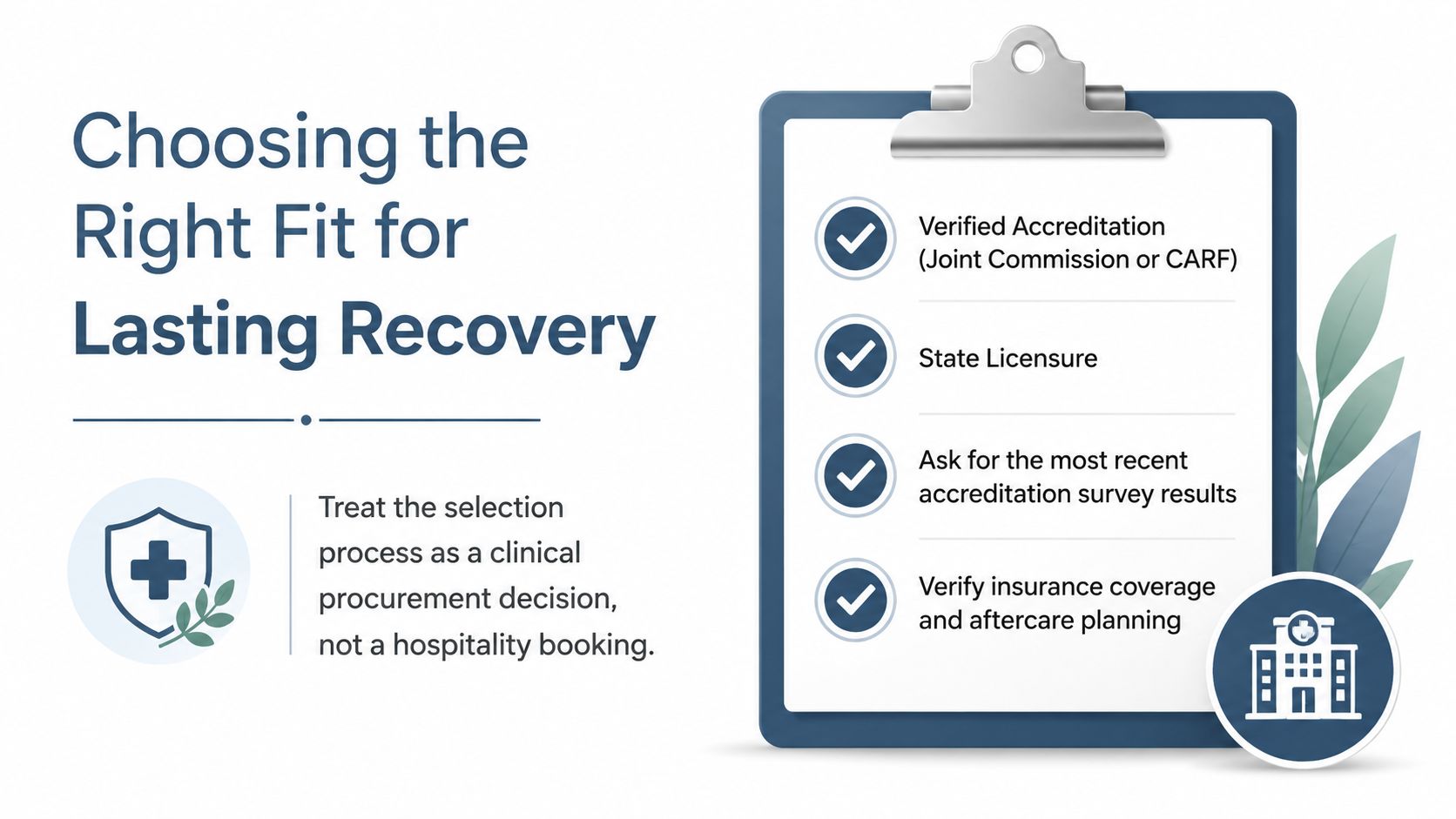
The selection process should resemble clinical procurement, not a hospitality booking. The family or referring professional should test the program before admission, ask direct questions, and pay attention to whether staff answer with documentation or polished generalities.
Start with accreditation and licensure. Joint Commission accreditation is relevant because it reflects an organization-level review process, while state licensure establishes the facility's legal operating status. Ask for the most recent survey letter or equivalent documentation, then verify that the named clinical leaders still work at the program.
Questions that expose weak programs
A credible program should answer these questions during the first call:
- Who makes medication decisions, and how often does that clinician see residents?
- How does the team distinguish substance-induced symptoms from an independent psychiatric disorder?
- What happens if the resident needs a longer stay?
- How are family sessions scheduled, and what support continues after discharge?
- What are the rules for laptops, phones, confidential calls, and work obligations?
- Which clinicians receive the discharge handoff?
- What does the quoted private-pay fee include, and what is billed separately?
For executives, electronics access must be controlled rather than casually granted. A California luxury program example describes all-private rooms, structured access to cell phones and laptops, Joint Commission accreditation, and California Department of Health Care Services licensure. Review the example of private executive treatment operations. Those features show how privacy and continuity can be operationalized, but they still require inspection of the actual clinical program.
Reflections offers California-licensed, Joint Commission-accredited residential dual diagnosis care with private rooms in detox and rehabilitation, individualized psychiatric and addiction treatment, structured electronics access, family involvement, and continuing-care planning. The relevant comparison is not whether a facility feels luxurious. It is whether the setting gives a high-functioning professional enough privacy to enter treatment while maintaining the clinical intensity needed to recover.
Executives and families considering residential dual diagnosis treatment should contact Reflections to discuss psychiatric oversight, private rooms, managed access to phones and laptops, family programming, and a 30 to 90 day care pathway. The admissions conversation should include current symptoms, substance use, medication history, work obligations, privacy needs, and the level of aftercare required before any financial commitment is made.