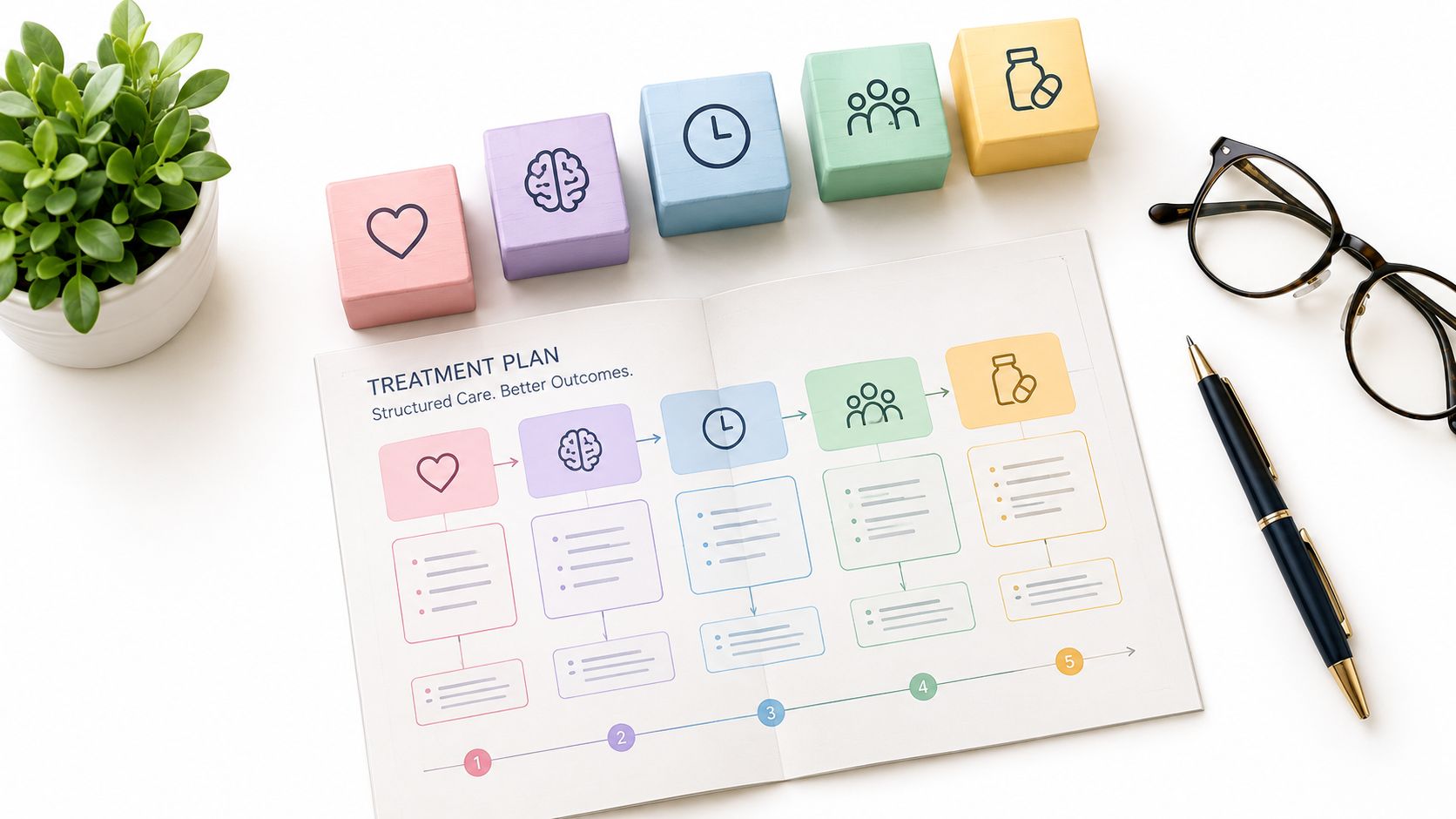

A partner who once answered every message before sunrise now spends the night awake, reaches for alcohol to quiet the mental noise, and walks into the next board meeting running on exhaustion. The calendar still looks successful. The person behind it may be deteriorating.
For executives, founders, C-suite leaders, and other working professionals, adult mental health treatment has to solve two problems at once. It must address symptoms and substance use while protecting privacy, preserving essential responsibilities, and creating enough clinical structure for real change. Luxury residential care can be appropriate when standard outpatient treatment no longer contains the risk, but the setting only matters when the clinical model is fully integrated.
When High Performers Finally Seek Help
A 47-year-old private equity partner may recognize the pattern only after several warning signs converge. Two o'clock in the morning brings a surge of anxiety, bourbon intake has moved from occasional relief to routine regulation, and the pressure of quarterly closes now feels harder to manage than the work itself. The problem isn't a lack of discipline. The problem is that symptoms have begun to outrank the perceived cost of treatment.
Adult mental health includes far more than feeling stressed. Clinicians assess mood and anxiety disorders, trauma-related conditions, psychotic-spectrum illnesses, personality patterns, and cognitive changes associated with prolonged burnout, sleep deprivation, or stimulant dependence. A high-functioning professional may continue signing deals or leading teams while experiencing serious impairment in judgment, relationships, memory, sleep, or emotional control.
Three anchors that justify an assessment
A difficult season can improve with rest, boundaries, and support. A likely clinical condition deserves professional evaluation when several anchors appear together:
- Duration: Symptoms persist beyond two weeks rather than resolving after a short period of recovery.
- Functional impairment: Work performance, decision-making, parenting, relationships, or basic self-care begin to suffer.
- Substance regulation: Alcohol, sedatives, stimulants, cannabis, or other substances become the primary way to manage distress, sleep, confidence, or emotional pain.
These anchors don't replace diagnosis. They identify the point at which self-management has become an unreliable strategy. A professional assessment can separate depression from exhaustion, panic from a medical problem, bipolar symptoms from unipolar depression, and substance-induced symptoms from an independent psychiatric disorder.
Clinical rule: Status, income, and professional reputation don't reduce clinical acuity.
Executives often delay care because they assume treatment requires complete disappearance from work. That assumption is outdated, but the alternative shouldn't be unstructured access to a phone while symptoms remain unstable. An executive-focused program must set clinically approved boundaries around work, communication, sleep, medication, and family contact. A confidential executive rehab program can provide that structure while acknowledging that professional obligations may still require careful planning.
The Scale of Adults Mental Health Today
A senior leader can keep running meetings, approving decisions, and meeting family obligations while a psychiatric condition steadily narrows judgment, sleep, relationships, and safety. Mental illness does not begin only after someone loses employment or housing. In 2023, an estimated 1.17 billion people worldwide were living with mental disorders, and those conditions accounted for 171 million DALYs, or 6.1% of all-cause DALYs, making mental disorders the fifth leading cause of global disability burden, according to the Institute for Health Metrics and Evaluation's updated analysis. The burden was higher among females than males and peaked in the 15 to 19 age group, underscoring why mental health requires attention across the life course.
The World Health Organization reported that in 2021, nearly 1 in 7 people globally, about 1.1 billion individuals, were living with a mental disorder. Its WHO mental disorders fact sheet identifies anxiety disorders affecting 359 million people and depression affecting about 332 million people. WHO also reported that 970 million people were living with a mental disorder in 2019. These figures establish the scale of need, not an individual's severity or appropriate level of care.
Why prevalence isn't enough
In the United States, 59.3 million adults aged 18 and older, or 23.1%, had any mental illness in 2022, while 15.4 million adults, or 6.0%, had serious mental illness, according to the NIMH mental illness statistics. The practical question is whether symptoms, impaired functioning, safety concerns, or substance use exceed what outpatient treatment can reliably contain. Care planning must separate conditions manageable through weekly therapy and medication monitoring from those requiring psychiatric, medical, or residential support.
| Condition | U.S. Adult Prevalence | Co-Occurrence With Substance Use | Source |
|---|---|---|---|
| Any mental illness | 59.3 million adults, 23.1% in 2022 | Requires individual assessment | NIMH mental illness statistics |
| Serious mental illness | 15.4 million adults, 6.0% in 2022 | Requires individual assessment | NIMH mental illness statistics |
| Mental disorders globally | About 1.1 billion people in 2021 | Often requires dual-diagnosis screening | WHO mental disorders fact sheet |
For working professionals, the setting is part of the treatment decision. A private residential program can protect confidentiality, impose enough structure for stabilization, and coordinate psychiatric and substance-use care without treating career demands as proof that symptoms are mild. The right level of care is determined by clinical risk and function, not title, income, or the ability to remain visible at work.
Common Disorders That Drive Adults Into Care
High-functioning adults rarely present with a single neat symptom. Anxiety may coexist with alcohol use. Depression may conceal bipolarity. Trauma may appear as overwork, perfectionism, or relentless vigilance. A capable assessment looks beneath performance and evaluates the pattern across sleep, mood, relationships, substances, cognition, and risk.
Anxiety and panic
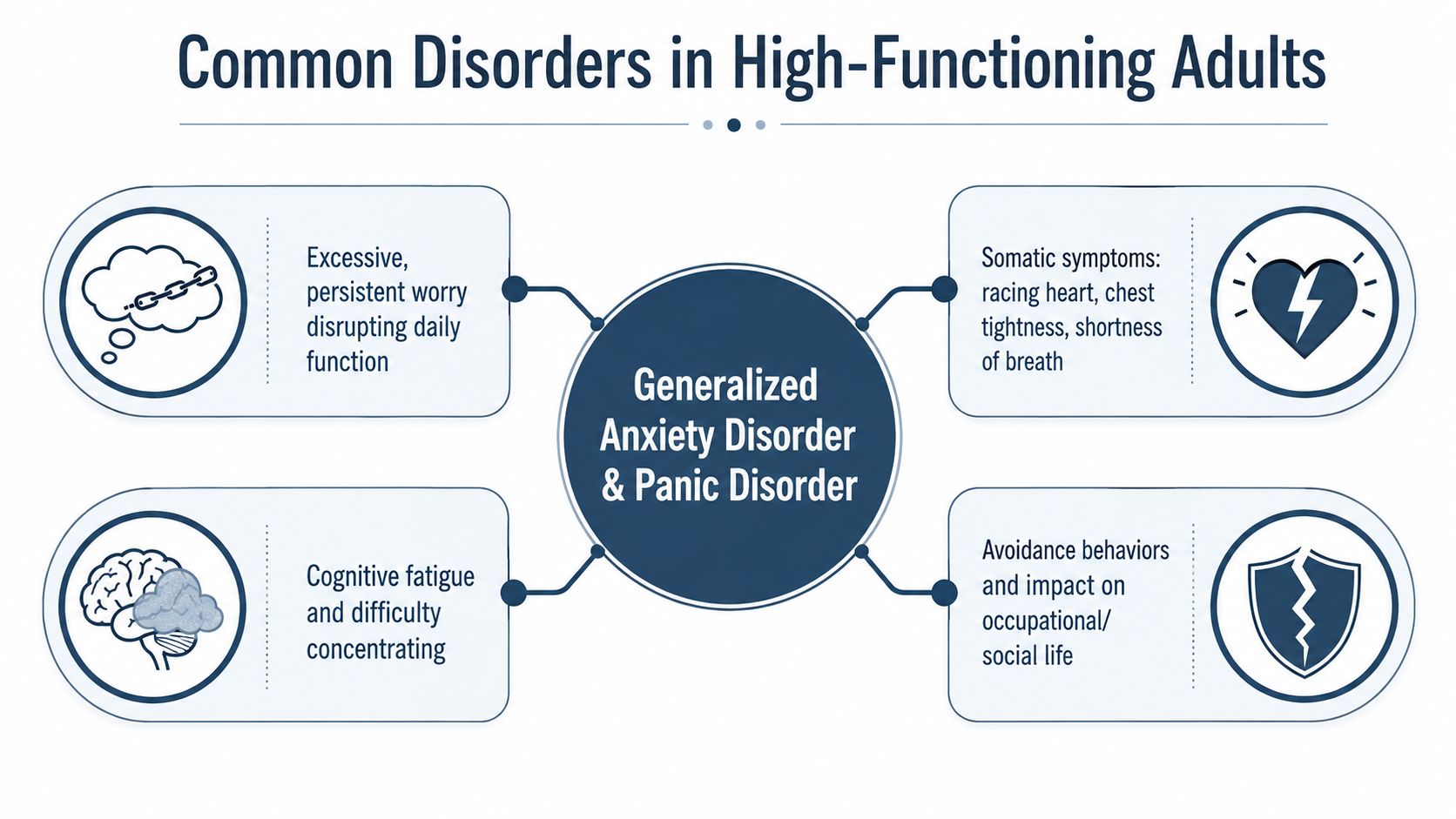
Generalized anxiety disorder involves excessive, persistent worry that can produce muscle tension, irritability, sleep disruption, fatigue, and difficulty concentrating. Panic disorder adds recurrent panic attacks and fear of their return, often leading to avoidance. In a working professional, symptoms may surface during air travel, presentations, negotiations, medical appointments, or quiet moments after the office empties.
The clinical issue isn't just nervousness. It's whether worry and physiological arousal are narrowing the person's choices and impairing judgment. Avoiding travel, delegating every difficult conversation, or using alcohol before meetings signals a need for deeper evaluation.
Depression and bipolar disorders
Major depressive disorder can look like sadness, but anhedonia, slowed thinking, indecision, disrupted sleep, hopelessness, and loss of initiative often matter more in executive settings. Persistent depressive disorder may appear less dramatic while steadily reducing creativity, connection, and resilience.
Bipolar I and II require particular caution. A client may seek care during a depressive phase and receive an incomplete formulation before a history of mania or hypomania emerges. Clinicians must assess periods of reduced need for sleep, accelerated thinking, unusual confidence, impulsive decisions, increased goal-directed activity, and changes noticed by family or colleagues.
Trauma, OCD, ADHD, and personality patterns
Post-traumatic stress disorder may involve intrusive memories, avoidance, emotional numbing, irritability, and hypervigilance. High performers can disguise hypervigilance as dedication, treating constant scanning and over-preparation as professional virtue. Complex trauma can also affect trust, boundaries, identity, and emotional regulation.
Obsessive-compulsive disorder requires careful distinction between intrusive obsessions with compulsive rituals and ordinary perfectionism. Adult ADHD may affect attention, organization, impulse control, and follow-through, while stimulant misuse can complicate the picture. Borderline and narcissistic personality patterns may influence relationships, self-image, emotional reactivity, and treatment engagement. Each presentation changes medication decisions, assessment depth, family work, and whether residential containment is necessary.
Why Co-Occurring Substance Use Changes Everything
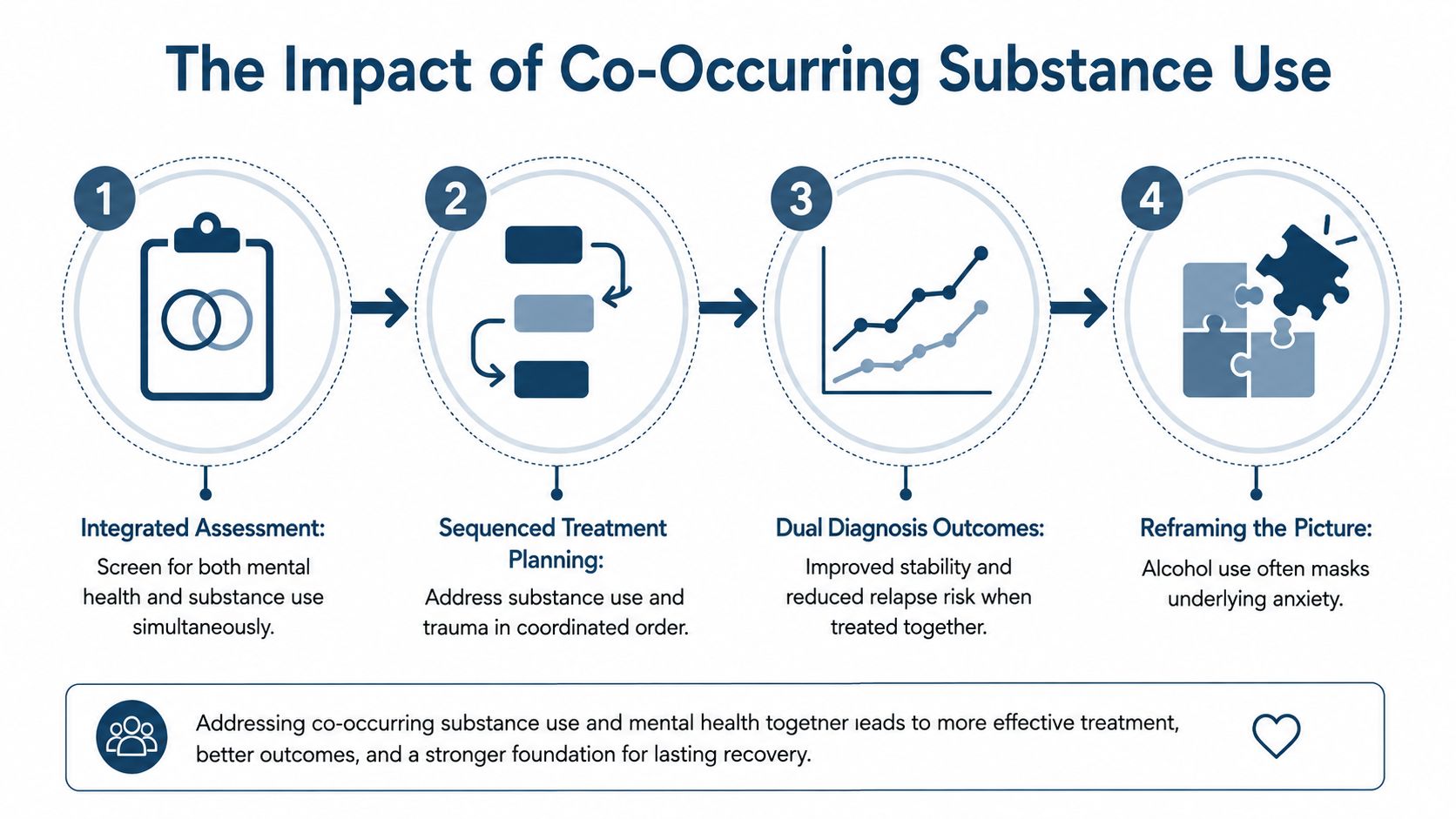
Alcohol or drug use can be the most visible problem while remaining only part of the diagnosis. A professional who drinks to quiet generalized anxiety may stop drinking briefly and still face untreated panic, trauma, insomnia, or depression. If the underlying condition isn't treated, relapse becomes a predictable attempt to restore emotional control.
Integrated care begins with simultaneous screening for mental health symptoms and substance use. Clinicians then determine whether anxiety, depression, agitation, or sleep disruption existed before substance use, emerged during intoxication or withdrawal, or continues after stabilization. That distinction affects medication selection, therapy timing, safety planning, and the appropriate level of supervision.
Stabilization comes before interpretation
Medically supervised stabilization may need to precede intensive trauma processing or emotionally demanding psychotherapy. Withdrawal can produce anxiety, insomnia, agitation, depressed mood, and cognitive disruption, making early conclusions unreliable and increasing risk. Psychiatric oversight and nursing observation create the conditions for a more accurate formulation.
The treatment plan should then combine modalities rather than place addiction and psychiatric care on separate tracks. CBT can identify the connection between thoughts, emotions, and substance urges. EMDR may address trauma when the client is stable enough for trauma-focused work. Motivational interviewing can strengthen engagement without turning ambivalence into confrontation.
The clinical framework for co-occurring disorders matters because dual diagnosis isn't a special category for a small minority of clients. SAMHSA-linked coverage reported that among adults with both a mental health disorder and co-occurring SUD, 41.2% received no treatment for either condition, while 69.8% received mental health treatment rather than substance-use treatment, as described in this treatment-gap analysis. Those figures point to a practical failure of fragmented care.
Treating only the substance leaves the psychiatric driver intact. Treating only the psychiatric symptoms leaves the substance pattern in control.
A luxury residential model should therefore integrate detoxification, medication management, psychotherapy, skills work, relapse prevention, and discharge planning from the beginning. Sequencing still matters, but separation is the mistake.
Inside Luxury Dual-Diagnosis Residential Treatment
A high-end residential program should feel calm, private, and comfortable, but comfort isn't the treatment. The value lies in how the environment supports a disciplined clinical schedule, reduces unnecessary exposure, and gives the treatment team enough access to observe patterns that outpatient appointments may miss.
The team and the clinical week
A serious program may include board-certified psychiatrists, addiction medicine physicians, licensed clinicians, trauma specialists, certified addiction counselors, adjunctive therapists, and 24-hour nursing. Dedicated case managers should coordinate with employers, family members, attorneys, and outpatient providers only with appropriate authorization.
A typical clinical week layers several forms of care:
- Individual psychotherapy: Focuses on diagnosis, motivation, trauma, relationships, emotional regulation, and relapse patterns.
- Trauma-informed groups: Build skills for distress tolerance, communication, boundaries, and recovery support.
- Medication management: Reviews efficacy, side effects, withdrawal needs, interactions, and the goal of minimal effective pharmacology.
- Experiential therapies: May include mindfulness, meditation, art, music, somatic work, equine work, fitness, massage, and nutrition.
- Measurement and observation: Tracks changes in sleep, mood, cravings, anxiety, behavior, and functioning instead of relying only on self-report.
Cognitive Behavioral Therapy deserves a central role. A 2025 JAMA Psychiatry synthesis of 375 trials found CBT produced large effects for major depression, panic disorder, social anxiety disorder, generalized anxiety disorder, bulimia nervosa, binge eating disorder, and obsessive-compulsive disorder, with very large effects for PTSD and specific phobia, according to the published CBT synthesis. The appropriate lesson isn't that CBT replaces every other modality. It's that manualized, diagnosis-matched, measurement-based CBT belongs in a robust adult program.
Accommodations as clinical infrastructure
Private rooms reduce unwanted exposure and give clients a controlled space for sleep, reflection, and confidential calls. Luxury facilities may offer private accommodations, including private rooms and suites, as shown in this verified residential property listing. A secure workspace and controlled connectivity can help an executive remain involved without allowing work to consume the treatment day.
Residential treatment commonly runs 30 to 90 days, with 30-day, 60-day, and 90-day stays described as standard ranges for adults with substance use or co-occurring disorders in this residential treatment guide. Family programming should begin before discharge, and continuing care should be designed at intake rather than added during the final days.
| Feature | Standard Residential | Luxury Dual-Diagnosis Residential |
|---|---|---|
| Clinical focus | May emphasize substance stabilization | Integrates psychiatric and substance-use treatment |
| Accommodation | Shared or limited private space | Private rooms or suites for residents |
| Work access | Often restricted or unavailable | Structured, clinically approved electronics access |
| Psychiatric care | Varies by program | Ongoing psychiatric assessment and medication management |
| Family work | May be limited | Private sessions and educational programming |
| Discharge planning | Often concentrated near discharge | Begins at intake with continuing-care coordination |
Confidentiality, Family, and Staying Connected to Work
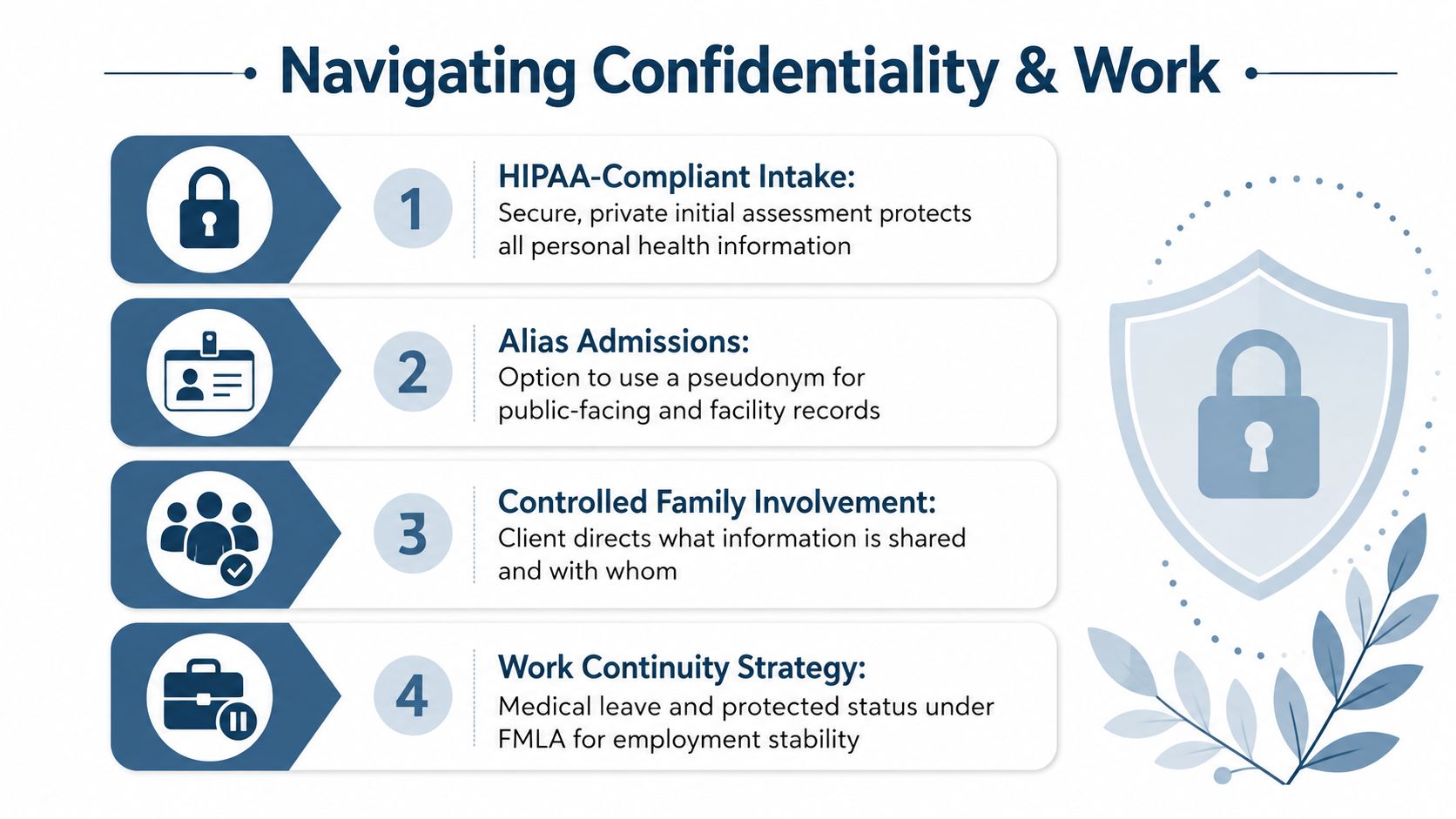
A senior executive entering treatment needs a written privacy process, not vague reassurance. Intake should identify who may access records, how communications are secured, what information can be shared with family or employers, and how public-facing clients are protected from unnecessary exposure. Ask for these procedures before admission.
A discreet admission may use restricted-access records and, where legally and operationally appropriate, an alias. Employer communication should be encrypted and limited to authorized contacts. Legal counsel, public-relations staff, and executive assistants can work from a pre-negotiated plan that identifies urgent responsibilities without turning treatment into a remote office.
A controlled connection plan
Consider a technology executive whose company is preparing for a sensitive transaction. The appropriate plan limits access rather than removing it entirely. It may include a secure workspace, scheduled video calls, asynchronous review of urgent documents, and a coverage map that routes routine decisions to designated colleagues. Clinical staff should adjust access when sleep, anxiety, cravings, or compulsive work behavior worsens.
Some executive programs permit structured laptop and phone access with scheduled, clinically approved use in private workspaces and controlled remote-work windows, as shown in this executive residential work-access example. Reflections also describes balanced access to electronics for work, school, and loved ones. Review structured work access during residential treatment before choosing a program. The standard is structured continuity, not convenience.
Family contact with purpose
Family involvement should follow stabilization and serve a defined therapeutic purpose. A partner may learn to respond to relapse warning signs. An adult child may join a guided conversation about trust and boundaries. A spouse may receive education about enabling, communication, and the difference between support and surveillance.
HIPAA-aligned procedures protect health information, but privacy does not require isolation. The client should direct what may be shared and with whom. Clinicians then help family members understand how coordinated involvement supports recovery without turning contact into monitoring.
Privacy is a clinical intervention when it reduces fear, protects dignity, and makes honest disclosure safer.
How to Choose the Right Provider
Luxury amenities can be copied. Integrated clinical capability is harder to build. Families and referring professionals should evaluate the program's accreditation, team credentials, medical capacity, privacy architecture, and continuing-care design before considering the appearance of the property.
Three filters for serious evaluation
First, verify accreditation and the scope of that accreditation. A Joint Commission or CARF credential matters only when the program's actual services match the client's needs, including co-occurring psychiatric and substance-use treatment.
Second, inspect the clinical team. The roster should include board-certified psychiatric expertise, addiction credentials, licensed therapists trained in trauma and CBT-based modalities, and nursing coverage appropriate to the level of stabilization offered. Ask who sees the client, how often psychiatric reviews occur, and who manages medication changes.
Third, test program depth. A credible provider should explain medical detox or clinically managed withdrawal, individual therapy access, family programming, alumni support, and post-residential coordination. It should also explain how benzodiazepines, stimulants, and mood stabilizers are handled during stabilization without promising a universal medication policy.
| Evaluation Criterion | What to Look For | Red Flag |
|---|---|---|
| Accreditation | Current accreditation that matches the services offered | Accreditation is unclear or unrelated to clinical care |
| Team composition | Psychiatric, addiction, nursing, trauma, and therapy expertise | Marketing emphasizes amenities while clinical roles remain vague |
| Dual-diagnosis model | Mental health and substance use treated together | Conditions are handled sequentially by disconnected teams |
| Privacy | Restricted access, secure communication, discreet admissions | Staff cannot explain who receives information |
| Work continuity | Clinically approved electronics and defined work windows | Either unrestricted access or total lack of planning |
| Aftercare | Family work, alumni support, and provider handoff | Discharge is treated as the endpoint |
Two facilities can offer private rooms, fine dining, and attractive grounds while differing sharply in clinical substance. Reflections is a California-licensed, Joint Commission-accredited provider that offers private residential care, dual-diagnosis treatment, clinically managed medication-assisted withdrawal when appropriate, and structured access to electronics.
Your Next Step Toward the Right Level of Care
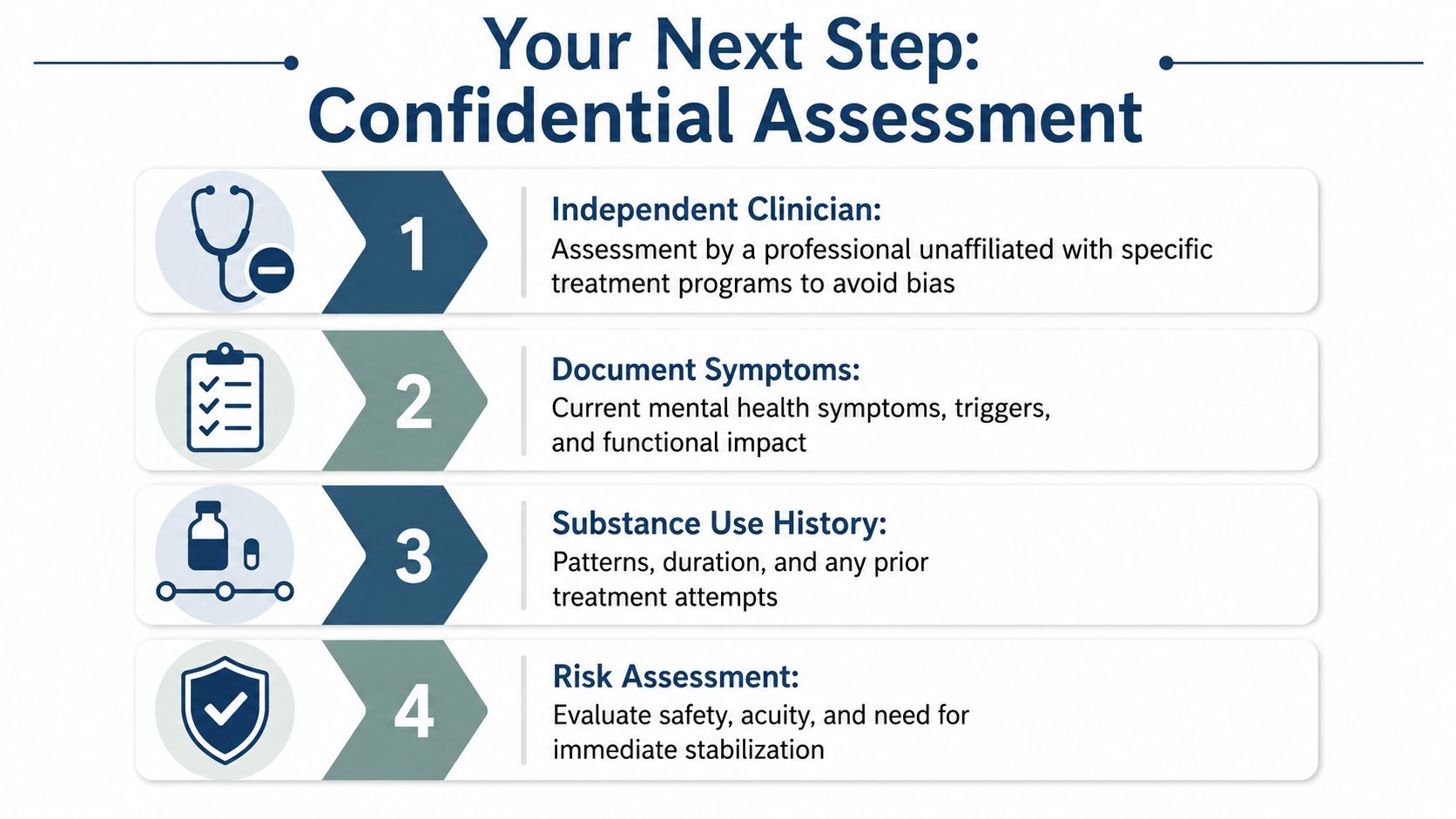
The next step should be a confidential level-of-care assessment, preferably with an independent clinician who isn't financially tied to a particular facility. The assessment should document current symptoms, substance use patterns, medications, prior treatment, withdrawal risk, functional impairment, and immediate safety concerns.
A residential recommendation should follow clinical need, not the client's income or professional title. Some adults need medically supervised stabilization and residential containment. Others may be appropriate for intensive outpatient care or a stepped plan that combines frequent therapy, psychiatric monitoring, family involvement, and continuing support.
A practical decision sequence
- Define the essentials. Require genuine dual-diagnosis integration, strong privacy standards, and a realistic plan for professional obligations.
- Request evidence. Ask for clinical team biographies, accreditation documentation, medication policies, nursing coverage, staffing structure, and sample schedules.
- Tour before admission. Use an on-site or virtual tour to evaluate private rooms, workspaces, communication procedures, family arrangements, and the overall clinical atmosphere.
- Set the logistics. Clarify private-pay arrangements, insurance involvement, expected length of stay, visitation rules, electronics access, transportation, and discharge coordination.
- Choose a target. A defined decision window and intake date reduce the chance that fear, work pressure, or another crisis postpones care again.
Families should also ask how the facility handles relapse risk after discharge. Continuing care may include outpatient referrals, medication follow-up, family sessions, alumni programming, and flexible services that support a return to leadership without returning to the old coping system.
An executive doesn't need to choose between treatment and every responsibility. The person needs a program capable of separating urgent duties from compulsive overwork, protecting confidential information, and treating psychiatric symptoms and substance use as one clinical picture.
Reflections provides private, luxury residential dual-diagnosis treatment for adults who need psychiatric care, substance-use support, clinically managed withdrawal when appropriate, and structured continuity with work and family. Visit Reflections to request a confidential assessment and discuss whether its California residential programs match the needed level of care.