

A Sunday flight lands late, the phone is full of unanswered messages, and the Monday board meeting starts at nine. Somewhere between the airport and home, an executive realizes that morning alcohol is no longer occasional, sleep has become unreliable, and anxiety is shaping decisions that once felt routine. The question isn't whether treatment is needed. It's what is the best rehab program when privacy, professional obligations, mental health, and physical safety all matter at once?
For a high-earning professional, a standard admission can create genuine friction. Shared accommodation may feel unsafe or exposing. A blanket electronics ban can disrupt a company, a practice, or a fiduciary responsibility. A short stay may address withdrawal while leaving trauma, depression, anxiety, or bipolar symptoms untreated. The right program must therefore be judged by clinical depth and operational fit, not by a spa menu or an impressive property.
The Executive's Dilemma When Treatment Becomes Urgent
By Friday, the executive has several options, and none is painless. A conventional 28-day admission could interrupt a critical quarter, prompt questions from staff, and create anxiety about confidential information reaching clients or colleagues. Delaying treatment preserves the calendar temporarily, but the underlying pattern continues through another board meeting, another flight, and another night of fragmented sleep.
The decision becomes more difficult when substance use and mental health symptoms are connected. Treating alcohol or drug use without addressing trauma or anxiety can leave the trigger system intact. Treating anxiety alone while substance use continues can create a false sense of progress. SAMHSA describes integrated treatment as a way to address the whole person, coordinating services for substance use and mental health rather than managing each condition separately (SAMHSA's guidance on co-occurring disorders).
An executive may also need to coordinate treatment with demanding travel, family responsibilities, or care for aging relatives. Practical planning resources, including guidance on executive travel logistics, can help a family or professional team manage travel obligations without allowing logistics to determine a clinical decision.
The cost of every option
The cost of postponement isn't abstract. Fragmented care can increase the risk of severe outcomes, including hospitalization, incarceration, homelessness, and HIV infection for people who don't respond to integrated outpatient treatment, according to SAMHSA's overview of co-occurring disorders. A public incident, medical emergency, or sudden leave of absence can create far more disruption than a deliberately planned admission.
The cost of admission is real too. A senior professional may need a discreet arrival, private accommodation, controlled work access, and a clinically credible explanation for a temporary absence. Those requirements don't make treatment less serious. They determine whether treatment can begin before a crisis forces the decision.
Practical rule: The best program is the one that protects safety and produces genuine engagement without treating confidentiality or professional continuity as inconveniences.
The rest of the decision should be handled with that same seriousness. The relevant question isn't which facility looks most luxurious. It's whether the program can stabilize the person, treat the connected disorders, protect privacy, and build a return to work that doesn't depend on wishful thinking.
What the Best Rehab Program Actually Means in 2026
“Best” should describe a clinical and practical fit, not a marketing category. A clinician assessing an executive program would first ask whether one coordinated team can evaluate substance use and co-occurring depression, anxiety, trauma, ADHD, bipolar symptoms, or other psychiatric concerns within one treatment plan.
The core yardsticks
Integrated care comes first. SAMHSA reports that coordinated treatment can reduce or discontinue substance use, improve psychiatric symptoms and functioning, increase the likelihood of recovery for both disorders, reduce hospitalization, limit medication interactions, improve housing stability, and lower arrests. That is a more meaningful standard than a property's appearance.
Retention matters because treatment has to last long enough to work. A widely cited NIDA benchmark is at least three months of continuous care for a significant reduction in drug use, with longer participation associated with better outcomes (NIH-hosted review of treatment retention). A separate review found that patients receiving three months or more of long-term residential or outpatient treatment had lower illicit drug use and better employment and criminal-justice outcomes at 12 months than those treated for less time (review of continuing care for substance use disorders).
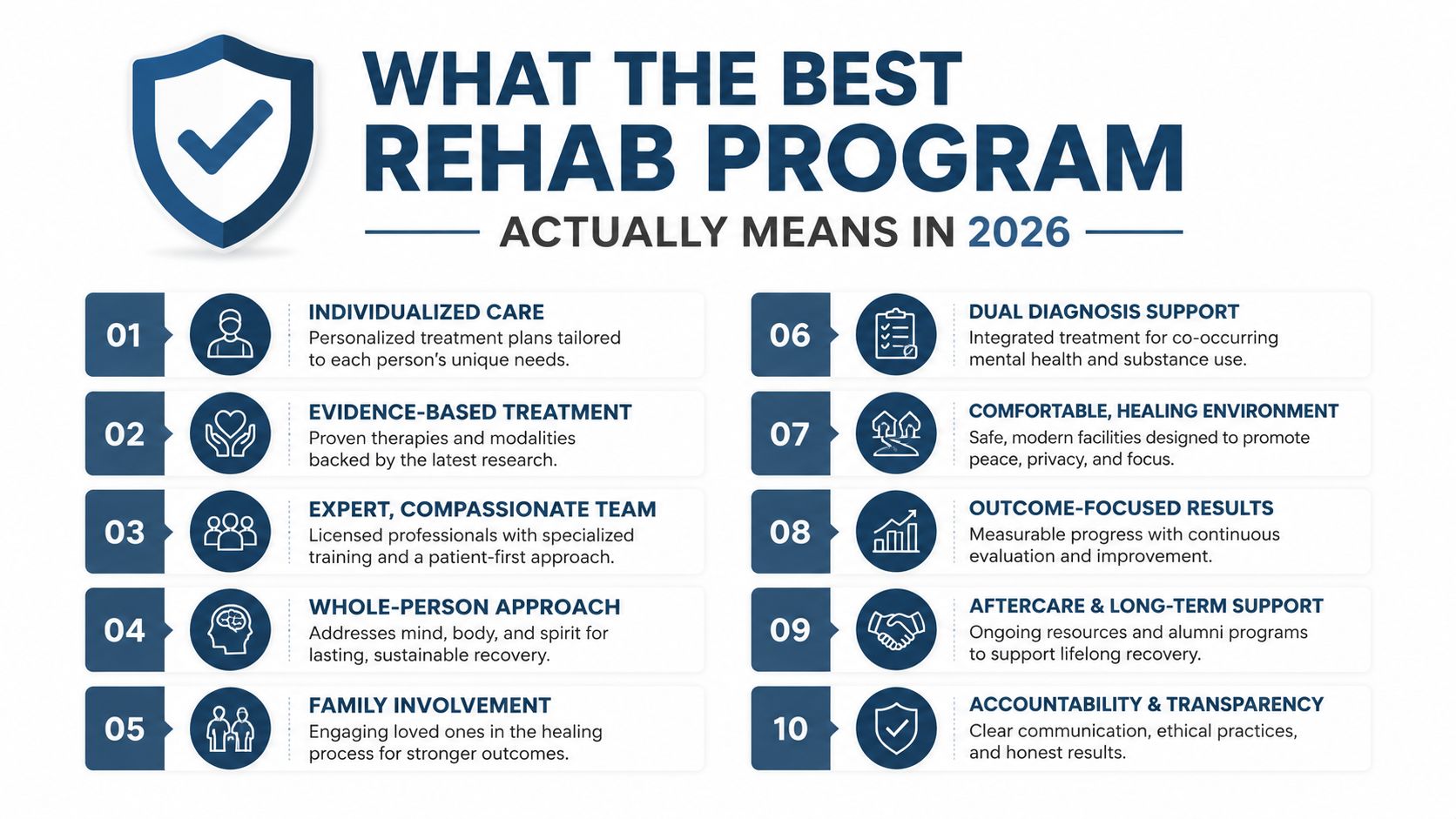
Accreditation provides an external check. Joint Commission accreditation covers addiction treatment organizations and includes substance use disorder providers in its locator (Joint Commission behavioral health provider locator). CARF accreditation and a clearly stated ASAM level-of-care designation can also help a family verify whether the organization has documented standards rather than relying on polished claims.
Luxury as a delivery system
A luxury setting matters when it supports treatment. Private rooms can reduce exposure and improve rest. A calm residence can make it easier to remain engaged. Structured access to phones and laptops can preserve essential continuity without turning the program into remote work with therapy added around the edges.
Reflections describes its model through luxury rehab in California as private residential care for adults needing individualized treatment, including co-occurring mental health and substance use support. The governing principle remains simple: amenities should remove unnecessary friction, while the clinical program does the therapeutic work.
Standard Rehab Versus Executive-Track Care
The difference between standard and executive-track treatment is easiest to see in daily operating details. Standard programs may rely on shared rooms, fixed schedules, broad group programming, and strict phone restrictions. Those structures can suit some patients, but they can also create avoidable barriers for a chief executive, physician, attorney, founder, or senior finance professional.
| Dimension | Standard Rehab | Executive-Track Rehab |
|---|---|---|
| Privacy | Shared rooms and common entry routines may be typical | Private rooms, discreet arrival planning, and controlled access |
| Electronics | Devices may be stored or restricted for extended periods | Scheduled, clinically approved access to phones and laptops |
| Staffing | Counselors may rotate across a larger census | Smaller caseloads, business-aware clinicians, and coordinated psychiatric support |
| Clinical depth | Comorbidity care can vary by program | Dual-diagnosis and trauma treatment built into the care plan |
| Setting | Dormitory-style campus or institutional environment | Private residence with quiet spaces, dining, fitness, and work areas |
| Work continuity | Professional communication may be difficult | Limited work triage is integrated around treatment priorities |
The friction test
A standard program may ask an executive to surrender a phone, share a room, and explain an absence to colleagues without a clear privacy protocol. An executive-track program should explain exactly when electronics are available, where calls occur, who can access records, and how urgent professional matters are triaged.
That flexibility isn't permission to continue normal life unchanged. It should be bounded. A resident may review an urgent message during an approved window, then return to therapy, meals, rest, and recovery work. Without boundaries, electronics become an escape route. With boundaries, they can reduce the fear that often delays admission.
Clinical differences matter more than décor
A private residence has limited value if psychiatric care is difficult to access or if trauma is treated as a side issue. The program should offer a coherent plan for withdrawal management, psychiatric assessment, individual therapy, groups, medication decisions, family participation, and continuing care.
Executives comparing inpatient and outpatient rehab should focus on the level of structure required, not on which format sounds more convenient. Residential care is often the stronger choice when the home environment, travel schedule, access to substances, or psychiatric instability makes outpatient attendance unreliable.
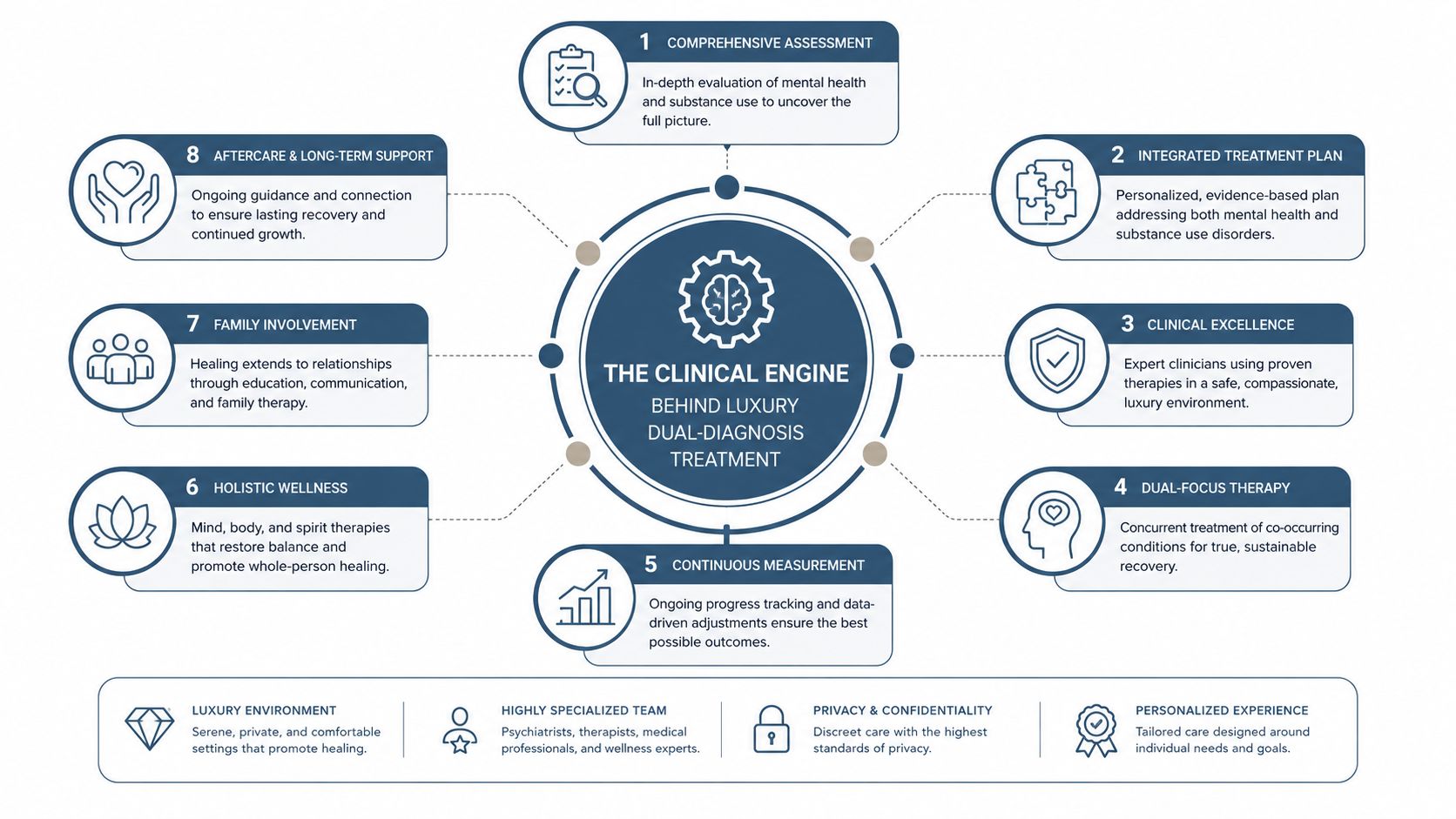
The Clinical Engine Behind Luxury Dual-Diagnosis Treatment
Luxury dual-diagnosis care should not be a collection of therapies placed beside one another. The clinical team has to connect each intervention to the person's substance-use pattern, psychiatric symptoms, medical status, and real-world responsibilities.
Cognitive behavioral therapy helps identify the sequence that precedes use. An executive may recognize that the pattern begins with an exhausting travel day, moves through self-criticism and insomnia, and ends with alcohol used as an attempted sleep aid. CBT gives the team a way to test each link and build alternatives.
Dialectical behavior therapy is useful when emotion intensity, impulsivity, interpersonal conflict, or distress tolerance problems drive substance use. Acceptance and commitment therapy adds a values-based question: what behavior supports the leader, partner, parent, or professional identity the person wants to sustain?
Motivational interviewing addresses ambivalence directly. Many high-functioning professionals understand the risks and still believe they can manage the problem without slowing down. A skilled clinician doesn't win an argument. The clinician helps the resident examine the conflict between immediate relief and long-term values.
Trauma and medication require coordination
When PTSD, complex grief, or chronic stress sits beneath the substance use, trauma-informed care becomes central. EMDR or somatic work may be appropriate after stabilization, but trauma processing shouldn't outrun the resident's ability to regulate emotion and remain safe.
Medication-assisted treatment can also be clinically appropriate for alcohol or opioid use disorders, and medication optimization may be necessary for depression, anxiety, bipolar symptoms, or sleep disruption. It isn't a crutch. It is one clinical tool, used with monitoring and psychotherapy rather than as a substitute for either.
A credible program should identify who manages medication, how often psychiatric reviews occur, whether a psychiatrist is available on site or on call, and how medical and therapeutic decisions are shared. Its psychiatric medication management should fit the full treatment plan instead of operating as a separate prescription service.
The team must work as one team
Families should request the staffing roster and ask how often multidisciplinary case reviews occur. Strong executive care typically uses small caseloads, psychiatric oversight, licensed therapists, medical staff, and weekly reviews that align therapy goals, medication decisions, withdrawal monitoring, and discharge planning.
Clinical standard: If the psychiatrist, therapist, and medical provider hold separate stories about the same resident, the program isn't delivering integrated care.
A Day Inside a High-End Residential Program
A well-designed residential day feels structured without feeling institutional. The resident wakes in a private room, completes vitals or a medication check when clinically indicated, and eats a balanced breakfast prepared around dietary, medical, and metabolic needs. The morning then moves into a primary therapy block, often individual psychotherapy or a focused clinical group.
The schedule is active, but it isn't designed to keep residents busy for the sake of appearing intensive. Each block should have a purpose and enough transition time for the person to absorb difficult material.
A realistic daily rhythm
- Morning assessment: Nursing staff review symptoms, sleep, vitals, and medication needs.
- Primary therapy: Individual or group work targets substance use, mood symptoms, trauma, or relapse patterns.
- Midday processing: A process group gives the resident a supervised setting to examine reactions and interpersonal behavior.
- Specialty work: Trauma reprocessing, relapse prevention, movement, or somatic regulation may follow.
- Afternoon care: One-on-one therapy, psychiatric appointments, family video sessions, and quiet reflection blocks create a less crowded pace.
- Evening recovery: A recovery meeting, service, dinner, and limited electronics access close the day.
Meals should support recovery rather than function as a luxury performance. A chef-prepared lunch can help restore routine, but nutrition counseling, sleep repair, movement, and medication review carry greater clinical weight than presentation.
Electronics with boundaries
For an executive, phone and laptop access can be the difference between accepting treatment and postponing it. The access should be scheduled and supervised where appropriate, with private workspaces available for urgent communication. The purpose is to triage genuine obligations, not to recreate the office inside the residence.
A high-end program may also include massage, acupuncture, fitness, mindfulness, or creative work. These services can help regulate stress and make the environment more tolerable, but they should complement therapy and medical care rather than replace them.
The week adds family sessions, medical rounds, treatment-plan review, and revisions to the next stage of care. A resident should know what is changing, why it is changing, and what evidence the team is using to judge readiness for step-down treatment.
Family, Alumni, and the Continuity That Drives Outcomes
When an executive enters treatment, the family system does not pause. It needs its own roadmap, with defined roles, communication rules, and decisions that do not depend on the resident managing everything from inside care.
Family involvement can improve treatment entry and retention. Reviews also associate family engagement with reduced substance use and stronger family functioning (systematic review of integrated dual-diagnosis treatment and family involvement).
A partner may need education about withdrawal, medication, boundaries, relapse warning signs, and communication. Children need age-appropriate explanations. A board or business partner may require a limited reintegration plan that protects privacy while accepting that the executive cannot immediately resume the old pace.
Family programming is clinical infrastructure
Effective programming can include weekly multifamily groups, conjoint sessions, and psychoeducation matched to the resident's relationships. The purpose is shared understanding. Families should learn how cravings, psychiatric symptoms, medication adherence, boundaries, and recovery-supportive behavior affect daily decisions.
This structure matters for families carrying demanding responsibilities, including supporting aging parents. A pressured family needs clear roles and practical plans, not a general instruction to “be supportive.”
The discharge plan starts early
Before residential treatment ends, the team should map each next setting:
- Residential care: Stabilization, assessment, intensive therapy, and daily structure.
- Partial hospitalization or intensive outpatient care: Continued clinical intensity with greater community exposure.
- Weekly outpatient care: Ongoing psychotherapy, psychiatry, family work, and recovery support.
- Executive reintegration: A written return-to-work plan covering workload, travel, communication, boundaries, and warning signs.
Alumni programming should provide continuing-care coordination, peer connection for professionals, sober-living placement when indicated, and regular follow-up. These services preserve accountability after discharge without making the resident dependent on the facility.
A 2026 systematic review associates family-based interventions with reduced substance use and improved family functioning, supporting treatment of the family system as part of the recovery environment rather than as an audience for discharge instructions (2026 review of family-based interventions).
Cost, Privacy, and the Hidden Trade-Offs of Executive Rehab
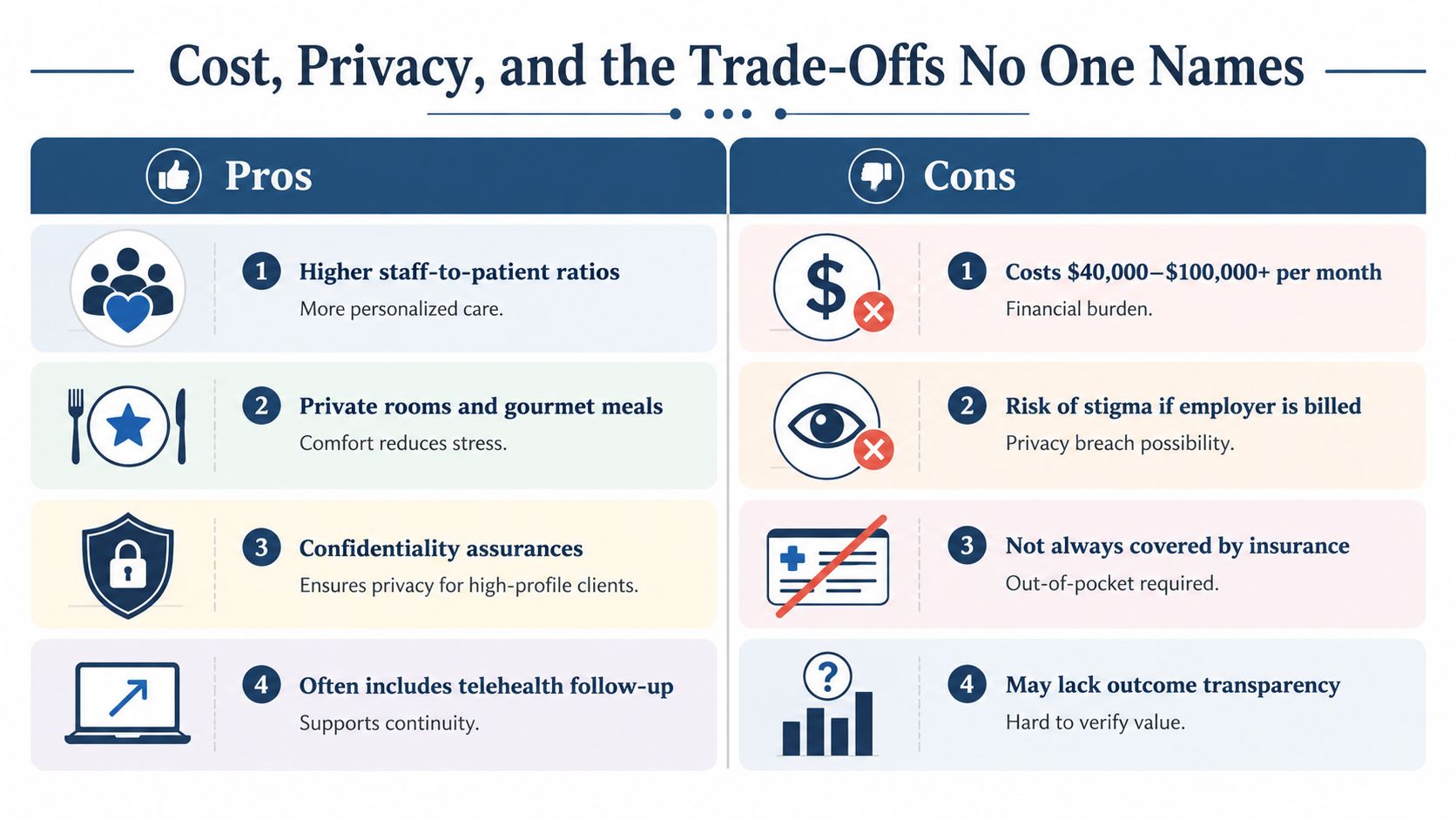
Luxury care can cost $40,000 to $100,000 or more per month, as shown in the supplied comparison visual. That fee may cover private accommodation, a smaller census, greater staff access, deeper clinical services, and work-friendly logistics. It does not prove clinical value. Ask for an itemized explanation of what is included, what costs extra, and how the program measures quality.
Privacy requires the same level of scrutiny. A serious provider should explain intake procedures, record handling, communications, visitor rules, staff-device restrictions, and confidentiality expectations. NDAs can support discretion, but they do not replace lawful record protection, controlled access, and staff training. For a prominent professional, electronics access and communication rules should be designed around clinical safety and career continuity, not added casually after admission.
Time away is not the same as lost time
Treatment takes time. The evidence summarized earlier supports sustained engagement, with at least three months often used as a meaningful benchmark for observing reduced drug use and improved outcomes. A shorter admission may fit some clinical situations, but the program must show how stabilization connects to residential treatment, outpatient care, and ongoing monitoring.
The business calculation extends beyond “days away from work.” It includes continued impairment, repeated sick days, poor decisions, family disruption, medical emergencies, and a crisis that removes the executive from work without a plan.
A private room and controlled device access can make treatment more workable, but they do not compensate for weak clinical care.
What a lower price may leave out
A lower-cost program may still provide excellent treatment. It may also offer fewer private rooms, less flexible communication, limited psychiatric availability, less trauma specialization, reduced family programming, or minimal discharge coordination. Compare the actual staffing model, clinical schedule, privacy process, electronics policy, and continuing-care plan.
The trade-off is often capacity, not comfort. Executive-track care is engineered to protect confidentiality and preserve a workable connection to professional responsibilities while maintaining treatment structure.
Stigma can distort the decision. Treatment is not a declaration that an executive has failed. It is a controlled response to a health condition affecting judgment, relationships, sleep, or safety. The discreet choice is often the one that addresses the problem before circumstances make privacy impossible.
How to Choose and What to Do Next
A family, attorney, therapist, or executive can verify a program quickly by asking precise questions. The goal isn't to collect polished assurances. It is to determine whether the provider can deliver integrated care in the setting and format the client can realistically complete.
The verification sequence
First, verify accreditation and licensure. Confirm Joint Commission or CARF accreditation, state licensure, and the program's stated level of care. The Joint Commission locator specifically includes substance use disorder treatment providers, making it a useful starting point for checking whether an organization appears within its behavioral health accreditation system (Joint Commission provider locator).
Second, request the clinical roster. Ask for names and credentials, including addiction psychiatrists, licensed therapists, nurses, medical providers, and clinicians trained in the modalities the resident may need. Ask who is physically present, who is on call, and how psychiatric and medical decisions are coordinated.
Third, request documents before admission. The program should provide written admission criteria, discharge procedures, privacy policies, electronics rules, emergency protocols, and a sample week schedule. If staff can't explain how a resident can handle an urgent work issue without abandoning treatment, the executive track may be cosmetic.
Fourth, clarify financial exposure. Confirm private-pay fees, insurance interaction, deposits, exclusions, and what happens if the clinical team recommends a longer stay or a different level of care. The family should receive the answer in writing.
Fifth, speak with the treating side of the organization. A confidential call with an admissions director is useful, but it shouldn't be the only conversation. A prospective resident or referrer should also ask to speak with a clinician who can discuss dual-diagnosis assessment, medication, trauma work, and step-down planning.
Reflections provides private residential detox and rehabilitation for adults with co-occurring substance use and mental health disorders, with private rooms and appropriate access to phones and laptops for residents managing professional responsibilities. Families evaluating that model should still apply the same verification standards to every provider, including Reflections, before making an admission decision.
Reflections offers discreet, private-room detox and residential treatment for executives and working professionals who need integrated dual-diagnosis care without abandoning responsible career communication. Visit Reflections to discuss clinical fit, electronics access, privacy procedures, and a continuing-care plan with the admissions team.