
A chief financial officer can spend years protecting a company from visible risk while hiding a private one. Weekend drinking becomes a weekday drink before the first meeting. Anxiety gets labeled as pressure, insomnia as travel, and missed family commitments as the unavoidable cost of leadership. Eventually, a board call, medical result, or direct conversation at home makes the existing explanation impossible to maintain.
For executives and high-performing professionals, group therapy for substance abuse has to meet a higher standard than a crowded discussion room and a generic worksheet. The right program uses small, expertly facilitated groups as a clinical backbone, then adds private rooms, psychiatric care, individual therapy, family involvement, medical oversight, and carefully managed access to work obligations. Privacy and comfort matter, but they can't substitute for clinical depth.
The Moment Work and Recovery Collide
The executive doesn't usually arrive at treatment because of one dramatic incident. More often, the pattern has become operationally unsustainable. A 48-year-old CFO may still deliver strong results while drinking after work, waking during the night, and using alcohol in the morning to quiet anxiety before an earnings call. The problem remains hidden until a missed meeting, a spouse's ultimatum, or a flagged blood panel removes the last credible explanation.
Private outpatient efforts may have offered useful insight without creating enough separation from the environment driving the behavior. The executive returns to the same calendar, the same access to substances, the same professional pressure, and the same expectation of emotional control. Appointments become another obligation to fit between board meetings. Recovery never receives enough protected attention to change the underlying system.
The executive treatment problem
A senior professional usually faces three pressures at once:
- Clinical urgency: Substance use may coexist with anxiety, depression, trauma, insomnia, attention problems, or mood instability.
- Professional exposure: A sudden disappearance can create questions, especially when the person holds a visible leadership role.
- Family exhaustion: A spouse or adult child may no longer accept promises that aren't supported by a credible treatment plan.
A local detox followed by an inflexible schedule may address withdrawal while leaving the executive unprepared for the emotional and relational demands that follow. A premium setting should do more than provide attractive surroundings. It should create enough clinical structure to interrupt the pattern while preserving appropriate communication with family and essential work responsibilities.
Why groups become practical
A well-run residential program can make group therapy the place where clinical concepts become behavior. The executive learns to identify the thought that precedes a drink, hears how another client handles pressure, practices a different response, and receives immediate feedback from a clinician and peers. That work complements private sessions, where more sensitive material can be explored in greater depth.
Confidentiality must be explicit, not assumed. Cohorts should remain small, facilitators should control disclosures, and the program should explain how admissions, communications, visitors, and discharge information are handled. A client who has never tolerated vulnerability may not speak freely on the first day. That isn't failure. Skilled clinicians build participation gradually, without turning the group into a performance or a forced confession.
The right question isn't whether an executive can disappear from work. It's whether treatment can be structured well enough that the executive no longer has to choose between clinical care and every essential professional obligation. That requires disciplined boundaries, not unrestricted remote work and not unnecessary isolation.
What Group Therapy for Substance Abuse Actually Is
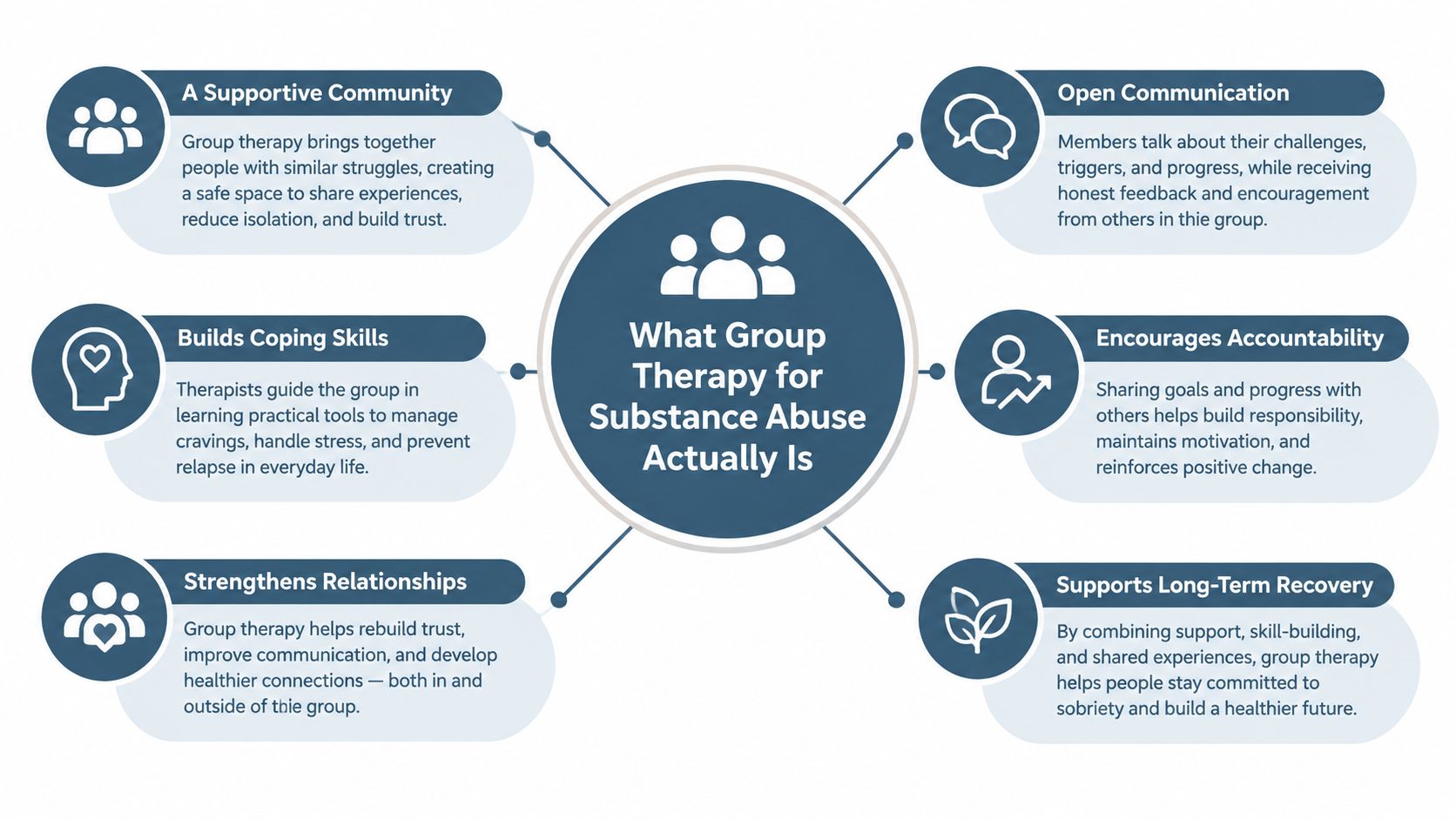
Group therapy for substance abuse is structured clinical treatment led by one or more trained clinicians. A typical group includes 6 to 12 clients meeting regularly with one or two therapists, a model described in SAMHSA's TIP 41 guidance on group therapy. The facilitator sets the clinical purpose, manages safety and confidentiality, keeps discussion focused, and translates shared experience into recovery skills.
Groups aren't boot-camp confessions or anonymous confessionals. They're scheduled sessions with a defined therapeutic job. Residential programs often use sessions lasting 60 to 90 minutes several times each week, although the exact schedule depends on the level of care, client stability, medical needs, and program design.
The five core group formats
SAMHSA identifies five core formats for addiction care:
- Psychoeducational groups explain substance effects, craving, withdrawal, sleep, stress, and co-occurring mental health conditions. The clinical purpose is informed decision-making, not passive listening.
- Skills development groups teach practical abilities such as emotional regulation, communication, grounding, refusal skills, and relapse-response planning. Participants should practice skills during the session.
- Cognitive-behavioral groups examine the connection among thoughts, emotions, actions, and substance use. A clinician may help a client challenge the belief that a difficult meeting requires alcohol afterward.
- Support groups provide structured peer encouragement, accountability, and perspective. They reduce isolation without making peer approval a substitute for professional care.
- Interpersonal process groups examine the way clients relate to others in the room. Shame, defensiveness, control, withdrawal, and conflict can become observable patterns that clinicians address in real time.
The group format works because participants see recovery problems outside the privacy of a one-to-one appointment. One executive may recognize avoidance in another client before acknowledging it in personal behavior. Another may discover that a successful coping strategy can be adapted to demanding travel, family conflict, or leadership pressure.
Programs and clinicians can also use professional education resources to strengthen their understanding of group facilitation and behavioral health practice. The ProMed Certifications groups resource offers context for professionals reviewing group-focused certification and education options.
What the Evidence Shows About Group Therapy Outcomes
The evidence supports group therapy, but it doesn't support exaggerated promises. A 2019 systematic review and meta-analysis of randomized controlled trials included 33 studies and found significant small effects on abstinence when group therapy was compared with no treatment, individual therapy, and other treatments. The same review found that effects on substance-use frequency and SUD symptoms weren't significant, while the effect on mental state was significant and moderate when group therapy was compared with no treatment. The findings are available through the 2019 review of group therapy for adults with substance use disorder.
That distinction matters to executives and families evaluating expensive residential care. Group therapy can support abstinence and psychological stabilization, but it isn't a guaranteed standalone solution. A strong program uses groups to improve engagement, coping, insight, and peer connection while individual therapy, psychiatric care, medical treatment, and continuing care address problems that groups can't fully contain.
What later treatment reviews add
A 2021 review of 50 studies on adult drug-use disorder group treatments found that group CBT and contingency-management groups reduced cocaine use more than treatment as usual. Contingency management also helped with methamphetamine use, while relapse-prevention, motivational-interviewing, and social-support groups reduced marijuana use compared with delayed treatment controls. The review also found that group therapy or group CBT combined with pharmacotherapy reduced opioid use more effectively than pharmacotherapy alone. These findings appear in the review of group treatments for adult drug-use disorders.
| Group Modality | Comparison | Outcome Focus | Typical Effect |
|---|---|---|---|
| Group therapy | No treatment | Abstinence and mental state | Small abstinence effect, moderate mental-state effect |
| Group therapy | Individual or other treatment | Abstinence | Small effect |
| Group CBT | Treatment as usual | Cocaine use | Reduced use in the reviewed evidence |
| Group treatment plus pharmacotherapy | Pharmacotherapy alone | Opioid use | Greater reduction with integrated care |
A practical expectation follows. Clients may experience earlier improvements in structure, emotional awareness, craving management, and willingness to engage than in stable long-term abstinence. Continued participation matters because recovery requires repeated practice under changing conditions. For a senior professional, the goal isn't to collect group attendance. It's to build responses that hold during conflict, travel, sleep disruption, pressure, and family repair.
A clinical overview of group therapy benefits in addiction treatment can help families understand how group work fits within a broader residential plan. The key standard remains simple: evidence-based groups should be coordinated with the rest of care and measured reliably.
Group Formats and Which Clinical Jobs Each One Performs
Not every group solves the same problem. A client who understands addiction intellectually but reacts impulsively under pressure needs different work from a client who remains unsure whether sobriety is necessary. High-end programs should assign groups according to the dominant clinical problem, not fill a schedule with interchangeable topics.
A functional comparison
| Format | Primary Clinical Job | Typical Group Size | Best-Fit Patient Profile |
|---|---|---|---|
| CBT skills | Identify and change thought-behavior links | 6 to 12 | Clients who rationalize use or repeat predictable trigger patterns |
| DBT skills | Build emotion regulation and distress tolerance | 6 to 12 | Clients with impulsivity, intense emotions, self-destructive coping, or borderline traits |
| MI group | Resolve ambivalence and strengthen commitment | 6 to 12 | Clients who want change but remain divided about stopping |
| Relapse prevention | Map warning signs and create coping responses | 6 to 12 | Clients preparing for work, travel, family stress, or transition home |
| Psychoeducation | Explain addiction, mental health, and recovery mechanisms | 6 to 12 | Clients who need a clear clinical framework before deeper work |
| Interpersonal process | Examine relational patterns in real time | 6 to 12 | Clients whose substance use affects trust, control, intimacy, or leadership relationships |
| Family or multifamily | Repair communication and establish boundaries | 6 to 12, with family participation | Clients whose recovery depends on household change and restored accountability |
The table describes a typical structure rather than a universal rule. SAMHSA's guidance supports the 6-to-12-client model, while the facilitator's background should match the group's purpose. A licensed psychologist, psychiatrist, LMFT, social worker, or certified addiction counselor may lead different formats, but the program should identify the clinician responsible and the curriculum being used.
Matching the group to the problem
CBT groups are especially useful when an executive says, “The substance isn't the issue. The pressure is.” The clinician tests that belief by mapping the sequence from event to interpretation, emotion, action, and consequence.
DBT groups focus less on explaining the pattern and more on surviving the moment without making it worse. Distress tolerance, emotion regulation, mindfulness, and interpersonal effectiveness are valuable for clients who move quickly from frustration to impulsive behavior.
MI groups suit early treatment, particularly when attendance is externally pressured. The facilitator doesn't argue a client into recovery. Instead, the group examines competing values, consequences, and reasons for change.
Relapse-prevention groups convert vague intentions into operational plans. A client identifies warning signs, high-risk situations, people to contact, medication needs, and specific actions after a lapse.
Psychoeducation groups provide the shared language needed for dual-diagnosis care. Clients learn how sleep disruption, anxiety, trauma responses, and substance use can reinforce one another.
Interpersonal process groups reveal the behavior that polished professionals often hide. A client may control the conversation, withdraw when challenged, or intellectualize pain. A skilled facilitator addresses the pattern without humiliating the person.
Family groups extend treatment beyond the client. Relatives learn how to communicate concern, set boundaries, and stop rewarding avoidance while preserving dignity.
A detailed explanation of group addiction therapy can help referring professionals and families evaluate whether a program treats groups as clinical interventions or merely as scheduled activities.
What to Expect Inside a Luxury Dual-Diagnosis Group Program
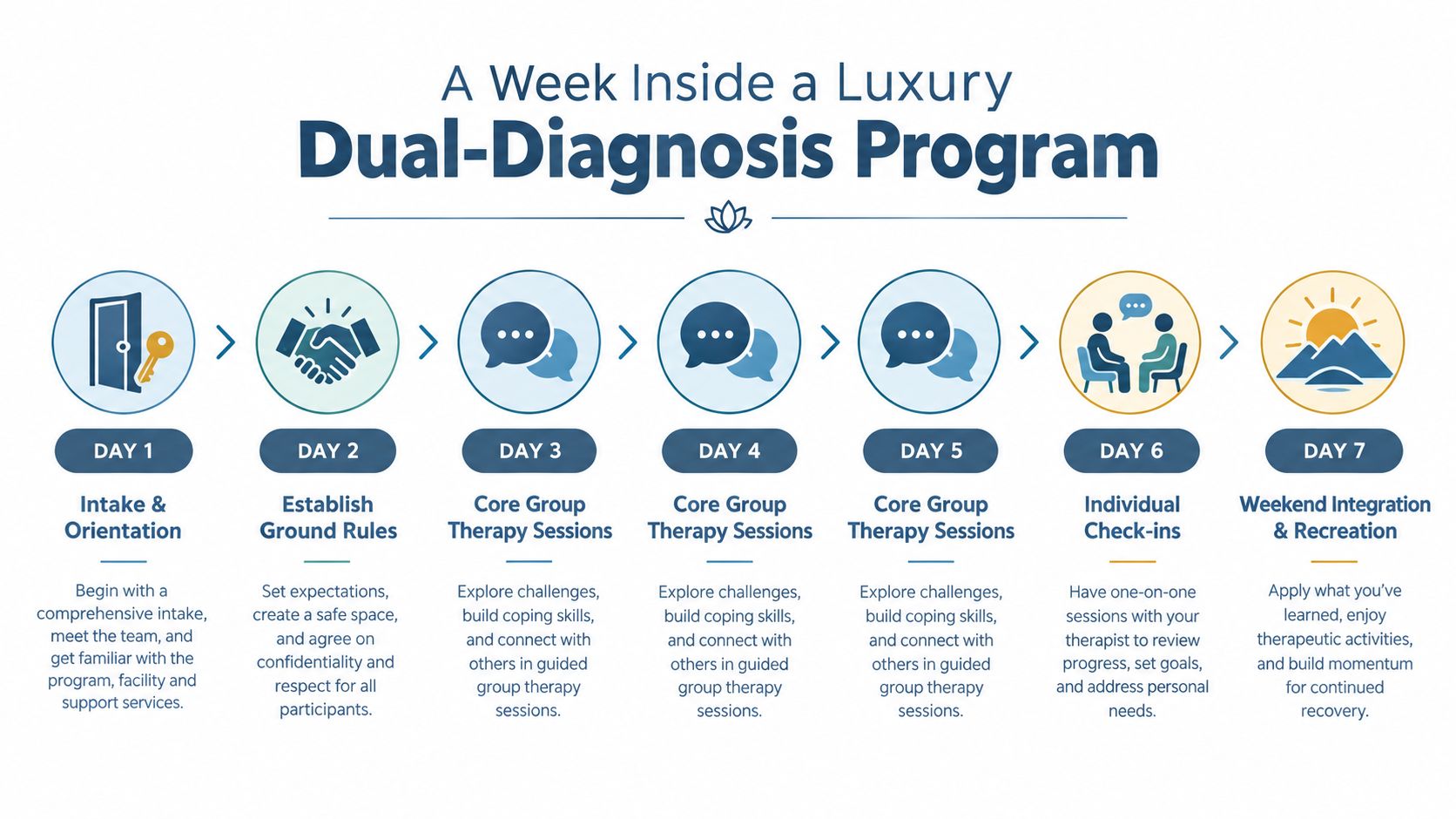
A serious luxury residential program starts with assessment, not amenities. Intake should identify substance-use patterns, withdrawal risk, psychiatric symptoms, trauma history, medication needs, professional obligations, family dynamics, and privacy concerns. Orientation then explains confidentiality, attendance, participation, crisis procedures, and whether the program uses a 12-step, non-12-step, or integrated recovery orientation.
A disciplined clinical week
A realistic week may include morning process work, midday CBT or DBT skills, and afternoon specialty groups addressing trauma, family communication, mindfulness, or relapse prevention. Cohorts commonly follow the 6-to-12-client structure described by SAMHSA, with groups adjusted for acuity, diagnosis, readiness, and interpersonal fit.
The group isn't a place where every disclosure receives automatic approval. If a client reports a relapse, the facilitator assesses immediate safety, clarifies what happened, identifies contributing factors, and coordinates individual or medical follow-up. If conflict develops, the clinician slows the exchange, protects each participant, and uses the interaction as material for treatment rather than allowing the room to become chaotic.
Participation can begin at a measured pace. A client may listen, answer direct questions, and gradually offer more as trust develops. High performance often depends on control, so the clinician's job is to create enough structure that vulnerability becomes a skill rather than a loss of status.
Work and privacy boundaries
A luxury executive program should state its electronics policy before admission. The model described by Reflections allows residents to keep and use phones and laptops in a controlled way, with scheduled access, workspace arrangements, and clinician coordination for essential obligations. That policy doesn't turn treatment into full-time remote work. Groups and clinical appointments remain protected.
Discretion also requires practical systems. Staff should control who receives calls, how records are communicated, how visitors are screened, and how discharge planning is discussed. Privacy isn't achieved by promising secrecy in marketing language. It depends on consistent behavior from every department.
A program addressing co-occurring anxiety, depression, trauma, ADHD, mood symptoms, or borderline traits should bring those issues into the group formulation. The client shouldn't receive addiction treatment in one lane and mental health treatment in another, with no clinician integrating the two.
What group therapy isn't
Group therapy doesn't replace individual sessions, psychiatric evaluation, medication-assisted treatment, medical monitoring, somatic work, or family therapy. Those services form the surrounding architecture. Relapse-prevention group activities can reinforce skills, but activities alone aren't equivalent to clinician-led treatment.
How Group Therapy Fits Into a Full Treatment Plan
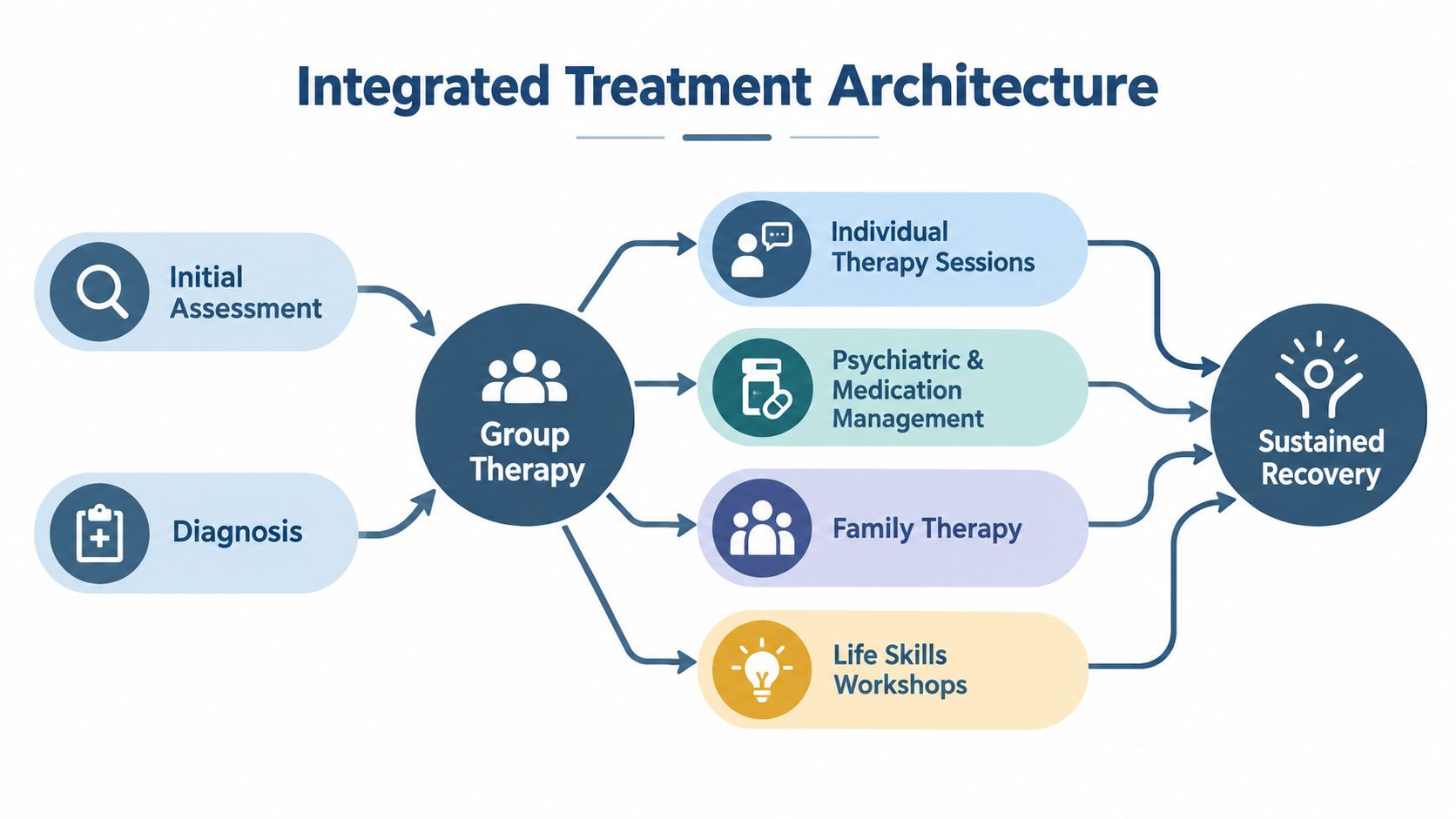
Group therapy works best as the connective tissue of care. Individual therapy can uncover trauma, grief, shame, or family history that requires privacy. Group work then tests how the client responds to challenge, feedback, disagreement, and emotional closeness. Psychiatric and medication care address symptoms and withdrawal risks that behavioral sessions can't manage alone.
The care pathway
A coordinated pathway generally moves through these stages:
- Assessment and diagnosis: Clinicians clarify substance use, medical stability, psychiatric symptoms, risk, motivation, family conditions, and professional constraints.
- Detoxification when indicated: Medical staff manage withdrawal and determine whether the client needs medication, monitoring, or transfer to a more intensive medical setting.
- Residential stabilization: Frequent groups create structure and repetition while individual therapy and psychiatric care address personal drivers of use.
- Step-down care: Intensive outpatient treatment reduces the residential container while maintaining scheduled group contact and clinical accountability.
- Aftercare and alumni support: Ongoing groups help clients respond to new stressors rather than waiting for a crisis.
Group composition should change as the client advances. Early residential groups may prioritize safety, stabilization, education, and immediate coping. Later groups can focus on leadership pressure, intimacy, parenting, travel, reintegration, and the practical realities of returning to work.
Coordination prevents fragmented care
Medication-assisted treatment should be discussed without shame or ideological pressure. The group can address adherence, cravings, concerns about dependence, and communication with family, while the prescribing clinician manages the medical decisions. Family sessions carry the work into the home by addressing boundaries, trust, monitoring, and communication.
Clinical rule: Group therapy should reinforce the individual treatment plan, not operate as a separate service with separate goals.
Continuing care matters because discharge doesn't remove the conditions that contributed to substance use. A professional may return to a demanding role, unresolved marriage conflict, disrupted sleep, or a travel schedule within days of leaving residential treatment. The plan must specify which groups continue, who receives updates, how medication is managed, and what happens after a lapse.
Choosing a High-End Program That Uses Groups Well
Luxury treatment deserves scrutiny because premium surroundings can obscure weak clinical operations. A credible program should explain who leads groups, how clients are assigned, what curriculum guides each session, how psychiatric care is integrated, and how family participation works. A beautiful room doesn't demonstrate therapeutic quality.
Six checks for serious buyers
- Accreditation and level of care: Verify California licensure, Joint Commission accreditation, and any additional accreditation or formal level-of-care designation claimed by the program.
- Clinical leadership: Confirm access to addiction psychiatry, licensed therapists, medical professionals, and clinicians experienced with co-occurring disorders.
- Group design: Ask for the group schedule, facilitator credentials, cohort size, written curriculum, attendance expectations, and process for handling relapse or conflict.
- Privacy systems: Request written protocols for admissions, visitors, electronic communication, records, transportation, discharge, and high-profile clients.
- Family programming: Confirm that relatives can receive structured education and participate in appropriate private sessions rather than being treated as an afterthought.
- Work continuity: Review electronics rules in writing. Video calls and board obligations should be scheduled around treatment, not allowed to replace it.
Programs should also explain what outcome information they can share. Completion rates, continuation after discharge, and follow-up measures for co-occurring conditions are more useful than broad claims about success. They should be able to describe medical escalation procedures and coordinated transfer arrangements for clients whose complexity exceeds the setting.
| Credential | What to Verify | Red Flag |
|---|---|---|
| State license | Current license and applicable level of care | Vague claims without verification |
| Joint Commission accreditation | Current accreditation status and scope | Accreditation mentioned without clinical detail |
| Clinical staffing | Named medical and behavioral health roles | Amenities emphasized more than clinicians |
| Group program | Written schedule, curricula, and facilitator credentials | Ad hoc discussions presented as treatment |
| Privacy operations | Specific communication and discharge procedures | “Discreet” used without a process |
| Family care | Private sessions and educational programming | Family involvement left to informal contact |
| Work policy | Scheduled electronics access and clinical boundaries | Unrestricted work or total device prohibition |
| Medical coordination | Clear escalation and transfer arrangements | No answer for medical complications |
Reflections is described as a California-licensed, Joint Commission-accredited residential provider for adults with co-occurring mental health and substance use disorders. Its executive-care model combines multidisciplinary treatment, private rooms, and controlled access to phones and laptops so residents can manage essential professional obligations without converting treatment into remote work. Those features should be evaluated alongside the program's actual group schedule, staffing, privacy procedures, and continuing-care plan.
Families considering residential treatment should ask for a clinical call before discussing amenities. Describe the substance-use pattern, psychiatric concerns, medical history, work demands, and privacy requirements directly. Then ask the program to show how its groups would address those realities.
Reflections provides private rooms in both its detox and rehabilitation programs, an accredited dual-diagnosis clinical setting, multidisciplinary care, intensive groups, and controlled electronics access for essential work and family responsibilities. Visit Reflections to discuss confidential residential treatment for an executive or working professional who needs clinical depth without unnecessary disruption to a career.