
A chief executive reviews a luxury residential treatment proposal and pauses at one word, group. Private rooms, clinical credentials, device access, and discreet transportation make sense. Sitting with peers and discussing personal failures feels less compatible with board responsibilities, public visibility, and a career built on control.
That hesitation is understandable, but it can also conceal a clinical blind spot. Group therapy benefits executives because it tests the interpersonal habits that individual treatment may not fully expose. A senior professional can explain patterns privately to a therapist, then repeat those patterns in a room with peers who can observe them in real time. In a properly designed program, group work isn't a generic support circle. It's a structured clinical setting with clear boundaries, skilled facilitation, and a direct relationship to the individual treatment plan.
Premium care should adapt group therapy to executive realities. That means thoughtful screening, appropriate cohort composition, strong confidentiality procedures, private accommodation, and enough schedule flexibility to address essential professional obligations. It also means honest limits. Group therapy won't replace psychiatric care, individual psychotherapy, medical stabilization, or family work when those services are clinically necessary.
Executives assessing burnout can also review practical strategies for protecting attention and reducing overload in this resource on how to prevent burnout with focus tools. The right treatment decision starts with the same discipline used in any serious business decision, define the objective, test the operating model, and verify whether the service can deliver under real conditions.
Why Group Therapy Matters for High-Performing Professionals
High-performing professionals often arrive with advanced coping systems. They delegate difficult tasks, manage impressions, control information, and maintain relationships that serve clear personal or professional functions. Those skills can produce success, but they can also prevent honest feedback from reaching the person who needs it.
A founder may know that alcohol is affecting sleep and judgment, yet still frame the issue as a temporary workload problem. A managing partner may understand perfectionism intellectually while continuing to interrupt colleagues, avoid uncertainty, or punish vulnerability. Individual therapy can examine these patterns in depth. Group therapy adds a live interpersonal laboratory where the patterns become visible to other people.
Why peer feedback reaches different blind spots
A therapist can interpret a client's account of a difficult board meeting. Peers can also notice how that client responds when challenged in the group. Does the client explain rather than reflect? Does the client turn every concern into a performance review? Does the client ask for honesty and then withdraw when honesty arrives?
Those moments matter because treatment isn't only about insight. It's about changing behavior under emotional pressure. Group members provide reactions that executives rarely receive from employees, advisers, or carefully selected friends. A skilled clinician then slows the interaction down, identifies the pattern, and helps the client practice a different response.
What luxury adaptation should look like
A premium group program shouldn't place every resident into the same room without assessing fit. Admissions and clinical teams should consider diagnosis, acuity, communication style, privacy risk, readiness for participation, and the likelihood that the group can remain psychologically safe.
The operating standards should include:
- Cohort fit: Members should share enough clinical relevance to support useful discussion without creating unnecessary exposure.
- Confidentiality discipline: Staff should explain privacy expectations clearly and respond quickly to boundary violations.
- Clinical facilitation: Licensed clinicians should manage pacing, challenge avoidance, protect quieter members, and prevent dominant personalities from controlling the room.
- Executive practicality: Treatment should allow appropriate access to phones and laptops when clinically safe, rather than assuming every professional can disconnect without consequence.
Practical rule: An executive shouldn't judge group therapy by whether it feels comfortable on the first day. The better question is whether the group produces observations and behavioral practice that private conversation alone wouldn't generate.
The strongest luxury setting treats group therapy as one component of an integrated plan. Private rooms, an accredited organization, dual-diagnosis capability, and work continuity can reduce unnecessary friction. They don't make the clinical work easier, but they can make sustained participation more realistic for a client whose responsibilities extend beyond the treatment campus.
The Core Mechanisms Behind Group Therapy Benefits
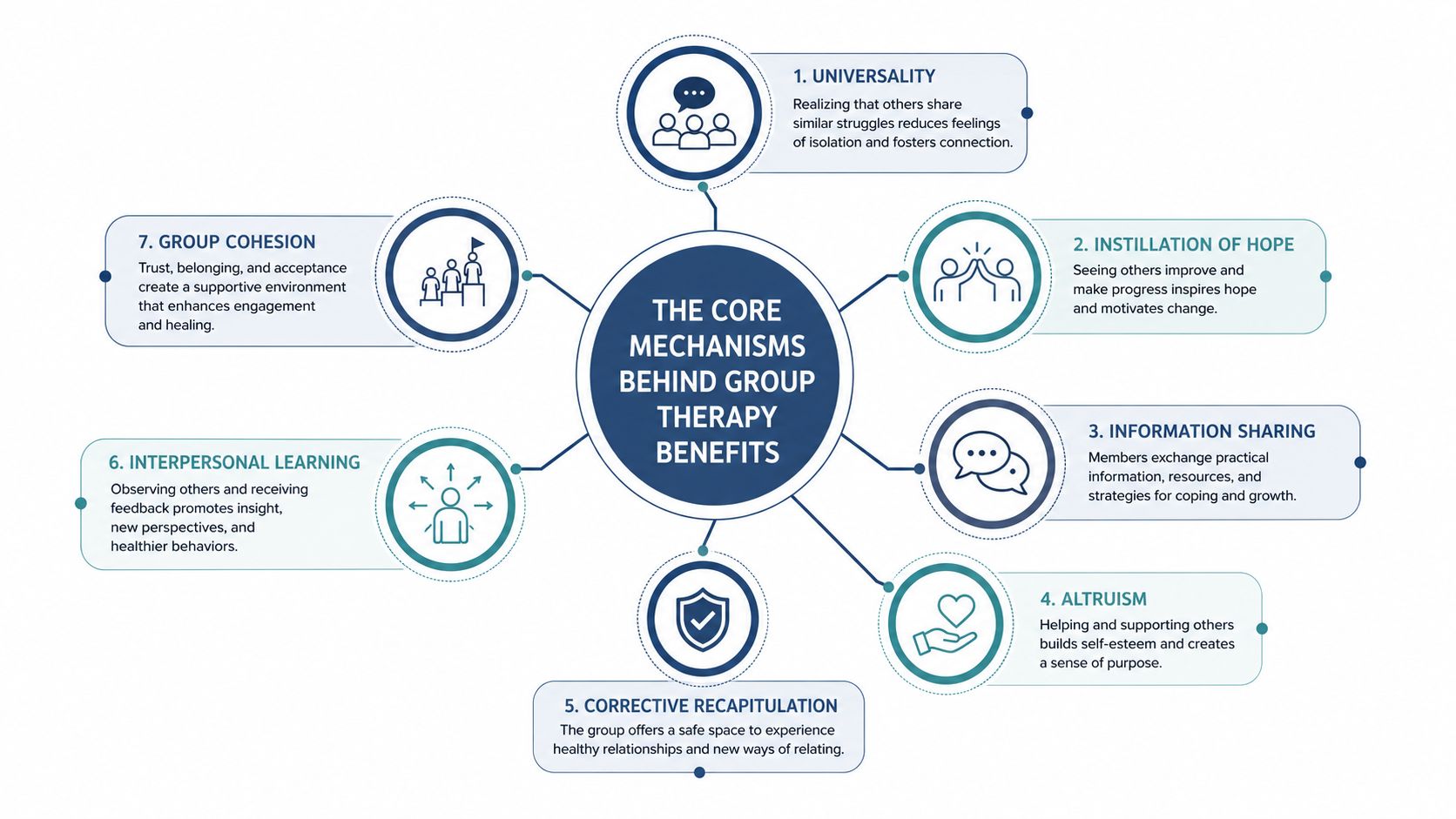
Group therapy works through several mechanisms that individual treatment can't reproduce in the same form. The therapist remains responsible for structure and safety, but the therapeutic material comes from live interaction among members. For executives, that interaction can reveal how authority, shame, avoidance, control, and defensiveness operate outside the office.
Universality reduces executive isolation
Senior professionals often assume that their position makes their problems unusual. They may believe other people can't understand the pressure of ownership, leadership, public scrutiny, or high-stakes decision-making. Hearing peers discuss compulsive overwork, secrecy, family strain, anxiety, or substance use can challenge that assumption.
This doesn't minimize the client's situation. It removes the false conclusion that difficulty represents personal defect or professional failure. A managing partner who hears another accomplished professional describe the same avoidance pattern may become more willing to disclose the pattern rather than defend against it.
Interpersonal learning turns behavior into observable data
A founder might describe a conflict with a board member and insist that the other person was unreasonable. In group, the founder may dismiss a peer's reflection in the same way. The facilitator can connect the two moments without shaming the client. The group then becomes a place to test curiosity, listening, and accountability while the behavior is happening.
That live feedback is especially valuable for clients whose workplace status protects them from correction. Employees may soften observations. Peers in a well-screened clinical group have less incentive to preserve the executive's preferred image.
Accountability and peer support create non-transactional connection
Accountability becomes more credible when other members remember a commitment. A client who agrees to use a coping strategy before a difficult call must later report what happened. The point isn't surveillance. It's the experience of being known by people who aren't direct reports, investors, clients, or family members.
Peer support also differs from networking. Members aren't exchanging referrals or negotiating status. They can offer recognition without a business transaction, which gives the executive an opportunity to receive care without immediately reciprocating through influence or resources.
Luxury programs can preserve these mechanisms by keeping groups clinically coherent and ensuring that facilitation remains active. Small, well-matched groups make it easier for clinicians to track participation, notice subtle shifts, and connect group observations to individual goals.
Evidence-Based Outcomes for Substance Use and Mental Health
The evidence supports group therapy, but it doesn't support every claim commonly made about it. A 2019 systematic review and meta-analysis of 33 studies found small but significant benefits for abstinence when group treatment for substance use disorder was compared with no treatment, individual therapy, and other treatments (the PubMed review). The same review found a moderate improvement in mental state when group therapy was compared with no treatment.
The boundaries are important. That review didn't find a significant overall change in substance use frequency or substance use disorder symptoms. For executives with dual diagnoses, the practical interpretation is clear, group therapy can support abstinence and psychological functioning, but it shouldn't be sold as a complete intervention or a guaranteed solution.
Depression has a substantial group-treatment history
Group psychotherapy also has a long research history in depression treatment. An NCBI summary reports that 45 of 48 studies concluded group therapy was effective, while 43 of 46 studies with adequate data found significant reductions in depression (the NCBI clinical review). In the strongest pooled comparison, group therapy versus no treatment produced a post-treatment effect size of 1.026 and a follow-up effect size of 1.178, indicating substantial symptom reduction that persisted at follow-up.
Those findings don't mean every group works equally well. Modality, facilitator skill, diagnosis, attendance, group composition, and the presence of individual care all influence results.
Dual-diagnosis care requires matching modality to need
A 2025 review concluded that group therapy is a primary treatment modality for adults with substance use disorders, with evidence supporting abstinence and reduced mental health distress after treatment (the review of group psychotherapy for substance use disorders). Research-supported approaches discussed in that evidence base include group CBT, contingency management, relapse prevention, Seeking Safety, DBT groups, and mixed-format interventions. Results vary by drug type and therapeutic approach, so a program should explain why a particular group belongs in the treatment plan.
| Condition | Group Modality | Evidence Strength |
|---|---|---|
| Substance use disorder | Structured group therapy, CBT, relapse prevention, and mixed formats | Supported, with outcomes varying by approach and substance |
| Depression | Group psychotherapy and structured cognitive approaches | Strong historical and pooled evidence |
| Co-occurring substance use and mental health disorders | Integrated CBT, DBT, trauma-informed, and recovery groups | Supported, but treatment matching remains essential |
| Trauma-related symptoms | Skills-based and safety-focused groups alongside individual care | Useful as an adjunct, more limited for primary trauma processing alone |
| Severe acute psychiatric instability | Group work only after stabilization and readiness assessment | Requires individualized clinical judgment |
Luxury treatment should layer group therapy with individual psychotherapy, psychiatric management, medication decisions when appropriate, and family involvement. Group work has the greatest practical value when it reinforces a broader plan rather than carrying the entire burden of treatment.
Types of Therapeutic Groups Used in Luxury Programs
A serious executive program shouldn't rely on a single group format. Different groups solve different clinical problems, and sequencing affects whether a client can use the material outside the treatment setting.
CBT groups target automatic thoughts, cravings, catastrophic predictions, and avoidance. An executive might identify the thought, “If this issue becomes public, the company will collapse,” then examine the evidence and choose a more measured response. CBT is often most useful when clients need a clear framework and repeatable tools.
DBT skills groups focus on distress tolerance, emotion regulation, mindfulness, and interpersonal effectiveness. Structured homework matters. A client learns a skill, applies it during a difficult interaction, and returns with specific information about what worked and what failed.
Process-oriented groups use the immediate interaction among members as clinical material. A psychodynamic or Yalom-style group may examine how a partner seeks control, reacts to disagreement, or withholds emotion. This format can be demanding, but it often reaches relational patterns that psychoeducation alone leaves untouched.
Psychoeducational groups provide a common clinical language around neurobiology, medication, sleep, nutrition, trauma, and recovery. They reduce confusion and help families participate more constructively when family sessions are added.
Relapse-prevention and recovery-maintenance groups rehearse high-risk situations before discharge. Members can plan responses to travel, client entertainment, board conflict, fatigue, access to substances, and the return of professional pressure.
| Group Type | Primary Mechanism | Typical Length | Best Integrated With |
|---|---|---|---|
| CBT | Thought and behavior change | Structured sessions | Individual CBT and psychiatric care |
| DBT skills | Emotion regulation and distress tolerance | Skills-based series | Individual therapy and crisis planning |
| Process | Interpersonal learning | Ongoing residential work | Individual psychotherapy |
| Psychoeducational | Knowledge and treatment engagement | Focused teaching sessions | Family education and medication management |
| Relapse prevention | Risk rehearsal and recovery planning | Discharge-focused sessions | Continuing care and family support |
The sequence should usually move from stabilization and skills acquisition toward interpersonal processing, then relapse rehearsal as discharge approaches. Executives evaluating program design can review how group addiction therapy is structured, but the admissions team should still explain how each format connects to a specific diagnosis and treatment objective.
A Realistic Week of Group Therapy in Executive Rehab
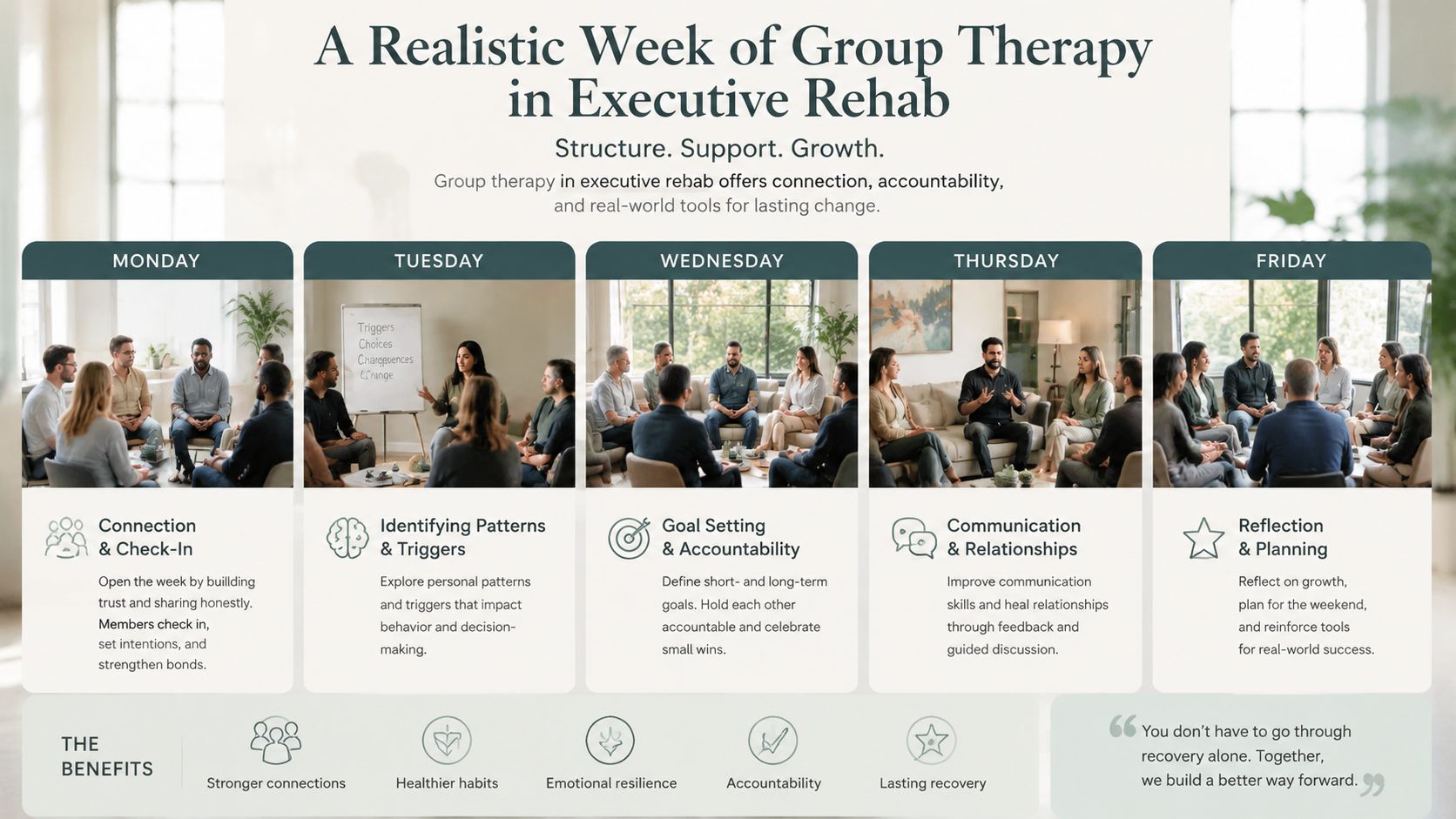
Premium residential care should feel structured without becoming chaotic. A realistic schedule may place a skills group in the morning, specialty education around midday, process work in the afternoon, and peer-support meetings in the evening. Each group commonly lasts 60 to 90 minutes, while the overall therapeutic schedule may reach 18 to 25 therapeutic hours per week when group, individual, family, and adjunctive work are combined.
How the day can be organized
A representative day might begin with a CBT or DBT skills group from 9:00 to 10:30. A client may then have individual therapy, medication management, fitness, or somatic work before a midday psychoeducational group focused on sleep, trauma, chronic pain, grief, or nicotine recovery.
Afternoon process work might run from 2:00 to 3:30, followed by a protected period for approved professional obligations. A client may use a secure area for a limited video call, review essential documents, or address a board matter. Evening programming can include peer-support or recovery meetings compatible with the client's clinical plan.
The schedule should remain clinically purposeful rather than filling every hour. A high-functioning client may appear capable of sustained intensity while still needing rest, medical monitoring, meals, sleep protection, and time to absorb difficult material.
Work continuity requires boundaries
Access to cell phones and laptops can help an executive address essential obligations, but unrestricted access can also preserve avoidance. The clinical team should define when devices are available, where calls occur, what information must remain private, and how work activity relates to treatment goals.
A verified executive-oriented residential listing describes computer, phone, and internet access, including cell phone availability, and identifies time to work as needed for business executives. Independent treatment-directory information also describes executive programs designed around privacy, work continuity, flexible technology policies, and upscale residential comfort.
The caseload should be defined before admission, not left vague. Executives should ask how many residents each clinician manages, how many groups occur each day, who can modify the schedule, and how protected work blocks are documented. A schedule that looks luxurious but offers no clinical control over device use isn't executive care. It is residential treatment with better furnishings.
Who Thrives in Group Therapy and Who May Need Alternatives
Group therapy tends to fit clients who can remain socially engaged while receiving feedback. The strongest candidates usually show enough stability to listen, reflect, tolerate discomfort, and respect boundaries. They don't need to be naturally outgoing. A quiet executive can benefit substantially if the client can participate at a sustainable pace rather than treating every session as a performance.
Clients with alcohol use disorder, depression, anxiety, and co-occurring mood or trauma-related conditions may find skills-based, relational, and recovery groups useful when the program matches the format to the clinical presentation. The deciding factor isn't status or income. It's readiness, safety, and the ability to use peer interaction as treatment rather than as another arena for control.
When group work needs modification
Group therapy may not be appropriate during an active severe psychiatric crisis or acute suicidality. A client with significant cognitive impairment may need a more individualized structure. Certain personality structures can also require careful assessment if group participation is likely to increase destabilization, coercion, or interpersonal risk.
Public exposure creates another legitimate concern. A recognizable executive, public figure, or professional involved in sensitive litigation may require a restricted cohort, enhanced confidentiality procedures, or an individual-heavy track. Group confidentiality depends on member behavior outside the room, so no responsible program should promise absolute control over what another participant remembers or repeats.
Privacy isn't a reason to reject group therapy automatically. It is a reason to demand better screening, clearer rules, and a clinically justified cohort.
Executives can also review how peer support groups fit into a broader treatment model, while asking whether peer contact is therapeutic, voluntary, monitored, and connected to documented goals.
A practical fit test
A group-forward program may be a reasonable choice when the client:
- Can tolerate honest feedback: Defensiveness can be worked with, but total refusal blocks the central mechanism.
- Needs dual-diagnosis care: Co-occurring substance use and mental health symptoms often require several coordinated treatment relationships.
- Wants behavioral practice: A client seeking only private insight may miss the value of practicing communication and regulation with others.
- Has manageable privacy risk: The program must be able to explain how it protects confidentiality without making guarantees it can't control.
If acute stabilization, severe impairment, or exceptional confidentiality needs dominate, individual-heavy care may be safer. Premium treatment should adjust the ratio of group to individual work instead of treating one schedule as suitable for every resident.
Choosing a High-Quality Luxury Program With Strong Groups
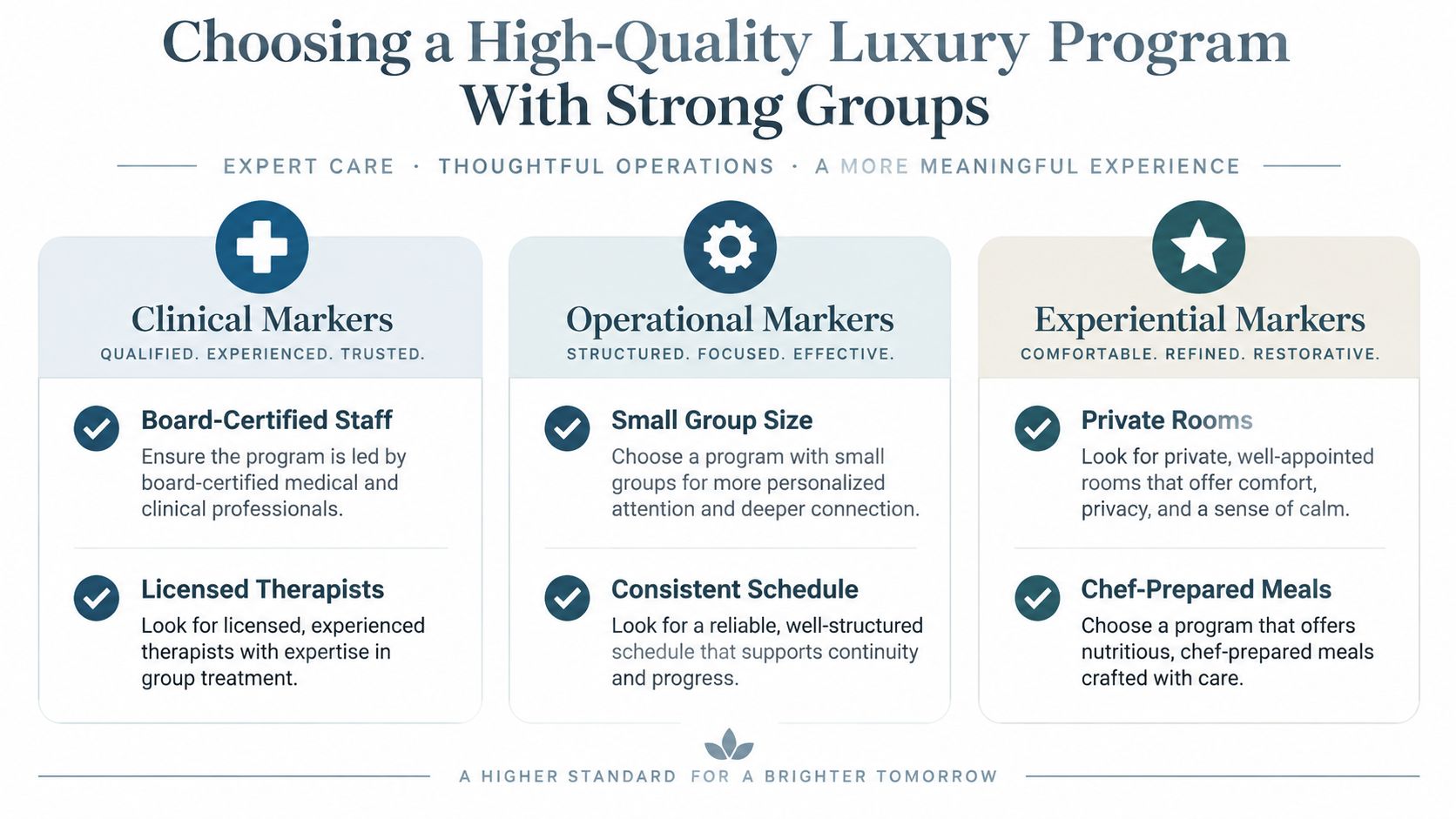
Luxury branding doesn't establish clinical quality. Executives should evaluate the treatment system, not the décor. Joint Commission accreditation is a recognized quality-and-safety credential, and its provider locator helps identify accredited substance use disorder treatment organizations (the Joint Commission provider locator).
Clinical markers
The admissions team should answer these questions directly:
- Psychiatric depth: Are board-certified addiction psychiatrists available to assess substance use, mood, trauma, sleep, and medication needs?
- Licensed facilitation: Does a licensed clinician lead or co-facilitate every therapeutic group?
- Treatment fidelity: Does the program use defined CBT, DBT, and relapse-prevention curricula rather than loosely labeled discussion sessions?
- Individual integration: Do group observations enter the client's individualized treatment plan and inform individual therapy?
- Dual-diagnosis competence: Can the team treat substance use and psychiatric symptoms together rather than referring one problem elsewhere?
A program should also explain how it measures progress. The answer doesn't need to be a promotional scorecard, but clinicians should be able to describe which symptoms, behaviors, risks, and functional goals they track.
Operational and experiential markers
Executives need privacy and flexibility without losing structure. Strong operational standards include secure areas for approved device use, clear rules for phones and laptops, transportation procedures that reduce exposure, private arrivals when available, and confidentiality practices aligned with applicable privacy requirements.
The group model itself should be specific. Staff should disclose cohort size, facilitator credentials, group frequency, the balance between process and skills work, and how the schedule changes as the client moves toward discharge. Family programming matters because recovery rarely occurs in isolation from a spouse, children, business partner, or trusted adviser.
Private rooms in both detox and rehabilitation can support sleep, boundaries, and recovery from intensive clinical work. Comfort matters, but it should serve treatment rather than replace it. Chef-prepared meals, wellness services, and attractive surroundings are useful only when the underlying program can deliver consistent clinical attention.
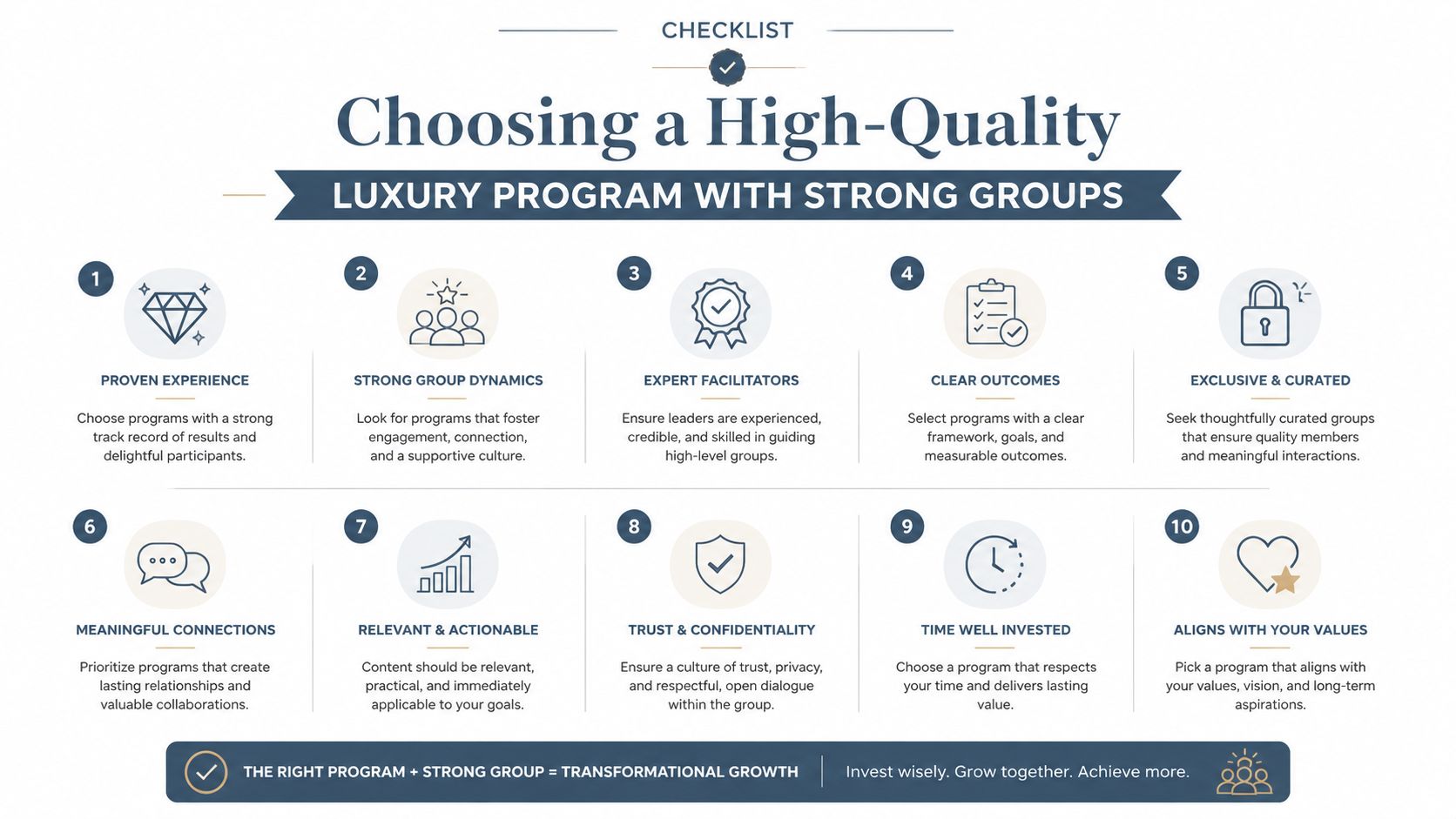
Red flags include vague answers about group composition, large groups with limited clinical oversight, device policies that change without explanation, no clear dual-diagnosis pathway, and an admissions process focused more on amenities than assessment. Executives seeking a specialized model can review executive rehab services as part of a broader comparison, then verify every operational promise with the clinical and admissions teams.
Deciding if Group-Focused Luxury Care Is Right for You
The decision should rest on four questions, not on whether group therapy sounds appealing.
First, can the executive participate authentically with a small peer cohort? The client doesn't need to disclose everything immediately, but must be willing to listen, respond, and examine interpersonal behavior. If every interaction becomes a negotiation of status, group work will produce resistance rather than progress.
Second, does the clinical picture require dual-diagnosis treatment? Substance use alongside anxiety, depression, trauma, mood instability, or personality-related patterns usually calls for coordinated care. Group therapy can provide repeated skills practice and peer accountability, but it must sit inside psychiatric, individual, medical, and family planning.
Third, can the work calendar tolerate structured treatment? A group-rich program may involve one to three group blocks per day, controlled access to electronics, individual sessions, and recovery activities. A client who must remain continuously available to the business may need a modified schedule, a trusted delegate, or a short transition period before residential admission.
Fourth, does the privacy model meet the client's actual threshold? The admissions team should explain screening, confidentiality expectations, transportation, device access, private rooms, and procedures for public-facing clients. A vague assurance of discretion isn't enough.
Group-focused luxury care is often a sound fit for executives who need help with co-occurring symptoms and can use peer interaction productively. Individual-heavy care may be preferable during acute stabilization, severe psychiatric impairment, active suicidality, or legal and public-exposure circumstances that require enhanced confidentiality.
Three practical next steps can clarify the decision:
- Request a sample weekly schedule with group times, individual sessions, work blocks, device rules, and family programming.
- Ask direct questions about composition including screening, facilitator credentials, group size, diagnosis mix, and confidentiality procedures.
- Discuss a staged commitment such as an assessment or short initial stay before deciding whether the full treatment structure is appropriate.
Reflections provides private, upscale residential dual-diagnosis treatment with clinically facilitated groups, individual psychotherapy, psychiatric support, private rooms in detox and rehabilitation, and appropriate access to electronics for essential work obligations. Executives and families can visit Reflections to discuss confidentially whether its group therapy model fits the client's clinical needs, privacy requirements, and professional responsibilities.