

The call usually comes after a board meeting, a missed family event, or a frightening night that nobody wants to describe twice. The executive is still answering emails, closing deals, and appearing composed. At home, an alcoholic family member may be hiding bottles, missing commitments, or becoming unpredictable. The family sees competence in public and deterioration in private.
That split creates a difficult question. How can a spouse or relative protect the family, respect the professional's privacy, and secure serious treatment without turning recovery into another crisis? For executives and high-earning professionals, the answer requires more than comfortable surroundings. It requires discreet residential care, dual-diagnosis expertise, clear boundaries, and a plan that respects both clinical needs and legitimate professional responsibilities.
Understanding the Alcoholic Family Member in High-Functioning Roles
A senior executive may still perform at work while alcohol takes over the rest of life. The person may blame travel, pressure, insomnia, or a demanding board. Those factors can intensify drinking, but they don't explain the entire problem. Alcohol use disorder often develops alongside anxiety, trauma, depression, burnout, or another psychiatric condition that needs direct treatment.
A spouse might first notice the pattern through small disruptions. A late-night call becomes several drinks. A business trip becomes a recovery period at home. A senior leader insists that work is manageable, yet becomes emotionally absent, defensive, or unsafe after drinking. The family doesn't need to prove a diagnosis before asking for a professional assessment.

Competence can conceal clinical risk
High performance can delay treatment. The professional may continue leading teams while sleep deteriorates, relationships fracture, and alcohol becomes the main method of regulating distress. A facility that treats drinking without evaluating trauma, mood, anxiety, medication use, and personality patterns may address the visible behavior while leaving the driver intact.
This is why dual-diagnosis treatment matters. The clinical team should assess drinking severity, withdrawal risk, psychiatric symptoms, safety, motivation, and the family environment before recommending a level of care. Detoxification may be necessary, but detox alone doesn't resolve the psychological conditions that make alcohol feel necessary.
Clinical priority: The person needs treatment designed around the whole life, not only the drinking.
The family burden is substantial, especially when the alcoholic family member is also a parent. Analysis of combined 2009 to 2014 U.S. National Surveys on Drug Use and Health data found that approximately 7.5 million children age 17 or younger, or 10.5% of U.S. children in that age range, lived with at least one parent who had alcohol use disorder during the previous year (developmental research on parental alcohol use disorder). That finding makes family education and safety planning clinical priorities, not hospitality extras.
Why Standard Rehab Falls Short for Executives
Standard treatment can work well for some people, but a generic model often fails the executive who needs privacy, clinical sophistication, and carefully managed continuity. A program that demands a complete professional disappearance may create a false choice between treatment and leadership. That pressure encourages postponement, concealment, or premature discharge.
The issue isn't that executives deserve less accountability. They need more precise accountability. The treatment plan must address alcohol use, psychiatric symptoms, medical risk, family disruption, and the practical realities of running a company or managing a high-stakes career.
Comfort isn't the same as clinical fit
A high-end setting should never be judged by décor alone. The relevant questions are clinical and operational:
- Dual-diagnosis capacity: Can the team evaluate trauma, anxiety, depression, bipolar symptoms, sleep problems, and medication needs alongside alcohol use disorder?
- Privacy procedures: Are admissions, records, visitors, communications, and family sessions handled with appropriate discretion?
- Work continuity: Does the program define how residents may use cell phones and laptops without allowing work to displace treatment?
- Residential structure: Is there continuous access to trained behavioral-health personnel rather than luxury lodging with occasional counseling?
- Continuing care: Does discharge planning connect residential treatment to outpatient therapy, medication follow-up, family work, and professional reintegration?
Residential care has a specific meaning. A Joint Commission residential program provides 24-hour care and services for people who need less structure than inpatient care and can preserve themselves during an emergency, with trained personnel addressing behavioral-health disorders (the ASPE review of residential behavioral-health care). That distinction separates genuine treatment from a retreat that merely looks private.
The family needs treatment too
The spouse or relative shouldn't become the unpaid case manager. The family member needs a parallel assessment covering depression, anxiety, trauma exposure, sleep, physical safety, caregiving burden, coping style, and patterns of enabling or detachment. Skills work should address stress regulation, problem-solving, assertive communication, and limits around money, transportation, housing, and crisis response.
The family's progress should also be measured. Validated instruments can track distress, depression, family functioning, and coping at baseline and follow-up, rather than treating the patient's sobriety as the only meaningful outcome (systematic review of interventions for affected family members).
The Role of Family in Luxury Treatment Journeys
Family involvement should be structured, consent-based, and clinically guided. It isn't a demand that relatives monitor every drink or report every mood change. It gives loved ones a safe way to understand the condition, communicate clearly, and stop protecting behavior that needs professional consequences.
The process starts before admission. A reputable program assesses drinking severity, withdrawal risk, psychiatric comorbidity, readiness to change, family safety, and the family member's own distress. Treatment may combine motivational interviewing or CBT with a manualized partner or family component. Private sessions can teach communication, boundaries, contingency management, recognition of relapse warnings, and coordinated follow-up (NIAAA review of family involvement in adult recovery).
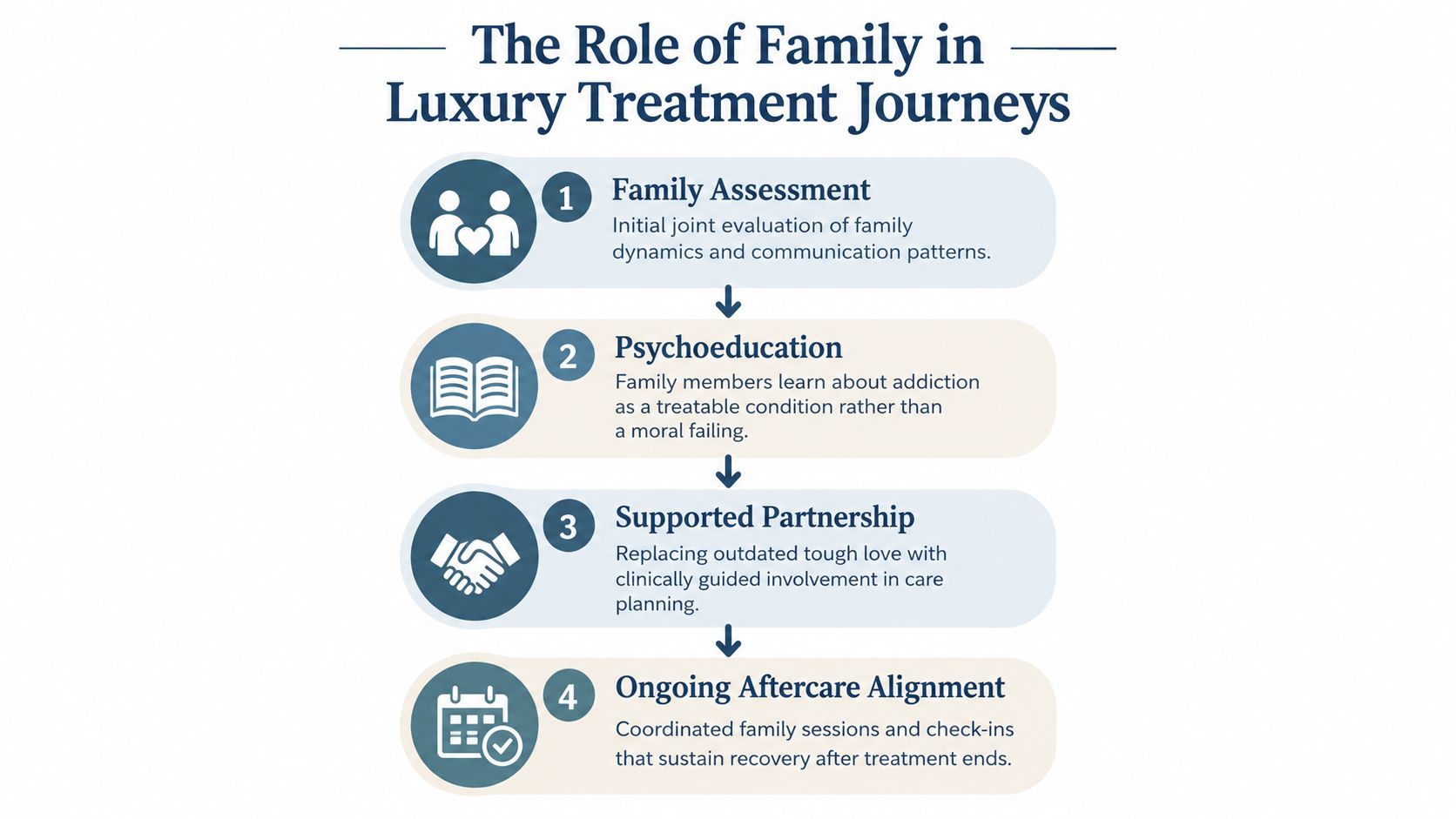
A practical family framework
- Assessment: The family identifies communication patterns, safety concerns, financial exposure, and the professional's clinical needs.
- Education: Relatives learn that alcohol use disorder is treatable and that guilt, threats, and secrecy rarely create stable recovery.
- Supported partnership: Family members join consented sessions, agree on specific limits, and avoid taking over medication, therapy, or crisis work.
- Aftercare alignment: The family coordinates follow-up sessions, communication expectations, travel plans, and responses to warning signs.
A luxury provider should also make family participation workable for demanding schedules. Reflections, for example, offers private family sessions in person or by Zoom and a monthly full-day family program covering substance-use-disorder treatment, cross-addiction, relationships in recovery, and expectations after treatment. Families considering privacy-conscious wellness planning around treatment or continuing care may also find bespoke wellness itineraries useful when travel needs to be handled discreetly and thoughtfully.
Families should ask for written answers about electronics, work access, rooms, clinical staffing, and communication. Reflections describes private rooms for residents in both detox and rehabilitation programs, along with appropriate access to cell phones and laptops. Those features must support treatment rather than become a way to keep the professional fully immersed in business.
Further questions about structured participation can be explored through family engagement examples. The right standard is not unlimited access. It is purposeful contact that strengthens treatment while protecting everyone's role.
Evaluating Treatment Options and Accreditation
The level of care should match risk, not status. Detox addresses withdrawal and medical stabilization. Residential treatment provides continuous structure for therapy, medication management, psychiatric evaluation, and family work. Outpatient care can support continuing recovery when the person is medically and psychiatrically stable and the home environment is safe.
Executives often need residential treatment because their public competence can hide serious deterioration. The setting offers separation from alcohol, consistent clinical observation, and enough time to examine the conditions that drinking has been masking. A private room can support rest and discretion, but the defining feature remains 24-hour behavioral-health care, not hotel-style accommodation.
What accreditation verifies
Joint Commission accreditation is meaningful because it involves external review. The Joint Commission surveys addiction-treatment services, including residential and detox programs, through an onsite process that examines care and treatment, medication management, human resources, information management, patient rights, safety, and performance improvement (Joint Commission accreditation information).
That framework matters to a C-suite client. Privacy depends on information management. Safe detox depends on medication and emergency systems. Continuity depends on records, staffing, discharge planning, and performance improvement. A luxury program should be able to explain how these systems operate, not merely display an accreditation mark.
A disciplined comparison
| Treatment option | Best suited to | Family's appropriate role |
|---|---|---|
| Detoxification | Withdrawal risk or need for medically managed stabilization | Share accurate history and follow safety instructions |
| Residential treatment | Need for continuous structure, dual-diagnosis work, and separation from alcohol | Join consented therapy and learn recovery-support skills |
| Outpatient care | Clinical stability with a safe, workable home environment | Support appointments and maintain agreed boundaries |
Reflections is one example of a California-licensed, Joint Commission-accredited residential provider offering dual-diagnosis treatment, medically managed sub-acute detox when appropriate, private rooms, and structured family involvement. Accreditation doesn't guarantee an outcome. It gives families a concrete basis for evaluating whether clinical and operational systems deserve trust. Additional explanation is available in what Joint Commission accreditation means.
Setting Boundaries and Practicing Self-Care
An alcoholic family member needs support, but support isn't the same as rescue. Paying an overdue personal expense, calling an employer to explain a missed commitment, or hiding alcohol-related behavior may reduce immediate discomfort while allowing the pattern to continue. A boundary states what the family member will do, not how the drinker must behave.
A useful boundary is specific. “If alcohol is brought into the home, the spouse will leave with the children and contact the agreed support person.” “The family will not provide money for unexplained expenses.” “If threats or violence occur, safety services will be contacted.” The statement should be delivered when the professional is sober, without a long argument.
Enabling and supporting are different
Enabling removes consequences. It conceals, finances, excuses, and negotiates around behavior that requires treatment.
Supporting reinforces recovery. It helps arrange an assessment, attends consented family sessions, encourages medication and appointment adherence, and responds consistently to relapse warnings.
Family members should build their own care plan. Individual therapy, peer support, sleep protection, legal or financial advice, and a private safety plan may all be appropriate. The relative doesn't need permission from the drinker to seek care.
A boundary is not a punishment. It is a clear decision about what the family will and won't participate in.
When boundaries have become confused through years of crisis, a structured coaching conversation can help clarify expectations. Resources on using Coachful for boundary resets may offer a practical framework for reviewing agreements after repeated slippage. That support should complement, not replace, clinical care and safety planning.
If coercive control, intimidation, aggression, or active violence is present, conjoint therapy may be unsafe. The family should prioritize immediate protection and professional guidance rather than attempting a private confrontation.
Facilitating Intervention and Admissions
A dramatic confrontation is rarely the best first move for a high-profile professional. A discreet, clinically planned conversation is more effective. The objective is not to shame the alcoholic family member into surrender. It is to make treatment concrete, available, and difficult to postpone.
Community Reinforcement and Family Training, or CRAFT, offers a middle path when the person refuses care. Relatives stop shielding drinking from its consequences, reinforce healthier behavior, communicate specific requests, and keep safety central. CRAFT is especially relevant when a family wants to encourage voluntary treatment without staging a public or adversarial event (review of CRAFT and family engagement).
A private admission plan
- Coordinate first: Speak with the clinical admissions team before approaching the professional.
- Choose the setting: Use a private, sober moment with only essential participants.
- State observable facts: Describe missed commitments, health concerns, family impact, and specific treatment options.
- Offer immediate logistics: Clarify transportation, payment, room arrangements, electronics policies, medical evaluation, and expected timing.
- Avoid bargaining: Don't promise that treatment will be effortless or that career obligations can continue without limits.
- Protect safety: If there is violence, suicidal intent, severe withdrawal risk, or immediate medical danger, contact emergency professionals.
Families should prepare relevant medication, medical, psychiatric, and drinking history. They should also identify who can communicate with the clinical team, what information remains private, and how work responsibilities will be handed over. A detailed guide to staging an intervention can help relatives plan the conversation without turning it into a spectacle.
Sustaining Recovery and Professional Life
Recovery doesn't require an executive to abandon ambition. It requires a structure that prevents work from becoming an excuse to resume drinking or ignore psychiatric care. The return should be gradual, clinically supervised, and connected to continuing therapy, medication review, family sessions, and relapse planning.
The family's role should also change after residential treatment. Relatives can maintain predictable communication, support appointments, notice agreed warning signs, and protect household boundaries. They shouldn't become the patient's monitor, therapist, or emergency system.

A systematic review of family-based substance-use interventions identified 15 eligible trials, with 11 reporting significant positive effects, including reduced substance use and improved family functioning, while also noting that stronger randomized evidence is still needed (systematic review of family-based interventions). The practical lesson is balanced involvement. Family participation can support recovery, but the professional remains responsible for engaging in treatment, and clinicians remain responsible for clinical decisions.
Reflections offers private residential dual-diagnosis care, clinically managed sub-acute detox when appropriate, private rooms, appropriate access to electronics, family therapy, educational programming, and continuing-care planning. A family facing an alcoholic family member in an executive role should request a confidential clinical assessment and choose a program that protects privacy without compromising treatment.
Reflections provides discreet luxury residential treatment for executives and working professionals facing alcohol use disorder with co-occurring mental-health concerns, including private family sessions, individualized clinical care, and structured continuing support. Families can visit Reflections to explore treatment options and begin a confidential conversation about admission.