

A chief executive can lead a company through a crisis, deliver under relentless pressure, and still reach a point where alcohol, prescription medication, anxiety, depression, trauma, or mood instability begins affecting judgment, relationships, sleep, and health. The difficulty is often not recognizing that help is needed. It's finding care that protects privacy, respects professional responsibilities, and assesses the full clinical picture without reducing a complex life to a checklist.
A dual diagnosis assessment for an executive should feel discreet, structured, and clinically serious. It must identify both substance-related concerns and mental health symptoms, while also clarifying whether symptoms are independent, substance-induced, or connected to withdrawal. The process should lead to a treatment plan that accounts for safety, functional capacity, medication needs, family relationships, and the practical demands of leadership.
Redefining Intake for High-Functioning Professionals
A senior professional may seek treatment after months of concealment. Colleagues still see decisive leadership, while a spouse may notice irritability, insomnia, or emotional distance. The executive may describe the problem as exhaustion, pressure, or a need to “reset,” while privately wondering whether substance use has become the only dependable way to sleep, focus, or slow down.
The first clinical task is to create enough trust for accurate disclosure. A rushed, adversarial intake, built around rapid questions, repeated forms, and immediate labels, can produce an incomplete account. A luxury clinical setting should preserve dignity while examining how symptoms, substance use, physical health, relationships, and professional obligations interact.
Privacy supports clinical honesty
Privacy affects the quality of the history clinicians receive. A client who trusts the handling of sensitive information may speak more openly about relapse patterns, suicidal thoughts, trauma, medication misuse, family psychiatric history, and consequences at work.
Private accommodations provide space for rest and confidential clinical work. Executive-oriented programs may also offer structured access to phones and laptops, allowing residents to manage limited career responsibilities without letting work displace treatment. Guidance on high-end rehab describes program features that may include private rooms, electronics access, and modified schedules for clients with significant professional obligations.
These arrangements involve a clinical trade-off. Work access can protect continuity and reduce anxiety, yet unrestricted availability can maintain the same pressure that contributed to the crisis. The intake team should therefore define communication windows, decision-making limits, and who may receive updates before treatment begins.
Clinical principle: Discretion should make honest assessment easier, not make difficult questions disappear.
History matters more than a single score
A dual diagnosis assessment depends on a structured clinical history rather than one screening result. Clinicians examine when psychiatric symptoms began, how they relate to substance use, whether they continue during abstinence, and how they affected functioning before, during, and after periods of use. This reasoning helps distinguish an independent psychiatric illness from symptoms caused or intensified by intoxication, withdrawal, or medication effects, consistent with clinical guidance on co-occurring disorders.
For an executive, the history may include frequent travel, irregular sleep, confidential business stress, public scrutiny, family expectations, litigation, or repeated high-stakes decisions. These factors do not establish a diagnosis. They clarify context that a brief intake may miss, including what has changed, what the client has been carrying, and which responsibilities require protection during care.
The assessment should also identify how the client has maintained performance. Strong results can conceal escalating use, impaired judgment, or deteriorating relationships. Functional success is relevant clinical information, not evidence that symptoms are minor.
A private-pay setting can reduce practical friction during admission. An executive may enter high-end rehab through a quieter intake process while the clinical team completes a rigorous evaluation. Premium surroundings should support coordination, privacy, and respect without reducing clinical scrutiny.
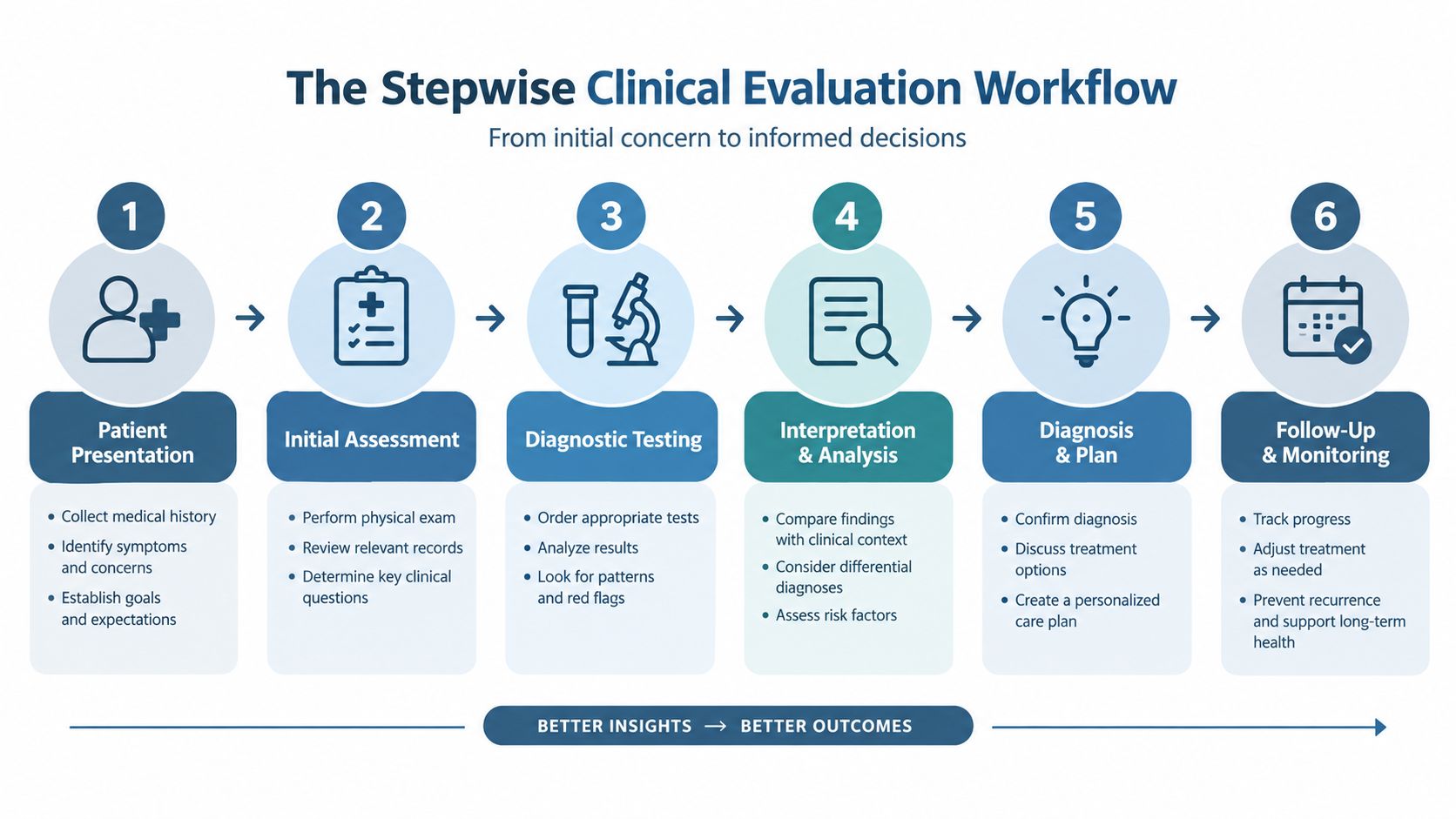
The Stepwise Clinical Evaluation Workflow
A discreet, structured intake gives high-functioning professionals room to speak candidly without turning assessment into an interrogation. The sequence matters. Clinicians establish rapport before sensitive disclosure, obtain collateral information before forming conclusions, and apply diagnostic reasoning before recommending a level of care. SAMHSA guidance outlines a workflow covering engagement, collateral information, screening, level-of-care determination, diagnosis, functional review, strengths and supports, cultural needs, problem domains, stage of change, and treatment planning. The SAMHSA co-occurring-disorders guidance provides the clinical foundation for this sequence.
1. Begin with engagement
The opening conversation determines whether the client feels safe enough to be direct. Clinicians explain confidentiality, clarify the reason for seeking care, identify urgent risks, and ask what the client needs from treatment. For an executive, that may include privacy safeguards, communication limits, controlled work access, family participation, and a schedule that protects important professional obligations.
Engagement is part of the clinical work. A respectful, well-organized introduction lowers defensiveness and shows the team which priorities must be addressed first.
2. Build the timeline
The team places substance use, psychiatric symptoms, medical events, previous treatment, medication changes, trauma, sleep disruption, and functional decline in sequence. With appropriate permission, family members, trusted colleagues, outpatient clinicians, or other providers may add collateral information.
This material can correct memory gaps and identify patterns the client has come to regard as normal. The process should remain discreet, with consent confirmed and the purpose of each contact explained in advance.
3. Use validated screening tools
Brief instruments identify concerns that require closer examination without subjecting a client to unnecessary questionnaires. In the cited material, the AC-OK Cooccurring Screen identified 96% of people later found to have a co-occurring disorder in one comparison and 90.5% in another. Those figures also show the limitation of screening. A tool can flag risk, but it cannot replace a trained diagnostic interview.
A concise validated screen followed by focused clinical questions usually produces a clearer picture than separate, unstructured interviews for every possible concern. It also respects the client's time and attention during a demanding admission.
4. Determine the appropriate level of care
The team assesses whether the client needs medically managed withdrawal, residential rehabilitation, a less intensive setting, psychiatric stabilization, or another arrangement. The decision considers withdrawal risk, safety, medical complexity, psychiatric acuity, support at home, and the ability to function safely outside treatment.
A luxury program should not promise admission before completing this review. Responsible placement depends on the client's clinical needs and the facility's capacity to manage them safely.
5. Complete the functional and diagnostic review
The assessment connects symptoms with work performance, relationships, self-care, decision-making, housing, legal matters, and other responsibilities. Clinicians also document strengths, motivation, support systems, cultural considerations, and barriers to participation.
For an executive seeking a structured psychiatric evaluation, this phase helps determine whether care should prioritize medication optimization, trauma work, emotional regulation, relapse prevention, executive functioning, family repair, or a carefully coordinated combination.
6. Translate findings into a coordinated plan
Psychiatrists, psychologists, therapists, medical professionals, and addiction specialists review the findings together. The outcome is a working formulation rather than a fixed label. It should identify immediate concerns, questions requiring observation, ways the client can manage essential duties during treatment, and the measures that will be used to monitor progress.
Navigating Differential Diagnosis and Symptom Timing
The hardest diagnostic question is often not whether symptoms exist. It's what those symptoms mean. Anxiety, depression, agitation, insomnia, suspiciousness, emotional volatility, and impaired concentration can occur with an independent psychiatric disorder, intoxication, withdrawal, medication effects, trauma, sleep deprivation, or several factors at once.
A positive screening result doesn't settle the question. Clinical guidance emphasizes that there is no gold-standard tool for distinguishing independent from substance-induced disorders, so trained evaluation remains essential. The assessment must examine symptom timing, periods of abstinence, prior treatment response, and family history, as explained in guidance on substance-induced and independent disorders.
The timeline is the diagnostic instrument
Clinicians ask questions that place symptoms in sequence:
- Did mood instability begin before problematic substance use?
- Do panic symptoms appear only after drinking, stimulant use, or medication changes?
- What happens during a sustained period without the substance?
- Has a symptom continued beyond the expected effects of intoxication or withdrawal?
- Did a previous psychiatric medication or therapy produce meaningful improvement?
- Does the family history suggest vulnerability to a mood, psychotic, trauma-related, or anxiety disorder?
These questions don't produce an automatic answer. They create a pattern that the team can test against observation, collateral information, medical findings, and the client's prior treatment history.
Abstinence provides context, not a shortcut
A period without substance use may clarify symptoms, but it doesn't make diagnosis automatic. Withdrawal can temporarily intensify anxiety, depression, insomnia, irritability, or perceptual changes. Acute medical concerns may also emerge during detoxification, which is why withdrawal management and psychiatric evaluation must be coordinated.
A luxury residential program can offer a controlled environment in which clinicians observe sleep, mood, behavior, cravings, medication response, and engagement over time. That observation is more informative than relying on a single intake answer, particularly when the client has been compensating at work while deteriorating privately.
Practical rule: A screening score starts the conversation. It doesn't finish the diagnosis.
Precision protects treatment quality
Misclassifying bipolar symptoms as ordinary stress can lead to an unsuitable treatment emphasis. Treating trauma-related hyperarousal as simple intoxication can leave the underlying condition untouched. Assuming every depressive symptom reflects withdrawal can delay appropriate psychiatric care.
The reverse error is also serious. Substance-induced symptoms may be mistaken for a lifelong psychiatric disorder, creating unnecessary medication complexity or an inaccurate understanding of the client's identity. Careful differential diagnosis protects against both forms of overreach.
For a high-functioning professional, precision has practical consequences. The diagnosis influences medication selection, therapy design, family communication, relapse planning, work access, and the level of clinical monitoring required. A discreet assessment must therefore be thorough enough to protect the client from both under-treatment and unnecessary treatment.
Assessing Functional Capacity and Executive Needs
A symptom list can describe distress without explaining what the client can safely manage. An executive may still attend board meetings while sleeping poorly, using substances daily, avoiding family contact, or making increasingly risky decisions. Another client may appear outwardly stable but be unable to care for basic needs without private support.
An integrated assessment includes disability, housing, work, legal matters, culture, support needs, and risk of self-harm. It treats dual diagnosis as a question of functional impact, not diagnosis alone, as outlined in integrated assessment guidance.
Two intake philosophies
A standard residential intake may focus on symptoms, substance history, immediate safety, and program fit. Those elements remain necessary, but an executive-focused assessment adds operational detail. It asks which obligations are urgent, who can safely cover them, what information may be shared, how devices should be managed, and whether professional access supports recovery or undermines it.
| Assessment Domain | Standard Rehab Approach | Luxury Executive Approach |
|---|---|---|
| Privacy | General confidentiality procedures | Individualized communication boundaries, discreet coordination, and carefully defined collateral contact |
| Accommodation | Shared or standard residential arrangements may be considered | Private rooms are available for all residents in both detox and rehabilitation programs |
| Work obligations | Work may be paused during treatment | Essential professional responsibilities can be reviewed and managed through structured electronics access |
| Functioning | Focus on symptoms and immediate safety | Evaluation of decision-making, leadership demands, family roles, self-care, and sustainable work capacity |
| Clinical planning | Broad residential schedule | Coordinated psychiatric, medical, therapeutic, and recovery planning adapted to the client's needs |
| Support system | Family participation when clinically appropriate | Private family work and education can be incorporated with the client's consent |
Privacy and access require boundaries
Private rooms can support sleep, reflection, and confidential conversations. Private accommodations are also a defined premium feature in behavioral health settings, and one accredited hospital behavioral health unit advertises all-private rooms, illustrating that privacy can coexist with formal inpatient quality standards. The relevant behavioral health facility information describes that combination.
Electronics access requires equal care. A phone or laptop may allow an executive to protect a company, communicate with family, or hand off responsibilities. It may also enable avoidance, work compulsions, access to substances, or exposure to destabilizing conflict. The correct policy isn't unrestricted access or automatic confiscation. It's a structured agreement tied to clinical goals, safety, privacy, and therapeutic participation.
Function determines the treatment design
The team may schedule protected work windows, limit high-stress communications during early stabilization, involve an executive assistant or family member in practical planning, or create a gradual return-to-responsibility plan. These decisions should follow the assessment rather than marketing promises.
A client who can't sleep, eat, or remain safe may need full stabilization before handling business. A client with stable medical status and reliable support may be able to address selected obligations sooner. High-end care earns its value by making those distinctions carefully.
Translating Assessment Data into Bespoke Care Plans
The assessment becomes clinically meaningful when it changes what happens next. A diagnosis without a coordinated plan leaves the client with information but little direction. A strong formulation connects symptoms, substance use, medical status, history, strengths, functional demands, and goals to specific interventions.

Medication decisions should follow the formulation
Medication optimization begins with a full review of current prescriptions, adherence, prior benefits, side effects, allergies, sleep, pain, medical conditions, and substance interactions. The clinical aim is minimal, effective pharmacology, not automatically adding medications whenever symptoms appear.
A psychiatrist may determine that withdrawal management comes first, that a current medication needs adjustment, or that a presumed psychiatric symptom requires observation before a long-term prescription is considered. The client's history and response matter more than a generic protocol.
Clinicians also need to identify whether medication has been used safely. An executive may have access to several prescribers, controlled substances, or informal changes to a regimen during travel. That information must be handled without judgment because it directly affects safety and planning.
Therapy should match the clinical pattern
The assessment helps determine which therapies are likely to fit the client's needs and capacity:
- CBT can address distorted thinking, avoidance, anxiety, and relapse-related beliefs.
- DBT can strengthen emotional regulation, distress tolerance, interpersonal effectiveness, and impulse control.
- ACT can help clients act according to values while difficult thoughts and feelings remain present.
- Motivational interviewing can clarify ambivalence without turning treatment into a confrontation.
- Trauma-focused and somatic work can address physiological activation, dissociation, grief, and unresolved experiences when the client is stable enough to engage safely.
- Individual and group psychotherapy can connect private insight with interpersonal practice and accountability.
The treatment team shouldn't select modalities because they sound impressive. It should select them because the assessment identifies a clinical need those modalities can address.
Root causes require careful pacing
Trauma, grief, burnout, shame, relationship rupture, chronic overwork, and fear of losing status may all influence substance use. They shouldn't be treated as interchangeable explanations. The team needs to determine which issues are active, which are historical, and which can be addressed safely during residential care.
Family involvement can also be adapted. Private sessions and educational meetings may help relatives understand boundaries, relapse warning signs, communication patterns, and the difference between support and over-functioning. Participation should respect consent and confidentiality.
At Reflections, the admission process can include psychiatric, medical, neurobiological, psychological, and therapeutic assessment, followed by individualized dual-diagnosis treatment, medication management when appropriate, and structured access to electronics. The clinical team can use those findings to coordinate evidence-based and experiential therapies around the client's specific needs rather than applying a uniform residential schedule.
The plan must remain adjustable
Assessment doesn't end on admission. Clinicians should revisit diagnosis, medication response, sleep, cravings, safety, participation, family dynamics, and work boundaries as the client stabilizes. New information often emerges when the client is rested, medically safer, and no longer managing every conversation from a position of crisis.
A bespoke plan is therefore specific without being rigid. It defines priorities, responsibilities, and review points while allowing the team to respond to what the client's presentation reveals.
Selecting an Accredited Luxury Treatment Provider
A private setting and polished accommodations don't prove clinical quality. Families and referral professionals should evaluate how the program assesses co-occurring disorders, who leads the clinical work, how medication decisions are made, what happens during withdrawal, and how continuing care is organized.
Joint Commission accreditation is one quality signal worth verifying. The organization states that accredited providers undergo a thorough review at least every three years to assess compliance with hundreds of national safety and quality standards, as described in its behavioral health accreditation information. Accreditation doesn't guarantee a particular outcome, but it gives families an external framework for evaluating operational and clinical standards.
Questions for admissions teams
A serious executive program should answer specific questions without making unrealistic promises:
- Assessment depth: Does admission include psychiatric, medical, substance use, psychological, and functional evaluation?
- Diagnostic reasoning: How does the team distinguish independent psychiatric illness from substance-induced symptoms?
- Clinical leadership: Which licensed professionals complete and review the assessment?
- Withdrawal management: What level of medical oversight is available, and when is a higher level of care required?
- Privacy controls: Who may receive information, how are calls handled, and how is collateral contact authorized?
- Work boundaries: How are phones and laptops managed, and what happens if work interferes with treatment?
- Accommodations: Are private rooms available throughout detox and rehabilitation?
- Family care: Can family members participate through consent-based sessions and education?
- Continuing care: How does the program prepare for medication follow-up, therapy, relapse prevention, and professional reintegration?
The best answers will be concrete. “Personalized care” should be supported by an explanation of who reviews the data, how often plans change, and how progress is documented.
Look beyond the luxury label
High-end care should combine private accommodations with clinical accountability. A program that offers a beautiful environment but relies on informal screening may miss important comorbidity. Conversely, a clinically strong program that ignores privacy, work obligations, or family systems may lose the engagement of the very professionals it hopes to serve.
The right provider treats assessment as the foundation of care. It protects confidentiality, uses qualified clinicians, applies structured tools appropriately, evaluates functional risk, and builds a continuing-care plan before discharge. Executives and their families should verify accreditation through the Joint Commission accreditation resource and ask how the provider turns assessment findings into daily clinical decisions.
Reflections offers private-room detox and residential rehabilitation for adults seeking discreet, luxury dual-diagnosis care, with appropriate access to phones and laptops for essential professional responsibilities. Contact the team to discuss a confidential assessment, clinical fit, and a treatment plan designed around both recovery and the demands of executive life, then visit Reflections.