
A chief executive can arrive at a private treatment program with a phone vibrating through a jacket pocket, a board packet open on a laptop, and a carefully managed professional image beginning to fail behind the scenes. Anxiety may be driving insomnia, alcohol or another substance may be controlling the day, and years of high performance may have concealed how serious the problem has become. Treating that situation requires more than placing the client in a room with a single therapist and hoping that one perspective can manage every clinical, medical, relational, and professional demand.
A multidisciplinary team approach gives high-acuity clients one coordinated clinical architecture. At a luxury private-pay program, privacy, private rooms, appropriate electronics access, and executive scheduling matter, but they only become clinically meaningful when psychiatrists, psychologists, addiction specialists, medical providers, and therapists work from one plan.
Why Executives Need More Than a Single Therapist
The executive's first treatment day often begins before the clinical day does. A client may be answering a message from a board chair during intake, delegating an operational crisis between assessments, and asking whether treatment can accommodate a critical meeting. At the same time, the clinical team may be evaluating withdrawal risk, panic symptoms, depression, trauma, medication history, sleep disruption, and the substance use pattern that has begun to affect judgment.
A single therapist may build trust and identify the emotional drivers of the behavior. A psychiatrist may evaluate diagnosis and medication. Neither role, operating alone, can reliably integrate every medical, behavioral, family, and professional variable involved in complex dual-diagnosis care.

The clinical problem is connected
Executives often present with overlapping concerns rather than a single isolated diagnosis. Trauma can intensify hypervigilance. Anxiety can increase reliance on alcohol, stimulants, sedatives, or other substances. Sleep loss can worsen mood instability, while family conflict can remove the support that might otherwise protect recovery.
The team must therefore answer several questions at once:
- What requires immediate medical attention? Detox and medication decisions need medical oversight, especially when withdrawal or medication interactions are concerns.
- What maintains the pattern? Psychological assessment can identify trauma responses, avoidance, perfectionism, shame, or compulsive coping.
- What will threaten continuity? The treatment plan must account for family responsibilities, business pressures, confidentiality, and the client's actual capacity to disengage from work.
- What happens after discharge? A residential stay has limited value if continuing care, medication follow-up, therapy, and relapse-prevention planning remain disconnected.
A luxury program designed for executives should make those decisions collectively. The client shouldn't have to carry information from one appointment to the next or act as the messenger between professionals.
Luxury means clinical discretion, not decoration
High-end treatment is often associated with attractive surroundings, but the meaningful distinction is depth of care delivered discreetly. Private rooms in detox and rehabilitation can reduce unnecessary stimulation and give a client space to regulate after difficult sessions. A structured approach to phones and laptops can preserve essential work contact without allowing professional obligations to consume treatment.
That balance is the reason an executive-focused program needs a coordinated team. The psychiatrist can assess whether work stress is worsening sleep or agitation. The therapist can help establish boundaries. The addiction counselor can connect work triggers to cravings. The family clinician can address the impact of constant availability at home.
Executives and referring professionals evaluating this level of care can review the executive rehab program model, then ask how the program turns those promises into daily clinical decisions.
The Core Disciplines in a Multidisciplinary Dual-Diagnosis Team
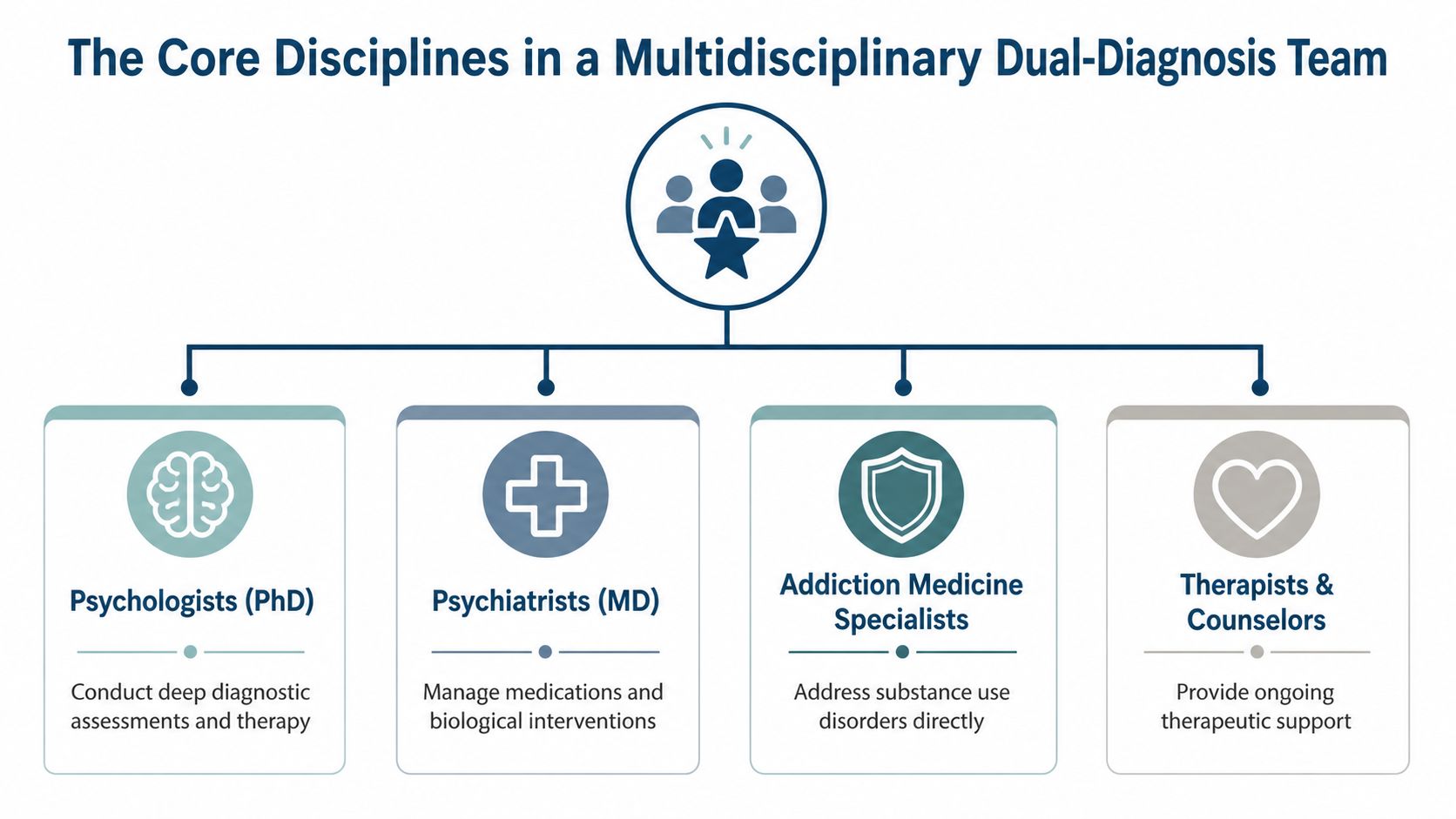
Depth of integration defines a multidisciplinary team more than the number of names on a website. Each discipline should provide a distinct assessment, share relevant observations, and influence the care plan when new evidence changes the clinical picture. That coordination matters especially for executives, whose treatment must account for symptoms, substance use, leadership demands, and limited capacity to step away from work.
Psychologists establish the formulation
PhD-level psychologists conduct detailed diagnostic assessments and translate symptoms into a working clinical formulation. Their work may include individual psychotherapy and evidence-based modalities such as cognitive behavioral therapy, dialectical behavior therapy, acceptance and commitment therapy, and motivational interviewing.
The clinical question extends beyond whether a client has anxiety or depression. The team must examine how symptoms interact with substance use, trauma, relationships, leadership responsibilities, and decision-making. A psychologist then helps the client develop skills that remain usable in a boardroom, at home, and during acute stress.
Psychiatrists manage medication with restraint
Psychiatrists assess diagnosis, risk, medication history, sleep, mood, and biological factors. In an integrated program, medication decisions remain connected to therapy and addiction treatment. A change in medication can affect energy, concentration, emotional range, appetite, or sleep, so the therapist and addiction clinician need timely visibility into those effects.
The aim is minimal, effective pharmacology, rather than accumulating prescriptions. Psychiatric medication management should be tied to observed symptoms, client preferences, safety considerations, and progress in psychotherapy. For a working executive, the team also weighs whether a medication plan supports reliable concentration and responsible professional functioning without compromising safety.
Addiction specialists address the disorder directly
Certified addiction counselors and addiction medicine specialists examine substance-use patterns, triggers, consequences, ambivalence, cravings, and relapse risk. Their role extends beyond education. They help identify how professional travel, pressure, privacy, access, social rituals, and emotional avoidance may sustain substance use.
This discipline prevents the team from treating a substance problem as a secondary symptom. Recovery planning should address high-risk meetings, work dinners, travel, stress after a major decision, and the loss of familiar coping routines. Those details distinguish an operational plan from general advice.
Therapists, family clinicians, and adjunctive providers complete the picture
LMFTs address relational and family dynamics, including secrecy, mistrust, enabling patterns, emotional distance, and the effect of treatment on a spouse or children. Adjunctive therapists may add art, music, somatic, equine, mindfulness, fitness, massage, or nutrition-based work when those interventions support the primary plan.
Clients and families exploring neurodevelopmental complexity may also consult approaches to care for ADHD and autism. Experiential work should reinforce psychiatric assessment, addiction treatment, and trauma-focused psychotherapy, rather than substitute for them. In a private-pay executive program, the clinical director should be able to show how each provider's observations reach the shared plan and affect daily decisions.
What the Evidence Shows About Team-Based Care Outcomes
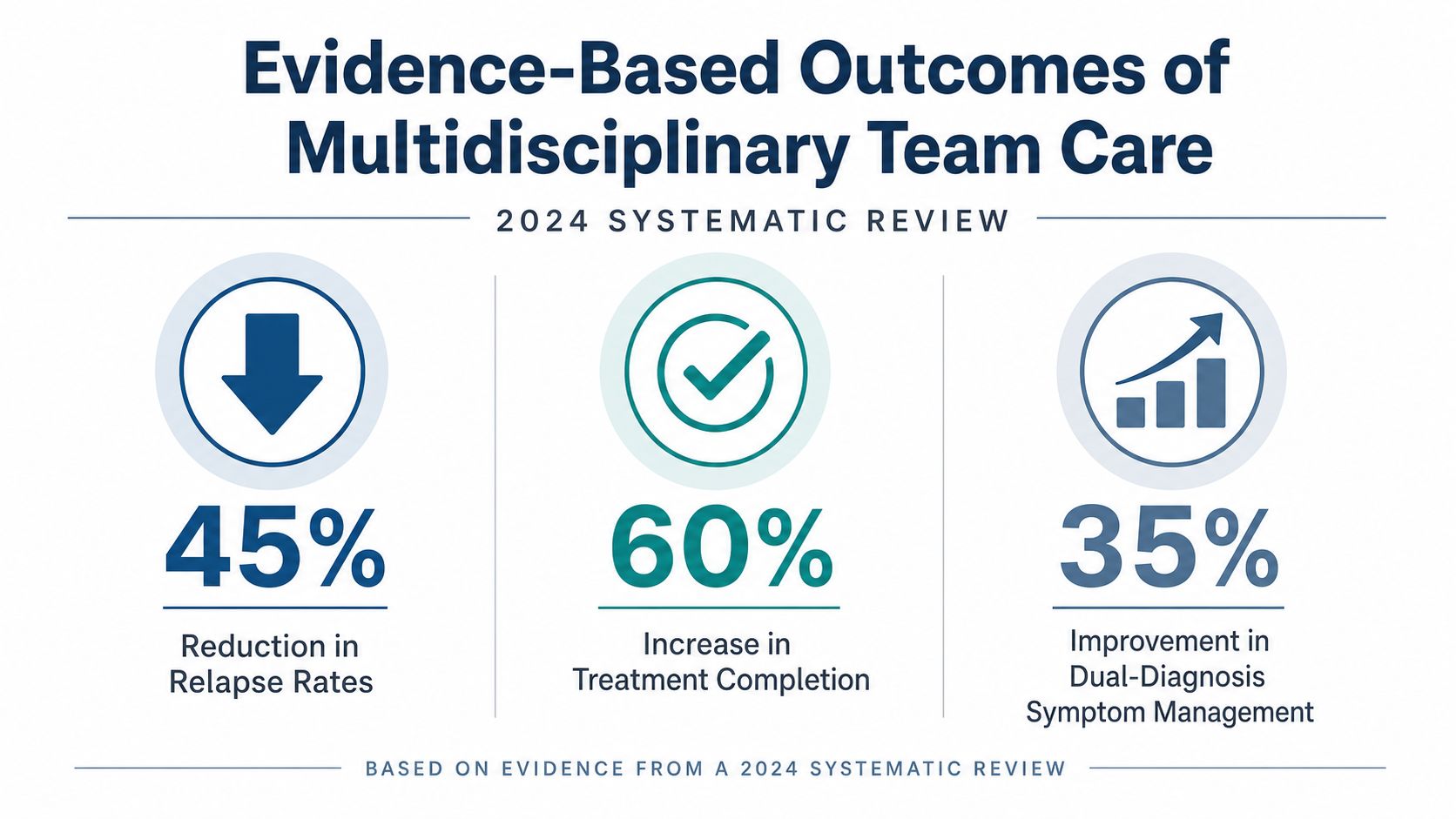
A 2024 systematic review of 10 studies found measurable benefits from interdisciplinary care across patient outcomes, provider performance, and healthcare utilization. The review associated team-based care with better self-management, health outcomes, shared decision-making, and efficiency in care delivery. The systematic review is available through PubMed.
For an executive in treatment, these findings support a practical operating principle. Complex cases require decisions that connect symptoms, medication, behavior, family systems, and medical safety. A larger roster of clinicians does not create integration by itself. The benefit appears when the team combines observations before committing to a plan, then applies that plan consistently across clinical encounters.
Satisfaction reflects team design
A 2019 systematic review of hospital team-based care found that 57% of included studies reported a statistically significant improvement in patient satisfaction, while about one-quarter of studies measuring satisfaction alongside another outcome improved on both. Teams involving more than two professions and more extensive structures had higher satisfaction scores. The hospital-care review provides the underlying analysis.
For private-pay clients, satisfaction has clinical meaning. It can indicate whether clinicians communicate clearly, whether the client understands decisions, and whether the program respects autonomy and confidentiality. A polished setting cannot correct contradictory instructions or repeated assessments that never reach the wider team.
Programs evaluating their internal culture can begin with frameworks describing the qualities of effective teams, then verify whether those qualities appear in case reviews, documentation, handoffs, and client-facing decisions.
Outcomes require a measured interpretation
A large retrospective cohort associated MDT decision-making with lower in-hospital mortality, adjusted OR 0.78; lower 30-day mortality, adjusted HR 0.82; fewer 30-day readmissions, adjusted OR 0.88; and fewer complications, adjusted OR 0.91, after propensity-score adjustment. The study also found greater healthcare resource consumption. Better outcomes may therefore reflect more intensive evaluation and follow-up rather than reduced utilization. The cohort and review-level evidence are reported in this open-access analysis.
A 2025 systematic review found that multidisciplinary teamwork improved most patient-reported outcomes, including satisfaction, health behaviors, and knowledge. Effects on clinical outcomes, service use, and costs were inconsistent over short follow-up periods. The review is available in full through PMC.
For behavioral health, the practical conclusion is measured. A multidisciplinary team approach can strengthen assessment, adherence, self-management, and coordination. Durable downstream outcomes still depend on treatment length, transitions, and continuing care. For working executives, that distinction separates genuine clinical integration from a siloed specialist model with more appointments but no shared accountability.
How Coordination Actually Works Behind the Scenes
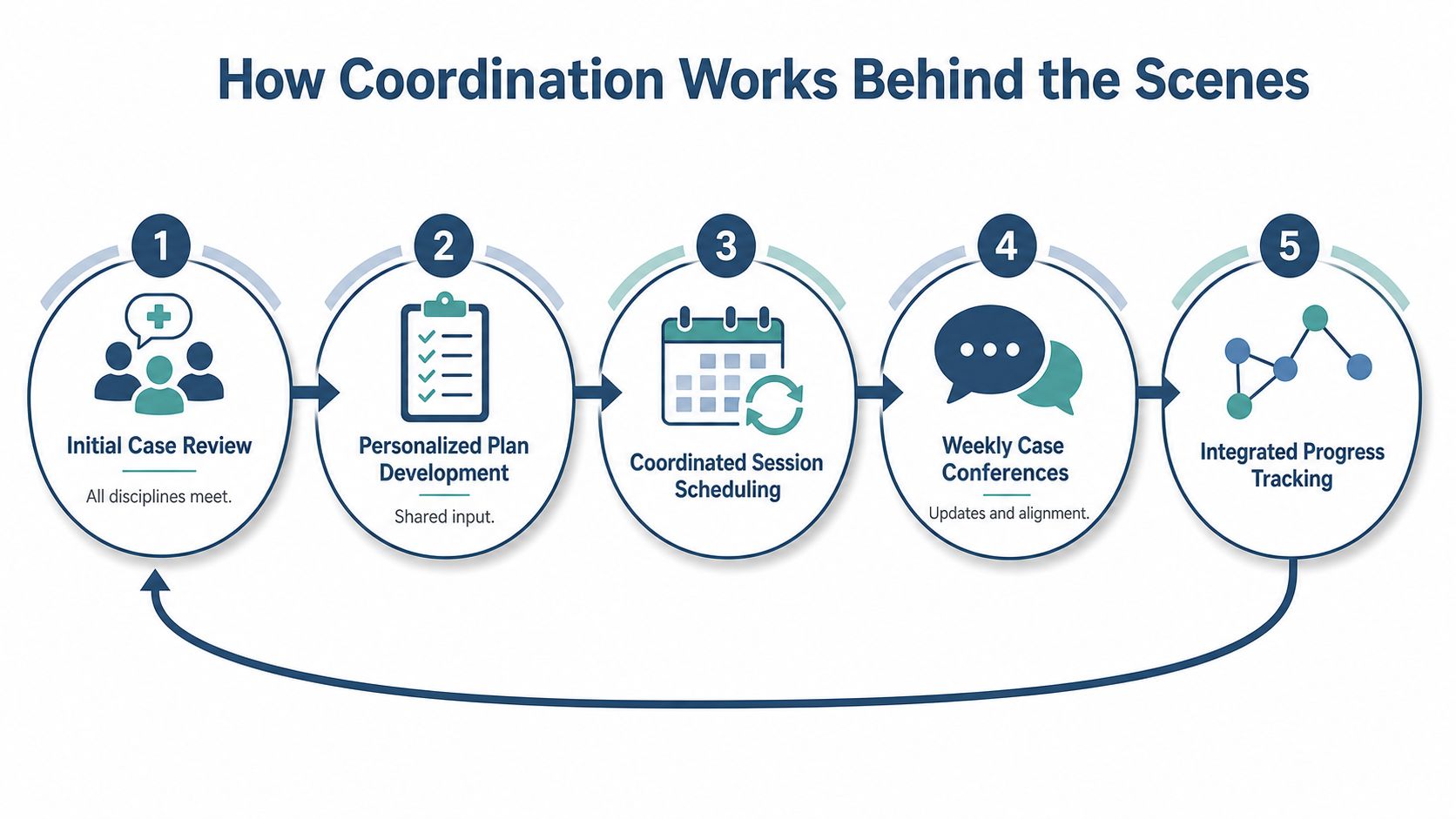
Clinical integration begins with a shared case review, not a list of independent appointments. Psychiatry, addiction medicine, therapy, and medical oversight should review the same client, identify competing risks, and agree on the immediate priorities. The resulting plan needs to state who owns each action, what information must be shared, and when the team will reassess the decision.
A working model has visible handoffs
A practical workflow includes:
- Initial case review: Relevant disciplines examine the intake, medical history, substance use pattern, risk factors, and client priorities.
- Personalized plan development: The team combines those perspectives into one treatment plan, rather than issuing separate recommendations.
- Coordinated scheduling: Therapy, medication reviews, medical monitoring, family work, and experiential services are arranged so the client isn't overloaded or left waiting for a critical intervention.
- Recurring case conferences: The team reviews progress, setbacks, medication effects, sleep, cravings, family feedback, and work-related stress.
- Integrated progress tracking: Documentation records changes in symptoms, behavior, goals, safety, and next steps in a form the authorized team can use.
Shared documentation is especially important after a medication change or a difficult therapy session. If a client becomes activated, withdrawn, sedated, or unusually energized, every relevant clinician should know whether the response is being interpreted as a medication effect, a trauma response, withdrawal, mood instability, or another concern.
Practical rule: If the client has to explain the same clinical change to several professionals, the team may be staffed but not integrated.
One accountable pathway protects continuity
The continuity problem deserves direct attention. A 2025 scoping review of primary-care MDTs found mixed effects, with some models improving chronic disease management and others reducing relational continuity by fragmenting care. The models varied substantially across settings. The scoping review is indexed by PubMed.
A luxury program should designate clear clinical leadership and preserve one accountable pathway. Case conferences need decisions, not just discussion. Notes need to distinguish a proposed intervention from an agreed intervention. The client and family should understand who can answer urgent questions and how recommendations move from one discipline to another.
Programs that want support for alcohol-related family intervention can review alcohol intervention specialists, while still asking how intervention planning connects with detox, psychiatric care, therapy, and aftercare.
Luxury Accommodations as Clinical Infrastructure
A private room can function as a clinical tool when it reduces stimulation, protects confidentiality, and gives a client room to recover after demanding therapeutic work. In executive treatment, private rooms in detox and rehabilitation also reduce the pressure of managing vulnerability in a shared living arrangement. Privacy supports clinical care by making sustained participation more feasible.
The difference between a cosmetic luxury program and an integrated one appears in how accommodations are governed. A private workspace, secure connectivity, and device access should serve an agreed treatment objective. Without clear limits, the same features can become an escape from treatment or a way to keep work in control of the day.
Electronics require structure
Many rehabilitation programs use staged electronics access. Facilities may begin with a blackout period, then allow phones or laptops during designated windows, with rules governing where and when devices can be used. An overview of electronics policies in rehabilitation describes this staged model.
For executives, structured phone and laptop access can support limited work continuity through secure Wi-Fi, private workspaces, and scheduled use. The executive-treatment discussion of work access explains this model. The arrangement should be designed by the clinical team, rather than treated as a hospitality benefit.
Clinicians should set access according to sleep, cravings, anxiety, confidentiality, and treatment engagement. A client might address a defined business responsibility during a scheduled window, then return to therapy without bringing the entire company into the clinical environment. That decision may change as symptoms, withdrawal risk, or participation changes.
Privacy should serve recovery
Private rooms are a concrete feature of upscale treatment, with clinical value that depends on how staff use them. Guidance on private rooms and electronics describes private-room access as a premium feature that may accompany higher-end amenities or device privileges. The guidance on private rooms and electronics provides additional context.
Privacy can become isolation if staff do not maintain meaningful contact. The team should monitor sleep, session attendance, eating, peer avoidance, and whether work is being used to avoid emotional engagement. Regular check-ins, coordinated observation, and clear escalation pathways keep the room connected to care.
A private room supports treatment only when the team remains clinically present.
Benefits for Clients, Families, and Referring Professionals
The client receives a plan that can address trauma, PTSD, anxiety, depression, grief, bipolar symptoms, borderline traits, and substance use without forcing one clinician to manage every layer. Psychiatrists can optimize medication, psychologists can deliver structured psychotherapy, addiction counselors can target relapse patterns, and adjunctive therapists can help clients access experiences that verbal treatment alone may not reach.
For a working professional, that integration also protects continuity. The team can plan appropriate contact with work, identify situations that increase risk, and help the client distinguish responsible delegation from compulsive availability. Treatment doesn't need to pretend that a chief executive has no professional obligations. It needs to prevent those obligations from controlling the treatment schedule.
Families need their own clinical pathway
Families often carry fear, anger, confusion, and exhaustion into treatment. LMFT-led private sessions can help relatives understand boundaries, enabling, communication, and the behavioral effects of addiction. Monthly educational workshops can give families a shared vocabulary and prepare them for the transition home.
Family participation also provides information the client may not recognize or disclose. Changes in sleep, spending, irritability, secrecy, or risk-taking can become clinically relevant when the team evaluates progress and continuing-care needs.
Referrers need evidence of execution
Therapists, psychiatrists, attorneys, and other referring professionals need confidence that the receiving program can protect confidentiality while maintaining clinical communication. Joint Commission accreditation, credentialed leadership, clear consent procedures, shared documentation, and strong continuing care should be verified rather than assumed.
An employer or family evaluating long-term recovery can also consider how treatment supports employee engagement and longevity, while recognizing that residential treatment must remain clinically led. A successful referral isn't measured by amenities alone. It rests on whether the program can translate multiple professional perspectives into a coherent plan the client can follow after discharge.
How to Evaluate a Program's Multidisciplinary Credentials
A website can list psychiatrists, psychologists, counselors, and therapists without proving that they work as a team. Executives, families, and referring professionals should ask operational questions that require specific answers.
Ask how the team functions
The most revealing questions concern frequency, ownership, and documentation:
- Active disciplines: Which professionals participate in each client's care, and which are available for consultation?
- Case conferences: How often do the disciplines review cases together, and who leads the meeting?
- Shared records: Can authorized team members see current symptoms, medication changes, risk updates, and treatment goals?
- Decision ownership: Who resolves disagreement between medication, therapy, medical, and addiction recommendations?
- Client participation: How does the client review and consent to the integrated plan?
- Continuing care: How are medication follow-up, therapy, family work, alumni support, and relapse prevention coordinated after residential treatment?
A credible program should answer these questions in workflow terms. “The team communicates regularly” is less useful than a description of scheduled conferences, shared notes, escalation procedures, and named clinical accountability.
Verify the investment
Private-pay residential rehabilitation has a wide price range. Standard private 30-day programs are often cited around $14,000 to $27,000, while luxury or executive programs may cost roughly $30,000 to $80,000 or more for 30 days. Some private-luxury facilities are described as exceeding $60,000 for a 30-day stay. Published residential pricing guidance outlines these ranges.
The price should correspond to clinical depth, privacy, medical oversight, staffing, individualized scheduling, family services, and continuing care. Accreditation and credentials matter, but they don't replace questions about how those resources are used each day.
A California-licensed, Joint Commission-accredited program such as Reflections offers private residential dual-diagnosis treatment, clinically managed medication-assisted withdrawal when appropriate, psychiatric medication optimization, individual and group therapy, family involvement, and structured access to work, school, and loved ones. Those features should be evaluated through the same lens applied to any program, whether the team's disciplines communicate, document, and act as one accountable clinical system.
Executives and families seeking coordinated, discreet dual-diagnosis care can visit Reflections to learn how its multidisciplinary team, private rooms, executive-friendly electronics access, detox services, residential treatment, and continuing-care planning fit together. Contact the program directly to discuss clinical needs, work obligations, privacy requirements, and the level of team involvement appropriate for the prospective client.