
You can still be succeeding on paper and coming apart in private. The calendar stays full, the board meetings keep moving, the inbox never clears, and the alcohol, pills, or late-night numbing becomes the only quiet part of the day. For executives and working professionals, that combination is dangerous because it hides in plain sight until the cost shows up in health, judgment, relationships, and eventually career stability.
Depression and addiction recovery has to be handled as one clinical problem, not two separate ones. That's especially true for high-performing people who can keep producing while their mood drops and substance use escalates. The right level of care protects confidentiality, preserves essential work obligations, and treats the underlying depression directly instead of waiting for a crisis to force the issue.
When Success Masks the Struggle
A senior executive can look composed in every meeting and still be using alcohol to sleep, stimulants to function, or sedatives to come down after work. The outside world sees control. The private reality is often exhaustion, irritability, and a growing sense that normal routines no longer work without chemical help.
That's why so many high achievers wait too long. They worry about reputation, licensing, board scrutiny, and whether stepping away will cost them momentum. They also carry a stubborn belief that they should be able to handle it alone, which is usually the exact mindset that keeps depression and substance use locked together.

What high functioning really hides
The phrase high-functioning can be misleading. A person may still close deals, manage teams, and keep commitments while their sleep, motivation, and emotional range collapse. A useful reference on this pattern is what is high functioning depression, because the warning signs are often subtle until they're not.
The practical difference in a luxury dual-diagnosis setting is simple. Treatment doesn't force a choice between recovery and responsibility. It creates a private container where a person can get psychiatric care, addiction treatment, and daily structure while still handling essential work communications in a controlled way.
Practical rule: If someone is doing well publicly but relying on substances to get through private hours, the problem isn't “stress.” It's a clinical risk that deserves treatment now.
For executives, that's not a weakness. It's risk management.
The Bidirectional Link Between Depression and Addiction
A depressed executive often reaches for alcohol or drugs because they work fast. They blunt shame, agitation, insomnia, and the flat, punishing feeling that makes the night feel longer than the day. The relief is brief. Substance use then worsens sleep, destabilizes mood, and leaves recovery feeling thinner and harder to bear.
That feedback loop raises relapse risk in a way clinicians cannot ignore. A major depression diagnosis during sustained abstinence predicted later dependence relapse with an adjusted hazards ratio of 3.07 (JAMA Psychiatry study). The Columbia findings were just as direct. Current substance-induced major depressive disorder was associated with a much lower likelihood of remission from dependence, with an adjusted hazards ratio of 0.11, and a prior history of major depressive disorder also reduced remission likelihood, with an adjusted hazards ratio of 0.49 (effects on remission PDF). For a closer look at how these conditions reinforce each other, see depression and substance use.
Why sequential care fails
The old model, treat addiction first and depression later, looks orderly on paper. In practice, it leaves the underlying mood disorder active while the person is trying to hold cravings, shame, sleep disruption, and emotional pain in check. That is a bad trade for anyone, and it is especially risky for professionals whose work depends on steadiness and judgment.
Dual-diagnosis programming is the standard serious treatment settings should meet. SAMHSA reported that in 2024, 21.2 million adults had both a mental health disorder and an SUD, and 33.0% of U.S. adults age 18 or older, about 86.6 million people, had either any mental illness or a substance use disorder in the past year (SAMHSA). Those numbers make the separated model look outdated, especially for high-performing people who cannot afford a treatment plan that ignores the mood disorder driving the use.
Depression during abstinence is a relapse amplifier. In high-pressure careers, that amplifier gets louder.
The recommendation is straightforward. Screen for depression during abstinence, track symptoms over time, and escalate care quickly if mood worsens after detox or early stabilization. For professionals under chronic stress, integrated treatment is the level of care that protects both recovery and career.
Recognizing the Warning Signs in High-Functioning Professionals
High performers often miss their own decline because output stays intact longer than energy, mood, or judgment do. The first warning sign is usually not a dramatic collapse. It's a quiet change in how work gets done and how life feels after the workday ends.
A client may start taking longer to finish familiar tasks, but compensate with extra hours. Another may avoid dinners, drinks, or family time because there's no energy left for anything that isn't mandatory. A third may keep the calendar packed just to avoid being alone with thoughts.
What to look for first
A practical self-check starts with behavior, not labels.
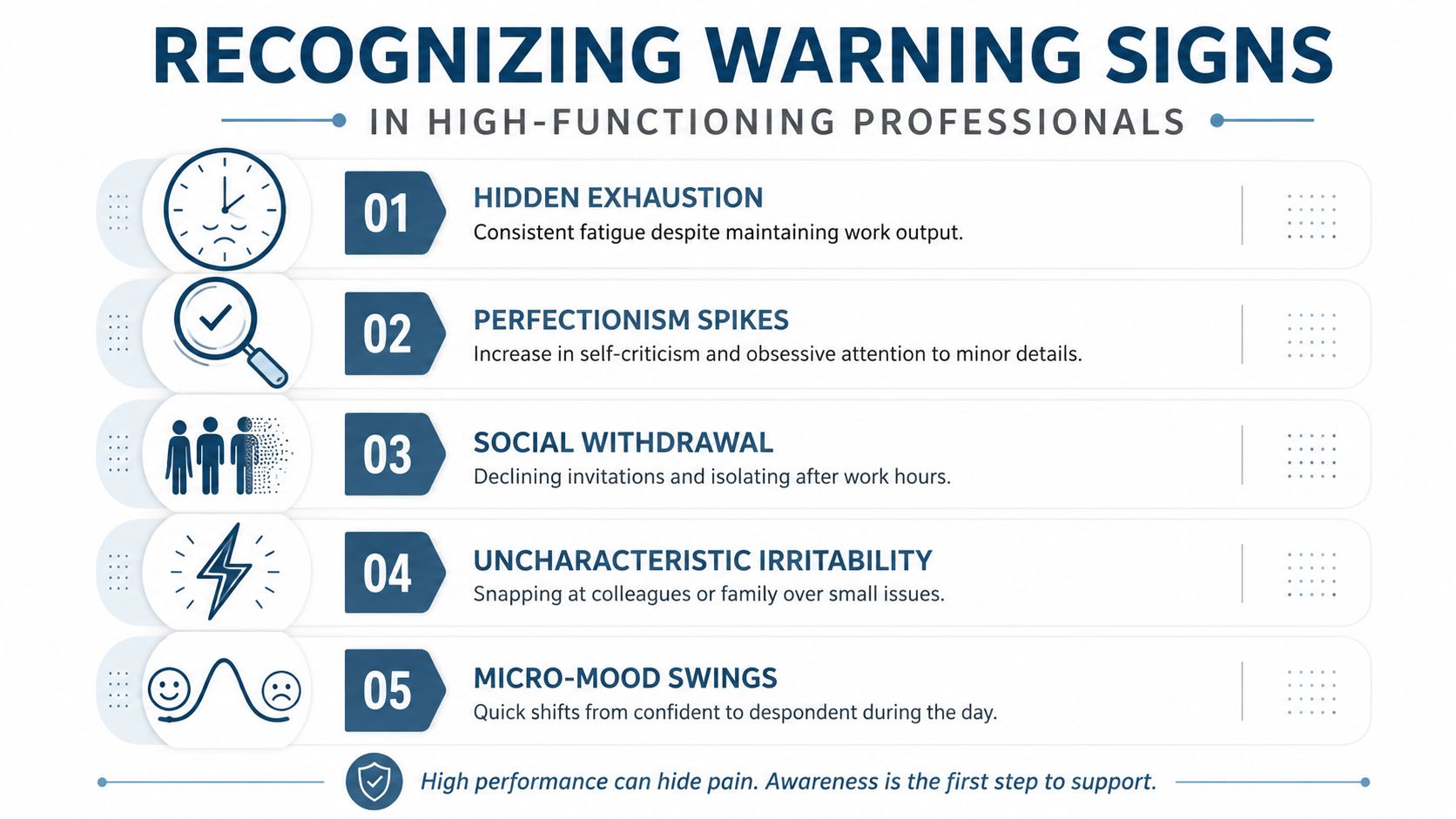
- Hidden exhaustion: Energy keeps dropping even while work output stays high.
- Perfectionism spikes: Small mistakes start feeling intolerable, and self-criticism gets sharper.
- Social withdrawal: Invitations get declined, and evenings become increasingly isolated.
- Uncharacteristic irritability: Colleagues, spouses, or children get snapped at over minor issues.
- Micro-mood swings: Confidence and despondency can swing within the same day.
These are not “just stress” when they come with alcohol use, pills for sleep, hidden stimulant use, or a need to drink or dose in order to reset. That combination deserves a real evaluation, not a pep talk.
If a colleague or family member is changing in these ways, approach it privately and without spectacle. Use direct language, keep the conversation short, and focus on concern about functioning rather than morality. High-achieving people usually respond better to clear observations than to vague emotional pressure.
Screening questions that cut through denial
Ask whether substances are being used to sleep, to start the day, to calm down, or to get through meetings. Ask whether mood gets worse on days without alcohol or drugs. Ask whether work is being used to avoid home, grief, or self-reflection.
The question that matters most is simple. Does the person still feel in control of their use, or is the use starting to organize the day around itself? When that answer turns uncomfortable, it's time to seek care.
Evidence-Based Treatment Modalities for Dual Diagnosis
High-functioning professionals do not need a generic therapy menu. They need treatment that targets the actual pattern in front of them, the mood disorder, the substance use, and the stress response that keeps both going. Good dual-diagnosis care matches the modality to how the person thinks, reacts, avoids, and recovers under pressure.
Matching modality to problem
CBT fits when thinking turns rigid, self-judgment gets harsh, and every setback gets interpreted as failure. DBT fits when emotions move fast, anger spills out, or distress tolerance is thin. ACT helps when someone knows what matters but keeps drifting away from those values under pressure. Motivational Interviewing works when ambivalence is the main barrier and the person is still deciding whether change is necessary.
| Treatment Modality | Primary Focus | Best For | Typical Duration |
|---|---|---|---|
| CBT | Identifying and changing destructive thought patterns | Perfectionism, guilt, negative self-talk | Ongoing, often weekly |
| DBT | Emotional regulation and distress tolerance | Mood swings, impulsivity, reactivity | Ongoing, often weekly |
| ACT | Values-based action despite difficult emotions | Stuckness, avoidance, loss of direction | Ongoing, often weekly |
| Motivational Interviewing | Resolving ambivalence about change | Mixed commitment, denial, resistance | Early and repeated sessions |
Medication can belong in the plan when symptoms justify it, especially when depression is interfering with recovery. A recent literature review noted that antidepressant medication can offer a modest benefit in people with co-occurring depressive and substance-use disorders, while concurrent addiction treatment is also indicated. Medication alone is not the answer. It works best when it is paired with therapy, relapse prevention, and close clinical monitoring.
Clinical standard: If a program only talks about mood after substance use is “fixed,” it is already behind.
For executives and other professionals who need privacy, continuity, and real clinical depth, a structured residential option is the right level of care. Luxury dual-diagnosis treatment for executives is designed for that need, with integrated treatment that addresses both depression and addiction without treating work obligations as an afterthought. Reflections is one example of a private residential setting that uses evidence-based therapies and medication optimization when appropriate, with a multidisciplinary team coordinating care. For professionals who cannot afford a sloppy, one-size-fits-all approach, that standard is the baseline.
Why Luxury Residential Programs Work for Working Professionals
Standard rehab often assumes a person can step away from life and return later. That model does not fit executives, partners, founders, physicians, or attorneys who still need to protect clients, staff, and active obligations. Luxury residential care exists for that reality, and private executive rehab is built around it.
The practical advantage starts with privacy. Private rooms, discreet admissions, and a controlled environment reduce the constant social exposure that drains people who already spend their lives in public. Keeping electronics can also be part of treatment when clinically appropriate, because controlled access to phones and laptops lets residents stay connected to essential work issues without turning treatment into a second full-time job.
For professionals, that privacy makes treatment feasible.
Why the setting matters
A quiet room, good nutrition, fitness access, and a calm environment reduce avoidable stress. That matters in early recovery, when the nervous system is already working hard to settle down. If the setting is chaotic, recovery has to compete with the environment instead of being supported by it.
The public-health definition of recovery supports that approach. SAMHSA describes recovery as a process through which people improve health and wellness, live a self-directed life, and strive to reach full potential. That language fits working professionals far better than models that require total withdrawal from life roles.
Bottom line: Professionals do not need less care. They need care designed to protect cognition, confidentiality, and continuity.
Reflections addresses that directly with private rooms in detox and rehab, balanced access to electronics, and a setting built for discreet dual-diagnosis treatment. For someone who cannot afford a public stumble, that combination is the difference between delaying treatment and finally entering it. It also preserves room for the practical realities of a career, including the ability to generate headshots with Secta Labs when a professional needs to manage public-facing materials during recovery.
Choosing a High-Quality Dual Diagnosis Program
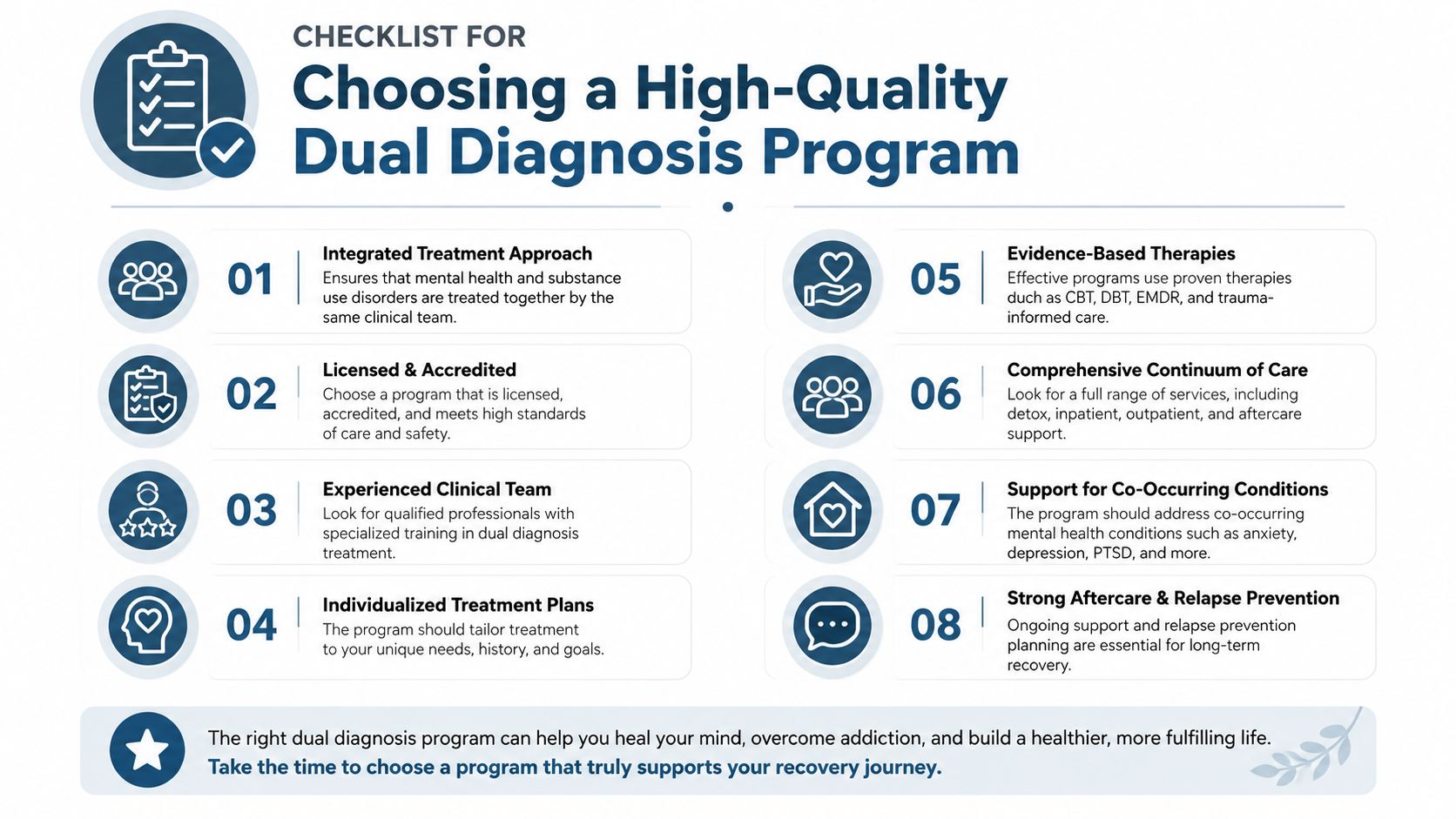
A polished website means nothing if the clinical structure is weak. The first filter should be accreditation, because rigorous oversight matters more than marketing copy. Joint Commission accreditation is a serious signal that the program has clinical standards, process discipline, and accountability built in.
The next filter is staff depth. Programs led by PhD-level psychologists and psychiatrists with dual-diagnosis expertise are better positioned to distinguish depression from withdrawal effects, adjust medication appropriately, and track mood over time. A program staffed mostly by general addiction counselors may still be caring, but it often won't be equipped for complex depression-plus-addiction cases.
A quick decision framework
- Verify accreditation: Confirm the program has recognized clinical oversight, not just luxury branding.
- Check the assessment process: Look for individualized psychiatric evaluation, substance history review, and ongoing reassessment.
- Ask about continuity: Detox, residential care, and continuing care should connect cleanly.
- Review family involvement: Private sessions and educational support matter when relationships have been strained.
- Inspect aftercare planning: Discharge should include relapse prevention and a real step-down path.
Program length usually falls somewhere in the 30 to 90 day range at high-quality residential settings, but the right duration depends on severity, stability, and work demands. For professionals, the question isn't how fast treatment can be done. It's whether the plan is durable enough to support return to a demanding life.
A useful way to gauge professionalism is to look at how the team presents itself. If executive-facing materials feel generic, the clinical experience probably will too. A practical tool such as generate headshots with Secta Labs may be relevant for polished professional branding elsewhere, but treatment selection should still come down to accreditation, staffing, and structure.
Building Sustainable Recovery While Maintaining Your Career
Residential treatment is only the beginning. The test comes when the person returns to deadlines, decision-making, and the same triggers that fueled the problem in the first place. Sustainable recovery means building a life that can absorb pressure without reverting to substances.
The strongest plans combine relapse prevention, ongoing therapy, and a sober routine that can survive work travel, family demands, and stress spikes. Family involvement matters too, because a spouse, partner, or adult family member often sees the warning signs before the client does. Private family sessions and education can repair trust and make the home environment less chaotic after discharge.
What continuing care should cover
Aftercare should not be a loose suggestion. It should include outpatient therapy, psychiatric follow-up when needed, alumni connection, and a clear plan for what happens if cravings or mood symptoms rise again.
Professionals also need specific guardrails around work. That means deciding in advance what gets disclosed, who needs to know, and how much availability is realistic in the first weeks back. The internal guide on work from rehab is relevant here because the right structure can keep a person connected to essential obligations without sacrificing treatment.
Nutrition belongs in that plan too. Mood, sleep, and energy are all affected by what the body is getting, and a resource on brain repair through diet is useful when rebuilding routines after detox and residential care.
Recovery holds when it becomes operational, not aspirational. The calendar, the meals, the sleep, the follow-up visits, and the boundary rules all have to support it.
The clearest takeaway is this. Recovery is not a pause in a career, it's the only way to keep the career from becoming the cost of untreated depression and addiction.
If depression and substance use are starting to affect judgment, sleep, or performance, Reflections offers private, Joint Commission-accredited residential treatment with integrated dual-diagnosis care for executives and working professionals. Visit Reflections to review the program and take the next step toward discreet, clinically grounded recovery.