

The call comes in before 7 a.m. A board member wants an update. A spouse is still hurt. The calendar is full. The inbox never stops. Early recovery can feel less like a quiet reset and more like a return to the same high-pressure environment with less margin for error.
For executives, communication skills in recovery aren't a side topic. They sit at the center of whether treatment gains hold under pressure. The issue usually isn't intelligence. It's that many successful professionals know how to persuade, negotiate, contain risk, and lead teams, but they haven't been taught how to communicate when shame, craving, exhaustion, trauma, or family distrust enter the room.
That gap matters even more in high-end private-pay treatment settings built for working professionals, where discretion, clinical sophistication, and continuity with career obligations aren't luxuries in the casual sense. They're part of the treatment design. Executive clients often need private rooms in both detox and residential rehab, strong clinical oversight, and appropriate access to electronics so they can remain responsive to essential responsibilities without losing the structure recovery requires. In premium executive care, cost often reflects clinical intensity and personalization. Executive luxury rehab programs typically cost over $1,000 per day, with some reaching up to $3,500 daily, according to this executive rehab overview.
Beyond Words Why Communication Is a Cornerstone of Executive Recovery
A senior leader leaves treatment with a clear plan. No drinking. Daily structure. Better sleep. More honesty at home. Then the first difficult conversation lands. A colleague asks why travel is being limited. A partner wants to revisit old lies. A direct report notices irritability. The risk isn't only saying the wrong thing. The risk is slipping back into old patterns such as deflection, overexplaining, minimizing, or silent withdrawal.
In recovery, communication isn't just about sounding calm. It's about organizing thought under stress. It shapes whether a person asks for help before a lapse, sets a limit before resentment builds, or tells the truth before a problem grows. For executives, the impact is greater because poor communication can threaten two identities at once: the leader at work and the trusted person at home.
What executives often get wrong
High performers tend to rely on the same strengths that made them successful. They move fast. They solve. They contain emotion until later. Those habits help in a crisis meeting. They often fail in recovery.
What doesn't work:
- Using performance language instead of honest language. Saying "Everything is handled" when it isn't.
- Treating vulnerability like loss of authority. Recovery usually improves leadership judgment, but only when the person stops confusing privacy with concealment.
- Waiting for the perfect moment. Hard conversations don't get easier through delay.
What works better is simpler and harder. Name the issue. State the limit. Ask for the next support step.
Practical rule: If a conversation leaves the other person informed but not connected, the message was incomplete.
Why this matters clinically and professionally
Communication changes more than optics. It affects stress load, emotional regulation, and the quality of support around the person. A family can only help with what they understand. A colleague can only adjust expectations that have been stated. A therapist can only work with what has been said plainly.
For executives in discreet residential care, this becomes part of treatment itself. The best clinical teams don't teach generic "be a better listener" advice and leave it there. They help clients rehearse high-stakes moments, manage confidentiality, and communicate in ways that protect both sobriety and credibility.
That is one reason communication belongs in the same category as relapse prevention, trauma work, and mood stabilization. It isn't polish. It's operating capacity.
The Clinical Blueprint for Effective Communication
Communication becomes reliable in recovery when it rests on a clinical framework, not on good intentions. For executives, that distinction matters. In business, a system beats improvisation when the pressure rises. Recovery works the same way.
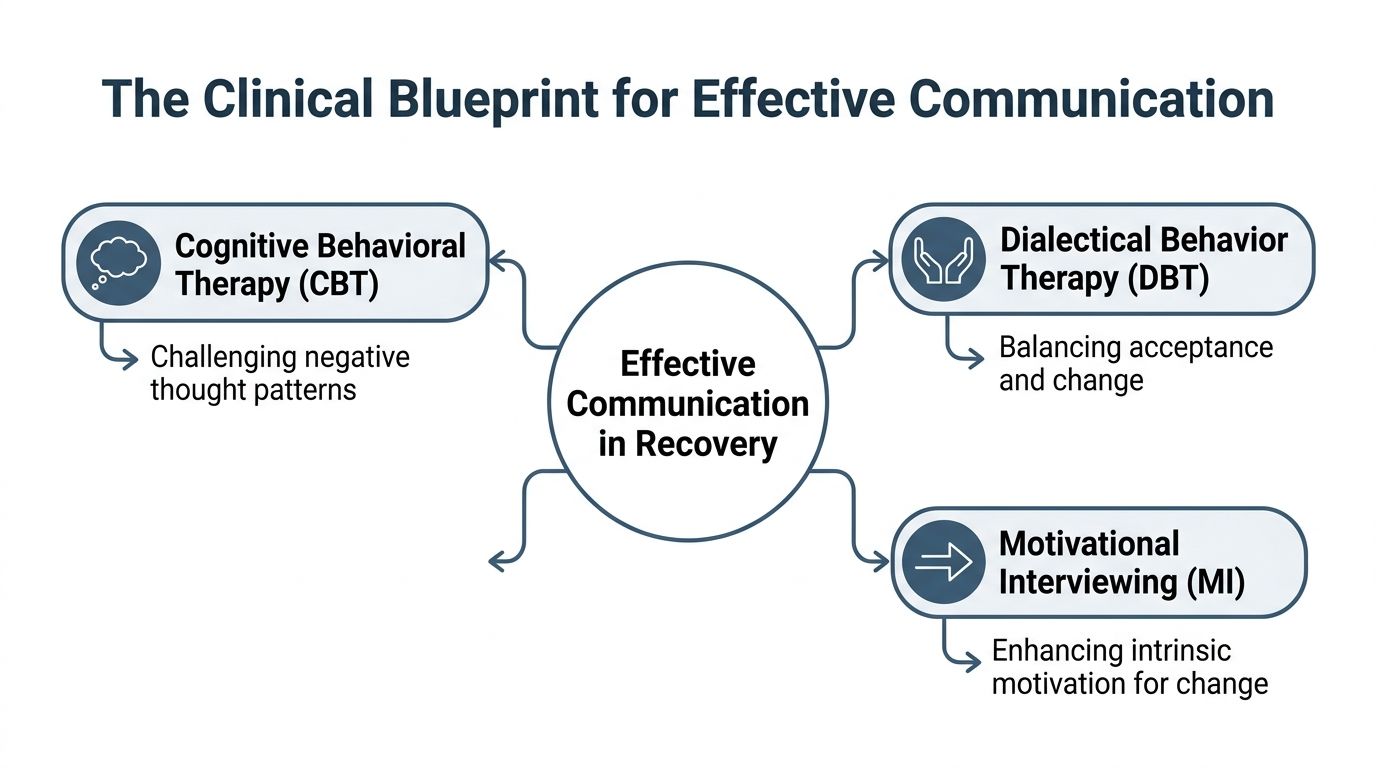
A useful blueprint combines principles often drawn from CBT, DBT, and motivational interviewing. Each one addresses a different failure point. One corrects distorted thinking. One regulates emotion during conflict. One strengthens commitment to change without triggering resistance.
CBT, DBT, and motivational interviewing in conversation
CBT helps a person catch the thought driving the reaction. An executive doesn't snap at a colleague just because the email was abrupt. The reaction usually runs through an interpretation first. "They think I'm slipping." "I'm losing control." "I have to prove myself now." Once the thought is identified, the response can change.
DBT matters when the body is activated. Many people know the right words after the conversation. The skill is finding them during the conversation. DBT-based communication leans on emotional regulation, distress tolerance, and clear expression of needs without attack or collapse.
Motivational interviewing is especially useful for internal dialogue and high-resistance moments. It doesn't push with shame. It draws out reasons for change the person already values. For executives, that often means linking recovery communication to leadership integrity, decision quality, and long-term trust.
A strategic sequence that holds under pressure
When communication breaks down, it usually fails in a predictable order:
- Interpretation gets distorted
- Emotion spikes
- Defensiveness takes over
- The fundamental need is obscured
A clinical response reverses that sequence.
- Name the thought. "This feedback feels like an accusation."
- Settle the nervous system. Slow the response before trying to win the exchange.
- State the need directly. "A same-day turnaround isn't realistic. A revised deadline is."
- Stay curious. Ask what the other person means, not what fear assumes they mean.
This is one reason formal treatment matters. Communication training isn't a motivational slogan. In a controlled study on alcohol use disorder, communication skills training produced statistically significant improvements in "personal responsibility taking" and "congruent affect," while shifting participants from an external focus to an internal focus, a change tied to foundational recovery work in the PubMed study on communication-skills training.
That finding fits what seasoned clinicians see. When people stop explaining their pain by blaming others and start speaking from ownership, conversations become more accurate and recovery becomes more stable.
Why discerning professionals should care about the mechanism
Executives usually respond well when the rationale is clear. "Use an I statement" sounds simplistic until the mechanism is understood. It lowers blame, reduces escalation, and keeps the speaker anchored in observable experience rather than accusation. "Reflect back what you heard" isn't etiquette. It's a way to test assumptions before acting on them.
In quality treatment, these skills are strengthened inside individual psychotherapy for executives and professionals, where communication patterns can be tied directly to trauma, anxiety, perfectionism, or substance-driven avoidance.
Strong recovery communication isn't passive. It's structured honesty delivered with enough regulation to be usable.
Building Your Toolkit Active Listening Assertiveness and Boundaries
Skills matter most when they're specific enough to use at 9 p.m. after a hard day, not just in a therapy room. Three tools carry a disproportionate share of the load in executive recovery: active listening, assertiveness, and boundaries.

Active listening when the stakes are high
Active listening isn't agreement. It's disciplined attention. In practice, that means hearing the content, the concern underneath it, and the part that triggers defensiveness before responding.
In a boardroom, this can prevent unnecessary escalation. At home, it helps a spouse or adult child feel heard without the recovering person rushing to self-defense.
A usable sequence looks like this:
- Pause before answering. A short delay prevents reflexive rebuttal.
- Reflect the concern. "You're worried the handoff creates more work for your team."
- Clarify the actual ask. "Is the problem the deadline, the process, or the lack of notice?"
- Respond to the issue presented. Not to the old shame attached to it.
A common mistake is listening for the weak point in the other person's argument. That's not listening. That's trial preparation.
Assertiveness without aggression or apology
Many executives are comfortable being forceful. Far fewer are comfortable being clear without overexplaining. Assertiveness sits in that middle lane. It says what is true, what is possible, and what isn't.
Examples of assertive communication in recovery:
- Declining a nonessential trip. "Travel isn't the right choice for me this month. I'll support the meeting remotely and prepare the team beforehand."
- Protecting a treatment appointment. "That hour isn't available. If this needs executive review today, send the summary by noon."
- Correcting speculation. "There have been some health-related adjustments. The work plan is in place, and urgent matters are covered."
Assertiveness fails when it drifts into apology for having a limit. It also fails when it becomes a disguised threat. Calm, brief, and specific usually works best.
The clearest message often sounds less impressive than the rehearsed one. That's usually a sign it's better.
Boundaries that support recovery instead of inviting conflict
A boundary isn't a speech. It's a limit with follow-through. In executive life, people often make the mistake of declaring boundaries they haven't operationalized. "I'm protecting evenings" means nothing if messages still get answered at midnight.
Better boundaries are concrete:
- Time boundaries. No nonurgent calls after a set hour.
- Context boundaries. No alcohol-centered client dinners during early stabilization.
- Emotional boundaries. No continuing a discussion once voices rise or contempt enters the room.
This matters even more for dual-diagnosis clients. For those with co-occurring trauma or PTSD, hyperarousal can make sustained eye contact or direct questioning physiologically overwhelming, and trauma-informed communication may need adaptations such as written communication or shorter pauses, as explained in this recovery communication resource on trauma-sensitive approaches.
Adapting the toolkit to trauma and executive pressure
Not every conversation should happen live and face-to-face. For some people, the best version of honesty starts in writing. A brief email draft, a shared note, or a prepared script can reduce reactivity enough for the genuine message to come through.
That isn't avoidance when used well. It's accommodation.
A practical decision filter helps:
| Skill | Best use case | What to avoid |
|---|---|---|
| Active listening | Conflict, family repair, team tension | Interrupting to correct details too early |
| Assertiveness | Scheduling, workload, treatment protection | Overexplaining or sounding defensive |
| Boundaries | Repeated pressure, after-hours intrusion, social risk | Announcing limits without enforcement |
For many professionals, the strongest communication move in early recovery is not saying more. It's saying less, more clearly.
Navigating High-Stakes Conversations in Your Career
Workplace communication is where many executives lose momentum. They can handle clinical insight. They struggle when they have to translate it into a discreet conversation with a chairperson, assistant, business partner, or HR contact.
That gap is large enough to shape whether people seek care at all. A recent industry analysis found that 68% of executives in recovery delay seeking help due to fear of workplace repercussions, and fewer than 15% of recovery communication guides address professional communication strategies, according to this industry analysis on communication and recovery.
The workplace standard for early recovery
The aim at work isn't full disclosure. It's functional honesty. An executive doesn't owe every colleague a personal narrative. But concealment that undermines planning will usually create more damage than a brief, professionally managed disclosure to the right people.
Structured executive programs can help clients remain engaged with essential responsibilities. For professionals who need continuity, work-from-rehab support for executives can make it possible to protect treatment while staying connected to critical obligations.
Executive Communication Scripts for Recovery
| Scenario | Script Framework |
|---|---|
| Delegating when overloaded | "I need to reassign this project for the next phase so quality stays high. Here's what needs to transfer, here's what still requires my review, and here's when I'll reassess capacity." |
| Setting after-hours limits | "For the next several weeks, nonurgent matters need to come before the evening cutoff. If something is time-sensitive, mark it clearly and route it through the agreed channel." |
| Discussing treatment needs with HR or a superior | "I'm addressing a health matter with appropriate care and a clear plan. My priority is continuity, confidentiality, and sustained performance. I'd like to discuss what temporary adjustments would support that." |
| Declining alcohol-centered events | "I won't be able to join that setting, but I'm happy to meet earlier, host breakfast, or take the client meeting in another format." |
| Responding to questions about behavior changes | "A few priorities have changed for health and performance reasons. The work remains covered, and some routines are being handled differently on purpose." |
What works and what usually backfires
There are trade-offs in every workplace conversation. Too much detail can create confusion, gossip, or a sense that the listener is being asked to process something they aren't equipped to hold. Too little detail can look evasive.
A useful professional standard is:
- Disclose upward and strategically. Share more with the person responsible for accommodations or oversight than with peers.
- Lead with continuity. Explain how responsibilities will be handled.
- Name the adjustment, not the whole history. Most conversations only need the present-tense plan.
- Prepare for the second question. That is often where people either overshare or become defensive.
Some scripts need a hard edge. If a colleague repeatedly pressures someone into drinking situations, the answer may need to be plain: "That doesn't work for me. Please stop asking." Courtesy matters. So does finality.
In professional recovery communication, privacy is earned through clarity. Vague messaging invites more scrutiny, not less.
Rebuilding Connection and Trust with Family and Loved Ones
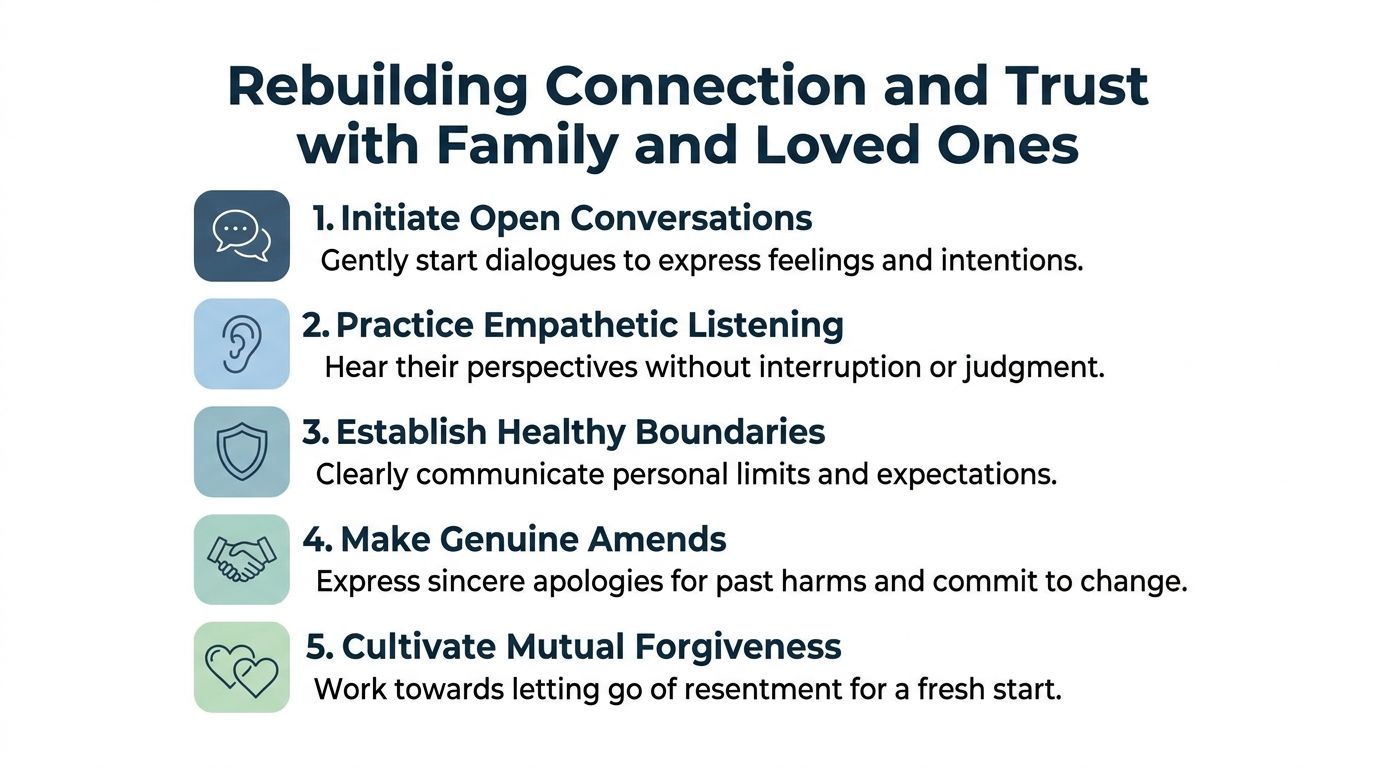
Family conversations are harder than workplace conversations for one reason. The history is longer, and the emotional ledger is fuller. A spouse may hear one sentence and remember ten years. An adult child may hear sincerity and still wait for proof. That doesn't mean repair isn't possible. It means language has to match reality.
Trust rarely returns because someone sounds convincing. It returns because communication becomes consistent, honest, and less self-protective over time.
Hope with honesty is the right tone
Families don't need false reassurance. They also don't need relentless pessimism. The healthiest conversations hold both truths at once. Recovery is possible, and setbacks may happen. Repair is underway, and trust may take time.
That balance matters clinically. Effective communication in recovery requires families and clinicians to balance "hope with honesty" and to teach healthy boundary-setting as self-care rather than punishment, as outlined in this training resource on effective communication in substance use disorder management.pdf).
What amends should sound like
An apology in recovery should be clean. It should not ask the injured person to comfort the speaker. It should not contain hidden arguments.
Better language sounds like this:
- Owning impact. "The dishonesty and inconsistency affected your sense of safety."
- Avoiding self-justification. No long preamble about stress, pressure, or intentions.
- Connecting words to process. "Trust should rebuild through what happens next, not through promises."
What often fails is the polished speech that sounds legally careful but emotionally absent. Families usually recognize that immediately.
Boundaries protect the relationship
Family members also need language. Without it, they often swing between over-involvement and shutdown. A healthier family system might include agreements such as who gets called in a crisis, what topics aren't productive late at night, and what behavior leads to ending a conversation until the next day.
That can be reinforced in family therapy for addiction recovery, where expectations and roles can be clarified in a contained setting.
Examples of useful family boundary statements:
- From a spouse. "Support doesn't include checking your devices or tracking your every move."
- From a parent. "Love is constant. Financial rescue is not automatic."
- From the recovering person. "If this conversation turns into character attacks, it needs to pause."
For parents in recovery, another layer often matters. Rebuilding trust at home includes better digital boundaries, better attention, and safer family routines. In that context, practical guidance on fostering healthy digital habits for children can support calmer household expectations and more intentional communication.
Family healing usually slows down when either side tries to force certainty before consistency has earned it.
Integrating Communication as a Lifelong Leadership Asset
The strongest version of recovery doesn't split life into two identities. It doesn't ask a person to be rigorous at work and emotionally unskilled everywhere else. It builds one integrated standard. Calm under pressure. Clear requests. Better limits. More ownership. Less defensiveness.
That is why communication skills in recovery become a leadership asset, not just a treatment goal. Executives who learn to pause before reacting, speak accurately under stress, and tolerate difficult feedback without collapse often lead better than they did before treatment. They usually make cleaner decisions too, because reality gets less filtered through fear, secrecy, and urgency.
This is ongoing work. Therapy, alumni support, family sessions, and deliberate practice all matter. So does regular review of where communication is still breaking down. Usually the clues are obvious. Repeated conflict. Avoided conversations. Overpacked schedules. Growing irritation. Those are rarely just productivity problems.
For leaders interested in the overlap between emotional skill and results, Recepta.ai insights on business performance offer a useful business lens on why emotional intelligence shapes outcomes.
Recovery doesn't ask successful people to become less capable. It asks them to become more direct, more regulated, and more trustworthy under strain. Those aren't soft traits. They're executive strengths with far more depth behind them.
Reflections provides discreet, California-licensed, Joint Commission-accredited luxury dual-diagnosis treatment for executives, C-suite leaders, and high-performing professionals who need serious clinical care without abandoning essential responsibilities. With private rooms in both detox and residential treatment, appropriate access to electronics for work continuity, and a highly credentialed multidisciplinary team, Reflections is designed for clients who expect the best of the best in private-pay rehab. Learn more about Reflections if confidential, high-end treatment with real clinical depth is the standard required.