
A public-facing career can make private collapse feel impossible to admit. The person considering rehab for celebrities often isn't wondering whether treatment works. The key question is whether treatment can happen without blowing up a company, a reputation, a family system, or a carefully managed public life.
For executives, founders, artists, public figures, and other high-earning professionals, the old image of rehab is often the biggest barrier to entry. Many still picture total disconnection, shared rooms, generic programming, and weeks away from every responsibility. That model can help some people. It doesn't fit many high-functioning adults whose decisions affect employees, boards, investors, productions, clients, or children.
The strongest private programs approach treatment differently. They treat rehab as a controlled, confidential intervention that protects health while preserving what can responsibly be maintained. In that setting, privacy isn't an amenity. Clinical depth isn't decorative. Work access isn't a loophole. Each one has to serve recovery, not interfere with it.
The High-Stakes Balancing Act of Executive Recovery
By the time many high-profile clients reach out, the outer structure of life still looks intact. Meetings are still happening. Deadlines are still being met. Public appearances may still be polished. But behind that surface, sleep is deteriorating, alcohol or drug use is becoming less predictable, anxiety is rising, and relationships are straining under the weight of secrecy.
For a senior executive, the fear usually isn't just about being "found out." It's about the ripple effect. A short unexplained absence may trigger board concern. A missed media obligation may spark speculation. A sudden drop in responsiveness may create business consequences. For parents in high-visibility households, treatment also raises practical questions about staffing, routines, and family stability. In those situations, support systems often need to be coordinated with the same level of discretion used in treatment planning. That can include trusted household help or specialist resources such as celebrity nanny agency services for families trying to protect children from unnecessary disruption.
Why standard rehab assumptions fail this group
Traditional treatment messaging often assumes that stepping away completely is always the healthiest option. Sometimes it is. But many high-profile individuals delay care because they believe the only path to recovery requires surrendering every professional obligation at once.
That belief keeps people sick longer than necessary.
Modern executive treatment is built around a more realistic premise. Some responsibilities can be paused. Some should be delegated. A small number must still be managed directly. The clinical task is to determine which is which, then create a treatment structure that protects recovery without creating avoidable panic in the rest of the client's life.
The best rehab for celebrities doesn't ask whether a person has status. It asks whether the treatment plan fits the pressures that status creates.
What actually changes when treatment is designed for leaders
In a high-end private setting, treatment is structured around discretion, stability, and precision. That means private rooms in detox and residential care, close clinical oversight, and enough individualized attention to address addiction and mental health issues without forcing the client into a one-size-fits-all routine.
A working professional doesn't need a resort. A working professional needs containment. That includes a secure environment, a highly accredited clinical team, and a program that understands the difference between healthy continuity and unhealthy overextension.
A useful way to think about rehab for celebrities is this:
| Old assumption | Executive reality |
|---|---|
| Treatment stops life | Treatment stabilizes life before it fails publicly |
| Work access always harms recovery | Limited, structured access can reduce panic and improve engagement |
| Privacy is a marketing promise | Privacy has to be operational, clinical, and constant |
When treatment is done well, rehab isn't a career-ending disruption. It's a strategic move that protects health, judgment, and long-term performance before the cost of waiting gets higher.
The Clinical Core of Executive Treatment Programs
At this level of care, the key differentiator is not marble bathrooms or better food. It is clinical depth, speed of assessment, and the ability to treat the problem beneath the public persona without destabilizing the rest of the client's life.
Executives, founders, performers, and public figures often arrive after a long period of high functioning that concealed serious deterioration. They may still be closing deals, filming, touring, litigating, or leading teams while relying on alcohol, stimulants, sedatives, or opioids to regulate sleep, energy, mood, and fear. That pattern can fool families, employers, and sometimes the client. It should not fool the treatment team.
A credible private celebrity rehab program for high-profile individuals starts with a disciplined diagnostic process. The goal is to determine what is primary, what is secondary, and what has been masked by success, status, or constant activity.
Clinical quality determines whether treatment holds
A refined setting can support regulation and engagement. It cannot compensate for weak diagnosis, inconsistent psychiatric oversight, or generic therapy.
That distinction matters in executive treatment because high achievers often present with layered problems. Substance use may sit alongside trauma, bipolar spectrum symptoms, major depression, panic, disordered sleep, burnout, grief, chronic pain, or personality patterns that intensify under pressure. If the program treats only the visible behavior, the client may leave abstinent but unchanged in the areas that drove relapse risk in the first place.

What strong clinical architecture looks like
The strongest executive programs can hold several treatment tracks at once without fragmenting care. That usually means one coordinated plan covering substance use, mental health, trauma history, family dynamics, medical concerns, and the performance pressures tied to the client's role.
Key elements include:
- Dual-diagnosis capability: Many clients need treatment for addiction and co-occurring psychiatric symptoms at the same time. Anxiety, mood instability, trauma reactions, and emotional overcontrol often become clearer after the first days of stabilization.
- Advanced psychiatric care: Medication review, diagnostic clarification, and close monitoring matter, especially when the client has been self-medicating insomnia, agitation, grief, or depressive symptoms.
- Evidence-based psychotherapy: CBT, DBT, ACT, motivational interviewing, and trauma-informed modalities should be selected for clinical fit, not listed as marketing language.
- Integrated treatment planning: Detox, therapy, recovery support, family work, sleep restoration, and medical care should be coordinated by one team with a shared formulation of the case.
The trade-off is straightforward. The more clinically precise a program becomes, the less it can rely on a fixed, one-size-fits-all schedule. High-profile clients usually benefit from that flexibility, but only if it is driven by treatment needs rather than preference or status.
In some cases, continuity planning starts early. If admission logistics require reduced public exposure, families or representatives may coordinate seamless private jet travel so the client can enter care with less chaos and less resistance.
Clinical test: If a program cannot explain how it evaluates substance use, trauma, mood symptoms, sleep disruption, and relapse risk as one connected clinical picture, it is not built for complex executive cases.
What actually improves outcomes
More privacy helps. More comfort helps. Neither is enough on its own.
What improves outcomes is frequent one-to-one clinical contact, real-time adjustment of the treatment plan, psychiatric access that goes beyond a cursory medication check, and therapists who understand how image management, perfectionism, chronic stress, and shame can keep a high-functioning person stuck. In executive care, those factors are not side issues. They are often central to the addiction itself.
Treatment works best when it restores judgment, emotional range, and behavioral stability while the client is still able to protect a future worth returning to. That is why high-end rehab, done properly, functions less like an interruption and more like a strategic reset with clinical substance behind it.
Ensuring Absolute Confidentiality and Discretion
Fear of exposure keeps many people from entering treatment until the situation becomes harder to contain. In rehab for celebrities, confidentiality can't be reduced to a privacy statement on a website. It has to show up in admissions, transport, staffing, communication, scheduling, and housing.
A discreet program treats privacy as infrastructure.
The first layer is operational
Legal confidentiality matters, but legal compliance is only the starting point. High-profile clients need an environment designed to reduce visibility from the moment admission begins.
That usually includes a controlled intake process, carefully managed arrival timing, limited access to identifying information, and private accommodations throughout detox and residential treatment. In a serious executive program, private rooms aren't a perk. They're part of risk management, emotional regulation, and basic dignity.
For some clients, even the travel process requires planning. Families and representatives often prefer seamless private jet travel when commercial exposure would create unnecessary attention during admission or discharge.
The second layer is staff behavior
Privacy failures usually happen in ordinary moments, not dramatic ones. A careless phone conversation, a recognizable name used in the wrong setting, a visible visitor pattern, or staff who don't understand the stakes can compromise treatment quickly.
Strong facilities train for discretion at the practical level. Staff know what can be shared, where conversations can happen, how records are handled, and how to avoid creating identifying patterns. Clinical sophistication matters here too, because a client who feels watched or vulnerable will often remain defended in treatment.
A private program for celebrity, VIP, and private individuals should be able to explain those safeguards plainly, not vaguely.
Privacy isn't created by saying little. It's created by controlling process, access, and exposure at every step.
What to ask before admission
Many families ask, "Is it confidential?" That's too broad. Better questions get better answers.
Consider asking:
- Who knows the client is there: Is access to identifying information limited to essential personnel?
- How arrivals are managed: Are admissions staggered or handled privately?
- What housing looks like: Are private rooms standard in both detox and rehab?
- How outside communication works: Who handles calls from assistants, family offices, legal teams, or media contacts?
- How visitors are screened: Is there a process that protects the client's anonymity and treatment boundaries?
What discretion should not become
There is a mistake some high-profile clients make early in care. They confuse secrecy with treatment. Those aren't the same. Excessive concealment inside treatment can block honest clinical work, especially around family systems, grief, trauma, and public identity.
The most effective programs create a secure perimeter around care while building increasing honesty inside that perimeter. That balance allows clients to stop performing and start recovering. Without that shift, privacy protects the same painful patterns that brought them into treatment in the first place.
Integrating Career Obligations with Recovery
A chief executive enters treatment after months of deteriorating sleep, rising alcohol use, and a board calendar that will not pause neatly for 30 days. If the program demands total disconnection on day one, admission may collapse before treatment begins. If the program allows unrestricted work access, the client can stay busy enough to avoid the very work that needs to happen in rehab.
Executive treatment has to solve that tension with discipline.
The strongest programs accept a basic reality. Some high-profile clients carry responsibilities that cannot disappear overnight. Regulatory matters, payroll decisions, litigation, investor communication, and succession planning may need limited attention. The clinical task is to decide what requires the client's involvement, what can be delegated, and what should wait until the nervous system is more stable.
Work access should serve recovery
In well-run executive care, access to phones and laptops is a clinical tool, not a customer amenity. It is used sparingly, scheduled clearly, and reviewed often. A client may have a private space for a confidential call, a defined window to review urgent documents, or support from staff in coordinating necessary contact with an assistant, general counsel, or family office.
That structure protects treatment time.
Without it, work expands to fill every vulnerable hour. I often see this with founders and public figures who are accustomed to solving distress by increasing output. In treatment, that pattern can look polished while still functioning as avoidance. The question is not whether the client can answer email. The question is whether that contact helps preserve treatment engagement or pulls the client back into the same stress cycle that drove admission.

What appropriate flexibility looks like
A clinically sound executive schedule usually protects the core of the day for treatment. Medical review, individual therapy, group work, psychiatric care, skills practice, and recovery planning remain the priority. Professional access is fitted around that core, not the reverse.
Useful signs include:
- Defined electronics policies: Devices are permitted under clear limits, with specific times and clinical rationale.
- Private work areas: Sensitive calls can happen discreetly without disrupting the treatment environment.
- Delegation planning: Staff help the client reduce unnecessary involvement and identify what another executive, assistant, or advisor can handle.
- Real-time clinical review: Therapists address the difference between legitimate urgency and anxiety-driven checking.
- Schedule protection: Treatment sessions are not routinely displaced by routine business demands.
Programs built for this level of structure are designed differently from standard residential care. In luxury rehab for executives, work continuity is incorporated into treatment planning so the client can remain professionally responsible without surrendering the primary goal of stabilization and recovery.
The trade-off that needs to be stated plainly
Every accommodation has a cost if it is poorly managed. More work access can reduce resistance to admission and lower panic in the first phase of care. It can also preserve control, feed perfectionism, and keep the client psychologically unavailable. Less access can create the separation needed for honest treatment. It can also trigger so much fear about reputation, finances, or operational fallout that the client leaves early.
Good executive treatment does not pretend this tension disappears. It manages it case by case, with clinical authority.
The goal is not to maintain a full professional pace from inside rehab. The goal is to preserve enough continuity that a high-performing person can enter treatment, stay long enough to benefit from it, and protect the long-term life and career that are at risk if nothing changes.
A Look Inside the Personalized Treatment Experience
The daily experience in a high-end private program should feel customized from the first day, not just comfortable. Personalization begins in detox, where privacy, medical oversight, and pacing shape how safely the client can stabilize. It continues in residential care, where treatment is adjusted to the person's psychiatric profile, work demands, family situation, and history of previous treatment.
That level of adaptation is one reason private luxury programs differ clinically from standard settings.
What individualized care looks like in practice
In a serious executive program, the client doesn't disappear into a crowd. The treatment team tracks mood, sleep, motivation, stress tolerance, cravings, interpersonal patterns, and response to therapy in a much more immediate way.
Private luxury programs typically run staff-to-client ratios of 1:1 to 1:3, which is what makes them clinically distinct from standard addiction treatment, enabling higher individual therapy and heightened confidentiality for professionals, based on this discussion of what to look for in private luxury rehab with executive programs.
That ratio changes the texture of care. It means there is more room for observation, adjustment, and private intervention before small destabilizations become major setbacks.

A day rarely looks generic
One client may need a slower morning because withdrawal, trauma activation, or depression is still prominent. Another may benefit from an early fitness session, followed by individual therapy and structured work time. A third may need more psychiatric check-ins and fewer group demands while trust is still being established.
Common elements often include:
- Private room recovery: Every resident has a private room in detox and rehab, which supports rest, confidentiality, and emotional decompression.
- Primary individual therapy: The core work often happens one-on-one, where performance defenses soften and more difficult material can emerge.
- Selective group engagement: Group work can be powerful, but it should be curated carefully for high-profile clients who may need psychological safety before speaking openly.
- Integrated and experiential care: Mindfulness, fitness, somatic work, art-based therapies, and nutrition support are useful when they serve the clinical plan rather than distract from it.
A useful framework for families reviewing options is personalized treatment planning, because real customization should be visible in how the schedule, therapies, and recovery goals are coordinated.
Some clients need more confrontation. Others need less noise, more containment, and enough trust to stop performing competence for everyone in the room.
What doesn't belong in personalized care
Personalization doesn't mean the client gets everything requested. It doesn't mean treatment bends around comfort at the expense of progress. And it doesn't mean every preference is clinically wise.
The strongest private programs know when to adapt and when to hold the line. They may allow electronics, private accommodations, and flexible scheduling, but they still challenge denial, image management, and manipulative forms of control. That's what makes the experience both refined and effective. Comfort matters. Clinical honesty matters more.
How to Evaluate and Choose a High-End Program
At this level of care, the risk is not overpaying for comfort. It is choosing a polished program that cannot hold a complicated case once detox, psychiatric symptoms, family pressure, and work demands all collide.
High-profile clients often enter treatment at a point where the cost of delay is already clear. Judgment is being affected. Relationships are strained. Public exposure is a possibility. A well-built program should be evaluated as a serious intervention and a long-term investment in personal stability, decision-making, and professional continuity.
Start with what the money is actually buying
Private treatment in this category is expensive. That should lead to disciplined questions about staffing, clinical access, medical oversight, and the quality of the treatment plan.
The strongest programs can explain, in concrete terms, why they cost more. Daily psychiatric availability, experienced primary therapists, private accommodations, medical support, medication management, family work, and discharge planning all affect price. So does the ability to care for clients who need privacy without weakening the treatment itself.
Amenities have a place. They reduce noise, protect dignity, and make it easier for some clients to stay long enough to do meaningful work. They are not the treatment.
A practical screening framework
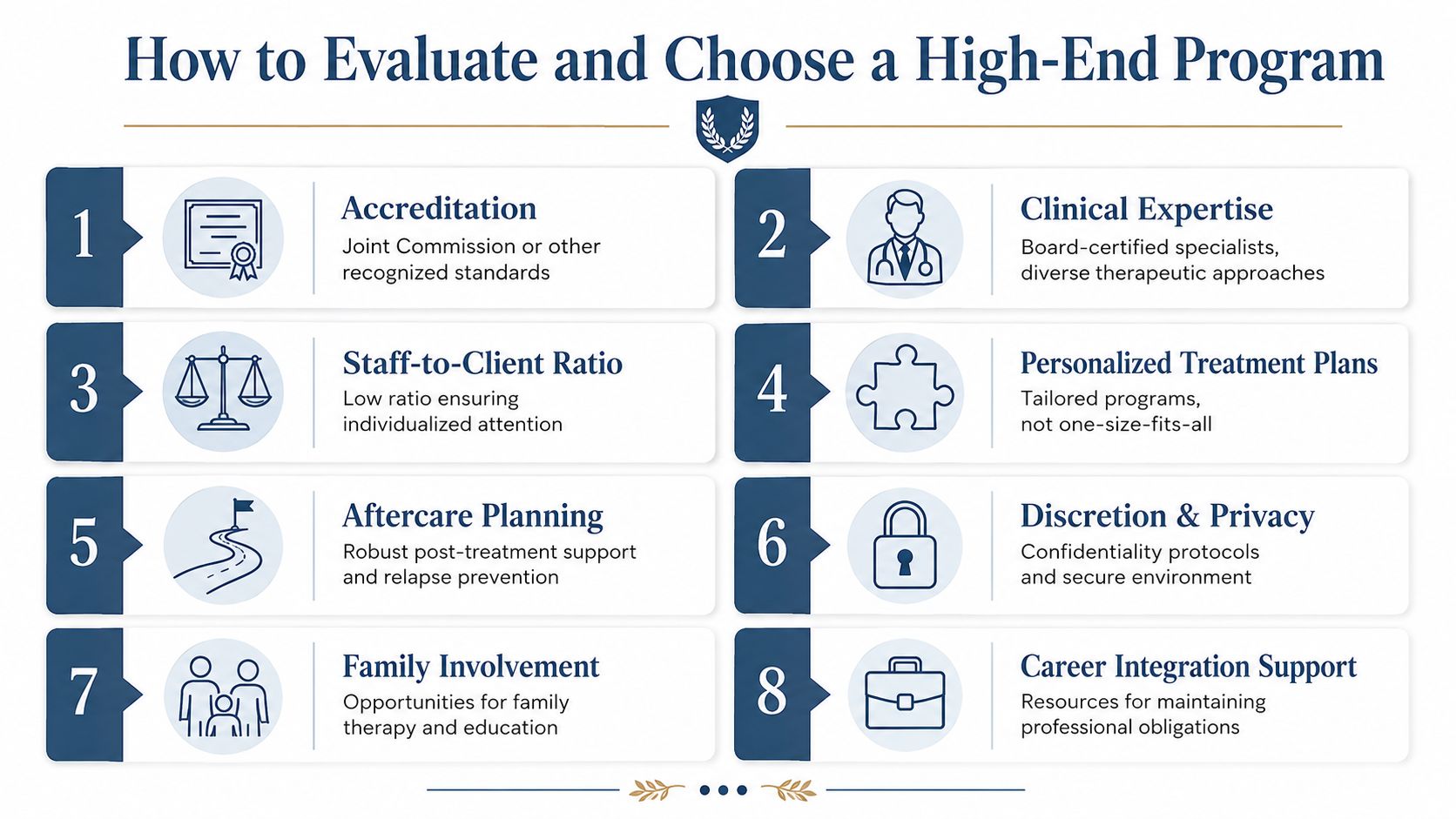
A careful review should cover the following points:
- Accreditation and licensure: Joint Commission accreditation and current state licensure show that the program meets baseline operational and clinical standards.
- Who treats the client: Ask which clinicians will be involved day to day, not just who appears on the website or admissions call.
- Dual-diagnosis capability: The program should be able to explain how it treats substance use, trauma, mood symptoms, anxiety, sleep disruption, and personality factors in the same plan.
- Work-access policy: For executives and public figures, treatment is often only realistic if the program can permit limited, structured contact with business responsibilities without letting work take over the admission.
- Detox capacity and privacy: Clarify whether detox is handled onsite or through transfer, and whether private rooms are standard during both stabilization and residential care.
- Family and relational work: Ask how the program involves spouses, parents, adult children, or key support people when those dynamics are clinically relevant.
- Continuing care: A good discharge process should include specific providers, timelines, and accountability measures, not a generic list of referrals.
One factual example in this category is Reflections, a California-licensed, Joint Commission-accredited luxury rehabilitation provider that offers dual-diagnosis treatment for adults with co-occurring mental health and substance use disorders in a private residential setting. That alone is not a reason to choose it. It is the kind of concrete profile families should look for when they are comparing any serious option.
Questions worth asking on the first call
The first conversation usually tells you a great deal. Strong programs answer directly and with clinical specificity.
| Ask this | Why it matters |
|---|---|
| Who leads the clinical team, and who will the client see each week? | Senior titles mean little without real involvement |
| How do you treat addiction, trauma, anxiety, depression, and sleep problems together? | High-functioning clients often present with several drivers at once |
| Are private rooms standard in detox and residential care? | Privacy affects stabilization, honesty, and retention |
| What is your policy on phones, laptops, and business communication? | Work continuity can support admission or undermine it, depending on the rules |
| How do you decide when to protect privacy and when to challenge avoidance? | High-end care should balance discretion with clinical honesty |
| What does discharge planning include before the client leaves? | Residential progress is harder to keep without a defined next phase |
Watch for evasive answers. Watch for admissions language that focuses on setting, chef-prepared meals, or exclusivity before it explains psychiatric care, therapist access, and how the program handles difficult behavior.
The right high-end program protects privacy, supports appropriate work continuity, and still holds a firm clinical line. That balance is what turns treatment from a temporary interruption into a strategic reset with a real chance of lasting return.
Building a Sustainable Life After Residential Treatment
Residential care can interrupt a crisis. It can clarify diagnosis, stabilize substance use, improve sleep, reduce chaos, and begin trauma work. But the value of a high-end program is measured after discharge, when the client returns to the environments that shaped the problem in the first place.
That is where many treatment episodes either consolidate or unravel.
Why aftercare determines whether treatment holds
High-profile adults often leave treatment and re-enter intense systems immediately. The inbox is full. Family tension is waiting. Public obligations resume. Old social circles reappear. The pace that once helped fuel success can quickly reactivate the same patterns that fed addiction, burnout, and emotional avoidance.
Without a structured continuation plan, the client is left trying to translate residential insights into a live-fire setting alone. That's rarely enough.
A sustainable aftercare plan should include more than a referral list. It should address:
- Ongoing therapy: Continued work with a therapist who understands both the substance use pattern and the underlying mental health drivers.
- Psychiatric follow-up: Medication, sleep, mood, and stress response often need continued monitoring.
- Family involvement: Loved ones usually need education, boundaries, and support of their own.
- Recovery structure: Alumni contact, accountability, and practical relapse-prevention planning help bridge the move back into normal life.
- Professional re-entry planning: The client may need guidance on scheduling, delegation, travel, social obligations, and media exposure.
The transition has to be intentional
Some clients benefit from a gradual return to work intensity. Others need immediate structure around travel, public appearances, or high-risk professional environments. Family offices, assistants, spouses, attorneys, and referring clinicians may all need coordinated guidance, depending on the client's life.
Leaving treatment with no plan is like leaving detox with no diagnosis. Something was started, but nothing was secured.
Good aftercare also keeps the treatment story honest. It reminds the client that recovery isn't a branding exercise or a one-time reset. It is an ongoing practice of living differently under pressure.
What long-term success actually looks like
For high-achieving adults, sustainable recovery often looks quieter than expected. Better sleep. Less secrecy. More reliable mood regulation. More direct communication. Sharper judgment. Fewer hidden crises. A career that is no longer being held together by stimulants, alcohol, self-isolation, or emotional numbness.
That is why entering treatment should be viewed as a long-term investment in personal and professional sustainability, not a temporary retreat. The strongest programs understand that residential care is only one phase of the work. They build a support network that can continue holding the client steady after the protected environment ends.
Reflections provides private, clinically driven residential treatment for adults who need discreet, high-end dual-diagnosis care without losing sight of real-world responsibilities. Those exploring rehab for celebrities, executives, or other high-profile professionals can learn more about the program and admissions process through Reflections.