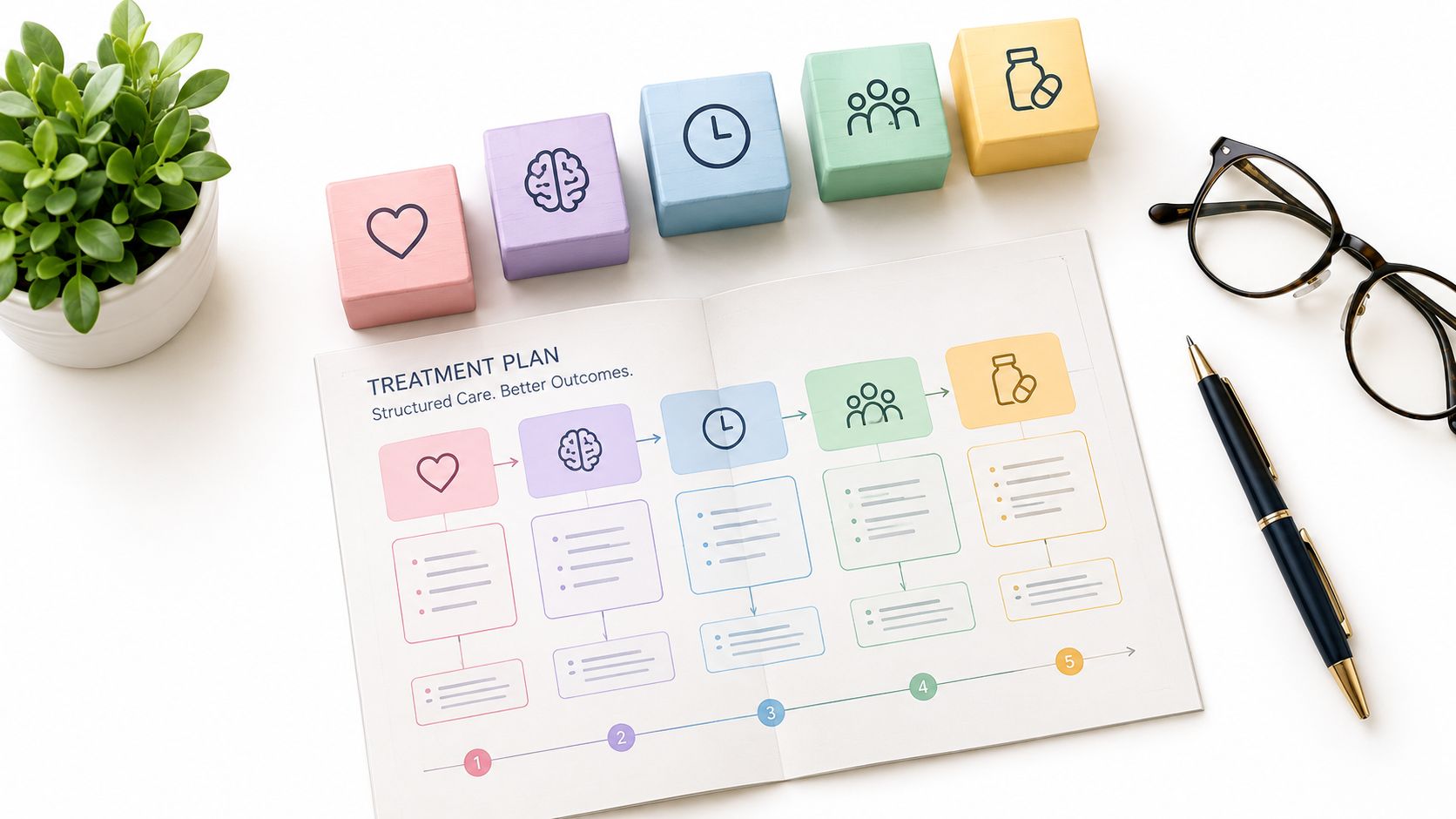

A certain kind of person can keep performing long after their internal systems have started to fail. Colleagues still see composure. Family still sees responsibility. Clients still get replies. But sleep is thin, patience is gone, alcohol or medication has stopped being occasional, and the mind no longer turns off.
That's often when the phrase inpatient mental health starts to sound threatening. For high-functioning professionals, it can feel like a public collapse, a career risk, or an admission that outpatient therapy should have been enough. That framing is wrong.
For the right person, inpatient care isn't a retreat from life. It's a controlled, private intervention that protects what matters most. When done well, it gives a high-achieving adult a secure setting, concentrated clinical attention, and enough structure to stabilize fast without surrendering dignity, privacy, or momentum.
Beyond the Boardroom Recognizing the Need for Deeper Support
A managing partner starts canceling dinners because conversation feels impossible. A founder stops trusting their own judgment because anxiety has become indistinguishable from instinct. A physician keeps showing up to work, but every off-hour is spent numbing out, spiraling, or trying to recover enough energy to do it again the next day.
From the outside, none of that always looks severe. That's the trap.
High-performing adults often stay functional longer than they stay well. They compensate with intelligence, discipline, and image management. They delegate more. They withdraw discreetly. They hide panic behind competence. By the time they search what is inpatient mental health, they're often not asking out of curiosity. They're asking because the current strategy has stopped working.
Why high achievers wait too long
Success distorts the threshold for seeking care. Many professionals assume treatment is only justified when there's dramatic collapse, obvious danger, or total inability to work. That standard is reckless.
A person doesn't need to lose everything before needing a higher level of care. They need it when symptoms have become too destabilizing, too persistent, or too risky to keep managing in fragments between meetings and obligations.
The smartest time to consider inpatient support is before a full crisis forces the decision.
That's especially true when the stakes include leadership responsibility, family strain, substance use, or a pattern of treatment that helps briefly but never fully holds.
A better way to think about inpatient care
For a discerning client, modern inpatient treatment should be viewed less like punishment and more like a strategic medical containment period. Not indefinite withdrawal from real life. Not a bleak holding environment. A focused interval for stabilization, diagnosis refinement, medication review when appropriate, intensive therapy, and recovery of mental clarity.
That's the right frame for executives and professionals who need more than weekly therapy but won't accept chaotic care. The goal isn't to dismantle a capable life. It's to preserve it by treating the mind with the same seriousness that high performers already bring to cardiac health, legal risk, or succession planning.
What Inpatient Mental Health Means Today
What is inpatient mental health? At its clinical core, it means 24/7 psychiatrically supervised care delivered in a hospital or psychiatric unit for people with severe mental illness. The American Psychiatric Association uses that round-the-clock definition, and U.S. national survey data show that in 2020, 77,622 clients received mental health treatment services in inpatient settings on April 30 alone, according to the American Psychiatric Association psychiatric bed report.

That definition matters because it strips away the confusion. Inpatient care is the highest level of psychiatric containment short of emergency intervention. It exists for moments when symptoms are too serious, too volatile, or too disruptive to be managed safely in an office-based model.
For professionals exploring more private, non-hospital options, it also helps to understand how inpatient-level intensity differs from longer-form live-in care offered by residential mental health facilities for adults.
What people get wrong about the term
Many people hear inpatient and picture a fluorescent ward, confiscated belongings, and little more than observation. That stereotype is outdated and incomplete.
The modern executive interpretation of inpatient care should be much more precise. It means a protected environment where a psychiatrist, therapist, nursing staff, and other clinicians can observe symptoms in real time, respond quickly to changes, adjust treatment without delay, and coordinate care throughout the day instead of one appointment at a time.
A useful comparison is this:
| Setting | Core purpose |
|---|---|
| Standard emergency psychiatric response | Immediate safety and short-term containment |
| Executive-focused inpatient approach | Safety, stabilization, diagnostic clarity, and deeper therapeutic reset in a more private setting |
What discerning clients should expect
A high-end inpatient experience shouldn't just monitor distress. It should organize treatment around dignity, privacy, and precision.
That means looking for elements like these:
- Private accommodations: A private room changes the emotional tone of treatment. It protects rest, confidentiality, and basic personal space.
- Multidisciplinary attention: Psychiatric oversight matters, but so do psychology, nursing, family systems work, and substance use expertise when both issues are present.
- Thoughtful environment: Calm surroundings reduce noise, social friction, and overstimulation that can interfere with stabilization.
- Personalized planning: Serious care isn't one-size-fits-all. It should adapt to mood disorders, trauma patterns, anxiety, psychotic symptoms, or dual diagnosis needs.
Practical rule: If a program can't clearly explain how it handles privacy, medication review, family involvement, and step-down planning, it isn't sophisticated enough for a high-stakes client.
Key Indicators for Seeking Inpatient Treatment
Most professionals don't ask whether they need inpatient care until they're already overdue. They keep negotiating with symptoms because they're still technically functioning. That's a poor metric.
The better question is simpler. Has life become organized around managing instability rather than living well?
When outpatient care isn't holding
A high-functioning person may still attend meetings, answer messages, and keep up appearances while their internal state is deteriorating. The problem isn't whether they can force performance for another week. The problem is whether the current treatment level is containing risk, restoring judgment, and creating real traction.
These signs usually mean outpatient care may no longer be enough:
- Work performance has become erratic: Not because of laziness, but because concentration, sleep, or emotional regulation has broken down.
- Depression has become immobilizing: Daily basics start requiring disproportionate effort. Withdrawal increases. Motivation disappears.
- Anxiety is driving decisions: A person stops acting from strategy and starts acting from fear, avoidance, or compulsive control.
- Substance use has become structural: Alcohol, sedatives, stimulants, or other substances are no longer occasional coping tools. They've become part of the daily operating system.
- Past treatment keeps failing: Therapy helps briefly. Medication adjustments help briefly. Then symptoms return with the same force.
A major clue is this: the person still looks capable, but privately knows they're no longer steering well.
Mood symptoms are a common reason
This isn't rare or exotic. In California in 2024, the most common inpatient behavioral-health diagnosis was mood disorders, with 504,840 encounters, according to California behavioral health hospitalization data. Severe depression, bipolar instability, and related mood disruption are central reasons people need this level of care.
That matters for professionals because mood disorders don't always announce themselves dramatically. They often first appear as stalled thinking, depleted resilience, irritability, isolation, or inability to recover between demands.
Waiting for obvious catastrophe is the wrong threshold. Loss of internal control is enough reason to escalate care.
A blunt self-assessment
If a person checks several of these boxes, inpatient evaluation deserves serious consideration:
- They can't reliably get through a day without using something to calm down, numb out, or push through.
- Their relationships are now absorbing the cost of their symptoms.
- Their work image still looks intact, but only because they're spending nearly all available energy maintaining it.
- Their mind feels less flexible, less hopeful, or less safe than it did even a short time ago.
- They've started thinking in terms of endurance rather than recovery.
That's not a character flaw. It's a signal.
For executives, decisive treatment is often the more conservative choice. It protects career continuity, family stability, and long-term cognitive performance better than prolonged denial ever will.
Comparing Standard and Executive Inpatient Care
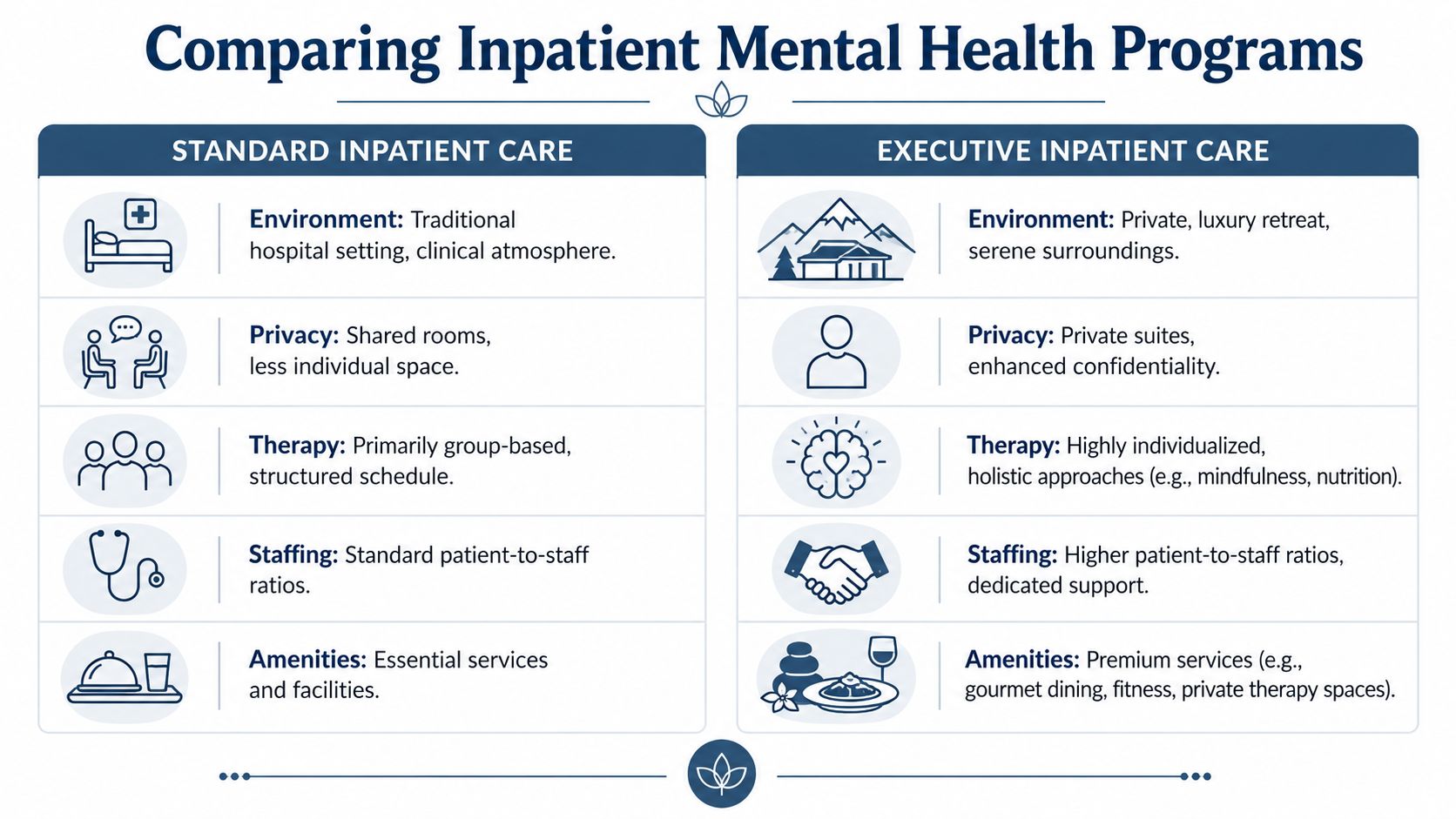
All inpatient care sits under the same broad umbrella, but the lived experience varies dramatically. That distinction matters. A standard hospital-based program and an executive-focused inpatient setting may both provide high-level psychiatric support, yet they're built for different realities.
The clinical baseline is the same. Inpatient care is the most intensive service tier, delivered in a 24-hour, secure, medically staffed environment to reduce near-term risk when symptoms are too unstable for outpatient management, as outlined in inpatient level-of-care clinical criteria. Executive programs build on that baseline with privacy, personalization, and continuity features that matter to professionals.
A broader explanation of those differences appears in this overview of what executive rehab is and how it can help you.
Side-by-side realities
| Decision point | Standard inpatient care | Executive inpatient care |
|---|---|---|
| Primary aim | Acute stabilization and safety | Stabilization plus deeper restoration and high-touch planning |
| Setting | Hospital or highly clinical unit | Private, more discreet, comfort-oriented environment |
| Rooming | Shared or limited personal space | Private rooms or suites |
| Schedule | Rigid, broad, system-driven | Structured but more individualized |
| Professional continuity | Often limited | Managed access may be built into treatment planning |
| Peer environment | Mixed population with varying needs | Often better suited to professionals seeking discretion |
Where executive care changes the experience
For high-profile adults, the difference isn't luxury for its own sake. It's clinical usefulness.
A private room improves sleep, lowers social strain, and protects confidentiality. Controlled access to electronics can make treatment more realistic for someone with unavoidable responsibilities. A calmer setting makes it easier for a burned-out or overstimulated nervous system to settle enough for therapy to work.
Programs should also differ in therapeutic ambition. Standard units often focus on getting a person safe enough to discharge. Executive-level care should ask harder questions: What triggered the collapse in functioning? Is this depression, trauma, bipolarity, addiction, unresolved grief, or a mix of several factors? What has to change so the same crisis doesn't repeat under a new calendar?
What serious buyers should demand
A discerning client should evaluate programs on concrete points, not marketing language.
- Privacy design: Private admission process, protected communication, and confidential accommodations.
- Clinical depth: Real psychiatric involvement, strong individual therapy, and dual-diagnosis capability.
- Flexibility with boundaries: Enough structure to protect treatment, enough customization to fit a complex life.
- Discharge planning: A credible next step, not a vague promise to “follow up later.”
One example in this category is Reflections, a California-licensed, Joint Commission-accredited luxury provider for adults with co-occurring mental health and substance use disorders that includes private rooms, multidisciplinary treatment, and appropriate access to electronics as part of care planning.
What to Expect During Your Stay
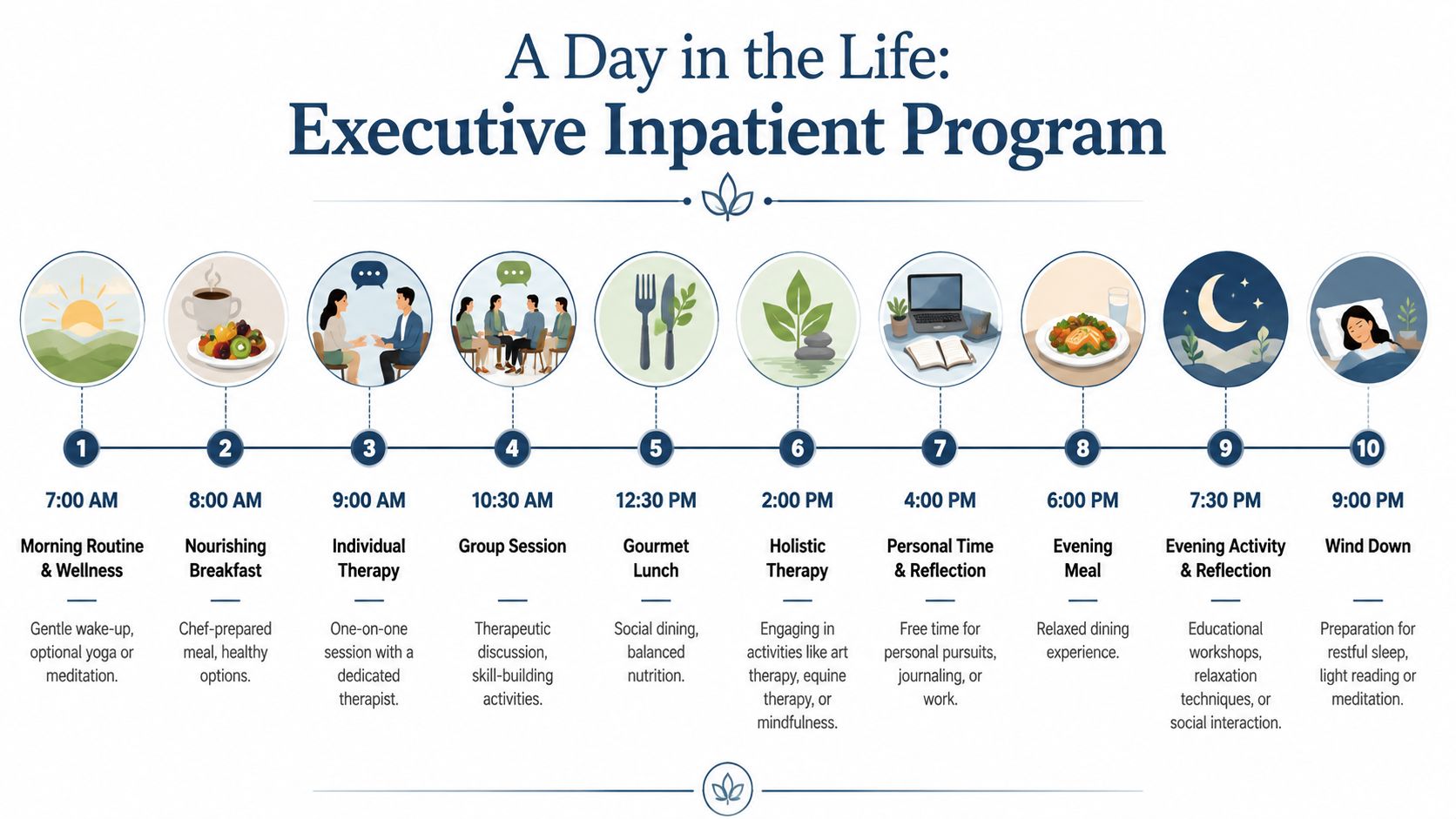
The daily rhythm in an executive inpatient setting should feel structured, not punitive. The point is to lower chaos, sharpen observation, and create enough consistency for the brain and body to respond to treatment.
That doesn't mean lying in a room waiting for medication rounds. It means a carefully planned day with therapy, clinical check-ins, wellness support, privacy, and selected time for personal responsibilities when appropriate.
A day that balances treatment and continuity
A typical day may have a calm beginning. The resident wakes in a private room, has breakfast, and enters the day without the usual barrage of demands. That alone can be therapeutic for someone whose nervous system has been running on urgency for months or years.
The morning often includes an individual session focused on the immediate drivers of instability. That may involve depression, panic, trauma responses, bipolar symptoms, or compulsive substance use patterns. Group work later in the morning can reinforce skills without turning the day into a lecture circuit.
Afternoons usually broaden the lens. A psychiatrist may review medication strategy. A therapist may introduce somatic work, mindfulness, or another experiential modality that reaches symptoms intellectual insight alone hasn't moved. For clients with work obligations, there may be designated windows for carefully managed contact with the office or family.
According to NewYork-Presbyterian adult inpatient psychiatric services, modern executive programs can integrate specialized tracks for dual diagnosis with multidisciplinary therapy, medication optimization, and family involvement, while supporting continued, structured contact with work and loved ones.
What the treatment day should include
The strongest programs don't rely on one modality. They coordinate several.
- Individual psychotherapy: Focused work on the patterns driving symptoms, not just the symptoms themselves.
- Psychiatric oversight: Ongoing review of diagnosis, medication fit, side effects, and response.
- Group process with standards: Small, well-facilitated groups can reduce isolation and sharpen self-awareness.
- Family or partner involvement: When handled well, this improves alignment and lowers the chance of post-discharge confusion.
- Protected personal time: Reflection, rest, reading, journaling, and decompression matter.
Professionals often benefit from practical communication support during this phase. For example, guidance on effective relationship communication can help clients prepare for difficult conversations with spouses, partners, or family members once emotional defenses start to lower.
Treatment works better when a person doesn't have to choose between honesty and dignity.
What should not happen
An executive inpatient stay shouldn't infantilize the client. It shouldn't erase autonomy without reason. It also shouldn't become a loophole for staying half-engaged in work while avoiding the clinical work entirely.
The right model is disciplined flexibility. Work access, family contact, exercise, rest, and therapy should all serve one objective. Stabilization strong enough to support a real return to life, not a cosmetic pause.
Confidentiality and Continued Professional Engagement
For executives, confidentiality isn't a preference. It's infrastructure. If a program treats privacy like a minor administrative issue, it isn't designed for high-stakes adults.
Legal confidentiality protections matter, but serious clients should look beyond legal minimums. A key question is how a facility handles discretion operationally. That includes admissions, records, communication, staff boundaries, room assignments, transportation coordination, and the way family or professional contacts are managed.

Privacy should be active, not symbolic
A discreet program should think through details that public-facing programs often can't prioritize. That may include private rooms, limited-visibility admission processes, clear consent practices, and communication protocols that prevent unnecessary exposure.
Confidentiality also depends on culture. Staff should understand that high-profile clients aren't asking for special treatment. They're asking for competent containment of reputational, family, and business risk while they receive medical and psychological care.
Privacy protects treatment. When clients feel exposed, they edit themselves. When they edit themselves, treatment slows down.
Work continuity can be therapeutic when handled correctly
Many professionals fear that entering care means vanishing from their responsibilities without warning. In a strong executive program, continued professional engagement can be structured rather than forbidden.
That doesn't mean unrestricted screen time or constant inbox monitoring. It means clinically guided access. A resident may need to handle a board message, coordinate a temporary delegation plan, or reassure key family members. Done properly, that contact reduces panic and supports engagement in treatment.
A useful overview of that balance appears in this discussion of working from rehab.
The standard should be simple. Work must not run treatment. Treatment should decide when and how limited work contact serves recovery, rather than sabotaging it.
Your Next Chapter After Inpatient Care
An inpatient stay should never be treated as the whole answer. It's the stabilization phase. The handoff that follows determines whether progress holds.
That's why informed clients should ask about discharge planning before admission, not after. If a program can't describe the next level of care, relapse prevention strategy, family coordination, and ongoing therapeutic support, it's selling an isolated episode instead of a recovery model.
The real purpose of inpatient care
Expert sources note that a primary goal of inpatient programs is stabilizing symptoms and preparing patients for ongoing treatment after discharge, making follow-up care essential, as described in this overview of what to expect from inpatient behavioral health hospitalization.
That's the right expectation for professionals. Inpatient care creates traction. It doesn't replace the longer work of building a healthier life.
A strong next chapter may include:
- Step-down treatment: A move into residential, partial hospitalization, or intensive outpatient care, depending on clinical need.
- Psychiatric follow-up: Ongoing medication monitoring when medication is part of the plan.
- Individual therapy with continuity: Work that deepens the insight and momentum built during the stay.
- Family alignment: Clear expectations, communication boundaries, and support roles at home.
- Professional reintegration planning: A realistic return-to-work structure instead of an abrupt jump back into overload.
The right outcome
The goal isn't to emerge polished and instantly optimized. The goal is stronger judgment, steadier mood, better insight, and a treatment structure that supports durable functioning.
For high-achieving adults, that often means returning to work with more restraint, clearer boundaries, and less dependence on adrenaline, avoidance, or substances. It means protecting performance by no longer sacrificing mental health to sustain it.
A well-designed inpatient experience doesn't interrupt a meaningful life. It gives that life a better chance to continue.
Reflections offers private-pay, California-licensed dual-diagnosis treatment for adults who need discreet, high-touch care with room for both clinical depth and continued connection to work and family. Those evaluating whether a private inpatient-style setting fits their situation can explore Reflections for details on private rooms, electronics access, multidisciplinary treatment, and continuing care options.