
A family often reaches this search in the same condition. The executive is still taking calls, still replying to email, still showing up polished and functional. Behind that surface, sleep has collapsed, anxiety is climbing, alcohol or medication use is becoming harder to hide, and home life is straining under the weight of constant pressure.
That profile doesn't need generic advice. It needs a precise decision.
For high-net-worth adults, the right residential setting can protect privacy, stabilize mental health, address substance use if it's part of the picture, and preserve enough continuity with work and family that treatment feels possible. The wrong setting creates new problems. It can be too restrictive, too thin clinically, too chaotic, or too dismissive of the professional realities that brought the person to treatment late in the first place.
When Success Hides a Struggle
The outward story is usually impressive. A founder closes deals while panic builds in the background. A physician keeps performing at a high level but drinks every night to shut off. A lawyer with severe depression hasn't missed a deadline, yet can't get through a weekend without isolation, irritability, and emotional collapse. A spouse or business partner notices the shift long before the individual admits it.
That pattern is dangerous because success can camouflage decline.
High performers often delay treatment for one reason above all others. They assume the available options were designed for someone else. They picture a hospital, a forced disappearance from work, shared rooms, a loss of control, and exposure they can't afford socially or professionally. So they keep managing, until management stops working.
The decision to enter treatment isn't an act of retreat. For many professionals, it's the first competent response to a problem that has outgrown self-discipline.
Why standard advice fails this audience
A working professional with public visibility, financial responsibility, or fiduciary obligations has different requirements from a typical consumer searching for care. Privacy matters more. The quality of the clinical team matters more. The environment matters more. The ability to keep limited, structured access to devices may matter enough to determine whether treatment happens at all.
That's where executive-focused residential mental health facilities for adults become relevant. They are not just prettier versions of ordinary programs. The good ones are built around a more demanding reality: the client may need trauma treatment, psychiatric evaluation, and dual-diagnosis care while still maintaining selective contact with family, legal counsel, or key business personnel.
What the best decision looks like
The right placement gives the client containment without humiliation. It creates enough structure to interrupt destructive patterns, but not so much rigidity that the person spends the whole stay fighting the setting instead of doing the work.
A serious executive program should feel like a protected clinical environment, not an institutional punishment. That distinction determines engagement. And engagement determines whether treatment addresses the core drivers of the crisis, or just pauses them briefly.
Understanding Your Treatment Options
Not every adult who's struggling needs residential care. But many high-achieving adults waste months in the wrong level of care because they choose based on convenience, image, or fear of disruption instead of clinical fit.
That mistake is costly. The U.S. system is already strained. HHS notes high utilization of inpatient and residential beds, which means access is tight and the initial level-of-care decision matters because moving later can be difficult (HHS issue brief on treatment need and system capacity).
The practical differences that matter
Outpatient care works when the person is safe, stable enough to live at home, and able to do honest therapeutic work without being derailed by access to substances, nonstop stress, or a deteriorating home environment.
Inpatient care serves a different purpose. It is for acute stabilization when risk, severity, or medical complexity requires a hospital setting. It is necessary when safety comes first and ordinary life must stop immediately.
Residential treatment sits between those two. It offers 24-hour structure outside a hospital and is often the most sensible option when the person needs more than weekly therapy but doesn't require inpatient crisis management. For professionals, the executive model matters because some programs can accommodate controlled work continuity and privacy in ways standard settings often don't.
For readers evaluating this level of care, residential treatment options at Reflections show the basic structure of a residential model built for adults with complex needs.
Comparing Care Levels for Professionals
| Feature | Outpatient | Inpatient | Executive Residential |
|---|---|---|---|
| Intensity | Lower. Best for stable clients who can function safely at home | Highest. Designed for acute stabilization | High. Immersive treatment without hospital-level restriction |
| Life disruption | Lowest, but daily stressors remain active | Complete pause on normal responsibilities | Significant, but some programs allow selective continuity |
| Privacy | Depends on local providers and commuting logistics | Limited by hospital routines and setting | Usually stronger when the program is private and discreet |
| Work continuity | Easiest to maintain, hardest to protect boundaries | Usually not realistic | Sometimes possible with structured electronics access |
| Best fit | Mild to moderate symptoms, good supports, low immediate risk | Crisis, severe instability, safety concerns | Complex symptoms, burnout, dual diagnosis, relapse risk, declining function |
A direct recommendation
If an adult is still performing publicly but deteriorating privately, outpatient care is often too weak and inpatient care is often too blunt. Executive residential care is usually the better call when the person needs depth, containment, and enough flexibility to keep treatment from colliding head-on with a professional life.
Practical rule: Choose the setting that can manage the real risk, not the setting that looks least disruptive on paper.
The Pillars of Clinically Excellent Treatment
Luxury without clinical depth is an expensive distraction. The facility can be quiet, beautiful, and private, but if the treatment model is generic, the stay won't hold.
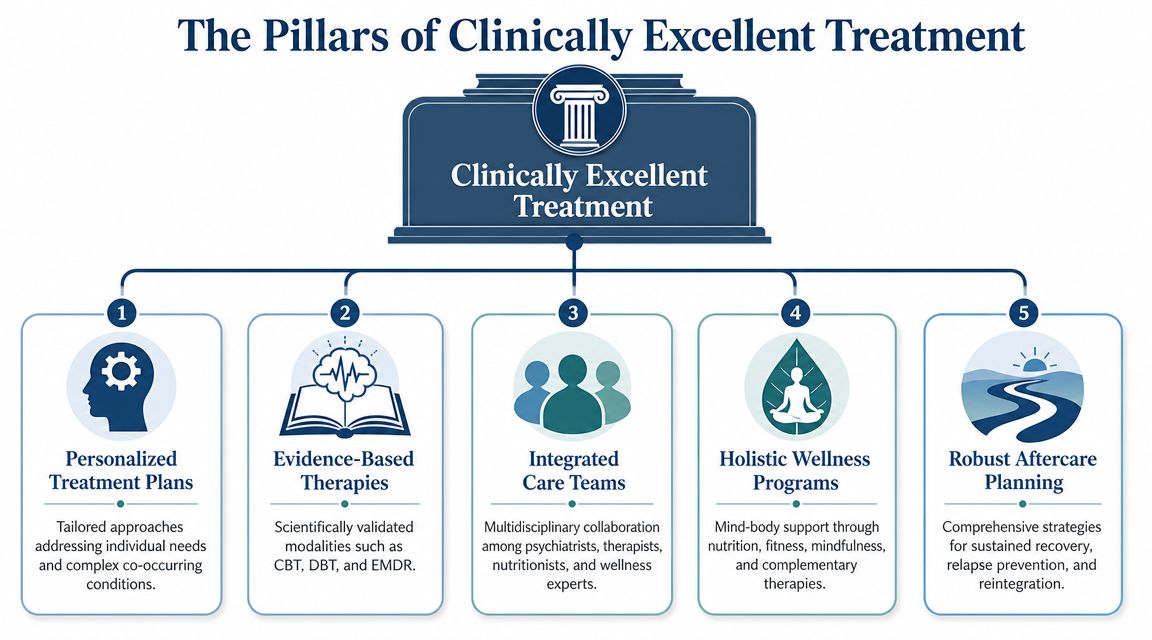
The strongest residential mental health facilities for adults are organized around a few essential principles. These are the elements that separate true treatment from upscale lodging with therapy attached.
Dual-diagnosis capability isn't optional
A residential program for adults must be able to treat mental health conditions and substance use together when both are present. That isn't a niche issue. SAMHSA's 2020 national survey estimated that 22% of clients in mental health treatment had co-occurring mental health and substance use disorders, and 21% of all mental health treatment facilities were operated by private for-profit organizations (SAMHSA 2020 National Mental Health Services Survey).
That data matters because plenty of facilities market themselves well. Not all of them have integrated clinical sophistication.
A strong dual-diagnosis program should be able to answer clear questions:
- How are psychiatric symptoms evaluated alongside substance use? Depression, trauma, bipolar symptoms, anxiety, and compulsive substance use often interact. Treating one while minimizing the other is poor medicine.
- Who manages medication decisions? A credible program has psychiatric oversight, not vague promises about “support.”
- What happens if withdrawal, cravings, or relapse risk complicate therapy? The team should have an actual protocol, not optimism.
Evidence-based therapies should be visible in practice
The right therapies aren't buzzwords. They solve distinct problems.
- CBT helps clients identify and challenge distorted thinking that drives anxiety, depression, shame, and self-defeating behavior.
- DBT is especially useful when emotional regulation is weak, impulses are strong, or relationships are volatile.
- ACT helps clients stop organizing their lives around avoidance and start acting from values even when discomfort is present.
- Trauma-informed treatment, including EMDR when appropriate, addresses the unresolved experiences that often sit beneath substance use, perfectionism, panic, and chronic overcontrol.
If a program can't explain when and why it uses these modalities, it likely isn't practicing them with much precision.
One example of a program page that outlines an integrated, adult-focused clinical model is mental health treatment at Reflections.
The team matters more than the brochure
Titles alone don't mean much. Families should look for a multidisciplinary structure that includes psychiatry, licensed therapists, addiction specialists when indicated, and clinicians who can work with trauma, mood disorders, personality patterns, family dynamics, and professional burnout without reducing everything to stress management.
An expert team doesn't chase symptoms one by one. It forms a working formulation. Why this person. Why now. What's driving the collapse. What supports genuine stabilization.
A polished admissions call means very little if the program can't name who will actually treat the case, how often, and with what clinical approach.
Accommodations That Support Executive Recovery
For this client population, amenities aren't cosmetic. They are part of the treatment strategy.
A private room lowers social strain, protects confidentiality, and gives the client enough decompression space to stay engaged. Good nutrition, exercise options, quiet surroundings, and a physically calm environment reduce noise and friction. High-performing adults often arrive overstimulated, sleep-deprived, physically run down, and suspicious of treatment. The environment should lower resistance, not amplify it.

Why electronics access can be clinically smart
Many traditional programs remove phones and laptops across the board. That policy can make sense in some populations. It isn't automatically the right move for executives, owners, public figures, and professionals whose responsibilities cannot be set aside.
Independent coverage of residential versus inpatient care notes that some residential facilities are built around partial continuity and controlled outside contact for high-functioning adults whose safety and relapse profile allow it. That's the key distinction. Controlled access, not unlimited access.
For the right client, device access can reduce panic about abandoned obligations and make treatment possible in the first place. It also allows the clinical team to work on boundaries in real time. That's more useful than pretending the outside world doesn't exist.
What executive accommodations should actually accomplish
A premium setting should support three outcomes:
- Containment without exposure so the client can recover without unnecessary contact, noise, or loss of dignity.
- Selective continuity so urgent family or professional communication can happen within a treatment framework.
- Reduced treatment resistance because the client isn't battling avoidable discomforts like shared living, poor sleep conditions, or chaotic surroundings.
Travel planning matters too. Families coordinating a discreet admission from another region often need to think through timing, privacy, and reduced friction during transport. For those evaluating that piece of the logistics, this guide to understanding family private jet benefits is a useful resource.
For readers assessing what an executive-capable environment looks like in practice, private residential accommodations at Reflections provide a concrete example of the standard to look for.
Vetting a Facility for Quality and Discretion
A beautiful website is irrelevant. The essential question is whether the facility can protect the client, treat the case correctly, and operate with discretion under pressure.
Families should evaluate a program the way they'd evaluate any high-stakes advisor. Credentials first. Process second. Security, privacy, and staffing details immediately after that.
Start with legitimacy
There are a few questions that should be answered directly, without sales language.
- Is the program licensed? A residential provider should be operating under the appropriate state framework.
- Is it accredited? Accreditation signals that an external body has reviewed systems, policies, and standards.
- Who leads treatment? The facility should identify clinical leadership clearly.
- Who will work the case? Families should ask for the credentials of the treating professionals, not just executives on the organization chart.
Good programs won't be annoyed by due diligence. Weak ones usually become vague.
Ask for clinical specifics
A serious admissions conversation should cover the following:
- Primary psychiatric concerns. Anxiety, depression, trauma, bipolar symptoms, personality structure, and substance use should all be discussed plainly.
- Medication philosophy. Some clients need optimization. Some need simplification. A thoughtful program can explain its approach.
- Therapy frequency and format. Families should know how much individual therapy, group work, and family involvement are included.
- Work and device policy. “Allowed case by case” is too vague. The program should explain how access is structured and supervised.
- Discharge planning. If aftercare isn't part of the conversation early, the program is already behind.
The safest facility isn't the one that promises everything. It's the one that answers difficult questions with precision.
Understand the private pay model
For affluent families, private pay isn't just a financing method. It can be a strategic choice.
It often allows more flexibility in treatment planning, less pressure to fit care into insurance-driven formulas, and stronger privacy. For certain clients, that privacy is paramount. The family may want to limit administrative visibility, avoid unnecessary disclosures, and choose a setting based on fit rather than reimbursement.
The investment should buy something tangible:
- More individualized attention
- A quieter and more controlled setting
- Experienced clinicians
- Stronger accommodation for complex lives
- A higher standard of discretion
Security should also be part of the evaluation. High-profile clients may need more than ordinary front-desk procedures. Families looking at the physical and operational side of protection may find this overview of a modern health care security strategy helpful when thinking through access control, visitor management, and incident prevention.
The Admission Process and Planning for Aftercare
The admission process at a credible residential facility should feel private, clinical, and efficient. It shouldn't feel theatrical or bureaucratic.
A proper intake starts with confidential assessment. The team should clarify symptoms, substance use if relevant, safety concerns, medical needs, psychiatric history, work realities, and family context. The point isn't to “close” the admission. The point is to decide whether the placement is appropriate and what conditions need to be in place on day one.
What a strong admission process includes
- Clinical fit review so the program can determine whether residential care is appropriate.
- Operational planning for travel, arrival timing, device policy, and communication boundaries.
- Family coordination when spouses, parents, assistants, or legal advisors need limited involvement.
- Immediate treatment priorities such as psychiatric evaluation, detox needs, sleep restoration, and crisis containment.
That early clarity matters because adults with demanding lives don't benefit from generic intake. They benefit from a treatment plan that recognizes what must stop, what can continue carefully, and what needs to be rebuilt from the ground up.
Aftercare starts immediately
Residential treatment is a concentrated intervention, not a complete life solution. The gains won't hold unless the facility builds a re-entry plan from the beginning.
That aftercare plan may include step-down care, outpatient therapy, psychiatric follow-up, family work, sober support when indicated, relapse-prevention planning, and structured accountability around work re-engagement. For executives, the return to normal life is often the highest-risk phase. The same environment that rewarded overwork, concealment, and emotional suppression will still be there.
A top-tier facility prepares the client for that reality instead of sending them home with generic encouragement.
Discharge shouldn't mark the end of treatment. It should mark the beginning of a controlled return to a high-pressure life with better structure, better insight, and better guardrails.
Your Executive Treatment Checklist
A facility should be able to answer these questions quickly and clearly. If it can't, the family should keep looking.
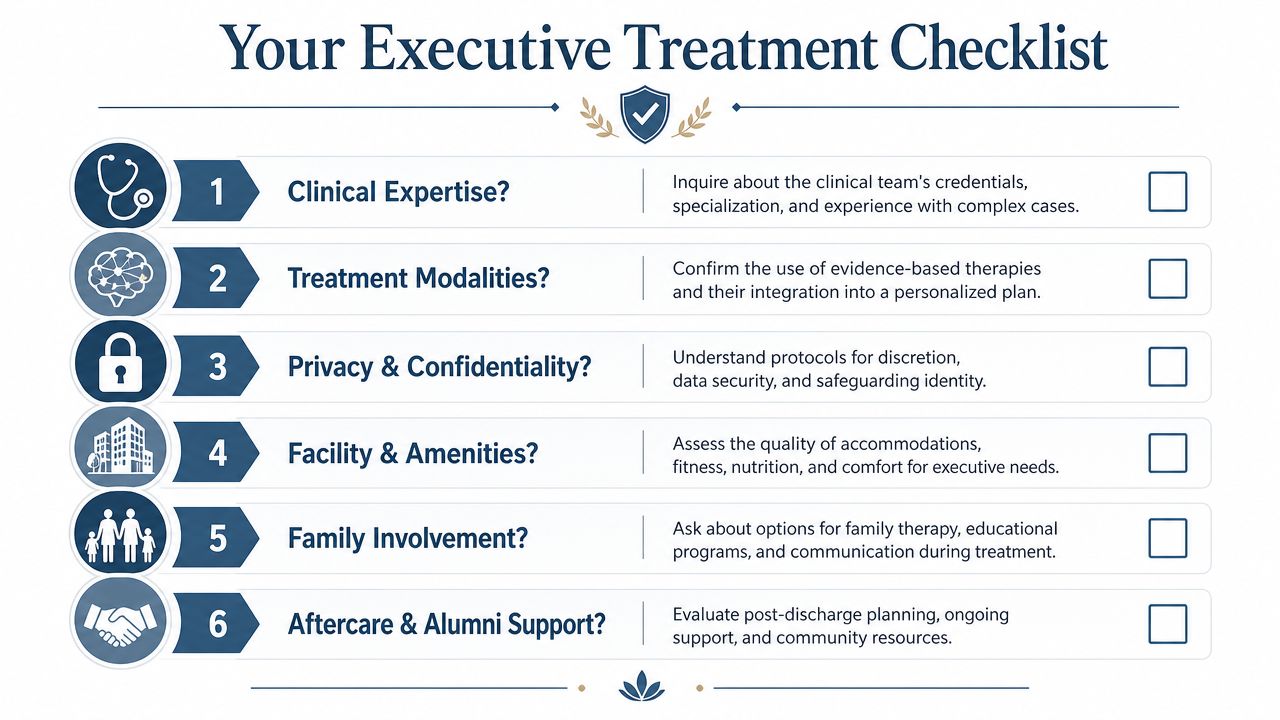
- Who is the lead clinician for this case? Ask for degrees, licensure, and relevant experience with trauma, mood disorders, personality patterns, and dual diagnosis.
- How much individual therapy is provided? Marketing language is meaningless without a concrete schedule.
- How is psychiatric care handled? Medication review and ongoing oversight should be built into treatment.
- What is the electronics policy? Families need the exact rules for phones, laptops, work access, and outside communication.
- Are private rooms available? For many executives, privacy is part of treatment compliance.
- How does the program involve family? Family sessions and education often determine whether progress holds.
- What happens after discharge? Ask for specifics on continuing care, referrals, alumni contact, and relapse-prevention planning.
- How does the facility protect confidentiality? Privacy protocols should be operational, not just promised.
For families seeking a discreet, private-pay residential option for adults with co-occurring mental health and substance use concerns, Reflections offers California-licensed, Joint Commission-accredited care in a luxury residential setting with private rooms, integrated dual-diagnosis treatment, family involvement, and structured access to electronics for clients who need continuity with work or family responsibilities.