

A board meeting starts in an hour. The phone is already buzzing. A private equity partner wants revisions. A spouse has stopped asking whether everything is fine and has started watching instead. Outwardly, nothing has slipped. The presentation will still be polished, the email replies will still go out, and the social calendar will still look intact.
Privately, the structure is failing.
For high-achieving adults, distress rarely looks dramatic at first. It looks efficient. Sleep gets cut. Alcohol becomes a nightly off-switch. Stimulants become a morning requirement. Anxiety gets explained away as pressure tolerance. Depression hides behind overwork. Trauma shows up as irritability, numbness, or a need to control every variable in the room. A professional can keep performing long after the cost becomes dangerous.
That's why residential treatment for adults often enters the picture later than it should. Many executives don't avoid care because they lack insight. They avoid it because the usual image of treatment feels incompatible with the life they've built. They assume treatment means disappearance, public exposure, loss of authority, or a complete break from responsibilities.
In a properly designed executive setting, it doesn't have to mean any of those things.
High-end residential care is not a retreat from reality. It's a protected environment where clinical work happens with enough depth, privacy, and structure to interrupt a pattern that outpatient care can no longer contain. For professionals with co-occurring mental health and substance use concerns, the right program preserves dignity, protects confidentiality, and makes recovery operationally possible.
When High Performance Meets an Unseen Struggle
The executive profile often confuses families, colleagues, and sometimes clinicians. The person is still closing deals, still leading teams, still showing up in sharp attire and speaking in complete sentences. That can make serious impairment easy to miss.
But functional isn't the same as well.
A high-performing adult may be drinking more than intended every night and still making every meeting. A founder may rely on prescribed medication in a way that started as treatment and has become dependency. A physician, attorney, or C-suite leader may look composed in public while cycling through panic, insomnia, resentment, and emotional exhaustion in private. Because they can still produce, people around them often underestimate the severity.
The signs professionals tend to dismiss
Executives rarely describe the problem as “needing rehab.” They describe consequences.
- Decision fatigue: Routine choices feel harder, and reactions become sharper or flatter than usual.
- Secret management: More energy goes into hiding use, mood instability, or withdrawal than into actual recovery.
- Performance distortion: Work output may remain high, but judgment, patience, and relational steadiness begin to erode.
- Failed self-corrections: Limits are set on Sunday and broken by Wednesday.
- Shrinking life: Work remains, but sleep, family, health, and genuine pleasure disappear.
A person can look highly disciplined from the outside while losing control in every private corner of life.
This is the moment when residential treatment for adults becomes less about crisis branding and more about strategic containment. If outpatient therapy, medication management, coaching, or self-directed attempts haven't changed the pattern, a more immersive level of care may be necessary.
For professionals, the central question isn't whether they're strong enough to avoid treatment. It's whether their current system is still reliable. When the answer is no, protecting a career often requires addressing the condition directly, before it creates legal, financial, relational, or medical fallout.
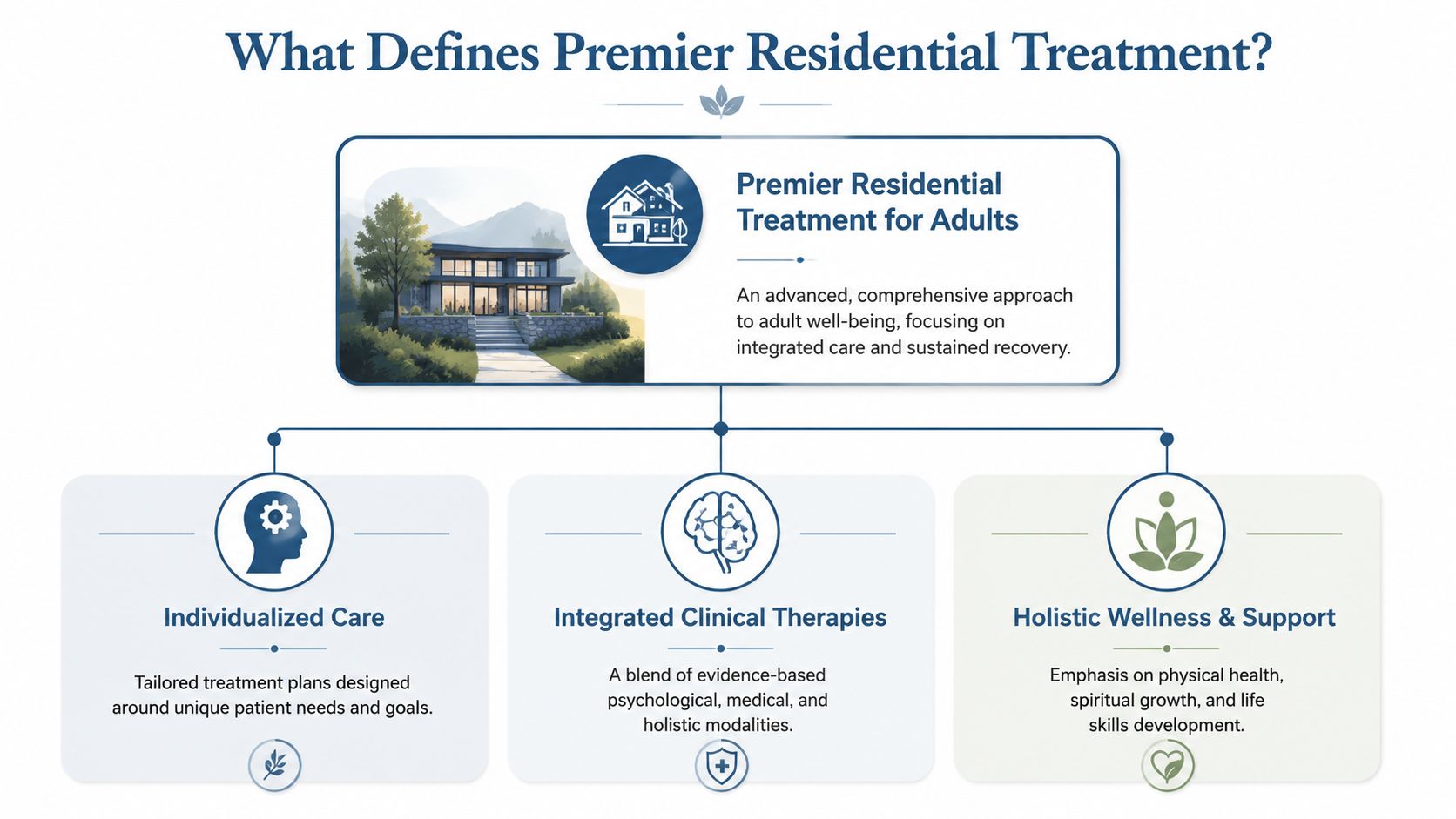
What Is Premier Residential Treatment for Adults
Residential treatment for adults is a 24-hour living environment that provides clinical services for mental health and substance use disorders, with continuous supervision, structured daily programming, and on-site support that place it above standard outpatient care in the treatment continuum, as outlined in the HHS overview of adult residential treatment.
That definition is the floor, not the ceiling.
Premier residential treatment takes the same core level of care and changes the conditions under which healing happens. The difference is similar to the gap between basic lodging and a fully staffed private property. Both provide a bed. Only one is designed around privacy, responsive service, calm, and individualized attention.
What makes it premier
A high-end program isn't defined by aesthetics alone. The setting matters, but comfort without clinical rigor is just expensive avoidance.
Premier care usually includes:
- Private, quiet living space: Professionals often need a room where they can decompress, regulate, and maintain dignity.
- Integrated assessment: Co-occurring conditions are evaluated together, not in silos. Substance use, anxiety, depression, trauma, sleep disruption, and medication issues often interact.
- Customized scheduling: The day is structured, but not treated like a generic boot camp.
- Discreet operations: Admissions, communication, and family coordination are handled with confidentiality in mind.
- Clinical depth with executive realism: Treatment addresses performance identity, perfectionism, stress exposure, and chronic overfunctioning.
For readers comparing settings, residential mental health facilities for adults can differ substantially in privacy, staffing model, and whether they're equipped for dual-diagnosis complexity.
What it is not
Premier residential treatment is not a vacation with therapy attached. It's also not a punitive environment where adults are stripped of autonomy for appearance's sake.
A weak program often makes one of two mistakes:
| Approach | What goes wrong |
|---|---|
| Hospital-like rigidity | The environment becomes sterile, impersonal, and poorly suited to adults who need reflection, trust, and nuanced care |
| Luxury without structure | The setting is attractive, but the treatment plan lacks intensity, accountability, and measurable clinical direction |
Practical rule: If a program can describe its linens in detail but can't clearly explain how it treats trauma, relapse risk, and co-occurring psychiatric symptoms, it isn't offering premier care.
The right model protects the client from chaos without infantilizing them. It creates enough containment for detoxification, stabilization, and insight, while preserving the basic respect a successful adult expects and deserves.
Designed for the Discerning Professional
Executives don't just bring symptoms into treatment. They bring reputational risk, complex calendars, financial responsibility, and an ingrained conditioned belief that stepping away equals failure. Generic residential programming often misses that psychology.
That mismatch matters. Treatment works better when the environment fits the person entering it.
Why executives need a different model
The pressure profile of a senior professional is distinctive. Privacy concerns are sharper. The consequences of abrupt disappearance may be wider. Many are carrying both public leadership and private caretaking roles at the same time.
They also tend to present with layered problems rather than a single diagnosis. Substance use may sit on top of untreated trauma. Burnout may mask depression. Anxiety may drive alcohol use, and alcohol may worsen sleep, irritability, and executive function. A program that treats only the visible symptom usually gets a shallow result.
The secured residential treatment overview for adults with higher acuity needs makes an important distinction: the most effective placement matches the level of care to the person's complexity. An executive with dual diagnosis needs a different model than an adult with severe and persistent mental illness, major cognitive impairment, or developmental disability who may require a more specialized residential framework.
Who fits this level of care
A premier executive-focused program is often appropriate for adults who are:
- Still functioning publicly but declining privately
- Using substances to regulate stress, mood, or sleep
- Experiencing anxiety, trauma symptoms, depression, or bipolar-spectrum concerns alongside substance use
- Unable to gain traction in weekly therapy or lower levels of care
- Needing confidentiality and a highly individualized setting
It may be the wrong fit when the person needs a secured environment, extensive behavioral support related to cognitive limitations, or a residential model built around severe long-term psychiatric disability rather than executive reintegration.
The real selling point is fit, not status
Luxury features matter because they remove barriers. They don't replace treatment. For high-functioning adults, private rooms, discreet admissions, and a more refined environment reduce resistance and make it easier to accept care without shame. But the core value is that the clinical model understands high performers.
The goal isn't to make treatment feel indulgent. It's to remove unnecessary friction so the client can actually engage.
Professionals often respond well when treatment respects competence while confronting denial. They need directness, not theatrics. They need clinicians who can identify when “I'm just under pressure” is accurate, and when it's a polished defense against a condition that's already taking over.
The Pillars of Elite Clinical Care
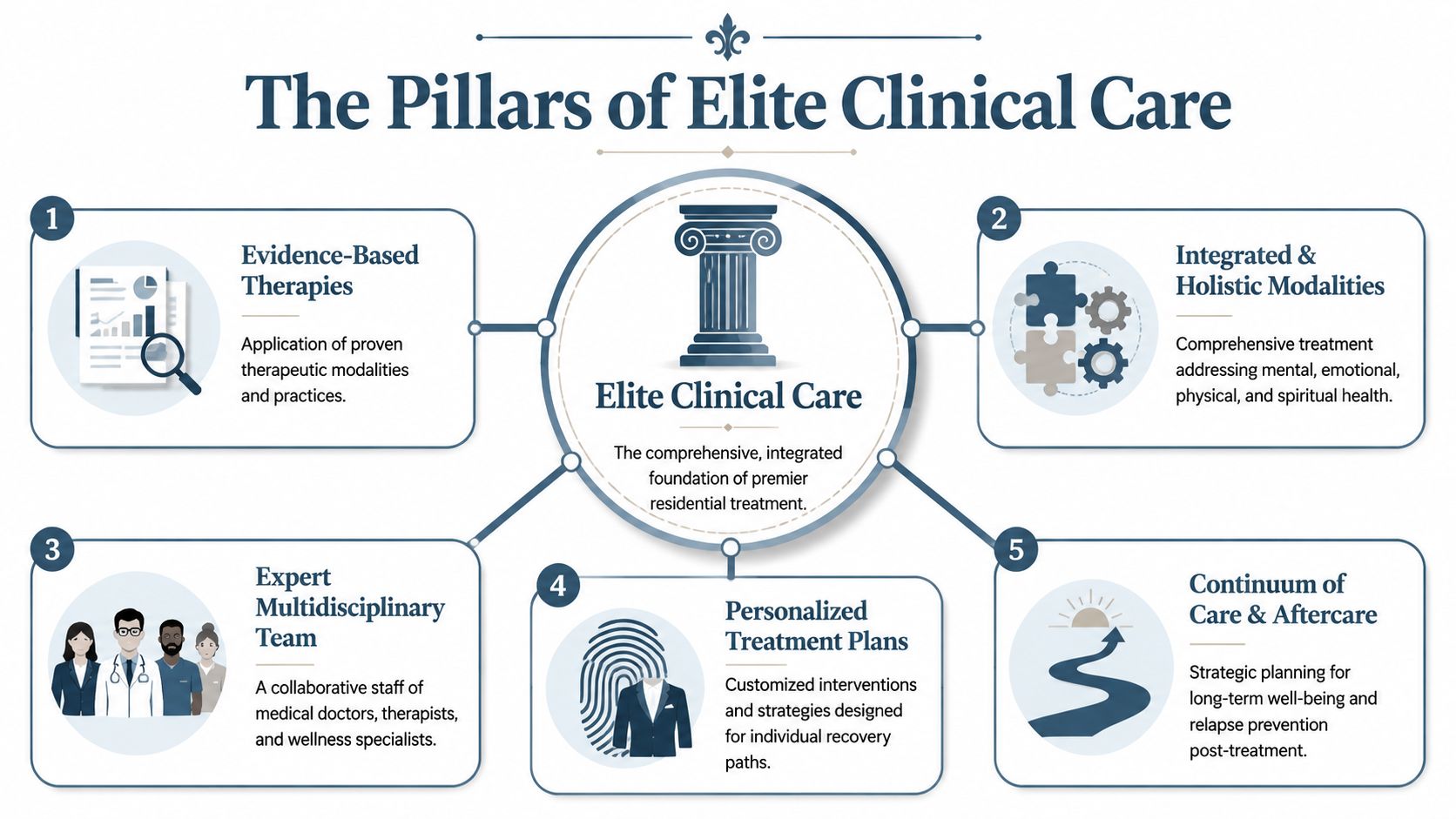
The clinical core of residential treatment determines whether a stay produces temporary relief or durable change. Comfortable housing helps a client settle in. Skilled treatment changes the trajectory.
An HHS environmental scan found that adult residential providers commonly deliver serious clinical services, including psychotropic medications at 80% of facilities, group psychotherapy at 65%, individual psychotherapy at 60%, cognitive behavioral therapy at 58%, and integrated dual-disorders treatment at 44%, according to the HHS environmental scan on adult residential behavioral health services. Those numbers show that residential care is not peripheral support. It's a clinically intensive level of service.
Private detox and stabilization
For some adults, treatment starts with medically managed withdrawal. In executive populations, this phase is often delayed because the person is still “functioning.” That doesn't make withdrawal risk less real.
A well-run detox setting should provide close medical oversight, psychiatric input when indicated, and a private room that reduces stimulation and preserves dignity. This matters clinically. Agitation, insomnia, panic, shame, and uncertainty can all spike in early abstinence. If the environment is chaotic, the client may disengage before deeper treatment begins.
Sophisticated psychotherapy
Elite care goes beyond symptom discussion. It identifies the mechanisms that keep the cycle in place.
That usually includes a combination of:
- Individual therapy: Focused work on trauma, mood, identity, shame, grief, or relationship patterns
- Group process: Carefully facilitated interpersonal work that breaks isolation and exposes defenses
- Cognitive and behavioral approaches: Useful for distorted thinking, compulsive habits, and relapse patterns
- Emotion regulation work: Especially important for impulsivity, reactivity, and high-stress professions
A polished executive may explain their life brilliantly and still avoid contact with the feelings driving the problem. Skilled therapists know the difference between insight and real change.
Psychiatry that serves treatment
Medication can help, but medication alone rarely resolves a dual-diagnosis pattern. In a quality residential setting, psychiatry should clarify diagnosis, review current prescriptions carefully, and optimize treatment without turning the client into a passive medication recipient.
For professionals, this is especially important. Some arrive overmedicated, undermedicated, or dependent on medications originally prescribed for legitimate reasons. The goal should be precision. Use what helps, reduce what doesn't, and coordinate psychiatric care with the rest of the treatment plan.
Strong psychiatric care doesn't chase symptoms in isolation. It helps the whole team understand what's primary, what's secondary, and what's being chemically amplified.
Adjunctive therapies that have a real job
High-end programs often include mindfulness, somatic work, expressive therapies, movement, nutrition support, and experiential modalities. These shouldn't be decorative add-ons.
They matter because many adults can describe their distress cognitively while remaining disconnected from their body, affect, and stress physiology. Trauma and chronic stress often live there. A client who cannot downshift from hyperarousal will struggle to benefit from insight alone.
The question to ask isn't whether a program offers comprehensive care. It's whether those services are integrated into the treatment strategy, or listed in a brochure.
Integrating Work and Wellness Without Compromise
For many executives, the largest barrier to residential treatment isn't denial. It's logistics. They fear that once they step into care, the outside world will begin to fracture. Deals will stall, teams will panic, clients will drift, and family obligations will pile up unanswered.
That fear keeps many people sick longer than necessary.
The more realistic model treats recovery as part of life, not a disappearance from it. The adult residential treatment discussion focused on continuity of life during a 30- to 90-day stay highlights a concern many professionals share: how to manage work and family obligations without derailing treatment entirely.

Why absolute disconnection often backfires
A blanket ban on phones and laptops can reduce distraction in some settings. It can also create unnecessary panic for adults with real responsibilities. If a CEO is lying awake wondering whether payroll approvals, investor communication, or a child's school issue are being handled, that anxiety doesn't support treatment. It competes with it.
The better approach is structured access.
That means communication happens inside a clinical frame. Devices are not used to avoid therapy, manage emotion compulsively, or recreate the same overstimulation that contributed to the problem. But they also aren't treated as contraband if they're legitimately needed for continuity and peace of mind.
What a workable model looks like
A modern executive-capable residential program often includes:
- Private rooms: Space to take a confidential call, attend to essential communication, or decompress after clinical work
- Defined device access: Enough flexibility to preserve key responsibilities without letting work consume treatment
- Case management support: Help coordinating outside obligations so the client isn't carrying every burden alone
- Therapeutic boundaries: Clear limits around when work contact is stabilizing and when it becomes avoidance
For professionals looking at programs that explicitly support this balance, work-friendly rehab options that allow continued professional engagement can show how electronics access fits into treatment rather than undermining it.
The trade-off that needs honest handling
Not every work task should continue in treatment. That's where many clients need blunt guidance. Some communication is essential. Some is ego protection. Some is a way to stay indispensable because rest feels intolerable.
A skilled team helps separate the categories.
| Work involvement during treatment | Usually helpful | Usually harmful |
|---|---|---|
| Essential leadership continuity | Limited check-ins, high-level decisions, critical approvals | Micromanaging daily operations |
| Professional identity | Staying informed enough to reduce panic | Performing competence instead of engaging clinically |
| Family responsibility | Coordinating genuine care needs | Becoming the default fixer for everyone else |
Treatment should reduce unnecessary collapse, not preserve the exact lifestyle that made collapse inevitable.
When electronics access is handled thoughtfully, it can increase engagement. The client knows they don't have to choose between health and career. They can stabilize, do meaningful clinical work, and still protect the obligations that require their attention.
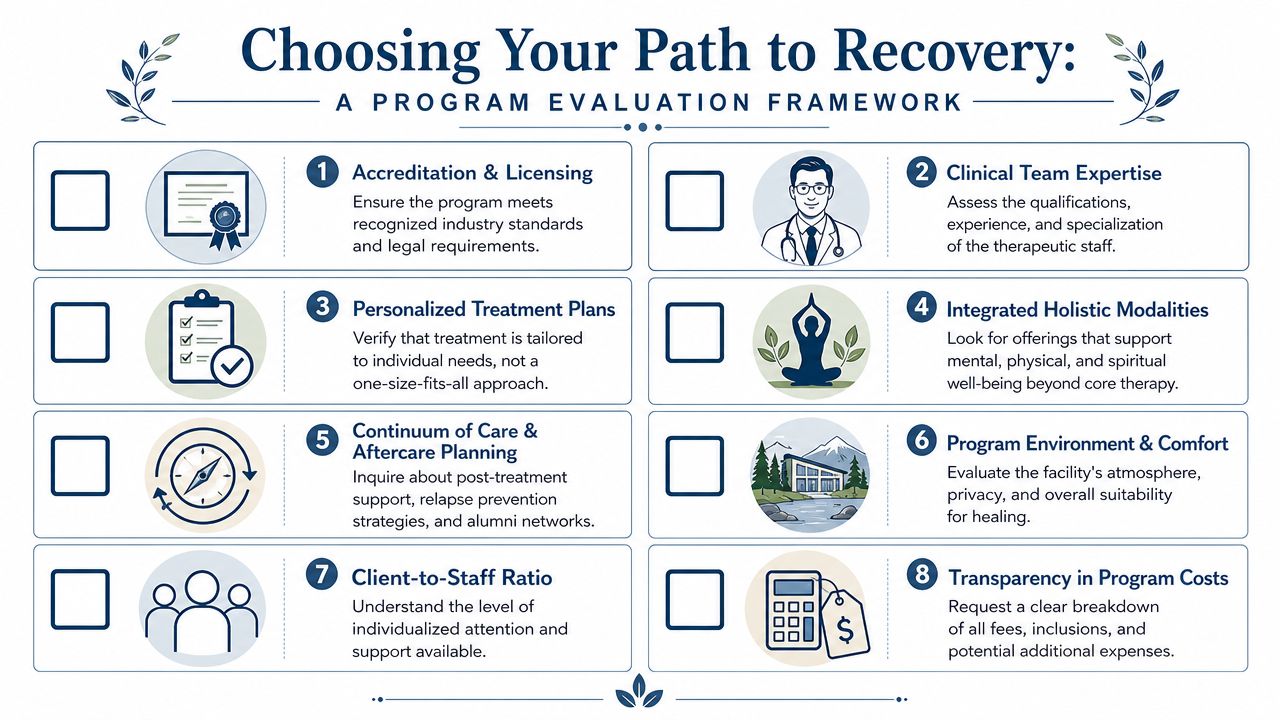
Choosing Your Path to Recovery A Framework for Evaluation
Residential treatment can be difficult to compare because marketing language tends to converge. Nearly every program promises individualized care, comfort, and expertise. A discerning adult needs a sharper filter.
That's especially important in a market where residential care is limited. A national analysis found that the United States has about 14,700 substance use treatment facilities, but only about 24% offer residential care, as summarized in the KFF review of substance use and mental health treatment facilities across the U.S.. Scarcity alone doesn't signal quality, but it does mean careful evaluation matters.
Start with clinical credibility
Before discussing amenities, ask who is treating the client and how the program is governed.
Use this checklist early:
- Accreditation and licensing: Confirm the program meets recognized regulatory and quality standards.
- Multidisciplinary staffing: Look for psychiatry, licensed therapists, addiction clinicians, and medical support when detox may be relevant.
- Dual-diagnosis competence: The program should treat mental health and substance use issues together.
- Trauma literacy: Many professionals don't identify with the word trauma, but their symptoms often reflect it.
If the answers stay vague, that's a warning sign.
Then assess whether the model fits real executive life
A luxury setting can still be a poor match if it isn't built for professionals who need discretion and thoughtful flexibility.
Questions worth asking include:
- How are private rooms handled?
- What is the electronics policy, and how is it individualized?
- How does the team protect confidentiality in communication, admissions, and family coordination?
- Can the staff work with a client who needs limited ongoing contact with work?
- How is treatment adjusted for someone who presents as high-functioning but clinically defended?
For readers weighing levels of care more broadly, the differences between inpatient and outpatient rehab can help clarify when a residential model is justified.
Aftercare is not optional
Many people choose a program based on admission experience and overlook discharge planning. That's a mistake. Residential treatment is powerful because it removes a person from triggers, pressure, and access. The harder task is maintaining gains after reentry.
The review of residential treatment outcomes and post-discharge continuity notes an important pattern. Residential treatment is associated with improvements in substance use, mental health, and broader social outcomes, but the practical signal for lasting benefit is continuity after discharge. Gains can fade without step-down planning, monitoring, and linkage to outpatient care.
Ask specific questions:
- What happens after discharge?
- Is there a structured continuing care plan?
- How are therapists, psychiatrists, or recovery supports coordinated back home?
- Does the client receive relapse prevention planning tied to their actual triggers?
A beautiful discharge packet is not aftercare. A real aftercare plan names people, appointments, responsibilities, and next steps.
A short evaluation table
| Evaluation area | Strong answer sounds like | Weak answer sounds like |
|---|---|---|
| Assessment | Comprehensive review of substance use, mental health, trauma, medications, and functioning | “We'll figure it out once the client arrives” |
| Customization | Clear explanation of how treatment is tailored | Generic schedule for everyone |
| Professional accommodation | Defined boundaries for work access and confidentiality | Blanket statements with no nuance |
| Family involvement | Structured therapy or education when clinically appropriate | Family contact is either unrestricted or absent |
| Continuing care | Specific handoff plan to next level of support | “We'll make recommendations near discharge” |
How to think about cost
Private-pay residential treatment is expensive. That needs to be stated plainly. The useful question is not whether it costs a lot. The useful question is what failure to treat is already costing.
For executives, untreated addiction, trauma, and mood instability can damage marriages, expose businesses, compromise decision-making, and erode health in ways that become far more expensive than treatment. That doesn't mean every costly program is worth the price. It means cost should be weighed against clinical quality, privacy protection, and the likelihood of sustained recovery.
Reflections is one example of a California-licensed, Joint Commission-accredited residential provider that offers dual-diagnosis care, private rooms, clinically managed withdrawal support when appropriate, and structured access to electronics for adults who need to remain engaged with work and family responsibilities.
Frequently Asked Questions About Executive Treatment
Will colleagues or clients find out
Not unless the client or family chooses to disclose it, subject to legal and practical realities outside the program's control. Confidentiality should be handled as an operational priority, not a slogan. That includes careful admissions communication, limited information sharing, and clear boundaries around who may receive updates.
High-profile adults should ask exactly how phone calls, records, transportation, and family contact are managed. Precision matters.
Can family be involved without taking over the process
Yes, and healthy family involvement often improves treatment. The important word is healthy. Family participation should support recovery through education, boundary work, and clinically guided sessions. It should not become a second command structure that overrides the treatment team or turns every conversation into conflict management.
In strong programs, loved ones are included in a deliberate way that helps the client return to a more stable home environment.
Is thirty days enough
Sometimes it's enough to interrupt the spiral, complete detox if needed, stabilize symptoms, and establish a serious treatment trajectory. It may not be enough to resolve longstanding trauma, entrenched relationship patterns, or years of substance dependence.
Length of stay should be based on clinical need, not wishful thinking or optics. Executives often want the shortest acceptable answer. A better question is whether the treatment window is long enough to produce reliable change and a realistic continuation plan.
How can a person tell if a program is actually high quality
Scarcity makes discernment more important. Because only a portion of treatment facilities offer residential care, the burden falls on the consumer to evaluate carefully rather than assume quality from the label alone. The fastest screen is to examine credentials, dual-diagnosis competence, privacy practices, and aftercare planning before being impressed by amenities.
If a program cannot explain how it treats co-occurring mental health symptoms, how it handles professional obligations, and what happens after discharge, it hasn't answered the questions that matter most.
Reflections provides confidential, private-pay residential treatment for adults in a luxury California setting, with dual-diagnosis care, private rooms in detox and rehab, and appropriate electronics access for professionals who need to stay connected to essential responsibilities. Readers exploring whether this model fits their situation can review the program at Reflections.