

The message usually arrives late at night. A board meeting went sideways. Sleep has become chemical. Alcohol has shifted from social ritual to private management tool. Medication that began as a way to steady anxiety now feels impossible to stop without consequences. Outwardly, performance is intact enough to keep the machine running. Privately, concentration is thinning, mood is less predictable, and the fear is no longer just about health. It's about exposure, reputation, and whether getting help will disrupt everything built over decades.
That fear keeps many executives and high-performing professionals stuck longer than they should be. They assume treatment means disappearing, surrendering all communication, and returning to work marked by absence and speculation. For this population, that assumption is often the single greatest barrier to care.
A well-designed luxury rehab program solves a different problem than standard messaging admits. It does not exist to make treatment feel indulgent. It exists to make treatment workable for people with unusual privacy demands, significant professional responsibilities, and complex clinical presentations. In that setting, private rooms, discreet admissions, and appropriate access to electronics are not perks for appearance. They are operational features that protect treatment engagement.
Beyond the Standard Redefining Luxury Rehab for Professionals
A senior executive rarely enters treatment because life has slowed down enough to allow it. More often, treatment becomes necessary precisely because life has remained intense for too long. Performance pressure, international travel, decision fatigue, public visibility, and chronic stress create conditions where substance use and mental health symptoms can become tightly interwoven.
Luxury rehab addresses that reality directly. For professionals, the question isn't only, “Will this help?” It's also, “Can this be done without detonating my career, exposing my family, or creating more chaos than the condition itself?” The right program answers yes, but only when the structure is clinically serious and operationally discreet.
What executives usually need that general programs may not provide
Many high-achieving clients arrive with the same concerns:
- Privacy that feels credible: They need an environment where discretion is built into admissions, communication, housing, and staff conduct.
- Professional continuity: They may need carefully bounded access to phones or laptops so urgent responsibilities can be handled without turning treatment into another workweek.
- High-level clinical depth: Burnout, anxiety, trauma, depression, and substance use often coexist. Treating one while ignoring the others rarely holds.
- Physical and emotional decompression: They need enough quiet, comfort, and structure to stop performing and begin telling the truth.
A luxury setting only helps when it lowers resistance to treatment and increases honest participation.
That is the distinction that matters. The environment should support clinical work, not compete with it.
In executive-focused care, success often begins with reducing the practical obstacles that keep people from entering treatment in the first place. When a client can sleep in a private room, maintain appropriate contact with essential business stakeholders, and speak openly without worrying about unnecessary exposure, treatment becomes possible in a way it often wasn't before.
This is why luxury rehab for professionals should be understood as a strategic health intervention. It protects the individual, but it also protects judgment, leadership capacity, family stability, and long-term professional function.
Clinical Excellence vs Resort Amenities
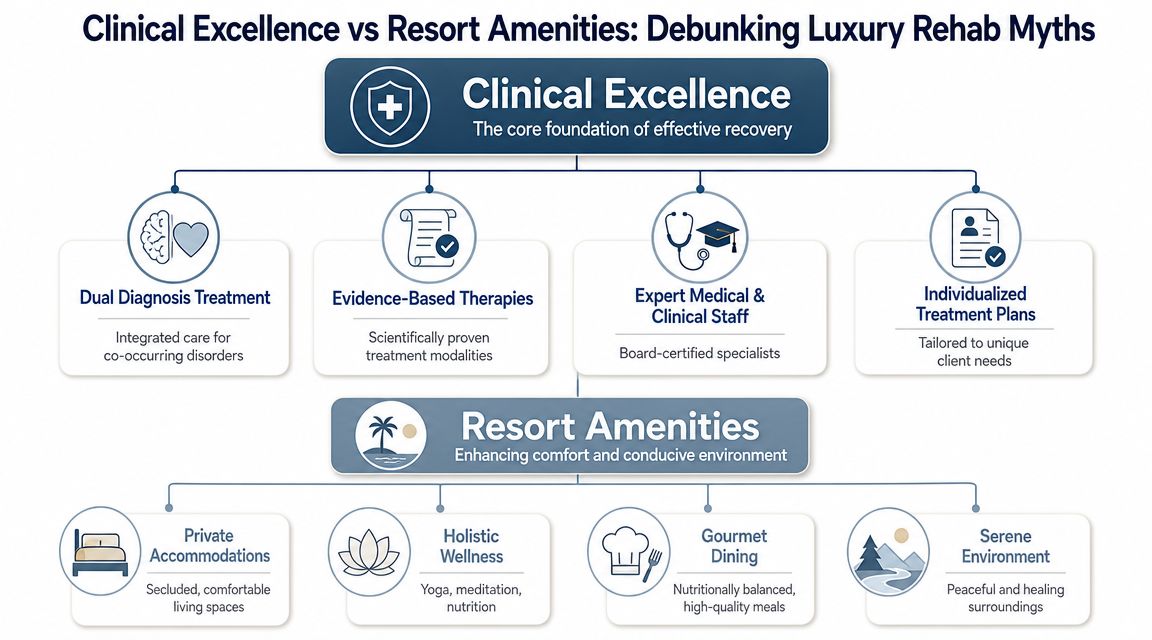
The market has confused luxury with comfort. Clinically, that's the wrong standard. Elegant surroundings may reduce stress, but they do not treat substance use, trauma, mood instability, or co-occurring psychiatric conditions. A serious luxury rehab program should be judged first by the quality of its assessment, psychiatric oversight, therapeutic depth, and ability to individualize care.
What actually defines real value
Industry guidance consistently describes luxury rehab as being distinguished less by a different clinical model than by enhanced privacy, lower client-to-staff ratios, and individualized treatment delivery layered on top of standard evidence-based care such as CBT, DBT, and MAT, as outlined in this discussion of how luxury rehab centers are set apart.
That distinction matters because it corrects a common misconception. Luxury rehab is not supposed to replace evidence-based treatment with spa culture. It's supposed to create the conditions in which evidence-based treatment can be delivered with more precision, privacy, and consistency.
A useful way to evaluate a program is to separate clinical assets from environmental comforts.
| Focus area | What to look for |
|---|---|
| Clinical leadership | Accredited programming, licensed medical and mental health staff, psychiatric capability, dual-diagnosis competence |
| Treatment delivery | Individualized planning, medication management when appropriate, evidence-based therapies, family integration |
| Environment | Private accommodations, calm setting, nutrition, restorative routines, protected space for recovery |
| Executive accommodations | Thoughtful technology policies, discreet communication structures, schedule flexibility without clinical compromise |
Amenities are supportive, not curative
Private rooms matter. So does good food. So does a peaceful setting. For executives and public-facing professionals, these factors reduce friction. They improve sleep, lower unnecessary stimulation, and increase the likelihood that a client will stay long enough to do meaningful work.
But amenities become a liability when they distract from weak clinical foundations.
- Private housing helps when it gives clients room to decompress, regulate, and speak honestly.
- Technology access helps when it is structured around treatment goals rather than used to avoid treatment.
- Holistic services help when they complement psychotherapy and psychiatric care rather than replace them.
Practical rule: If a program markets the view more clearly than it describes psychiatric assessment, trauma treatment, or relapse planning, caution is warranted.
Reflections is one example of a luxury program built around dual-diagnosis treatment in a private residential setting, with evidence-based therapies, psychiatric support, and appropriate access to electronics for clients who must maintain limited professional continuity. That model reflects what luxury rehab should be for this audience. Comfort in service of deeper treatment.
Addressing Co-Occurring Conditions and Root Causes
Executives often seek help after trying to manage symptoms privately for years. The presenting issue may be alcohol, stimulants, sedatives, or another substance. The underlying drivers are frequently more complicated. Anxiety gets managed with drinking. Depression gets concealed through overwork. Trauma gets buried under productivity. Sleep disruption becomes dependence on medication. By the time treatment begins, the problem is rarely just the substance.
That is why dual-diagnosis care is not optional in executive treatment.

How integrated treatment works
Consider the professional whose drinking spikes before investor calls, during travel, or after conflict-heavy workdays. If treatment focuses only on stopping alcohol use without evaluating panic, chronic stress, perfectionism, sleep disruption, or unresolved trauma, the drinking may stop briefly while the engine driving it stays intact.
A competent luxury setting should approach this in layers, often through the kind of integrated care described in who treats co-occurring disorders in a luxury executive setting.
- Thorough assessment identifies substance use patterns, psychiatric symptoms, medical issues, sleep problems, and functional stressors.
- Psychiatric evaluation clarifies whether anxiety, depression, bipolar features, trauma responses, or other conditions are present.
- Medication planning is considered carefully when needed, with attention to stabilization, symptom relief, and misuse risk.
- Psychotherapy addresses both behavior and meaning. CBT may challenge distorted thinking and performance-linked anxiety. DBT may build emotional regulation and distress tolerance.
- Trauma-informed work helps clients understand what the substance has been doing for them psychologically, not just what it has been costing them.
Root cause work is what makes treatment durable
High-functioning clients are often skilled at intellectual explanation. They can describe the problem in polished language while staying emotionally defended. Real treatment has to go deeper than insight.
That usually means exploring issues such as:
- Chronic overcontrol: difficulty resting, delegating, or tolerating uncertainty
- Identity fusion with performance: self-worth tied to output, status, or role
- Unprocessed trauma: adverse experiences that still shape stress responses and relational patterns
- Hidden grief or shame: losses, failures, or internal narratives that remain untreated
The substance is often the most visible symptom. It is rarely the whole disorder.
When luxury rehab works well, it gives professionals enough privacy and therapeutic sophistication to stop managing appearances and start treating causes.
A Day in the Life The Executive Treatment Experience
At 6:30 a.m., a CEO reaches for a phone that is no longer on the nightstand. By 8:00, there is no inbox triage, no performance mask, and no fast way to outrun withdrawal, panic, exhaustion, or shame. That moment unsettles many high-achieving clients. It also marks the beginning of useful treatment.
Executives rarely resist care because they dislike structure. They resist care because they expect loss of control, exposure, and professional fallout. A well-run executive program addresses those concerns from the first contact. The day is organized, clinically deliberate, and private. The goal is not to recreate a resort schedule. The goal is to create enough stability for serious treatment while preserving appropriate continuity with work and family.
Industry observations suggest that luxury inpatient treatment often lasts 30 to 90 days, with longer stays for clients who need extended stabilization, dual-diagnosis treatment, or step-down planning. That timeline reflects the work involved. Sleep disruption, substance withdrawal, mood symptoms, trauma activation, and high-functioning denial do not resolve on an executive calendar.
Admission and early stabilization
Admission should feel discreet and controlled. Transportation, arrival timing, communication protocols, and intake flow all matter because privacy failures at the front end can undermine trust before treatment begins. For some clients traveling long distance or internationally, logistics may include private medical transport planning. Families who are comparing options often review a medical plane cost guide as part of that discussion.
The first phase centers on assessment and stabilization. Medical review, psychiatric evaluation, substance use history, sleep patterns, medication reconciliation, and risk assessment need to happen quickly and carefully. If detox is required, it should be integrated into the broader treatment plan so the client is not shuffled from one level of care to another without continuity.
These first days are often harder than expected.
High performers are used to controlling discomfort through action. In treatment, they are asked to slow down long enough to notice what has been driving the pattern. Irritability, fatigue, grief, cognitive fog, and fear about work are common early on. Good clinical teams normalize that without minimizing it.
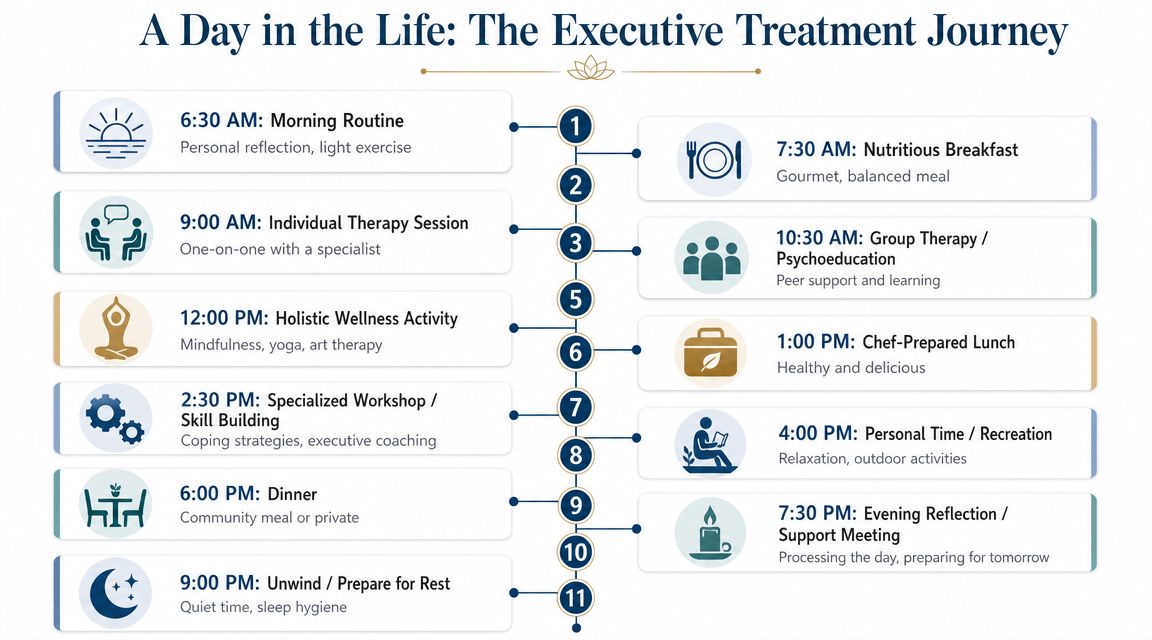
What a treatment day often includes
Executive treatment should feel disciplined. It should also leave enough room for rest, reflection, and nervous system recovery.
A typical day may include:
- Morning routine: wake-up, breakfast, light movement, nursing check-in, medication support when indicated
- Primary clinical sessions: individual therapy, psychiatry, or focused work on substance use, anxiety, depression, trauma, or relapse patterns
- Small, relevant groups: psychoeducation and process groups with clear confidentiality standards and practical discussion
- Protected downtime: time to eat, decompress, journal, walk, or rest without constant stimulation
- Afternoon treatment blocks: family sessions, skills work, executive stress management, or planning for return to work and reintegration
- Evening structure: peer support, reflection, reading, quiet recreation, and consistent sleep preparation
That rhythm matters. Clients who arrive overstimulated and under-rested often begin to think more clearly once the day stops being driven by crisis and reaction.
How electronics fit into treatment
For executives, electronics policy is rarely a simple yes-or-no question. The clinical issue is whether access supports treatment or protects the very patterns that brought the client into care.
In some cases, full disconnection is the right call. A founder in acute burnout who checks messages every ten minutes is not maintaining continuity. He is rehearsing compulsion. In other cases, bounded access lowers resistance to admission and prevents avoidable damage to a business, a board relationship, or a transaction already in motion.
The best programs set terms clearly:
- Clinical care comes first: therapy, groups, psychiatric care, and recovery assignments are the priority
- Access is time-limited: phones and laptops are used during agreed windows, not throughout the day
- Delegation is part of treatment: clients identify what requires their attention and what should have been handed off earlier
- The plan is adjusted by impact: if work contact spikes anxiety, fuels avoidance, or disrupts sleep, access is reduced
Measured access can protect a career. Unlimited access often protects the illness.
Why the routine matters
An executive schedule in treatment is not a luxury feature. It is a clinical tool. Predictable structure lowers noise, exposes patterns, and gives clients repeated chances to practice a different way of functioning.
When this is done well, treatment stops feeling like a professional disappearance. It becomes a strategic period of recovery, assessment, and course correction. That is the true value of the executive experience. Premium surroundings may make it easier to enter the door, but the daily structure is what helps a high-achieving person stay long enough to do honest work.
Understanding the Cost and Value of Premier Rehab
A senior executive can lose far more than tuition by choosing the wrong program. I have seen clients spend heavily on attractive facilities, then discover the center could not manage mood instability, trauma, sleep disruption, or the level of discretion their role required. The question is not whether premier rehab costs more. It is whether the program reduces clinical risk, protects professional continuity where appropriate, and gives the client a serious chance to recover without unnecessary collateral damage.
Premier care is private-pay for a reason. It usually funds a quieter setting, lower census, more individual attention, stronger psychiatric coverage, and operational privacy that is difficult to deliver in high-volume environments. For professionals whose judgment affects a company, a portfolio, or a family system, those differences can materially affect engagement and retention in treatment.
What does the premium buy?
- Private accommodations: better sleep, more privacy, and less social strain during early stabilization
- More individualized care: schedules can be shaped around psychiatric needs, trauma work, medical issues, and executive-level pressures
- Higher staff access: clinicians have more time to notice subtle changes in mood, motivation, cognition, and relapse risk
- Protected continuity for work: some programs can structure limited communication windows without letting work overrun treatment
- Discreet admissions and logistics: travel, arrival, and communication can be handled with a level of privacy many clients require
Those features matter only if they support outcomes. A private room has value if the client finally sleeps. Flexible scheduling has value if it keeps a board chair or founder in treatment long enough to complete real clinical work. Family meetings have value if they are planned well and tied to treatment goals, as described in this guide to family visits in executive rehab and how support enhances healing.
Cost should be judged against exposure. Untreated addiction, burnout, depression, trauma, and anxiety show up in missed decisions, reputation damage, legal problems, medical decline, family disruption, and preventable leadership failures. For some clients, one quarter of impaired judgment costs more than treatment.
Travel can also add cost before care begins. If a client is medically unstable, highly visible, or traveling a long distance with privacy concerns, families sometimes review a medical plane cost guide as part of planning admission.
A better way to evaluate value is to ask four direct questions:
| Question | Why it matters |
|---|---|
| Can the program treat both substance use and psychiatric conditions at the same time? | Luxury surroundings do not make up for weak clinical depth |
| Is there a clear policy for work access and technology use? | Executives often need structure that protects treatment without creating avoidable business fallout |
| Does the setting help the client stay engaged long enough to benefit? | Retention matters. Comfort and privacy can reduce early dropout in the right population |
| Are confidentiality practices operational and specific? | High-profile clients need procedures, not broad promises |
Premier rehab is a strategic health decision. At its best, it is also a career-protective decision. The value is not in the optics of luxury. It is in buying the time, privacy, staffing, and clinical precision needed to address the problem before the personal and professional costs rise further.
Confidentiality Family Involvement and Aftercare
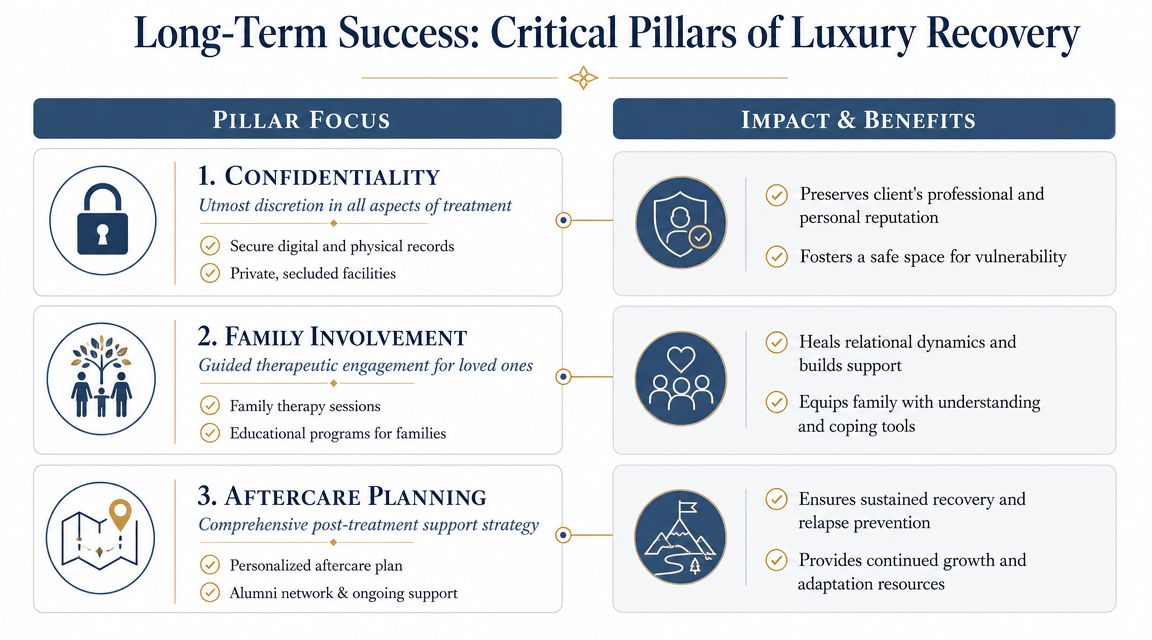
A luxury rehab program earns trust in three stages. It protects privacy on the way in, uses family involvement carefully during treatment, and builds an aftercare plan strong enough to hold once the client returns to real life. If any one of those is weak, long-term recovery becomes more fragile.
Confidentiality has to be operational
Executives and high-profile families don't need vague assurances. They need practical protections. That includes discreet admissions, controlled communication, private accommodations, careful record handling, and clear boundaries around who knows what.
For households already accustomed to managing privacy across personal staff, assistants, drivers, estate teams, or domestic personnel, a resource on confidentiality for household staff can be useful context. Treatment privacy doesn't exist in isolation. It often has to align with the wider confidentiality practices surrounding the family system.
Privacy supports treatment because people speak more honestly when they aren't spending energy managing exposure.
Family involvement should be structured, not automatic
Family participation helps when it is therapeutic. It hurts when it becomes performative, coercive, or poorly timed. In executive care, loved ones may depend financially, emotionally, or operationally on the client's functioning. That can complicate treatment.
The right program uses family work to improve clarity and reduce reenactment. A useful reference point is the role of family visits in executive rehab and how support enhances healing.
Effective family involvement may include:
- Education: helping loved ones understand co-occurring disorders, not just substance use
- Boundary repair: addressing enabling, secrecy, resentment, and role confusion
- Communication work: improving honesty without escalating blame
- Discharge alignment: clarifying what support will look like once treatment ends
Aftercare is where seriousness becomes visible
Many programs market the residential stay. Fewer communicate clearly about what happens after discharge. For professionals returning to demanding environments, aftercare should be specific and executable.
Strong aftercare often includes ongoing psychotherapy, psychiatric follow-up, relapse-prevention planning, family recommendations, alumni support, and flexible step-down care when needed. For some, it also means structured support around re-entry into work, travel, and high-risk social settings.
A polished residential experience means little if the client leaves without a disciplined plan for the first weeks and months that follow.
In executive recovery, confidentiality, family work, and aftercare are not separate topics. They are parts of one containment strategy. The more public or demanding a client's life is, the more tightly those parts need to fit together.
Essential Questions for Executives and Clinical Referrers
At 10 p.m., a CEO is still answering messages from a private room while trying to decide whether entering treatment will protect a career or disrupt it. A referring psychiatrist is asking a different question. Will this program actually stabilize the patient, or will luxury features distract from the work that matters.
Those are the right concerns. Executive treatment should stand up to close questioning due to its critical importance. Premium surroundings can support recovery by lowering friction, protecting privacy, and making it easier for high-functioning adults to stay in care. They do not replace psychiatric depth, disciplined structure, or a clear plan for returning to work.
What should an executive ask before admission
Can work continue in a limited, structured way?
Ask for exact rules, not broad reassurance. Who approves device access, when is it permitted, and what happens if work contact starts feeding avoidance, stress, or symptoms?How is privacy handled day to day?
Ask how admissions are scheduled, how records are protected, who has access to identifying information, and what staff are trained to do if a public-facing client is recognized.Who is directing the clinical side of the case?
If substance use is tied to anxiety, depression, trauma, burnout, sleep disruption, or another psychiatric issue, ask who evaluates those conditions and how treatment decisions are coordinated.What is the plan for professional continuity?
Some executives need temporary containment from work. Others need limited contact to prevent larger fallout. A serious program can explain that trade-off and set boundaries that protect treatment.
What should a clinical referrer ask
Referring therapists, psychiatrists, physicians, attorneys, and family offices usually need operational clarity more than branding language.
- How is diagnostic formulation established, then revised during the stay?
- What communication is available to outside professionals when the client consents?
- How are medication decisions, behavioral observations, and clinical milestones documented?
- What criteria determine readiness for discharge, step-down care, or a longer stay?
I tell referrers to listen for specificity. Vague answers often signal a program that is organized around presentation rather than clinical process.
What answer matters most
The question that reveals the most is simple. How do you define success for this particular client?
A strong answer is individualized. It should address substance use, psychiatric stability, insight, risk, family system factors, work pressures, and the client's ability to sustain change after returning to a demanding role. That is where the difference becomes clear between a polished residence and a treatment setting built for executives who need privacy, serious care, and a realistic path back to professional life.
Reflections provides luxury dual-diagnosis treatment in a private California residential setting for adults who need confidential care, private rooms, clinically managed detox support when appropriate, and structured accommodation for work and family continuity. Executives, professionals, families, and referring clinicians who need a discreet next step can learn more through Reflections.