

A senior executive sits in a parked car after another delayed flight, answering messages, promising the team everything is under control, and recognizing it isn't. Sleep is thinner. Alcohol, stimulants, or medication have shifted from coping tool to private dependency. Anxiety, trauma, depression, or burnout may be driving the cycle, but the immediate fear is simpler: if treatment means disappearing from work, losing privacy, or being placed in a generic setting with little understanding of executive pressure, getting help can feel impossible.
That's why the conversation around luxury rehab centers in California needs to be more precise. For high-earning professionals, C-suite leaders, founders, attorneys, physicians, and public-facing executives, the right program isn't defined by polished interiors alone. It's defined by whether a center can deliver discreet, clinically advanced, dual-diagnosis care while accommodating real-world responsibilities. In this market, comfort matters, privacy matters, and clinical depth matters most.
The Executive's Dilemma Finding Discreet and Effective Care
At 6:30 a.m., an executive can be on a secure call with counsel, answering overnight messages from Asia, and trying to steady a system that is starting to fail. Substance use rarely shows up at work first as obvious collapse. More often, it appears as sleep loss, irritability, missed judgment, medication misuse, hidden drinking, or stimulant dependence held together by performance and fear.
That is the treatment dilemma for professionals. They may know they need residential care, yet still delay admission because the usual model feels risky. Shared rooms, broad exposure to other clients, rigid communication blackouts, and little understanding of licensing boards, investor pressure, or public visibility can all become barriers to treatment.
In practice, the question is rarely, "Do I need help?" The harder question is, "Can I get help without creating new damage?"
| Consideration | Standard approach | Executive-focused luxury approach |
|---|---|---|
| Privacy | Often limited by shared spaces | Greater discretion, private accommodations |
| Work continuity | Communication may be heavily restricted | Structured access to devices and scheduling support |
| Clinical depth | Varies widely | More emphasis on individualized psychiatric and trauma care |
| Environment | Functional, community-based | Calm, private, high-comfort setting |
When work obligations cannot simply stop
Some responsibilities can be delegated. Some cannot. A founder in the middle of financing, a physician with credentialing concerns, or an attorney managing active litigation may need tightly controlled contact with a small circle while still stepping out of day-to-day operations.
Professionals who travel often already understand controlled logistics and confidentiality. The same mindset behind executive itinerary planning, including decisions covered in this guide to private business travel, often carries into treatment planning. Timing, privacy, and access matter.
Clinical quality matters more.
A polished property does not treat trauma, stabilize mood, or interrupt a relapse cycle. For executives, the better programs are built to assess what is underneath the substance use from the start. That often means depression, anxiety, trauma, burnout, grief, chronic insomnia, or a long pattern of high-functioning overcontrol. If a center cannot treat the psychiatric side with the addiction side, comfort becomes expensive distraction.
Why discreet residential care matters
Discreet care is not a marketing extra. It directly affects whether a professional will enter treatment early enough to prevent medical, legal, and occupational fallout. Private rooms, careful release-of-information practices, coordinated family communication, and a treatment team that can set firm limits around work contact all reduce resistance to admission.
The other benefit is clinical. Executives often arrive highly defended, accustomed to managing perception, and skilled at performing stability. In a confidential setting, it is easier to move past image management and address the actual drivers of use, especially unresolved trauma and other dual-diagnosis concerns that predict relapse when left untreated. Programs built for discreet and confidential rehab for executives in California are designed around that reality.
Recovery and career protection are not competing goals. The right residential setting handles both, with clear boundaries, serious psychiatric care, and enough discretion for a professional to stay focused on getting well.
What Truly Defines a Luxury Rehab Experience
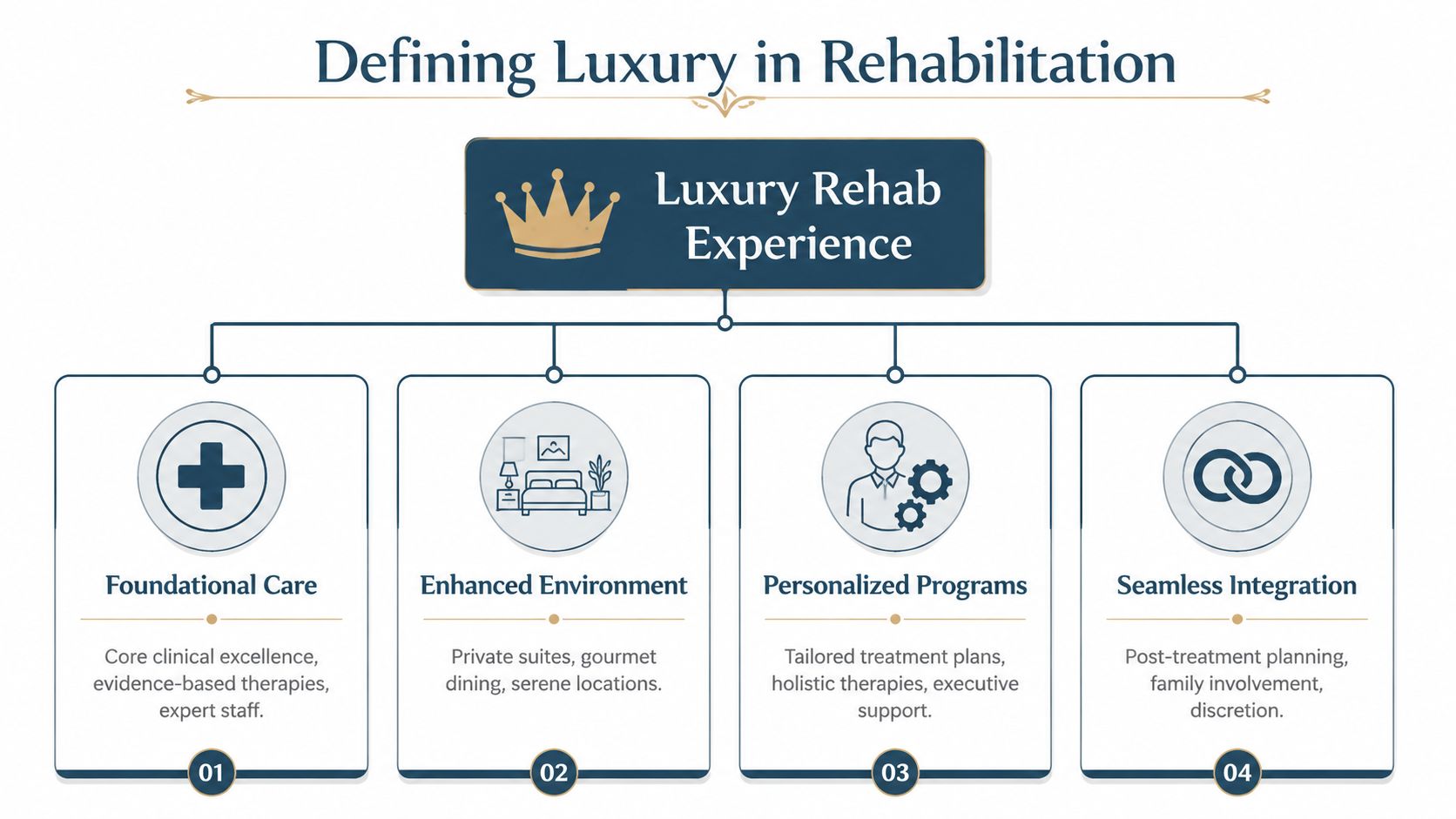
The word “luxury” gets overused in behavioral healthcare. In practice, it should mean more than attractive property, better food, or a scenic address. In this field, luxury means a treatment environment built around clinical access, privacy, personalization, and smooth daily routines for people with complex lives.
Luxury rehabilitation centers are defined by high staff-to-client ratios, private suites, and the integration of evidence-based treatments with whole-person therapies like equine therapy, yoga, and nutritional counseling in a setting designed for privacy and calm, as outlined in this overview of luxury rehab in California.
Early in the admissions process, professionals should look at the model behind the setting, not just the setting itself.
Clinical care comes first
A high-end program earns the label when it can provide medically informed detox support, psychiatric assessment, dual-diagnosis treatment, and a customized therapy plan that changes as the client stabilizes. Executives often arrive with layered presentations. Substance use may sit alongside trauma, chronic anxiety, depression, grief, sleep disturbance, or bipolar-spectrum symptoms. A true luxury setting has the staffing and expertise to treat those issues together.
Private rooms matter here for a clinical reason, not just a hospitality reason. Sleep, regulation, emotional safety, and concentration usually improve in a more controlled environment.
The environment should reduce noise, not replace treatment
Amenities have value when they support recovery. A quiet property, gourmet meals, fitness access, massage, mindfulness, and integrated therapies can help highly activated professionals slow down enough to engage in treatment. They don't replace evidence-based work. They create conditions that make that work more possible.
For executive clients, another practical marker matters. Top-tier luxury rehab facilities may allow residents to keep cell phones and laptops during treatment so they can maintain necessary career engagement, according to Recovery.com's overview of luxury rehab. That policy is especially relevant for professionals who can't ethically or operationally disappear for a month.
The strongest programs integrate life, not avoid it
The most effective luxury care for working professionals usually includes:
- Private rooms in detox and residential care so clients can recover without the strain of shared sleeping space.
- Highly accredited clinical staff including psychiatrists, psychologists, licensed therapists, addiction specialists, and adjunctive providers.
- Structured electronics access that supports work continuity without letting work dominate treatment.
- Whole-person treatment that combines psychotherapy, psychiatric care, wellness work, and recovery planning.
- Discretion by design through limited census, protected communication, and thoughtful scheduling.
Practical rule: If a program talks more clearly about thread count than trauma treatment, it isn't offering real luxury care.
Key Evaluation Criteria for Working Professionals
Executives often evaluate treatment the same way they evaluate any high-stakes professional decision. They look for credentials, process quality, confidentiality, and outcome logic. That approach is useful. It protects against one of the biggest problems in the luxury market: polished marketing that says very little about the actual clinical model.
The central screening question is simple. Can this center treat addiction and the underlying psychiatric drivers at the same time?
That matters because 70% of individuals with substance use disorders also have a co-occurring mental health condition, and a 2025 study found that 45% of patients in high-end rehab drop out when underlying trauma isn't addressed. If a program uses trauma-aware language but doesn't clearly explain its dual-diagnosis and trauma protocols, that's a major warning sign.
What to verify before admission
Working professionals should ask direct questions and listen for direct answers.
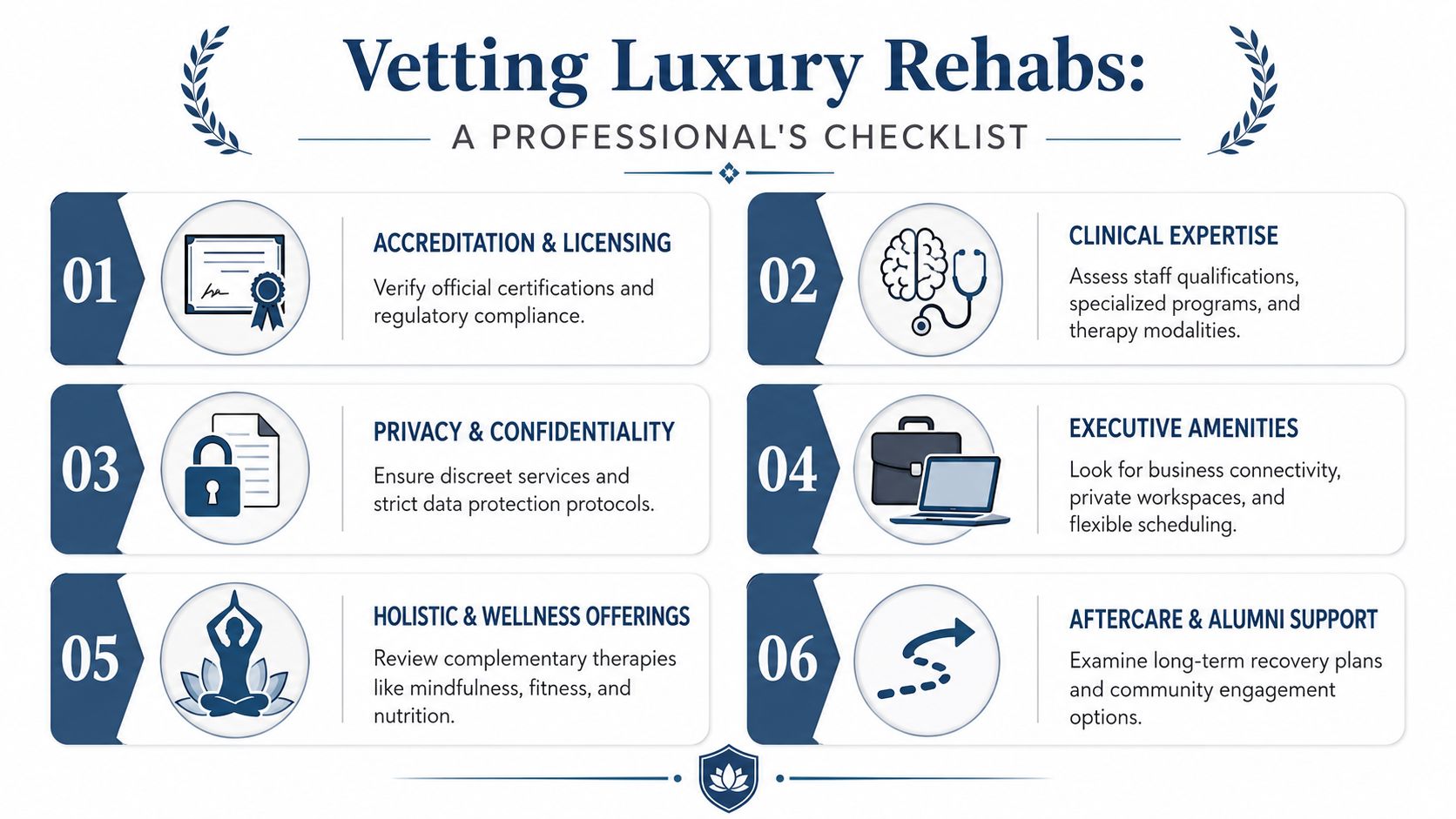
- Accreditation status: A reputable center should clearly disclose licensure and recognized accreditation. This isn't administrative trivia. It's a marker of safety systems, policy discipline, and clinical accountability.
- Psychiatric capability: Many clients need more than a therapist and a detox protocol. They need real psychiatric evaluation, medication review, and treatment for co-occurring conditions.
- Trauma-specific modalities: Programs should be able to name how trauma is treated in practice, not just mention it in broad terms.
- Clinical staffing depth: Titles matter. So does who is present and directing care.
- Electronics policy for professionals: If a client must remain reachable for essential matters, the program should explain how that works without undermining treatment.
- Discharge and continuing care planning: Residential treatment is the start of recovery structure, not the end.
Questions that reveal substance fast
A discerning caller will usually learn more from five minutes of specifics than from an hour of amenities talk.
“Who handles medication management, who provides psychotherapy, how is trauma treated week to week, and what happens if work obligations arise during residential care?”
Those questions move the conversation from sales language to treatment reality.
Credentials matter, but fit matters too
A highly credentialed team is necessary, but executives should also consider whether the program understands professional identity. Some clients need a setting that can hold both high performance and psychological vulnerability without shaming either. That means clear boundaries, sophisticated family work, and a treatment culture that doesn't confuse professional success with emotional health.
For a practical example of what to examine, this guide on identifying California luxury rehabs with licensed psychiatrists and PhD psychologists on staff offers a useful framework.
A Curated Look at Top California Centers
The California market includes a wide range of upscale residential programs, but “luxury” covers very different treatment realities. Some centers emphasize privacy and comfort. Others pair those features with stronger psychiatric assessment, trauma treatment, and executive accommodations. The distinction matters most for professionals with co-occurring disorders.
The practical comparison isn't about décor. It's about what a client will experience during detox, residential treatment, work communication, psychiatric care, and discharge planning.

California luxury rehab feature comparison
| Feature | Center A | Center B | Reflections |
|---|---|---|---|
| Private rooms | Often available | Often available | Private rooms in detox and rehab |
| Executive electronics access | Varies by policy | Varies by policy | Allows cell phones and laptops with structure |
| Dual-diagnosis focus | May be present | May be present | Explicitly built around co-occurring disorders |
| Trauma treatment depth | Sometimes described broadly | Varies | Integrated trauma-informed psychotherapy within daily care |
| Clinical staffing model | Mixed credentials | Mixed credentials | PhD-level psychologists, psychiatrists, LMFTs, addiction counselors, adjunctive therapists |
| Family involvement | Usually available | Usually available | Private sessions and educational workshops |
| Continuing care | Varies | Varies | Ongoing planning, alumni support, flexible post-residential services |
How to read a comparison like this
Most luxury centers can offer a calm setting, private accommodations, and a more discreet experience than standard programs. That's useful, but it isn't enough for a professional who's carrying trauma, panic, depression, or unstable mood underneath substance use. The key difference is whether the center can translate that complexity into a daily treatment plan.
The strongest centers for executives generally share a few traits:
- They protect confidentiality operationally, not just rhetorically.
- They can manage both addiction and mental health with one integrated team.
- They allow structured contact with the outside world when it's clinically appropriate.
- They plan for what happens after residential care, including work re-entry.
One factual example of this model
Reflections is a California-licensed, Joint Commission-accredited luxury rehabilitation provider focused on adults with co-occurring mental health and substance use disorders. Its residential setting is private and upscale, the clinical team includes PhD-level psychologists, psychiatrists, LMFTs, certified addiction counselors, and adjunctive therapists, and the program allows appropriate access to electronics for clients who need to maintain balanced engagement with work, school, and family. Private rooms are offered in both detox and residential treatment, and care integrates modalities such as CBT, DBT, ACT, motivational interviewing, psychotherapy, medication optimization when appropriate, and integrative therapies including mindfulness, art and music therapy, somatic work, equine work, fitness, massage, and nutrition.
That combination matters because executive clients often need more than abstinence support. They need a treatment environment that can address trauma, PTSD, anxiety, depression, grief, bipolar and borderline traits, and the professional pressures that often complicate recovery.
A luxury center should be able to explain what happens on a Tuesday morning in treatment, not just what the property looks like on a website.
Some families also use location planning as part of the admissions decision, especially when they want a setting that feels restorative and private. For broader regional context, these curated LA luxury escapes can help illustrate the kind of secluded, high-comfort environment many executive clients prefer, though treatment quality should always drive the final choice.
Understanding the Investment Costs and Insurance
A common call goes like this: a founder, physician, attorney, or family office principal is ready for treatment, but the quote triggers hesitation. The question is rarely whether care matters. The question is whether the premium buys better outcomes or just better surroundings.
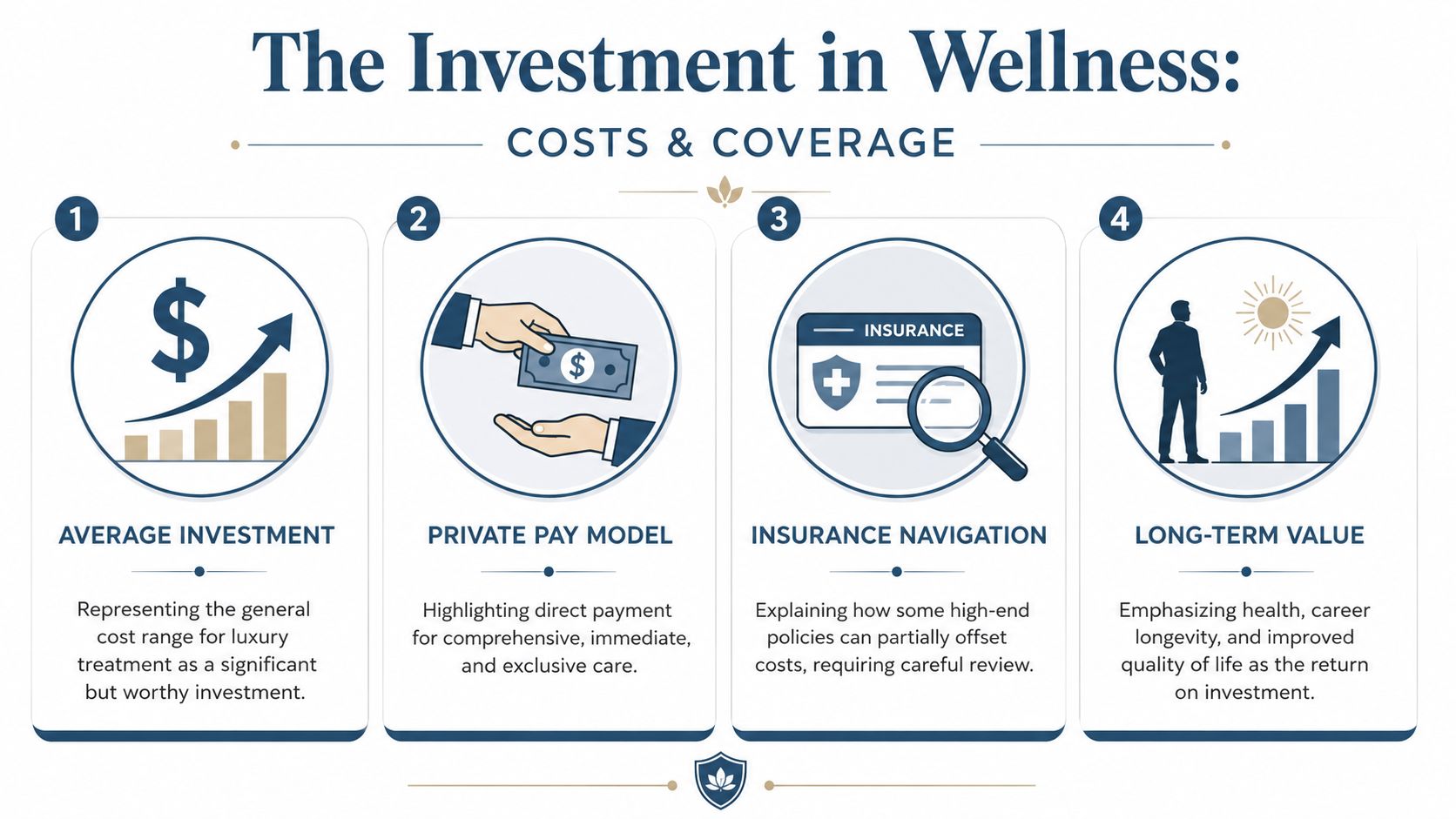
For executive treatment, that distinction matters. The higher price point should reflect more than privacy and comfort. It should pay for stronger psychiatric assessment, trauma-informed therapy that is integrated into the weekly schedule, experienced medical oversight, lower client-to-staff ratios, and treatment planning built around both substance use and the mental health issues driving it. For professionals with PTSD, anxiety, depression, burnout, or a history of high-functioning trauma, that clinical depth often determines whether treatment holds after discharge.
What the premium is actually paying for
The primary cost drivers are usually clinical and operational.
- More senior clinical time: greater access to licensed therapists, psychiatry, and case review by experienced staff.
- Integrated dual-diagnosis care: one plan addressing addiction, trauma, mood symptoms, sleep disruption, and medication needs together.
- Discretion: private rooms, lower census, controlled communication, and tighter handling of professional or public-facing privacy concerns.
- Workability for professionals: thoughtful policies for electronics, legal or licensing coordination, and family communication when those issues affect treatment adherence.
I tell families to ask a simple question: if the client has a panic disorder, alcohol dependence, trauma history, and a board investigation or major deal in motion, who is coordinating that care day to day? If the answer is vague, the premium may be going to hospitality more than treatment.
Insurance and private pay
Many luxury programs are private pay, out of network, or a mix of both. Insurance may cover detox, physician visits, psychiatry, medications, group therapy, and individual therapy, while leaving room charges, upgraded accommodations, and concierge-style services outside the benefit structure. That is normal. It still needs to be explained clearly before admission.
A careful financial review should cover deductible, out-of-pocket maximum, out-of-network reimbursement, preauthorization requirements, and whether the program can provide the clinical documentation needed for claims. This overview of insurance coverage for addiction treatment is a useful starting point for that conversation.
Travel can also affect cost, especially for families arranging immediate admission from another state or coordinating private visitation. Resources like Passport Premiere's luxury flight tips may help with logistics, but I would keep the decision anchored to clinical fit, not convenience.
The right financial comparison is not treatment cost versus no treatment cost. It is treatment cost versus relapse, impaired judgment, disrupted family systems, medical risk, and untreated trauma that keeps driving the addiction.
The Admissions Process What to Expect
Admissions should feel private, orderly, and manageable. For executives, the process usually works best when one point person coordinates the clinical screening, logistics, and communication boundaries from the first call forward.
Step one begins with a confidential conversation
The first call typically covers the immediate clinical concern, substance use pattern, mental health history, current medications, safety issues, and whether detox is needed. For professionals, this is also the time to discuss work obligations, electronics access, privacy concerns, travel timing, and any legal or licensing sensitivities.
The best admissions teams don't rush this part. They clarify what the program can support.
Clinical review and practical planning
After the initial call, the center usually completes a more detailed assessment. That may include psychiatric history, prior treatment, trauma history, medical needs, family dynamics, and current functioning. If the caller is a spouse, attorney, physician, therapist, or executive assistant helping coordinate care, the team should explain what information is needed and what confidentiality rules apply.
A thoughtful admissions process also addresses logistics:
- Arrival coordination: timing, transportation, and whether the client needs direct admission into detox.
- Packing guidance: clothing, permitted electronics, medication handling, and restricted items.
- Communication planning: who can be contacted, when, and under what circumstances.
Arrival should reduce stress, not add to it
For many high-functioning adults, the hardest part is the transition from decision to arrival. Once that threshold is crossed, the environment should become more contained. The client should know where they'll sleep, who will meet them, what the first day looks like, and how work contact will be handled.
That clarity matters. Executives are often calmer when expectations are concrete.
Asking the Right Questions and Taking the Next Step
A strong admissions conversation should leave a client with less ambiguity, not more. The right questions quickly separate programs that market luxury from programs that deliver clinically advanced executive care.
Questions worth asking directly
- How do you treat co-occurring trauma, anxiety, depression, or PTSD alongside substance use?
- Who provides psychiatric care, and how often does the client meet with that provider?
- What are the credentials of the primary clinicians working with residents day to day?
- Are private rooms available in both detox and residential treatment?
- What is the policy on cell phones and laptops for professionals who need limited work continuity?
- How is family involvement handled, and when does it begin?
- What does continuing care look like after residential treatment ends?
- How do you protect confidentiality for executives, public figures, or licensed professionals?
What a good answer sounds like
A credible program usually answers with specifics. It can describe the treatment model, name the types of clinicians involved, explain how trauma is addressed, and outline how professional obligations are managed without promising unlimited access or making unrealistic guarantees.
A weak answer often sounds vague. It circles back to amenities, views, food, or generalized reassurance.
The right center should feel calm, but it should also sound clinically organized.
Seeking treatment at an executive level is rarely an impulsive decision. It's often the result of months or years of mounting consequences, private concern, and attempts to keep functioning through an increasingly costly pattern. Taking the next step doesn't signal failure. It signals that health, judgment, and long-term stability are finally being treated with the seriousness they deserve.
Reflections provides private-pay, luxury dual-diagnosis treatment in California for adults who need discreet residential care with strong clinical depth. The program offers private rooms in detox and rehab, allows appropriate access to cell phones and laptops for residents managing professional obligations, and delivers integrated treatment for substance use and co-occurring mental health conditions through a highly accredited multidisciplinary team. For a confidential conversation about fit, timing, and admissions, visit Reflections.