

The laptop is still open, tomorrow's presentation is unfinished, and another night of sleep feels uncertain. For an executive managing panic, persistent worry, or alcohol use that has become difficult to control, the question may no longer be how to perform better under pressure. It may be whether continuing the same routine is safe or sustainable.
Residential anxiety treatment deserves consideration when a professional needs more than appointments fitted around an increasingly unmanageable calendar. For discerning private-pay clients, the central question isn't whether a setting feels luxurious. It's whether the clinical team can help someone return to leadership, relationships, and daily responsibilities with skills that work outside the treatment environment.
When Residential Anxiety Treatment Makes Sense
Consider a hypothetical executive who still attends meetings but increasingly avoids travel, sleeps poorly, and drinks to settle evening anxiety. Therapy appointments keep getting postponed, and family members notice irritability and withdrawal. Professional achievement can coexist with substantial impairment, so an impressive résumé shouldn't substitute for a clinical assessment.

Anxiety is common, but residential admission isn't the default response. WHO estimates that approximately 5.8% of the global population currently experiences an anxiety disorder, while only 27.6% of people needing care receive treatment. Those figures establish the importance of access to care, not an individual's need for residential placement.
Functional impairment matters more than job title
A clinician should examine what anxiety prevents the person from doing, what previous treatment has involved, and whether the current environment permits recovery. Someone who can participate consistently in outpatient treatment may not need to leave home. Another professional may need sustained support because symptoms, substance use, or psychiatric complexity repeatedly interrupt treatment.
Relevant considerations include:
- Daily functioning: Sleep, concentration, relationships, travel, and basic self-care have become difficult to maintain.
- Treatment engagement: Less intensive care hasn't been sufficient, or the person cannot reliably participate in it.
- Clinical complexity: Trauma symptoms, substance use, medication effects, or other psychiatric conditions complicate assessment.
- Safety and withdrawal: The person needs evaluation of self-harm risk, withdrawal risk, or medical concerns before placement.
Clinical intensity isn't a premium vacation
A residential program should provide a therapeutic environment with clear objectives, repeated practice, and coordinated review. Private accommodation can support comfort and discretion, but it doesn't establish that the treatment matches the resident's needs.
Placement principle: The appropriate setting is the one equipped to address the person's risks and functional difficulties, not the one with the most impressive amenities.
Residential care also shouldn't be confused with emergency psychiatric treatment. If immediate danger, severe medical instability, or an inability to remain safe is present, urgent assessment should take priority over a routine residential admission.
For executives, families, and referring professionals, the decision begins with a candid clinical conversation. Work obligations belong in that conversation, but they shouldn't determine whether an unsuitable setting is chosen.
How Residential Anxiety Treatment Works
Calm inside a facility isn't the same as restored function outside it. A professional may feel comfortable discussing anxiety with a therapist yet still struggle during a contentious board meeting. Residential treatment should therefore operate like intensive rehearsal, with opportunities to learn, practice, review, and adapt.
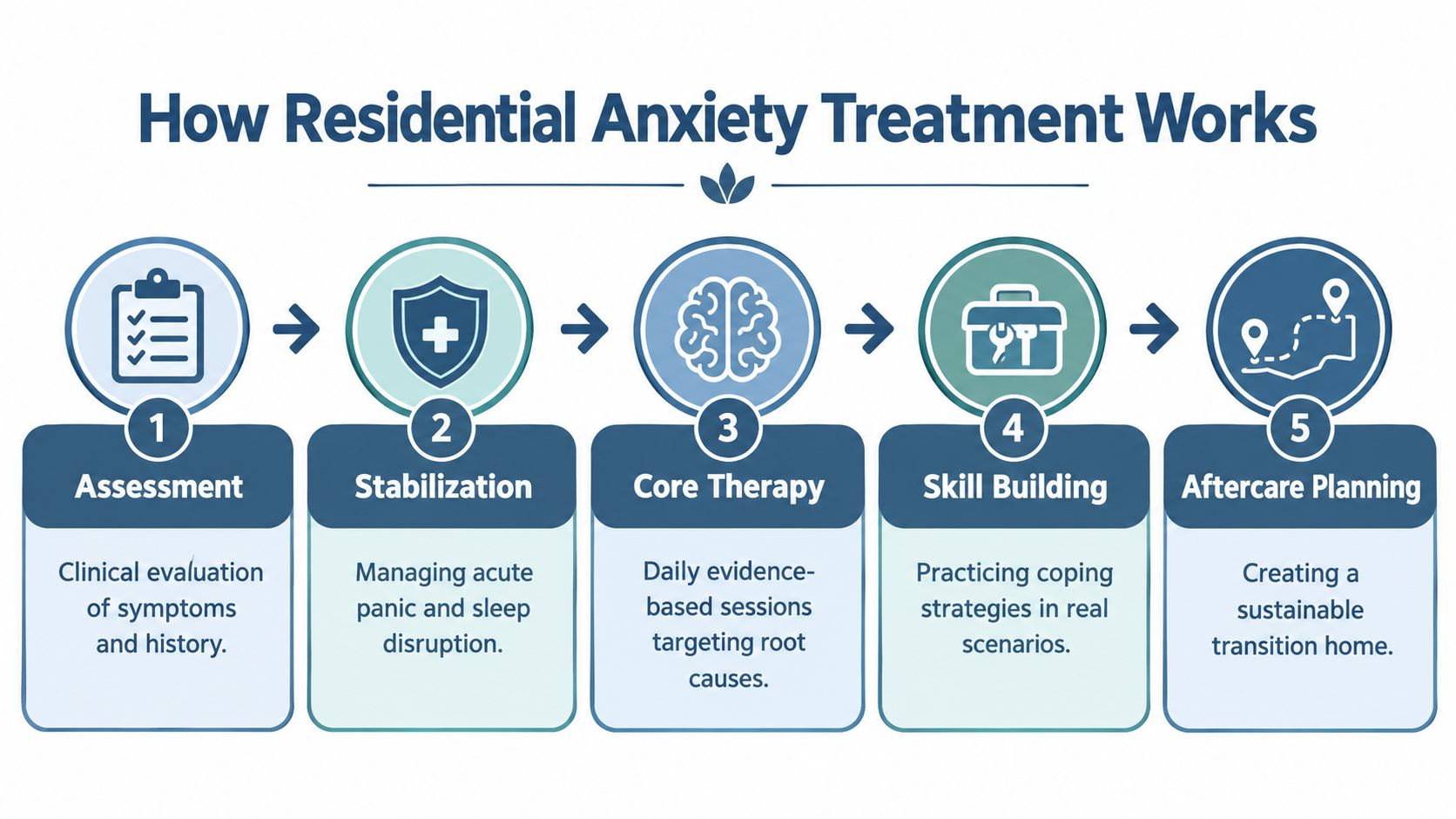
The strongest rationale for residential intensity is access to sustained therapeutic work, not merely more appointments or medication changes. NICE recommends CBT for generalized anxiety disorder delivered by trained practitioners using clinical-trial-supported manuals, typically across 12–15 one-hour sessions. That outpatient benchmark does not establish an equivalent residential duration or guarantee that compressing sessions produces better results.
Stabilization and active treatment serve different purposes
Early care may focus on whether the resident can sleep, participate safely, and tolerate the treatment schedule. Clinicians should also clarify which symptoms require immediate attention and which need further observation. Stabilization makes participation possible; it isn't the entire treatment.
Active therapy then needs specific targets. For an executive who repeatedly seeks reassurance before sending routine correspondence, the target might involve making an appropriate decision without repeated checking. For someone avoiding disagreement, it might involve participating in a difficult conversation while allowing anxiety to be present.
The daily program should make those targets visible:
- Preparation: The therapist and resident identify the feared prediction and the behavior to practice.
- Supported rehearsal: The resident attempts an agreed task with coaching appropriate to the situation.
- Review: The team compares expectations with what happened and adjusts the next assignment.
- Documentation: Clinicians record participation, symptoms, obstacles, and functional change.
Transfer requires deliberate planning
A quiet setting can remove immediate pressures, but treatment shouldn't depend on keeping ordinary life permanently at a distance. A useful question is whether the resident can apply a skill when reassurance is unavailable, a conversation becomes uncomfortable, or a decision remains uncertain.
For example, a professional might rehearse giving a brief presentation, review the experience with a therapist, and later practice an appropriate work-related task. The purpose isn't to eliminate every anxious sensation before action. It's to develop a workable response that doesn't require avoidance.
A full schedule is not sufficient evidence of a coherent program. Prospective residents should ask how individual sessions, groups, psychiatric consultations, and practice assignments connect to the same goals. A premium program should be able to explain that connection plainly rather than relying on a long menu of activities.
Choose the Right Level of Anxiety Care
The treatment decision shouldn't become a prestige ranking. A professional who can safely remain at home and participate consistently may benefit from a lower-intensity option, even when private residential care is financially accessible. Conversely, maintaining an outwardly successful career doesn't establish that outpatient care is sufficient.
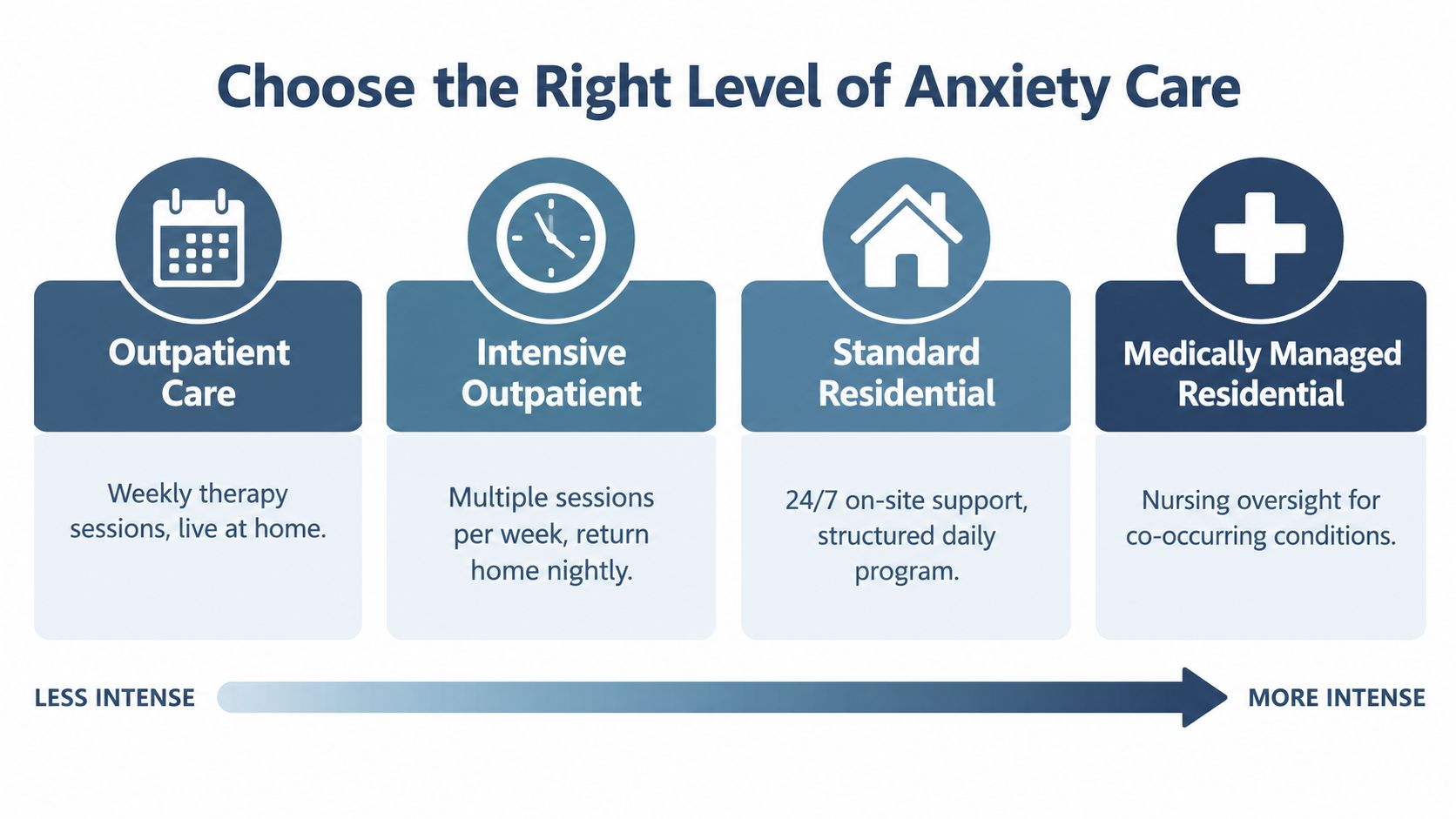
Choosing an Anxiety Treatment Level
| Care Level | Best-Fit Considerations | What the Program Must Coordinate | Key Limitation |
|---|---|---|---|
| Outpatient care | Symptoms and safety permit living at home; regular attendance and independent practice are feasible | Psychotherapy, prescribing when appropriate, and communication among clinicians | Limited support between appointments |
| Intensive outpatient care | More frequent therapeutic contact is needed, while home remains a workable environment | A structured schedule, psychiatric coordination, and practice between visits | The person still manages evenings and home pressures independently |
| Standard residential care | The person needs a live-in therapeutic environment and more sustained support | Individualized treatment, staff availability, daily practice, and transition planning | Medical and withdrawal-management capabilities vary |
| Medically managed residential or detox-level care | Withdrawal concerns or medical complexity require an appropriately equipped service | Medical assessment, monitoring, medication processes, and transfer arrangements | Stabilization alone doesn't replace continuing psychological treatment |
These categories are starting points for discussion, not interchangeable labels. Providers should describe their actual staffing, clinical capabilities, and exclusions. A program's marketing terminology shouldn't determine whether it can manage a particular risk.
For professionals comparing broader treatment pathways before considering admission, anxiety care from reVIBE Mental Health provides an additional resource to discuss with a referring clinician. Educational material should support, rather than replace, an individualized placement assessment.
Questions that clarify the decision
The referring clinician should help distinguish clinical need from practical preference. A resident may prefer privacy and a residential setting while still needing a careful explanation of why that intensity is appropriate.
- Symptom stability: Can the person sleep, eat, attend appointments, and complete necessary daily tasks?
- Home support: Is there a dependable environment for practicing skills without unmanaged conflict or substance exposure?
- Attendance: Can the professional protect treatment time, or do work demands repeatedly displace care?
- Substance use: Are anxiety symptoms linked to intoxication, withdrawal, cravings, or attempts to self-medicate?
- Medical capability: Who evaluates withdrawal risk, and what happens if the program cannot safely manage it?
- Treatment goals: What requires residential support that a less restrictive setting cannot reasonably provide?
A written placement rationale is particularly useful for high-end clients receiving several different recommendations. It should identify the current concerns, explain the proposed level, and describe what improvement would support a step down.
No amount of flexibility around meetings can correct a mismatch between clinical needs and program capabilities. Equally, admission shouldn't require an executive to abandon every professional responsibility when carefully bounded participation is clinically appropriate.
Understand the Evidence-Based Therapies
A therapy menu can be difficult to interpret. CBT, DBT, ACT, exposure, mindfulness, and experiential approaches don't have identical purposes, and their inclusion on a website doesn't establish how competently they're delivered. The relevant question is how each intervention addresses a defined problem.
Historically, access has also been fragmented. An epidemiological review reported that only 20.6% of people with an anxiety disorder sought help from health services, with care varying across medication, psychological treatment, or both. For a professional entering private residential care, coordination deserves as much scrutiny as the list of available therapies.
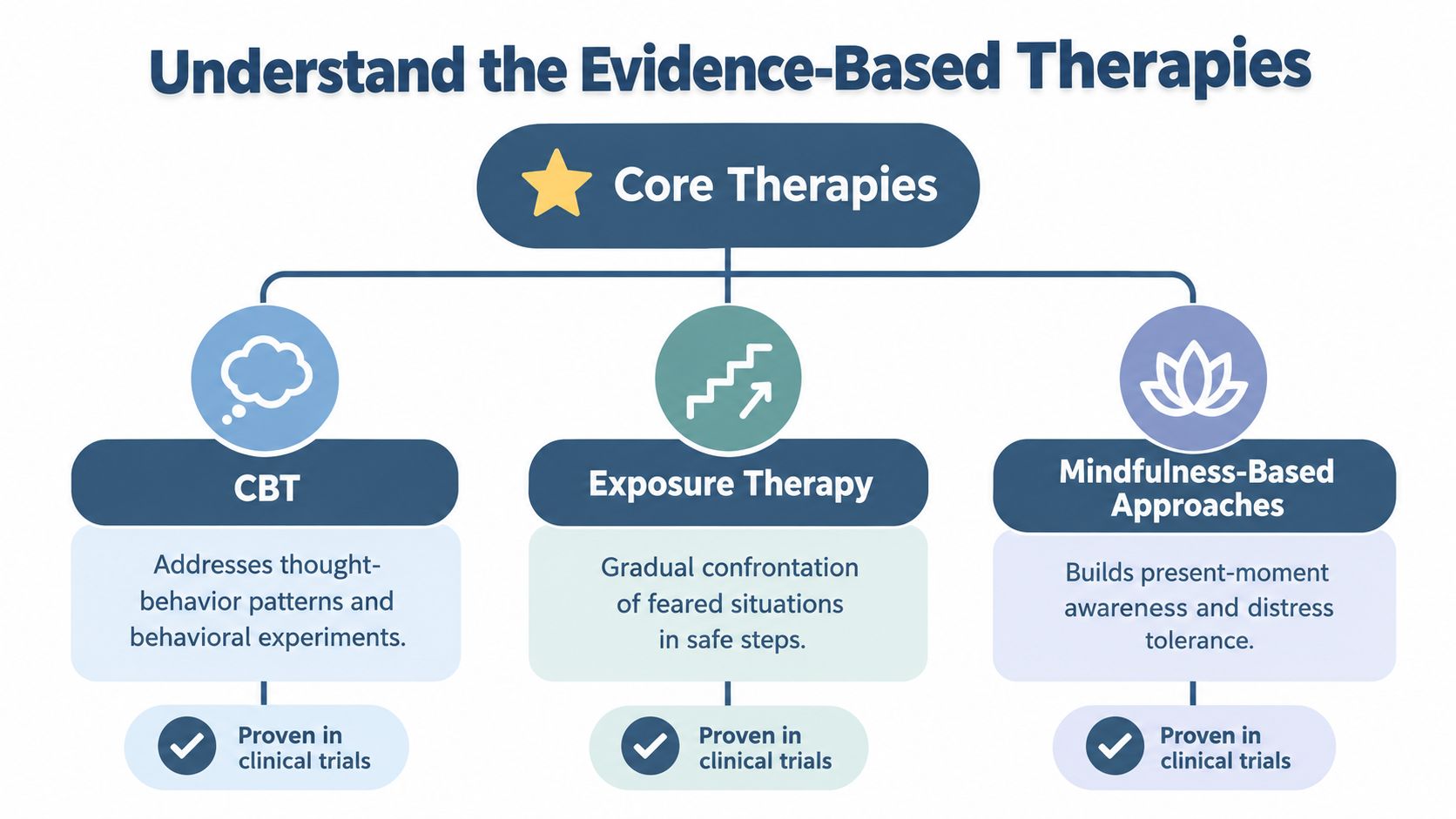
Match the method to the target
Cognitive behavioral therapy, or CBT, examines relationships among interpretations, emotions, and behavior. A behavioral experiment might test an executive's prediction that acknowledging uncertainty during a presentation will undermine credibility. The therapist should define what will be tested and how the result will be reviewed.
Exposure-based work addresses avoidance through planned practice. An individualized hierarchy might move from contributing briefly in a discussion to delivering a presentation. The task should be clinically appropriate and collaborative, not an exercise in overwhelming the resident.
Dialectical behavior therapy, or DBT, offers skills for emotion regulation, distress tolerance, and interpersonal effectiveness. A professional might use those skills to pause during conflict, communicate a boundary, or tolerate discomfort without impulsive action.
Acceptance and commitment therapy, or ACT, helps a person relate differently to difficult thoughts and feelings while taking action consistent with personal values. For someone preoccupied with appearing perfectly composed, the work may involve participating meaningfully despite anxiety rather than waiting for complete confidence.
These descriptions clarify intended functions; they don't establish equal evidence for every diagnosis. The earlier NICE recommendations provide a specific standard for CBT in generalized anxiety disorder. Other modalities require their own diagnosis-specific justification.
Adjunctive care needs a defined supporting role
Individual psychotherapy can address personal history and patterns that require privacy. Motivational interviewing can help explore ambivalence about changing substance use or protecting treatment time. Groups offer opportunities to practice participation and communication with others.
Mindfulness, meditation, somatic work, art, music, equine activities, fitness, massage, and nutrition may complement the central plan when clinically suitable. A discussion of holistic therapies for anxiety can help families understand these options without treating them as substitutes for targeted psychological care.
Before choosing a premium program, prospective residents should ask:
- Therapist preparation: What training and supervision support the proposed intervention?
- Individual targets: Which avoidance patterns, behaviors, or functional problems will receive attention?
- Progress review: Which symptom measures and observed behaviors will inform changes?
- Clinical integration: How do adjunctive activities connect to the resident's goals?
A restorative activity can be valuable without being the treatment that addresses the central disorder.
The aim isn't to collect modalities. It's to build a coherent plan that the resident understands and the clinical team can evaluate.
Follow the Residential Treatment Journey
A discreet inquiry should lead to a substantive assessment, not just a room reservation. The team needs psychiatric and treatment history, trauma context, current medications, substance-use information, withdrawal concerns, family circumstances, and professional obligations. With appropriate consent, outside clinicians can help clarify what has already been tried.
At Reflections, treatment typically ranges from 30 to 90 days, followed by continuing care. That range describes the provider's usual treatment framework, not a deadline by which every resident should recover. Length and progression should remain responsive to clinical needs.
From admission to active participation
Assessment should produce a shared plan that identifies priorities and responsibilities. Stabilization may precede demanding therapeutic work, particularly when sleep disruption, withdrawal concerns, or diagnostic uncertainty interfere with participation.
Once active treatment begins, individual sessions, intensive groups, behavioral assignments, and clinician reviews should connect. A resident practicing assertive communication in therapy might use the same approach during a family session, then review what made the actual conversation harder than rehearsal.
Useful progress records should distinguish several domains:
- Symptoms: Changes in anxiety, panic, distress, and sleep relative to an initial assessment.
- Function: Participation in relationships, self-care, decision-making, and appropriate responsibilities.
- Safety and substance use: Emerging concerns, cravings, return-to-use risk, and help-seeking behavior.
- Medication response: Intended benefits, adverse effects, and unresolved questions.
Reconnection belongs inside the treatment plan
Home leave, exposure homework, family contact, and appropriate work engagement can provide opportunities to test skills beyond the residential setting when clinically suitable. Not every program offers home leave, and not every resident is ready for it. The team should explain the purpose, preparation, support, and review process.
A specialized residential anxiety service incorporating home leave reported average symptom reductions through February 2025 of 43% for OCD, 67% for body dysmorphic disorder, and 54% for other anxiety disorders. These observational service outcomes don't prove that residential treatment universally outperforms outpatient care, and they shouldn't be presented as expected results for another provider.
For prospective residents, the practical lesson is to request clear definitions. An improvement measured before discharge is different from improvement maintained after returning to work. Programs should explain which outcomes they track, when follow-up occurs, and how incomplete follow-up affects interpretation.
Discharge should be a supported transition, not an abrupt loss of structure. The resident should leave with scheduled clinical follow-up, a medication handoff when relevant, a plan for setbacks, and clear responsibilities among providers. Continuing care and alumni participation can support connection, but they shouldn't replace necessary clinical appointments.
Manage Medication With Clinical Caution
Residential anxiety treatment shouldn't operate as a prescription-writing service. A professional arriving with panic, insomnia, and substance use may need diagnostic clarification before another medication is added. The clinical team should examine timing, previous responses, current prescriptions, and the relationship between symptoms and substance exposure.
Anxiety-like symptoms may require consideration of withdrawal, medication effects, PTSD, bipolar-spectrum activation, or an independent anxiety disorder. The point isn't to delay needed relief. It's to avoid treating every uncomfortable symptom as evidence of the same condition.
Define the purpose before changing the prescription
A prescriber should identify the target, expected benefit, monitoring plan, and reasons to reconsider treatment. Residential observation can help clinicians review sleep, agitation, sedation, cravings, panic, and participation across the treatment day.
The NICE quality standard advises against routine benzodiazepine treatment for generalized anxiety disorder, limiting use to short-term crises. Tolerance, dependence, withdrawal, and rebound anxiety are important concerns, especially when substance use already complicates care.
That caution doesn't mean all medication is inappropriate. It means medication selection should follow diagnostic assessment and a reasoned plan, with attention to misuse potential and adverse effects. Existing prescriptions shouldn't be abruptly changed without the responsible clinician's guidance.
Coordinate anxiety and substance-use treatment
A review of psychosocial interventions for adults with substance use and mental-health conditions found that integrated or coordinated treatment generally appeared more helpful than treating a condition alone or providing uncoordinated parallel services. Evidence comparing integrated and sequential approaches was limited, so coordination shouldn't be promoted as proof that a single format always works better.
The provider's approach emphasizes minimal, effective pharmacology, medication optimization when appropriate, and clinically managed medication-assisted withdrawal when needed. Prospective residents can examine its psychiatric medication management approach alongside questions about actual oversight.
- Prescriber responsibility: Who makes medication decisions and provides coverage when concerns arise?
- Monitoring: How are benefits, side effects, sleep, and functional changes reviewed?
- Crisis prescribing: What justifies a short-term sedative, and what taper or exit plan accompanies it?
- Continuity: How will outside physicians receive records and assume ongoing care?
Medication safeguard: Rapid symptom suppression shouldn't become the only definition of progress.
For executives, the desired result isn't merely feeling less anxious during admission. Medication decisions should support safe participation, clear thinking, and a sustainable longer-term plan.
Evaluate Luxury Residential Care for Executives
Consider a chief executive who needs to approve essential decisions during treatment. Keeping a laptop may make admission feasible, but unrestricted work could also recreate the conditions that prevented meaningful engagement in care. A useful arrangement identifies necessary tasks, protected treatment periods, confidential calling space, and circumstances requiring tighter boundaries.
A spouse faces a different question. Family participation should help prepare for life after treatment without turning sessions into pressure for an early return to full responsibility. Private conversations and education should clarify supportive behavior, communication, and realistic expectations.
Executive Residential Care Evaluation Matrix
| Criterion | Questions to Ask | High-End Program Evidence | Warning Sign |
|---|---|---|---|
| Privacy | How are records, calls, visitors, and shared spaces handled? | Clear confidentiality procedures and private accommodation | Discretion promised without an explanation of procedures |
| Work flexibility | Which obligations can continue, and who reviews the arrangement? | An individualized electronics and work-contact plan | Unlimited work presented as compatible with every treatment need |
| Family participation | How are consent, sessions, education, and boundaries managed? | Structured involvement with a defined clinical purpose | Family pressure determines clinical decisions |
| Credentialed care | Who delivers and supervises treatment? | Verifiable licenses, qualifications, and responsibilities | Impressive titles without clear accountability |
| Dual-diagnosis expertise | How do clinicians coordinate psychiatric and addiction care? | A shared assessment and treatment plan | Separate teams offering conflicting recommendations |
| Continuing support | What happens after residential discharge? | Identified providers and an actionable handoff | Vague assurances of ongoing availability |
Comfort should accompany accountable care
The provider permits residents to retain cell phones and laptops for appropriate professional engagement and offers private rooms in both detox and rehab. Family involvement includes private sessions and monthly educational workshops. These features address practical concerns, but individual arrangements still need clinical boundaries.
Its multidisciplinary team, directed by Executive Clinical Director Dr. William Hanna, includes PhD-level psychologists, psychiatrists, LMFTs, certified addiction counselors, and adjunctive therapists. Prospective residents should distinguish individual professional credentials from organizational accreditation and verify both.
The Joint Commission accredits residential behavioral-health organizations through external evaluation that includes onsite review of care delivery and patient experience. That provides a meaningful quality-review mechanism, not a guarantee of a particular resident's outcome.
Luxury is most useful when it makes appropriate treatment accessible and tolerable. Privacy, space, and individualized attention should accompany clinical accountability, not distract from its absence.
Make a Confident Private-Pay Decision
An expensive private-pay admission warrants careful verification before a deposit is paid. Referring clinicians and families should compare clinical fit, external oversight, and documented practices before evaluating amenities. A polished tour can show the environment, but it cannot establish how care is delivered when a resident struggles.
Verify the clinical and operational details
For a California program, prospective residents should confirm current licensing and the services covered by that license. They should also verify current Joint Commission accreditation and whether the relevant residential services fall within its scope.
Joint Commission provider-locator information states that accredited substance-use-disorder providers receive comprehensive expert review at least every three years against national safety and quality standards. Accreditation remains one part of due diligence, alongside direct questions about everyday practice.
- Clinical accountability: Review staff credentials, psychiatric availability, therapist preparation, and the basis for staffing claims.
- Safety systems: Ask about emergency response, medication procedures, care transfers, and concerns that exceed the program's capabilities.
- Resident protections: Clarify privacy practices, electronics access, visitors, room arrangements, and complaint procedures.
- Outcome reporting: Request definitions, measurement timing, follow-up practices, and limitations rather than testimonials alone.
Obtain written financial terms
No exact program price or universal insurance policy is established here. Families should request an individualized written estimate and review the cost of luxury treatment programs before making commitments.
The financial discussion should address included services, separately billed care, deposits, cancellation terms, extensions, early departure, and transfer arrangements. Any anticipated reimbursement should be independently clarified rather than assumed.
The immediate next steps are concrete: gather relevant records, arrange a clinical conversation, tour the setting when feasible, and obtain written financial and treatment expectations. With consent, family members and outside practitioners should agree on the continuing-care plan before admission creates distance from existing support.
Reflections offers private-pay luxury dual-diagnosis residential care with private rooms, individualized clinical treatment, and appropriate electronics access for executives and working professionals. Prospective residents and referring clinicians can visit Reflections to request a confidential assessment, discuss anxiety and substance-use needs, and clarify clinical fit, work boundaries, and written costs before admission.