

A chief executive can deliver a flawless presentation after sleeping badly, losing focus during routine decisions, and avoiding the places or conversations that trigger unwanted memories. Colleagues may see composure, while the executive privately manages nightmares, irritability, emotional distance, or an urge to use alcohol or medication to get through the day. That split between outward performance and internal strain is one reason PTSD treatment goals need to address more than symptom relief.
Introduction Why Clear PTSD Treatment Goals Matter
A senior professional may keep meetings, decisions, and family commitments on track while trauma narrows what feels possible. Sleep disruption can weaken judgment. Intrusive memories can pull attention away from a strategy discussion. Hyperarousal can make routine uncertainty register as danger, while avoidance gradually shapes travel, leadership, relationships, and social choices. PTSD treatment goals make that hidden workload visible and give care a practical direction.
A useful plan asks which parts of life should become safer, steadier, and more usable. Clinicians and clients can set realistic aims before treatment, then review them as symptoms, risks, and priorities change. Common goals include reducing symptom severity, addressing co-occurring conditions, improving personal, social, and occupational functioning, preventing relapse, and protecting quality of life and safety. These goals also support executive functioning by reducing the cognitive load that trauma places on attention, planning, emotional control, and decision-making.
Recovery has distinct phases
Residential care may begin with sleep, medication safety, emotional regulation, and substance-use stabilization. Once a client can remain present during difficult material, treatment can progress to trauma-focused psychotherapy, including Prolonged Exposure, Cognitive Processing Therapy, or EMDR, approaches identified in a national clinical guideline as effective options. The sequence works like restoring a control room: first reduce immediate alarms, then examine the damaged system, and finally return it to reliable operation.
Later work connects clinical gains with leadership, family contact, travel, decisions, and a sustainable routine. In a private residential setting, individualized scheduling and appropriate access to professional responsibilities can help a client protect career continuity without treating work identity as a clinical problem.
Privacy and continuity matter
Executives may postpone care because they expect treatment to require complete withdrawal from every obligation. Clear boundaries around devices, communication, and work can make treatment more workable while preserving confidentiality. The aim is a protected setting for recovery, followed by a deliberate return to responsibilities rather than an abrupt return to pressure.
A resource on mental health care in 2026 can help readers understand the wider range of psychiatric and behavioral support. The practical standard remains clear: treatment should improve health while reconnecting the client with relationships, responsibilities, and private goals that give recovery meaning.
Understanding What PTSD Treatment Aims to Achieve
PTSD treatment is less like silencing an alarm and more like restoring a house after a severe storm. The alarm matters, but repairing the building also requires checking structural safety, clearing damaged rooms, rebuilding reliable systems, and making the space usable again.
First, establish safety and stability
Early goals often focus on reducing immediate disruption. A client may work with the clinical team to improve sleep, identify triggers, reduce dangerous substance use, create a safety plan, and learn grounding or breathing skills. These steps don't dismiss trauma processing. They give the nervous system enough stability to approach difficult memories without overwhelming dissociation, panic, or impulsive behavior.
For an executive, stabilization might mean remaining present through a board discussion, sleeping without relying on alcohol, or recognizing the difference between a current workplace pressure and a trauma reminder. The goal isn't emotional numbness. It's a more accurate, flexible response to the present.
Next, process what remains unresolved
Once safety and readiness are established, evidence-based trauma-focused therapy can address the memory, beliefs, avoidance, and physiological reactions that keep PTSD active. Cognitive Processing Therapy may examine guilt, shame, and beliefs about responsibility. Prolonged Exposure may reduce avoidance by helping the client approach memories and reminders in a controlled therapeutic setting. EMDR uses structured processing procedures to reduce the intensity of traumatic memories.
The clinician won't choose a method because it sounds advanced or fashionable. The choice should reflect the client's symptoms, history, co-occurring conditions, preferences, and capacity to engage.
Finally, rebuild daily life
Durable improvement includes functional recovery. A client may aim to tolerate travel, resume exercise, communicate during conflict, reconnect with a partner, or make decisions without constant threat scanning. These outcomes are measurable through repeated clinical assessment and observation of daily behavior, not just through the client's impression immediately after a session.
Practical rule: A useful PTSD goal describes what the client will be able to do differently, not only what the client hopes to stop feeling.
The Five Core Domains of PTSD Treatment Goals
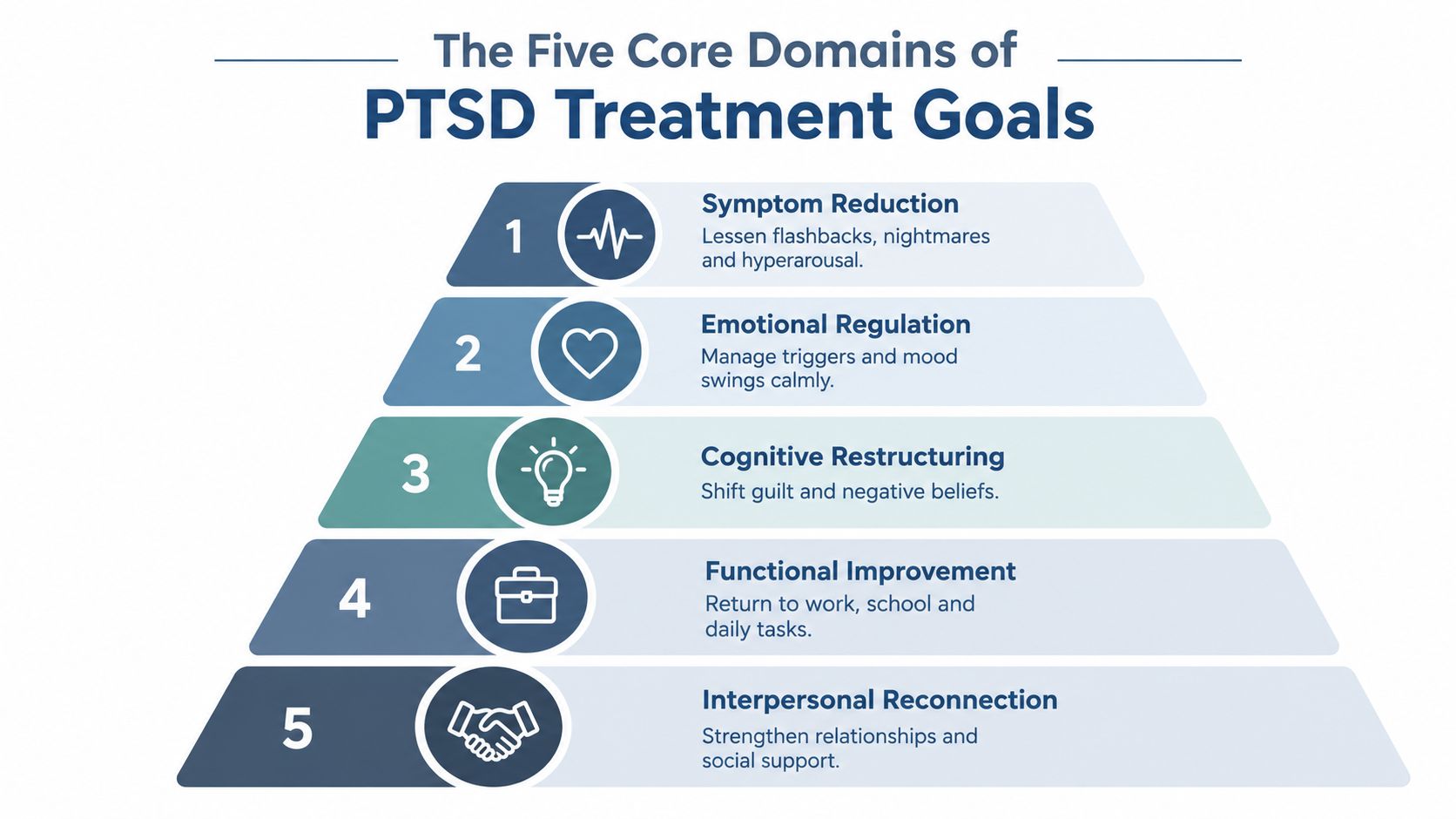
A senior professional may look composed in meetings while losing sleep, avoiding travel, or scanning every room for danger. PTSD treatment goals therefore need to measure more than distress. A clinical guideline framework groups recovery into five connected domains, giving the treatment team a way to protect executive functioning, privacy, relationships, and career responsibilities in residential care (APA treatment goals guidance).
Symptom reduction
The first domain tracks intrusive memories, nightmares, avoidance, hyperarousal, anger, and sleep disturbance. Progress might mean fewer flashbacks during travel, less startle response in crowded settings, or sleeping without repeatedly checking the room. Validated assessments, symptom diaries, and structured interviews help distinguish a meaningful change in severity from a general impression that “things seem better.”
The goal is not emotional numbness. It is to reduce symptoms enough that attention, judgment, and choice become available again.
Prevention and treatment of co-occurring problems
PTSD can occur alongside substance use, depression, affect dysregulation, suicidal ideation, or dissociation. Reducing flashbacks while alcohol misuse or severe emotional instability continues leaves the recovery plan unfinished. Clinicians identify the conditions that interfere with safety and functioning, then coordinate psychotherapy, psychiatric care, withdrawal management when appropriate, and continuing support.
Grounding skills can help a client return attention to the present during distress. A practical grounding guide from Refresh Psychiatry & Therapy offers present-focused strategies, but these techniques support rather than replace individualized clinical treatment.
Personal, social, and occupational functioning
Functioning tests whether symptom change transfers into ordinary life. Can the client concentrate on a complex task, respond to a partner's concern without withdrawing or becoming enraged, attend a family event, delegate responsibility, or resume a predictable work rhythm?
For professionals, treatment may track decision quality, communication, boundaries, and sustainable workload. Confidentiality remains part of the plan. Returning to full productivity immediately does not, by itself, show that recovery is stable.
Relapse protection
Relapse prevention prepares for predictable stress before discharge. The plan can list trauma reminders, early warning signs, substance-use urges, sleep deterioration, and people to contact when risk rises. It should also clarify how medication reviews, therapy appointments, family participation, and peer support will continue.
Like an executive contingency plan, it turns vague concern into defined actions.
Quality of life and safety
The final domain connects treatment with a life the client wants to live. Safety includes managing self-harm risk, impulsive behavior, medication concerns, and substance-related danger. Quality of life includes rest, intimacy, purpose, recreation, and the ability to choose meaningful activities instead of organizing every decision around symptom avoidance.
How Clinicians and Clients Set SMART Goals Together
A broad ambition such as “return to normal” isn't clinically useful until the client and clinician define what normal means. For one executive, it may mean sleeping through the night and leading a difficult negotiation without dissociating. For another, it may mean stopping substance use, repairing a marriage, and tolerating a previously avoided neighborhood.
Begin with the client's priorities
The clinician first maps symptoms, risks, co-occurring conditions, responsibilities, and values. The client then identifies the outcomes that would make treatment worthwhile. This partnership matters because a goal imposed by a provider may be technically measurable but irrelevant to the person's life.
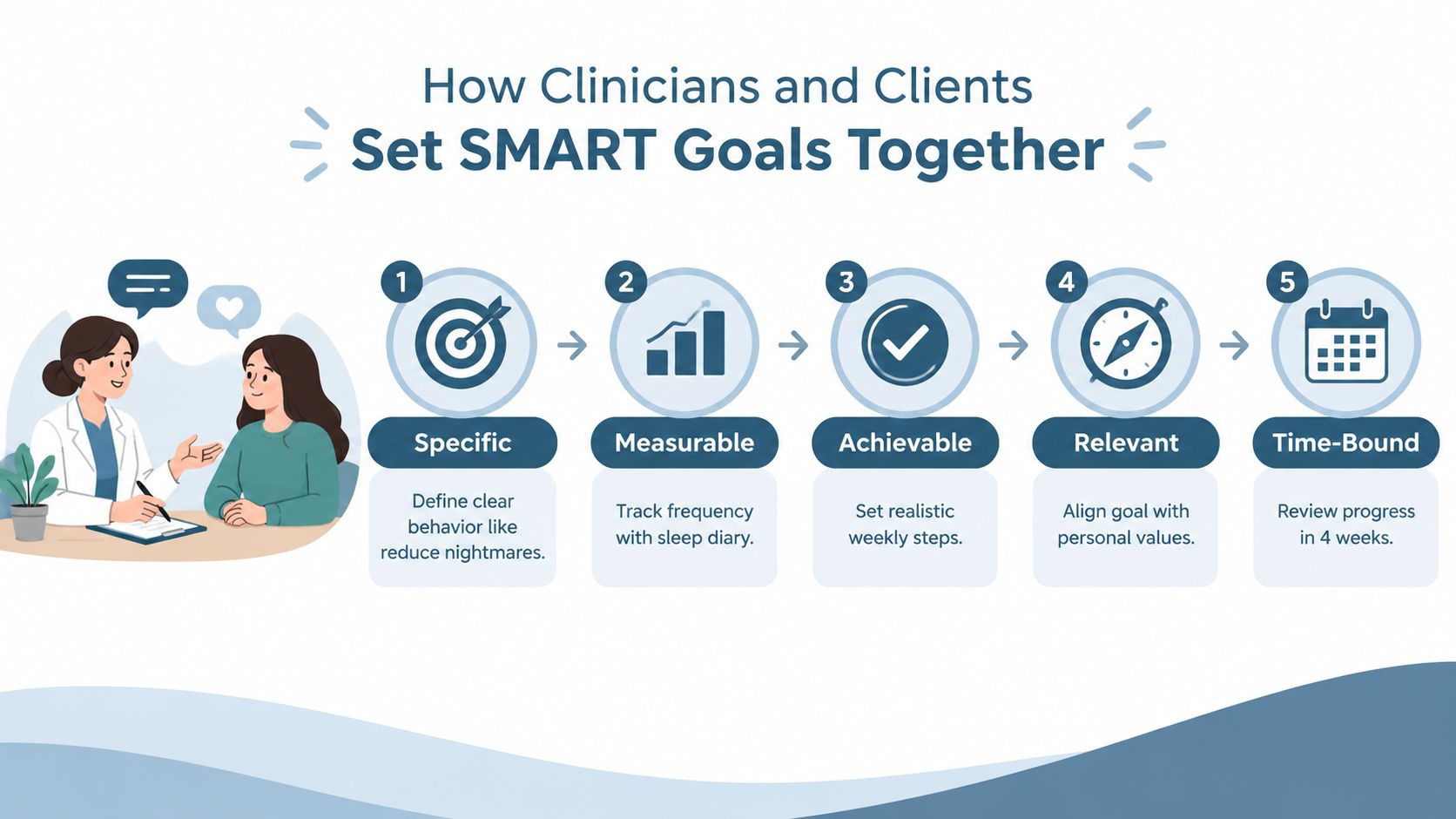
A strong goal has five features:
- Specific: It names a behavior or symptom, such as fewer trauma-related nightmares or more consistent participation in family conversations.
- Measurable: It uses a symptom measure, clinician-rated assessment, sleep record, substance-use log, or functional observation.
- Achievable: It matches current stability, resources, medical needs, and readiness.
- Relevant: It connects directly to safety, recovery, relationships, or meaningful work.
- Time-bound: It includes a review point so the team can evaluate whether the plan remains appropriate.
Professionals who want a practical framework for helping clients turn ambitions into reality can apply the same principle to trauma recovery, while keeping clinical decisions with the treatment team.
Use measurement to guide decisions
The APA guideline emphasizes periodic assessment. Its evidence tables include PTSD symptom reduction measured with instruments such as the Clinician-Administered PTSD Scale, or CAPS, making change in overall severity a practical benchmark (APA PTSD evidence appendices).
Measurement doesn't turn recovery into a performance review. It gives the team a shared language. If intrusive symptoms improve but sleep and functioning remain poor, the clinicians can examine medication, co-occurring depression, substance use, arousal, or environmental stress rather than declaring success too early.
Review and revise
At regular clinical reviews, the team and client ask:
- Which symptoms have changed?
- Which daily activities are easier or more reliable?
- What remains unsafe or disruptive?
- Is the current intervention tolerable and effective?
- Should treatment continue, intensify, or change direction?
A personalized plan can preserve career continuity while maintaining therapeutic boundaries. Details about how a residential program can structure that process appear in personalized treatment planning, including the importance of adapting care to the individual rather than applying a fixed template.
When Goals Shift for Complex PTSD and Dual Diagnosis
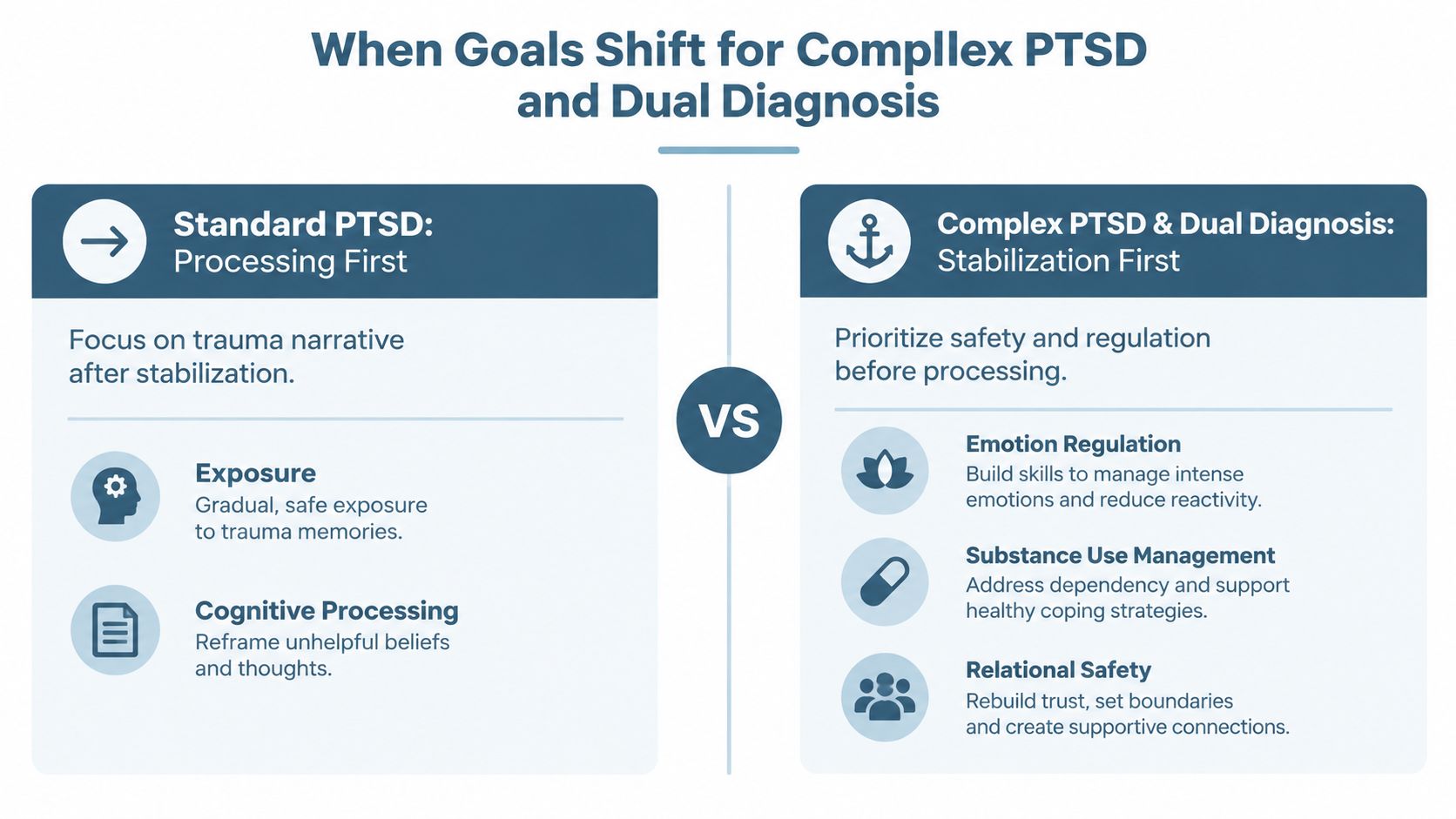
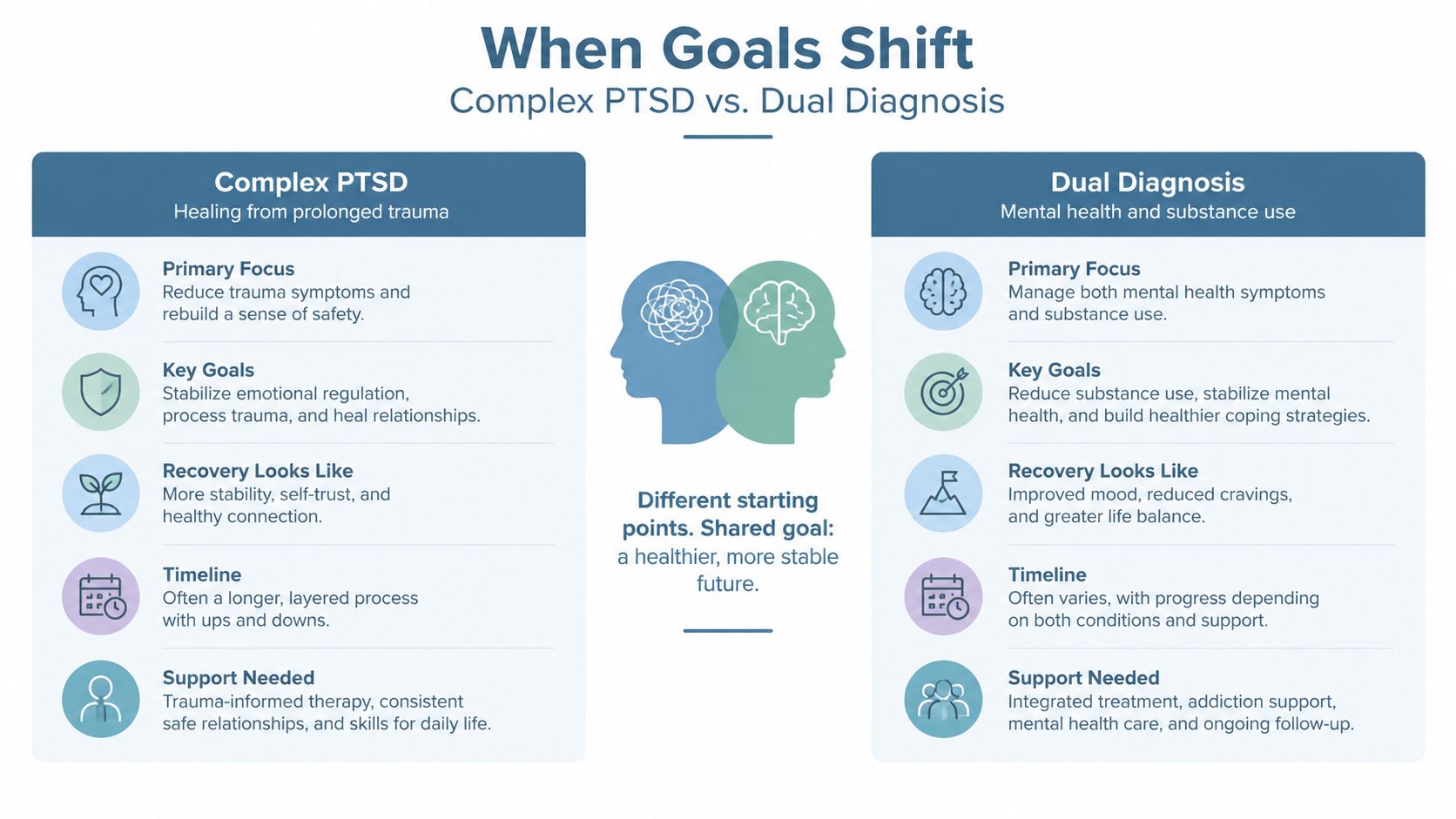
A senior professional may appear composed in meetings while privately managing dissociation, depression, cravings, or sudden emotional surges. In complex PTSD and dual diagnosis, treatment goals therefore follow the order that protects executive functioning: first enough safety and stability to think clearly, maintain relationships, and make reliable decisions, then carefully paced trauma processing.
Stabilization first
Stabilization creates the conditions for meaningful participation. Goals may include:
- Emotion regulation: Recognizing rising anger, shame, panic, or despair and applying practiced skills before reactions damage work or relationships.
- Dissociation management: Detecting depersonalization or derealization, then returning attention to the present through grounding and sensory orientation.
- Substance-use management: Addressing intoxication, withdrawal risk, cravings, and the role substances play in sleep or emotional avoidance.
- Relational safety: Setting boundaries, building trust, and using communication patterns that reduce conflict and protect treatment engagement.
These goals are the foundation for later work. Like securing the controls of an aircraft before changing course, they help the client stay present while treatment becomes more demanding.
Processing when readiness supports it
For adults with established PTSD, the VA/DoD clinical practice guideline strongly recommends individual, manualized trauma-focused psychotherapy involving exposure or cognitive restructuring, including PE, CPT, and EMDR, over other pharmacological and non-pharmacological options.
A 2025 PTSD treatment review found that psychological treatments outperform controls overall, while benefits lasting beyond one month were clearest for trauma-focused CBT and EMDR. Guidance for complex PTSD found no clear difference between trauma-focused therapies with or without exposure. It also weakly recommended skills training for complex PTSD and noted that body-focused and mindfulness approaches may help when depression or dissociation co-occur.
Clinical judgment determines the sequence. A client who can sleep, remain oriented, manage urges, and use coping skills may be ready for memory-focused work. Another may need more time building those capacities. Information about complex PTSD recovery can help families understand why readiness, alliance, and treatment targets may change.
What PTSD Treatment Goals Look Like in Luxury Residential Care
A senior professional may arrive with insomnia, irritability, alcohol use, and poor concentration while still carrying major responsibilities at work. Residential care gives clinicians a protected setting to address those symptoms without treating career demands, privacy, and relationships as irrelevant.
Early goals usually focus on medical safety, sleep, emotional regulation, and reduced substance reliance. These goals support executive functioning, much like stabilizing a building's foundation before repairing its upper floors. As the client can stay present, manage urges, and use coping skills, the team may introduce trauma-focused psychotherapy, cognitive restructuring, somatic work, and carefully paced exposure or EMDR.
The environment carries clinical meaning
Privacy can reduce unnecessary stimulation and support sleep, boundaries, and a sense of safety. A private room also gives a client space to decompress after difficult therapy, organize thoughts, and limit unplanned conversations while the nervous system settles.
Clinicians should connect that setting to observable treatment goals. For example, a client preparing for a board review might use the room for quiet planning during an approved period, then put devices away early enough to protect sleep. The goal is not uninterrupted productivity. It is practicing attention, limits, and recovery in the same plan.
Work access needs clinical boundaries
Some residential programs permit supervised laptop and cell-phone use during designated hours, with access shaped by clinical approval and clear boundaries (guidance on rehab with cell phones). Structured access can help a client handle a necessary work message or review materials without turning treatment into an extension of the office. It also creates a practical test of executive control: can the client complete a defined task, stop on schedule, and return to therapy or rest?
At Reflections, private residential dual-diagnosis care can connect PTSD goals with substance-use recovery, professional responsibilities, relationships, privacy, and continuing care. Private rooms, psychiatric support, family involvement, trauma-informed therapy, and supervised electronics access each serve a clinical purpose when they help the client sleep, focus, regulate emotion, and maintain boundaries. The treatment plan should show how these supports protect recovery rather than describe comfort features.
Measuring Progress and Preventing Relapse for Lasting Recovery
Recovery becomes durable when the client and treatment team measure both symptoms and function. A lower symptom burden matters, but so does sleeping more consistently, handling a trigger without using substances, communicating during conflict, and returning to meaningful responsibilities without recreating the conditions that caused collapse.
Track change across settings
Clinical reviews can combine validated assessments, structured interviews, sleep records, substance-use monitoring, safety reviews, and observations from therapy. The team should distinguish a temporary good day from a dependable pattern. It should also notice uneven progress, such as improved nightmares alongside persistent dissociation or better concentration alongside growing alcohol cravings.
Relapse prevention deserves its own goals. A practical plan identifies triggers, early warning signs, coping responses, emergency contacts, medication follow-up, therapy appointments, family roles, and limits around work intensity. A client may also benefit from structured continuing support, including an activity for relapse prevention groups that turns abstract planning into practiced responses.
Ask providers precise questions
Prospective clients and families should ask:
- Measurement: Which instruments and functional benchmarks will the team use?
- Sequencing: What must improve before trauma processing begins?
- Dual diagnosis: How will clinicians address substance use, depression, dissociation, or safety risk?
- Privacy: How are rooms, communications, visitors, and records handled?
- Continuity: How will work access, family participation, discharge planning, and follow-up be coordinated?
- Accreditation: What does the provider's accreditation cover, and how does it shape clinical operations?
The strongest plan is individualized, measurable, and flexible. It protects the client's future by treating symptoms, safety, relationships, career function, and relapse risk as connected parts of recovery.
Reflections offers private, luxury residential detox and rehabilitation for adults with co-occurring PTSD, mental health, and substance-use concerns, with individualized treatment, accredited clinical oversight, private rooms, and structured access to electronics when clinically appropriate. Visit Reflections to discuss confidential treatment planning that supports recovery while respecting professional responsibilities and long-term goals.