

A founder is checking overnight messages before sunrise. A hospital executive is trying to decide whether to enter treatment while payroll, litigation, investor updates, and family obligations keep moving. A managing partner knows care is needed now, but the idea of disappearing from every call, text, and inbox feels impossible.
That conflict is real. For high-earning professionals, entering residential treatment often isn't a question of willingness. It's a question of whether treatment can be structured around the realities of a life that still carries responsibility, visibility, and consequence. A rigid electronics blackout may sound clean on paper, but for some executive clients it creates a level of external disruption that keeps them from seeking help at all.
A high-end residential program should be able to hold both truths at once. Recovery requires boundaries, containment, and clinical focus. It also needs to account for the fact that some clients cannot ethically or practically vanish from work, legal, or family communication for an extended period. In that context, rehab that allows cell phones isn't a loophole. It's often a sign that the program knows how to treat complex adult lives with precision.
The Executive's Dilemma Needing Rehab and Staying Connected

The executive client usually isn't asking for a phone because of boredom. The phone represents access to obligations that may affect employees, boards, clients, patients, shareholders, or children. A complete disconnect can feel less like rest and more like professional collapse.
That fear keeps many successful people stuck. They know the drinking, stimulant use, burnout, trauma symptoms, depression, or mood instability can't continue. They also know a standard model that says "turn everything in and disappear" may not match the actual demands of their life.
Why the stakes feel different for executives
A C-suite client may need to approve a narrow category of decisions, attend a confidential virtual meeting, or stay reachable for a family legal matter. For that person, a carefully structured program doesn't confuse selective communication with denial. It builds a structure around it.
Private-pay executive treatment reflects that level of customization. Executive luxury rehab programs typically cost over $1,000 per day, with some high-end facilities reaching up to $3,500 daily, because the model includes personalized clinical teams and continuous access to advanced care rather than décor alone, as described in this overview of executive luxury rehab costs.
Some clients also need a realistic plan for where they'll work during treatment and how communication will be managed. A useful example is this resource on working from rehab in a structured residential setting, which reflects the kind of planning executives should ask about before admission.
Practical rule: If a program treats electronics as a yes-or-no amenity question, it's probably missing the clinical and operational complexity of executive care.
Connection is practical, not just emotional
High-level professionals often travel between homes, offices, and remote properties. Even basic logistics matter. If someone expects to coordinate urgent communication from a rural location before admission or during a transition, it helps to understand how to boost cell signal in rural areas so essential contact doesn't fail at the wrong moment.
The right program doesn't ask an executive to choose between getting help and preserving the essential functions of adult life. It asks a better question. Which communications are necessary, which are avoidant habits in disguise, and how can the difference be managed clinically?
Why Rehab Cell Phone Policies Vary So Widely
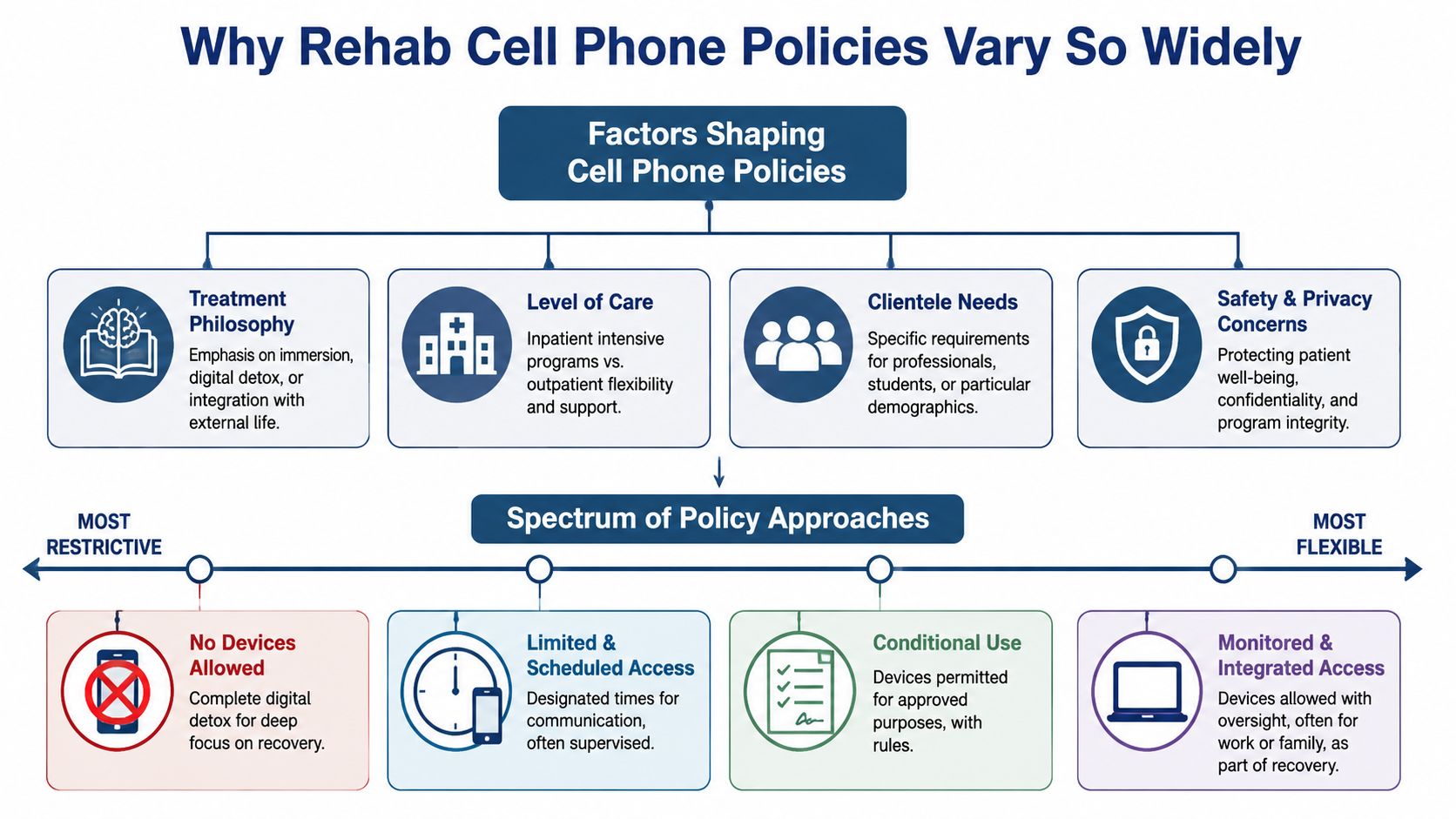
Many people assume phone policies are arbitrary. They aren't. They usually reflect the program's philosophy, safety concerns, client population, and level of care.
A young adult primary addiction program may use stricter restrictions because social media, impulsive contact, or online access are part of the active problem. An executive dual-diagnosis setting serves a different reality. The policy has to fit the person being treated, not a generic profile.
The main policy models
Most residential programs fall somewhere on a spectrum.
- Complete device prohibition works like a hard reset. The program removes phones and laptops entirely so clients focus on stabilization, community engagement, and treatment immersion.
- Scheduled access allows communication during designated windows. Staff can set limits around timing, supervision, and purpose.
- Conditional use permits devices for approved functions, such as family updates, legal matters, or specific work tasks.
- Integrated executive access treats technology as something to be clinically managed inside the treatment plan rather than outside it.
In residential dual-diagnosis settings, a common middle-ground approach is a staged privilege model with a 24 to 72 hour therapeutic hold at intake, followed by limited access windows once stabilization and early group integration are underway, as outlined in this discussion of phone access in residential dual-diagnosis care.
What drives those differences
Four variables usually shape the rules more than anything else:
| Factor | How it changes the policy |
|---|---|
| Treatment philosophy | Some teams prioritize digital detox. Others emphasize practicing healthy use in real life. |
| Level of care | Medically and psychiatrically intensive settings usually need tighter early structure. |
| Client needs | Students, parents, public figures, and executives don't all need the same boundaries. |
| Safety and privacy | Phones can expose peer confidentiality, create access to triggers, or interrupt treatment flow. |
A phone policy should answer a clinical question, not just enforce a house rule.
Why one-size-fits-all usually fails
A blanket prohibition can be useful for some populations. It becomes less useful when the client has a fiduciary role, a high-confidentiality profession, or a narrow set of duties that can't be abandoned without harm.
That doesn't mean unrestricted access is the answer. It means the policy has to distinguish between compulsive use and necessary use. A CEO joining a scheduled board call from a private setting is not the same clinical issue as doom-scrolling through distressing messages between groups.
The better programs understand that rehab that allows cell phones should still feel structured. If it feels casual, the policy is too loose. If it feels punitive, the policy is too blunt.
Balancing Recovery and Responsibility The Clinical View
Phones can help treatment, and phones can interfere with treatment. Both are true.
The risk side is straightforward. A device can become an avoidance tool. Clients may leave difficult feelings untouched by staying busy with inboxes, market updates, family conflict, or constant reassurance-seeking. Phones can also expose clients to triggers, break concentration, and create peer privacy problems in any residential community.
Where phone access goes wrong
Clinically, access tends to fail in predictable ways:
- Avoidance of discomfort. A client reaches for work every time grief, shame, trauma, or anxiety rises.
- Stress amplification. A manageable work responsibility turns into all-day activation because there are no boundaries.
- Blurred confidentiality. Photos, recordings, speakerphone use, and unsecured communication can compromise other residents.
- False productivity. The client feels "responsible" while delaying the deeper work that treatment requires.
A flexible policy only works when the team is willing to confront those patterns directly. If technology use isn't being observed, discussed, and adjusted, it can become part of the illness cycle.
Where structured access helps
There is also a valid clinical argument for managed access in an executive population. Some clients engage more fully in treatment when they know critical obligations won't be ignored. The reduction in anticipatory panic matters. A person who isn't catastrophizing about a collapsing business or an urgent family issue is often more able to settle into therapy.
There is also an unresolved clinical gap in the broader conversation. Existing content often doesn't address whether a standard therapeutic hold on phones may delay trauma processing for some patients with PTSD or bipolar traits who rely on digital grounding techniques, as noted in this review of electronics policies in rehab. That matters because a rule can be clinically sensible in one case and destabilizing in another.
The best use of technology in treatment isn't indulgence. It's deliberate containment.
The actual therapeutic task
For professionals, the deeper goal isn't merely access. It's boundary retraining.
A strong executive program uses phone access to teach skills the client will need after discharge. How to prepare for a stressful call without spiraling. How to limit communication to essential topics. How to hand off responsibilities. How to notice when "one urgent message" becomes a way to escape therapy.
That approach respects adult responsibility without romanticizing it. Work can provide identity, structure, and meaning. It can also hide fear, trauma, perfectionism, and compulsive self-worth. A clinically managed electronics policy should help reveal the difference.
Evaluating a Program's Tech Policy What to Ask
"Asking whether phones are allowed" isn't enough. Most advanced programs can answer yes or no. The meaningful question is how the policy operates once treatment begins.
Executives and families should listen for precision. Vague answers usually signal a vague process. A clinically mature program can describe intake expectations, supervision, escalation pathways, and confidentiality practices without sounding defensive.
Questions that reveal the real policy
A good admissions call should cover what happens on day one, how exceptions are handled, where devices may be used, and who approves work-related communication. If the answer is "it depends," the follow-up should be "depends on what?"
Here is a practical screening tool.
| Question to Ask | Why This Is Important | What a Strong Answer Includes |
|---|---|---|
| What happens to my phone and laptop at intake? | This reveals whether the program has a calm, organized admission process or an improvised one. | A clear explanation of initial assessment, temporary holding procedures if needed, and when the treatment team reviews access. |
| Who decides whether work-related device use is clinically appropriate? | Access shouldn't be negotiated ad hoc with nonclinical staff. | A defined decision-maker, typically the clinical team, with attention to psychiatric status, substance use patterns, and treatment goals. |
| Are there scheduled work windows? | Predictable structure prevents devices from taking over the day. | Set time blocks, location rules, and a process for handling truly urgent matters outside that window. |
| Where can calls or virtual meetings happen? | Confidentiality matters for the client and for the treatment community. | Private spaces, sound control, and rules that protect other residents' privacy. |
| How is professional data protected? | Executives may carry sensitive legal, financial, or client information. | Secure handling expectations, storage protocols, and guidance around approved communication methods. |
| How do you respond if device use starts undermining treatment? | Every policy needs an intervention plan. | Specific examples of clinical review, boundary resetting, and modification of access rather than random punishment. |
| Can family or key colleagues communicate with the team about urgent matters? | Work and family crises don't always fit a schedule. | A defined pathway for urgent communication that doesn't force the client into constant availability. |
Red flags to watch for
Some answers should make a prospective client pause.
- "We allow phones, no problem." That often means there isn't enough structure.
- "Nobody gets any exceptions." That may signal inflexibility rather than clinical rigor.
- "You'll work it out with staff when you get here." Important boundaries shouldn't be invented in real time.
- "Privacy is handled case by case." In an executive setting, confidentiality should be designed into the program.
A more useful benchmark is whether the program can explain how technology integrates with treatment. This resource on managing Zoom calls in a tech-friendly luxury rehab program illustrates the level of operational detail serious clients should look for.
A thoughtful answer sounds specific, calm, and clinical. It doesn't sound casual, punitive, or improvised.
The Anatomy of a High-End Executive Electronics Policy
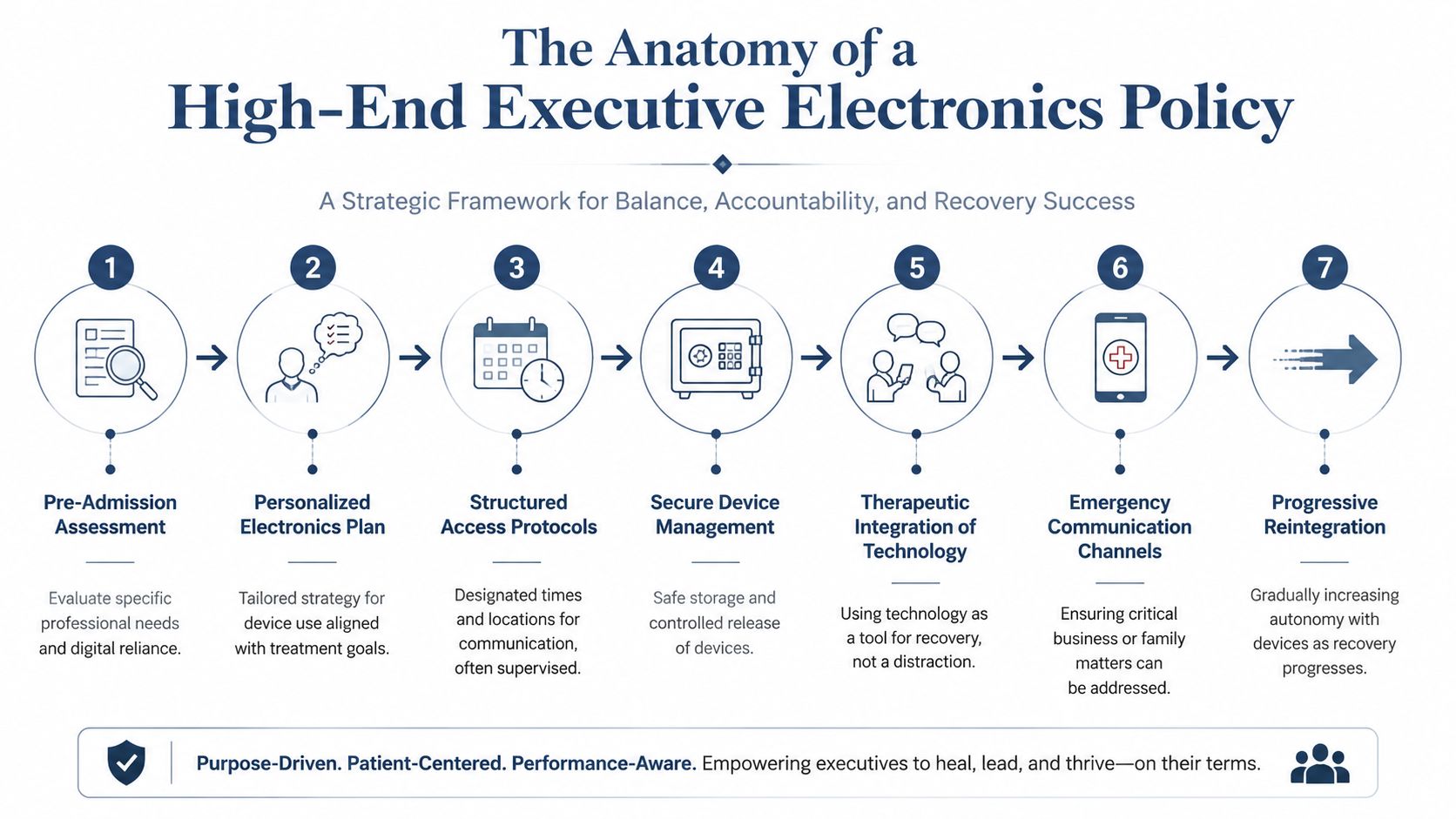
A premium executive electronics policy isn't just permission to keep a phone. It's a coordinated system built around privacy, treatment goals, and real-world responsibility.
That system starts before admission. The team needs to know whether the client is carrying active legal matters, oversight duties, public-facing roles, or essential family responsibilities. It also needs to know whether the phone itself has become part of the disorder through compulsive checking, secret use, high-conflict communication, or substance-related risk.
The nonnegotiable components
A high-end model usually includes several elements working together.
- Private accommodations matter because confidential calls shouldn't happen in shared sleeping quarters. In executive treatment, private rooms in both detox and residential care aren't just luxury touches. They support dignity, regulation, and discretion.
- Dedicated workspaces separate treatment life from professional communication. That physical distinction reduces spillover.
- Scheduled work periods prevent constant re-entry into outside stress.
- Clinical oversight makes the plan dynamic. If access is helping, it can remain stable. If it starts feeding avoidance, the team adjusts it.
- Secure communication procedures protect business and personal confidentiality.
One concrete example of this model appears in the executive track at Reflections. The program explicitly permits laptops and cellphones so executives can maintain limited work responsibilities, with secure communication systems and scheduled work time in the specialized Simmons executive facility, as described in this overview of the executive rehab track.
What integration looks like in practice
The strongest policies make technology part of treatment instead of treating it as an exception. A therapist may help a client prepare for a difficult investor call, identify likely triggers, and set a decompression plan for immediately afterward. A psychiatrist may notice that late-night email checking is worsening sleep and mood instability, then recommend a tighter evening boundary.
Some executive clients also arrive after constant travel, timezone shifts, and international connectivity stress. For those trying to simplify device use before admission, these valuable iPhone data tips for travelers can help reduce one layer of logistical noise.
A useful reference point for families and referring professionals is this description of a tech-friendly rehab model for working adults. The key issue isn't the presence of devices. It's whether access sits inside a disciplined therapeutic framework.
Healthy phone use in treatment should feel intentional, limited, and accountable. If it feels limitless, it isn't therapeutic.
Choosing a Rehab That Respects Your Life and Your Recovery
The right search isn't for the most permissive program. It's for the program that understands why permission alone isn't enough.
For executives, real luxury in treatment isn't superficial convenience. It's clinical sophistication. It's a highly accredited team that knows how to treat dual-diagnosis complexity, protect confidentiality, and build a plan around the client's actual life. It's private rooms in detox and residential care. It's the ability to keep essential electronics when clinically appropriate, without letting those devices run the admission.
What the decision should come down to
The most useful question is simple. Does the program respect both the seriousness of the illness and the seriousness of the client's responsibilities?
That kind of respect shows up in practical details:
- Clear boundaries around when and why devices are used.
- Professional-grade privacy for calls, meetings, and sensitive data.
- Individualized planning rather than one-size-fits-all rules.
- A clinical team that can say both yes and no for good reasons.
Some people still need a full break from their devices. Others need phased access. High-functioning professionals with complex obligations may need a fully integrated model. None of those approaches is automatically more ethical than the others. The ethical question is whether the policy fits the patient's psychiatric needs, recovery risks, and real-world duties.
A high-end private-pay rehab should be able to hold that complexity without becoming permissive or punitive. When it can, rehab that allows cell phones becomes something more meaningful than a convenience. It becomes a way to help a client practice recovery in the same life they intend to return to.
Reflections offers California-licensed, Joint Commission-accredited luxury dual-diagnosis treatment for adults who need serious clinical care without ignoring professional reality. For executives, C-suite leaders, and other high-earning professionals seeking discreet residential treatment with private rooms, structured access to electronics, and a clinically managed path to staying connected, Reflections is one option to explore.