

A quarterly board meeting is approaching. A senior executive has a lumbar surgery in the rearview mirror, a prescription in the briefcase, and a private rule that no one else knows. One tablet before an early flight. Another to sleep after a late deal call. A little extra before a high-stakes presentation because the body feels tight, the mind won't stop, and work can't slow down.
From the outside, nothing looks wrong. Revenue is still moving. Meetings are still sharp enough. The calendar is still full. That's exactly why prescription drug addiction can stay hidden for so long in accomplished professionals.
This condition rarely begins with recklessness. It often begins with medical treatment, pressure tolerance, and a career culture that rewards endurance. For executives, founders, physicians, attorneys, and other high-performing professionals, the problem isn't only the substance. It's the combination of access, stress, privacy concerns, and the belief that as long as performance continues, treatment can wait.
The Professional's Dilemma with Prescription Drugs
A professional may start with a legitimate need. Pain medication after surgery. A sedative after weeks of insomnia. A stimulant to keep up with punishing deadlines and travel. Then the pattern shifts. The medication that once solved a clear problem starts managing every difficult hour of the day.
That shift is easy to miss in a high-functioning life. The person still makes decisions, still leads teams, still shows up polished and prepared. But internally, the relationship to the medication has changed. It is no longer support. It is becoming control.

Why this problem feels different for executives
Most public discussions of addiction are built around collapse. Arrests. Job loss. Public crisis. Many professionals don't recognize themselves in that picture, so they keep bargaining with the problem.
That mismatch matters. The World Health Organization reports that approximately 500,000 deaths worldwide are linked to drug use annually, with over 70% of these deaths attributed to opioid addiction. In the United States, treatment demand for prescription opioids surged by 460% between 1998 and 2009, reflecting a major shift toward prescription drugs as a primary source of addiction, as summarized in this review of prescription drug abuse statistics.
For professionals using medications such as Percocet after injury or surgery, the risks often become clearer when tolerance rises, doses drift upward, or withdrawal starts to shape behavior. A practical overview from the Addiction Resource Center on Percocet risks can help families and patients identify when ordinary use is becoming something more dangerous.
What discreet care must account for
Executives don't need a watered-down version of treatment. They need a model calibrated to their reality. That means confidentiality, dual-diagnosis evaluation, and an environment that doesn't force a false choice between health and total professional disappearance.
Private-pay executive care is built for that level of complexity. It typically serves clients who need strong clinical treatment in a private, upscale residential setting, often with private rooms in both detox and residential care and with structures that support limited, appropriate continuity with work. For professionals evaluating those options, executive rehab considerations often center on privacy, clinical depth, and whether the program can treat the underlying drivers behind the substance use.
The executive dilemma isn't whether life has already fallen apart. It's whether success has made the disorder easier to hide.
Understanding Addiction Beyond the Prescription
A prescription label doesn't protect anyone from addiction. Once misuse begins, the brain doesn't care whether the drug came from a dealer or a physician. It responds to chemistry, reinforcement, relief, and repetition.
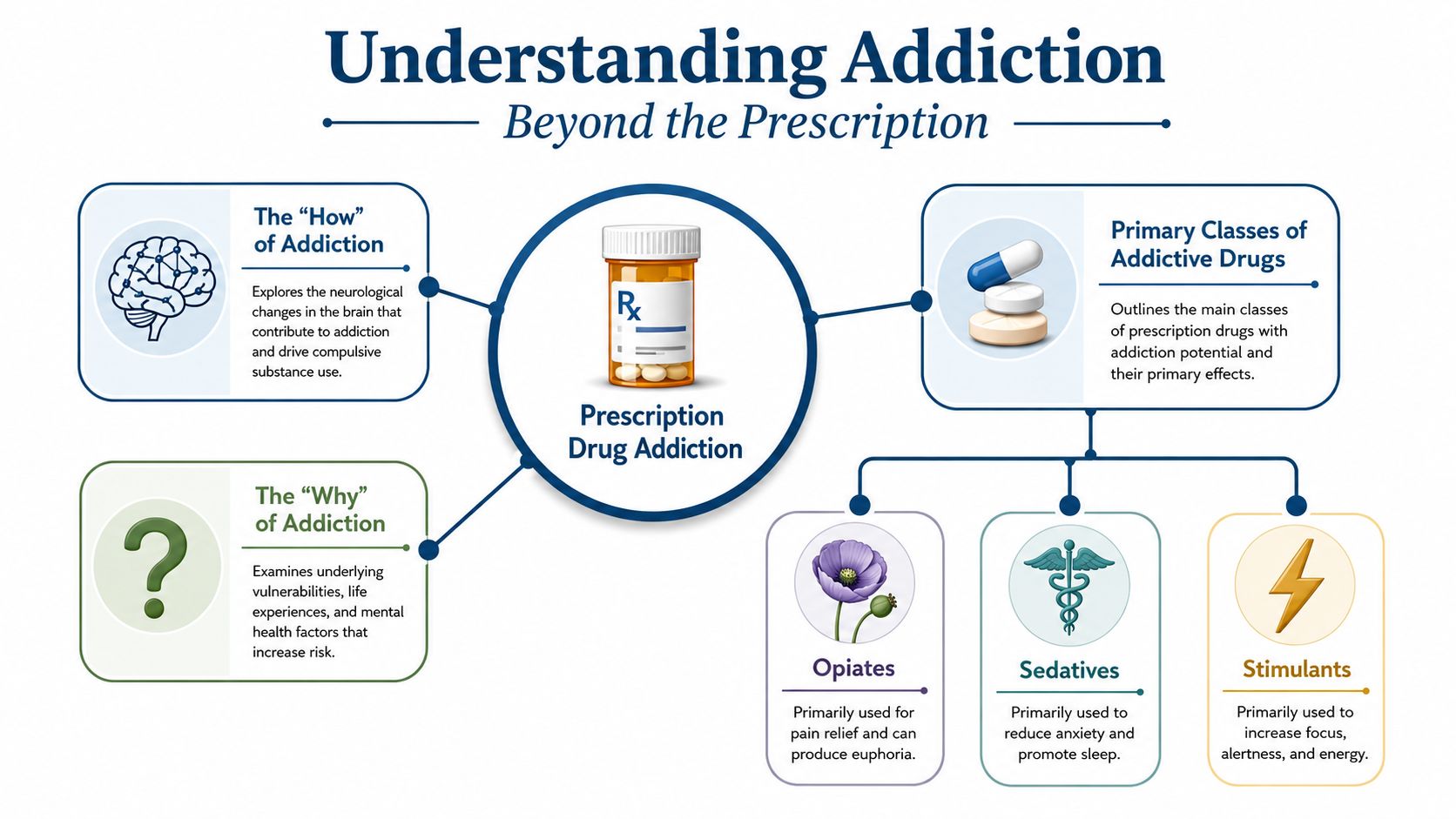
The three categories that most often affect professionals
Opioids are usually introduced for pain. In high-achieving adults, they may stay in the picture long after the original injury has improved because they also blunt tension, emotional discomfort, and exhaustion.
Benzodiazepines and other sedating medications are often tied to anxiety, panic, or sleep disturbance. For professionals who need to be composed in public, these drugs can feel deceptively useful. They can quiet the nervous system quickly, which is exactly why dependence can take hold.
Prescription stimulants are commonly misused in performance-driven environments. They may seem like a shortcut for focus, stamina, productivity, or travel-heavy schedules. Over time, many people find they can no longer work at the same pace without them.
Dependence and addiction aren't the same thing
Physical dependence means the body has adapted to a drug. Addiction adds loss of control, compulsive use, and continued use despite harm. In practice, the two often overlap, especially when someone starts taking a medication for reasons beyond the original prescription.
In the United States, 55.3% of individuals who misuse prescription drugs are definitively addicted to them. This is rooted in neurobiological changes where the drugs activate the brain's reward center, leading to physical dependence and severe withdrawal symptoms upon cessation, necessitating medically supervised detox, according to this review of prescription drug addiction data.
That last point matters. Professionals often try to stop on their own over a long weekend, convinced discipline will solve what looks like a private habit. But once withdrawal risk enters the picture, self-directed detox becomes clinically unsound.
What usually doesn't work
Several approaches fail repeatedly in this population:
- Relying on willpower alone because the person is successful in other parts of life.
- Switching schedules without treatment such as taking pills only at night or only on travel days.
- Treating only the mood symptom while ignoring the substance pattern.
- Using work performance as proof of safety when the addiction is still progressing underneath.
Clinical reality: If a medication has become the primary strategy for pain relief, sleep, emotional regulation, or performance, the treatment plan has to address both the drug use and the function it now serves.
Recognizing the Subtle Signs in High-Functioning Individuals
In high-status professionals, addiction often announces itself through pattern changes, not public disasters. A spouse may notice increasing distance. A colleague may notice unusual irritability before meetings. An assistant may observe frequent refill logistics, changing pharmacies, or unexplained gaps in availability.
The signs usually look polished, not chaotic
A high-functioning person may still meet deadlines while becoming more secretive around medication. They may appear disciplined while reorganizing the day around dosing. They may compensate for cognitive dulling or emotional volatility by working longer hours, speaking less spontaneously, and avoiding unstructured family time.
Common indicators include:
- Secrecy around medication such as hiding bottles, splitting prescriptions across bags, or becoming unusually protective of personal space.
- Defensiveness when a partner, physician, or colleague asks a simple question about use.
- Multiple prescribers or refill strategies that seem designed to avoid scrutiny.
- Mood instability that doesn't fit the situation, including sharp irritability, flatness, or agitation.
- Social narrowing where the person stays engaged at work but withdraws from home life and long-standing relationships.
- Performance strain that gets covered by extra hours, rehearsed presentations, or overcontrol.
Why many professionals wait too long
For this population, the most dangerous story is often, "It isn't that bad." The person is still functioning, still earning, still making decisions. That outward capacity becomes the justification for delay.
The research on the high-functioning paradox captures this barrier clearly. The most cited reason for not seeking treatment among professionals is the belief that treatment is unnecessary or a preference to withdraw alone because of shame and confidentiality concerns. That perceived lack of need is the single most reported barrier to care in this analysis of treatment barriers among professionals.
That is why loved ones often feel confused. They can see deterioration, but not the kind they were taught to look for.
A person doesn't need to lose a career to qualify for treatment. In executive populations, preserving the career is often one reason treatment should happen now.
Families who are trying to interpret these quieter warning signs often benefit from guidance focused on non-stereotypical presentations, including this discussion of hidden signs of prescription drug abuse.
Why Executive Treatment Is a Clinical Necessity
For a high-level professional, the treatment setting isn't a cosmetic detail. It can determine whether the person enters care at all, whether they stay, and whether the underlying drivers of the addiction are addressed. Standard programs may be effective for many people, but they often miss the practical and psychological barriers that keep executives from engaging fully.
What executive care changes
A senior professional may need privacy, a quieter peer environment, and a treatment team that can work at the level of trauma, anxiety, depression, bipolar traits, or chronic stress that often sits beneath the substance use. When those elements are missing, treatment can become superficial. The person may comply outwardly while withholding the material that matters most.
High-end executive programs are designed differently. They emphasize discretion, stronger clinical staffing, and more individualized care. According to this overview of private luxury rehab with executive programs, high-end executive rehab centers require accreditation from The Joint Commission or CARF, use credentialed, PhD-level psychologists and psychiatrists, and offer significantly higher staff-to-client ratios, with some providing double the amount of individual therapy, such as two sessions per week.
Standard Rehab vs. Executive Luxury Rehab
| Feature | Standard Rehab | Executive Luxury Rehab |
|---|---|---|
| Privacy | More limited privacy, often with a broader mix of client needs | Greater discretion, private-pay setting, and a treatment culture built for confidentiality |
| Living environment | Shared or less personalized accommodations are common | Private rooms are often part of the care model in both detox and residential treatment |
| Clinical intensity | May rely more heavily on generalized programming | Higher staff-to-client ratios and more individualized therapy |
| Mental health complexity | Dual diagnosis may be present but not always deeply specialized | Psychiatric and psychological care is typically central to treatment planning |
| Peer environment | Mixed population with widely different life circumstances | Greater likelihood of peers who understand executive pressure and reputation concerns |
| Work accommodation | Often limited | Structured support for essential professional obligations when clinically appropriate |
Why "luxury" is often misunderstood
For executives, luxury isn't about indulgence. It reduces barriers that otherwise block treatment. A private room lowers defensiveness. A discreet setting increases honesty. A highly credentialed team can sort out whether the drug use is being driven by trauma, panic, grief, burnout, perfectionism, or another untreated condition.
A useful discussion of these distinctions appears in this article on understanding luxury rehabilitation, especially for families trying to distinguish appearance from actual clinical depth.
Navigating Sophisticated and Integrated Treatment
Good treatment for prescription drug addiction isn't a single intervention. It is a coordinated sequence of medical stabilization, psychiatric evaluation, psychotherapy, family work, and long-term planning. For executives, that sequence works best when it happens in a setting that lowers stress rather than adding more of it.
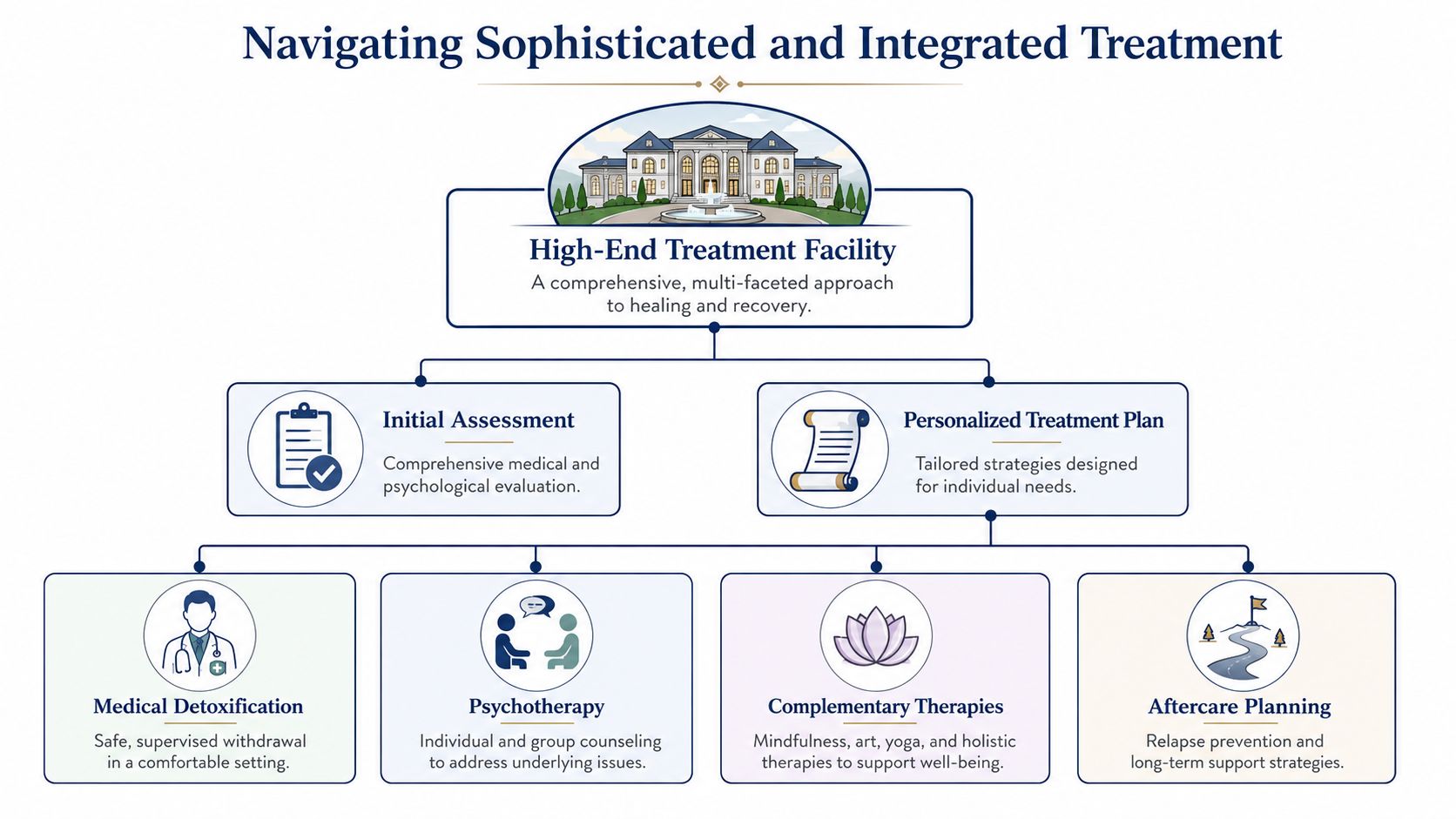
Treatment starts with stabilization
The first phase is assessment. Clinicians need to know what was prescribed, what is being taken now, how often, what other substances are involved, and which psychiatric symptoms predated the drug use.
If withdrawal risk is present, medically managed detox is the appropriate entry point. In an executive setting, this often occurs in a private room with close monitoring and a plan that prioritizes comfort, safety, and clear communication. For some clients, medication-assisted treatment is part of that strategy when clinically indicated. A concise explanation of that approach appears in this overview of medication-assisted treatment.
The center of treatment is dual diagnosis work
Detox alone rarely resolves prescription drug addiction in professionals because the medication usually came to serve a psychological function. It may have muted trauma symptoms, controlled panic, softened grief, or kept a sleep-deprived executive performing past a healthy limit.
That is why integrated programs rely on evidence-based therapies delivered with sophistication:
- CBT helps clients identify thought patterns and behavioral loops that sustain use.
- DBT helps with distress tolerance, emotion regulation, and impulsive coping.
- ACT helps clients build a life organized around values rather than avoidance.
- Individual psychotherapy creates room for private, high-level clinical work that many professionals won't risk in a less discreet setting.
- Family therapy addresses enabling patterns, communication breakdown, and trust repair.
Treatment is most effective when it answers two questions at the same time. How does the person stop using safely, and what was the medication doing for them that now needs a healthier replacement?
Work contact can support treatment when used correctly
Many executives avoid residential care because they assume they will vanish from their responsibilities. In well-designed executive programming, that's not always necessary. Leading executive rehab programs explicitly allow residents to keep cell phones and laptops and provide Wi-Fi and private spaces for handling essential work tasks, as described in this overview of luxury executive rehab programs.
That doesn't mean treatment turns into remote office life. It means clinical teams can structure limited professional contact in a way that reduces panic, preserves accountability, and keeps the client engaged in care.
Building a Life of Sustainable Recovery
Residential treatment is a reset, not a permanent shelter from real life. Executives need an aftercare plan that works in airports, boardrooms, hotel bars, investor dinners, family conflict, and the quiet hour after a stressful day when the old solution starts calling again.
The first months after treatment need structure
A strong continuing care plan usually includes ongoing therapy, psychiatric follow-up when needed, recovery-oriented peer support, and clear communication with family. For professionals, the plan also needs to anticipate calendar pressure. Recovery fails more often when it is treated as something to think about only after work is handled.
The most useful aftercare plans are practical:
- Travel planning includes medication safeguards, meeting options, sleep protection, and a clear response if cravings increase on the road.
- Event management addresses work dinners, client entertainment, and celebrations where substances may be normalized.
- Stress forecasting identifies known high-risk periods such as major launches, litigation deadlines, restructuring, or financial review cycles.
- Communication rules define who knows what, who can intervene, and what signs should trigger immediate support.
Family systems need treatment too
Prescription drug addiction often gradually distorts a household. A spouse may become hypervigilant. Children may adapt to unpredictability without understanding it. Family therapy helps replace secrecy, minimization, and resentment with informed boundaries and a workable plan.
Many professionals return home to people who have been carrying fear alone. Recovery deepens when the family understands the condition, the warning signs, and the difference between support and rescue.
Career success has to be rebuilt on healthier terms
Some professionals believe recovery means stepping away from ambition. It doesn't. It means changing the machinery underneath performance.
That may include firmer travel limits, protected sleep, better delegation, trauma treatment, realistic prescribing oversight, and stronger boundaries around perfectionism. It may also include alumni support or a discreet peer network of other accomplished adults who understand the pressure to appear unfailingly capable.
Sustainable recovery doesn't ask a professional to become less capable. It asks them to stop using self-destruction as a performance strategy.
Taking the Next Step with Confidence and Discretion
For many executives, the hardest part isn't recognizing the problem. It's deciding to act before the problem forces a public reckoning. Treatment is often postponed because the person wants one more quarter, one more deal cycle, one more chance to prove they can manage it privately.
That delay is expensive. Not only financially, but cognitively, emotionally, medically, and relationally.
A practical way forward
The next steps are usually straightforward:
- Arrange a confidential assessment with a program equipped for executive, dual-diagnosis care.
- Review detox needs realistically rather than planning a private withdrawal attempt.
- Clarify work realities so treatment can distinguish essential obligations from fear-driven overconnection.
- Involve one trusted family member or advisor who can support logistics and accountability.
- Choose a setting built for privacy and clinical depth, not just comfort.
Brief answers to common executive concerns
Is treatment confidential?
In a properly structured private-pay executive setting, confidentiality is a central part of care, operations, and environment.
Can a career survive time away?
Yes. In many cases, prompt treatment protects a career far more effectively than prolonged concealment. Some executive programs also accommodate limited essential work contact.
When is help urgent?
Immediate medical attention is warranted when there is overdose risk, severe sedation, confusion, breathing problems, seizure risk, suicidal thinking, or dangerous withdrawal symptoms. Waiting for a convenient time is not a sound plan in those situations.
Seeking help isn't a retreat from responsibility. For a high-performing adult, it's often the most strategic decision available.
Reflections provides confidential, high-end residential treatment for adults who need serious dual-diagnosis care in a private, upscale setting. With Joint Commission-accredited treatment, PhD-level clinicians, private rooms in both detox and rehab, and appropriate access to electronics for essential career obligations, the program is designed for executives, C-suite leaders, and working professionals who need discreet help without compromising clinical quality. Learn more or speak confidentially with the team at Reflections.