
A polished career can hide a private collapse for a long time. The executive still joins the call, signs the agreement, answers the late-night text, and looks composed at dinner. But internally, concentration slips, patience shortens, sleep becomes unreliable, and alcohol, pills, or other compulsive patterns start serving as both accelerator and sedative.
That's often the real moment when Fresh Start Recovery becomes relevant. Not when a person has lost everything, but when too much is still working on the outside for anyone else to see how much strain it takes to keep going.
For high-performing professionals, treatment shouldn't feel like exile from real life. It should feel like a carefully structured reset that protects dignity, supports complex mental health needs, and allows essential career continuity while deeper healing takes place.
Redefining What a Fresh Start in Recovery Means
A fresh start in recovery is often misunderstood. Many people hear the phrase and assume it means wiping the slate clean, disappearing from normal life, and rebuilding from nothing. For a working professional, that framing can feel threatening, even unrealistic.
A better definition is strategic recalibration. The person isn't erasing a life. The person is restoring judgment, emotional steadiness, physical regulation, and the ability to lead without relying on unhealthy coping.
When success stops feeling like stability
Executives often delay help because they can still perform. They may still close deals, manage teams, and maintain appearances. What changes first is usually more subtle. Decision fatigue sets in earlier. Mornings require more effort. The line between “celebrating,” “coping,” and “needing it” becomes blurred.
That's why a true fresh start recovery process isn't about punishment for excess. It's about recognizing that performance and well-being have become too expensive to maintain through willpower alone.
A sophisticated recovery program treats disruption as a signal, not a moral failure.
A fresh start isn't starting over
For professionals, “starting over” is the wrong model. A stronger model is an operating system upgrade.
That upgrade usually includes:
- Clearer thinking: Reduced mental clutter, less impulsive decision-making, and more stable attention.
- Better emotional range: Less irritability, numbness, and reactivity in high-pressure moments.
- Reliable routines: Sleep, nutrition, movement, and work boundaries stop being afterthoughts.
- Healthier recovery architecture: The person no longer depends on substances or compulsive behaviors to transition between stress and rest.
This perspective matters because shame keeps many accomplished people stuck. They assume treatment belongs to someone else, someone less functional, less educated, or less in control. In reality, high-functioning distress is still distress.
Fresh Start Recovery makes the most sense when it's viewed as an investment in long-term capacity. The person who seeks help isn't stepping away from ambition. The person is protecting it.
Recognizing the Need for a Deeper Reset
High achievers rarely miss the obvious signs forever. The challenge is that they often rename them. Alcohol becomes “a way to decompress.” Stimulants become “what it takes to stay sharp.” Isolation becomes “protecting time.” Irritability becomes “high standards.”
That relabeling can continue until stress and substance use start feeding each other. If anxiety increases, use increases. If sleep worsens, concentration drops. If concentration drops, shame rises. Then the cycle tightens.
A visual overview helps clarify what often gets minimized.
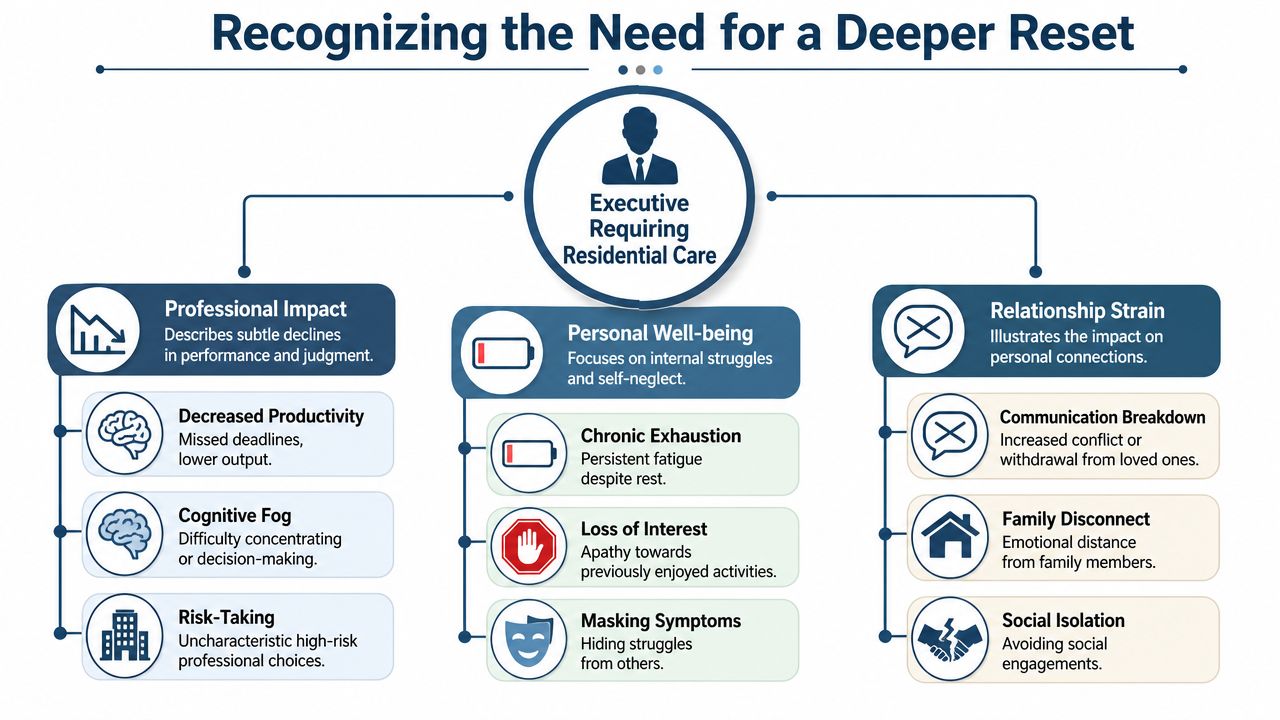
The signs executives often miss
The need for residential treatment doesn't always look dramatic. It often shows up as a pattern of erosion.
- Cognitive drift: The person rereads the same email three times, avoids complex decisions, or starts relying on others to compensate for lost sharpness.
- Emotional narrowing: Frustration becomes the default tone. Empathy drops. Small setbacks trigger outsized reactions.
- Split identity: Public competence grows more polished while private life becomes increasingly chaotic or joyless.
- Chemical dependence on transitions: A substance is used to get going, power through, come down, sleep, socialize, or feel normal.
These patterns can resemble burnout, but they often go deeper. Burnout alone doesn't always create compulsive use, hiding, escalating secrecy, or a persistent gap between external functioning and internal collapse.
Why mental health can't be separated from substance use
For many professionals, substance use and mental health symptoms don't sit in separate boxes. They interact continuously. Integrated dual-diagnosis treatment is technically more effective than treating substance use and mental health conditions in separate silos because symptom loops are bidirectional. Depression, PTSD, anxiety, and relapse can amplify each other, so care must target both simultaneously, as noted in this treatment overview of integrated care.
That matters because an executive may say, “The drinking is the issue,” when untreated panic, trauma, or depression is helping drive it. Another may say, “The anxiety is the issue,” while overlooking how substance use is worsening sleep, mood, and resilience.
A useful comparison comes from health behavior change more broadly. The conversation around sustainable weight management often makes the same point: long-term results don't come from forcing symptoms into submission. They come from changing the system that keeps recreating them.
Practical rule: If a professional has tried self-discipline, reduced use temporarily, and still returns to the same loop under pressure, a deeper reset is warranted.
The Blueprint for Executive Recovery Dual Diagnosis Care
A senior leader can look fully intact from the outside and still feel mentally scattered, emotionally exhausted, and privately dependent on alcohol, medication, or another coping habit just to get through the day. In that situation, treatment has to do more than stop use. It has to restore clear thinking, steadier mood, better sleep, and the capacity to lead a life and career with judgment intact.
That is the purpose of dual-diagnosis care.
It treats substance use and mental health conditions as parts of the same operating system. If anxiety is fueling late-night drinking, or poor sleep is worsening irritability and impulsive decisions, working on only one problem usually leaves the other free to restart the cycle. A well-designed executive program addresses the pattern as a whole so recovery becomes more stable and more relevant to real life.

What integrated care actually looks like
In practice, integrated treatment means one coordinated clinical team is looking at the full picture at the same time. Psychiatric care, addiction treatment, trauma-informed therapy, sleep support, medication evaluation, and family work are aligned around one plan rather than split into disconnected tracks.
That matters for professionals because fragmentation creates blind spots. One clinician may focus on drinking, another on panic, and neither may fully address the pressure cycle connecting both. Good dual-diagnosis care closes that gap.
The questions become more precise:
- Is substance use serving as short-term relief for anxiety, grief, trauma, or insomnia?
- Are depression, burnout, or chronic stress affecting concentration, motivation, or self-control?
- Would medication support help stabilize cravings, mood, or sleep early in treatment?
- Which relationship patterns, leadership pressures, or family dynamics could strengthen or weaken recovery?
For a clear explanation of how both conditions can be treated together, this guide to treatment for addiction and mental health at the same time outlines the integrated model in practical terms.
Why this model fits executive recovery
Executives usually respond well to treatment when it respects complexity. They are used to solving problems by identifying the variables, understanding the feedback loops, and applying the right intervention at the right point. Effective dual-diagnosis care follows that same logic.
A simple comparison helps:
| Approach | Likely result |
|---|---|
| Treat substance use alone | Anxiety, depression, trauma symptoms, or sleep disruption may keep pushing the person back toward use |
| Treat mental health alone | Ongoing substance use may interfere with therapy, judgment, medication response, and emotional stability |
| Treat both together | The recovery plan is more coherent, more personalized, and easier to sustain under real-world pressure |
For many professionals, this is also a matter of protecting cognitive performance. Recovery is not only about abstaining from a substance. It is about getting back attention span, emotional regulation, decision quality, and the internal steadiness that high-responsibility work demands.
Some residential programs, including Reflections, organize care around this combined approach for adults with co-occurring conditions. The true test is simple. One team should be able to address the entire pattern with discretion, consistency, and a plan that supports both personal healing and professional continuity.
Recovery lasts longer when treatment matches the full complexity of the person's life.
Choosing a Program That Protects Your Privacy and Career
You may be fully aware that life needs to change, yet still hesitate to step into treatment for one reason. Exposure. For many professionals, their primary fear is not whether care will help. It is whether getting help will disrupt a career, raise questions at work, or create avoidable visibility during a very personal process.
A well-designed executive program addresses that concern directly. Privacy is not a decorative feature. It is part of the treatment architecture. The right setting protects your reputation, reduces unnecessary stress, and gives you enough stability to do the deeper work of recovery without feeling that everything you have built is suddenly at risk.
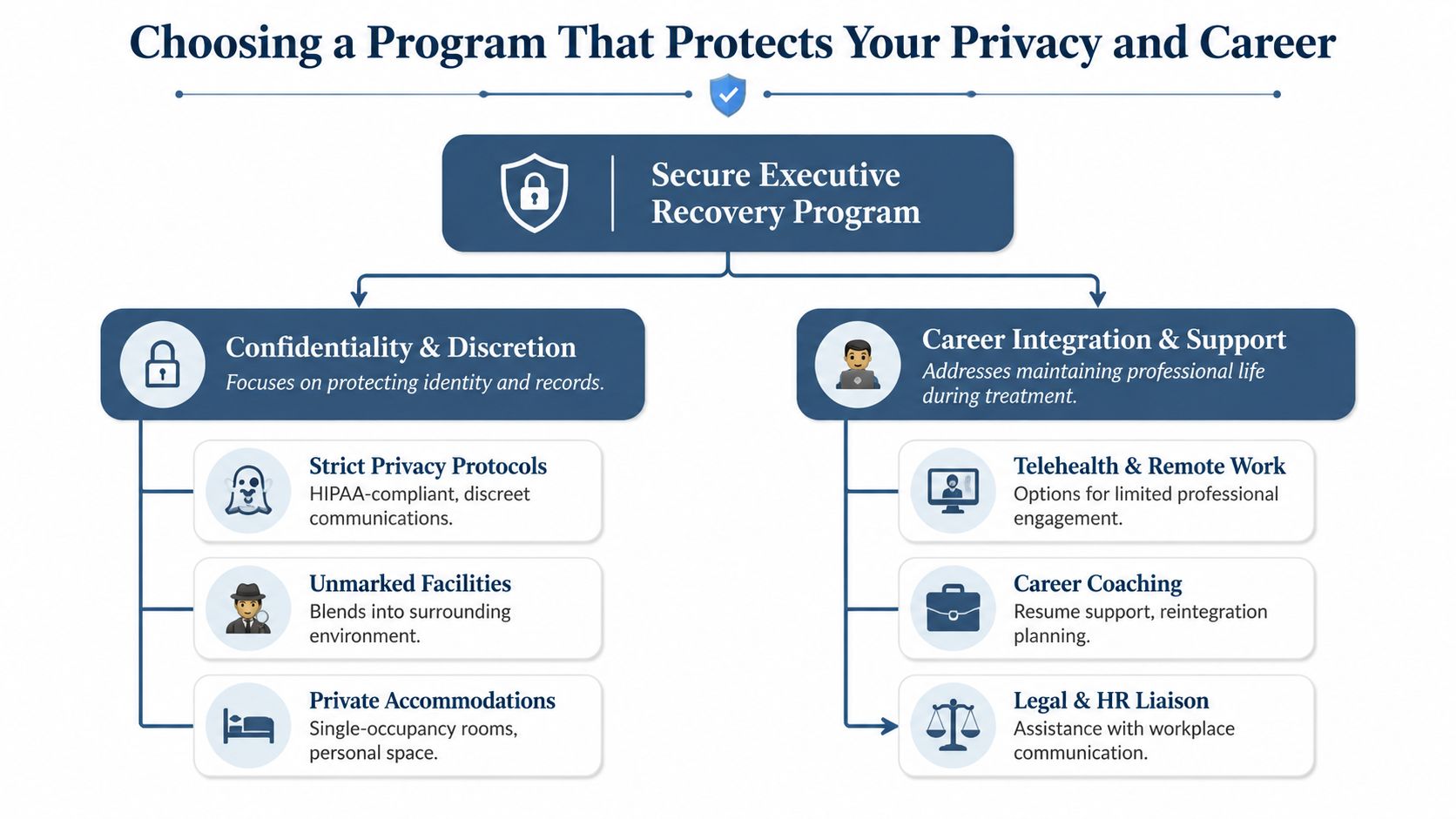
What privacy looks like in real treatment
Professionals often hear the word luxury and picture comfort. Comfort helps, but discretion depends on structure. A private room, carefully managed communication, and clear boundaries around information sharing are not indulgences. They lower the noise around treatment so the mind can settle, sleep can improve, and attention can return.
That matters more than it may seem at first. Recovery for a high-performing adult is often a strategic reset of executive function. Concentration, judgment, emotional steadiness, and impulse control tend to improve when treatment removes chaos instead of adding to it.
Programs built for professionals usually pay close attention to details such as:
- Private accommodations: Space for rest, confidential conversations, and emotional decompression.
- Managed electronics access: Limited phone or laptop use, when clinically appropriate, can help contain genuine work obligations without pulling a client back into constant performance mode.
- Individualized scheduling: The clinical day stays intact while making room for time-sensitive responsibilities when necessary.
- Discreet communication protocols: Intake, family coordination, and any employer-related contact should be handled carefully and only with the client's clear consent.
For a closer look at how these standards are applied, this guide to confidential addiction treatment for professionals explains what thoughtful discretion should include.
Why program design carries more weight than appearances
A peaceful environment can calm the nervous system. Program design determines whether progress holds once the first hard days pass.
The simplest comparison is this. A beautiful setting without a clear clinical framework works like a well-appointed office with no operating plan. It may look reassuring, but under pressure, confusion shows up quickly. By contrast, a program with round-the-clock support, coordinated psychiatric care, and discharge planning from the beginning gives recovery a steadier foundation.
This is also where career protection becomes practical. If detox, mental health care, and next-step planning are fragmented, the client may leave treatment physically stabilized but mentally overloaded and professionally unprepared. If those parts are connected, treatment can support healing while preserving order in the rest of life.
Useful outside reading can help clarify the difference between atmosphere and substance. Some people reviewing higher-end care also compare broader top alternative wellness options, then look more closely at which programs pair comfort with disciplined clinical structure.
A strong program should be able to answer a few direct questions without vagueness:
| Question | Why it matters |
|---|---|
| Is care supervised around the clock? | Early recovery can bring withdrawal symptoms, insomnia, anxiety, and abrupt mood shifts |
| Is detox connected to the next phase of treatment? | Better continuity reduces the risk of losing momentum after stabilization |
| Is psychiatric care addressed early? | Untreated anxiety, depression, trauma symptoms, or sleep problems can quickly erode progress |
| Is work continuity discussed realistically? | Professionals often need containment, planning, and discretion rather than total disconnection |
| Is continuing care planned from the start? | Recovery is more stable when the return home is organized before discharge |
Confidential care protects privacy and preserves order. The best programs do both while helping you recover the clarity, steadiness, and professional edge that substance use and untreated distress tend to erode.
The Treatment Experience A Fusion of Science and Serenity
Analytical professionals often do well in treatment once the approach reaches both intellect and emotion. Insight alone rarely changes entrenched patterns. A person can understand every trigger and still feel hijacked by craving, fear, shame, or numbness.
That's why an effective luxury program combines evidence-based psychotherapy with experiential and regulatory practices. One addresses thought patterns and behavior. The other helps the nervous system relearn safety, steadiness, and emotional access.
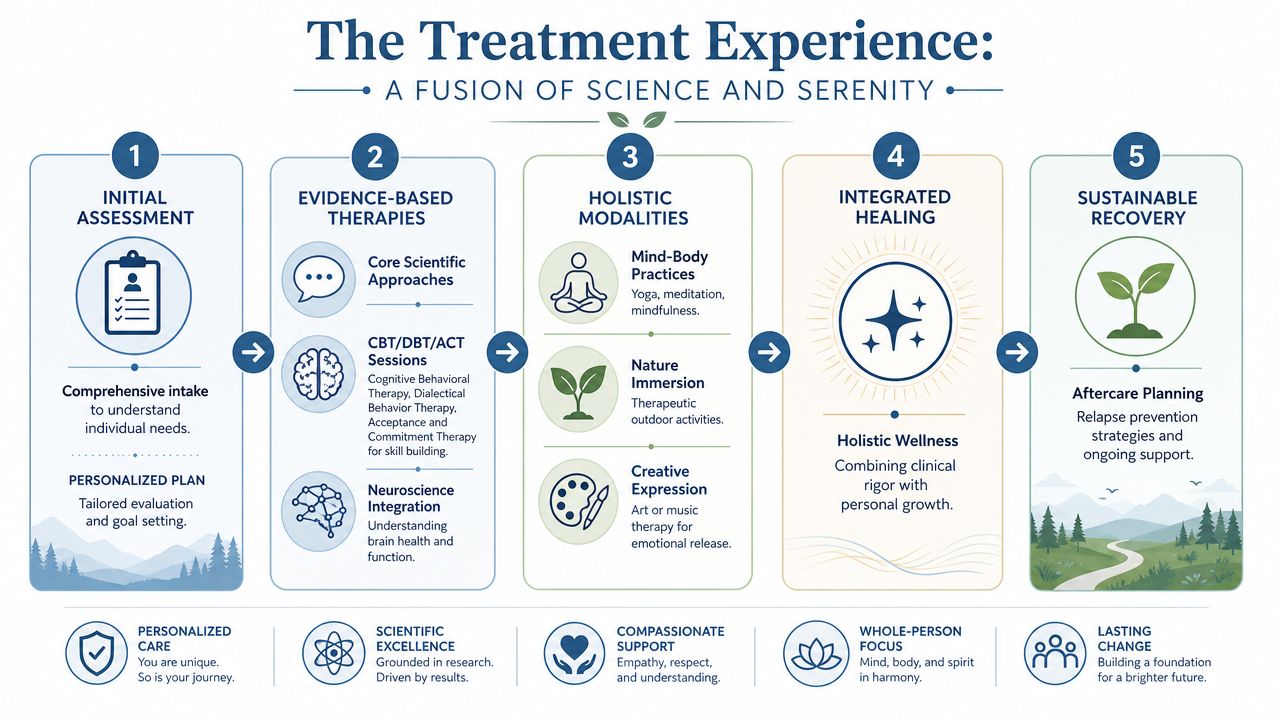
The head work
Cognitive and behavioral therapies give structure to recovery. They help clients identify loops like perfectionism, catastrophic thinking, avoidance, resentment, and self-justification.
Examples include:
- CBT: Helps a client challenge distorted thought patterns and replace them with more accurate, workable thinking.
- DBT: Strengthens distress tolerance, emotional regulation, and interpersonal effectiveness under pressure.
- ACT: Helps a person stop organizing life around avoidance and start acting from values, even when discomfort is present.
- Motivational work: Supports honest engagement when a person feels ambivalent about change.
For professionals, these methods often feel familiar in the best way. They're organized, practical, and skill-based. A customized approach to personalized treatment planning can help match these modalities to the person's clinical profile and work realities.
The deeper emotional work
A polished executive can explain feelings without processing them. That's where experiential therapies become valuable. They create access to grief, fear, anger, shame, and exhaustion that may sit below the level of polished language.
This may include mindfulness, art or music therapy, somatic work, movement, meditation, nature-based practices, or carefully guided relational work. These approaches don't replace clinical therapy. They widen it.
Some professionals also benefit from exploring top alternative wellness options as part of a broader conversation about restorative practices that support nervous system recovery, stress reduction, and sustainable lifestyle change after residential care.
Why the combination works
The science-serenity model is effective because it treats both content and state. Content is what a person thinks and believes. State is how regulated or dysregulated the body feels while those thoughts are happening.
A short example shows the difference:
- A client may know that one difficult board meeting doesn't equal catastrophe.
- But if the body remains flooded with adrenaline and tension, that insight may not hold.
- When therapy and experiential work are combined, the person can think more clearly because the body isn't constantly sounding an alarm.
Some of the most meaningful progress in executive recovery happens when competence no longer has to cover pain.
Your Journey From Intake to Continuing Care
At 6:30 a.m., before the first meeting of the day, a prospective client steps into a quiet hallway to make a call no one else knows about. The questions are practical and personal at the same time. Who will know? Can work be protected? What happens if sleep has collapsed, drinking has increased, or anxiety has started driving every decision?
A well-run admissions process answers those questions with clarity, not pressure. The first conversation should feel discreet, informed, and steady. People in demanding roles are often listening for more than facts. They are trying to determine whether a program understands the difference between public success and private depletion.
Once admission is set, the process should begin to reduce strain immediately. Intake is not a stack of forms with a bed at the end of it. It is the first stage of treatment. The assessment looks carefully at substance use, mental health symptoms, medications, physical health, trauma exposure, family context, and the realities of professional life. That full picture matters because effective treatment is built around the person's actual operating system, not a generic template.
What the early phase should accomplish
Early treatment has a clear purpose. It helps the mind and body become stable enough for accurate thinking, honest emotional work, and sound planning.
That may include withdrawal support, medication review, sleep repair, nutrition, and the start of individual and group therapy. For a high-performing adult who has been compensating with willpower, this stage can feel surprisingly unfamiliar. Many clients realize they have been functioning like a company running too many background applications at once. The screen still works, but speed, judgment, and battery life have all been compromised.
Family work may begin early too. In healthy form, it is not about blame or forced disclosure. It helps reduce secrecy, clarify boundaries, and improve communication so the home environment is less likely to pull the person back into old patterns.
A strong sequence often includes:
- Confidential pre-admission planning: Travel, privacy, urgent professional responsibilities, and communication boundaries are arranged carefully.
- Detailed assessment: Clinical staff review substance use, psychiatric symptoms, medical needs, trauma history, current stressors, and functional decline.
- Individualized residential treatment: The client enters a structured setting designed to restore stability, insight, and daily rhythm, with limited work continuity when clinically appropriate.
- Discharge and aftercare design: Outpatient therapy, psychiatric follow-up, recovery support, family sessions, and accountability measures are set in place before the client leaves.
The order matters. Recovery is more durable when each step prepares the next one.
Why continuing care defines the real fresh start
The residential stay creates traction. Continuing care protects it.
For professionals, this phase often determines whether treatment becomes a turning point or a brief interruption. Returning home means returning to pressure, access, expectations, travel, conflict, and fatigue. A good aftercare plan accounts for those realities in concrete terms. It identifies which therapist will be seen, who manages medications, what recovery structure fits the person's life, how family work will continue, and what the response will be when risk rises.
That last part deserves attention. High-risk moments are usually predictable. A red-eye flight after a tense client dinner. A weekend alone after overwork. A conflict at home that triggers shame and withdrawal. Continuing care should address these situations in advance, the way an experienced executive prepares for a known market risk rather than hoping it never appears.
The idea of a fresh start holds deeper meaning. It is not merely discharge with good intentions. It is a deliberate plan to protect cognitive clarity, emotional steadiness, and professional continuity while a new way of living becomes practiced enough to hold under stress.
For many prospective clients, the best sign of program quality is simple. Discharge should not feel like being released back into chaos. It should feel like stepping into a structure that still holds, even after residential care ends.
Measuring Success Beyond Sobriety
Sobriety matters. But for a high-functioning adult, it isn't the only meaningful outcome. The broader return on treatment often shows up in abilities that were deteriorating unobserved long before anyone else noticed.
What success often looks like in real life
A professional who's doing well after treatment may not describe the change in dramatic terms. The signs are often cleaner and more powerful than that:
- Sharper executive function: Better concentration, better sequencing, and less mental clutter.
- More stable leadership: Fewer reactive decisions and more consistent presence with teams and family.
- Greater emotional intelligence: The ability to tolerate discomfort without numbing, escaping, or dominating.
- Restored creativity: New ideas emerge more easily when the brain isn't cycling through survival patterns.
- Better quality of life: Sleep, relationships, physical health, and self-respect become more reliable.
This is why Fresh Start Recovery is best understood as high-performance restoration, not image repair. The person isn't just removing a substance or behavior. The person is recovering access to judgment, connection, discipline, and inner steadiness.
The strongest outcome in recovery is often this: a person can finally perform well without betraying personal health to do it.
For the executive, entrepreneur, physician, attorney, founder, or public-facing leader, that's a meaningful return. Treatment becomes less about stepping away from life and more about returning to it with far more capacity.
Reflections offers California-licensed, Joint Commission-accredited dual-diagnosis residential care for adults who need private, upscale treatment that supports both recovery and professional continuity. For those considering a discreet fresh start recovery program with private accommodations, integrated mental health and addiction treatment, and appropriate access to electronics during care, Reflections is one option to explore.