

The call often comes after a difficult handoff. An executive has completed detox or left the hospital, but returning directly to an office, home, or frequent travel feels unsafe. The person may need structured clinical care for substance use, trauma, anxiety, depression, or another co-occurring condition, yet doesn't require acute hospital treatment. At the same time, the family worries that a conventional program could expose private information, interrupt leadership responsibilities, or strip away the professional identity that still matters to the client.
A subacute rehab facility can provide the middle ground. It offers a residential setting with clinical oversight, daily treatment, and a planned transition toward greater independence. For executives and working professionals, the right program must also address privacy, private accommodation, secure communication, continuity with work, and the complexity of dual-diagnosis care.
The decision isn't whether treatment is needed. It's whether the setting matches the person's medical stability, psychological needs, professional obligations, and capacity to participate. This guide explains how subacute rehab works, how it differs from more intensive and less intensive options, what a luxury program may include, and which questions can help families and referral professionals evaluate fit.
Introduction to Subacute Rehab for Busy Professionals
A chief executive may leave medically managed withdrawal stable enough for discharge, yet still be too fragile to return to a full calendar of meetings, travel, and decisions. A senior attorney after a mental health crisis complicated by prescription misuse may face the same problem. The practical question is which level of care can protect recovery without forcing unnecessary disconnection from work, family, and identity.
Subacute care fills that middle space. It sits between hospital-level intervention and lower-acuity outpatient treatment, pairing clinical structure with a gradual return to autonomy. For busy professionals, that structure can include private rooms, discreet routines, individualized therapy, and carefully managed access to phones and laptops.
The term can still create confusion. Some programs use it for physical rehabilitation after illness or surgery. Others use it for clinically managed detoxification and residential treatment for co-occurring mental health and substance use disorders. A careful assessment has to establish which meaning applies and whether the program has the right medical and psychiatric capability.
Expectations should stay measured. A federal review described the research on subacute care quality and outcomes as very limited (Department of Health and Human Services review). Families should look past polished surroundings and ask how clinicians assess progress, manage risk, coordinate discharge, and involve relatives.
For a working professional, luxury is not only décor. It can mean a private room, confidentiality, responsive clinical care, appropriate device access, and enough flexibility to preserve key professional responsibilities while treatment remains the priority.
What a Subacute Rehab Facility Really Means
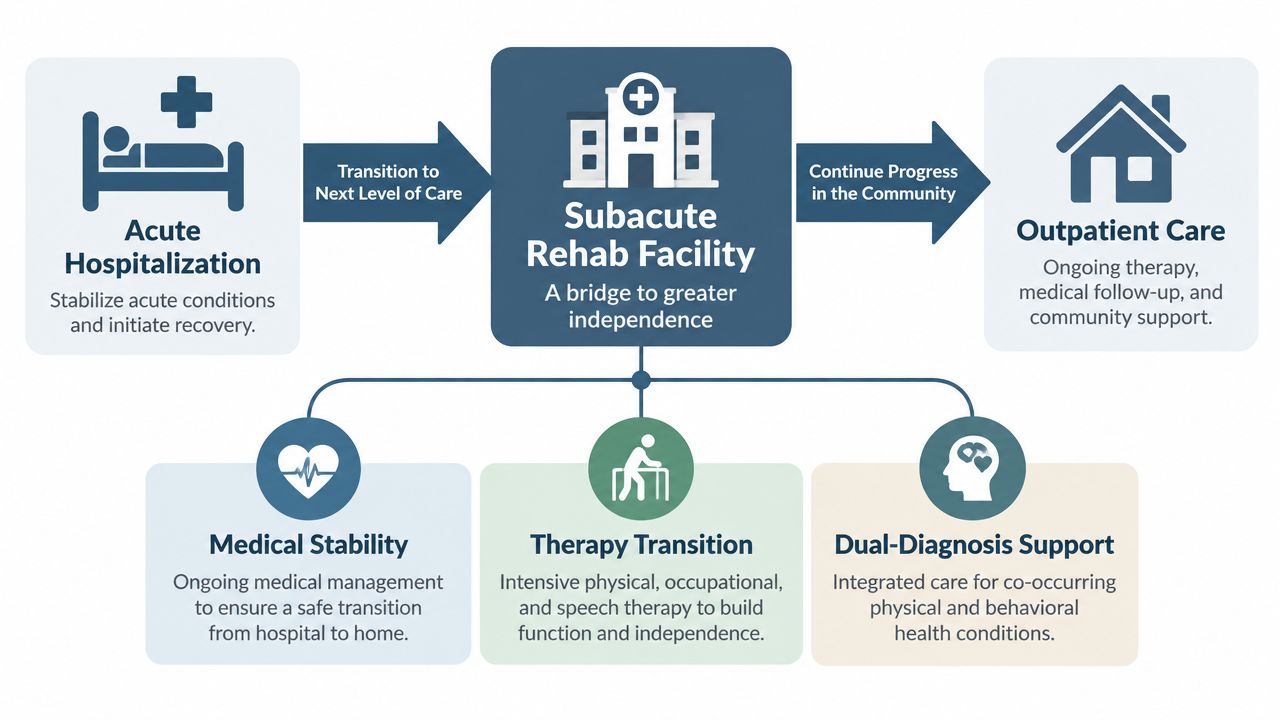
A senior executive leaves the hospital medically stable but still unable to manage medication changes, cravings, sleep disruption, or work pressure safely alone. That person may not need emergency intervention, yet a weekly appointment provides too little support. A subacute rehab facility fills this clinical gap with residential structure, regular monitoring, therapy, and supervised practice between stabilization and independent living.
Acute hospitalization functions like an emergency command center. Clinicians address immediate medical decisions and serious safety risks. Outpatient care is closer to a maintenance base, where the person lives in the community and manages daily responsibilities between scheduled appointments. Subacute care connects those settings. It focuses on converting early stability into dependable functioning.
The clinical bridge
A subacute program may fit a person who:
- Needs residential accountability: Home access, professional demands, or social exposure could disrupt early recovery.
- Has co-occurring conditions: Substance use may interact with depression, trauma, anxiety, bipolar symptoms, or personality-related traits.
- Requires medication oversight: Clinicians may monitor withdrawal, psychiatric symptoms, side effects, or medication changes.
- Can participate in treatment: The person does not require hospital-level containment and can engage in therapy and structured activities.
- Needs a planned transition: Recovery may require practice with communication, family relationships, work boundaries, and relapse prevention before discharge.
The distinction is clinical, not cosmetic. A subacute setting allows the team to observe patterns that a brief appointment may miss. A therapist can see how a client responds to feedback. A psychiatrist can track changes after medication adjustments. Family sessions may uncover pressures that the client manages effectively in public but struggles with at home.
The HHS subacute care literature review found that research on subacute care remains limited. Individual assessment therefore matters. The program should explain why its supervision, staffing, medical access, and psychiatric capabilities match the client's present needs, rather than treating subacute care as a universal answer.
Structure with discretion
For high-performing professionals, treatment may need to protect recovery without cutting every connection to work. Executive-oriented programs may permit cell phones and laptops outside therapy and group activities, subject to clinical limits, dedicated workstations, and secured WiFi. Device access should support selected responsibilities, not turn the residential stay into a remote office.
Privacy can also affect participation. A private room may give a client space to decompress, prepare for difficult conversations, and maintain discretion while still following the program's daily expectations. Dual-diagnosis expertise matters just as much, because treating substance use without addressing related psychiatric symptoms can leave the central pattern unchanged.
A guide to rehabilitation assessment tools can help families and referral professionals understand how clinicians evaluate function and progress. The practical question is whether the program can show how observations become treatment decisions and discharge goals.
How Subacute Rehab Compares to Other Levels of Care
A senior professional may be stable enough to leave a hospital yet too impaired to manage recovery alone. In that situation, the decision is less about prestige or convenience than about matching risk, medical needs, treatment tolerance, and independence with the right level of support. Privacy, device access, and schedule flexibility can matter, but they cannot replace a clinical assessment.
Acute inpatient rehabilitation usually provides the highest medical intensity among these options. It may fit someone recovering from a serious illness or injury who needs substantial physical, occupational, or speech therapy with close medical supervision. A subacute rehab facility serves a different point on the continuum. The person is medically stable, but still needs residential structure, monitoring, and therapy, often for psychiatric, substance use, or dual-diagnosis recovery. Outpatient care suits someone who can remain safe at home, attend scheduled treatment, and manage daily responsibilities between visits.
| Feature | Acute Inpatient Rehab | Subacute Rehab Facility | Outpatient Program |
|---|---|---|---|
| Primary purpose | Intensive recovery with close medical supervision | Structured residential stabilization and rehabilitation | Continued treatment while living in the community |
| Medical oversight | High, often focused on complex physical recovery | Ongoing clinical and psychiatric oversight matched to need | Scheduled appointments, with outside providers managing additional needs |
| Daily structure | Highly scheduled and therapy-intensive | Residential routine with therapy, monitoring, and skill practice | Treatment sessions combined with normal home and work life |
| Ideal candidate | Person needing intensive rehabilitation after acute illness or injury | Person stable enough to leave acute care but not ready for independent living | Person safe enough to manage recovery outside residential care |
| Professional continuity | Usually limited by medical intensity | May include carefully bounded device and work access | Broadest flexibility, with the greatest self-management demand |
Choosing more or less intensity
No setting works best for every person. As noted earlier, evidence about subacute outcomes remains limited, and comparative post-acute research has reported inconsistent findings about functional status and gaps in quality-of-life information. The facility label therefore matters less than the admission assessment, treatment capacity, and discharge plan.
A person who remains medically unstable, faces immediate safety risks, or cannot participate reliably may need a more intensive setting. Someone with stable symptoms, dependable support, and strong self-management may be ready for outpatient treatment. Subacute care occupies the middle ground. It offers more containment than appointments alone while avoiding the intensity of acute hospitalization when that level is no longer required.
Cognitive and functional information can sharpen the choice. Resources such as Orange Neurosciences cognitive profiles may help organize observations about attention, memory, or other cognitive patterns. The treating team still needs to interpret those findings alongside psychiatric, medical, and day-to-day functional information.
For families weighing residential treatment against community care, an inpatient versus outpatient rehabilitation guide can clarify the broad differences. The practical question is straightforward: What setting provides enough support for safety and meaningful participation, while allowing as much privacy, professional continuity, and independence as the person can manage?
Inside a Luxury Subacute Program and Who Provides Care
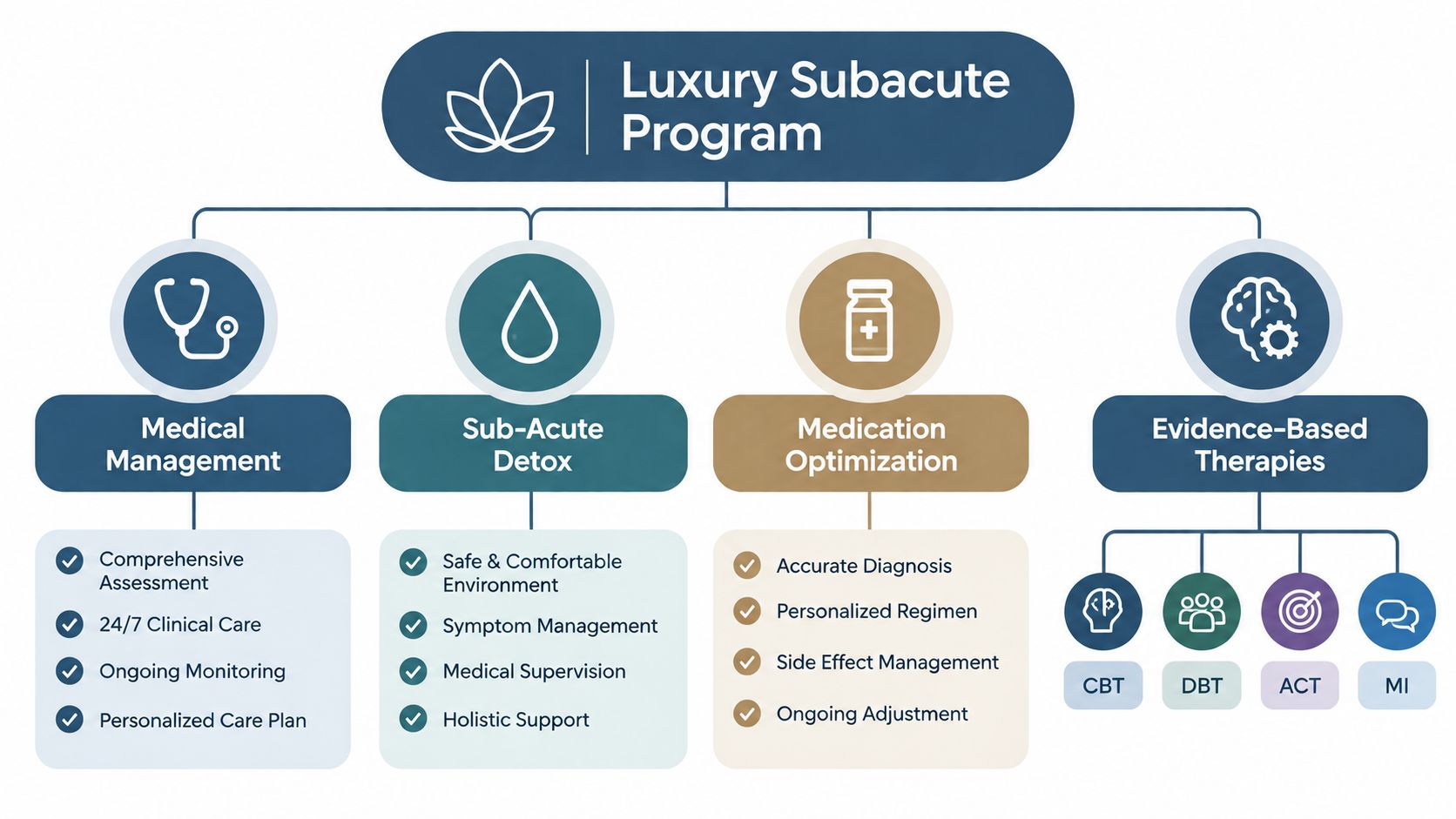
A luxury subacute program should be clinically substantial before it is visually impressive. The environment can reduce distraction and protect dignity, but the treatment plan must address withdrawal risk, psychiatric symptoms, behavior patterns, physical health, relationships, and the pressures that follow the client back into professional life.
Medical care and therapeutic work
Clinically managed medication-assisted withdrawal, sometimes described as subacute detoxification, can support a safer transition when withdrawal symptoms require medical oversight. Medication optimization then focuses on finding an effective, measured regimen while monitoring response, interactions, and side effects.
A dual-diagnosis program may integrate:
- Cognitive behavioral therapy: Identifies links among thoughts, emotions, and behavior.
- Dialectical behavior therapy: Builds skills for emotion regulation, distress tolerance, and relationships.
- Acceptance and commitment therapy: Helps clients act according to values while responding differently to difficult internal experiences.
- Motivational interviewing: Strengthens the client's own reasons for change rather than relying on confrontation.
- Individual psychotherapy: Creates private space for trauma, grief, anxiety, depression, or professional identity concerns.
- Intensive groups: Allows clients to practice communication, accountability, and coping with structured feedback.
- Experiential supports: Mindfulness, meditation, art and music therapy, somatic work, fitness, massage, nutrition, and, when clinically appropriate, equine work can reinforce insight through practice.
Clinical principle: Medication should be used thoughtfully, with the aim of achieving the minimum effective pharmacology rather than accumulating prescriptions without a clear purpose.
The team should explain how each intervention connects to an individualized treatment plan. A luxury setting may offer more privacy and comfort, but those features matter clinically only when they help the client participate, rest, reflect, and build routines that can survive outside the residence.
A coordinated multidisciplinary team
Reflections describes a model led by an Executive Clinical Director, Dr. William Hanna, with PhD-level psychologists, psychiatrists, LMFTs, certified addiction counselors, and adjunctive therapists. The broader principle applies to any facility under consideration: the team should have clear roles, regular communication, and expertise in both substance use and co-occurring mental health conditions.
A psychiatrist may oversee medication and diagnostic clarification. Psychologists and therapists can address trauma, mood symptoms, cognitive patterns, and behavior change. Addiction counselors often focus on recovery skills, cravings, peer accountability, and relapse prevention. Nutrition, fitness, and experiential clinicians can help rebuild the physical routines that support emotional stability.
Treatment lengths commonly range from 30 to 90 days in the Reflections model. Private rooms for every resident in both detox and rehabilitation programs can give clients space to sleep, decompress, and maintain appropriate boundaries. Higher staff availability can also make it easier to notice changes early and adjust the plan before a manageable problem becomes a crisis.
A multidisciplinary team approach offers further context on why coordinated roles matter. The essential question isn't how many credentials appear on a brochure. It's whether those professionals actively collaborate around the individual client.
What to Expect From Admission Through Daily Life
Admission should feel organized, confidential, and clinically purposeful. The process usually begins with a private assessment covering substance use, withdrawal history, psychiatric symptoms, medical conditions, medications, safety concerns, family context, and professional obligations. The team then determines whether the program can safely meet the person's needs or whether another level of care is more appropriate.
A strong intake doesn't reduce a client to a diagnosis. It also asks what the person wants to preserve. For an executive, that might include a board obligation, limited communication with a legal team, or a confidential handoff of responsibilities. Those details help clinicians create boundaries around work rather than allowing work to dominate treatment.
A private and structured routine
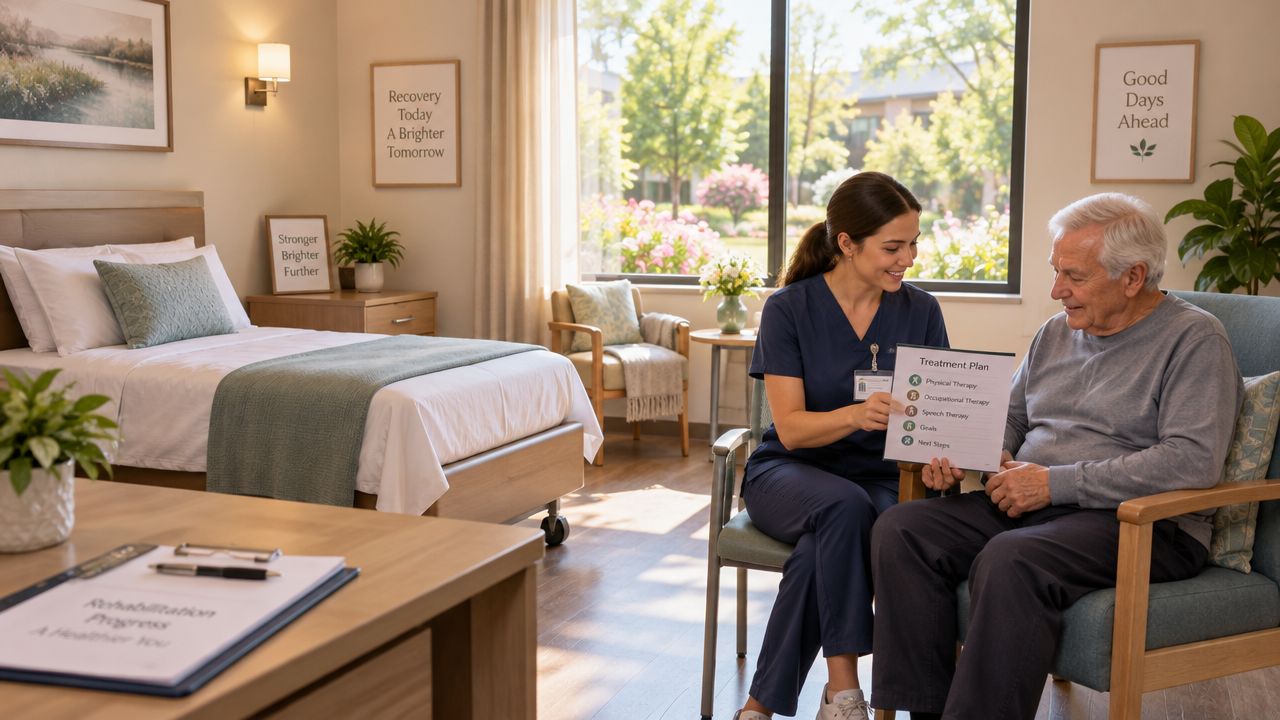
After admission, the client receives an individualized plan and a private room. Daily life generally combines individual therapy, groups, medication appointments, clinical check-ins, meals, wellness activities, family contact, and protected rest. The routine provides enough predictability to reduce decision fatigue while leaving room for clinicians to adjust treatment as symptoms and goals change.
Electronics may remain available under clear clinical rules. Clients can use phones and laptops outside active therapy and group activities, and an executive-oriented program may provide dedicated workstations and secured WiFi. That arrangement supports selected career obligations without confusing availability with recovery.
Family and discharge preparation
Family involvement can include private sessions and monthly educational workshops. Relatives learn how symptoms, substance use, communication patterns, and boundaries interact, while the client practices discussing needs without returning to old roles.
Discharge planning should begin early. The team can coordinate outpatient therapy, psychiatry, medication follow-up, family support, alumni involvement, work re-entry, sober supports, and strategies for high-risk travel or social events. The aim is not a dramatic handoff on the final day. It's a gradual transfer of responsibility that preserves continuity.
Practical rule: A work-friendly policy is useful only when the client and clinical team agree on what communication is necessary, what can wait, and how treatment remains protected.
How to Choose the Right Subacute Rehab Facility
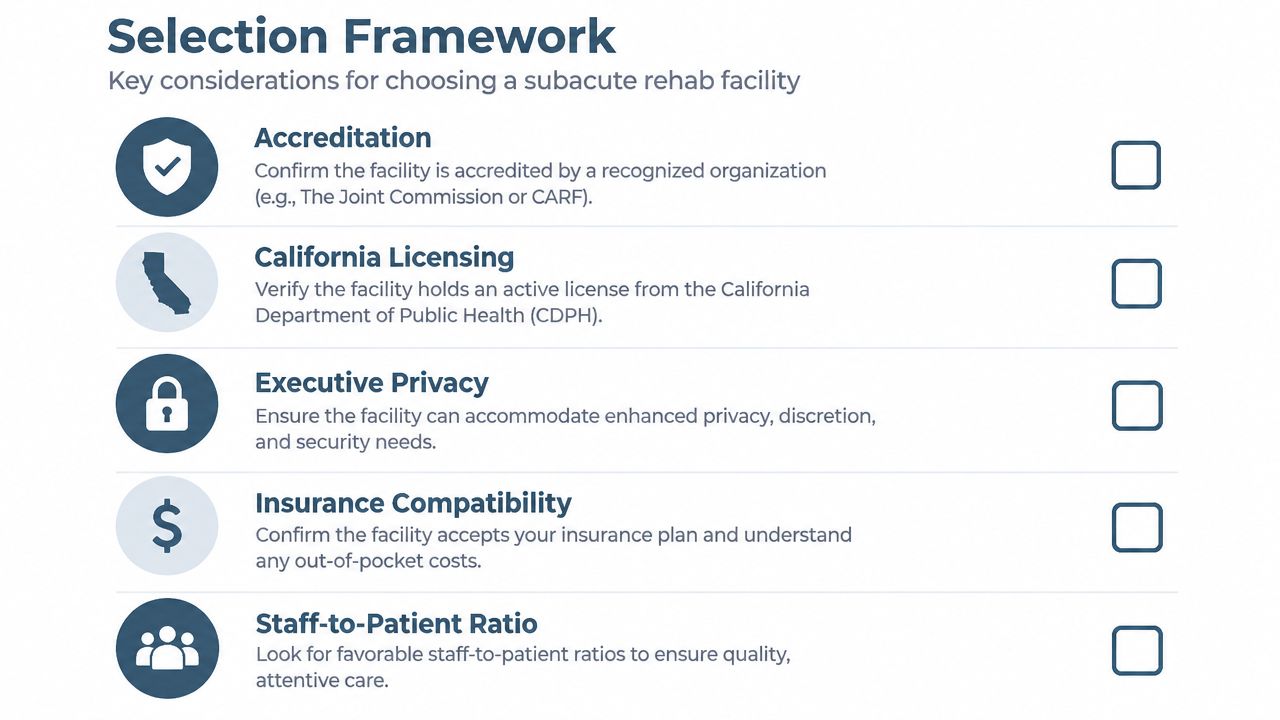
A polished residence can create an immediate impression, but families and referral professionals need evidence of clinical fit. For an executive or high-profile client, the selection process should evaluate accreditation, privacy, dual-diagnosis competence, device policies, staffing, and continuing care together.
Use external standards as a starting point
Joint Commission accreditation follows a successful on-site survey. The organization reports accrediting nearly 15,000 healthcare organizations and certifying or verifying more than 4,600 programs across the United States (Joint Commission accredited organization information). Accreditation doesn't guarantee that a program suits every client, but it gives families an external standard to investigate rather than relying only on marketing language.
Small residential programs can still meet formal standards. The Joint Commission states that homes with up to 18 beds require 3 beds, with at least 2 active during the survey, for accreditation (Joint Commission accreditation requirements). That threshold is relevant when a client wants an intimate setting without assuming that a small census means informal care.
California licensing should also be confirmed directly, along with the scope of services permitted. The team should be able to describe who manages detox, who prescribes medication, how psychiatric emergencies are handled, and when transfer to a higher level of care is required.
Ask questions that reveal the model
During a call or tour, families can ask:
- Accreditation: Which organization accredits the program, and when was the last survey?
- Dual diagnosis: How does the team treat substance use and psychiatric symptoms in one coordinated plan?
- Executive privacy: Are rooms private, how are visitors handled, and how is confidential information protected?
- Device access: Can clients use phones and laptops, during which periods, and who sets limits?
- Clinical coverage: Which licensed professionals are available, and how do they communicate about changes?
- Measurement: How does the program track symptoms, participation, discharge readiness, and return to care?
- Continuity: What happens after residential treatment, and who coordinates the next providers?
Measurement should be practical, not decorative. Rehabilitation services may use length of stay, functional progress, and readmission monitoring to identify where discharge planning needs improvement. CMS identifies 30-day acute-care readmission as a significant post-acute performance measure, with an overall rate of 11.8% in a large Medicare post-acute rehabilitation cohort, ranging from 5.8% after lower-extremity joint replacement to 18.8% for debility; about half of readmissions occurred within 11 days of discharge (CMS post-acute rehabilitation data). A residential addiction program won't use these figures as a direct promise of outcome, but it should demonstrate a comparable commitment to early follow-up and risk management.
Building Lasting Recovery Beyond the Residential Stay
Residential care creates a protected period for stabilization and practice. Long-term recovery depends on what happens when the client returns to a home, leadership role, relationship, or travel schedule that once reinforced unhealthy patterns.
A continuing-care plan should carry forward the same clinical logic used during residential treatment. That may include individual psychotherapy, psychiatric follow-up, medication monitoring, family sessions, peer or alumni programming, relapse-prevention planning, and flexible step-down services. The plan should also identify early warning signs, preferred contacts, crisis procedures, and boundaries around work.
Family education deserves a central place. Relatives often need to understand the difference between supporting recovery and managing every consequence. They can learn how to respond to mood changes, protect healthy boundaries, communicate concerns, and encourage treatment without turning the home into another clinical facility.
Root-cause work remains important after the immediate crisis has passed. Trauma, PTSD, anxiety, depression, grief, bipolar symptoms, and borderline traits can continue to influence substance use and relationships unless treatment addresses them directly and compassionately. A structured aftercare planning resource can help families organize the transition around providers, routines, support, and accountability.
For a professional, sustainable recovery doesn't require abandoning ambition. It requires building a way to pursue responsibility without using work, secrecy, or constant availability to avoid emotional care. The right subacute program gives the client a clinically secure place to begin that work, then extends the support beyond discharge.
Reflections provides California-licensed, Joint Commission-accredited dual-diagnosis treatment with private rooms, clinically managed subacute detox, medication optimization, evidence-based therapies, and appropriate access to phones and laptops during treatment. Families and professionals considering a confidential luxury subacute rehab facility can visit Reflections to learn about assessment, residential care, and continuing support.