

A chief executive searches “luxury rehab centers near me” after a private crisis begins affecting judgment, sleep, family relationships, and work. The search results promise ocean views, private suites, chefs, and discretion. The harder question is whether a nearby program can protect confidentiality, manage withdrawal safely, treat co-occurring mental health conditions, and preserve a workable connection to the responsibilities that can't disappear.
For senior professionals, luxury treatment should reduce friction around recovery without turning care into a hospitality purchase. The right program combines clinical depth, private-pay discretion, individualized treatment, private accommodations, structured electronics access, and continuing care. Amenities matter, but they're secondary to whether the clinical team can address the reasons substance use developed and help the client return to a demanding life with a realistic recovery plan.
What Luxury Rehab Really Means for Executives and Professionals
An executive may enter treatment with a board meeting pending, employees expecting decisions, family members asking difficult questions, and a phone that never stops. A standard residential model may provide safety and therapy, but it may not be designed around the privacy, professional obligations, and psychological complexity that accompany a public-facing or high-responsibility career.
That's why luxury rehab for executives should mean more than attractive surroundings. It should mean a setting where the client can step away from daily pressure, receive serious dual-diagnosis care, and maintain carefully bounded contact with work and loved ones. Reflections presents this model through a California-licensed, Joint Commission-accredited residential program focused on adults with co-occurring substance use and mental health disorders. Its clinical team includes PhD-level psychologists, psychiatrists, LMFTs, certified addiction counselors, and adjunctive therapists, under the direction of Executive Clinical Director Dr. William Hanna.

Comfort supports treatment, but it doesn't define it
A private room can give a client space to sleep, decompress, and process difficult therapy without the constant exposure of a shared living arrangement. Appropriate access to a laptop or phone can help an executive handle essential obligations, provided the program sets boundaries that keep treatment first. Those features are valuable because they remove avoidable obstacles to admission.
They aren't proof of clinical quality on their own. A polished property can still lack strong psychiatric assessment, trauma expertise, medication oversight, family programming, or a credible discharge plan. Executives should ask who provides care, how often treatment plans are reviewed, and what happens when depression, anxiety, trauma, bipolar symptoms, or personality-related traits complicate addiction.
The local search often hides a capacity problem
Residential addiction treatment is a comparatively scarce level of care in the United States. A federal SAMHSA report recorded 1,920 facilities operating 61,743 residential non-hospital beds in 2020, with an average utilization rate of 79%. Residential clients represented only 5% to 9% of all substance use treatment clients, which helps explain why searches for nearby luxury programs can produce limited availability and waitlists in major markets. SAMHSA's national treatment facility report provides the relevant national context.
A discreet admissions process should therefore establish clinical fit and timing quickly. A useful overview of the distinction between upscale presentation and meaningful treatment depth appears in this guide to what sets luxury rehab apart.
Executive standard: Luxury is worthwhile only when privacy and comfort make it easier to receive rigorous care, not when they distract from the absence of it.
How to Tell a Truly Accredited Luxury Program From Marketing
A luxury label is not a credential. It's a positioning term, and different facilities may use it to describe very different levels of medical oversight, staffing, psychiatric capability, and aftercare. Executives and their families should verify the program's clinical claims before discussing amenities.
Accreditation is one useful external signal. The Joint Commission maintains a public locator for accredited substance use disorder treatment organizations, so a provider claiming accreditation should be identifiable through the Joint Commission behavioral health provider locator. State licensing should also be visible and current, particularly when the program provides detoxification or medication management.
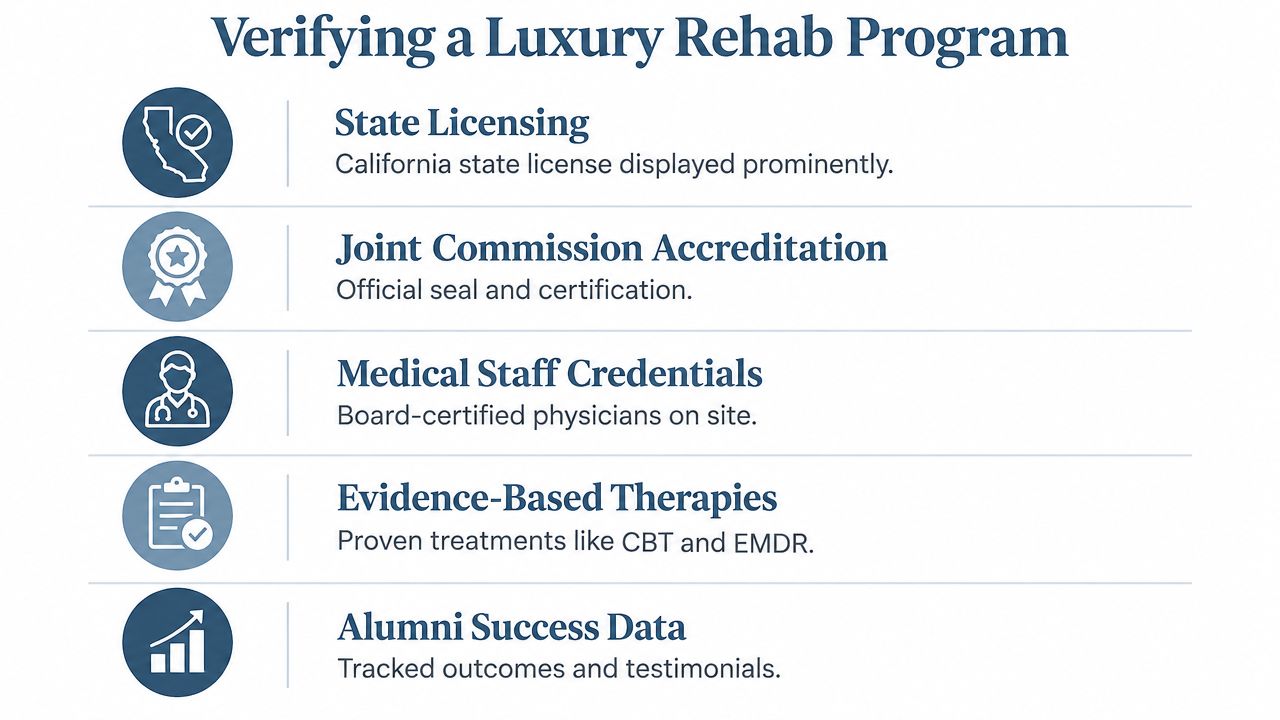
Compare clinical proof with amenity language
A credible program can explain its model in operational terms. It should identify the professionals responsible for assessment and treatment, describe how psychiatric and addiction care interact, and show how the team adapts treatment when the initial formulation changes.
| Clinical marker | Questions to ask | Marketing warning |
|---|---|---|
| Accreditation and licensing | Can the program provide its license details and accreditation status for independent verification? | “Highly accredited” appears without a registry or certificate |
| Dual-diagnosis capability | Who evaluates depression, trauma, anxiety, bipolar symptoms, or other co-occurring conditions? | Addiction is treated without meaningful psychiatric assessment |
| Multidisciplinary staffing | Which clinicians participate in care, and who leads treatment planning? | A luxury setting is emphasized while clinical roles remain unclear |
| Individualization | How are goals, medications, family needs, and work demands incorporated? | Every resident receives essentially the same schedule |
| Continuity | Who coordinates the transition after residential treatment? | Discharge is treated as the end of the relationship |
Evidence-based modalities should also be named clearly. CBT, DBT, ACT, motivational interviewing, individual psychotherapy, and intensive groups can form a structured clinical foundation. Experiential services, including mindfulness, art and music therapy, somatic work, fitness, massage, nutrition, and equine work, may support that foundation, but they shouldn't replace psychiatric and addiction treatment.
Staff availability deserves direct questioning. In a study of 188 inpatient patients, 87% reported high satisfaction with the admission process, 83% with courtesy and respect, and 76% with staff availability when needed. Satisfaction was much lower for housing support at 26%, financial support at 28%, and employment support at 23%, according to the published findings in the inpatient satisfaction study. The implication is practical: a premium program should add strong case management and aftercare coordination rather than assume a beautiful residence solves every transition problem.
For a plain-language explanation of the credential, families can review what Joint Commission accreditation means.
Levels of Care You Should Expect From Detox Through Aftercare
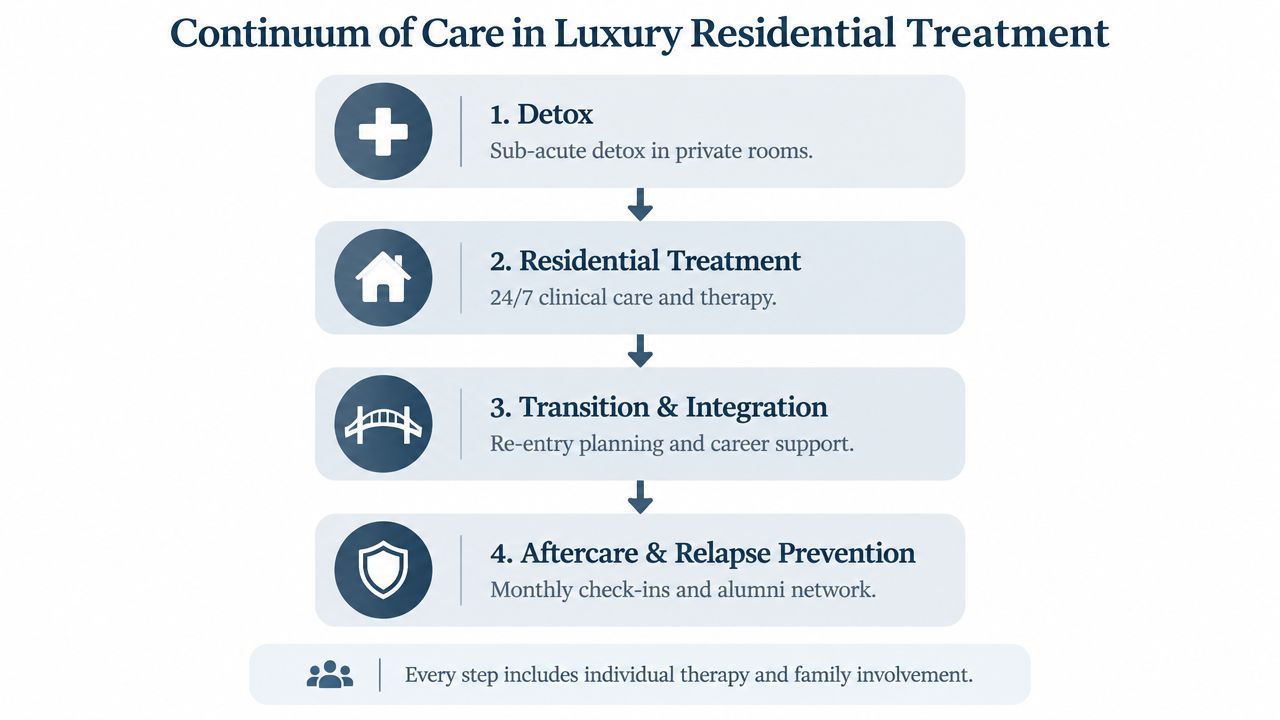
A luxury residential program should present a connected clinical pathway, not a collection of disconnected services. Executives often have enough resources to arrange separate detox, therapy, psychiatric care, and coaching. That arrangement can still fail if no team owns the full picture.
Detox should be private, medically directed, and clinically connected
Detox is the point at which safety and trust are established. A clinically managed sub-acute detox program should assess withdrawal risk, monitor symptoms, review medications, and determine what psychiatric conditions require immediate attention. Reflections offers private rooms in its detox program and uses medication-assisted withdrawal and medication optimization when appropriate, with a stated aim of minimal, effective pharmacology.
The private-room element matters for clients who are accustomed to controlling their environment or who worry about being recognized. It can also support rest during a physically and emotionally demanding phase. Families should ask how detox transitions into residential therapy, rather than accepting a handoff to an unrelated team. Questions about how long drug detox can take should be answered by the treating clinicians because withdrawal varies by substance, health status, medication, and clinical risk.
Residential treatment must address the whole operating system
After detox, the work moves beyond stopping substance use. A strong residential plan examines trauma, PTSD, anxiety, depression, grief, mood instability, relationship patterns, sleep, nutrition, decision-making, and the pressures that keep the client overfunctioning.
A program may combine:
- Individual psychotherapy: Sessions connect substance use with emotional triggers, beliefs, behavior, and personal history.
- Structured group work: Groups create repeated opportunities to practise communication, accountability, distress tolerance, and relapse prevention.
- Medication optimization: Psychiatric medications are reviewed for effectiveness, safety, and fit with the broader treatment plan.
- Experiential support: Mindfulness, somatic work, art, music, fitness, nutrition, and equine activities can help clients build regulation skills through more than conversation.
- Family participation: Private sessions and educational workshops help relatives respond consistently instead of reinforcing secrecy or crisis cycles.
Residential stays are individualized, and Reflections describes treatment lengths that typically range from 30 to 90 days. The correct duration should follow clinical need and progress, not a calendar chosen for convenience.
Re-entry is part of treatment, not an administrative ending
The transition plan should cover work, home environment, medical follow-up, therapy, family communication, travel, triggers, and emergency contacts. Continuing care and alumni programming give the client a structure to use after the protected residential setting ends.
A program that cannot explain who will coordinate those pieces is offering a phase of care, not a continuum.
Privacy Work Continuity and Private Accommodations That Protect Your Career
Executives don't need vague assurances about discretion. They need to understand how privacy works in practice, who can access information, how visitors are handled, how transportation is arranged, and what staff members may disclose. A private-pay setting can reduce exposure, but confidentiality still depends on policy, training, documentation, and disciplined communication.
Reflections offers private rooms for every resident in both detox and rehab, which creates a consistent accommodation standard rather than making privacy dependent on availability. The program also allows appropriate access to electronics, including cell phones and laptops, so residents can maintain balanced contact with career obligations, school, and loved ones.

Electronics access needs structure
Phone and laptop access isn't a universal rehab rule. Independent recovery guidance notes that programs differ, with some allowing devices only at specified times, some storing them initially, and others permitting supervised use. This overview of technology use in rehab supports the point that executives must confirm the policy directly before admission.
The right arrangement protects both priorities. A resident may need to approve a transaction, speak with counsel, respond to a critical employee issue, or remain available to family. Treatment still requires uninterrupted therapy, sleep, group participation, and emotional presence. Intake staff should explain when electronics are available, whether calls are private, how urgent work is defined, and who helps create a realistic communication schedule.
Confidentiality should be tested with specific questions
A prospective client should ask whether the program uses private rooms throughout the stay, how clinical records are protected, how staff communicate with outside parties, and how family participation is authorized. Public figures may also need to ask about photography, visitor screening, transportation, and the physical setting.
For a client with heightened security concerns, a separate specialist may help evaluate the privacy of a home or office before or after treatment. Information about bug sweeping services in London can be relevant to those broader security conversations, although it's separate from clinical confidentiality inside a treatment program.
Luxury accommodations should serve recovery. A private room, workspace, reliable connectivity, and calm surroundings can make admission more workable, but they must sit inside a schedule that keeps therapy and medical oversight central.
Vetting Nearby Luxury Centers and What to Ask During Intake
The fastest way to compare luxury rehab centers near me is to replace the amenities list with an intake interview. A serious admissions team should answer direct questions without redirecting the conversation toward décor, cuisine, or scenery.
Family involvement deserves particular attention. A government-supported review of family interventions reports that involving relatives can improve engagement, retention, abstinence, and family functioning, with one meta-analysis identifying a 5.7% reduction in substance use frequency and effects lasting 12 to 18 months after treatment. Those findings are summarized in the NCBI Bookshelf review of family interventions. A luxury program should therefore explain how family members participate clinically, not merely offer family visits as a hospitality feature.
Questions that expose the real model
Ask who evaluates co-occurring disorders, how trauma is treated, what happens if the client needs psychiatric medication, and how the team handles an executive who wants to keep working. Ask whether family education is scheduled, whether aftercare is coordinated before discharge, and whether continuing care can include secure virtual sessions.
Digital access is no longer a minor convenience. Telehealth availability in outpatient behavioral health increased from 33% of facilities in January 2020 to 61% by January 2021. Substance use disorder facilities increased from 26% to 57% over the same period, as described in the peer-reviewed telehealth analysis. The figures support a clear intake question: can the program maintain secure virtual family programming and remote continuing care when in-person attendance becomes impractical?
Executive Luxury Rehab Vetting Scorecard
| Evaluation Criteria | What Excellent Looks Like | Your Notes |
|---|---|---|
| Licensing and accreditation | California licensing is verifiable, and accreditation appears in a public registry | |
| Dual-diagnosis depth | Psychiatric and addiction clinicians assess co-occurring conditions together | |
| Privacy protocols | Private rooms, controlled information sharing, visitor procedures, and clear confidentiality policies | |
| Work continuity | Electronics access is defined, scheduled, and balanced against treatment participation | |
| Family involvement | Private family sessions and educational programming are part of the clinical plan | |
| Detox and residential care | Private-room detox connects directly with residential treatment and medication oversight | |
| Evidence-based treatment | CBT, DBT, ACT, motivational interviewing, psychotherapy, and groups are integrated appropriately | |
| Aftercare coordination | The team plans therapy, psychiatric follow-up, work re-entry, relapse prevention, and alumni support | |
| Communication quality | Admissions staff answer specific clinical questions without relying on luxury slogans |
Reflections is one option that aligns with this framework, offering private residential dual-diagnosis care, a credentialed multidisciplinary team, private rooms, electronics access, family involvement, and continuing care.
Choosing Confidential High End Care and Taking the Next Step
The right program should make a difficult decision clearer, not more glamorous. Executives and families should choose a provider that can demonstrate clinical credentials, explain dual-diagnosis treatment, protect private information, support safe withdrawal, and define how work contact will be managed. A scenic home and premium furnishings can improve comfort, but they don't establish whether the program can treat trauma, mood symptoms, addiction, family strain, and relapse risk as connected problems.
A confidential inquiry should begin with a concise clinical and logistical brief. The prospective client or referring professional should be ready to discuss substances used, recent withdrawal concerns, mental health symptoms, current medications, medical conditions, prior treatment, family involvement, work obligations, travel needs, and privacy concerns. The admissions team should then explain eligibility, detox capability, room arrangements, electronics policy, clinician availability, family programming, and the transition plan.
Families shouldn't wait for a crisis to become public before asking these questions. A private conversation with an accredited provider can establish whether residential care is appropriate, whether medical evaluation is needed first, and how relatives can support treatment without taking control of it.
The best luxury rehab experience protects the client's dignity and career while insisting on the clinical work required for sustainable recovery. Reflections represents that model through discreet, private-room residential care, dual-diagnosis treatment, structured electronics access, family involvement, and continuing support beyond discharge.
Reflections offers high-end private-pay detox and residential rehab for executives, C-suite leaders, and working professionals who need confidential dual-diagnosis care, private rooms, and balanced electronics access during treatment. Visit Reflections to begin a discreet conversation about clinical fit, privacy, work continuity, and the next step toward recovery.