

The first warning is usually not dramatic. It shows up in the small things, a missed meeting that would have been unthinkable a year ago, a second glass poured after midnight, a temper that feels out of proportion, a sleep pattern that no longer resets on weekends. For executives, the problem is often hidden behind competence, because the calendar still fills, the decisions still get made, and the pressure to look composed never really lets up.
A psychiatric evaluation is where that drift gets named accurately. It is not a casual conversation and it is not a quick screening. In major clinical guidance, it is a structured diagnostic process built from a direct interview, observed behavior, medical and family history, and the way symptoms affect work, school, and relationships, with additional testing used when needed to clarify the picture, including lab tests, brain imaging, educational assessment, speech-language assessment, and psychological assessment (Johns Hopkins Medicine).
That matters for high-achieving professionals because the stakes are different. Discretion matters. Continuity matters. Treatment has to respect the reality of board meetings, travel, family obligations, and the need to keep functioning while getting well. A good evaluation is the point where symptoms stop being guessed at and start being understood in full context.
Practical rule: if the problem affects sleep, judgment, substance use, relationships, or performance, it already belongs in a psychiatric evaluation.
For readers looking at the overlap between sleep disruption and mental strain, The Sleep Consultant on sleep and mental health is a useful companion piece because sleep often becomes one of the earliest signals that something deeper is off.
Why a Psychiatric Evaluation Is the First Step to Recovery
An executive rarely calls for help after one obvious crisis. More often, the turning point comes after a stretch of controlled damage, when anxiety starts shaping decision-making, depression flattens motivation, or alcohol becomes the only reliable off-switch. The person still performs, but at a cost that starts to show in mood, sleep, focus, and tolerance for stress.

A psychiatric evaluation matters because it identifies what kind of distress is present. The APA's adult guidance describes the face-to-face interview as the primary assessment tool, but it also expects the clinician to review trauma, substance use, suicide risk, aggression, collateral information, and, when needed, quantitative symptom measures that help distinguish one condition from another (APA guideline). That is a very different process from asking whether someone feels anxious or sad.
The evaluation is about function, not just feelings
The most important question is rarely, “How bad do you feel?” It is, “What has changed in how you live and work?” The DSM-5-TR assessment measures formalize that by using cross-cutting symptom measures and WHODAS 2.0 to assess functioning across six domains, including self-care, getting along with others, and life activities such as work or school (Johns Hopkins Medicine). That focus is especially useful for executives, because impairment often shows up first in concentration, impulsivity, irritability, or recovery time after stress.
A thorough evaluation also takes substance use seriously. In high-performing adults, alcohol, sedatives, stimulants, and cannabis can blur the line between coping strategy and pathology. When those patterns are part of the picture, a clinician has to separate temporary effects from an ongoing psychiatric syndrome before treatment can be matched correctly.
Why it opens the door to recovery
A strong evaluation does more than label symptoms. It creates the first clean baseline, which is what makes treatment measurable later. That baseline becomes the reference point for medication decisions, therapy planning, level-of-care decisions, and family involvement. Without it, treatment often stays vague, reactive, and easy to abandon when work pressure rises.
The scale of the problem is also too large to treat casually. The World Health Organization reported that in 2021 about 1.1 billion people worldwide, nearly 1 in 7, were living with a mental disorder, with anxiety and depressive disorders the most common (WHO data summarized in Johns Hopkins Medicine). That is why psychiatric evaluation is not a niche intake step, it is a foundational gateway process.
The Core Components of a Psychiatric Evaluation
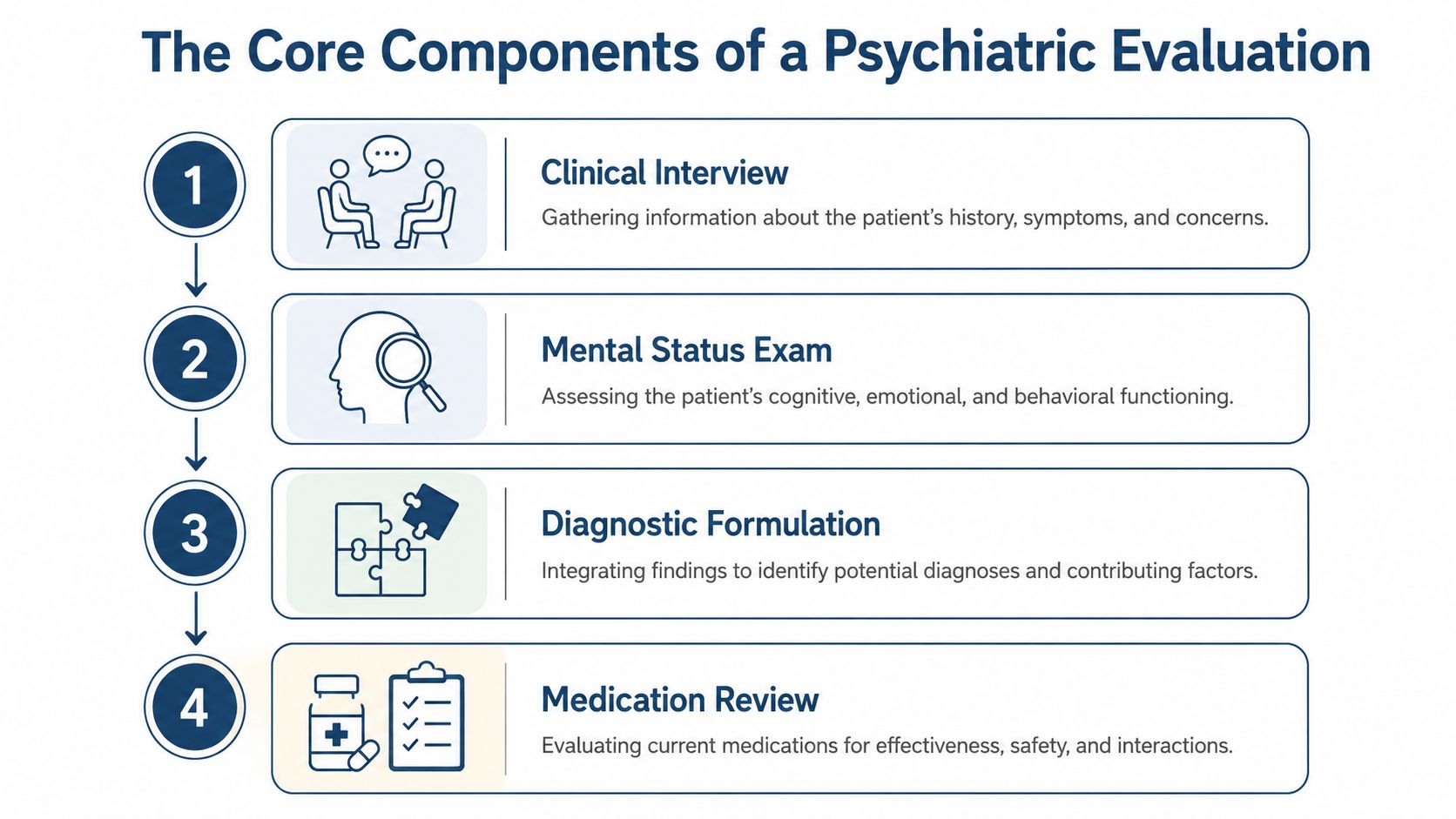
A careful psychiatric evaluation is built in layers. The clinician starts with what the person says, then checks what is observed, then tests whether the story fits a diagnostic pattern, and finally reviews what might be contributing medically or pharmacologically. The process feels conversational on the surface, but it is highly structured.
The interview and mental status exam do different jobs
The interview gathers the story. Clinicians ask about mood, anxiety, sleep, appetite, thought content, safety, trauma, and substance use, while also reviewing medical history, family history, and how symptoms affect daily life. The APA guidance says collateral information from family members and prior records can be important when the history is incomplete or the presentation is complex (APA guide).
The mental status exam is the observation piece. It documents appearance, behavior, speech, mood, thought process, perception, and cognition. The AAFP review also notes that expert-level evaluation should include quantitative measures of symptoms, functioning, and quality of life so the team can establish a baseline and track change over time instead of relying on impression alone (AAFP).
A polished presentation can hide severe impairment. The evaluation has to test the gap between performance and internal strain.
Formulation turns information into a plan
Diagnosis is only part of the work. A competent clinician also creates a formulation, which is the explanation for why these symptoms are happening now and what is driving them. That is where patterns like trauma exposure, escalating substance use, chronic sleep loss, or untreated mood instability start to connect into one coherent clinical picture.
This is also why medication review matters. Current psychotropic prescriptions, recent changes, adherence problems, side effects, and interaction risks can all shape diagnosis and treatment response. The evaluation is stronger when the medication picture is handled as part of the whole, not as an isolated checklist item.
For families or clinicians looking for a treatment-context example, the structure of psychiatric medication management shows how evaluation findings can translate into ongoing care rather than a one-time intake note.
What good evaluation avoids
A strong evaluation does not jump to conclusions after the first vivid symptom. It does not treat every sleep issue as depression or every agitation spike as bipolar disorder. It also doesn't ignore medical causes when the presentation is unclear, because psychiatric symptoms and medical illness can overlap in ways that mislead even experienced clinicians.
The best evaluations are disciplined about evidence. They combine what the person reports, what the clinician observes, and what collateral or historical data confirms. That is how treatment moves from guesswork to something defensible.
How Psychiatric Evaluations Drive Dual-Diagnosis Treatment
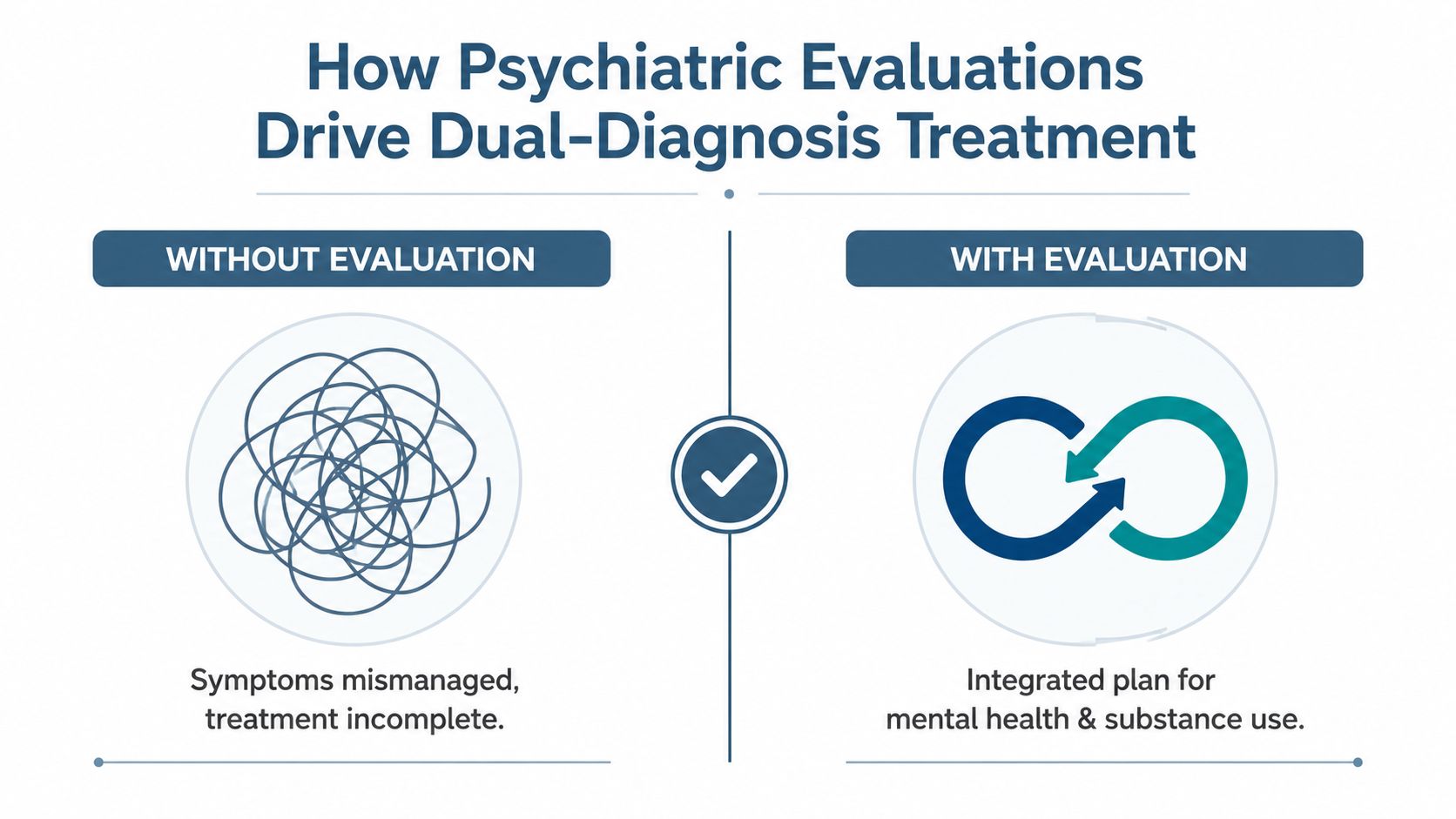
Co-occurring mental health and substance use problems are where superficial assessments fail fastest. A person can look depressed, irritable, disorganized, or paranoid for reasons that range from intoxication to withdrawal to a primary psychiatric disorder. Without a structured evaluation, those distinctions blur, and treatment gets less effective.
Symptom overlap is the main diagnostic trap
The AAFP review specifically notes that structured symptom measurement helps separate transient intoxication or withdrawal effects from persistent psychiatric syndromes (AAFP). That distinction matters because treatment changes depending on whether the symptom is substance-induced, part of a mood disorder, or part of a trauma-related pattern. In executive populations, that judgment has to be careful, since high stress and high access can both mask the problem.
The national primary-care analysis cited in the psychiatric evaluation guidance found that roughly 1 in every 8 or 9 primary-care visits involves a mental-health concern (APA guideline). That helps explain why dual-diagnosis screening can't sit only in specialty addiction settings. Patients often enter care through general medicine long before they identify the full scope of the problem.
Measurement improves the treatment match
A dual-diagnosis evaluation is useful when it identifies both severity and function. That means the clinician is not only asking whether substance use is present, but also how it affects judgment, sleep, mood regulation, motivation, and safety. Quantitative symptom measures support that process by making improvement or deterioration easier to track over time.
The result is a more integrated plan. Instead of splitting addiction treatment from psychiatric treatment, the team can align therapy, medication strategy, level of structure, and relapse-prevention work around the same clinical picture. That kind of alignment is especially important for executives who need a plan that is clinically serious without being operationally chaotic.
Why integrated treatment works better in practice
When evaluation findings are clear, treatment becomes less fragmented. The person who needs withdrawal support, mood stabilization, or trauma-focused therapy can receive the right sequence instead of a one-size-fits-all response. That is the difference between short-term stabilization and a plan that can hold once work pressure, family responsibilities, and external stress return.
Clinical bottom line: in dual diagnosis, the evaluation is not paperwork. It is the mechanism that decides what the real problem is and how the team should respond.
For a closer look at how an integrated program is organized, dual-diagnosis treatment is the relevant model when mental health and substance use are both part of the clinical picture.
What Sets a Luxury Psychiatric Evaluation Apart
Standard evaluations often assume the client can reorganize life around care. Luxury executive-focused treatment starts from the opposite assumption, that care has to be built around privacy, discretion, and continued professional responsibility. That difference changes the entire experience.
The most obvious contrast is pace and setting. A high-end program can offer a quieter admission process, more time for history-taking, and a treatment environment that lowers the sense of exposure. For executives and other high-profile professionals, that matters because the fear of disruption can keep them from being fully candid in a rushed intake.
Privacy and continuity change disclosure
People tell the truth faster when they believe the setting is controlled. In a discreet residential environment, clients can discuss substance use, medication misuse, family conflict, or performance anxiety without wondering who can overhear. That usually leads to better data, and better data leads to better decisions.
Luxury care also supports continuity with work and family life. Reflections states that clients can keep their electronics, including phones and laptops, while in treatment so they can continue with career obligations, and that all residents have private rooms in both detox and rehab. Those details matter less as amenities and more as clinical enablers, because they reduce the false choice between getting treatment and disappearing from professional life.
The clinical team is part of the difference
A premium evaluation is also stronger when it is multidisciplinary. Reflections describes a team led by Executive Clinical Director Dr. William Hanna, with PhD-level psychologists, psychiatrists, LMFTs, certified addiction counselors, and adjunctive therapists. In practice, that means the evaluation is not narrowed to one specialty lens. Medication questions, family dynamics, trauma history, and addiction severity can all be weighed together.
That approach fits the reality of dual diagnosis. Executive clients rarely present with one neat issue. They present with pressure, sleep disruption, substance use patterns, and symptoms that interact with one another. A team built to assess those layers can deliver a more useful formulation than a bare-bones intake.
Luxury does not mean softer standards. It means fewer barriers between the client and a serious clinical assessment.
How to Prepare for Your Psychiatric Evaluation
Preparation helps executives get more value from the first appointment, especially when time is limited and the stakes feel high. The goal is not to script the conversation. It is to give the clinician enough reliable information to make a clean assessment quickly.
Bring the facts the clinician cannot guess
The most useful materials are usually straightforward. Prior medical records, a current medication list, and a simple timeline of symptoms can reveal patterns that are hard to reconstruct on the spot. If family history is known, it also helps to note diagnoses, hospitalizations, substance use patterns, or major mood changes that have appeared in close relatives.
A private health diary can be especially useful. Short notes about sleep, alcohol or medication use, panic symptoms, missed work, or relationship conflict can show whether symptoms are steady, cyclical, or tied to specific stressors. That kind of detail often clarifies whether the problem is new, recurrent, or being amplified by something external.
- Prior Medical Records: recent discharge summaries, specialist notes, and relevant lab results help the clinician avoid repeating work that has already been done.
- Medication List: include prescription drugs, over-the-counter products, supplements, and any recent changes in dose or adherence.
- Personal Health Diary: note sleep, mood shifts, cravings, missed obligations, and major stressors in plain language.
- Family History Notes: record known psychiatric diagnoses, substance use issues, or patterns of hospitalization when available.
- Questions for Your Doctor: bring the concerns that would otherwise get forgotten once the appointment starts.
Honesty shortens the path to the right plan
The evaluation works best when the client is direct about substance use, suicidal thoughts, medication nonadherence, or shameful behaviors that may have been hidden for months. Clinicians are trained to handle difficult information. What slows care down is omission, not honesty.
That point matters even more when privacy is a concern. A discreet setting is valuable because it lowers resistance to disclosure, but confidentiality still depends on the client being specific. A vague description of “stress” may leave the treatment team guessing, while a clear account of how symptoms affect work, sleep, or judgment gives them something concrete to act on.
What to expect in the room
The appointment usually feels more organized than people expect. The clinician will ask about current symptoms, history, medical issues, safety, and substances, then may review collateral information or recommend additional workup if medical red flags appear. The process is collaborative, but it is also decisive, because the next step depends on what the evaluation shows.
In practice, preparation does one thing very well. It reduces noise. That lets the clinician spend more of the appointment on the parts that change treatment.
Confidentiality and Legal Considerations for Executives
High-profile clients often hesitate for reasons that have little to do with denial and everything to do with exposure. They worry about reputational risk, employment concerns, licensing issues, and whether sensitive information will travel farther than intended. Those are reasonable concerns, and they deserve a serious answer.
A psychiatric evaluation should be private by design. For executives, that means the setting, intake process, and communication channels all need to support discretion. It also means the team should be clear about what information is collected, who can access it, and how it is protected once treatment begins.
Confidentiality has practical value
The strongest privacy protections do more than prevent embarrassment. They improve clinical candor. When a client knows the process is controlled, they are more likely to discuss relapse, panic, medication misuse, or family strain without editing the truth. That improves the evaluation, and it improves the plan that follows.
For programs with strong privacy standards, it also helps to understand the operational side of compliance. Reflections discusses its confidentiality framework in its HIPAA compliance information, which is relevant because executives often want assurance that sensitive mental health information is handled under established privacy rules. The key point is simple, good care and privacy are not competing priorities.
Private pay can reduce friction
Insurance can be useful, but it can also introduce extra visibility and administrative complexity. For some executives, private pay is easier to manage because it creates a cleaner boundary around treatment decisions and scheduling. That does not make insurance wrong, it just changes the trade-off between convenience, coverage, and discretion.
Legal considerations can be equally important for professionals with licensure, board oversight, or public-facing roles. In those cases, the evaluation has to be accurate, documented carefully, and tied to treatment recommendations that make clinical sense. A rushed or vague assessment can create avoidable risk, while a precise one can support both recovery and responsible professional continuity.
Urgency should not be confused with spectacle
Not every concern requires emergency care, but certain symptoms do require immediate in-person assessment. The emergency psychiatry literature emphasizes targeted medical evaluation rather than routine blanket testing, especially when red flags such as abnormal vital signs, delirium, focal neurologic findings, intoxication, or new-onset symptoms later in life are present. That approach is both safer and more efficient than treating every case as identical.
The true luxury is not only privacy. It is being able to receive serious care without unnecessary exposure, delay, or confusion.
How Reflections Integrates Evaluations into Treatment Planning
A psychiatric evaluation matters most when it changes what happens next. At Reflections, the evaluation findings are used to shape an individualized plan rather than a generic track, which is essential for clients whose symptoms, responsibilities, and risks are tightly connected. That includes dual-diagnosis care, medication optimization when appropriate, therapy planning, and a level of structure that still respects career continuity.
The advantage of that model is coherence. When the same clinical team is looking at trauma, mood, substance use, and functioning together, the treatment plan is less likely to become fragmented. Clients do not get handed separate answers from separate silos; they get one plan built around the underlying pattern.
The plan has to fit the person, not just the diagnosis
Reflections combines evidence-based therapies such as CBT, DBT, ACT, MI, and individual psychotherapy with experiential supports like mindfulness, meditation, art and music therapy, somatic and equine work, fitness, massage, and nutrition. That mix matters because the evaluation often shows that symptoms are not isolated. They affect sleep, self-regulation, motivation, and family dynamics all at once.
The team also supports appropriate access to electronics, which helps clients stay connected to work and family while still receiving residential care. For many executives, that continuity lowers resistance to admission and makes sustained participation more realistic.
Follow-up is part of the assessment process
A strong psychiatric evaluation does not end when the intake note is signed. It creates a baseline for ongoing reassessment, medication adjustment, and coordination with the broader treatment plan. That is particularly important in dual diagnosis, where improvement can look uneven and needs to be measured over time.
Reflections also emphasizes family involvement through private sessions and monthly educational workshops, which helps the treatment team align the client's home environment with clinical goals. That is often what turns a good evaluation into a durable recovery plan.
For executives seeking confidential, high-end dual-diagnosis care, the difference is not mere comfort. It is whether the evaluation leads to a plan that can protect health without derailing a career.
Reflections offers discreet, high-end dual-diagnosis treatment built around a thorough psychiatric evaluation, private rooms, and the ability to keep working while in care. If the goal is serious clinical treatment that respects privacy, professional obligations, and long-term recovery, visit Reflections to learn how their team approaches executive-level care.