

A senior leader usually reaches this search in a narrow window. Performance is still intact enough to protect. Sleep is thinner, alcohol or pills have become part of the workday rhythm, and anxiety, depression, trauma symptoms, or burnout are no longer staying in the background. Family sees it. Colleagues may not. That gap is often where the search for a Bay Area medical resort begins.
The problem is that the phrase is misleading. Search results often point toward post-surgical nursing facilities, not discreet behavioral health programs for executives with co-occurring mental health and substance use disorders. Existing coverage often fails to distinguish transitional physical rehabilitation from dual-diagnosis behavioral health treatment, and that confusion matters for high-profile professionals who need the right level of care, not the wrong category with a polished name.
A real executive program has to do two things at once. It has to deliver serious clinical treatment, and it has to protect the client's professional life, privacy, and dignity while treatment is underway. That means private rooms, strong boundaries, advanced psychiatric care, and a structure that recognizes some residents still need to manage critical responsibilities.
That's the standard worth using. Anything less is expensive delay.
The Executive's Crossroads and the Promise of Healing
A founder, physician, attorney, investor, or C-suite operator rarely presents with a simple substance problem. The visible issue may be alcohol, stimulants, benzodiazepines, or a pattern of cycling between overcontrol and collapse. Underneath, there's often anxiety, trauma, mood instability, grief, or chronic stress that has gone untreated because functioning stayed high for too long.
That's why the phrase Bay Area medical resort creates so much confusion. The market uses “medical resort” to describe very different environments. Some are nursing facilities built for recovery after surgery or hospitalization. Others are private residential programs built for behavioral health. They are not interchangeable.
What executives are actually looking for
Most high-performing clients aren't seeking comfort for its own sake. They're seeking a setting where they can stabilize without public exposure, receive advanced dual-diagnosis treatment, and avoid the chaos that comes from entering a poorly designed program.
A proper fit usually includes:
- Confidentiality that isn't negotiable: Private space, controlled communication, and a culture that respects reputation.
- Clinical depth: Treatment for substance use and mental health in the same plan, not separate tracks.
- Professional practicality: Enough flexibility to handle limited work obligations without letting work hijack treatment.
A high-functioning client doesn't need a softer program. That client needs a sharper one.
Why the distinction matters
When an executive lands in the wrong setting, the consequences are immediate. The care model may focus on physical rehab. The staff may not be equipped for co-occurring psychiatric symptoms. The environment may be institutional, shared, and operationally mismatched to the client's actual risk profile.
The right setting feels different from the first call. Admissions questions are more precise. Privacy protocols are clearer. The clinical discussion includes detox, psychiatric evaluation, medication review, trauma history, family system stress, and aftercare. That's what a true Bay Area medical resort should mean in practice.
Defining the True Bay Area Medical Resort
The phrase needs a stricter definition. For executives and other high-earning professionals, a real Bay Area medical resort is not a dressed-up nursing home. It is a private behavioral health setting that combines strong medical oversight, integrated psychiatric and addiction treatment, and an environment designed to lower friction so the client can do the work.
That distinction becomes obvious when compared to facilities that dominate generic search results.
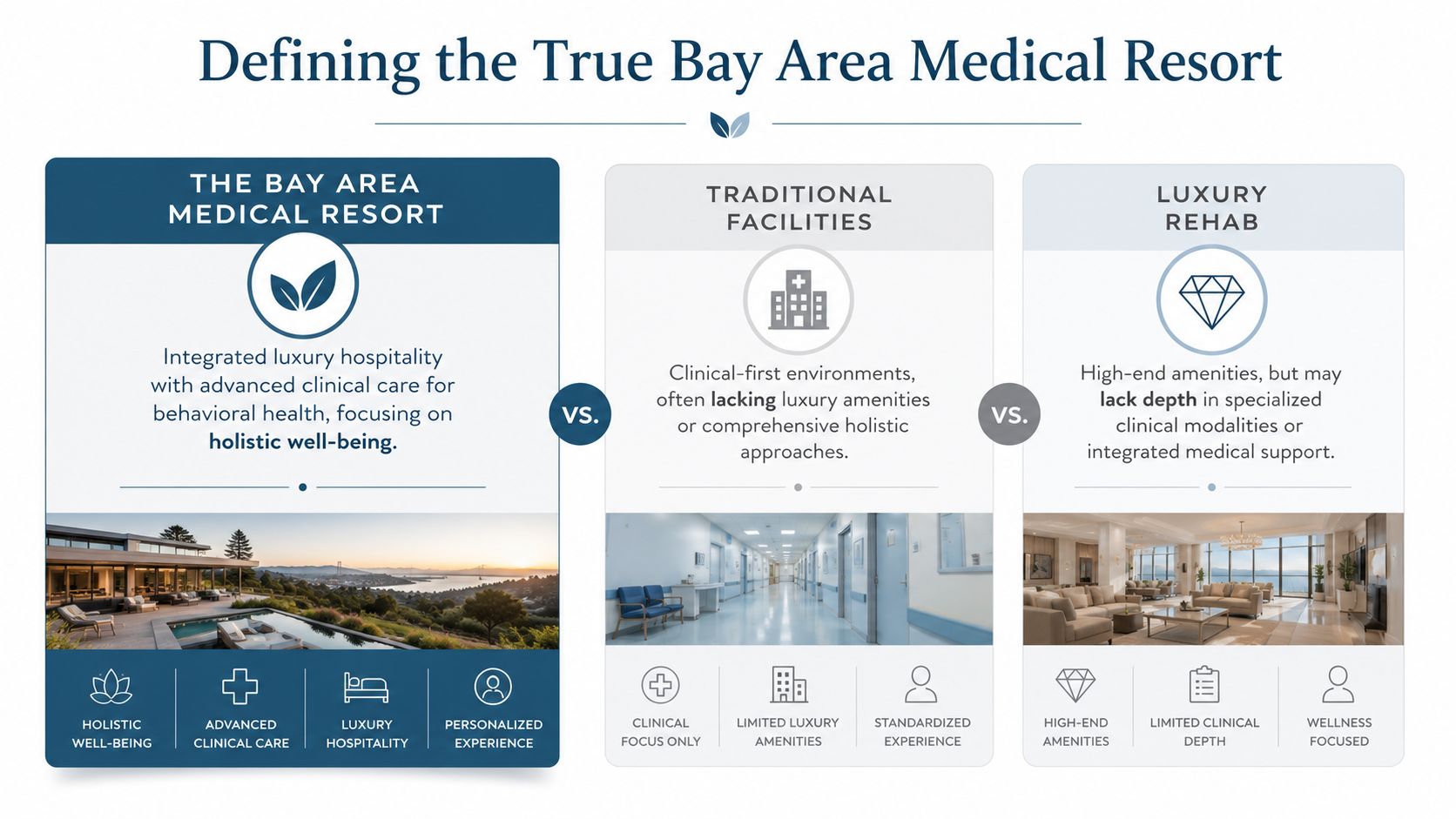
What the common search result gets wrong
A widely surfaced example is The Medical Resort at Bay Area in Pasadena, Texas. It is a for-profit nursing home, not an executive dual-diagnosis behavioral health program, and it holds a CMS rating of 1 out of 5 stars. That rating signals significant deficiencies. It also tells a discerning client something simple: name similarity does not equal clinical relevance.
A nursing home may be entirely appropriate for short-term physical rehabilitation. It is not the right answer for a leader who needs confidential treatment for alcohol dependence with panic symptoms, stimulant misuse with insomnia, or trauma-driven compulsive behavior.
The standard that matters
For this clientele, the useful definition is narrower. A true executive medical resort should provide:
| Setting feature | What matters for executives |
|---|---|
| Clinical focus | Dual-diagnosis treatment, not post-acute physical rehab |
| Living environment | Private, quiet, and controlled |
| Treatment design | Integrated psychiatric and addiction care |
| Operational tone | Discreet, structured, and adult |
| Work accommodation | Limited, appropriate access for real obligations |
The hospitality element matters, but not in the superficial sense. Quiet surroundings, private rooms, better food, and a more refined environment reduce noise, stress, and resistance. They remove obstacles that often keep high-functioning adults from engaging honestly.
Comfort isn't the product. Clinical engagement is the product. Comfort simply makes engagement more likely.
A generic facility can claim it's “medical” because nurses are present. That's not enough. Executive behavioral health requires coherent psychiatric care, experienced therapists, and a program that understands the difference between preserving identity and enabling avoidance.
For readers comparing high-end options in the region, this overview of luxury treatment in the Bay Area offers a useful frame for what a serious private-pay program should look like.
The Clinical Cornerstone of Dual Diagnosis Care
Most executive cases are dual-diagnosis cases, whether the client uses that term or not. The clinical picture often includes both a substance problem and a mental health condition that interact with each other. Treating only one side is poor medicine.
That's where many programs fail. Only about 9% of mental health programs and 18% of addiction treatment programs are “Dual Diagnosis Capable”. In plain terms, most facilities don't have the integrated infrastructure to treat both conditions well at the same time.
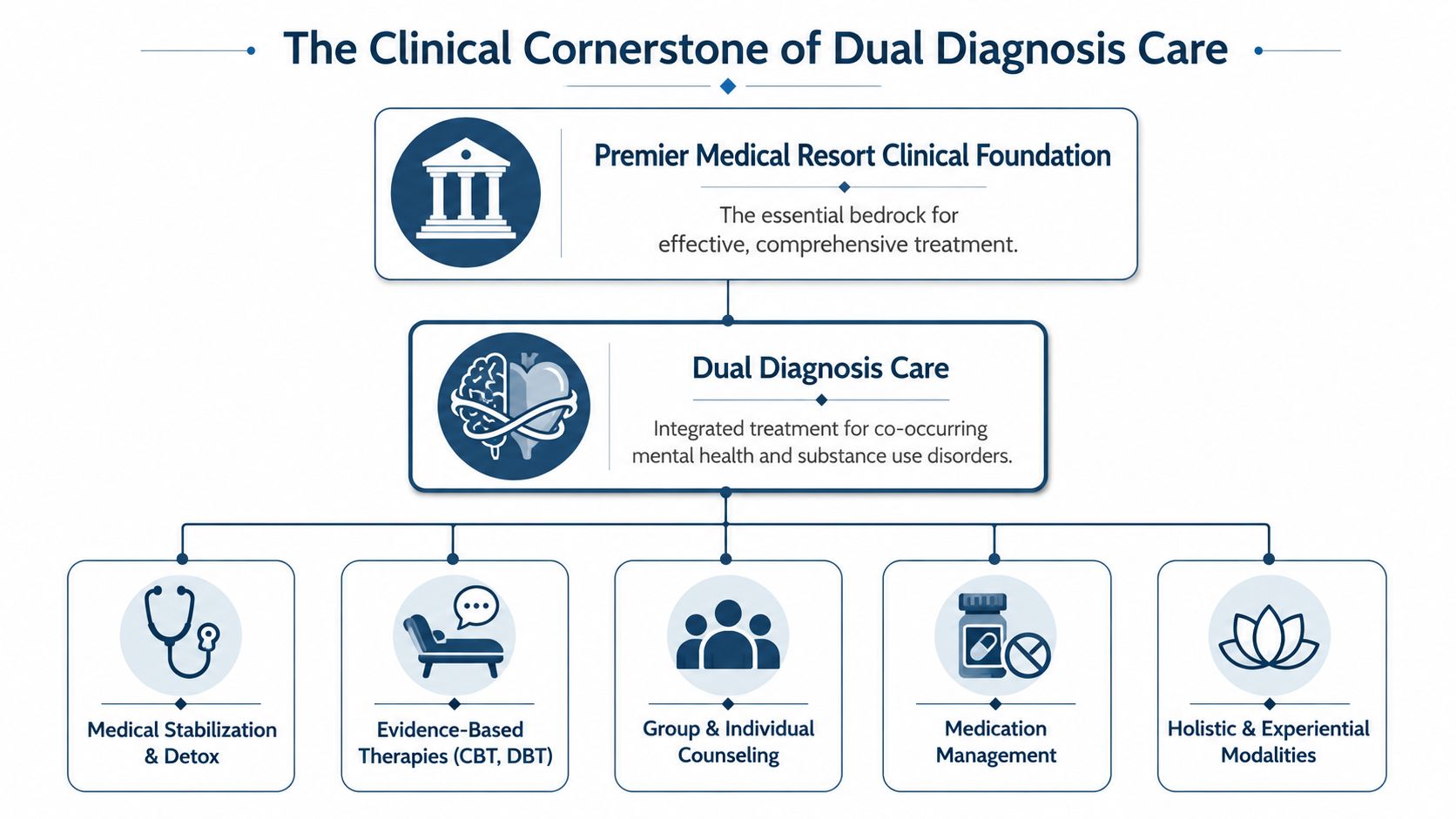
What integrated treatment actually means
Integrated care isn't a branding phrase. It means one treatment plan, one clinical team, and one set of goals addressing both the psychiatric condition and the substance use disorder together.
That includes several moving parts:
- Medical stabilization and detox: Withdrawal risk has to be assessed and managed correctly.
- Psychiatric evaluation: Mood symptoms, trauma symptoms, anxiety, sleep disruption, and medication issues need direct review.
- Therapeutic work: The client needs structured treatment that addresses triggers, self-defeating thinking, emotional reactivity, and avoidance.
- Family and systems review: Home pressure, relationship fractures, and enabling patterns often sustain the cycle.
Why CBT and DBT matter
An advanced program doesn't throw jargon at the client. It uses methods that solve actual problems.
Cognitive Behavioral Therapy helps the client identify thought patterns that drive use, shame, panic, or perfectionism. It gives language to the internal chain that often goes unnoticed until relapse has already started.
Dialectical Behavior Therapy is especially useful for clients who feel flooded, impulsive, self-critical, or relationally volatile under stress. It teaches emotion regulation, distress tolerance, and interpersonal effectiveness. For executives, those aren't abstract therapy concepts. They're operational skills.
The right treatment model doesn't ask whether the addiction came first or the anxiety came first. It treats the system as it exists today.
A strong program also needs legitimate medical and psychological leadership. High-acuity dual-diagnosis care shouldn't be built around generic counseling alone. It requires experienced psychiatrists, psychologists, therapists, and addiction clinicians who can work from the same formulation.
For readers evaluating programs with this level of complexity, a dedicated dual-diagnosis treatment model is the benchmark worth using.
The Executive Experience Privacy Professionalism and Peace
The executive question is rarely “Can treatment help?” The core question is “Can treatment happen without blowing up everything else?” A serious program answers that with design, not reassurance.
Top-tier executive rehab programs explicitly allow residents to keep personal electronics, including cell phones and laptops, so they can remain engaged with essential career obligations. That policy is a defining feature of treatment built for working professionals, as outlined in executive-focused rehab guidance.

What a day should feel like
The day shouldn't feel chaotic, punitive, or infantilizing. It should feel ordered. Clinical work comes first. Medical review, individual therapy, groups, and skills-based treatment anchor the schedule. Work access is structured around treatment, not the reverse.
For the executive client, several features matter immediately:
- Private rooms in detox and rehab: Shared rooms are often a poor fit for public-facing professionals, trauma survivors, and anyone trying to stabilize sleep and emotional regulation.
- Appropriate electronics access: A resident may need to review a board packet, respond to a legal issue, or maintain limited oversight of a team.
- An adult environment: Good programs don't create unnecessary exposure or noise.
Why privacy changes outcomes
Privacy isn't a luxury detail. It lowers resistance. When a client isn't preoccupied with exposure, roommate stress, or constant disruption, attention can move toward treatment. That's often the first real drop in defensive pressure the client has felt in years.
Integrated and experiential therapies also matter more than skeptical clients expect. Somatic work can help clients who've lived in chronic physiological activation. Mindfulness can improve response to stress. Equine work, movement, art, and other experiential methods can reach clients who are articulate but over-intellectualized.
A private room often does more than provide comfort. It gives a high-stress client enough psychological space to stop performing.
A confidential executive program should also know how to manage outside contact. Some clients need tight limits because work itself is a trigger. Others need narrow, scheduled access to maintain stability in business and family systems. The difference should be handled clinically, not casually.
For families or advisors vetting options where discretion is central, confidential rehab for executives is the right category to examine.
Navigating Costs and Viewing Treatment as an Investment
This level of care is expensive. It should be. A private-pay executive program isn't selling a bed and a schedule. It is providing clinical sophistication, discretion, individualized attention, private accommodations, and enough operational maturity to support treatment without unnecessary career fallout.
That cost should be evaluated against the actual alternative. Untreated addiction and unstable mental health don't stay politely contained. They spread into decision-making, reputation, family life, legal exposure, and physical health. By the time a high-performing adult is searching for a Bay Area medical resort, the price of delay is usually already visible.
What the buyer is actually paying for
The value isn't abstract. It usually includes:
- Clinical caliber: Better staffing, stronger psychiatric oversight, and integrated treatment for co-occurring conditions.
- Privacy architecture: Private rooms, more controlled communication, and a lower-risk environment for high-profile residents.
- Professional accommodation: The ability to stay connected to limited work responsibilities without turning treatment into remote office life.
- Continuity: A plan that extends beyond residential care.
Insurance may cover parts of treatment, but bespoke executive care often sits outside what standard coverage is built to support. That isn't automatically a negative. The private-pay structure often allows more customization and stronger confidentiality.
Families who are also trying to understand the broader context of care financing may find that Family Caregiving Kit explains long-term care in a way that helps separate elder-care planning from behavioral health treatment decisions. That distinction is useful because these categories are often confused.
A prudent client doesn't compare elite executive treatment to the cheapest available option. The relevant comparison is between a focused intervention now and a much larger personal and professional correction later.
Choosing with Confidence Questions for Any Facility
A polished website proves almost nothing. A serious buyer needs to ask questions that expose how the program operates. That due diligence protects both the client and the investment.
The central standard is straightforward. Integrated treatment for co-occurring disorders, using approaches such as CBT and DBT, is the standard of care because it improves psychiatric functioning while reducing substance use. If a facility can't explain how it delivers that standard, it's not the right facility.
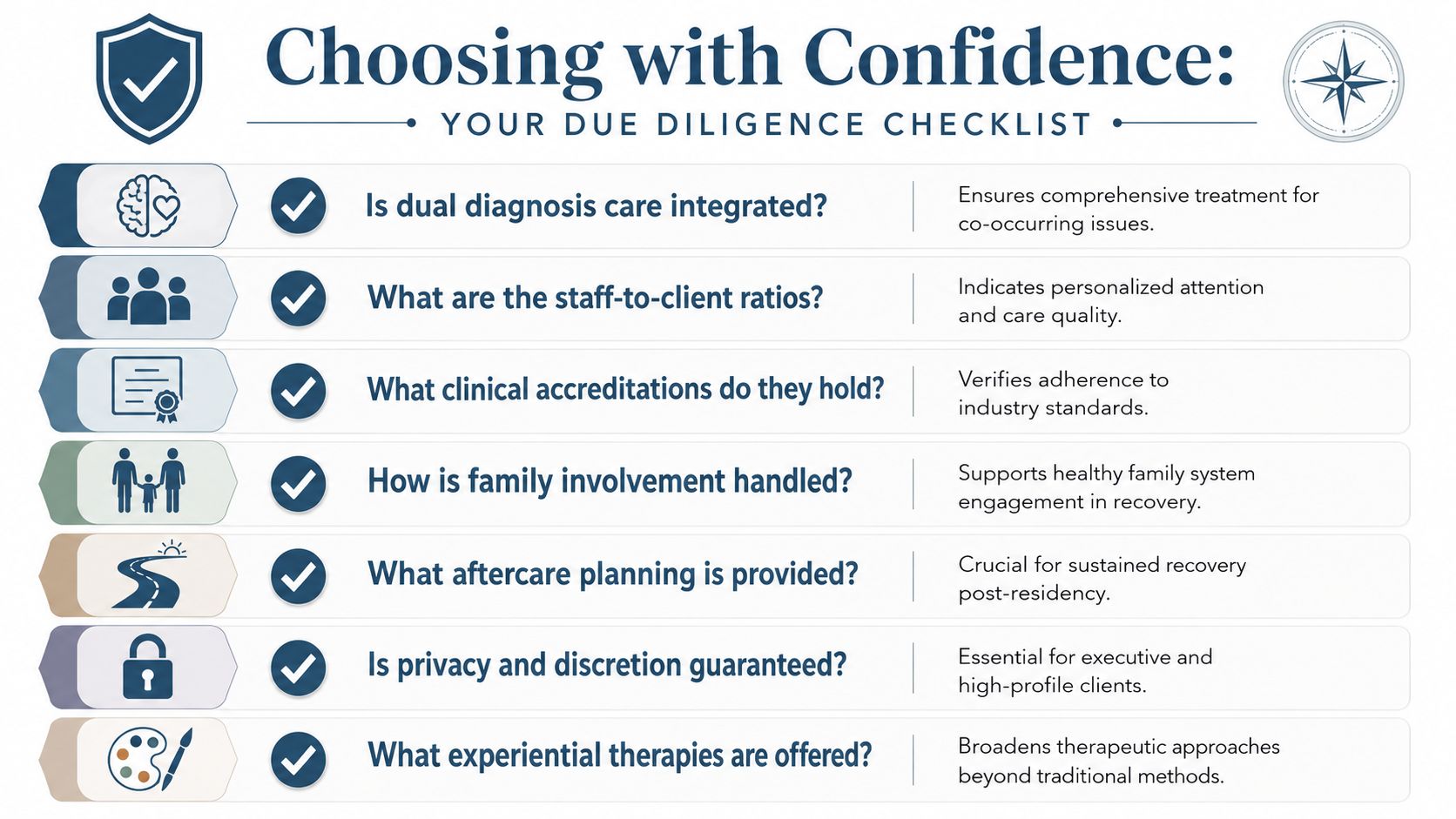
Questions that reveal the truth
Use questions that require specifics, not slogans.
- How is dual diagnosis treatment integrated? Ask whether one team manages both the psychiatric and substance use sides under a unified plan.
- Who is providing care? Get clarity on psychiatric involvement, therapist credentials, and who leads treatment decisions day to day.
- What accreditations does the facility hold? Formal accreditation matters because it reflects operational and clinical standards.
- What is the policy on privacy and outside communication? Executives need precise answers about confidentiality, electronics, and contact boundaries.
- Are private rooms standard in both detox and rehab? If not, the environment may not fit a high-profile client.
- How does aftercare work? Residential treatment without a continuation plan is incomplete.
Questions that separate image from substance
A few questions tend to cut through polished positioning quickly:
How does the facility handle relapse risk after discharge?
The answer should include continuing care, family work, and practical follow-up.What happens if psychiatric symptoms intensify during treatment?
The program should have a clear medical and clinical response, not a vague assurance.How are work obligations managed for executives?
The answer should sound structured and bounded.
If a facility answers hard questions with soft language, keep looking.
How are families involved without compromising the client's treatment?
Family participation should be purposeful, not performative.What kinds of experiential therapies are offered, and why?
The answer should connect each modality to regulation, trauma work, or behavioral change.
A serious facility won't be irritated by this level of scrutiny. It will expect it.
The Reflections Standard A Synthesis of Care and Comfort
For the executive client, the right program has to satisfy several requirements at once. It must treat co-occurring mental health and substance use disorders in an integrated way. It must offer a private, upscale residential setting. It must allow appropriate contact with work when clinically appropriate. It must provide private rooms in both detox and rehab. And it must be led by a highly credentialed team that can handle complex presentations without reducing the client to a diagnosis.
That combination is rare. It's also the standard that matters.
Reflections fits that standard directly. It is a California-licensed, Joint Commission-accredited luxury rehabilitation provider built specifically for adults with co-occurring disorders. Its treatment model combines evidence-based therapies such as CBT, DBT, ACT, MI, individual psychotherapy, and intensive groups with integrative and experiential modalities including mindfulness, meditation, art and music therapy, somatic work, equine work, fitness, massage, and nutrition.
Why the model fits executive care
The structure is designed for high-functioning adults who need more than generic rehab. Clients receive individualized treatment in a private residential environment under the direction of Executive Clinical Director Dr. William Hanna and a multidisciplinary team that includes PhD-level psychologists, psychiatrists, LMFTs, certified addiction counselors, and adjunctive therapists.
The practical details are just as important as the credentials:
- Private rooms throughout detox and rehab
- Appropriate access to electronics for continued work engagement
- Clinically managed medication-assisted withdrawal when appropriate
- Active family involvement through private sessions and educational workshops
- Continuing care and alumni support beyond residential treatment
The correct conclusion
A Bay Area medical resort worth considering isn't a post-surgical facility with an attractive name. It's a private, clinically serious setting where an executive can stabilize, address the underlying drivers of addiction, protect confidentiality, and return to life with more than temporary symptom control.
That's the real distinction. It isn't cosmetic. It determines whether treatment becomes a turning point or another concealed detour.
For a discreet conversation about private-pay executive detox and dual-diagnosis rehab, Reflections offers confidential guidance for professionals, families, and referring clinicians seeking high-acuity care in a private, upscale setting.