
A senior executive closes the laptop after midnight, pours a drink, and tells everyone that the week was just intense. The team saw sharp strategy, high energy, and fast decisions in the boardroom. No one saw the sleepless stretch before the presentation, the racing thoughts on the flight home, the crash afterward, or the pills and alcohol used to force the mind in one direction or the other.
That pattern is more common than many successful professionals realize. From the outside, life still looks intact. Revenue targets are met. Clients stay confident. Family members may sense strain, but the person at the center of it keeps functioning, at least for a while. Inside, though, mood instability and substance use can become tightly interlocked.
Clinically, this is often called a dual diagnosis. In plain language, it means a person is dealing with both a mental health disorder and a substance use disorder at the same time. When the mental health condition is bipolar disorder, the stakes rise quickly. Judgment, sleep, energy, impulse control, and emotional regulation are already vulnerable. Alcohol or drugs can make each of those problems harder to predict and harder to treat.
For executives, founders, physicians, attorneys, and other high performers, the barriers to getting help are specific. Privacy matters. Career continuity matters. Reputation matters. Treatment has to be advanced enough to address the psychiatric complexity and structured enough to respect ongoing professional obligations.
Navigating Success and Silence
A high-functioning professional with bipolar symptoms rarely presents like a stereotype. Colleagues may describe that person as brilliant, intense, driven, occasionally difficult, and unusually productive in bursts. At home, the same person may be far less steady. A partner notices long periods of agitation, then withdrawal. Sleep becomes erratic. Alcohol becomes part of the nightly routine. Stimulants, sedatives, or other substances start serving a purpose.
For many professionals, the silence around this pattern is deliberate. They've built careers on competence. They know how quickly perception shapes influence, board confidence, investor trust, or client retention. That's why concerns about privacy often sit beside concerns about health. In that context, resources on managing executive online reputation can be part of a broader risk-management mindset while treatment decisions are being made.
The problem is that secrecy can keep a dual diagnosis active for too long. A person may explain away the warning signs as pressure, ambition, burnout, or a demanding season. Those explanations can sound plausible for months or years.
When success masks impairment
In high achievers, bipolar disorder substance abuse often hides behind performance. A professional may still close deals, lead teams, and appear socially polished while personal stability erodes.
Common examples include:
- Using alcohol to come down: A leader who feels mentally overactivated at night uses drinking to force sleep.
- Using substances to stay up: A founder in a depressed phase leans on stimulants or misused prescription medication to stay present and productive.
- Calling mood swings intensity: Irritability, risk-taking, and abrupt changes in judgment get reframed as strong leadership style.
- Disguising consequences: Missed obligations, memory gaps, or emotional volatility are hidden behind travel, schedule changes, or delegated communication.
A closer look at hidden signs of addiction in executives often helps families and colleagues understand why “still functioning” doesn't mean “doing well.”
Some of the most impaired professionals are the ones who can still perform on command for short periods.
The Dangerous Intersection of Bipolar Disorder and Substance Abuse
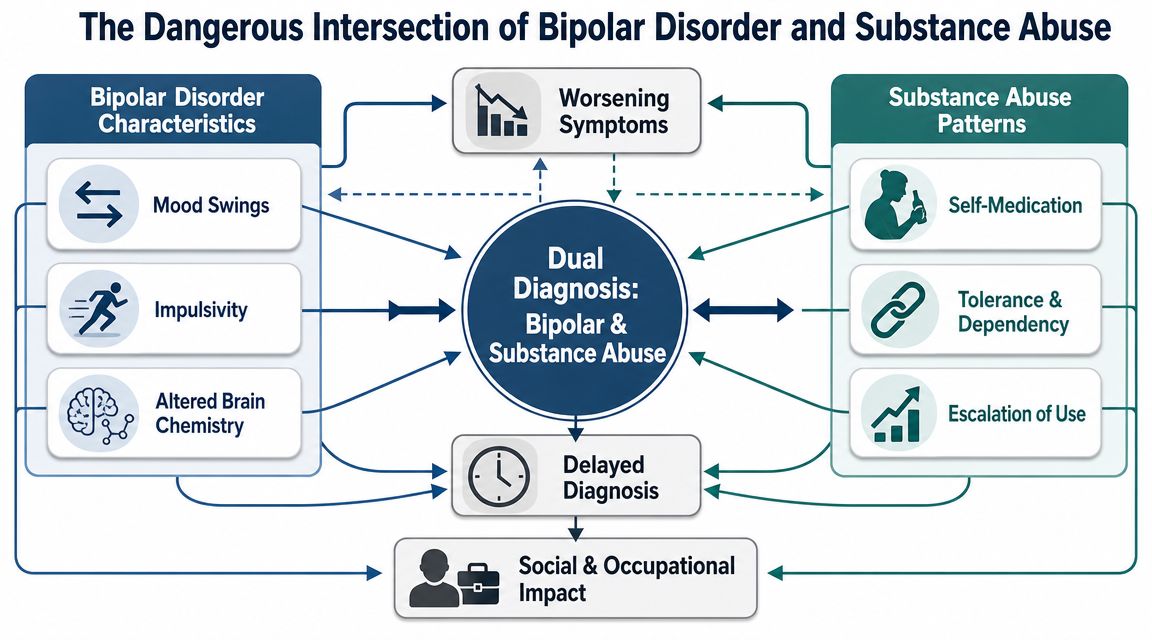
The relationship between bipolar disorder and substance use isn't random. These conditions often feed each other. One practical way to understand it is to think of a seesaw that's already unstable. The person tries to correct the imbalance by jumping harder on one side. For a moment it feels effective. Then the whole system swings wider.
A major epidemiological review found that substance use disorders are extremely common in bipolar I disorder, with a conservative estimate of at least 40% lifetime prevalence, and linked comorbid substance use to more frequent and prolonged mood episodes, lower treatment adherence, poorer quality of life, and increased suicidal behavior, as described in this epidemiological review of bipolar disorder and substance use comorbidity.
Self-medication feels logical at first
People with bipolar disorder often try to manage symptoms before they fully understand them. During a depressive phase, a substance may seem to soften emptiness, anxiety, or mental pain. During hypomania or mania, a person may use alcohol, cannabis, sedatives, or other substances to slow down racing thoughts or force sleep.
That's the self-medication trap. It isn't irrational in the moment. It's an attempt to create control without formal treatment.
But the relief is temporary. The underlying mood disorder remains active. Then the body adapts. Sleep becomes less natural. Emotional regulation gets weaker. The person needs more effort, more structure, or more substance just to feel briefly normal.
Substances amplify the illness they seem to help
The second mechanism is symptom amplification. Substances can worsen the exact bipolar symptoms a person is trying to manage.
Consider how that plays out in executive life:
| Pattern | Short-term perception | Actual effect |
|---|---|---|
| Drinking after high-intensity work | “It helps the brain shut off” | Sleep quality drops, mood becomes more unstable |
| Using sedatives without careful psychiatric oversight | “It calms the system” | Emotional blunting, dependence risk, rebound symptoms |
| Using stimulants to push through depression | “It restores focus” | Agitation, impulsivity, insomnia, possible mood escalation |
| Using substances socially during elevated phases | “It's just part of the lifestyle” | Lower inhibition, poorer judgment, greater behavioral fallout |
A person does not only have “bipolar disorder plus a bad habit.” The two conditions start interacting. Intoxication can mimic, mask, or intensify symptoms. Withdrawal can look like depression, anxiety, agitation, or mixed mood instability. Clinicians then have to sort out what belongs to the mood disorder, what belongs to the substance use, and how both are affecting treatment response.
Why isolated treatment often falls short
Treating only the substance problem misses the psychiatric engine driving part of the behavior. Treating only bipolar disorder while ongoing substance use continues leaves a major destabilizing force untouched.
Practical rule: If mood instability and substance use rise and fall together, both conditions need attention at the same time.
For professionals, this distinction matters because the cost of a partial solution is high. An untreated dual diagnosis can distort judgment, disrupt leadership behavior, strain marriages, and create avoidable legal, financial, and reputational exposure.
Recognizing the Signs in High-Functioning Individuals
In professional environments, bipolar disorder substance abuse often doesn't look chaotic at first. It looks expensive, polished, and explainable. The person still dresses well, speaks clearly, and knows how to command a room. That surface competence can delay recognition far longer than anyone expects.
A 2021 review reported that the lifetime prevalence of substance use disorders in bipolar disorder has been estimated as high as 56%, with alcohol as the most common at 42%, followed by cannabis at 20%. It also noted that the association is particularly strong in bipolar I disorder. Those figures appear in this 2021 review on bipolar disorder and illicit substance use.
Workplace clues that are easy to miss
Professionals and their families often confuse symptoms with personality. A leader who becomes unusually impatient may be called demanding. A founder who takes reckless financial risks may be called visionary until the decision quality slips too far. A physician who works through the night may be praised for endurance, even when the pattern is tied to a high mood state rather than discipline.
Subtle signs often include:
- Uncharacteristic impulsivity: sudden investments, spending, hiring moves, or relationship decisions that feel out of pattern
- Compressed sleep with high confidence: the person needs far less rest but becomes more certain, more argumentative, and less receptive to feedback
- Post-project crashes: after major wins or deadlines, the person collapses into heavy substance use, isolation, or a depressive state
- Functional drinking or drug use: substances become part of a predictable rhythm to switch on, switch off, socialize, travel, or recover
- Image management: absences, mood changes, and erratic communication are explained away with polished professional excuses
Home life often shows the strain first
Families usually see what colleagues don't. The executive who appears controlled in public may be irritable, withdrawn, volatile, or emotionally unreachable in private. Loved ones notice the cycle before the company does.
A useful question is not “Can this person still perform?” but “What does it cost them to keep performing?”
That shift matters. High-functioning professionals can stay outwardly productive while inwardly becoming less stable, less safe, and less able to recover without structured care. Programs designed for high-functioning professional addiction treatment are often better equipped to evaluate this gap between visible success and actual wellness.
Patterns that deserve immediate attention
The following combinations are especially concerning when they repeat:
- Sleep loss plus substance use
- Irritability plus increased risk-taking
- Periods of unusually high energy followed by marked crashes
- Medication inconsistency plus secretive drinking or drug use
- Growing conflict with partners, assistants, or direct reports
High-functioning is a description of appearance. It is not a measure of health.
Once these patterns are visible, waiting for a dramatic collapse isn't wise. Many successful people seek help only after a public mistake, a legal issue, a relationship rupture, or a severe mood episode. Earlier intervention gives more options and usually protects more of what matters.
Why Self-Medication Is a Losing Strategy for Professionals
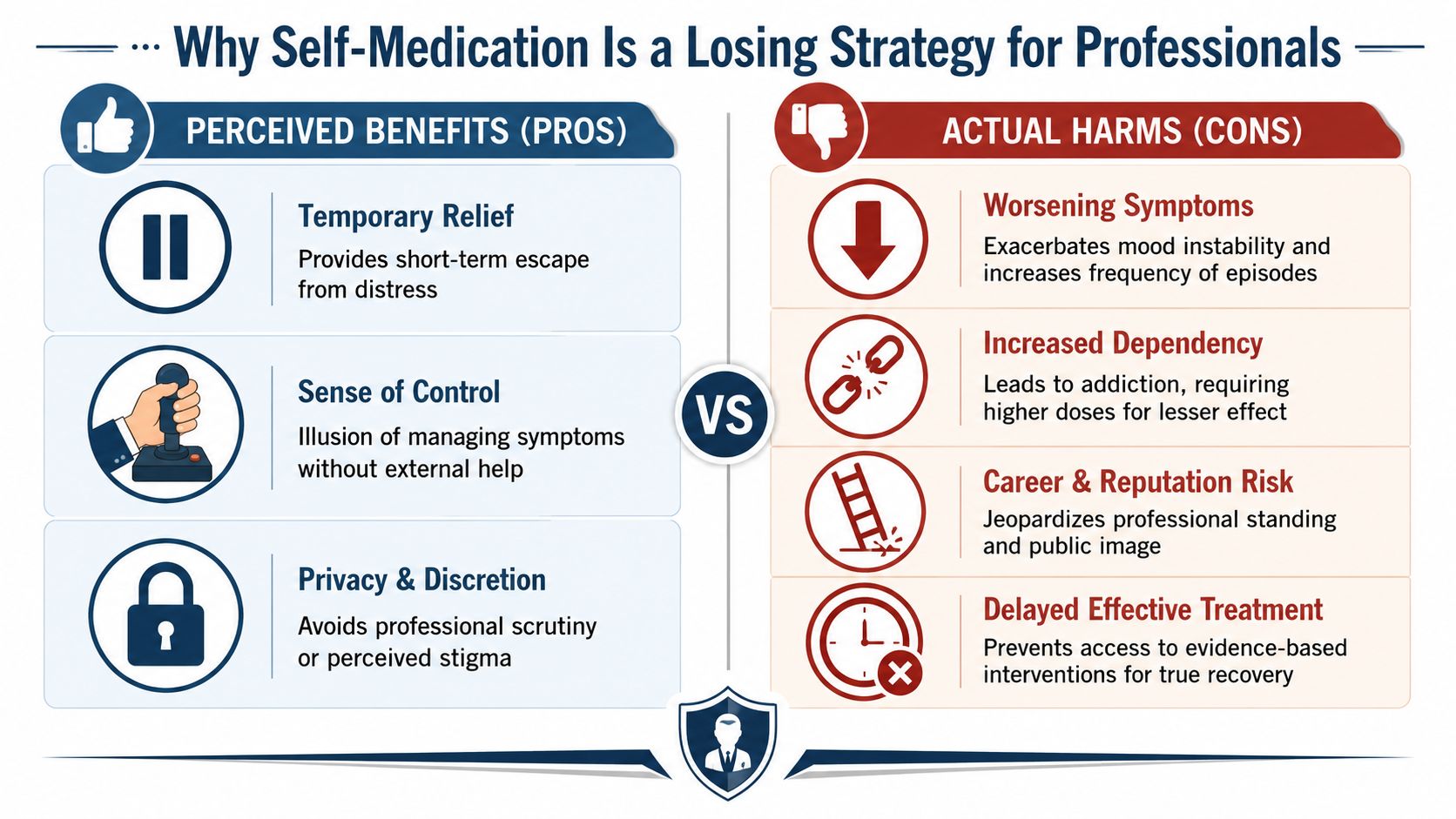
High achievers are often unusually good at solving problems under pressure. That strength becomes a liability when it turns into the belief that bipolar disorder and substance use can be privately managed with intelligence, willpower, scheduling, and selective secrecy.
That strategy usually fails because bipolar disorder and substance use are bidirectionally comorbid. Manic symptoms such as impulsivity and sleep loss can increase substance use, while intoxication and withdrawal further destabilize mood. This interaction materially alters the bipolar course and increases suicidality, treatment nonadherence, hospitalization, and functional impairment, as summarized in this review discussing the bidirectional relationship between bipolar disorder and substance use.
Why capable people keep trying anyway
Self-medication offers three seductive advantages. It feels private. It feels fast. It preserves the illusion that no one else needs to know.
For an executive, that can sound efficient. A drink to sleep after a red-eye. A pill to level out before a negotiation. A stimulant to push through a low period. On paper, each move appears tactical.
In reality, each one shifts the baseline in the wrong direction.
The professional costs are rarely immediate
That's part of what makes self-medication dangerous. The first consequences may be subtle rather than dramatic.
A professional may notice:
- Reduced judgment under stress: decisions become more emotional, more impulsive, or less consistent
- Shallower recovery: weekends, vacations, and downtime stop restoring mental clarity
- More interpersonal fallout: trusted colleagues start walking carefully around irritability or unpredictability
- Lower treatment engagement: medication plans, therapy, and psychiatric follow-up become harder to maintain consistently
Then the pattern escalates. A private coping strategy becomes a real dependency. A mood disorder that might have been stabilized becomes less predictable. The person who prides themselves on control starts organizing life around concealment and recovery from the last episode.
A strategy that works only in the next few hours isn't a strategy. It's a delay.
Professionals often respond well when treatment is framed accurately. This isn't surrender. It's risk management. It's protecting cognitive performance, reputation, relationships, and long-term earning capacity by stopping a cycle that gets harder to reverse over time.
The Gold Standard of Care for Dual Diagnosis
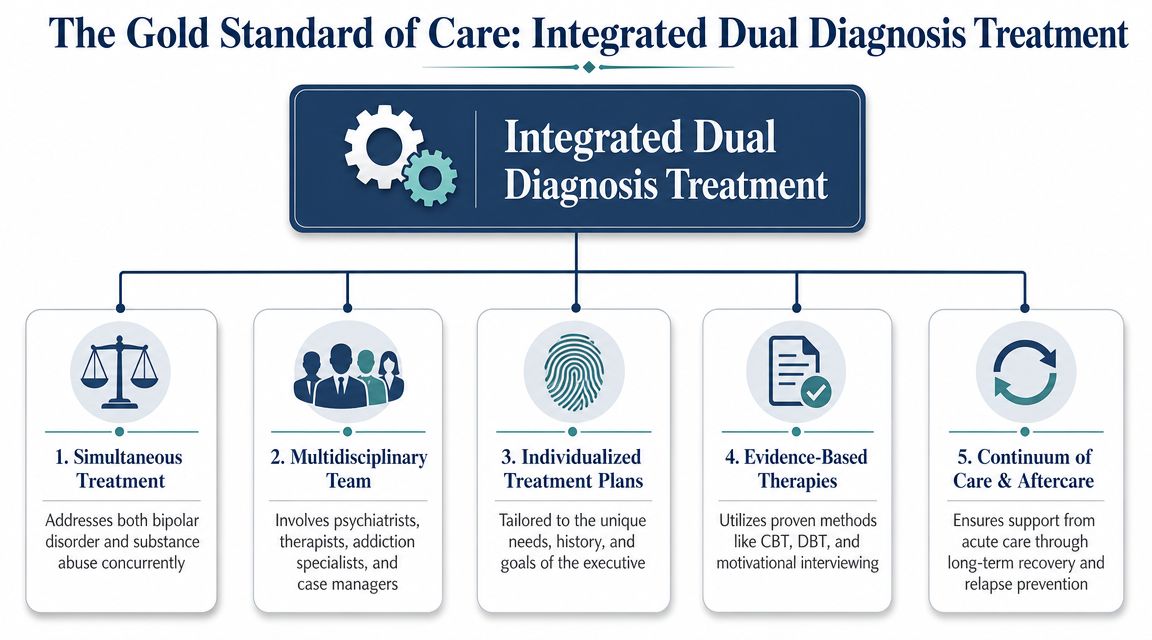
The most effective approach for bipolar disorder substance abuse is integrated dual-diagnosis treatment. That means both conditions are treated together by one coordinated clinical team. It sounds simple, but it changes almost everything.
When care is split, one provider may focus on sobriety while another focuses on mood symptoms, and the two plans may not line up. Medications, sleep goals, therapy priorities, and relapse prevention all need coordination. Bipolar disorder with active substance use is too interwoven for fragmented treatment.
What integrated care actually includes
At a high clinical level, integrated care usually includes several moving parts working in sync:
- Psychiatric evaluation and medication management: clinicians assess mood episodes, substance effects, sleep disruption, and medication response together rather than in separate silos.
- Individual psychotherapy: structured work such as CBT, DBT, ACT, and motivational interviewing can help patients identify triggers, improve emotional regulation, and reduce self-defeating decision patterns.
- Group treatment with relevant peers: carefully run groups help reduce shame and improve reality testing, especially for professionals used to carrying everything alone.
- Detox or withdrawal support when needed: if substances are active, stabilization may need to happen before the mood picture becomes clear.
- Family involvement: partners and family members often need education about both bipolar disorder and addiction dynamics so they can stop reacting to the crisis and start supporting recovery.
Why sophistication matters for executives
Executives often need more than generic therapy. They need clinicians who can work with complexity. That includes mixed presentations, trauma, medication sensitivity, occupational pressure, public exposure concerns, and the cognitive demands of returning to leadership responsibly.
A person evaluating programs may also benefit from reviewing specialized psychiatric options, including Integrative Psychiatry of America's addiction services, as part of broader due diligence around psychiatric support and continuity.
For residential care, integrated mental health and addiction treatment is the standard worth looking for because it addresses cause and consequence at the same time.
One coordinated plan is easier to follow
A strong dual-diagnosis program gives the patient one coherent treatment map. Sleep, medication, therapy, substance recovery work, family communication, and aftercare all support the same outcome.
That's also where a program such as Reflections may fit for some adults. Reflections is a California-licensed, Joint Commission-accredited residential provider focused on dual-diagnosis care, with coordinated psychiatric, psychological, addiction, and continuing care services in a private setting.
The Executive Advantage of Luxury Residential Treatment
For many professionals, the resistance to treatment isn't denial alone. It's a practical objection. They assume getting help means disappearing, losing control of communication, disrupting major responsibilities, and entering an environment that doesn't understand their world.
Luxury residential treatment changes that equation when it's built correctly. In an executive-focused setting, treatment can be both clinically serious and operationally realistic.
Privacy is a clinical need, not a perk
A successful professional often carries sensitive obligations, public visibility, and legitimate concerns about discretion. In that context, privacy isn't cosmetic. It helps people engage openly.
Private rooms matter because they reduce stimulation, support sleep stabilization, and make difficult psychiatric work more manageable. They also create space for confidential calls, quiet reflection, and decompression after intensive clinical work.
Other environment factors matter too:
- Discreet setting: lower visibility reduces fear of exposure
- Professional boundaries: staff understand confidentiality concerns without letting work take over treatment
- Calm surroundings: a regulated environment supports mood stabilization better than a chaotic one
Career continuity can support recovery
Many executives delay care because they believe treatment requires complete professional disconnection. In some cases, a short period of full separation is clinically necessary. In many others, limited and structured access to electronics can make treatment more feasible.
When a program allows appropriate use of phones and laptops, a professional can maintain essential oversight, protect key relationships, and reduce the panic that often keeps high performers from entering care at all. The important phrase is appropriate use. Work should be contained and supervised by the treatment plan, not used as an escape from it.
This model often fits professionals who need to:
| Professional need | Why it matters in treatment |
|---|---|
| Limited access to phone and laptop | Reduces disruption while preserving boundaries |
| Private room in detox and residential care | Supports confidentiality and emotional regulation |
| Sophisticated peer environment | Reduces shame and improves engagement |
| Strong clinical staffing | Helps manage psychiatric complexity safely |
Peer fit affects honesty
Successful people often open up faster when they're around others who understand pressure, leadership burden, and image management. That doesn't require celebrity culture or status signaling. It requires a treatment environment where achievement doesn't have to be hidden and vulnerability doesn't feel humiliating.
The right residential setting lets a professional stop performing competence and start practicing recovery.
Luxury care, at its best, isn't about indulgence. It's about removing unnecessary barriers so a person can do serious treatment work without avoidable friction.
Choosing Your Path to Sustainable Recovery
A dual-diagnosis treatment decision should be approached the way a serious professional evaluates any high-stakes investment. The right questions reveal whether a program is equipped for bipolar disorder substance abuse or merely using broad language.
The goal isn't to find a place that sounds reassuring. It's to find a program that can manage mood instability, substance use, confidentiality concerns, and the practical realities of professional life in one coordinated plan.
Questions worth asking directly
Before admission, professionals and families should ask specific questions and listen for clear answers.
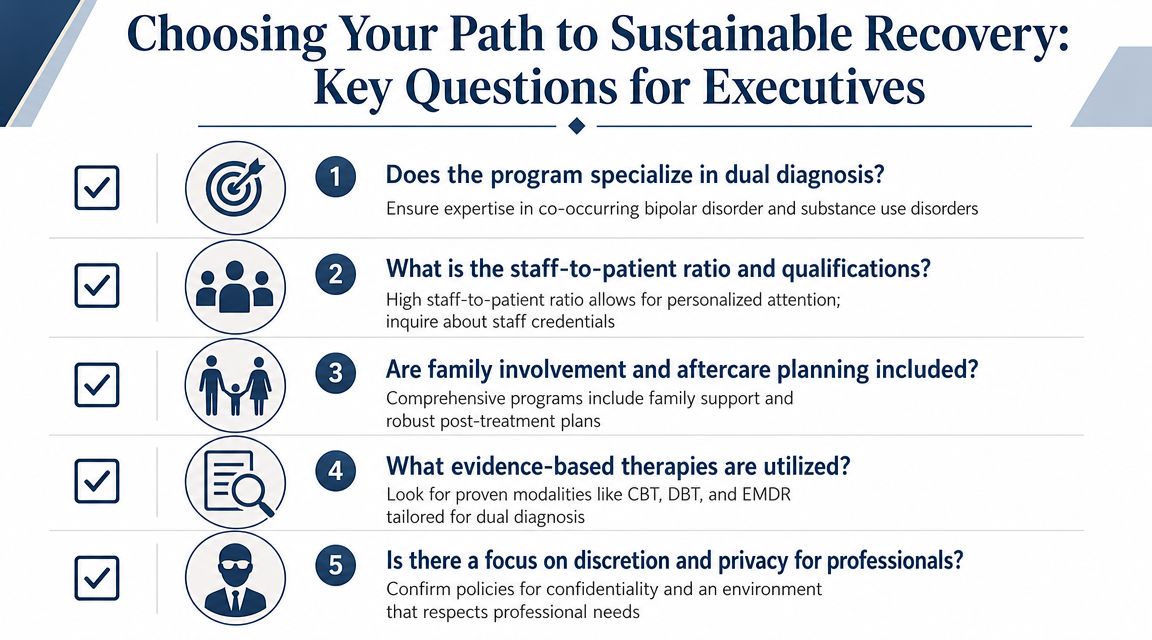
A strong checklist includes:
- Does the program specialize in dual diagnosis? A center should be able to explain exactly how it treats bipolar disorder and substance use together.
- Who is on the clinical team? Ask about psychiatrists, psychologists, licensed therapists, addiction counselors, and how they coordinate care.
- What does detox look like if it's needed? Withdrawal management should be clinically supervised and connected to ongoing psychiatric care.
- Are private rooms available? For executives and other high-profile clients, privacy can directly affect willingness to engage.
- What is the policy on electronics? Programs should explain whether phones and laptops are allowed, when they're allowed, and how work access is balanced with treatment.
- How are family and aftercare handled? Recovery becomes more durable when discharge planning, continuing care, and family involvement are built in from the start.
Signs of a thoughtful program
The best answers are usually concrete rather than glossy. A well-run program can describe how medication decisions are made, how therapists communicate with psychiatry, how relapse prevention is personalized, and how work obligations are managed without letting the job sabotage treatment.
A weaker program tends to stay vague. It may promise individualized care without explaining what that means in practice.
A confidential assessment is often the clearest next step. It allows the clinical picture, substance pattern, and work realities to be evaluated together before decisions are made.
Seeking treatment for a dual diagnosis is a disciplined move. It protects health, judgment, family life, and professional longevity. For a high-performing adult whose success has started to depend on unstable coping, timely treatment isn't a retreat from responsibility. It's a direct expression of it.
For professionals who need discreet, executive-level dual-diagnosis care, Reflections offers confidential assessment and residential treatment in a private setting, including private rooms, coordinated psychiatric and addiction care, and appropriate access to electronics so clients can stay connected to essential work responsibilities while addressing bipolar disorder and substance use safely.
Authored using Outrank app