

A chief executive can spend the morning approving a major decision, the afternoon concealing a panic attack, and the evening using alcohol, stimulants, or another substance to force the nervous system into a more manageable state. From the outside, performance may remain intact. Clinically, however, the pattern can involve anxiety, depression, trauma, emotional volatility, insomnia, and substance use that reinforce one another.
For professionals in this position, choosing between DBT, CBT, and ACT isn't a matter of selecting the most fashionable acronym. Each modality addresses a different maintenance pattern. CBT targets inaccurate or rigid beliefs, DBT addresses emotional reactivity and high-risk behavior, and ACT works with experiential avoidance and values-based action. A discreet residential program for executives should be able to determine which mechanism is dominant, then adjust treatment without disrupting the client's dignity, privacy, or appropriate career responsibilities.
Navigating Therapy Options for Executive Recovery
A senior partner, founder, physician, or C-suite leader may arrive for treatment after years of compensating successfully. The person may have a polished public identity, a demanding calendar, and a private pattern of using substances to manage pressure. A diagnosis of depression, trauma-related symptoms, anxiety, bipolar symptoms, or borderline traits can remain hidden until the coping strategy begins to affect judgment, relationships, health, or safety.
A clinical team shouldn't treat that presentation as a simple choice between three equivalent therapies. The relevant question is what keeps the problem going. If a leader interprets every setback as proof of failure, CBT may offer the clearest starting point. If conflict rapidly produces rage, impulsivity, self-harm urges, or substance cravings, DBT may be essential. If the client understands the consequences but remains trapped in efforts to suppress anxiety, grief, shame, or intrusive thoughts, ACT may help restore movement toward meaningful goals.

A clinical illustration
Consider an executive who repeatedly drinks after difficult board meetings. CBT may examine the belief that one imperfect presentation will destroy professional credibility. DBT may address the surge of anger, shame, and physiological activation that occurs after criticism. ACT may help the client stop organizing the evening around escaping those internal experiences and instead take a values-consistent action, such as repairing a relationship or following a recovery plan.
These approaches can overlap, but overlap doesn't make them interchangeable. A luxury residential setting should offer individualized psychotherapy, structured groups, skills practice, psychiatric oversight, and appropriate medical support so the treatment team can use the right tool at the right stage.
Practical rule: The modality should follow the dominant clinical mechanism, not the client's professional status, diagnostic label, or preference for a particular acronym.
DBT has a particularly important place in high-risk care. Marsha Linehan developed it in the 1980s to treat chronically suicidal patients, especially women diagnosed with borderline personality disorder. Its first randomized controlled trial, published in 1991, found reductions in the frequency and medical severity of self-harm, along with improved treatment retention compared with usual community care. Later research expanded DBT's study base, moving it from an experimental treatment toward a widely studied approach for high-risk populations. Those historical details are summarized in the clinical overview of DBT's development.
A high-end program also has to respect the reality that some professionals can't disappear from every work obligation without creating additional stress. Appropriate access to a phone or laptop can support continuity while treatment remains clinically structured, confidential, and focused. The purpose isn't to let work replace recovery. It's to remove an unnecessary false choice between receiving care and protecting essential responsibilities.
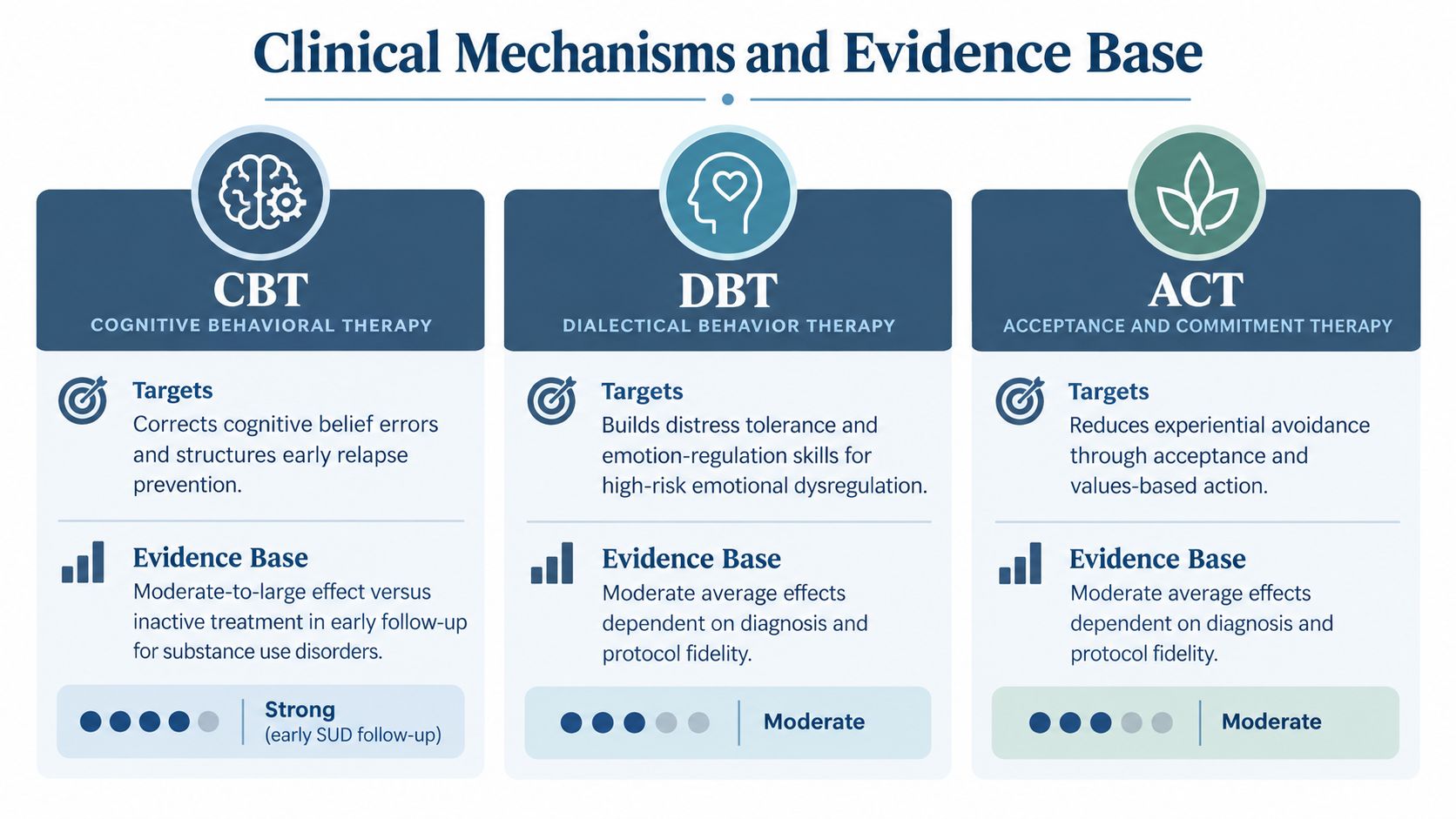
Clinical Mechanisms and Evidence Base
For an executive managing substance use, anxiety, and demanding career obligations, the key question is what happens immediately before the harmful behavior. One client may drink after catastrophic thinking about a deal or performance review. Another may use substances to escape emotional flooding after conflict. A third may understand the risks clearly yet avoid difficult feelings until use becomes the quickest form of relief. Therapy selection becomes more precise when clinicians match the intervention to that maintaining mechanism.
CBT and the relapse cycle
CBT examines how thoughts, emotions, physical sensations, and behavior reinforce one another. In substance use treatment, a clinician can map the sequence from a trigger to an automatic interpretation, escalating distress, craving, use, and consequences that intensify shame or hopelessness. Treatment may then test belief errors, identify high-risk situations, rehearse alternative responses, and build a relapse-prevention plan that can function during travel, meetings, and other work pressures.
CBT has one of the clearest evidence bases for substance use disorders. A systematic review found a small effect versus active treatment at early follow-up, reported as γ=0.15 with a 95% confidence interval of 0.06–0.24, and a moderate-to-large effect versus inactive or minimal treatment, reported as γ=0.63 with a 95% confidence interval of 0.57–0.69. The benefit was strongest during early follow-up and diminished later, supporting deliberate step-down planning after residential care. The findings are detailed in the systematic review of CBT, ACT, and DBT for substance use. For a practical account of CBT for addiction and relapse prevention, clinicians can also review how the approach structures early recovery.
DBT and emotional reactivity
DBT is better suited when the central problem is the speed and intensity of emotional activation rather than a distorted belief. It combines acceptance with change and teaches distress tolerance, emotion regulation, mindfulness, and interpersonal effectiveness. An executive who becomes impulsive after criticism may use these skills to create a pause before substance use, an aggressive message, or a damaging professional decision.
DBT does not require difficult emotions to disappear. It helps the client identify the emotion, tolerate immediate distress, and choose behavior that protects longer-term goals. That distinction matters for high-achieving professionals who understand the rational consequences of substance use but cannot access that reasoning during a crisis. DBT's development from high-risk clinical work into a widely studied approach is summarized in the clinical overview of DBT's development.
ACT and experiential avoidance
ACT changes the client's relationship with thoughts, memories, sensations, and feelings rather than focusing only on whether a thought is accurate. Acceptance, cognitive defusion, present-moment awareness, values clarification, and committed action help the client make room for discomfort without letting it dictate behavior. This can be particularly relevant when career performance depends on avoiding shame, grief, trauma memories, or anxiety until those experiences become harder to manage.
ACT's research history spans roughly five decades. A historical review examined approximately 1,000 randomized controlled trials on ACT-based interventions from 1986 through 2022, documenting development across countries and clinical settings. That history is described in the review of ACT's research history.
A meta-analysis reported ACT at d=0.68, with a 95% confidence interval of 0.42–0.94, across 13 randomized controlled trials, and DBT at d=0.58, with a 95% confidence interval of 0.38–0.77, across 13 randomized controlled trials. The overall third-wave effect size was d=0.56, with a 95% confidence interval of 0.33–0.79. Substantial heterogeneity means results depend on diagnosis, protocol fidelity, and whether treatment targets avoidance, emotional dysregulation, or comorbid personality pathology. Those figures and qualifications appear in the meta-analysis of third-wave therapies for substance use.
The most defensible plan may use CBT to organize relapse prevention, DBT to manage crises, and ACT to reconnect recovery with the client's values.
A client may request ACT because acceptance sounds less confrontational, or DBT because skills sound practical, while the immediate need is structured cognitive and behavioral relapse prevention. Preference informs engagement. Safety, diagnosis, risk, and treatment fidelity determine the clinical plan.
Comparing Therapeutic Targets and Indications
An executive may appear composed in meetings yet move from criticism, panic, or shame to substance use within hours. The treatment decision should begin with the mechanism immediately preceding that behavior. The matrix below provides a clinical starting point, while individualized assessment determines the final emphasis.
| Modality | Primary Clinical Target | SUD Evidence Strength | Ideal Patient Profile |
|---|---|---|---|
| CBT | Cognitive belief errors, behavioral reinforcement, triggers, and relapse patterns | Strongest early SUD evidence, including a moderate-to-large effect versus inactive or minimal treatment in early follow-up | A client with anxiety, depression, rigid thinking, cue-driven use, or a need for structured relapse prevention |
| DBT | Emotional reactivity, distress intolerance, impulsivity, interpersonal instability, and high-risk behavior | Moderate average effects, with outcomes dependent on diagnosis and protocol fidelity | A client with severe emotional dysregulation, borderline traits, self-harm risk, crisis-driven use, or recurrent relationship conflict |
| ACT | Experiential avoidance, fusion with thoughts, disconnection from values, and inflexible coping | Moderate average effects, with meaningful variation across diagnoses and protocols | A client who understands the problem but keeps avoiding anxiety, grief, trauma memories, shame, or other internal experiences |
Matching therapy to the presenting pattern
CBT usually provides the clearest foundation when distorted predictions and learned behavioral loops maintain substance use. A senior professional might believe, “If a colleague sees weakness, the entire organization will lose confidence.” Therapy can examine the evidence for that prediction, develop a more accurate appraisal, and test a different response. CBT also suits clients who value measurable assignments, structured review, and direct problem-solving while continuing to meet demanding career obligations.
DBT carries greater weight when emotional intensity rapidly changes behavior. A client may understand that drinking threatens a career and still reach for alcohol after humiliation, perceived abandonment, or conflict. Skills training addresses the interval in which reasoning becomes difficult to access. Individual work then examines the sequence, identifies points for intervention, and builds more stable responses to interpersonal and professional pressure.
ACT addresses a different form of impairment. A client may spend substantial energy trying not to feel grief, panic, shame, or trauma-related fear, gradually narrowing professional and personal life. ACT does not require the clinician to debate every thought. It teaches the client to notice thoughts, make room for difficult feelings, and choose actions aligned with health, family, leadership, or integrity.
A concise comparison of the mechanisms is available in the evidence-based framework for CBT, DBT, and ACT. CBT corrects belief errors, DBT develops emotion-regulation and distress-tolerance skills, and ACT reduces experiential avoidance through acceptance and values-based action.
Conditions that change the decision
Trauma, anxiety, depression, substance use, and borderline traits often overlap. A client with trauma may need stabilization and distress-tolerance work before intensive trauma processing. Severe anxiety may call for structured exposure or cognitive work, while ACT can address the avoidance that blocks participation. A client with borderline traits may need DBT's behavioral hierarchy and crisis skills alongside CBT for substance-related beliefs, rather than one approach replacing the other.
Clinical distinction: A diagnosis describes the case. The maintenance mechanism tells the team where to intervene first.
The strongest residential programs do not place every client through an identical sequence. They use assessment, observation, risk monitoring, and treatment response to decide whether CBT, DBT, ACT, or a blended plan should lead. For a high-functioning executive with dual diagnoses, that choice must also account for safety, confidentiality, cognitive capacity, and the practical demands of maintaining leadership responsibilities during recovery.
Integrating Modalities into Residential Schedules
A residential schedule for executives should provide structure without treating adults as incapable of making responsible decisions. The environment needs enough clinical intensity to interrupt substance use and psychiatric instability, while the daily plan should preserve privacy, focused work periods, rest, and preparation for life after discharge.

A practical treatment rhythm
A clinically coherent schedule may include the following elements:
Individual formulation. The therapist identifies the client's triggers, beliefs, emotional sequences, avoidance patterns, psychiatric symptoms, medication needs, and professional pressures. This formulation determines whether CBT, DBT, ACT, or an integrated approach carries the greatest weight.
Focused individual therapy. CBT sessions may address distorted predictions and relapse planning. DBT work may rehearse distress-tolerance and interpersonal skills. ACT sessions may clarify values and translate them into actions that remain possible even when discomfort is present.
Intensive groups. Groups allow clients to practice skills rather than merely discuss them. A professional can rehearse a response to criticism, identify the thought preceding a craving, or practice staying present during an uncomfortable internal experience.
Protected professional access. Appropriate use of cell phones and laptops can allow a resident to handle essential responsibilities, maintain selected relationships, and prepare for a realistic return to work. Luxury and executive-focused residential care is commonly positioned around continuity and privacy, and clinical discussions note that access to a laptop or phone can support ongoing responsibilities during treatment. This principle is discussed in the clinical perspective on therapy for executives.
Recovery rehearsal. The team tests how the client will respond to travel, board pressure, family conflict, fatigue, access to substances, and professional uncertainty. The point isn't to recreate every stressor in treatment. It's to develop a plan that can survive contact with ordinary executive life.
Why luxury matters clinically
An upscale setting can reduce avoidable distractions, but amenities alone don't produce recovery. The relevant benefit comes from combining privacy, comfort, clinical availability, and a schedule designed around the client's actual responsibilities. Private space can also make it easier for a professional to rest, complete therapeutic assignments, participate fully in care, and avoid the exposure that may feel threatening during early stabilization.
A residential program that includes DBT therapy for addiction should clarify whether it offers full DBT, DBT-informed skills, or selected DBT techniques. That distinction matters because a client with severe emotional dysregulation may need a more coordinated structure than a program that uses the acronym only as a marketing label.
The schedule should also change as the client stabilizes. Early care may emphasize medical monitoring, psychiatric evaluation, safety, and immediate coping. Later work can shift toward values, relationships, leadership decisions, family repair, and continuing care. Career continuity should support that progression, not prevent it.
The Role of Accredited Multidisciplinary Teams
Advanced modalities depend on the clinicians delivering them. CBT worksheets, DBT skills, and ACT exercises cannot compensate for an incomplete assessment, poor coordination, weak risk management, or limited understanding of how addiction interacts with psychiatric symptoms.
Expertise across disciplines
A strong dual-diagnosis team may include psychiatrists, PhD-level psychologists, licensed therapists, certified addiction counselors, nurses, and adjunctive clinicians. Psychiatry evaluates medication and withdrawal needs. Psychology develops a detailed formulation. Addiction specialists identify reinforcement patterns and barriers to recovery. Licensed therapists deliver psychotherapy and coordinate family or relational work.
Accredited addiction programs emphasize licensed professionals across disciplines, including addiction psychologists and licensed alcohol and drug counselors or professional clinical counselors. Reputable centers are also commonly associated with accreditation by The Joint Commission or CARF, alongside appropriately licensed clinical staff. The relevant service and staffing considerations are outlined in Mayo Clinic's overview of addiction services.
Accreditation provides a quality marker for families, attorneys, physicians, and referral professionals to investigate. It does not replace due diligence. The team should explain who conducts assessments, who manages medication, how suicide risk is addressed, how clinicians communicate, and how treatment changes when the client's presentation changes.
For executives with dual diagnoses, coordination is particularly important. Cognitive distortions may require structured cognitive work, emotional reactivity may call for DBT skills and psychiatric oversight, and avoidance may respond better to ACT-based exposure and values work. The team must match the intervention to the mechanism rather than apply every modality uniformly.
Measurement that supports clinical judgment
Executive clients often value data, but measurement should inform clinical reasoning rather than replace it. A team may track cravings, sleep, mood, urges, medication response, emotional activation, and participation in treatment. Clinicians then interpret those observations within the client's history, functioning, and current risk.
Some clients may also want broader information about health and performance. With clinical appropriateness and informed consent, Telomyx health and performance testing can support discussion of physiological and performance-related factors alongside formal psychiatric and addiction assessment. Such testing should complement, not supersede, the clinical formulation.
Quality test: A sophisticated program can explain which therapies it offers and why a particular clinician selected one intervention over another for a particular client.
Discretion also requires operational discipline. Staff should understand privacy expectations, communication boundaries, professional visibility, and the pressures accompanying a public role. Individualized care should never mean preferential clinical standards or an unstructured treatment plan.
Selecting the Right Environment for High Achievers
An executive may arrive for treatment still answering messages, managing staff, and protecting a public reputation. The right setting creates enough privacy and structure to examine what substance use has been doing in the background, whether it has been dampening emotional reactivity, avoiding difficult decisions, or compensating for distorted beliefs about performance. Comfort matters when it supports that clinical work.
Private rooms deserve a specific review. Private-room lodging is a documented differentiator in some rehabilitation settings, and accommodations may change by level of care. Room arrangements can differ between detoxification and residential treatment, so families and referral professionals should ask whether private space remains available across the full continuum rather than assume one phase guarantees the next. The distinction is discussed in the overview of private rooms in rehabilitation settings.

A decision framework for private-pay care
A private-pay program should be judged by its clinical operating model, not by décor. Prospective clients and families can ask:
- Private-room continuity: Are private rooms available during both detox and residential treatment, and how does the program protect privacy?
- Clinical credentials: Which clinicians are licensed, which disciplines are represented, and who holds responsibility for the treatment plan?
- Therapy fidelity: Does the program provide structured CBT, DBT, and ACT, with defined methods, or only use the modality names?
- Dual-diagnosis capability: Can the team address substance use and psychiatric symptoms together rather than send one concern elsewhere?
- Professional boundaries: How are phones, laptops, work obligations, visitors, and confidential communications handled?
- Accreditation: Does the facility maintain recognized quality credentials and explain what those credentials require?
The answers should clarify whether treatment can match the client's primary mechanism. Cognitive distortions may call for CBT work, emotional reactivity may require DBT skills, and avoidance may respond to ACT-based exposure and values work. For an executive managing a dual diagnosis while maintaining career obligations, the environment must support that match without allowing work demands to dictate every clinical decision.
Amenities should serve recovery
A private room, attractive surroundings, fitness access, nutritious meals, and quiet work areas may improve rest and participation. They do not replace medication management, psychiatric care, individual therapy, group treatment, family involvement, or continuing care. Their value lies in reducing practical friction so the client can engage with those services.
Privacy may also make it easier to discuss shame, impaired judgment, family conflict, financial risk, or suicidal thoughts without immediate professional exposure. That benefit is clinical, not merely cosmetic.
The selection process should examine how the setting, schedule, staffing, clinical modalities, electronics policy, private rooms, and discharge planning fit together. A beautiful room without clinical depth is insufficient. A clinically capable program that disregards privacy and professional realities may also lose the engagement of the high-achieving client it is intended to treat.
When to Combine Approaches for Complex Cases
An executive may understand that substance use is damaging performance yet still return to it after a board conflict, sleepless night, or private crisis. That pattern does not indicate that one therapy has failed. It may show that treatment is targeting the wrong mechanism. CBT addresses distorted beliefs and prediction errors, DBT manages emotional reactivity and impulsive behavior, while ACT addresses avoidance of uncertainty, grief, vulnerability, or values-based action.
Dual-diagnosis treatment should therefore be sequenced around risk, readiness, and the next clinical obstacle. Suicidal thinking, severe intoxication, withdrawal risk, or rapidly escalating behavior requires safety and stabilization before sustained cognitive examination or values-based exposure. DBT skills may provide enough behavioral control to begin deeper work. CBT can then organize relapse prevention and challenge beliefs such as, “Substance use is the only way I can remain effective.” ACT may help the client stop arranging professional and personal life around avoidance.
Where ACT requires caution
ACT can reduce experiential avoidance and may reduce suicidal ideation in some settings. A 2025 review concluded that current evidence remains insufficient to recommend ACT as a stand-alone suicide intervention. That limitation matters when clinicians and families are considering acceptance and commitment therapy for addiction. ACT belongs within a safety-led plan that includes dedicated suicide-risk assessment, appropriate psychiatric care, crisis planning, and interventions matched to the client's risk profile. The evidence and limitation are discussed in the review of ACT and suicide-related outcomes.
A blended plan in practice
A high-functioning client might begin with CBT when catastrophic thinking, perfectionism, or work-related triggers organize the substance-use cycle. DBT can be added when emotional intensity repeatedly defeats the cognitive plan, particularly after conflict, criticism, or perceived professional failure. ACT may take a larger role when abstinence improves but the client continues avoiding difficult conversations, grief, uncertainty, health needs, or close relationships.
The right question isn't which therapy wins. It's which intervention addresses the next obstacle to safe, durable recovery.
Treatment teams should review the client's response rather than defend a preferred modality. If the client can explain cognitive restructuring but relapses during emotional flooding, the plan needs more DBT practice and closer attention to triggers. If skills improve while the client remains absent from life outside treatment, ACT may support committed action. If acceptance language becomes permission to tolerate unsafe behavior without changing it, clinicians must restore behavioral accountability, monitoring, and risk management.
For executives, the schedule must allow this adjustment without letting work obligations control every clinical decision. Privacy and professional continuity can support honest discussion of impairment, family conflict, financial risk, and suicidal thoughts, while clinical depth allows the team to change direction. Reflections provides private dual-diagnosis residential care with CBT, DBT, and ACT integrated into individualized treatment, supported by multidisciplinary clinical care. Executives, families, and referral professionals can discuss clinical fit, privacy expectations, work access, and the next appropriate step directly with the program.