

At 11:47 p.m., the room is finally quiet, but the executive's mind isn't. The board call is over, the team has gone home, and the version of events that can be spoken aloud is only a fraction of what happened. That's the moment support groups for executives stop sounding like a wellness trend and start looking like infrastructure.
A serious executive has a narrow problem set. The role demands judgment under pressure, visible confidence, and near-total discretion, while the downside of a bad disclosure can be personal, legal, or reputational. That's why the best groups aren't social clubs. They're controlled environments for candid thinking, and for some leaders, they become the bridge between high-functioning performance and private collapse.
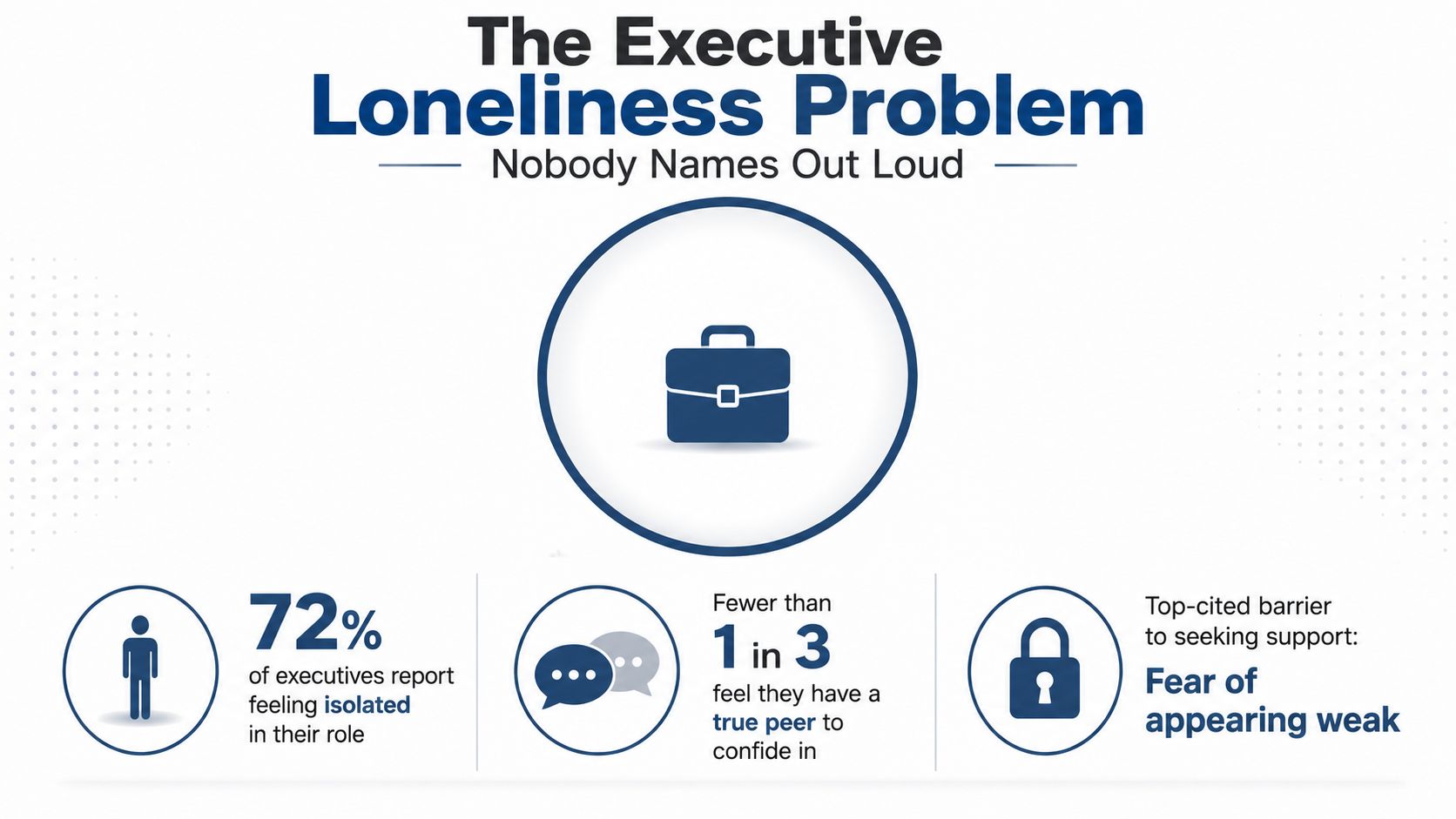
The Executive Loneliness Problem Nobody Names Out Loud
The corner office can be a very small room. A founder can have a full calendar, a compensation package that looks enviable on paper, and a team that depends on every word, yet still have nobody safe to call after a difficult board meeting. Staff want direction. Family wants presence. Peers often want a polished version of events. None of those relationships are built for the raw version of executive strain.
That strain shows up in familiar ways. In a 2024 survey cited by LGT, 55% of CEOs reported mental health issues such as anxiety, depression, and burnout, up from the previous year, and Korn Ferry reported that 71% of U.S. CEOs experience imposter syndrome (CEOWORLD summary of the Korn Ferry survey). Those numbers do not describe weakness. They describe what happens when decision pressure, public visibility, and isolation compound over time.
Why ordinary support falls short
A spouse can care and still not be an appropriate debriefing partner for a merger, a crisis, or a relapse scare. A therapist can help with insight and stabilization, but many executives need something else too, a place where the business stakes are understood immediately and the room is built for candid disclosure. That's the job of a peer forum.
Practical rule: if the executive cannot say the real problem without filtering every sentence for optics, the support system is too loose.
This is also where executive logistics matter. A leader who is constantly traveling, rotating between meetings, and trying to keep work moving may need protected time and private space just to stay regulated. For those days when the schedule is already punishing, some executives even look for find private jet charter for executives because the core issue is not status, it's preserving bandwidth and reducing exposure while high-stakes decisions are still happening.
What an Executive Support Group Actually Is
An executive support group is not a mastermind, not a networking dinner, and not group therapy with better suits. It is a confidential, vetted, stage-matched peer forum for senior leaders who need honest feedback from people facing similar stakes. The value comes from the structure, not the brand language.
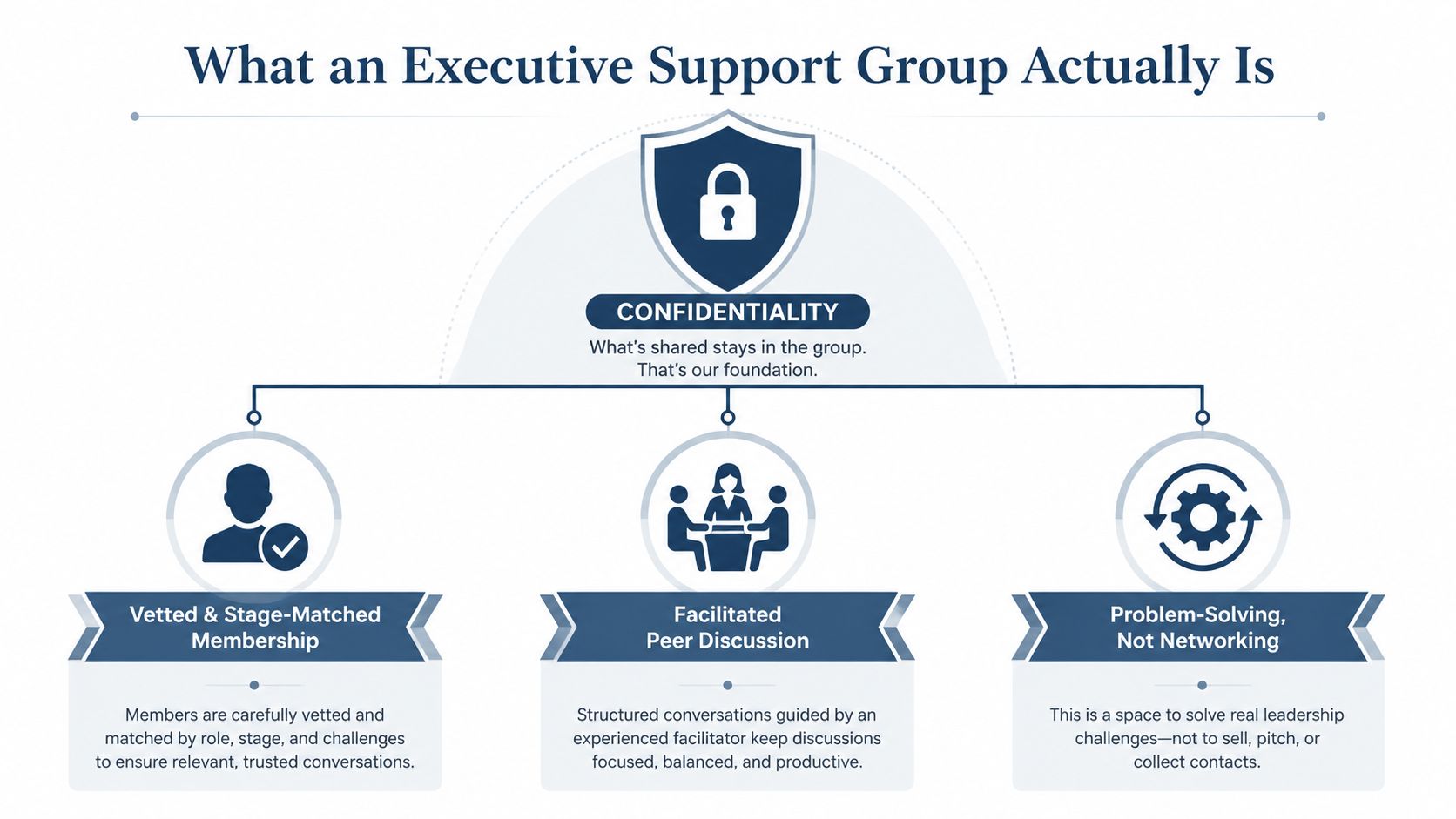
The four ingredients that separate a real group from a fake one
First, there has to be peer equivalence. A CEO, president, or senior executive will not disclose the same way in front of a room that includes junior operators, aspirants, or people looking for contacts.
Second, there must be confidentiality enforcement. Public descriptions of executive groups often mention sharing and mentorship, but the operational question is whether the group has written privacy rules, clear membership screening, and a real process for handling breaches. Without that, the room is just a liability with chairs.
Third, the group needs a structured cadence. Elite forums commonly use scheduled, recurring meetings, including monthly full-day formats in some long-running chapters, because repetition creates trust and accountability. Loose, irregular gatherings do not build enough shared context to matter.
Fourth, it needs skilled facilitation. A strong facilitator keeps the conversation from drifting into self-promotion, groupthink, or half-formed advice. In the best rooms, the point is not to perform competence. It is to surface better decisions.
Confidentiality is not a nice feature. It is the enabling condition for honesty.
Where recovery changes the design
For executives in recovery or dual-diagnosis treatment, the format tightens further. The group should not only protect privacy, it should also support medication stability, prevent disclosure that creates workplace fallout, and stay coordinated with the clinical team. That is a different animal from a casual peer circle, and it should be treated that way.
The Evidence Behind Executive Peer Groups
A senior leader under pressure does not need a pep talk. They need proof that a disciplined peer room changes how decisions get made. The cleanest business signal still comes from the Vistage comparison using Dun & Bradstreet data. In 2020, Vistage CEO members grew annual revenue by an average of 4.6%, while non-member businesses saw revenue decline by 4.7% (Vistage peer advisory groups). That does not prove a cure-all. It does support a practical conclusion, structured peer advisory can align with better performance when conditions get ugly.
What that result means
The point is not that every executive group lifts revenue. The point is that a disciplined peer system can improve the quality of decisions when leaders are under stress. Vistage describes these groups as peer advisory groups for CEOs and executives that provide candid feedback, accountability, and outside perspective, which is exactly why the format matters more than the branding.
The academic description is even narrower. Executive peer advisory groups are defined as exclusive organizations for CEOs and presidents that help them problem-solve business challenges, discuss strategy, share best practices, and address growth and performance issues (dissertation on executive peer advisory groups). That matters because the group is not generic support. It is a decision environment.
Why measurement belongs in the room
The strongest groups use data, not just empathy. Leadership research notes that executives commonly use 360-degree reviews, structured interviews, psychometrics, and simulations to improve leadership processes (Heidrick data-driven leadership PDF). That logic applies directly to peer groups. If the same problem keeps showing up, the group should measure it, not just discuss it.
A good executive group creates a feedback loop, not just emotional relief.
For dual-diagnosis clients, that distinction is decisive. A group can help normalize treatment adherence, reduce secrecy, and strengthen accountability. It can also backfire if the room is loose, the facilitator is weak, or disclosures outrun clinical readiness. In a high-end residential setting, the safer model is a cohort that tracks patterns over time, uses explicit challenge roles, and treats confidentiality as part of the treatment plan rather than an afterthought.
That same standard applies to referral decisions. A family, clinician, or attorney who is weighing residential treatment alongside peer support should read a practical inpatient vs outpatient rehab guide before assuming an executive can keep working at full speed. When the stakes include privacy, medication stability, and workplace fallout, the room has to fit the clinical picture.
A separate filter matters for executives who want high-trust contact without exposing their circle. The right C-suite networking guide should point toward vetted rooms, not social events dressed up as support. If the group cannot screen members, enforce confidentiality, and keep the conversation tied to real decisions, it is a dinner with a sign-in sheet.
| Group / Model | Founded | Reported Membership | Structural Features |
|---|---|---|---|
| Vistage | 1957 | More than 45,000 members | One-to-one coaching, rigorous vetting, peer advisory structure (Vistage overview) |
| YPO | 1950 | More than 34,000 members | Large, established executive network with formal membership structure |
Comparing the Main Formats Executives Can Join
The right format depends on what has to stay protected. A founder carrying legal exposure does not need the same room as a growth-stage operator who mainly needs perspective. A CEO in residential care needs even tighter filters because the issue is not only performance, it is privacy, compliance, and continuity of treatment.
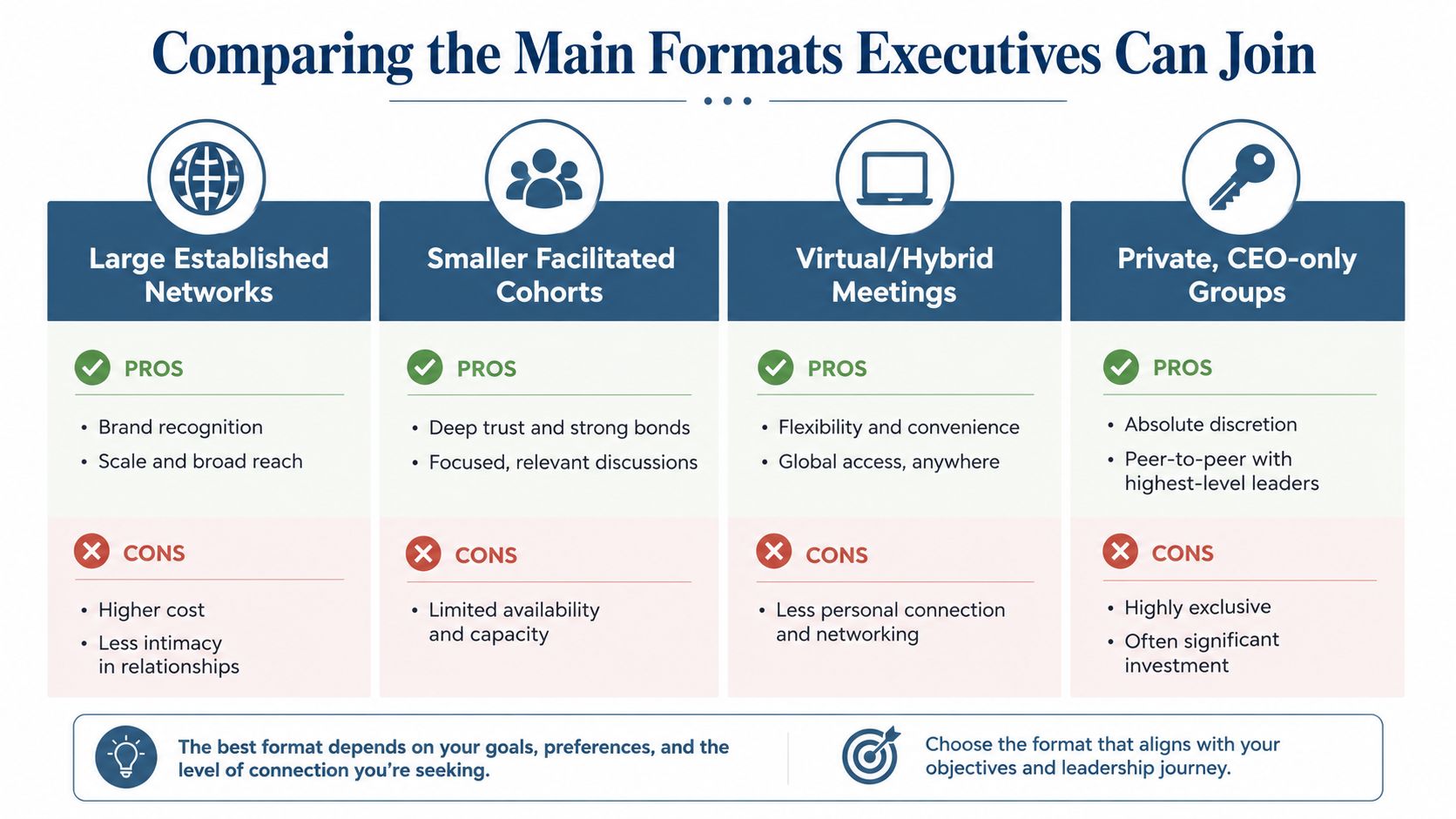
The four formats that show up most often
Large established peer-advisory networks offer brand recognition, vetting, and a broad alumni base. Fortune's 2023 comparison documented one model that required members to be CEOs or high-level executives with at least $5 million in annual sales revenue, charged at least $10,500 per year, and also imposed a $2,500 initiation fee. Another group in the same comparison charged $600 to $900 monthly. Those figures tell the truth quickly. These groups are premium, selective, and not built for casual participation.
Smaller facilitated cohorts are usually more intimate and more useful when the executive needs depth instead of scale. The tradeoff is access. A good cohort can be harder to find, and the room can be too small if the stage matching is sloppy.
Virtual or hybrid meetings are practical for travel-heavy leaders. They reduce friction and can improve attendance, but they usually weaken the sense of room safety unless the facilitator is excellent and the membership is already stable.
Clinically integrated recovery groups belong in a different category altogether. They are designed to sit alongside detox, residential care, or continuing care, not to replace them. For executives, this is often the highest-protection option because the group can be tied to work-readiness, disclosure planning, and relapse prevention.
For a broader clinical decision about levels of care, inpatient vs outpatient rehab is the right companion resource.
Simple filter: if the room cannot explain who else attends, how privacy is protected, and what happens when conflicts arise, it's not ready for a high-stakes executive.
For readers who want a social-entry layer, a curated C-suite networking guide can help separate polished events from real peer environments. The key is still the same. Access is not the goal. Safety is.
Choosing and Vetting a Group Without Leaking Your Life
The first screening call should feel procedural, not persuasive. If the person on the other end gets vague about membership, confidentiality, or who can overhear what, that is already the answer. A serious executive group should be able to explain its rules without improvising.
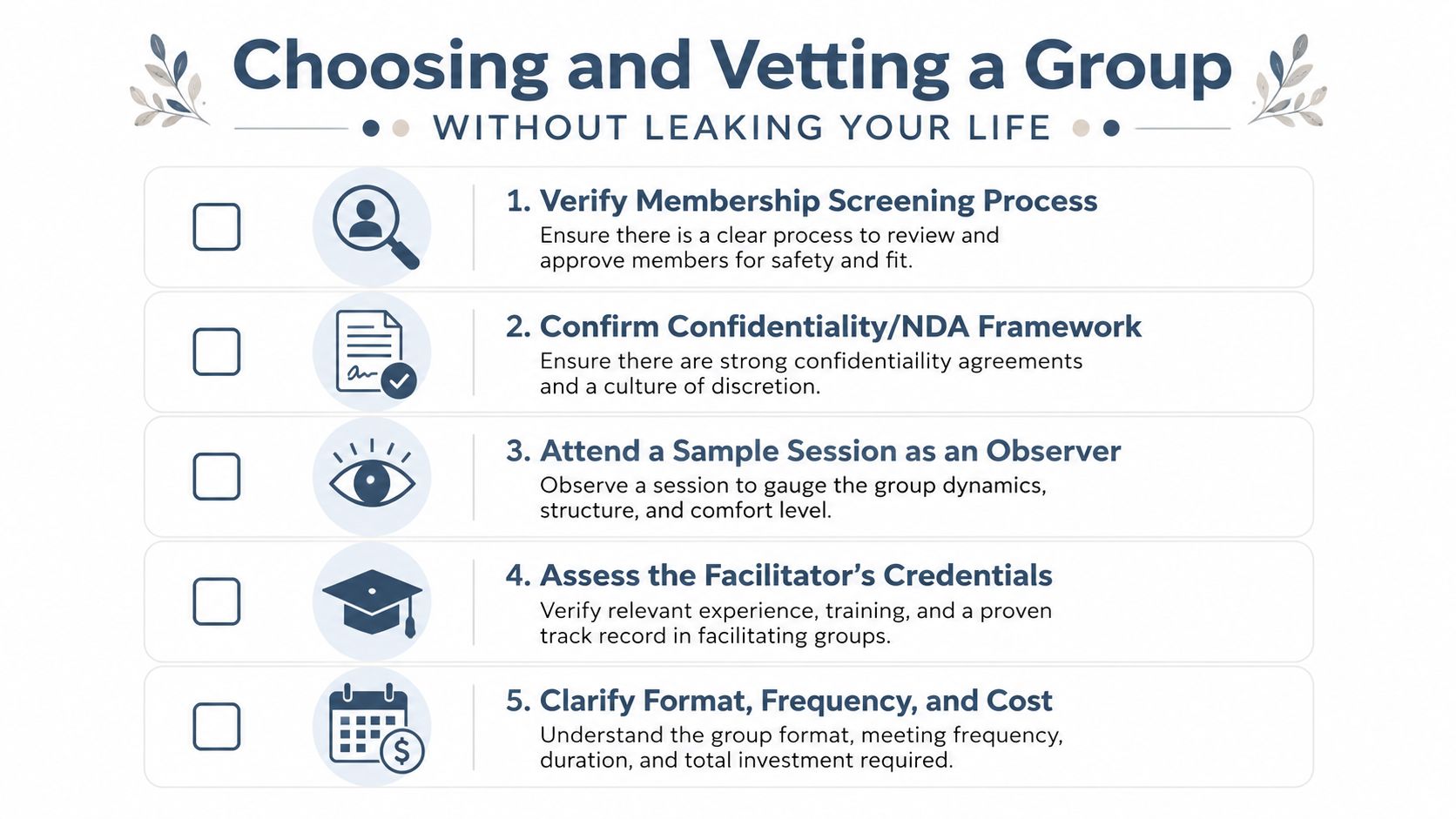
What to verify before any disclosure
The vetting bar should be high enough to make the room feel expensive, private, and worth the risk. Family Business Magazine's coverage of elite CEO forums described monthly full-day meetings and narrow eligibility, including YPO members who were presidents and CEOs under age 44 and had companies with more than 50 full-time employees, while the Executive Committee served 4,000 members from companies with more than $3 million in sales (Family Business Magazine). That level of selectivity is not decorative. It is what protects trust.
A useful due-diligence script is straightforward:
- Ask who is in the room. Membership class matters more than the logo.
- Ask how confidentiality is enforced. Written rules matter. Verbal reassurance does not.
- Ask whether peers can be competitors. If yes, ask how conflicts of interest are handled.
- Ask what happens on exit or expulsion. Loose departure rules often mean loose standards.
- Ask whether the facilitator has authority. If no one can challenge a breach, the policy is theater.
How to behave once admitted
Executives usually destroy trust by oversharing too early or by turning the room into a pitch session. Neither works. The right approach is to disclose the problem, not the entire biography behind it, until the group has earned more access.
A small observation test helps. Share a real but bounded issue in the first meeting, then watch what happens. If people interrupt to perform expertise, if the facilitator lets the room drift, or if the response feels like status-seeking, the group is not safe enough for sensitive material.
For legal and compliance-heavy situations, a separate review of HIPAA compliance can matter when the executive is moving between clinical care and outside obligations.
How Executive Support Groups Complement Luxury Residential Care
A high-end residential program and a strong executive support group should not compete. They should stack. Residential care stabilizes the person. The group protects the return to pressure. When both are designed well, the executive is not choosing between treatment and work. The executive is building a safer bridge back into both.
Why the clinical setting comes first
Luxury residential care matters because it creates the conditions for honest work. Private rooms, a highly accredited clinical team, dual-diagnosis treatment, and the ability to keep electronics for career obligations all reduce the reasons executives delay care. Those details are not perks. They are the infrastructure that makes treatment feasible for a person who cannot vanish from life for months.
An executive support group fits best once the person is medically and psychologically steady enough to use it. In that phase, the group can reinforce relapse prevention, normalize work stress, and help the executive practice disclosure boundaries before returning to a public-facing role. It can also continue after discharge as the durable aftercare layer that keeps the person from drifting back into isolation.
Where the group helps, and where it should pause
The group should intensify when the executive is entering a major transition, returning to work, facing a reputational issue, or needing a place to test decisions before acting. It should pause or tighten when the person is dysregulated, secrecy is rising, or disclosures are becoming operationally risky.
Clinical rule: if the group begins to outpace the treatment plan, the treatment plan wins.
For executives in dual-diagnosis care, that coordination is not optional. The safest model is a confidential cohort that aligns with the residential team, uses controlled disclosure, and keeps work obligations visible without letting them dominate the recovery process. That balance is exactly why residential mental health treatment and elite peer support belong in the same architecture.
A Referral Checklist for Families, Clinicians, and Referring Attorneys
A good referral sounds concrete, not abstract. Ask whether the group has written confidentiality rules, how members are screened, who facilitates, and whether the format fits the executive's current stress level. If the answer is hand-wavy, move on.
For dual-diagnosis clients, ask one more question, whether the group can coordinate with the treatment team without creating unnecessary disclosure. That single point separates a supportive peer container from a risk. Families and attorneys should also ask about continuity, because executives respond best when the recommendation protects time, privacy, and business credibility.
The clean referral note is simple, the executive needs a vetted cohort, clear privacy rules, and a defined trial period. If those pieces are in place, the group is worth serious consideration. If not, it's just another place to be visible.
The Decision Worth Making This Week
Pick one vetted cohort and stop collecting loose options. Run a single confidentiality check, set a 90-day trial, and coordinate with the clinical team if dual diagnosis is part of the picture. Skip open masterminds with no screening, skip groups with no facilitator, and skip any room that cannot answer privacy questions in the first conversation.
For executives also dealing with legal exposure or family business complexity, an AI legal assistant for business owners can help organize questions before counsel is involved, but it still doesn't replace a real confidentiality framework.
Reflections offers the kind of private, clinically managed environment that makes this whole conversation practical for executives who need discretion, structure, and real treatment. If the goal is to protect both recovery and career continuity, visit Reflections and start with a conversation that respects both.