

A senior executive can keep the calendar full, answer messages between meetings, and still feel the quiet strain that comes with using alcohol or another substance to stay functional. The pattern often starts as a private workaround, then becomes a hidden system that affects sleep, judgment, and relationships. CBT for addiction gives that executive a structured way to slow the pattern down, examine it clearly, and replace it with skills that hold up under pressure.
For high-performing professionals, treatment has to respect real obligations. A discreet residential setting with private rooms, electronics access, and a highly accredited clinical team can make recovery feel compatible with career continuity instead of separate from it. A useful starting point for readers who want a plain-language overview is how CBT can help with recovery, which frames the approach in practical terms.
In luxury residential care, the value of CBT is not only that it is evidence-based. It is that it works as a disciplined, skills-forward method for people who need structure, privacy, and a plan they can effectively use once they leave the building. The discussion below walks through how the method works, what the evidence says, how it pairs with other therapies, and what families and referrers should look for in a premium program.
Introduction to CBT and Luxury Wellness
A managing director who has been carrying two time zones, a board presentation, and a family crisis may not look like someone in crisis. Yet that same person may be using substances to decompress, sleep, or get through another demanding day. The danger is that the coping strategy starts to shape the day itself, until the executive feels productive only when the cycle is in motion.
CBT fits this profile because it is practical, not abstract. It teaches people to identify the thought, feeling, and behavior sequence that keeps addiction active, then interrupt that sequence with repeatable skills. In a luxury residential environment, that work can happen without forcing the client to disconnect from work entirely, since discreet access to cell phones and laptops helps preserve essential professional obligations while treatment stays in focus.
Practical rule: If a coping strategy depends on secrecy, exhaustion, or “just getting through today,” it usually deserves closer clinical review.
That matters for executives because recovery has to be both clinically sound and operationally realistic. Private rooms in detox and rehab reduce social friction and support privacy, while an upscale setting can lower the anxiety that often makes high-achieving clients delay care. When treatment feels orderly and confidential, people are more willing to engage fully instead of trying to manage everything at once.
Luxury care also changes the tone of accountability. Rather than relying on vague encouragement, a strong residential program can build a schedule around individual therapy, structured groups, and coordinated continuing care. That combination helps clients stay engaged with family, work, and recovery without pretending those demands disappear.
Understanding CBT Mechanisms in Addiction
CBT for addiction begins with a straightforward premise, thoughts, feelings, and actions reinforce one another. If a person learns to treat stress as something that can only be relieved through substance use, the mind starts to accept that belief as the default response. CBT interrupts that loop by helping the therapist and client examine what happens before use, during craving, and after use, then plan a different response that can be repeated in daily life.
Functional analysis as a clinical map
Functional analysis works like a case map in a detective file. The therapist tracks the triggers before use, the thoughts and emotions that show up, and the consequences that follow, then uses that map to identify where the cycle can be interrupted. A clinical mechanism review explains that this process is central in addiction CBT, and randomized trials show that improvements in coping-skill quality mediate reduced alcohol and drug use when CBT is delivered in structured formats (clinical mechanism review).
For an executive, the chain often looks ordinary on the surface. A tense investor call leads to frustration, a thought appears about needing a quick reset, and by evening the behavior has become automatic. CBT makes that sequence visible, which is often the first real opening for change.
Cognitive restructuring in real life
The second core mechanism is cognitive restructuring, which means challenging the permission-giving thoughts that keep use in place. The therapist helps the client test the thought behind the craving instead of arguing with the feeling itself. That distinction matters, because cravings often gain power when the mind treats them like commands rather than temporary states.
The goal is not to force positive thinking. It is to replace distorted certainty with a more accurate appraisal.
In luxury residential treatment, therapists often use personalized worksheets, live rehearsal, and structured feedback so the client can practice the same skill outside session. That approach is especially useful for high-level professionals, because board meetings, travel, and public obligations do not wait for a perfect emotional window. CBT works best when the skill is practiced until it becomes portable, much like a well-rehearsed protocol that can be used under pressure without losing clarity.
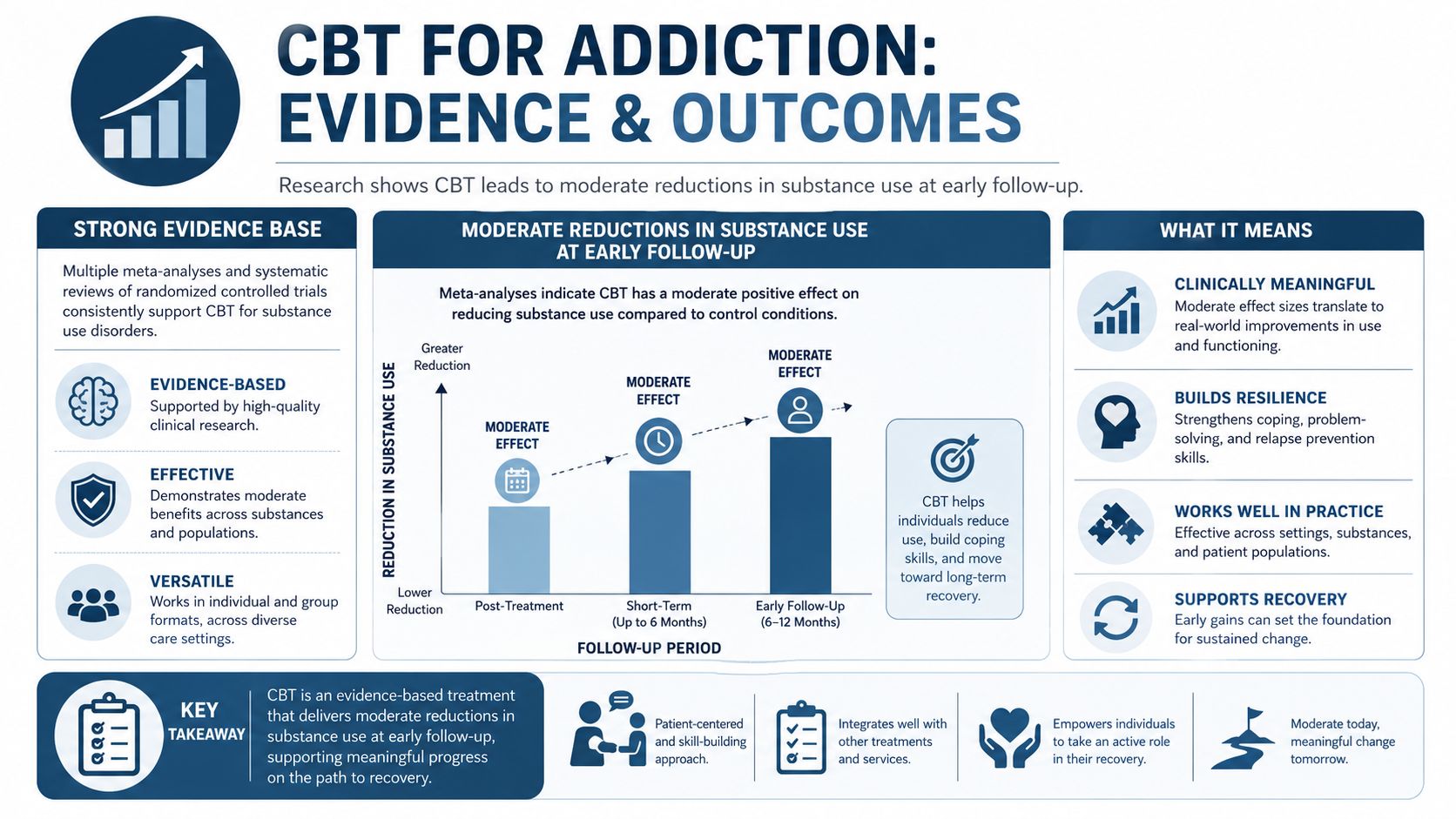
The broader evidence base supports that clinical precision. A meta-analysis of 34 randomized trials involving 2,340 patients found a moderate effect size for CBT in reducing substance use versus usual care, with the strongest benefits at 1 to 6 months after treatment (meta-analysis of CBT for substance use disorders). A later systematic review also found small-to-moderate effects versus inactive care and noted that the benefits were weaker at 8+ months (2023 systematic review). That durability pattern is exactly why continuing care matters.
Reviewing Evidence and Outcomes for CBT
A strong way to read the evidence on CBT is to separate short-term change from lasting change. The therapy is useful, but it does not work like a switch. A University of California-hosted review of a meta-analysis found that CBT for alcohol or other drug use disorders was 15% to 26% better than untreated or minimally treated controls, and another summary reported that 58% of patients receiving CBT fared better than comparison groups, with benefits seen across nicotine, alcohol, stimulants, marijuana, and opioids (UCLA-hosted review of the meta-analysis, overview of CBT for substance use disorders).
Those findings explain why high-end residential programs treat CBT as a main clinical method rather than an optional add-on. The approach works across different substances, and it fits especially well when addiction shows up with anxiety, depression, trauma, or perfectionism, which is often true for executives and other high-responsibility professionals. In that setting, therapy has to respect both recovery and career continuity, because a client may be managing private strain while still needing to show up with clarity in public and professional roles. CBT gives that client a practical structure for steady change.
What the durability data means
The most important point is timing. CBT often shows its strongest impact in the early follow-up window, especially around 1 to 6 months after treatment, and the effect can weaken later (34-trial meta-analysis, 2023 systematic review). For a luxury rehab client, that pattern does not mean the work failed. It means the first stage of recovery needs a deliberate bridge into continuing care, the same way a well-designed residence includes both the stay itself and the transition home.
Clinical takeaway: CBT has the most value when the program plans for what happens after discharge, not only during the stay.
Flexible follow-up matters here. Booster sessions, check-ins, and relapse-prevention planning can be matched to a client's work calendar, travel, and family obligations. A residential program that builds these supports into discharge planning is doing more than extending treatment. It is protecting the gains made during the highest-risk months.
For clients who want a closer look at how this is structured in residential care, the CBT program at Reflections offers a useful example of how therapy can be organized around real-world demands.
Core CBT Techniques and Session Examples
A strong CBT session for addiction usually feels focused and concrete. The therapist is not trying to cover everything in the client's life at once. The work moves from patterns to practices, and each practice has a job.
Five tools that change the relapse sequence
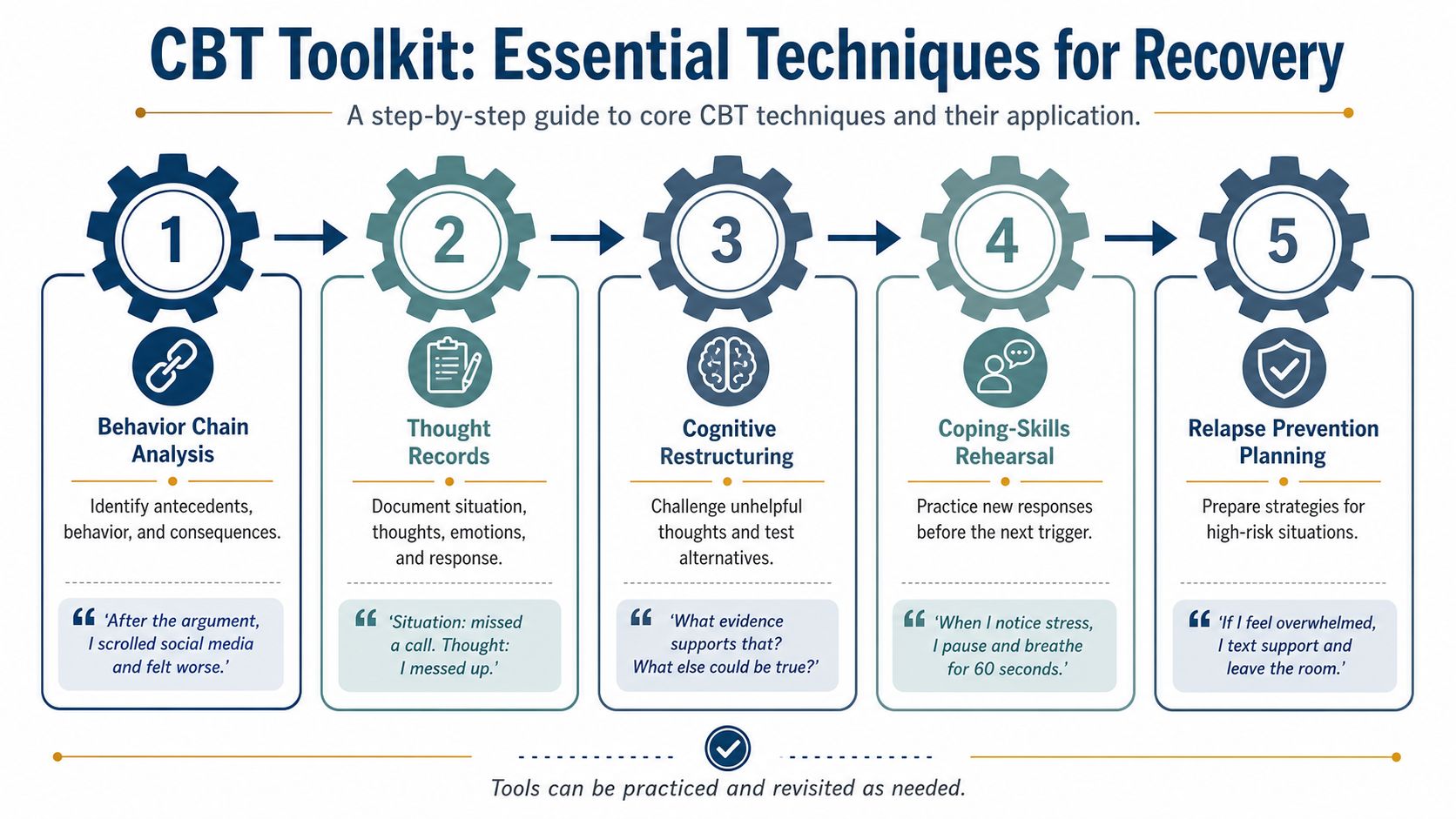
- Behavior chain analysis: Map the event in order, from trigger to urge to use. A client might trace a late-night message, a surge of irritation, and the decision to pour a drink after the last email is sent.
- Thought records: Write down the thought that appeared, the emotion that followed, and the response that was chosen. This helps a client see where the story escalated the craving.
- Cognitive restructuring: Challenge the thought that says, “This is the only way to relax,” and replace it with a more accurate statement, such as, “This feeling will peak and pass if it's handled directly.”
- Coping-skills rehearsal: Practice the response before the high-risk moment arrives, including refusal language, leaving a setting, or a grounding exercise during travel.
- Relapse prevention planning: Build a concrete plan for high-risk situations, warning signs, and rapid recovery after a lapse.
These tools become more effective when they are practiced in the settings where they will be used. That is why an executive in luxury care may rehearse a response before a networking dinner, a flight, or a family event instead of treating recovery as a separate compartment.
A sample executive session
A senior client with anxiety and alcohol use might begin by mapping a common chain, afternoon tension, a belief that relaxation requires a drink, and a habit of staying productive until exhaustion. The therapist then helps the client test the thought behind the urge. If the client says, “If I don't unwind fast, I'll fall behind,” the clinical question becomes whether that belief is true, helpful, or only familiar.
The next step is rehearsal. The client practices a short, usable response for the next high-risk window, perhaps a walk, a phone call, or a five-minute grounding routine before dinner. That is where executive coaching language can fit naturally, because the client is not being asked to become a different person, only to use a better operating system.
A clinically coherent luxury program may also include a brief mindfulness practice, since attention training can help a person notice urges without obeying them. One evidence-based option for program design is CBT at Reflections, where CBT sits within a broader dual-diagnosis model.
Integrating CBT with DBT ACT and Luxury Care
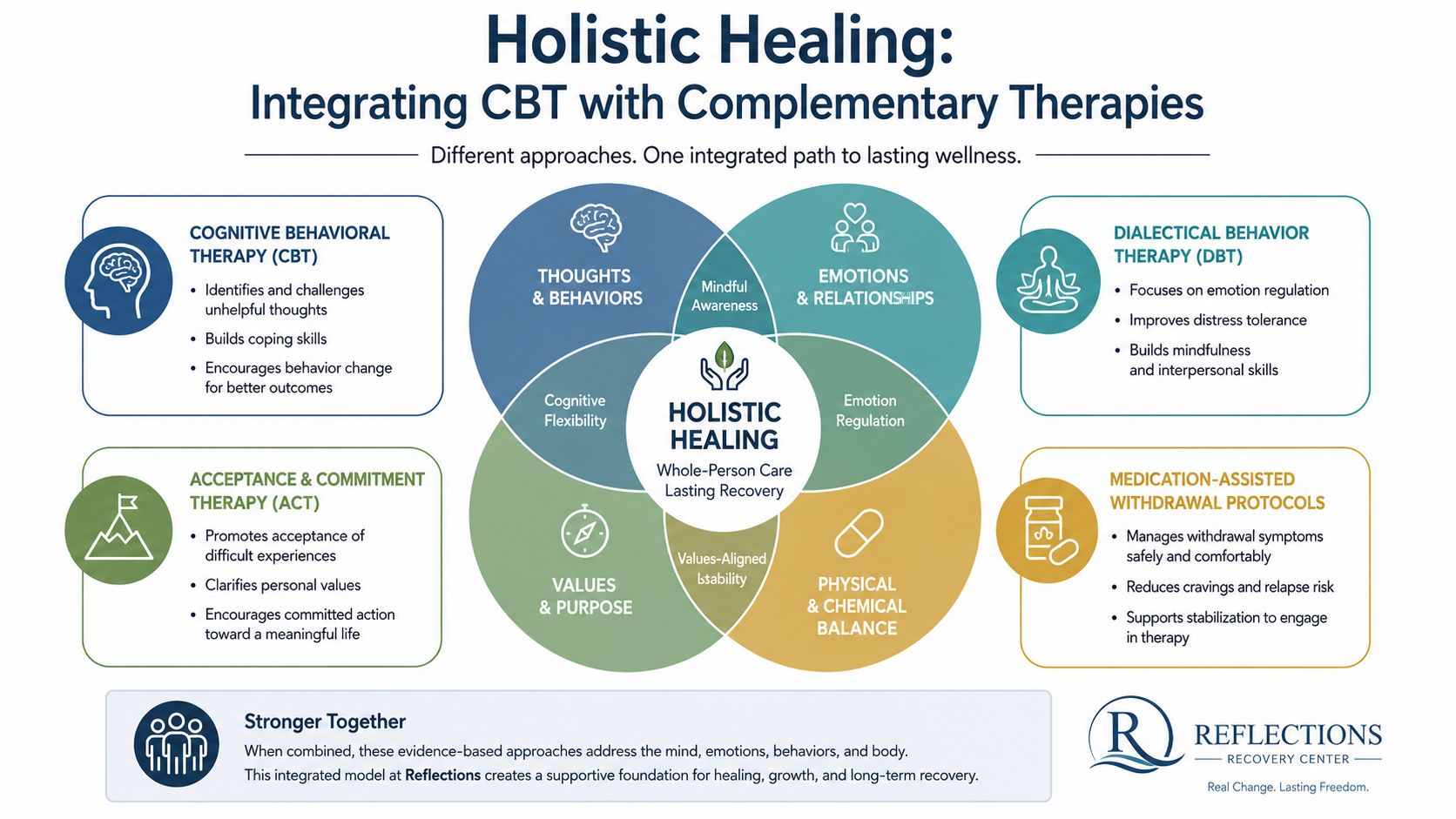
CBT works best inside a treatment system, not as a stand-alone method. For clients whose substance use is tied to emotional overload, DBT adds distress-tolerance and emotion-regulation skills, while ACT helps the client stop fighting every uncomfortable internal state and return to values-based action. Medication-assisted withdrawal protocols can steady the body early in care, which leaves more room for learning once the acute phase has passed.
Sequencing matters in residential care
A luxury residential program can sequence these supports with unusual precision. Medically managed detox in private rooms may come first, then CBT skill-building once the client is stable enough to focus, then DBT groups when emotional reactivity needs deeper regulation, and ACT workshops when values and long-term identity need to be clarified. That structure helps high-profile clients avoid the common trap of being asked to do too much before the nervous system is ready.
The integrated model also supports continuity. Because clients can keep their electronics, they can manage essential work responsibilities in a controlled way, maintain necessary teletherapy connections, and stay in touch with family or professional obligations without losing the clinical container. This is especially useful when treatment needs to preserve discretion and protect career continuity.
Why a multidisciplinary model fits dual diagnosis
Many executives do not present with addiction alone. They bring anxiety, trauma histories, depression, or burnout into treatment, and those issues can drive use just as much as the substance itself. The same evidence base that supports CBT also shows why long-term follow-up matters, and the 2023 systematic review noted that CBT's strongest effects occur within 1 to 6 months post-treatment, which makes booster sessions and continuing care clinically sensible rather than optional.
For that reason, an accredited residential team should be able to coordinate medication, psychotherapy, and family work without creating chaos. Referrals should look for a program that can do that coordination with discretion, because confidentiality is not a luxury feature, it is often the reason a high-profile client finally agrees to enter treatment.
Practical Takeaways for Patients and Families
Recovery gets easier when the daily plan is concrete. For executives, that means the treatment team should translate CBT into routines that survive business travel, long calls, and social obligations. A good residential stay is not just about insight, it is about building habits that can be repeated when life gets busy again.
Practical rule: If a strategy cannot be used on a phone call, in a hotel room, or after a hard conversation, it probably needs simplification.
Telephone-based continuing care and brief counseling have shown higher 24-month abstinence rates than more intensive face-to-face interventions for adults after outpatient treatment (continuing-care review). That makes flexible follow-up especially relevant for professionals who cannot disappear from work for long stretches.
A simple recovery checklist
- Schedule booster contact early: Set up follow-up sessions before discharge so the first high-risk weeks are already covered.
- Use CBT worksheets daily: Keep the thought record short enough to complete during a break, not only at night.
- Plan for travel triggers: Identify what happens after flights, hotel check-ins, dinners, and late-night work sessions.
- Involve family on purpose: A structured family session can reduce misunderstandings and keep support consistent.
- Protect sleep, movement, and meals: CBT works better when the body is not running on caffeine, stress, and shortage.
- Use electronics with boundaries: Phones and laptops can support accountability, scheduling, and self-monitoring when the treatment team helps set limits.
Families often want to help but don't know what that looks like in practice. Education matters because loved ones can accidentally reinforce avoidance, rescue, or shame if they are not guided. A structured family therapy for addiction recovery track gives them language, roles, and expectations that support the client without taking over the process.
Luxury care can support those habits by making the environment calm enough for repetition. When the day includes nutrition, exercise, mindfulness, and clear clinical structure, CBT stops being an abstract concept and becomes part of how the client lives.
Guidance for Clinicians Referrers and Next Steps
A referring therapist, psychiatrist, or attorney often has to solve three problems at once. The client needs clinical care that can address co-occurring disorders, the setting must protect privacy, and the treatment plan has to fit real-world responsibilities without collapsing under them. A well-matched program usually offers 30 to 90 day residential options, licensed medical support for detox when needed, evidence-based psychotherapy, and a continuing-care plan that does not stop at discharge. For clients who need discretion, private accommodations and controlled electronics access can reduce friction and support engagement.
Insurance and private-pay questions should be handled early, because financial clarity lowers resistance to admission. Confidentiality policies matter just as much, especially when the client's role makes discretion necessary. A strong admissions process should explain what information is collected, who receives it, and how clinical coordination will happen once the client arrives.
Referring professionals can send a concise clinical summary, current medications, substance use history, safety concerns, and any legal or occupational considerations so the intake team can determine level of care quickly. For direct outreach, the admissions team at Reflections can be contacted through the program's main site at Reflections.
FAQ, work during treatment: High-level professionals can often maintain limited work contact when the clinical team approves electronics use and sets boundaries around hours and responsibilities.
FAQ, family involvement: Families are typically included through private sessions and education that help them support recovery without driving conflict.
FAQ, CBT boosters: Booster sessions are usually planned as part of continuing care, especially in the early months after discharge when relapse risk is more active.
A thoughtful CBT plan gives executives a path back to steadier decision-making without asking them to give up privacy, dignity, or professional responsibility. For a confidential conversation about residential CBT, detox, continuing care, and dual-diagnosis treatment, contact Reflections and ask for admissions.