
A successful executive rarely looks like someone in crisis.
From the outside, the life still works. Meetings are covered. Deals close. The family sees someone tired, distracted, and more irritable than before, but still functional enough to explain it away. Alcohol becomes a nightly shutdown ritual. Pills become a way to regulate energy, sleep, or anxiety. Depression gets renamed burnout. Panic gets hidden behind competence.
That's why high-achieving adults often enter treatment later than they should. Their collapse is slower, quieter, and easier to disguise. They don't need a generic program built for people with no professional obligations. They need luxury rehab with enough clinical depth, privacy, and structure to treat the underlying problem without detonating the rest of their life.
The Executive's Dilemma When Success Hides a Struggle
He is still showing up. That's the problem.
A founder keeps a bottle in the office credenza and calls it “taking the edge off.” A hospital executive uses sedatives to sleep, stimulants to perform, and anger to keep everyone at a distance. A managing partner hasn't missed a board meeting, but his family has started tracking his mood by the sound of the garage door at night. None of them look like the stereotype of addiction. All of them are in danger.
High-functioning professionals often mistake capacity for stability. They can still produce, so they assume they're still in control. That logic fails fast once the nervous system starts depending on substances, secrecy becomes routine, and relationships begin orbiting around damage control.
For this population, treatment has to do more than remove substances. It has to preserve dignity, protect confidentiality, and address the identity crisis that comes when a person who leads others realizes he or she can't self-manage anymore. That's why the right environment matters.
A serious program for executives isn't an escape hatch. It's a controlled setting where someone can stabilize, think clearly, and start making disciplined decisions again. That includes private space, strong clinical oversight, and enough flexibility to keep essential responsibilities from unraveling. It also includes direct confrontation of denial, because polished denial is still denial.
Families usually see the turning point before the executive does. They notice the shorter fuse, the emotional absence, the drinking patterns hidden behind professional stress, and the way every concern gets argued down with logic. The warning signs often look like performance adaptation, not dysfunction. This overview of hidden signs of addiction in executives captures that pattern well.
The executive who “can't leave work” usually needs treatment more urgently, not less.
Luxury rehab fits this reality when it is designed for people whose lives carry visibility, pressure, and consequence. If a program can't handle privacy, complexity, and professional identity, it isn't built for this client.
What Truly Defines a Luxury Rehab Experience
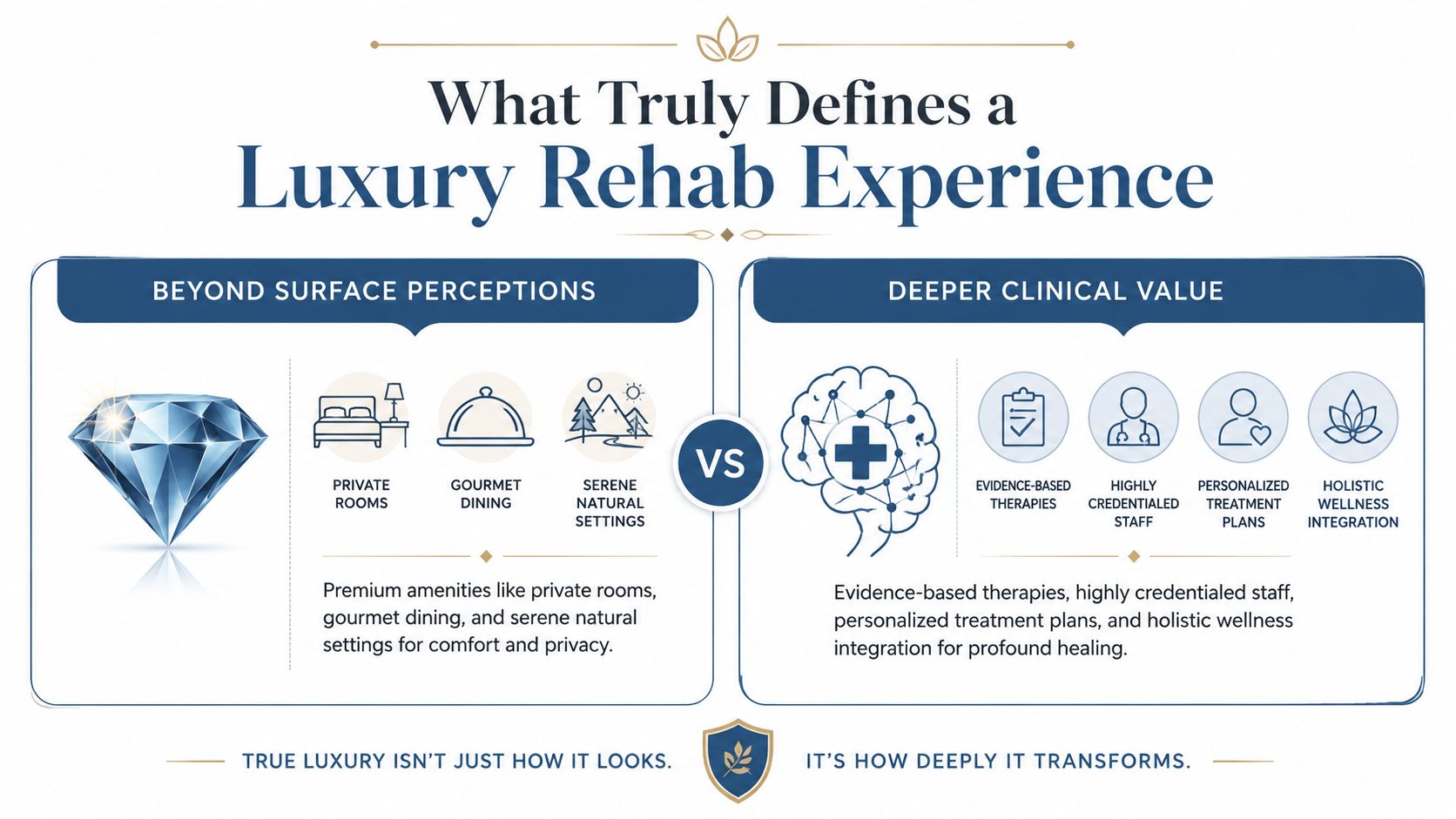
The term luxury rehab is often misunderstood. The focus tends to be on aesthetics first, which is backwards.
The category became distinct partly because of price. Industry sources commonly place a 30-day stay in luxury rehab at about $30,000 to $100,000, while standard rehab is typically cited at $5,000 to $20,000 for the same period, a major pricing gap tied to private rooms, concierge support, smaller client-to-staff ratios, and broader clinical access, according to Addiction Center's breakdown of luxury rehab costs.
What the premium should actually buy
A higher fee only makes sense if it funds better treatment conditions.
That means:
- Private living space: Executives and public-facing professionals often need room to decompress, take confidential calls when clinically appropriate, and regulate without the chaos of shared quarters.
- Smaller clinical load: Fewer clients per staff member means faster response, more observation, and less cookie-cutter treatment.
- Individualized planning: The treatment schedule should fit the person's psychiatric profile, substance use pattern, family system, and real-world obligations.
- Broader clinical bench: Complex clients need access to experienced therapists, psychiatrists, addiction specialists, and adjunctive providers who can work from the same treatment plan.
A useful parallel comes from healthcare more broadly. Strong care environments are built around responsiveness, clarity, and continuity, not décor. Recepta.ai's patient experience guide is worth reading for that reason. It reinforces a principle that applies in residential treatment too. People engage more fully when the system around them is thoughtful, coordinated, and human.
What doesn't count as quality
A chef, a pool, or a scenic property doesn't make a program clinically serious.
A family evaluating options should be skeptical of any facility that markets comfort more aggressively than treatment architecture. If the admissions team can describe menu options in detail but gets vague about psychiatric care, detox oversight, or treatment planning, that's a warning sign.
Practical rule: In luxury rehab, amenities should support treatment. They should never replace it.
The best explanation of this distinction is often the simplest one. What sets luxury rehab centers apart isn't indulgence. It's whether the environment creates enough privacy, continuity, and clinical access for serious work to happen without unnecessary friction.
For executives, that distinction matters. They aren't paying for pampering. They're paying for conditions that increase honesty, participation, and follow-through.
Rebuilding an Executive Skillset for Sustainable Recovery
Sobriety alone won't protect a high-performing adult who returns to the same pressure, the same reflexes, and the same emotional blind spots.
The work has to go deeper. Luxury rehab is clinically differentiated by treatment intensity and staffing structure, with individualized plans and evidence-based therapies such as CBT and DBT, while privacy and comfort improve engagement in that process, as described in Sage Recovery's overview of luxury rehab. For executives, those therapies aren't abstract. They translate into concrete professional skills.
The skills that actually need rebuilding
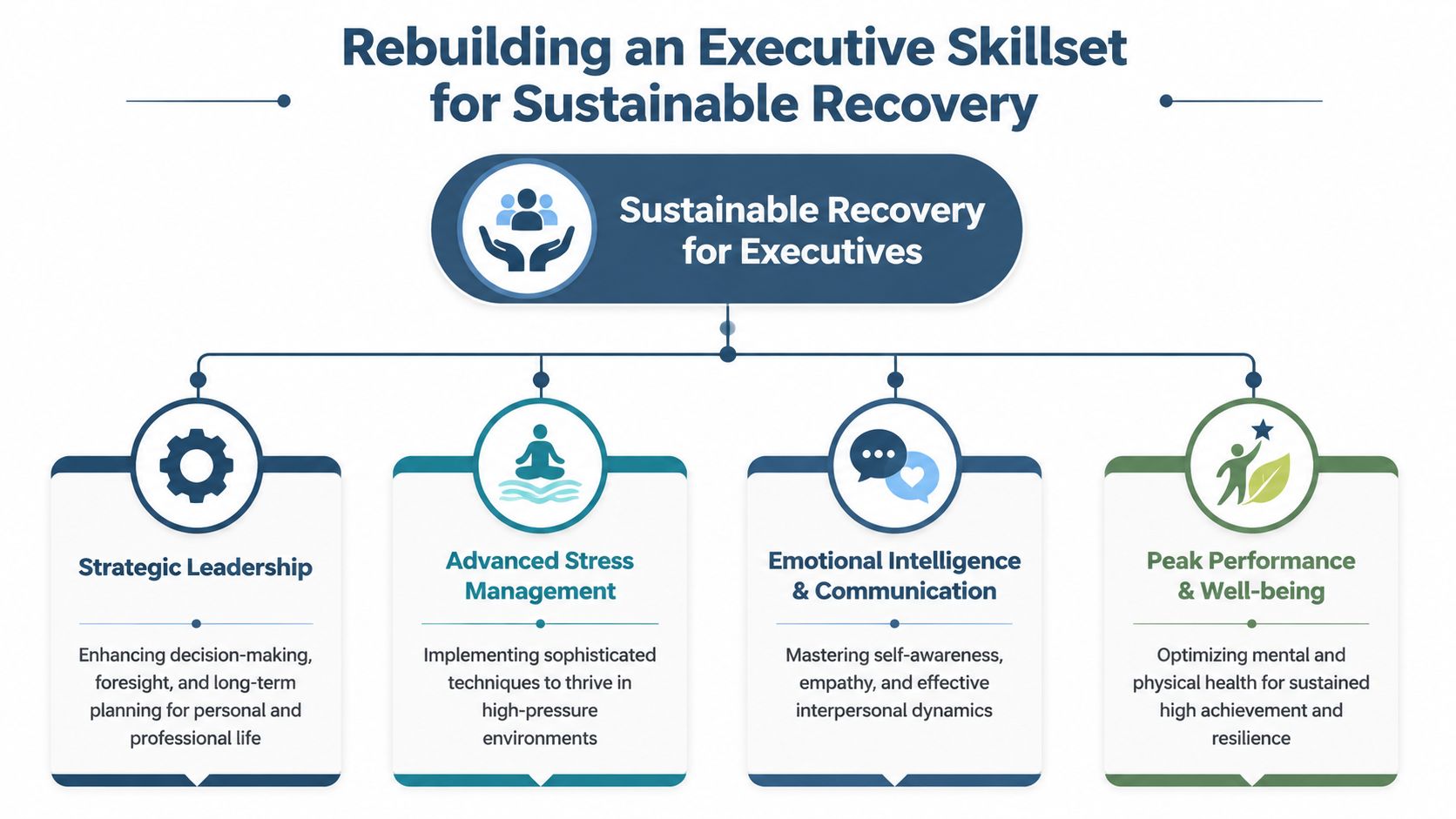
A strong program teaches recovery in the language of daily function.
- Stress regulation under pressure: Executives often know how to push through stress, but not how to metabolize it. CBT helps identify distorted thinking that fuels urgency, catastrophizing, and overcontrol. DBT helps the client interrupt escalation before it turns into drinking, drug use, rage, or emotional shutdown.
- Interpersonal effectiveness: Many professionals can negotiate deals but can't tolerate vulnerability, conflict at home, or feedback that threatens identity. Treatment should train direct communication, boundary setting, repair, and emotional honesty.
- Decision-making without chemical support: Some clients haven't made a difficult decision sober in years. Recovery requires learning how to tolerate uncertainty, fatigue, disappointment, and delayed gratification without reaching for a shortcut.
- Recovery-based scheduling: Structure matters. Calendar discipline, sleep protection, travel planning, and trigger mapping become part of executive functioning, not an afterthought.
How this looks in treatment
A clinician might challenge a client who says, “Work stress makes drinking inevitable.” That thought gets tested. What happened before the urge? What story was attached to the stress? What alternative behavior was available but ignored?
Then the work becomes behavioral. The client practices pausing before reacting, setting limits on late-night email exposure, rehearsing difficult conversations, and building transition rituals that don't involve substances.
A useful lens for this population is performance psychology. The issue isn't only how to stop using. It's how to remain effective without relying on destructive compensations. This discussion of boutique centers that specialize in performance psychology for addicted entrepreneurs speaks directly to that challenge.
Recovery for executives isn't retreat from responsibility. It's retraining the person who carries it.
When a program gets this right, the client leaves with more than abstinence. He or she leaves with usable skills for pressure, leadership, family life, and self-governance.
The Critical Importance of Dual Diagnosis Care
For executives, untreated mental health symptoms are often the engine underneath substance use.
Anxiety gets medicated with alcohol. Trauma gets buried under achievement and stimulants. Depression hides behind overwork, isolation, and emotional flatness. Then the person enters treatment and tries to address the substance only. That approach fails because it treats the visible behavior while ignoring the condition driving it.
The clinical benchmark is integrated dual-diagnosis care, meaning substance use and psychiatric disorders are treated in the same program by the same treatment team. Addiction treatment guidance summarized by American Addiction Centers on upscale rehab and co-occurring care describes this integrated model as the most effective long-term approach because psychiatric symptoms can drive relapse, and substance use can worsen mood, trauma, and impulse-control symptoms.
Why siloed treatment doesn't work
If one team handles addiction and another handles mental health later, the client usually ends up splitting the story.
One side hears about the drinking but not the panic. The other hears about the depression but not the cocaine. The result is fragmented care for a problem that is not fragmented inside the person.
An executive with a history of trauma, insomnia, and heavy nightly drinking doesn't have three separate issues. He or she has one intertwined clinical picture. That picture must be treated as a whole.
What integrated care should include
A serious dual-diagnosis program should address:
- Psychiatric evaluation and monitoring: Not casual symptom labeling, but real diagnostic work.
- Addiction treatment with mental health relevance: Therapy has to connect substance use to anxiety, shame, trauma, perfectionism, or mood instability.
- Adjunctive work that supports core treatment: Modalities such as mindfulness, somatic therapies, nutrition counseling, EMDR, or equine work can be useful when they complement evidence-based care.
- Aftercare continuity: The discharge plan must support both psychiatric stability and sobriety.
For families trying to understand the emotional side of recovery, thoughtful education helps. Peak Performance's emotional health podcast offers a useful conversation about trauma, beliefs, anxiety, and emotional healing. It doesn't replace treatment, but it helps clarify why surface-level symptom control rarely lasts.
This is not optional. A polished, successful adult with addiction and untreated psychiatric distress isn't a simple case. Any program that treats it like one will waste time.
Integrating Work and Recovery at Reflections
The question most executives ask first is blunt. Can treatment happen without letting the career implode?
Sometimes the honest answer is no. Some clients need a full break from work because every contact is destabilizing. But that isn't true for everyone. For high-functioning adults who need discretion and ongoing connection to essential responsibilities, select luxury programs may allow flexible treatment plans and managed access to phones and laptops, with the critical caveat that boundaries must prevent work from undermining care, as noted in Recovery.com's discussion of luxury rehab for professionals.

What a balanced treatment day can look like
In a clinically managed setting, the day doesn't revolve around inbox management. It revolves around treatment.
A resident might begin with morning stabilization, medication review if needed, and individual psychotherapy. Later in the day, he or she may participate in a process group, trauma-focused work, or an experiential modality such as equine or somatic therapy. Protected time for a critical call or limited laptop use can be built in, but it remains structured rather than open-ended.
That distinction matters. “Device access” should never mean unrestricted professional immersion. If a resident spends the whole day firefighting business problems, treatment becomes expensive denial.
The boundaries that make electronics clinically workable
A well-run executive program sets rules before the first call happens.
Consider the minimum standard:
| Area | What should be clear |
|---|---|
| Timing | Work contact happens in designated windows, not throughout the day |
| Purpose | Essential obligations only, not habitual monitoring |
| Privacy | Calls and laptop use occur in a confidential, private setting |
| Clinical review | The team adjusts access if work is feeding anxiety, avoidance, or relapse risk |
Reflections is one California-based option that allows appropriate access to electronics while providing private rooms in both detox and residential care. For the right client, that structure can support treatment without requiring professional disappearance. The key phrase is for the right client. Someone using work to avoid emotional exposure needs tighter limits, not more flexibility.
A laptop in treatment should be a tool under supervision, not an escape route.
Executives often fear that stepping into rehab means surrendering identity, influence, and relevance. In reality, the right structure can help restore judgment. Work gets handled more cleanly when the person doing it isn't intoxicated, sleep deprived, emotionally volatile, or hiding.
Family Involvement as a Cornerstone of Success
Executives rarely suffer alone. Their families absorb the spillover.
A spouse may become the unofficial risk manager. Adult children may stop trusting what “fine” means. Parents and siblings may swing between panic, anger, and financial rescue. In high-achieving households, everyone often protects appearances while the relational foundation weakens underneath.
That's why family involvement belongs inside treatment, not outside it. Recovery becomes more durable when the people closest to the client understand the illness, the enabling patterns around it, and the communication habits that keep the cycle going.
What productive family work should accomplish
Family participation isn't about assigning blame. It's about correcting a system that has adapted to dysfunction.
Useful family work usually includes:
- Private sessions: These create room for direct conversations that clients and loved ones have often avoided for years.
- Education: Families need a clear understanding of substance use, co-occurring mental health issues, relapse warning signs, and healthy limits.
- Boundary repair: Loved ones learn the difference between support and rescue.
- Reentry planning: The household needs a plan for communication, accountability, and expectations after discharge.
Why this matters for professional stability too
A stable home environment isn't separate from executive performance. It supports it.
When family members stop reacting from fear and start responding with clarity, the recovering client returns to a more predictable environment. That lowers chaos, improves accountability, and reduces the emotional whiplash that often pushes professionals back into old coping methods.
Family work also protects against a common failure point. The client changes in treatment, then goes home to the same secrecy, the same resentment, and the same unspoken rules. That setup invites relapse. A high-quality program doesn't let that happen without preparation.
How to Evaluate an Executive Rehab Program
Families often get distracted by polished websites, secluded properties, and language about transformation. None of that answers the essential question. Can the program handle a complex, high-functioning adult with professional obligations and possible dual diagnosis?
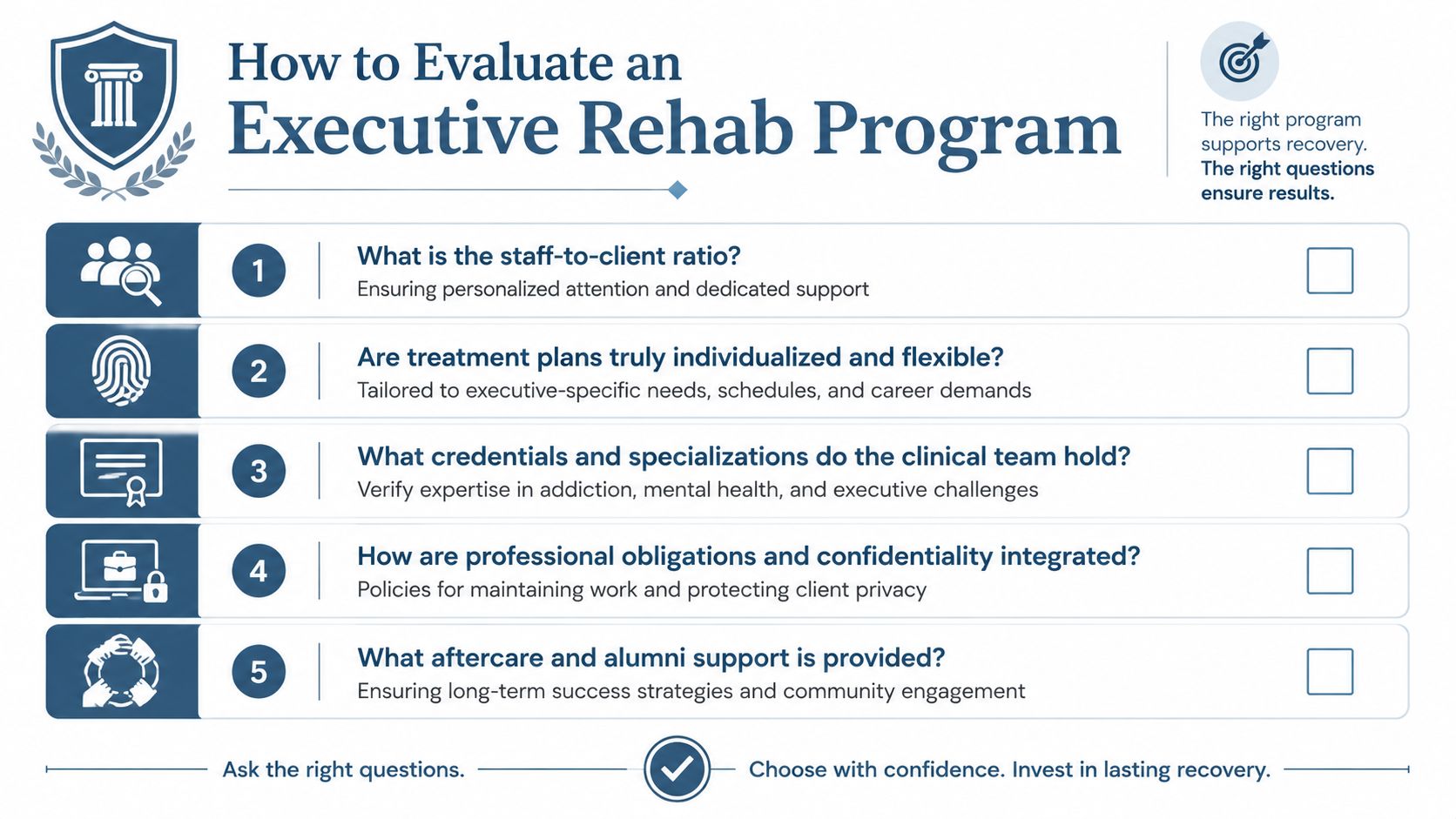
A discerning client should vet the program like any other high-stakes investment. Ask direct questions. Listen for direct answers.
The questions that matter most
- Who is directing care? Ask about the clinical director, the psychiatric team, therapist credentials, and who adjusts the treatment plan when the case becomes more complicated.
- How is dual diagnosis handled day to day? Don't accept vague reassurance. Ask how addiction and mental health treatment are integrated into the same schedule and same team process.
- What is the electronics policy in practice? “Allowed” means nothing without details. Ask when devices are permitted, where calls happen, and how the staff intervenes if work starts competing with treatment.
- Are rooms private in detox and residential treatment? For executives, privacy often affects sleep, honesty, and willingness to stay.
- What happens after discharge? A strong aftercare plan should include ongoing clinical support, relapse planning, and continuity for both mental health and substance use care.
The answers that should raise concern
Be cautious if the admissions team avoids specifics, overemphasizes amenities, or gives a one-size-fits-all answer to complex clinical questions.
A program built for executives should be able to explain its philosophy clearly. It should know when work access helps and when it hurts. It should understand that public image, family pressure, and identity loss are not side issues. They're part of the case.
The right luxury rehab won't flatter denial. It will protect privacy, insist on clinical rigor, and make room for responsible professional continuity only when that serves recovery rather than sabotages it.
Reflections provides California-licensed, Joint Commission-accredited residential dual-diagnosis care in a private setting for adults who need structured treatment, private rooms, family involvement, and appropriate electronics access while addressing substance use and mental health together. Families or professionals considering options can review the program directly at Reflections.