

A successful adult child often sees the problem before anyone else names it. The parent still hosts clients, still chairs the foundation meeting, still knows how to hold a room. Then private patterns start to accumulate. Slurred calls late at night. Missed commitments explained away with polished excuses. Irritability that appears only after the second drink, then gets folded into “stress,” “age,” or “a difficult season.”
That combination is disorienting because it doesn't look like the stereotype. It looks like influence, status, and family history wrapped around a growing health problem. For professionals, the challenge isn't only emotional. It touches reputation, inheritance decisions, caregiving expectations, and the quiet fear that one parent's drinking could destabilize a carefully built life.
Navigating the Crisis with Clarity and Strategy
Many adult children who are trying to learn how to deal with an alcoholic parent make the same early mistake. They treat it as a persuasion problem. If they say it perfectly, manage the fallout skillfully enough, or absorb enough of the damage privately, the parent will finally choose help.
That usually doesn't work.
Alcohol use disorder is better approached as a health crisis with relational, financial, and operational consequences. That shift matters. It moves the adult child away from family chaos and toward strategy. It also reduces shame, which is often what keeps high-profile families stuck.
Why this feels so charged
A respected parent can be harder to confront than an obviously impaired one. The public identity is intact, so the family starts negotiating with appearances. Was that comment at dinner just fatigue? Was the late arrival at a board event really traffic? Is the wine ritual now a dependency, or just a habit associated with success?
Those questions don't arise in a vacuum. The scale of exposure is large. AACAP notes that around 11 million U.S. children have a parent who struggles with alcohol use disorder, and that children of alcoholics are four times more likely than other children to become alcoholics themselves. For a high-performing adult child, that fact often lands in two ways at once. There is concern for the parent, and there is concern about repeating a pattern.
Families usually get traction when they stop asking, “How do we make this less embarrassing?” and start asking, “What protects health, safety, and long-term stability?”
A more useful frame
The most effective response is rarely dramatic. It is disciplined. That means observing patterns, documenting what matters, refusing to cover consequences, and choosing interventions that preserve dignity without protecting the addiction.
A thoughtful overview of effective ways to help family addiction can be useful at this stage because it reinforces a core principle many professionals need to hear clearly: support and rescue are not the same thing.
The adult child's job isn't to win an argument. It's to respond in a way that is calm, boundaried, and hard to manipulate. That approach protects the parent's dignity, but it also protects the career, household, and emotional stability the adult child has spent years building.
Recognizing AUD in a High-Functioning Parent
The polished parent often hides alcohol problems in plain sight. Success becomes camouflage. Family members hesitate because the parent is still productive, still socially fluent, and still capable of impressive self-control in selected settings.

What high functioning often looks like
A high-functioning parent may never drink in the morning, may insist on expensive alcohol only, or may frame drinking as a reward for long workdays. None of those details rules out a serious problem. In fact, they often become part of the family's rationalization.
Common patterns include:
- Controlled presentation in public while private interactions become tense, repetitive, or emotionally unsafe.
- Defensiveness around quantity such as irritation when anyone comments on how much is being poured or how often drinking is built into the day.
- Narrowing routines where evenings, travel, meals, or celebrations all start revolving around access to alcohol.
- Subtle withdrawal from family life even while professional obligations remain mostly intact.
- Memory gaps or revisionist conversations where the parent recalls events very differently from everyone else.
For readers who want a clinical primer on terminology and patterns, understanding ETOH abuse helps clarify how alcohol misuse can escalate without matching the public's outdated image of alcoholism.
What adult children tend to miss
The adult child usually notices tone before dysfunction. The parent becomes sharper, more brittle, or more unpredictable. There may be increasing hostility when plans change, when alcohol isn't available, or when anyone questions judgment.
That's why a description of high-functioning alcoholics is often more useful than generic addiction content. It matches what many accomplished families see: competence in one sphere, deterioration in another.
A maintained title is not evidence of wellness. It only shows that the person still has areas of life they can protect.
A practical test helps. Instead of asking whether the parent “looks alcoholic,” ask whether alcohol now affects trust, reliability, emotional regulation, or safety. If the answer is yes, the label matters less than the pattern.
What works better than arguing over the term
Arguing over whether the parent is “really an alcoholic” usually wastes time. Families get farther when they focus on observable impact.
A short table can help separate image from reality:
| Public appearance | Private reality to watch |
|---|---|
| Still successful at work | Increasing volatility at home |
| Social drinking seems polished | Drinking is central to daily rhythm |
| No obvious legal or work crisis | Family members feel they must manage around alcohol |
| Keeps commitments selectively | Reliability drops where there are fewer consequences |
The adult child doesn't need absolute certainty to act. A consistent pattern of impairment, denial, and family disruption is enough to justify boundaries and a serious conversation.
Establishing Boundaries to Protect Your Stability
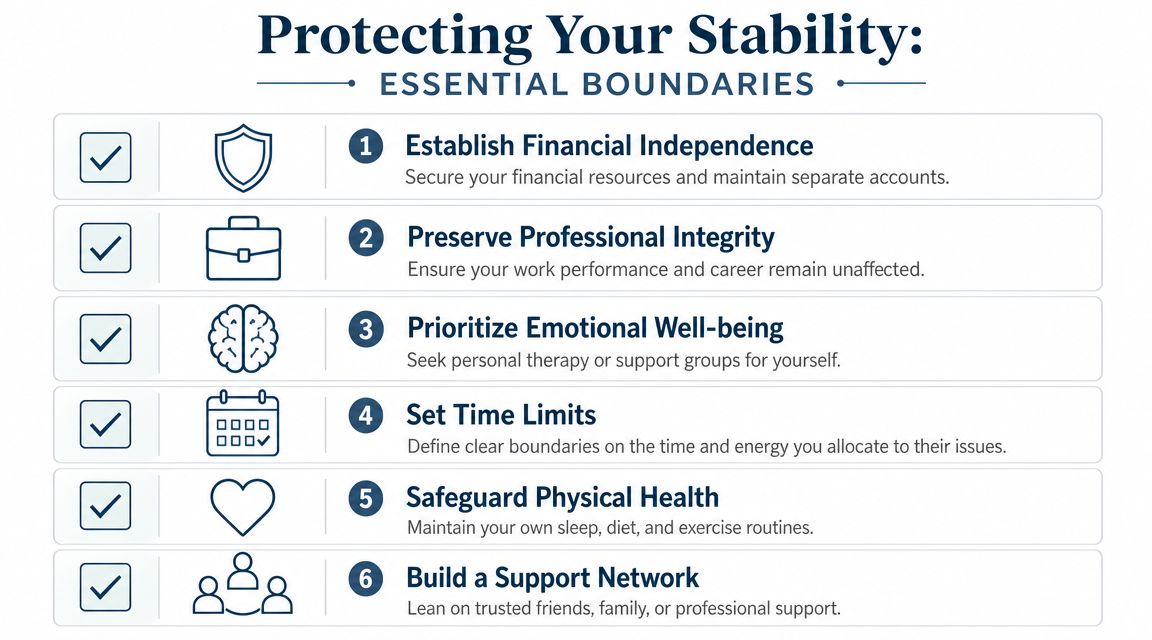
Before the adult child can help effectively, stability has to be protected. That includes sleep, work performance, financial independence, and emotional bandwidth. Without that structure, the parent's drinking starts setting the family calendar, shaping decisions, and draining attention from everything else.
Why boundaries aren't optional
This isn't only about stress. There is measurable mental health risk for children and adult children of alcoholic parents. A CDC analysis found parental alcoholism was associated with approximately twofold higher odds of lifetime major depressive disorder (OR 1.84) and persistent depressive disorder (OR 2.11). That is one reason boundaries should be treated as a health intervention, not a personality preference.
For high-performing adults, the danger is often overfunctioning. They manage the crisis well enough that no one else feels urgency. They smooth over events, fund repairs, reassure relatives, and absorb the reputational risk.
That pattern looks competent. It is usually enabling.
The boundaries that matter most
A practical boundary plan should be concrete enough to enforce under pressure.
- Money stays separate. No loans that disappear into drinking, no quiet debt cleanup, no shared accounts without safeguards if misuse is already affecting judgment.
- Transportation has a hard line. No getting into a car with an intoxicated parent, and no helping them normalize unsafe driving.
- Work life stays protected. No rescheduling meetings, inventing excuses, or asking colleagues to accommodate behavior the parent refuses to address.
- Access gets limited. If calls become abusive, manipulative, or relentless, contact can move to specific times and specific conditions.
- Home has rules. If the parent lives with the adult child or depends on access to the home, expectations should be explicit and tied to safety.
- Abuse ends the interaction. If threats, intimidation, or volatility escalate, the conversation stops and the adult child leaves or asks the parent to leave.
A clear discussion of enabling versus helping in Zoe Behavioral Health's blog post can sharpen this distinction for families who are still confusing rescue with care.
A boundary is only real if it has a consequence
Many adult children state preferences, not boundaries. “Please don't call me when you've been drinking” is a request. “If you call after drinking, the call ends and will be returned tomorrow” is a boundary.
Practical rule: A boundary should describe the adult child's action, not the parent's promised behavior.
For families already organized around guilt, this can feel harsh. It isn't. It is corrective. When alcohol has become the organizing force in the relationship, boundaries reintroduce reality.
Readers who recognize long-standing overinvolvement often benefit from learning more about codependency patterns. That lens helps explain why successful adults can still feel irrationally responsible for a parent's choices.
A short decision framework
When deciding whether to step in, ask three questions:
- Is there immediate danger? If yes, act on safety first.
- Does this help recovery, or only reduce today's discomfort?
- Will repeating this response make the next crisis more likely?
If the answer to the second and third questions points toward preserving the status quo, the adult child is likely carrying responsibility that belongs back with the parent.
How to Communicate Your Concerns Effectively
The first serious conversation should be planned, not improvised. When the parent is status-conscious, proud, or used to directing everyone else, an emotional confrontation usually produces denial, counterattack, or polished minimization.
A better approach is structured and sober. Priory and UKAT recommend choosing a private time when the parent is sober, using “I” statements, specific examples, open-ended questions, avoiding labels like “alcoholic,” and ending with concrete next steps.
What to say
The adult child should lead with observation, concern, and impact. Not diagnosis.
Useful language sounds like this:
- Start with concern. “There's something difficult that needs to be said because this relationship matters.”
- Use specifics. “There were three recent dinners where speech changed, memory became unreliable, and the evening ended in conflict.”
- Name the impact. “Contact has started to feel unpredictable, and that has affected trust.”
- Invite response. “What's your sense of what's happening?”
- Offer next steps. “A medical evaluation, therapy, or a recovery meeting would be a reasonable next move.”
What to avoid
Some approaches almost always backfire, especially with accomplished parents who are invested in image.
| Unhelpful approach | Better alternative |
|---|---|
| “You're an alcoholic.” | “There's a pattern with alcohol that's affecting your health and relationships.” |
| Listing years of grievances | Naming a few recent, specific examples |
| Having the talk during or after drinking | Waiting for a private sober window |
| Debating whether it counts as a problem | Focusing on observable consequences |
The purpose of the conversation is not to force confession. It is to state reality clearly enough that denial no longer gets the family's cooperation.
The tone that works
Respect matters. So does firmness. The adult child doesn't need to sound clinical or cold. But the parent should hear that the family has moved out of passive tolerance.
A concise close often works well:
- State the boundary. “There won't be cover stories, financial rescue, or participation in unsafe situations.”
- State the opening. “If help is accepted, support is available.”
- State the consequence. “If nothing changes, contact and involvement will change.”
That sequence preserves dignity. It also removes the parent's ability to mistake concern for unlimited access.
Exploring Executive Treatment that Respects a Career
Many families delay treatment because they picture disruption, exposure, and loss of control. Those fears are stronger when the parent is a founder, physician, attorney, investor, public figure, or senior executive. In those cases, standard rehab language can feel so misaligned with real life that the family avoids decisive action altogether.
That hesitation is understandable. It just isn't always useful.

What executive-level care needs to solve
A parent in a visible or demanding role often won't respond to vague encouragement to “take time away.” The treatment option has to answer practical objections:
- Privacy concerns
- Professional continuity
- Clinical credibility
- A setting that doesn't feel chaotic or anonymous
- Care that addresses both alcohol use and underlying psychiatric strain
That last point is often overlooked. High-achieving adults may use alcohol to manage anxiety, grief, trauma, sleep problems, depression, or a prolonged state of internal pressure. If treatment addresses alcohol alone while ignoring the deeper drivers, the family often sees a short-lived improvement followed by familiar patterns.
What thoughtful treatment looks like
For this population, treatment tends to work better when it combines discretion with structure. Private rooms matter. A calm residential setting matters. Access to phones and laptops can matter, too, when the parent has legitimate responsibilities that cannot easily be dropped overnight.
A clinically sophisticated program also needs enough depth to handle dual diagnosis care. That means the parent isn't being asked to choose between addiction treatment and mental health treatment. Both are addressed together, with a plan that can include detox support, medication oversight when appropriate, psychotherapy, skills-based work, and family involvement.
One option in this category is Reflections, a California-licensed, Joint Commission-accredited residential provider for adults with co-occurring mental health and substance use disorders. The program offers private rooms, clinically managed sub-acute detox when appropriate, dual-diagnosis treatment, and access to electronics so some clients can remain connected to work while in care.
Why this matters for the family
Executive treatment shouldn't be framed as indulgence. It is often what makes treatment acceptable to a parent who would reject a more generic model. The family's task is not to select the most austere setting. It is to identify the setting the parent is realistically willing to enter and remain in long enough to do meaningful work.
A treatment recommendation is strategic when it removes excuses without lowering clinical standards.
A successful adult child should also remember that treatment entry is not a referendum on family failure. It is an operational decision. If a parent's drinking is affecting judgment, reliability, relationships, or safety, then confidential, professionally aligned care is often the most responsible response available.
A useful way to present treatment
When speaking with a resistant parent, present care in the language they already respect:
- As risk management. Health, reputation, and decision-making are under strain.
- As an efficiency move. Continued private decline consumes more time and capital than focused treatment.
- As asset protection. Family stability, leadership continuity, and personal dignity all improve when the problem is handled directly.
This framing doesn't trivialize recovery. It makes the path legible to someone who is accustomed to making consequential decisions under pressure.
Building a Foundation for Long-Term Family Recovery
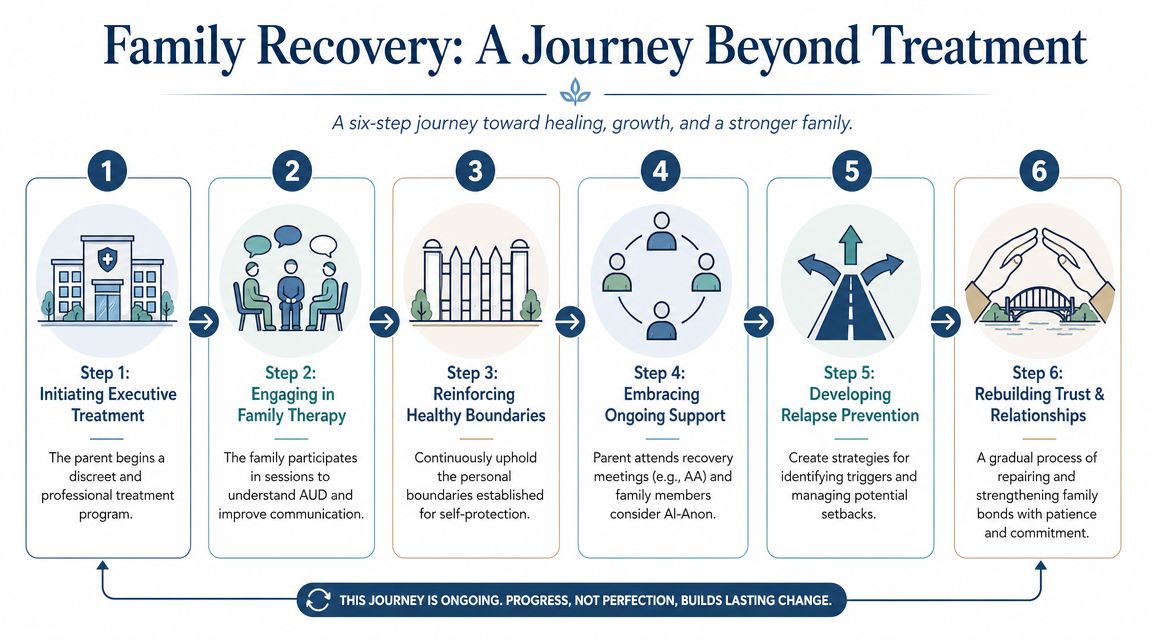
Treatment is the beginning of family recovery, not the conclusion. Once the immediate crisis settles, many families make another common mistake. They assume abstinence alone will repair trust. It won't. The family system has usually reorganized around secrecy, overfunctioning, fear, and role confusion. That architecture needs its own repair.
The work after treatment
Family recovery usually requires structure in three areas.
First, communication has to change. Old conversations often featured denial, appeasement, or emotional flooding. Family therapy can help relatives speak in ways that are direct, tolerable, and less reactive.
Second, boundaries need reinforcement. Alcoholhelp emphasizes practical anti-enabling steps such as refusing to loan money, not driving with an intoxicated parent, and separating finances when necessary, while noting that legal help or a formal intervention may be needed if safety is compromised. Those measures don't expire when treatment starts.
Third, responsibility must return to the right person. The recovering parent manages sobriety. The adult child manages personal limits, household protection, and informed support.
Protecting the family's future
For affluent families, recovery planning often needs to include financial and legal guardrails. If a parent's drinking has affected judgment, there may need to be more oversight around spending, major decisions, or access to shared assets. That conversation is rarely easy, but avoiding it usually creates larger problems later.
A practical family roadmap may include:
- Regular family sessions focused on repair, accountability, and communication habits
- Clear relapse response plans so no one improvises during a setback
- Defined financial rules for support, access, and decision-making
- Support for the adult child through therapy or mutual-help groups
- Measured trust-building based on behavior over time, not emotional promises
Families looking for concrete next steps can review guidance on helping a family member with alcohol addiction, especially when they need a framework for staying supportive without drifting back into rescue.
Recovery becomes durable when the family stops orbiting the addiction and starts organizing around honesty, limits, and repeatable routines.
What progress really looks like
Long-term recovery rarely feels dramatic. It looks quieter than that. Fewer emergencies. Cleaner conversations. Less monitoring. More predictability.
Trust comes back slowly, and that is appropriate. A parent doesn't re-enter the family system through declarations. Re-entry happens through sustained conduct, respect for boundaries, and willingness to participate in repair.
For the successful adult child, that may be the most profound shift of all. The relationship no longer depends on constant vigilance. It becomes possible to care profoundly without surrendering stability, career focus, or peace.
If a parent needs discreet, clinically serious treatment that can accommodate professional obligations, Reflections offers private residential care, dual-diagnosis treatment, sub-acute detox support when appropriate, family involvement, and access to electronics in a confidential setting designed for adults who need both privacy and structure.