
Xanax withdrawal is usually measured in days to weeks, not hours. The most intense phase often lasts 1 to 4 weeks, and some post-acute symptoms can continue for months, especially when the medication isn't reduced through a careful, medically guided process.
For a high-performing professional, that answer lands differently. The question usually isn't just how long does Xanax withdrawal last. It's whether stepping away to address it will expose a private struggle, disrupt a leadership role, or create a visible lapse in judgment at exactly the wrong time.
That tension keeps many executives trying to manage withdrawal at home, between meetings, during travel, or over a long weekend. Clinically, that's where serious mistakes happen. Xanax withdrawal moves fast, can become medically dangerous early, and often affects the exact capacities professionals rely on most: sleep, focus, emotional regulation, and decision-making.
A discreet, medically supervised plan doesn't remove every inconvenience. It does reduce preventable risk, protect privacy, and make the process far more workable for someone whose life can't be put on hold.
The Executive's Dilemma with Xanax Withdrawal
The typical executive presentation of Xanax dependence rarely looks chaotic from the outside. It looks polished, controlled, and productive. Deadlines are still met. Calls are still taken. Travel still happens. The person may even appear calmer than usual, which is part of what makes the problem easy to hide.
Behind that appearance, the pattern is often narrower and more fragile than anyone realizes. A professional starts using Xanax to sleep before a board meeting, settle panic during heavy stress, or come down after relentless work intensity. Then the body begins to expect it. Missing a dose doesn't feel like a small inconvenience anymore. It feels like a system failure.
Why high performers delay treatment
For this group, delay usually isn't denial in the ordinary sense. It's risk calculation.
They worry about:
- Reputation exposure because admitting dependence can feel incompatible with authority
- Operational disruption because teams, clients, and investors may rely on them daily
- Loss of control because treatment is often imagined as total disconnection from work and family
- Privacy concerns because many professionals don't want employers, colleagues, or social circles to know anything is wrong
The longer someone tries to “manage it privately,” the more likely the timeline is driven by crisis instead of planning.
That matters with Xanax. Short-acting benzodiazepines don't give much warning. A person can move from “I'll taper this on my own” to significant withdrawal symptoms quickly, and the professional consequences can surface before the medical ones are even fully understood.
What the real question usually is
Executives rarely need more motivational language. They need a realistic operating model.
A useful clinical frame is this: withdrawal has to be handled with the same seriousness as any other high-risk exposure. The goal isn't to prove toughness. The goal is to protect health, preserve judgment, and prevent an avoidable collapse in function.
For many professionals, the right setting isn't the most restrictive one. It's the one that combines privacy, clinical oversight, and enough continuity that career obligations can be managed appropriately while treatment proceeds.
Understanding the Xanax Withdrawal Timeline
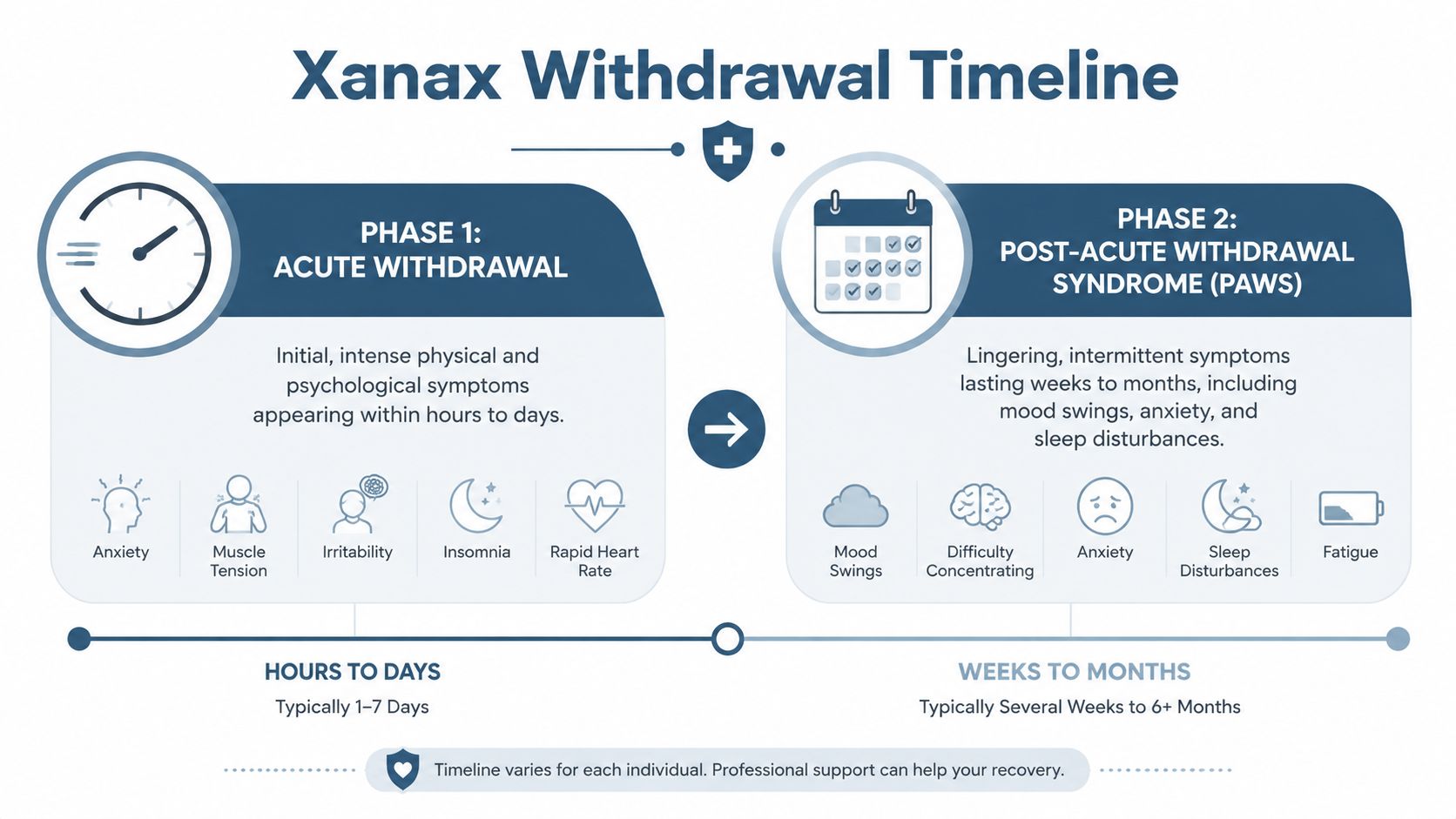
Xanax withdrawal is easier to understand as a storm followed by aftershocks. The storm is the acute phase. The aftershocks are the lingering symptoms that may continue after the worst physical instability has passed.
One clinical timeline notes that Xanax withdrawal symptoms may start within 6 to 8 hours of the last dose, usually within the first 24 hours, often peak around day 2, begin improving by about day 5, and may continue for 1 to 4 weeks overall, which is why withdrawal is usually measured in days to weeks rather than just hours, according to this clinical Xanax detox timeline.
The acute phase
The acute phase is the part that is widely feared, and for good reason. Symptoms tend to arrive quickly with alprazolam because it's a short-acting benzodiazepine. That fast onset can create a false belief that another dose is the only practical solution, which reinforces dependence.
A simplified way to think about the acute period:
| Time frame | What often happens |
|---|---|
| First several hours to first day | Symptoms may begin quickly after the last dose |
| Around day 2 | Intensity often peaks |
| By about day 5 | Some people begin to notice improvement |
| Following days and weeks | Symptoms may continue before the system stabilizes |
For an executive, this timing matters. It means withdrawal is rarely something that can be “snuck in” between major obligations without a plan. The body may react before the calendar allows for recovery.
The longer tail after detox
A second layer is the post-acute period. At this stage, people get discouraged if they expected a clean, rapid finish line. The medication may be out of the immediate acute window, but the nervous system can still feel unsettled.
Common lingering issues include:
- Sleep disruption that affects stamina and patience
- Residual anxiety that can feel out of proportion to the moment
- Mood changes that complicate leadership and relationships
- Cognitive fog that makes strategy work and communication harder
Acute withdrawal is the storm. Recovery after that is often about stabilizing the nervous system, rebuilding sleep, and treating the anxiety or trauma that helped drive the Xanax use in the first place.
That distinction matters because detox alone isn't a complete treatment plan. It's the opening phase of one.
Common Symptoms and Their Severity
Xanax withdrawal affects performance long before anyone else notices what's happening. A person may still appear composed on video calls, still answer emails, and still show up to work. But inside, the system is becoming less reliable.
A clinical review of alprazolam withdrawal notes that Xanax is an early-onset withdrawal drug because it's short-acting, with a reported half-life of about 11 hours. Symptoms often begin within 6 to 24 hours after the last dose, peak around days 1 to 4, with the highest seizure risk in days 1 to 3, and most acute physical symptoms resolve in about 1 to 2 weeks, according to this Xanax withdrawal timeline review.

The symptoms that disrupt work first
For professionals, the earliest consequences are often functional rather than dramatic.
- Insomnia weakens judgment, patience, and emotional control. A leader who hasn't slept doesn't just feel tired. That person often becomes more reactive, less strategic, and more error-prone.
- Rebound anxiety can distort ordinary pressure into something that feels unmanageable. Routine negotiations, public speaking, and staffing decisions may suddenly feel overwhelming.
- Restlessness and agitation make sustained concentration difficult. People start task-switching, overchecking messages, or avoiding complex work.
- Cognitive fog interferes with memory, executive functioning, and verbal precision. For someone whose role depends on clear thinking, that can be unsettling.
The symptoms that make home detox unsafe
Some withdrawal symptoms are uncomfortable. Others create real medical danger.
Physical symptoms can include tremor, sweating, headaches, nausea, muscle discomfort, and increased autonomic arousal. Psychological symptoms can include panic, irritability, depressed mood, and severe unease. In more severe cases, confusion and seizures can occur.
Clinical reality: the risk calculation changes when seizure risk enters the picture. This is no longer a willpower problem or a scheduling problem.
That's why a failed home taper can be especially costly for high-functioning adults. The person isn't just uncomfortable. That person may become professionally impaired, medically unstable, or both, while trying to preserve appearances.
Severity doesn't always look dramatic
Executives often assume serious withdrawal would be obvious. It isn't always. Sometimes it shows up as subtle but consequential decline:
- Emails become scattered
- Minor conflicts feel larger
- Sleep loss compounds over several nights
- Memory slips start affecting confidence
- Meetings require unusual effort to get through
A person can remain outwardly successful while becoming internally unstable. That mismatch is one reason discreet clinical care matters so much. It catches problems before they become visible, public, or dangerous.
Factors That Influence Withdrawal Duration
No responsible clinician can promise a fixed Xanax withdrawal timeline for every person. The better question is which variables are driving the likely duration and intensity in a specific case.
One broad benzodiazepine timeline describes the acute phase as 5 to 28 days after discontinuation, while noting that a protracted phase can last months to a year or longer in some patients. That same review explains that duration is shaped by dose, duration of use, and taper speed, and that medically supervised tapers commonly aim for reductions of about 5% to 10% per week, according to this overview of Xanax withdrawal timelines and tapering.
The variables clinicians watch closely
Some factors are straightforward. Others interact in ways patients don't expect.
- Dose history matters because higher exposure generally creates a more demanding withdrawal process.
- Length of use often matters just as much. A lower dose taken over a long period can still produce significant dependence.
- Taper speed is one of the few variables that can often be adjusted. Going too fast tends to increase distress and destabilization.
- Underlying mental health conditions shape the picture. Anxiety, trauma, panic symptoms, depression, and sleep disorders can all complicate withdrawal.
- Polysubstance use changes risk. Alcohol and other sedating substances can make the course less predictable.
A person who used Xanax briefly for a circumscribed period isn't in the same clinical situation as someone who has relied on it through sustained occupational stress, chronic insomnia, or untreated anxiety.
Why one-size-fits-all plans fail
Executives often look for efficiency. In withdrawal management, efficiency can be misleading. The fastest plan is not always the safest plan, and the most aggressive taper is not always the one that gets someone back to full performance sooner.
A personalized dual-diagnosis approach is often necessary when Xanax use is tied to anxiety or other psychiatric symptoms. Programs focused on benzodiazepine misuse and anxiety treatment are designed around that overlap rather than treating withdrawal as an isolated event.
A good taper respects biology. It doesn't negotiate with it.
That's the trade-off professionals need to understand. Pushing the process to satisfy a calendar can prolong instability. A measured plan often protects function better over the full course of recovery.
Why a Medically Supervised Detox Is Non-Negotiable
Many professionals ask whether they can withdraw from Xanax privately at home if they're disciplined enough. The clinical answer is that discipline isn't the issue. Risk is.
One treatment review notes that withdrawal can begin within hours to 24 hours after the last dose, acute symptoms often last about 5 to 28 days, longer use increases the chance of more severe withdrawal, and one review cited there reported that around 40% of people who used benzodiazepines for 6 months or more experienced moderate to severe withdrawal when stopping, according to this discussion of Xanax withdrawal duration and severity.
What home withdrawal gets wrong
Unsupervised withdrawal tends to fail for predictable reasons.
| Home approach | Clinical problem |
|---|---|
| Stopping abruptly | Can intensify symptoms and increase danger |
| Reducing based on guesswork | Often creates an unstable taper |
| Using work to distract from symptoms | Doesn't address medical risk or sleep loss |
| Taking rescue doses unpredictably | Reinforces dependence and disrupts stabilization |
For executives, there's another problem. Home detox often preserves access to every trigger that helped maintain the problem in the first place: constant email, performance pressure, interpersonal stress, and the expectation of immediate responsiveness.
What supervised detox actually provides
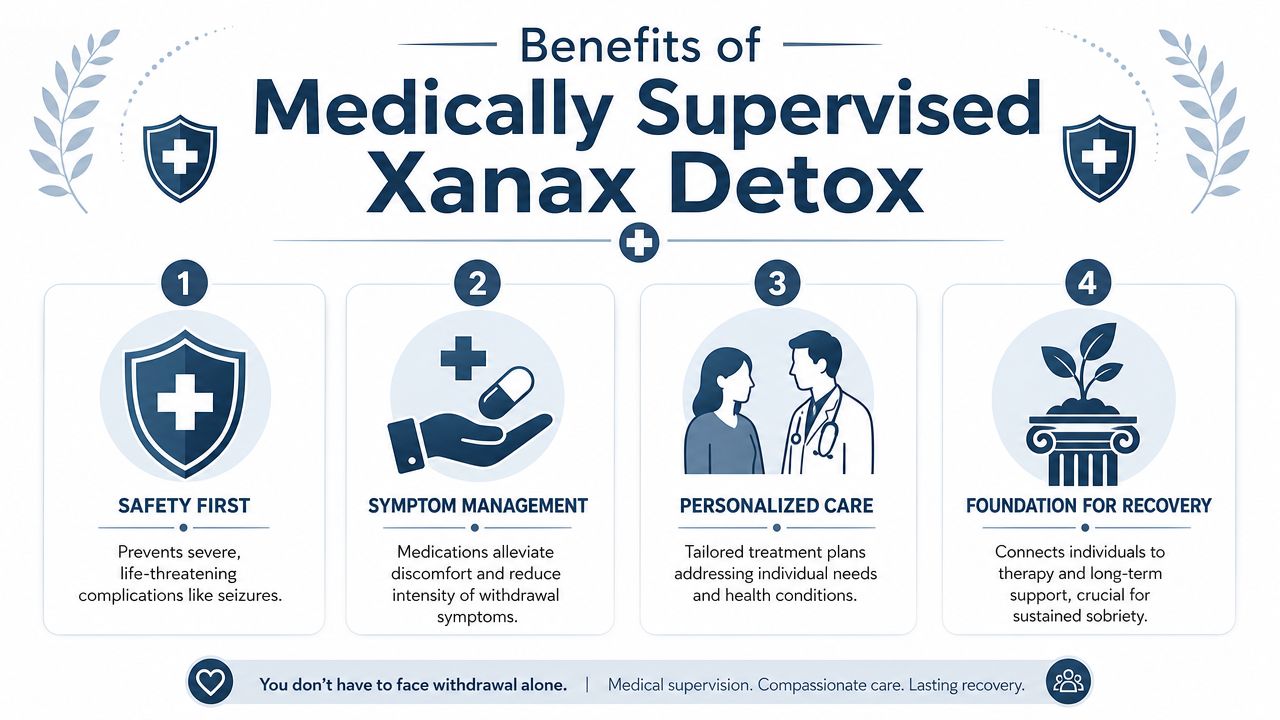
A medically managed detox is not just observation. It's active risk management.
- Monitoring: clinicians can respond quickly if symptoms escalate
- Medication management: the taper can be adjusted in a structured, medically appropriate way
- Environmental control: reduced stimulation supports sleep and stabilization
- Assessment: the team can identify when anxiety, trauma, depression, or another co-occurring condition is complicating the picture
This is the practical difference between enduring withdrawal and managing it well. A structured setting reduces avoidable volatility and creates a bridge into ongoing treatment.
For professionals considering options, medical detox services are designed to address the withdrawal period with clinical oversight rather than leaving patients to improvise through a medically sensitive process.
The strongest move is usually the least visible one. Handle the problem early, privately, and with enough clinical structure that it doesn't become a larger personal or professional event.
That's not indulgence. It's containment.
Integrating Recovery with Your Professional Life
Executives often assume treatment requires disappearing from their lives entirely. That assumption keeps many people stuck. In reality, the more relevant question is whether treatment can support recovery while preserving appropriate continuity with work, family, and high-level responsibilities.
Some people do develop a longer recovery arc. One review notes that about 10% to 15% of people may experience a prolonged post-withdrawal syndrome lasting 6 weeks to months or even years, and it also cites a clinical recommendation for a taper no faster than 0.125 mg per week over at least 8 weeks, according to this review of prolonged Xanax withdrawal and taper guidance.

Privacy and continuity can coexist
For high-profile clients, privacy isn't a luxury add-on. It's operationally important. Private accommodations, controlled communication, and clinically appropriate access to electronics can allow a professional to stay connected where necessary without collapsing back into the pace that fueled the dependence.
That model works best when boundaries are explicit. The person remains reachable for essential matters, but treatment still has enough protected space for sleep restoration, psychiatric assessment, therapy, and taper support.
A separate concern for many professionals is reputation management beyond the workplace itself. For anyone sensitive to confidentiality and hiring visibility, this guide to understanding online presence for employment can help frame why discretion still matters in a digital environment.
Recovery has to address the reason Xanax became necessary
The professionals who do well long term aren't just the ones who complete detox. They're the ones who understand what role Xanax came to play.
That role may have included:
- Sleep control during relentless stress
- Anxiety suppression before presentations, litigation, travel, or conflict
- Emotional shutdown during grief, trauma, or burnout
- Performance maintenance after the nervous system had already been overtaxed
A treatment plan that includes therapy, medication review, and dual-diagnosis work is usually more useful than one focused only on substance cessation. For people evaluating next steps, Xanax treatment and recovery guidance can help clarify what thorough care should include.
Sustainable recovery for a professional doesn't mean withdrawing from ambition. It means building a nervous system that no longer needs Xanax to keep up with the life being asked of it.
That's the standard worth aiming for.
Frequently Asked Questions About Executive Xanax Detox
Can professionals keep working during treatment
Sometimes, yes, within clinical limits. For working adults, the most effective environment is often one that allows appropriate access to phones and laptops while still protecting the treatment day. The key word is appropriate. If work contact prevents sleep, fuels anxiety, or interferes with stabilization, the treatment team will usually recommend tighter boundaries.
Is executive treatment actually confidential
Confidentiality is a central concern for high-profile clients, and reputable licensed programs are structured around privacy. That includes discreet admissions processes, limited disclosure, and careful handling of communication. Private rooms also matter because they reduce exposure, improve rest, and give professionals a more contained setting for difficult medical and psychological work.
How long should someone expect to be away
That depends on severity, taper needs, and whether co-occurring anxiety, depression, trauma, or insomnia also need treatment. Some people need focused detox first, then a longer residential phase to stabilize the underlying drivers of use. The most useful planning question isn't “What is the shortest stay possible?” It's “What length of care reduces the chance of relapse, medical risk, and a second disruption later?”
What happens after detox ends
Detox is the beginning, not the endpoint. Effective recovery requires continued therapy, psychiatric follow-up, relapse prevention planning, and support for sleep and stress regulation. For executives, aftercare should also include practical planning around travel, calendar load, high-stakes meetings, and the specific professional situations that previously triggered Xanax use.
Is a luxury setting really necessary
Not for everyone. But for executives, public-facing leaders, and people with significant privacy concerns, a private-pay residential setting can solve practical barriers that keep treatment from happening at all. If a person needs discretion, private space, high-level clinical care, and a way to maintain limited work continuity, the setting isn't cosmetic. It's part of making treatment feasible.
If Xanax has become something that a career, family, or personal stability now depends on, the safest next step is a confidential clinical evaluation. Reflections provides California-licensed, Joint Commission-accredited dual-diagnosis care in a private residential setting, including clinically managed detox, private rooms, and appropriate access to electronics for adults who need treatment without abandoning every professional responsibility overnight.