

A senior executive closes the laptop after another late-night meeting, pours a drink to come down, and tells himself it's temporary. A few months later, the same pattern happens after board tension, family conflict, travel fatigue, and the quiet drop that follows high achievement. The substance isn't only about pleasure anymore. It has become a fast, efficient way to manage inner intensity.
That pattern is common among high-functioning professionals. The problem usually isn't lack of intelligence, discipline, or ambition. It's that external success can coexist with an internal system that feels overloaded, reactive, and difficult to steady under pressure.
DBT therapy for addiction matters in that exact space. It doesn't treat a capable person as fragile or broken. It teaches a more advanced way to work with emotion, stress, urges, conflict, and self-defeating habits. For executives, founders, attorneys, physicians, and other professionals who operate in high-stakes environments, that shift can be decisive.
Beyond Coping A New Framework for Emotional Mastery
Many professionals have already tried “coping.” They've read the books, downloaded the meditation apps, and promised themselves they'll show more restraint next time. That approach often fails because it assumes the problem is weak willpower.
In reality, high performers often have strong systems for strategy, execution, and endurance. What they may not have is an equally refined system for emotional regulation. The same intensity that helps someone lead teams, carry risk, and tolerate pressure can also make substances feel unusually effective in the short term.
Why intensity becomes dangerous
A professional may use alcohol to shut off mental overdrive after a demanding day. Another may misuse medication to control anxiety before major presentations. Someone else may rely on drugs or drinking to move between emotional states faster, from keyed up to calm, from numb to productive, from ashamed to functional.
That's why DBT is more than stress management.
Practical rule: Addiction often survives because the substance solves a problem quickly, even while creating larger problems over time.
DBT treats that pattern directly. It helps a person understand what happens before the urge, during the urge, and after the behavior. Then it builds alternative responses that are deliberate, repeatable, and usable under real pressure.
What emotional mastery means in recovery
For a professional audience, emotional mastery doesn't mean becoming soft, passive, or endlessly introspective. It means learning how to:
- Pause under pressure instead of acting on the first impulse
- Stay effective during distress without reaching for a chemical shortcut
- Read emotions accurately rather than treating every internal shift as an emergency
- Repair relationships quickly when addiction has damaged trust
- Lead with clarity instead of cycling between control and collapse
This is one reason DBT therapy for addiction fits professionals so well. It respects complexity. It assumes a person can be competent in public and struggling in private. It also assumes those two realities can change together.
Understanding the Core Principle of DBT
The word dialectical sounds academic, but the idea is simple. It means holding two truths at once and working from both. In DBT, those two truths are acceptance and change.
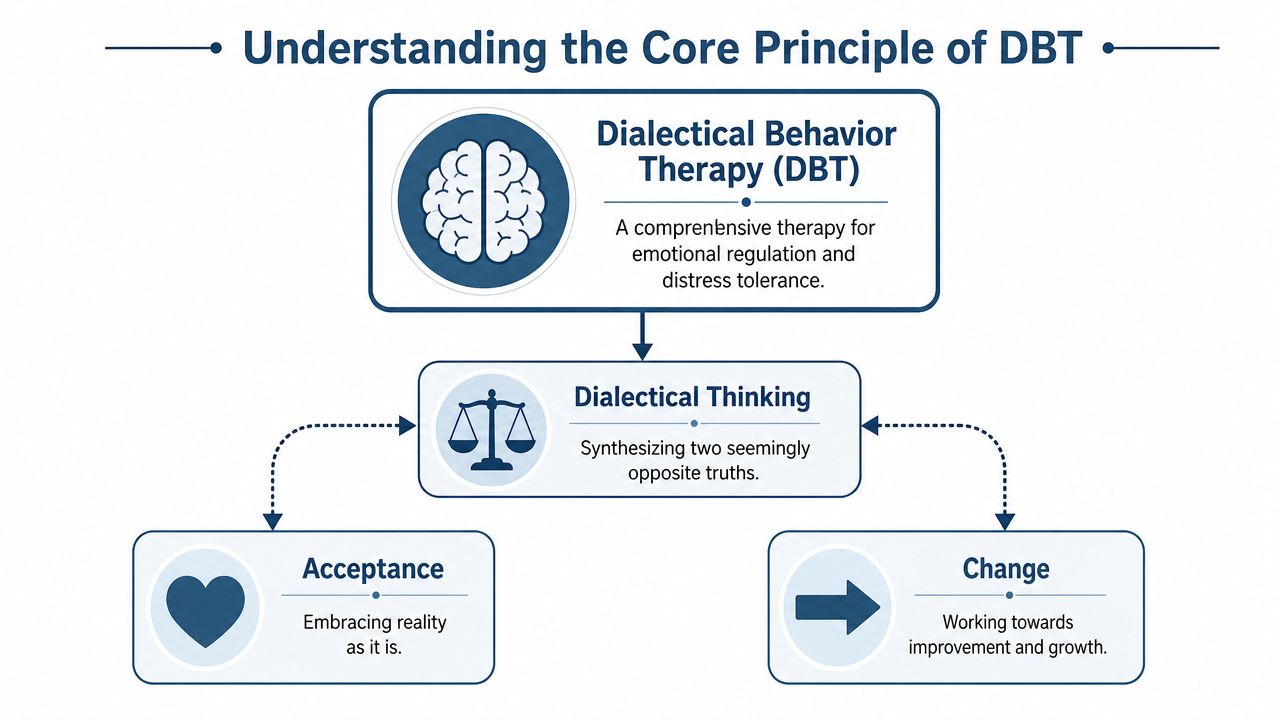
A strategist uses this mindset every day. First, the strategist accepts the facts on the ground. Denial leads to bad decisions. Then the strategist makes a plan to alter the outcome. DBT applies that same logic to emotion and behavior.
A person in addiction recovery might need to accept, without excuse or self-hatred, that stress, loneliness, perfectionism, or shame have become reliable triggers. At the same time, that person works to change the pattern. Acceptance without change becomes resignation. Change without acceptance becomes self-attack.
The balance that breaks all-or-nothing thinking
Professionals in addiction often get trapped in extremes. They think in categories like strong or weak, in control or out of control, flawless or failed. DBT interrupts that pattern.
A person can say, “This relapse happened, and it isn't the end.” A leader can say, “This emotion is real, and it doesn't get to run the meeting.” A parent can say, “Recovery is difficult, and continuing treatment is still necessary.”
That balanced thinking is one reason many people also benefit from learning how therapies differ. For readers comparing behavioral approaches, Different ACT mental health pathways offers a useful overview of another acceptance-based model that's often discussed alongside DBT.
What DBT targets first in addiction care
In addiction treatment, DBT has been adapted with specific recovery targets. A National Institutes of Health review describes additions such as dialectical abstinence, a clear mind target, and attachment strategies that actively follow up with missed-session patients. The same review ties these modifications to five treatment functions: improving motivation, building capability, generalizing new behaviors, structuring the environment, and strengthening therapist effectiveness, as outlined in the NIH review of DBT-SUD.
Those phrases matter.
- Dialectical abstinence means committing fully to abstinence while also planning carefully for the possibility of relapse, so one lapse doesn't become a total collapse.
- Clear mind means moving beyond the false confidence that often appears early in recovery. It keeps a person alert to risk even when life looks stable.
- Attachment strategies mean treatment doesn't become passive. If someone disappears, the program responds.
The practical tools behind that work are often taught through structured skills training. A closer look at DBT treatment at Reflections shows how those principles are translated into day-to-day clinical care.
How DBT Is Adapted for Substance Use Disorders
Standard DBT is already a strong model for people who struggle with emotional reactivity. DBT-SUD was developed to address addiction more directly. It doesn't just teach general coping skills and hope sobriety follows. It builds addiction-specific safeguards into the treatment itself.

Behavioral Tech explains that DBT-SUD retains core DBT while adding strategies such as urine toxicology screening, social networking meetings, and, when appropriate, pharmacotherapy for opioid replacement. That same review notes that five RCTs supported DBT as a treatment of choice for co-occurring borderline personality disorder and substance use disorder, and in one cited trial 87.5% of participants with substance dependence who received DBT achieved full remission for at least 4 weeks, compared with 33.3% in a comparison group, according to Behavioral Tech's DBT-SUD overview.
What changes in the addiction version
The adaptation matters because addiction has mechanics of its own. Urges can arrive fast. Shame can trigger secrecy. One missed appointment can become a week of avoidance. Social circles often reinforce use. A treatment model for addiction has to account for those realities.
DBT-SUD does that by focusing on patterns such as:
- High-risk situations that repeatedly lead to use
- Cravings and emotional escalation that narrow decision-making
- Missed sessions or withdrawal from care when a person feels exposed or discouraged
- Dual diagnosis patterns where anxiety, depression, trauma, or unstable relationships intensify substance use
Why this matters for professionals
Executives and working professionals rarely struggle in simplistic ways. A person may look productive while privately cycling through panic, irritability, insomnia, or emotional numbness. Another may have long periods of control followed by severe episodes after conflict, travel, or professional threat.
Recovery for professionals often depends on precision. The treatment has to target both the substance use and the emotional system that keeps feeding it.
That's where DBT-SUD stands out. It gives structure to moments that otherwise feel chaotic. It also works well for people who need practical language. Instead of vague advice to “manage stress better,” DBT-SUD identifies the chain of events, teaches specific responses, and reinforces them until they become usable under pressure.
For professionals with co-occurring conditions, that integrated focus is often the difference between temporary abstinence and a more stable recovery.
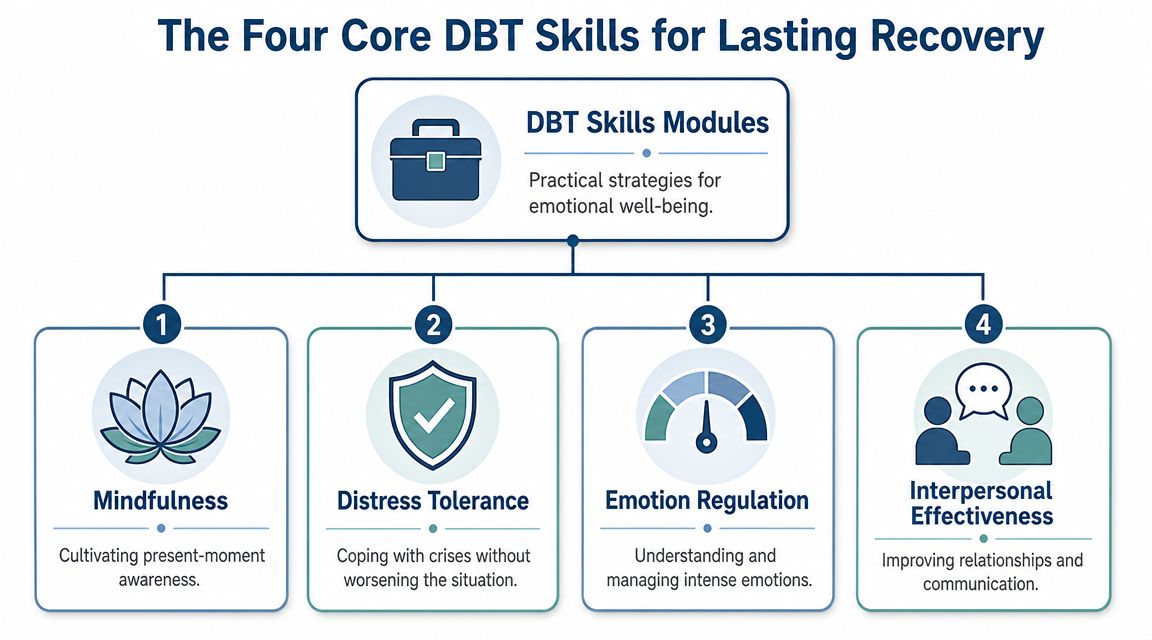
The Four Core DBT Skills for Lasting Recovery
The strength of DBT therapy for addiction becomes obvious when the skills are applied to real life. These aren't abstract concepts. They're usable tools for moments when a person is angry, ashamed, overwhelmed, triggered, tempted, or cornered.
Mindfulness
Mindfulness is the skill of noticing what's happening without immediately reacting to it. For a professional, that may sound basic, but it is often the first missing link. Many people don't notice the urge until they're already halfway into the habit.
An executive leaving a difficult investor call may feel a wave of agitation, humiliation, and urgency. Without mindfulness, that whole state gets labeled as “I need a drink.” With mindfulness, the person learns to identify the sequence more accurately: racing thoughts, tight chest, anger, catastrophic thinking, then craving.
That pause creates choice. Many programs pair DBT with broader contemplative work. A practical example appears in mindfulness programming at Reflections, where present-moment awareness is treated as a skill to be practiced, not a slogan to admire.
Distress Tolerance
Distress tolerance is about surviving a hard moment without making it worse. It is especially useful when the problem cannot be solved immediately.
A senior leader may leave a tense negotiation feeling flooded and cornered. Distress tolerance skills help the person get through the next hour safely, rather than using substances, sending impulsive messages, or creating fresh damage at home.
This skill does not ask a person to enjoy distress. It asks the person to endure it effectively.
A hard moment doesn't need to become a destructive night.
Emotion Regulation
Emotion regulation teaches people how emotions work, what increases vulnerability, and how to respond before intensity takes over. This is different from suppression. Suppressed emotion tends to return louder.
A physician in recovery, for example, may notice that sleep disruption, isolation, and perfectionistic self-criticism consistently precede cravings. Emotion regulation helps identify those patterns early and intervene before the system becomes overloaded.
Some people need behavioral changes. Others need improved routine, more accurate self-talk, or medication review in a dual-diagnosis setting. The point is precision.
Interpersonal Effectiveness
Interpersonal effectiveness teaches clear communication, boundaries, negotiation, and self-respect in relationships. Addiction often damages all four.
A partner may ask for honesty about urges. A team member may need firmer limits around after-hours demands. A family conversation may require accountability without collapse into shame. Interpersonal effectiveness helps a person stay direct without becoming aggressive, evasive, or defensive.
For professionals, this skill often becomes one of the most valuable parts of recovery because work stress and relationship stress frequently interact.
DBT Core Skills for Professionals
| Skill Module | Core Goal | Executive Application Example |
|---|---|---|
| Mindfulness | Increase awareness before reaction | Noticing the urge to drink after a hostile meeting and delaying action long enough to choose a safer response |
| Distress Tolerance | Get through crisis without adding harm | Managing the emotional crash after a failed deal without using substances or escalating conflict |
| Emotion Regulation | Reduce vulnerability to emotional overload | Recognizing that exhaustion and perfectionism are driving cravings and adjusting behavior early |
| Interpersonal Effectiveness | Communicate clearly while protecting self-respect | Setting limits with colleagues, repairing trust at home, and responding to conflict without avoidance |
Each module supports the others. Mindfulness helps a person notice. Distress tolerance carries the person through the acute moment. Emotion regulation reduces repeat vulnerability. Interpersonal effectiveness lowers the relationship chaos that often fuels relapse.
What a DBT Program Looks Like in a Luxury Setting
A real DBT program is a system, not a weekly conversation. For professionals, the setting also matters more than many realize. Privacy, calm, discretion, and continuity with professional responsibilities can either support the work or interfere with it.
The full outpatient DBT model for addiction includes four delivery modes: individual therapy, group skills training, telephone consultation, and therapist consultation. In a residential environment designed for high-functioning adults, those elements can be delivered with far less friction than in fragmented care.
How the four parts work together
Individual therapy is where treatment gets specific. A clinician helps connect urges, relapses, shame, conflict, and co-occurring symptoms into a clear behavioral map. For a professional, this often includes work around performance pressure, identity, secrecy, and control.
Skills groups aren't passive lectures. When run well, they feel more like intensive workshops. Clients learn a structured set of skills, then immediately apply them to live problems such as business travel, family strain, insomnia, exposure to triggers, and communication under stress.
Phone coaching matters because crises don't wait for the next session. Real-time support helps clients use skills in the moment they're needed, not just describe the crisis after the fact.
Therapist consultation is the part clients don't always see, but it protects quality. It gives the clinical team a disciplined way to stay aligned, thoughtful, and effective.
Why the environment changes the outcome
For an executive or public-facing professional, treatment often fails when the environment feels chaotic, impersonal, or infantilizing. Private accommodations reduce overstimulation and make emotionally demanding work more tolerable. Appropriate access to electronics can also matter. Some professionals need to remain connected to essential responsibilities, legal matters, family decisions, or carefully bounded work obligations while in care.
A luxury setting can support treatment when comfort serves function. Private rooms create space to decompress after difficult sessions. Discreet surroundings reduce social exposure. High-touch coordination protects time and mental bandwidth.
One example of that type of environment appears in luxury residential rehab programming, where private rooms and support for appropriate work continuity can coexist with intensive clinical treatment. For many professionals, that balance makes it more feasible to fully engage rather than delay care until life becomes unmanageable.
Evidence and Outcomes What Professionals Can Expect
Professionals usually want more than reassurance. They want evidence that a treatment model can produce observable change.
A 2015 meta-analysis of DBT for substance-related problems synthesized 4 studies with 118 participants and found that DBT groups were significantly better than comparison groups at increasing substance abstinence after treatment, with a standardized mean difference of 0.66 and a 95% CI of 0.27 to 1.04, p = .001, which the authors described as a medium-to-large effect size, according to the Marquette meta-analysis on DBT for substance-related problems.
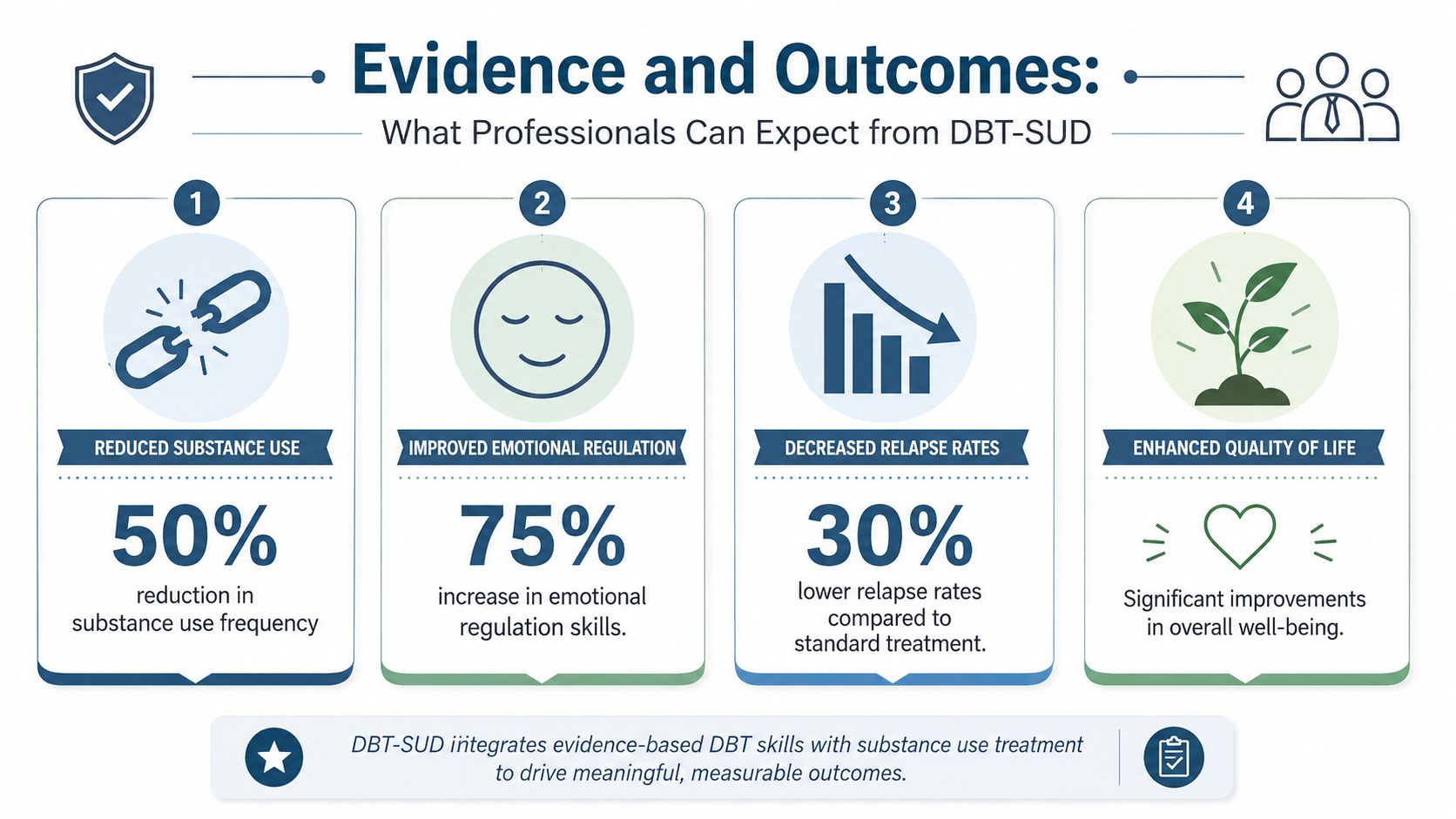
The same analysis reported that the advantage at follow-up was smaller and not statistically significant, with an effect size of 0.34 and 95% CI -0.02 to 0.71. That finding is important because it matches clinical reality. Early gains are meaningful, but ongoing support often determines whether they last.
How that translates in real life
For a working professional, “abstinence after treatment” isn't just a research phrase. It can mean:
- Steadier judgment during conflict, fatigue, and disappointment
- Less emotional whiplash between overcontrol and impulsive behavior
- Improved credibility at home and at work because behavior becomes more consistent
- Better leadership presence because stress no longer drives the room
Strong treatment outcomes matter most when they become durable habits in ordinary life.
DBT doesn't promise a frictionless existence. It teaches people how to manage pressure without defaulting to the very behaviors that keep creating more pressure. For professionals, that often leads to something deeper than symptom relief. It leads to more reliable decision-making, better boundary setting, and a more stable sense of self under demand.
Finding the Right DBT Program for You
Not every program that mentions DBT is offering a full DBT-informed addiction treatment model. Informed consumers should ask direct questions.
Questions worth asking
- How closely does the program follow the DBT model for addiction rather than offering a few DBT-style groups?
- How does the team treat co-occurring conditions such as trauma, anxiety, depression, bipolar symptoms, or personality-related patterns?
- What happens after a missed session or relapse? Passive programs often lose people at the exact moment they need structure.
- How are skills applied in real time? A strong program helps clients use the work under pressure, not only discuss it in session.
- What level of clinical expertise is on site? High-acuity dual diagnosis care requires more than generic counseling.
- Does the environment support privacy and function? Professionals may need confidentiality, private space, and carefully managed access to communication.
What discernment looks like
A discerning professional shouldn't only ask whether a center is comfortable. The more important question is whether the comfort supports serious treatment. A private room can help someone regulate after intensive trauma work. Access to a phone or laptop can reduce barriers to entering care when key responsibilities cannot be abandoned overnight. Clinical depth matters just as much.
The right fit is usually the program that can hold complexity without losing structure. It should understand addiction, emotional dysregulation, professional identity, family systems, and the realities of high-responsibility lives. It should also make continuing care part of the plan, because recovery tends to strengthen through consistency rather than intensity alone.
Reflections offers residential dual-diagnosis treatment for adults who need structured addiction care alongside treatment for co-occurring mental health conditions, within a private setting that supports discretion, private rooms, and appropriate access to electronics for essential life and work responsibilities. For professionals evaluating whether DBT therapy for addiction belongs in their recovery plan, Reflections is one option to review closely.