
A senior executive can look composed in every visible area of life and still be in real trouble. Meetings are handled. Deadlines are met. The family hears, “Things are just busy right now.” Meanwhile, sleep shortens, alcohol use becomes more regular, panic shows up at odd hours, or depression settles in behind performance. For some, prescription medication becomes the bridge between pressure and functionality. For others, irritability, isolation, or emotional shutdown becomes the norm.
That pattern isn't rare among high-achieving professionals. It's also not a character flaw. Sustained responsibility changes how people cope. The longer someone is expected to stay decisive, available, and composed, the easier it becomes to normalize symptoms that would concern them in anyone else.
A luxury mental health retreat can help, but only if the phrase is understood correctly. For executives, this shouldn't mean a spa with therapy language layered on top. It should mean confidential, clinically serious treatment in a setting that respects privacy, protects dignity, and recognizes that some residents still need to manage selected professional obligations while getting well.
Beyond Burnout A New Approach to Executive Well-being
The executive who finally asks for help usually doesn't describe the problem as collapse. They describe it as “not feeling like myself,” “being stretched too thin,” or “needing to reset before this gets worse.” That language often understates what's happening. Anxiety may already be driving insomnia. Depression may already be flattening judgment and motivation. Substance use may already be functioning as self-medication.
For high-performers, burnout is often the socially acceptable label placed over more complex clinical realities. A person may still close deals, lead teams, or sit in the boardroom while internally losing emotional range, cognitive flexibility, and the ability to recover between demands. Families often see it before the executive does.
That's why a luxury mental health retreat should be approached as a strategic intervention, not a reward and not an escape. It offers a contained environment where privacy, structure, and high-touch care can lower resistance to treatment. Independent market analysis notes that premium settings are often positioned around private accommodations, low census, and integrated therapy because those features can reduce barriers to entry and improve engagement for high-functioning adults who need discretion, even though direct comparative outcome data remains limited, as described in this overview of luxury mental health facilities.
For professionals dealing with this intersection of stress, substance use, and hidden impairment, the practical question isn't whether they can push through. It's whether continuing to push is already costing more than stepping away briefly for proper care. Many families recognize the pattern described in executive burnout and addiction as a hidden epidemic.
The right program doesn't ask a high-responsibility adult to pretend work no longer exists. It creates enough clinical structure that work stops driving the nervous system.
What executives usually need first
A strong starting point is clarity, not inspiration. Most professionals entering treatment need help answering three immediate questions:
- Is this burnout or something more serious: Persistent anxiety, depressive symptoms, trauma responses, or substance dependence often sit underneath the surface label.
- Can treatment stay private: For executives and public-facing professionals, discretion isn't optional. It affects willingness to enter care.
- Will life completely stop: The best executive-oriented settings understand that some residents need structured access to phones, laptops, and carefully bounded communication.
What Defines a True Luxury Mental Health Retreat
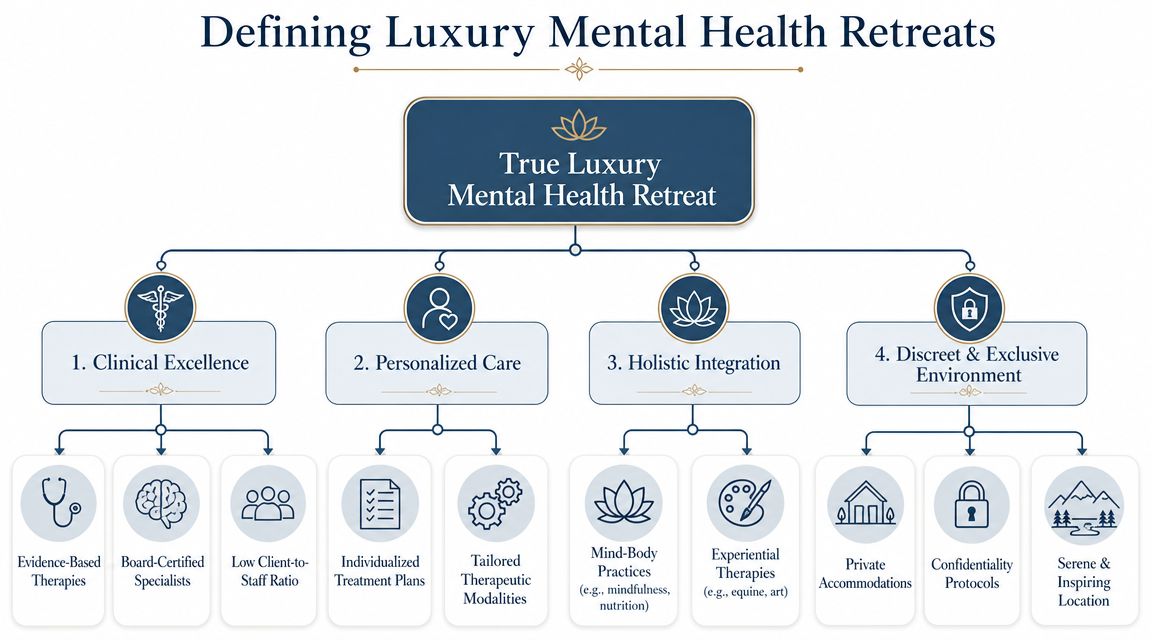
A true luxury mental health retreat isn't defined by architecture, views, or chef-prepared meals. Those features may improve comfort, but they don't determine whether treatment is appropriate for someone with panic, depression, trauma, or substance dependence. The defining issue is clinical acuity.
Independent guidance draws a clear distinction between two models. One is a hospital-like clinical retreat with psychiatrists, nursing staff, and medication management for stabilization. The other is a comfort-oriented wellness getaway that emphasizes holistic support and an upscale environment but doesn't have the same capacity for acute intervention, as outlined in this comparison of high-end mental health and wellness retreat models.
Luxury means clinical depth first
Executives often arrive after spending time and money on lower-intensity solutions that weren't built for the underlying problem. A private coach can't manage withdrawal. A wellness resort can't stabilize severe anxiety. A mindfulness weekend can't sort out bipolar symptoms, medication complications, or the interplay between alcohol use and depression.
A clinically serious luxury setting should offer:
- Psychiatric oversight: Residents need assessment, diagnosis, and medication management when appropriate.
- Nursing and observation: Some people require monitoring during early stabilization, especially if sleep disruption, withdrawal, or medication changes are in the picture.
- Individualized treatment planning: High-functioning adults rarely fit a generic schedule or a single explanatory label.
- Private accommodations: Privacy supports rest, discretion, and the kind of emotional honesty that shared-room environments can inhibit.
What to look for beyond the brochure
The fastest way to judge a program is to ask what happens when a resident presents with real complexity. If the answer centers on ambiance, healthy food, and optional therapies, that's a warning sign. If the answer includes psychiatric evaluation, crisis response, medication review, and coordinated psychotherapy, that's closer to the standard a high-achieving adult may need.
A useful comparison looks like this:
| Setting type | Primary focus | Best suited for |
|---|---|---|
| Clinical retreat model | Stabilization, psychiatric care, structured therapy | Executives with significant mental health symptoms, substance use, or both |
| Wellness getaway model | Restoration, comfort, holistic support | Individuals who are stable and seeking lower-acuity support |
Practical rule: If a program can't explain who manages medication changes, after-hours concerns, and psychiatric risk, it isn't luxury treatment in the clinical sense. It's hospitality with wellness language.
The executive-specific difference
For a senior professional, luxury also means treatment can be customized without becoming permissive. That balance matters. The resident may need private space, discreet handling, and a schedule adapted to real-world obligations. But the program still has to protect the integrity of treatment. Unlimited comfort with weak boundaries isn't expert-level care. It's avoidance in a refined setting.
The Clinical Advantage for Professionals Dual-Diagnosis Care
Many executives don't present with a single, isolated issue. They present with a tightly connected cluster of problems. Anxiety fuels insomnia. Insomnia increases drinking. Drinking worsens mood. Low mood reduces performance. Falling performance increases panic. Soon the person is trying to solve one problem with the very behavior that deepens another.
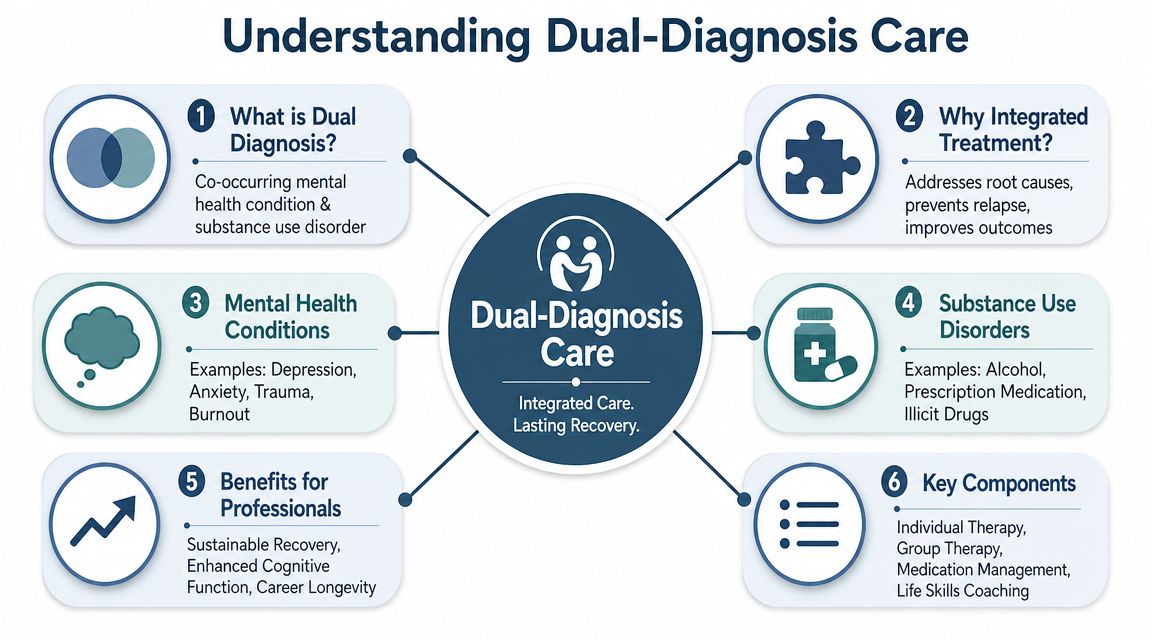
That's why dual-diagnosis care is often the most important feature in a luxury mental health retreat for professionals. It means treating a mental health condition and a co-occurring substance use disorder at the same time, in one integrated plan.
Why separate treatment often fails
A high-performing adult may be told to address drinking first and worry about anxiety later. Or they may receive therapy for depression while continuing a pattern of nightly substance use that keeps destabilizing mood and sleep. Both approaches miss the interaction.
For high-performing adults, integrated dual-diagnosis programming is the practical benchmark. Luxury rehab models commonly combine CBT, DBT, and ACT with medication-assisted recovery and step-down care planning so behavioral patterns and psychiatric needs are addressed within a single pathway, as described in this guide to luxury rehab and integrated care.
That matters for professionals because symptoms are often masked by competence. Someone can still sound articulate and remain profoundly impaired. Treatment has to look beneath performance and address the mechanisms keeping the cycle in place.
What integrated care looks like in practice
A sophisticated program typically coordinates several layers of treatment rather than relying on one favorite modality.
- Psychiatric assessment and medication review: This helps determine whether symptoms are primary, substance-induced, trauma-related, or mixed.
- Individual psychotherapy: One-on-one work allows for discussion of shame, leadership pressure, family dynamics, perfectionism, and identity loss without a performative audience.
- Group process: Executives often resist this at first, then find it's where control patterns, defensiveness, and emotional isolation become visible.
- Recovery planning: The resident needs a map for work travel, client dinners, medication adherence, sleep protection, and trigger management after discharge.
A concise way to evaluate a provider is to ask whether the team can explain how it treats panic and alcohol misuse together, or trauma and prescription medication misuse together. If those answers stay vague, the program may not have genuine dual-diagnosis depth. Families often begin that search by reviewing options such as dual diagnosis centers for C-level executives.
Treating only the visible behavior often brings temporary control. Treating the psychiatric drivers underneath it is what makes sustained recovery possible.
A Day in the Life Balancing Recovery and Responsibility
Executives often delay treatment because they assume residential care means disappearing completely. That assumption keeps many people sick longer than necessary. In a modern executive-oriented setting, treatment doesn't have to require total disconnection from career responsibilities. It requires structured engagement, not constant access.
A typical day should feel deliberate. The resident isn't left alone with a laptop all morning, nor stripped of every professional identity overnight. The program builds a rhythm where clinical work comes first, but selected responsibilities can still be handled in contained time blocks.
How a balanced day usually works
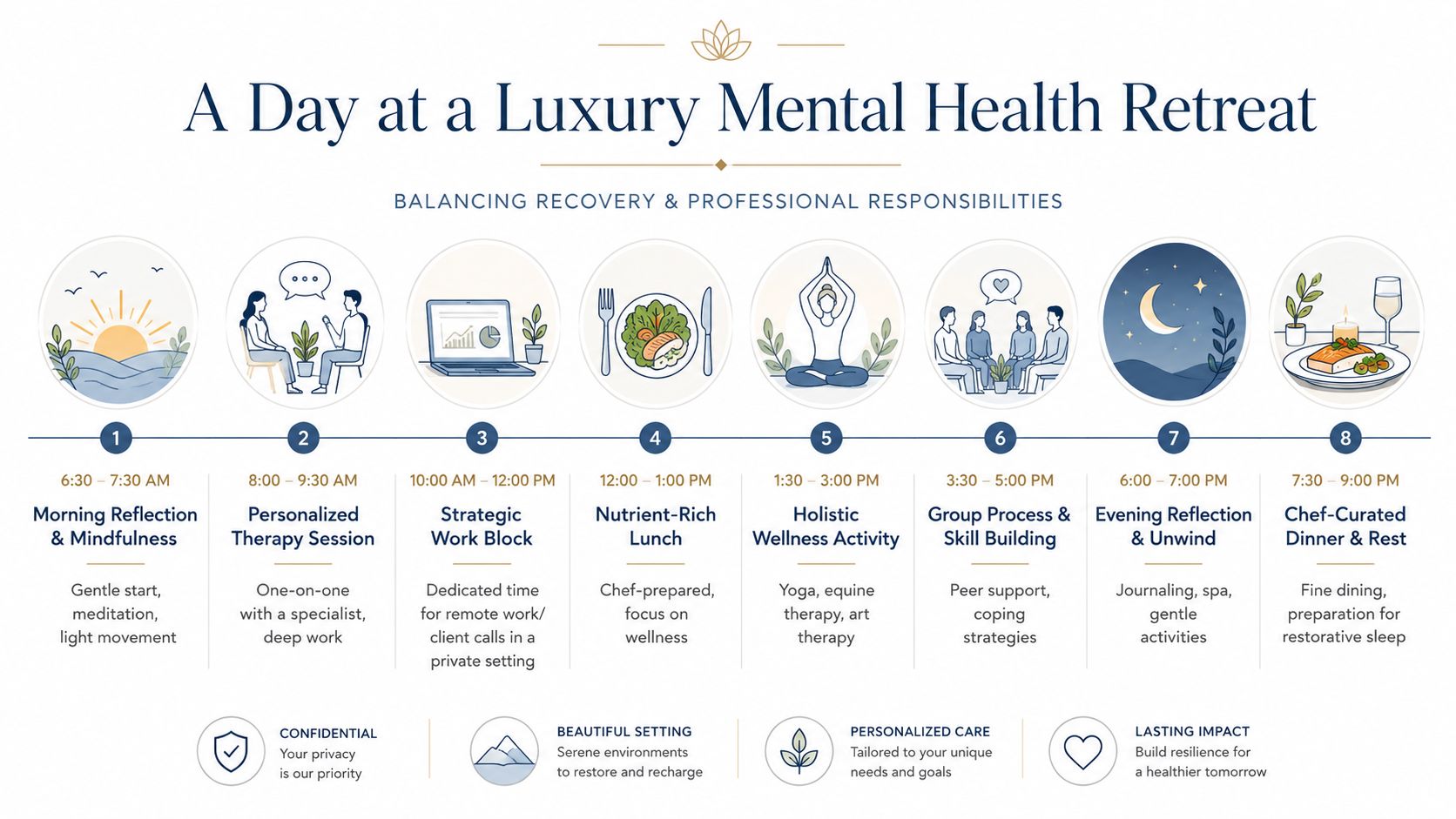
The morning often starts calm. That matters more than most professionals expect. A calm start gives the nervous system a chance to settle before email, calls, and decision-making intrude. From there, the day should move into formal treatment, not drift into unstructured “self-care.”
An executive-focused schedule may include:
- Early grounding practices: Mindfulness, light movement, breath work, or guided reflection to reduce baseline activation.
- Primary clinical session: Individual therapy, psychiatric follow-up, or focused trauma work when indicated.
- Protected work window: Time to review urgent communication, delegate, or join essential calls from a private setting.
- Afternoon treatment block: Group therapy, skills training, family work, or experiential therapy.
- Evening decompression: Nutrition support, journaling, quiet reflection, and preparation for restorative sleep.
What works and what doesn't
What works is a clear agreement about electronics and communication. Phones and laptops can support continuity when used with intention. They become destructive when they allow the resident to stay psychologically inside the same crisis environment that contributed to the admission.
The most effective programs set boundaries around:
| Area | Productive approach | Unhelpful approach |
|---|---|---|
| Phone access | Scheduled, clinically informed use | Constant reactive checking |
| Work contact | Essential communication and delegation | Full operational immersion |
| Family communication | Supportive, planned contact | Repetitive conflict or reassurance seeking |
This matters especially for high earners and business leaders who can't fully disappear. Appropriate electronics access can preserve trust with boards, partners, or teams while still keeping treatment intact. Reflections is one example of a California-licensed, Joint Commission-accredited provider that offers private rooms and appropriate access to electronics within a dual-diagnosis residential setting for adults who need clinically intensive care.
The point isn't convenience
A luxury mental health retreat shouldn't replicate the resident's old life with nicer furnishings. It should create enough distance from the old pace that treatment can be effective. The work block exists to reduce panic about absence and support practical continuity. It doesn't exist to preserve over-functioning.
Recovery for an executive doesn't require abandoning responsibility. It requires learning which responsibilities can be held, which must be delegated, and which have been confused with self-worth.
Ensuring Privacy Safety and Clinical Excellence
For executives, physicians, attorneys, founders, public figures, and family offices, privacy isn't a branding preference. It's a condition of entry. If a program can't protect confidentiality at every level, many high-profile adults won't engage authentically.
Privacy starts with design but doesn't end there. A private room matters. A discreet location matters. Staff training matters even more. Confidential care depends on how phone calls are handled, how information is shared internally, how visitors are managed, how transportation is arranged, and how quickly staff recognize when a resident's public role requires additional protection.
What safety actually looks like
The safest environments are clinically disciplined. They don't rely on charm, looseness, or informal promises. They operate through standards, documentation, and oversight. Families should ask direct questions about licensure, accreditation, psychiatric coverage, detox capability when relevant, and emergency procedures.
A practical screening list includes:
- Accreditation status: Reputable accreditation signals that an outside body has reviewed core standards of care, safety, and operations.
- Staff credentials: Ask who provides therapy, who prescribes, who monitors, and who is on site after hours.
- Medication protocols: There should be a coherent process for initiation, continuation, tapering, and monitoring.
- Confidentiality procedures: High-profile residents need more than verbal reassurance. They need operational discretion.
Privacy isn't the same as isolation
Some families assume privacy means extreme seclusion and minimal clinical contact. That's a misunderstanding. Effective discretion protects identity and personal information while still allowing close therapeutic observation, structured family work, and coordinated aftercare.
The strongest programs usually share a few cultural traits:
- They don't oversell exposure-based community living for clients who need a more discreet entry point.
- They protect dignity without colluding with avoidance. Residents can keep their status private without keeping their symptoms hidden from the treatment team.
- They understand professional risk. Licensing concerns, media concerns, reputational concerns, and family governance concerns all affect treatment planning.
Families evaluating confidential care often start with resources focused on discreet and confidential rehab for executives in California, then ask much more specific operational questions before admission.
A polished environment can be reassuring. It can also be misleading if it substitutes for clinical rigor. Real luxury in mental health treatment is the ability to trust the setting enough to become fully honest in it.
Navigating Your Investment and Planning for Aftercare
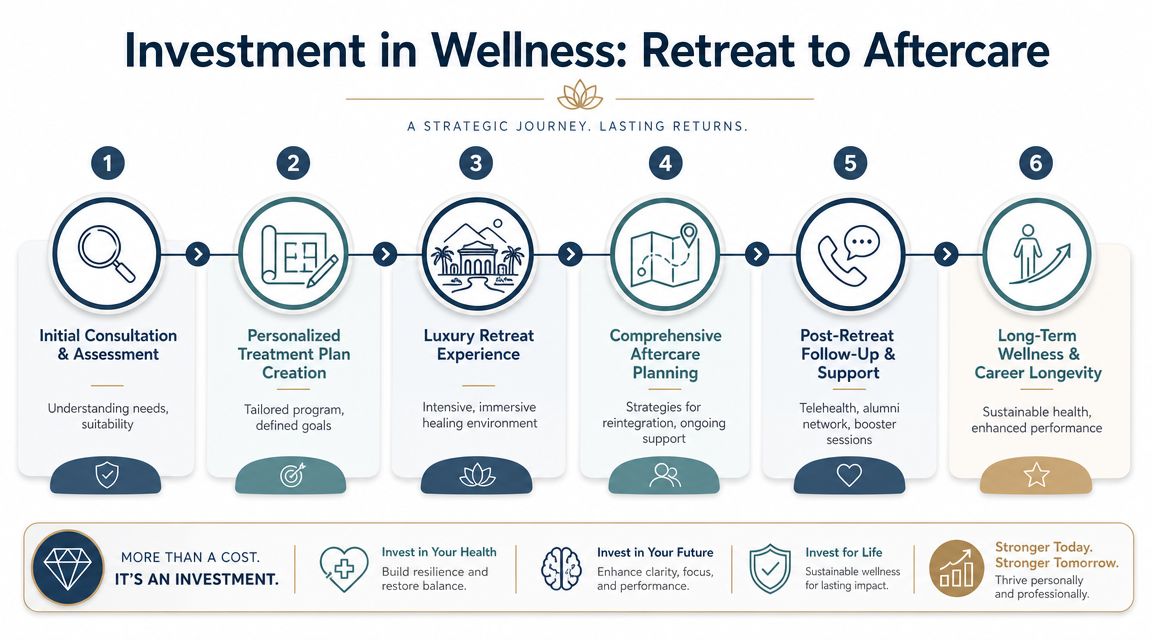
Private treatment for executives is expensive. That reality should be addressed plainly. The question isn't whether a luxury mental health retreat costs more than standard care. It does. The better question is what the investment is buying, and whether the program is structured to produce durable change rather than a brief period of containment.
The market itself shows how far the premium category has expanded. One report estimates the global wellness tourism and mental health retreat market at $1.1 trillion in 2025, with a projection to $3.2 trillion by 2034, and places average global wellness retreat traveler spend at $4,890 in 2025 while premium medically supervised retreats in key markets can range from $15,000 to over $85,000 per stay, according to this wellness tourism and mental health retreat market analysis. Those figures confirm that premium retreat care is now a significant segment, not a fringe offering.
What the investment should cover
A meaningful fee should correspond to meaningful clinical and operational value. Families should look for depth, not spectacle.
That usually means paying for:
- Thorough assessment: Diagnostic clarity, substance use evaluation, psychiatric review, and functional assessment.
- Low-census individualized care: More direct attention, more schedule flexibility, and less institutional friction.
- Private accommodations and discretion: Not as a vanity feature, but as support for sleep, privacy, and engagement.
- Discharge planning from the beginning: A resident shouldn't reach the final week with no structured plan for what comes next.
Aftercare is where many outcomes are lost
Residential treatment can stabilize someone. It doesn't automatically reorganize the life they return to. The executive still goes back to inbox volume, travel, family strain, social drinking culture, and performance pressure. Without step-down planning, the retreat becomes an interruption rather than a pivot.
A sound aftercare plan often includes a mix of the following:
| Aftercare element | Why it matters |
|---|---|
| Outpatient therapy | Maintains momentum and deepens the work started in residence |
| Psychiatric follow-up | Protects medication continuity and symptom monitoring |
| Recovery coaching or support groups | Adds accountability in real-life settings |
| Family sessions | Helps the home system stop reinforcing old patterns |
| Work reintegration planning | Prevents an immediate return to unsustainable pace |
A short residential stay can start recovery. The months after discharge determine whether recovery becomes a way of living.
The executive lens on value
For a high-responsibility adult, the return on investment isn't measured only by symptom reduction. It's also reflected in judgment, steadier mood, fewer impulsive decisions, better relationships, improved sleep, and the ability to work without relying on secrecy, substances, or collapse cycles.
When a program can't describe its aftercare structure in concrete terms, families should be cautious. A premium admission without premium continuity is often just an expensive pause.
Choosing Your Path to Renewed Well-being
A luxury mental health retreat earns its place when it combines four things: clinical acuity, dual-diagnosis capability, privacy, and realistic accommodation of professional life. Remove any one of those and the model weakens, especially for executives and other high-functioning adults who have too much at stake to enter the wrong setting.
The most important shift is conceptual. Treatment for a senior professional shouldn't be framed as stepping away from life because they couldn't handle it. It should be framed as entering the level of care required to protect health, judgment, relationships, and long-term professional capacity. High achievement can hide deterioration for a long time. It can't reverse it.
Questions worth asking before admission
A family or prospective resident can learn a great deal from a direct conversation with admissions or clinical staff. Useful questions include:
- What level of psychiatric care is available: Is there on-site psychiatric involvement, medication management, and clinical support for stabilization?
- How does the program handle co-occurring disorders: Can the team explain how it treats mental health symptoms and substance use together?
- What does privacy mean operationally: Are there private rooms, controlled communications, and staff trained for high-profile confidentiality needs?
- How are electronics and work responsibilities managed: Is access structured in a way that supports treatment rather than undermining it?
- Who provides care: What are the credentials of the therapists, prescribers, and clinical leadership?
- What happens after discharge: Is there a step-down plan with therapy, psychiatric follow-up, family involvement, and reintegration support?
- How is family included: Can loved ones participate in a way that supports accountability and long-term stability?
The decision that matters most
The right choice usually isn't the most glamorous program. It's the one that can meet the resident at the actual level of complexity they're carrying. For an executive, that often means choosing a setting capable of deep clinical work while respecting the realities of leadership, privacy, and ongoing responsibility.
Seeking this level of care is not an overreaction. It's often the first fully rational response after a long period of adaptation, concealment, and strain.
Reflections offers confidential, California-licensed residential dual-diagnosis treatment for adults who need private, clinically intensive care in an upscale setting. For executives, professionals, and families evaluating whether a luxury mental health retreat is the right next step, Reflections provides information about private rooms, appropriate electronics access, detox and rehab programming, and continuing care options.